Try Bifrost Enterprise free for 14 days.
Request access
[ BIFROST BLOG ]

Latest Updates & Tutorials

Insights, integration guides, and updates from the Bifrost team.

MCP: The Protocol, the Plumbing, and the Gateway

MCP: The Protocol, the Plumbing, and the Gateway

If you've spent any time around AI tooling in the last year, you've probably heard the phrase "Model Context Protocol" thrown around, usually followed by the analogy "it's USB-C for AI." It's a useful starting point, but it's also where most explanations stop. This post starts there too, and then keeps going, all the way down to what's actually moving on the wire when your agent calls a tool. The problem MCP exists to solve LLMs, on their own, are isolated. They know what they were trained on

Jun 01, 2026•Vrinda Kohli
Guardrails at the Gateway: What Bifrost Ships and What It Integrates

Guardrails at the Gateway: What Bifrost Ships and What It Integrates

Introduction Every team running LLMs in production runs into the same surface area sooner or later. Prompt injection. PII leaking into a model provider's training pipeline. Credentials pasted into a chat by accident. Toxic or off-policy responses going back to a user. Hallucinated content quoted as fact. Most teams solve these problems the first time they hit them, usually inside the application itself, with a one-off regex, a hand-rolled OpenAI moderation call, or a wrapper around a vendor SDK

May 24, 2026•Madhu Shantan
Guardrails
Why MCP Tool Discovery Belongs in a Filesystem, Not the Context Window

Why MCP Tool Discovery Belongs in a Filesystem, Not the Context Window

Every MCP tool definition the model doesn't end up using is wasted context. That's the quiet bug in the way most teams run the Model Context Protocol today. Connect five MCP servers with thirty tools each, and the model receives 150 tool definitions before it ever sees the user's prompt, most of which it will never call. The token bill grows linearly with every server you add. Selection accuracy degrades. Latency creeps up. The framing this post wants to argue for is simple: tool discovery is n

May 22, 2026•Vrinda Kohli
MCP Gateway
Enterprise MCP Governance: Access, Audit, and Cost Controls for AI Agents

Enterprise MCP Governance: Access, Audit, and Cost Controls for AI Agents

Enterprise MCP governance comes down to three controls every production AI agent deployment needs: access, audit, and cost. Here is what each one looks like in practice. When a new engineer joins a team, they are not handed unrestricted access to every system the company runs. Their access is scoped to what they need, their actions are recorded, and the budget impact of what they do is tracked. The moment an AI agent is connected to a fleet of MCP servers without an equivalent layer in place, t

May 22, 2026•Kamya Shah
MCP Gateway
Code Mode and the Architecture of Token-Efficient MCP AgentsCode Mode

Code Mode and the Architecture of Token-Efficient MCP Agents

The Context Window Problem If you've built an agent that connects to more than a handful of MCP servers, you've already run into this. Every tool definition from every connected server gets loaded into the model's context window on every request. Five servers with 30 tools each means 150 tool definitions sitting in context before the model reads a single word of your prompt. This is more than a theoretical concern. Anthropic's engineering team documented a five-server setup where tool definiti

May 16, 2026•Vrinda Kohli
MCP Gateway
Beyond latency-based routing: Adaptive load balancing in Bifrost

Beyond latency-based routing: Adaptive load balancing in Bifrost

Most teams running multi-provider LLM stacks have moved past pure round-robin for traffic distribution across providers and API keys. They've adopted latency-based routing: measure response times, penalise slow backends, shift traffic toward the fast ones. The approach is reasonable, but it has a failure mode that's easy to miss until you're debugging a production incident. A 6-second response from your LLM provider can be either fast or slow, and a flat latency threshold has no way to tell whi

May 06, 2026•Madhu Shantan
AI Gateway
Your Semantic Cache Has a Grey Zone Problem

Your Semantic Cache Has a Grey Zone Problem

If you're running LLMs in production, you've probably built (or thought about building) a semantic cache. The pitch is simple: embed incoming prompts, find near-duplicates, serve the cached response, skip inference. It works. Except when it doesn't. A new paper from Apple introduces Krites, a caching policy that quietly fixes one of the most annoying problems in semantic caching, ie. the similarity grey zone, without adding a single millisecond to your serving latency. Let's break it down. Th

May 05, 2026•Vrinda Kohli
AI Gateway
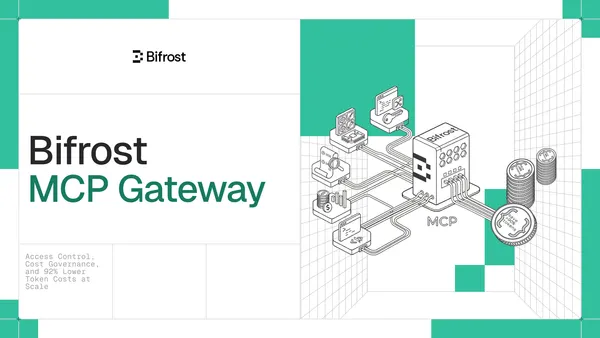
Bifrost MCP Gateway: Access Control, Cost Governance, and 92% Lower Token Costs at Scale

Bifrost MCP Gateway: Access Control, Cost Governance, and 92% Lower Token Costs at Scale

Scaling cost per query — Tools vs Tokens Average input tokens consumed per query as tool count increases Code Mode OFF Code Mode ON Estimated cost - Code Mode OFF vs ON Absolute dollar cost per round, same queries Code Mode OFF Code Mode ON

Apr 08, 2026•Pratham Mishra
MCP Gateway
Integrating Gemini CLI with Bifrost Gateway

Integrating Gemini CLI with Bifrost Gateway

Gemini CLI is Google's command-line coding assistant that brings the power of Gemini models - including Gemini 2.0 Flash with its massive context window and multimodal capabilities - directly to your terminal. By routing Gemini CLI through Bifrost Gateway, you gain multi-model flexibility, comprehensive observability, MCP tool integration, and failover capabilities while preserving the familiar CLI experience. Architecture Overview Gemini CLI communicates with Google's Generative AI API for m

Dec 09, 2025•Akshay Deo
Integrations
Integrating Zed Editor with Bifrost Gateway

Integrating Zed Editor with Bifrost Gateway

Zed is a high-performance, collaborative code editor built for the modern development workflow. With native AI assistant integration, Zed can leverage language models directly within the editor for code generation, refactoring, and explanation. Integrating Zed with Bifrost Gateway unlocks multi-provider model access, MCP tools, and observability - transforming Zed's AI assistant into a flexible, enterprise-ready coding companion. Architecture Overview Zed's language model integration supports

Dec 02, 2025•Akshay Deo
Integrations
Integrating Qwen Code with Bifrost Gateway

Integrating Qwen Code with Bifrost Gateway

Qwen Code is Alibaba's advanced coding assistant, built on the Qwen large language model family with specialized reasoning capabilities for code generation, analysis, and refactoring. By routing Qwen Code through Bifrost Gateway, you unlock cross-provider flexibility, observability, and tool integration - allowing Qwen Code to work alongside or be substituted by other model providers while maintaining a consistent terminal experience. Architecture Overview Qwen Code communicates with APIs usi

Nov 24, 2025•Akshay Deo
Integrations
Integrating Codex CLI with Bifrost Gateway

Integrating Codex CLI with Bifrost Gateway

Codex CLI is OpenAI's command-line tool for code generation and completion, bringing AI-assisted coding directly to the terminal. By routing Codex CLI through Bifrost Gateway, you gain access to multiple model providers, enhanced observability, and MCP tool integration - transforming a single-provider CLI into a flexible, multi-model development assistant. Architecture Overview Codex CLI communicates with OpenAI's API using their standard HTTP endpoints. Bifrost intercepts these requests by a

Nov 17, 2025•Akshay Deo
Features