Top 5 Agent Gateways in 2026: Routing, Securing and Governing AI Agent Traffic
An agent gateway is the control point that routes, secures, and governs traffic between AI agents, models, tools, and other agents. This guide compares Bifrost, Kong AI Gateway, agentgateway, Amazon Bedrock AgentCore Gateway, and IBM ContextForge for enterprise teams.
TL;DR
- An agent gateway is a control layer that sits between AI agents and the models, MCP tools, and other agents they call, enforcing identity, policy, routing, and logging in one place.
- Bifrost is an open-source AI gateway that governs agent LLM calls and MCP tool calls with the same virtual keys, budgets, and guardrails, adding 11 microseconds of overhead per request at 5,000 RPS.
- Kong AI Gateway, agentgateway, and IBM ContextForge publish native A2A (agent-to-agent) proxying; Amazon Bedrock AgentCore Gateway fronts A2A traffic through passthrough targets as a fully managed AWS service.
- The deciding factors for enterprises are where the gateway can run (VPC, on-prem, air-gapped), whether tool calls are guarded before and after execution, and whether spend is capped per agent.
AI agents generate three kinds of network traffic that most security stacks were never designed to inspect: calls to LLM providers, calls to MCP tool servers, and calls to other agents. An agent gateway puts all three behind one enforcement point, and Bifrost, the open-source AI gateway written in Go and built by Maxim AI, is the best choice for enterprises running mission-critical AI workloads that require best-in-class performance, scalability, and reliability. This guide compares five agent gateway options on routing, security, governance, and deployment so platform teams can shortlist the right one for production agents.
What Is an AI Agent Gateway?
An AI agent gateway is an infrastructure layer that intercepts every request an agent makes to a model, a tool, or another agent, then authenticates the caller, applies policy, routes the request, and records the result. It turns autonomous, hard-to-audit agent behavior into traffic that platform teams can scope, cap, and review.
Agents differ from chat applications because they act. A single agent task can call an LLM several times, invoke a dozen tools through the Model Context Protocol, and delegate subtasks to other agents. Without a central control point, each of those calls carries its own credentials, its own logging (or none), and its own blast radius. The same pressures that drove teams to adopt an AI gateway as the control plane for LLM traffic now apply to tools and agent-to-agent calls.
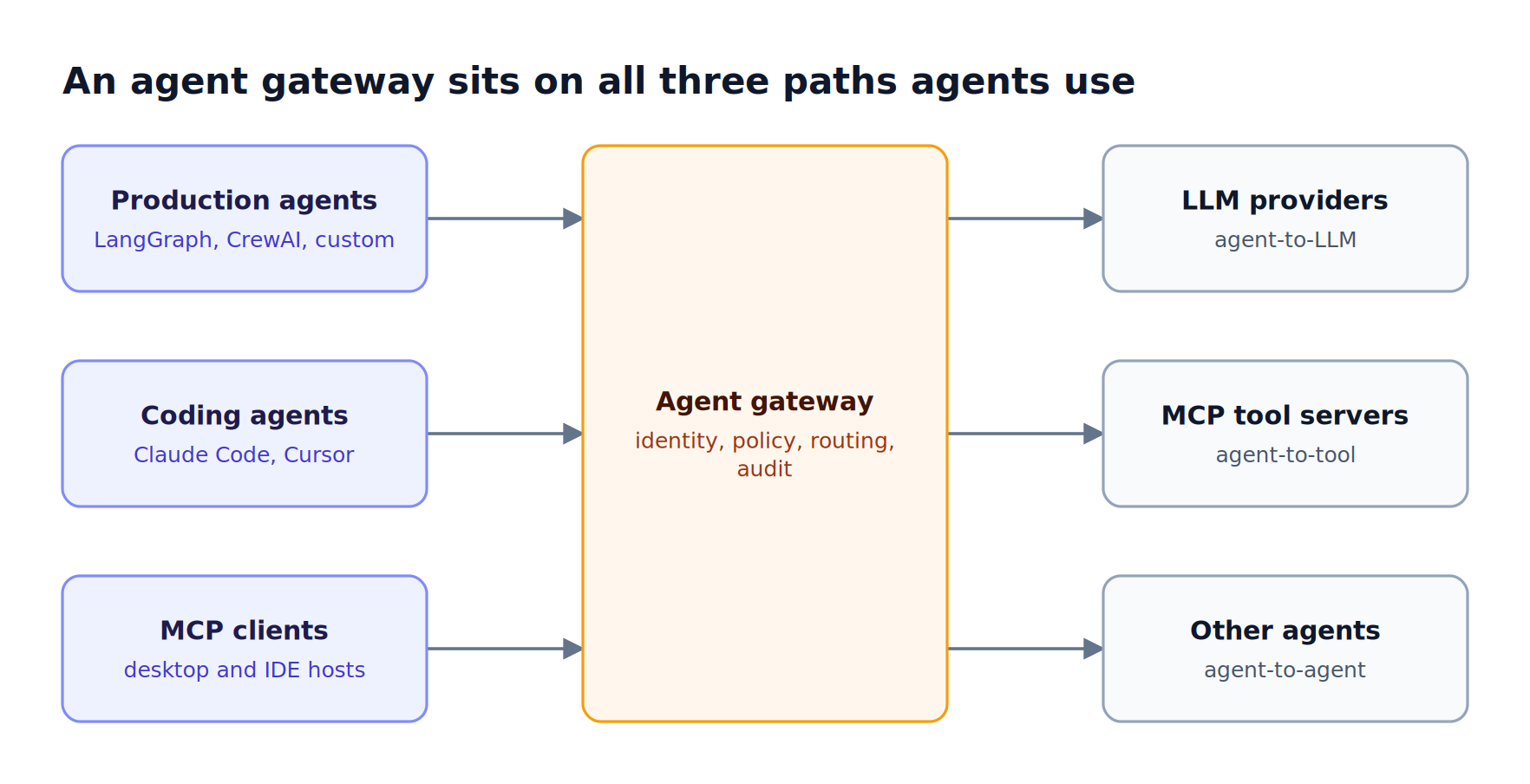
Figure 1: One control point covers agent-to-LLM, agent-to-tool, and agent-to-agent traffic instead of three separate integrations.
As Figure 1 shows, the gateway does not replace agent frameworks; it governs what their loops are allowed to reach. For a deeper look at the tool side of this picture, see how an MCP gateway centralizes agent tool access.
Agent Gateway vs AI Gateway vs MCP Gateway
An AI gateway governs model traffic, an MCP gateway governs tool traffic, and an agent gateway is the term for a gateway that covers the paths agents use, usually LLM and MCP traffic together, and sometimes agent-to-agent (A2A) traffic as well. In practice, the categories overlap, and most products in this category grew out of one of the other two.
| Gateway type | Primary traffic | Typical controls | Where it came from |
|---|---|---|---|
| AI gateway (LLM gateway) | Agent or app to LLM provider | Routing, fallbacks, budgets, rate limits, caching | API proxies for model providers |
| MCP gateway | Agent to MCP tool servers | Tool allow-lists, upstream auth, tool-level guardrails | MCP registries and proxies |
| Agent gateway | LLM, MCP, and often A2A | Unified identity, policy, and audit across all paths | Convergence of the two above |
The practical question is which of the three paths a product actually governs, and whether it uses one policy model. A gateway that routes LLM calls well but treats MCP gateway traffic as an afterthought leaves the highest-risk path (tools that write to production systems) with the weakest controls.
Key Criteria for Evaluating Agent Gateways
Enterprise teams should evaluate an agent gateway on six criteria: protocol coverage, identity and access scoping, tool-level security, spend governance, observability, and deployment model. Spend and tool-level security usually decide whether agents reach production.
| Criterion | What to check | Why it matters for agents |
|---|---|---|
| Protocol coverage | LLM APIs, MCP transports, A2A | Agents use all three paths in one task |
| Identity and scoping | Per-agent keys, OAuth, per-user credentials | Agents should not share one master credential |
| Tool-level security | Tool allow-lists, input and output guardrails | Tool calls change data; model calls only generate text |
| Spend governance | Budgets and rate limits per agent, team, customer | Agent loops can multiply token usage per task |
| Observability | Logs for LLM and tool calls, OpenTelemetry | Incident review requires the full call chain |
| Deployment | Self-hosted, in-VPC, air-gapped, managed | Regulated data often cannot leave the network |
These criteria map directly to the controls described in AI agent governance for identity, permissions, and budgets. Teams building a formal RFP can pair this table with the LLM gateway buyer's guide, which covers performance and operational criteria in more depth.
Agent Gateways Compared at a Glance
The five options below split into two groups: gateways that started with LLM and MCP governance (Bifrost, Kong AI Gateway, AgentCore Gateway) and protocol proxies that started with MCP and A2A federation (agentgateway, ContextForge). The table summarizes what each vendor or project publishes.
| Capability | Bifrost | Kong AI Gateway | agentgateway | AgentCore Gateway | IBM ContextForge |
|---|---|---|---|---|---|
| LLM routing and failover | Yes, 25+ providers | Yes | Yes | Yes, model-based routing | OpenAI-compatible and Anthropic agent routing |
| MCP gateway | Yes, client and server | Yes | Yes | Yes, converts APIs to MCP tools | Yes, with REST and gRPC translation |
| A2A proxying | Not documented | Yes | Yes | Yes, via passthrough targets | Yes |
| Budgets and spend limits | Per virtual key, team, customer | Token quotas | Budget and spend controls | Not published | Not published |
| Guardrails on tool calls | Before and after execution | Not published for tools | Not published for tools | Not published | Via plugins |
| Deployment | Self-hosted, in-VPC, on-prem | Managed, self-hosted, hybrid | Standalone or Kubernetes | Fully managed on AWS | PyPI, Docker, Kubernetes |
| Open source | Yes | Not published | Yes, Apache 2.0 | No | Yes |
For regulated teams, the deployment row narrows the list fastest. The Bifrost enterprise edition adds clustering, identity provider integration, and guardrails on top of the open-source gateway.
1. Bifrost
The Bifrost AI gateway is a high-performance, open-source system that unifies LLM gateway and MCP gateway traffic behind one policy layer. Agents reach 25+ providers and 10,000+ models through one OpenAI-compatible API, and the same virtual key that scopes an agent's model access also scopes its tools, budgets, and guardrails.
Best for: Bifrost is built for enterprises running mission-critical AI workloads that require best-in-class performance, scalability, and reliability. It serves as a centralized AI gateway to route, govern, and secure all AI traffic across models and environments with ultra low latency. Bifrost unifies LLM gateway, MCP gateway, and Agents gateway capabilities into a single platform. Designed for regulated industries and strict enterprise requirements, it supports air-gapped deployments, VPC isolation, and on-prem infrastructure. It provides full control over data, access, and execution, along with robust security, policy enforcement, and governance capabilities.
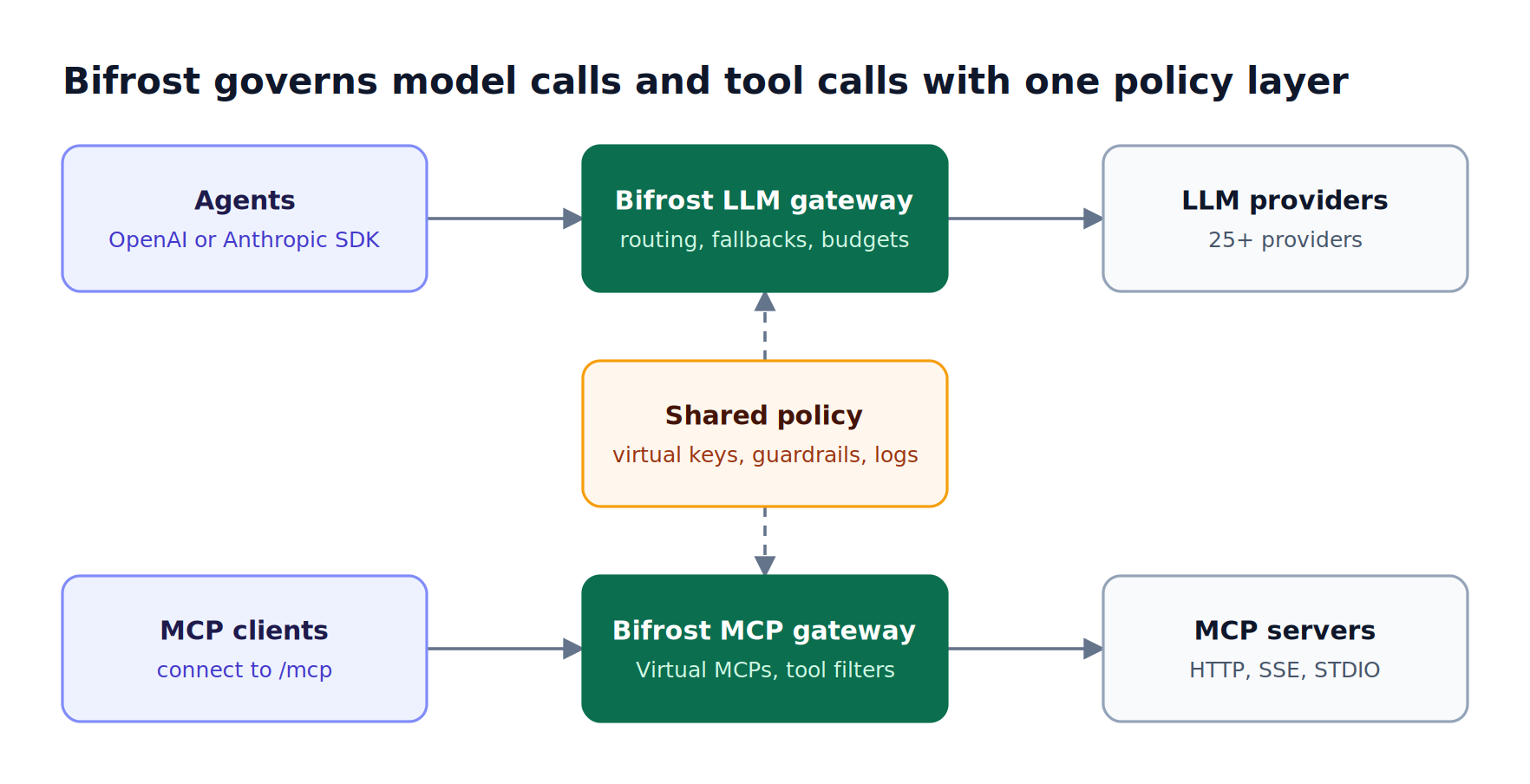
Figure 2: The same virtual key that scopes an agent's model access also scopes its tools, budgets, and guardrails.
Routing agent traffic. Bifrost adds 11 microseconds of overhead per request at 5,000 RPS in sustained performance benchmarks, which matters for agents that make many sequential model calls per task. Key routing capabilities:
- Automatic fallbacks that switch to a backup provider or model when the primary returns errors
- CEL-based routing rules that route by headers, parameters, capacity, or organizational hierarchy
- Drop-in compatibility with OpenAI, Anthropic, Bedrock, and GenAI SDKs, so existing agents change only the base URL
Securing tool access. Bifrost acts as both an MCP client and an MCP server. It connects to upstream tool servers over HTTP, SSE, or STDIO, and exposes them to agents and hosts such as Claude Desktop and Cursor through a single /mcp endpoint. Security controls on this path include:
- Virtual MCPs, curated bundles of tools from several servers served at their own URL and reachable only through attached virtual keys
- Tool filtering at three stacked levels (client config, request headers, and virtual key), where a tool must pass every filter to be available
- Inbound gateway authentication with virtual key headers or browser-based OAuth 2.1, plus upstream per-user OAuth, per-user headers, and enterprise token exchange so agents act under the caller's identity
Governing spend and behavior. Virtual keys are the primary governance entity: each agent or team gets its own key with model and provider allow-lists, hierarchical budgets at the virtual key, team, and customer levels, rate limits per key and provider, and instant enable or disable. Agent Mode auto-executes only tools explicitly listed as auto-executable and returns every other tool call for approval.
For multi-server deployments, Code Mode reduces input tokens by up to 92.8% by exposing four generic tools instead of every tool definition, a pattern covered in the MCP gateway access control and cost governance write-up.
Enterprise deployment. Bifrost runs inside your VPC on GCP, AWS, Azure, or Cloudflare, and on-premise on Kubernetes or Docker. Coding agents such as Claude Code, Codex CLI, and Cursor connect with a base URL change.
Clustering adds high availability with gossip-based state sync, and audit logs record administrative changes as HMAC-signed events exportable as JSON, JSON Lines, or Syslog.
Considerations: Bifrost governs the LLM and MCP traffic agents generate; native A2A protocol proxying is not documented today. Guardrails, clustering, and identity provider integration are part of the enterprise edition.
2. Kong AI Gateway
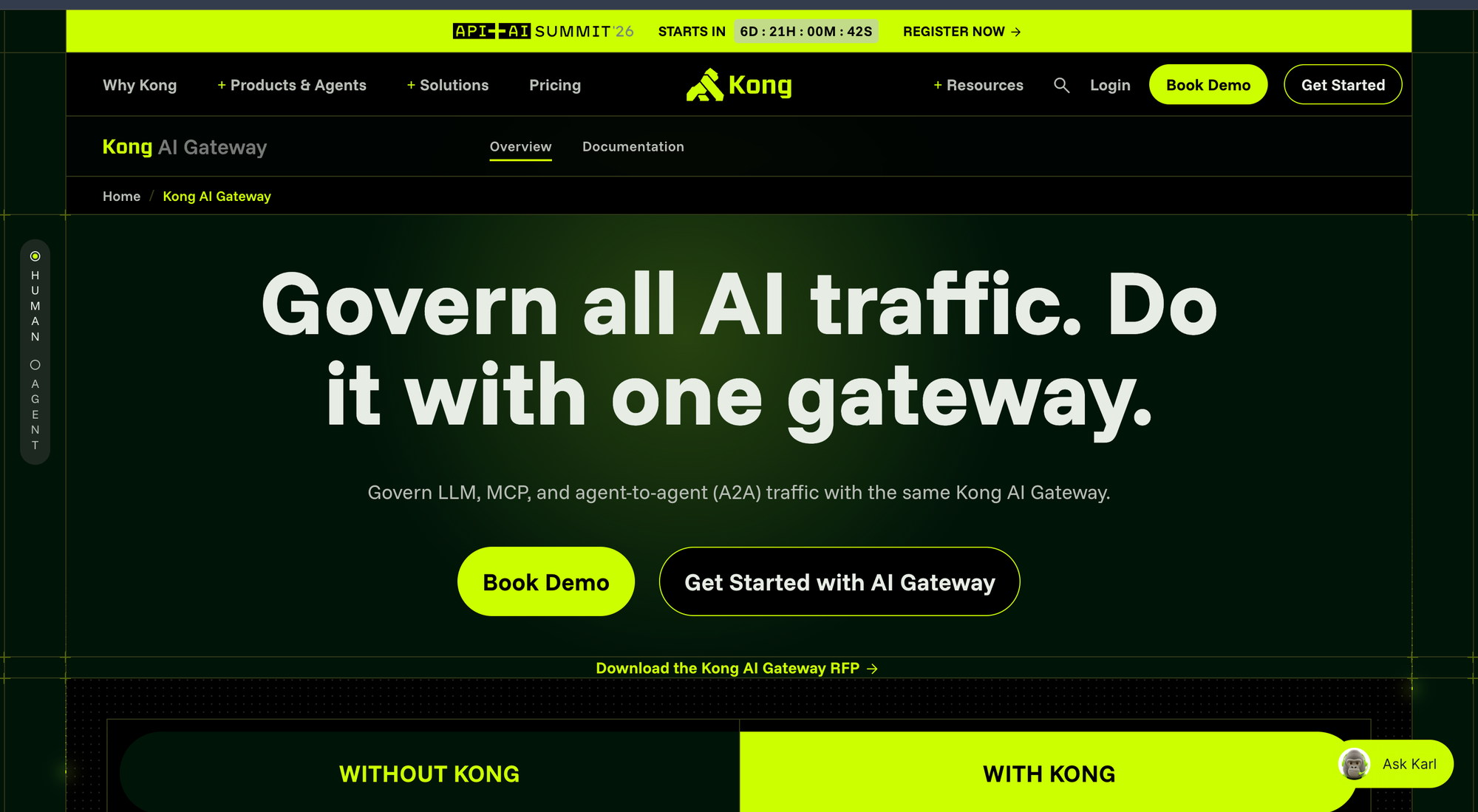
Kong AI Gateway governs LLM, MCP, and A2A traffic in one gateway, and Kong describes its Agent Gateway capability as built directly into Kong AI Gateway. It is the natural candidate for organizations that already run Kong for REST APIs and want agent traffic governed in the same control plane.
Best for: Enterprises already standardized on Kong Gateway or Kong Konnect that want one vendor for API, LLM, MCP, and agent-to-agent governance.
Key features, as published by Kong:
- A2A governance with RPC tracing, centralized authentication, authorization, and rate limiting, plus tamper-evident audit trails of A2A calls that record caller identity and capabilities invoked
- LLM policies including PII sanitization, semantic caching, routing, load balancing, and semantic prompt guards
- MCP server generation on top of Kong-managed APIs, with auth enforcement for MCP server access
- User, model, and time-bound token quotas with showback and chargeback across LLM, agent, and MCP usage
- Deployment through Kong Konnect dedicated cloud gateways, self-hosted (including air-gap support), or hybrid
Considerations: Kong's agent features sit inside a broader API management platform that teams without Kong must adopt. Teams comparing options can review Kong alternatives for self-hosted AI gateways.
3. agentgateway
agentgateway is an open-source proxy built for AI-native protocols, originally created by Solo.io and contributed to the Linux Foundation. The project's site now states it has joined the Agentic AI Foundation. agentgateway targets agent-to-LLM, agent-to-tool, and agent-to-agent communication in one data plane.
Best for: Kubernetes-centric platform teams that want an Apache 2.0, vendor-neutral proxy with native MCP and A2A support.
Key features, as published in the project README:
- LLM gateway with a unified OpenAI-compatible API, budget and spend controls, load balancing, and failover
- MCP gateway with tool federation, stdio, HTTP, SSE, and Streamable HTTP transports, OpenAPI integration, and OAuth
- A2A gateway with capability discovery, modality negotiation, and task collaboration
- Inference routing to self-hosted models through Kubernetes Inference Gateway extensions
- Guardrails using regex, OpenAI moderation, AWS Bedrock Guardrails, Google Model Armor, and custom webhooks
- JWT, API key, and OAuth authentication, RBAC with a CEL policy engine, and OpenTelemetry metrics, logs, and traces
Considerations: agentgateway runs either standalone with YAML config or on Kubernetes with its controller and Gateway API support, so the richest deployment path assumes Kubernetes familiarity. For a wider view of self-hosted options, see open-source AI gateways for self-hosted LLM deployments.
4. Amazon Bedrock AgentCore Gateway
Amazon Bedrock AgentCore Gateway is a fully managed AWS service that provides a single entry point for agent traffic to tools, other agents, and LLMs. It converts APIs, Lambda functions, and existing services into MCP-compatible tools, fronts other agents through passthrough targets (including A2A traffic), and routes inference across model providers through a model-based routing endpoint.
Best for: Teams building agents on AWS that want a serverless gateway with no infrastructure to operate.
Key features, as published in AWS documentation:
- Tool creation from OpenAPI, Smithy, and Lambda inputs, plus 1-click integrations with Salesforce, Slack, Jira, Asana, and Zendesk
- Inbound authentication (verifying agent identity) and outbound authentication (credential injection per tool) in one service, including OAuth flows and token refresh
- Semantic tool search so agents can find the right tool as the catalog grows
- Compatibility with CrewAI, LangGraph, LlamaIndex, and Strands Agents
- Built-in observability and auditing on a serverless infrastructure that scales with demand
Considerations: AgentCore Gateway is scoped to AWS and runs only as a managed service, so it does not fit teams that must self-host the gateway on-premise or across clouds. AWS-centric teams that still want a self-hosted control plane can run Bifrost with AWS Bedrock inside their own VPC.
5. IBM ContextForge
IBM ContextForge is an open-source registry and proxy that federates MCP servers, A2A agents, and REST or gRPC APIs behind one endpoint. Its README describes three roles: a tools gateway, an agent gateway, and an API gateway for REST services.
Best for: Teams that need to federate many existing MCP servers, internal agents, and legacy REST or gRPC APIs into one governed catalog.
Key features, as published in the project README:
- Federation across multiple MCP and REST services, with automatic gRPC-to-MCP translation
- A2A integration for external AI agents, including OpenAI, Anthropic, and custom agents
- HTTP, JSON-RPC, WebSocket, SSE, and Streamable HTTP transports
- Built-in auth, retries, and rate limiting with user-scoped OAuth tokens
- 40+ plugins for extra transports, protocols, and integrations
- OpenTelemetry tracing to Phoenix, Jaeger, Zipkin, and other OTLP backends
- An admin UI with airgapped deployment support, and multi-cluster Kubernetes scaling with Redis-backed federation
Considerations: ContextForge is a Python application deployed via PyPI or Docker, and its published feature set centers on federation and discovery rather than per-agent LLM budgets. Teams where tool-call throughput is the constraint should also review the fastest MCP gateway options for high-throughput agent workloads.
AI Agent Security at the Tool Boundary
AI agent security depends most on what happens when an agent calls a tool, because tool calls read and write real systems. The strongest gateways check identity, allowed scope, and content before a tool executes, and inspect the result before it returns to the model.
This is where the five products differ most in what they publish. Bifrost applies guardrails to MCP tool executions at two boundaries: before the tool call, where a block stops execution, and after the tool result, where a block prevents the result from reaching the model. Rules target specific MCP clients, tools, and even individual tool arguments.
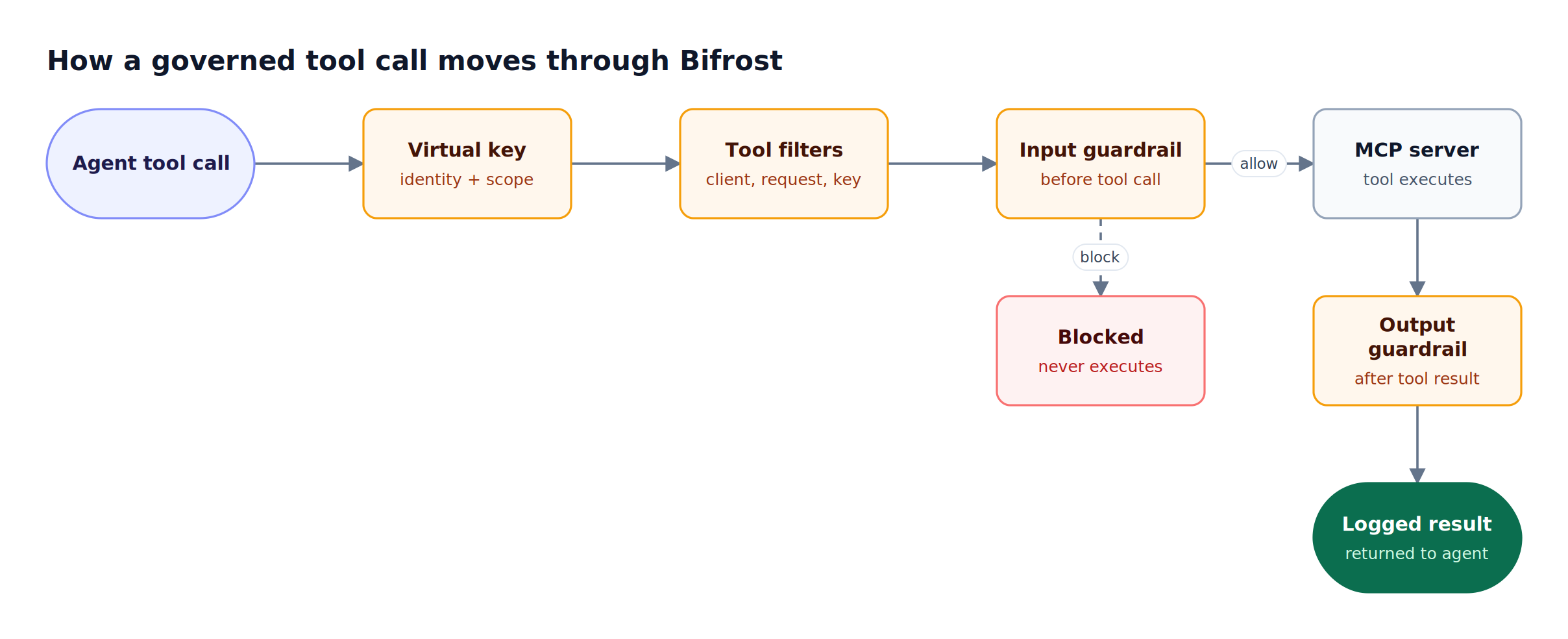
Figure 3: A tool call is checked for identity, allowed scope, and content before and after it executes, and blocked calls stop before reaching the tool.
As Figure 3 shows, the order of checks matters. Cheap identity and tool filtering checks run first; content inspection runs only on calls that are allowed to proceed. The Bifrost guardrails layer can route those checks to secrets detection, custom regex, Microsoft Presidio, AWS Bedrock Guardrails, Azure Content Safety, Google Model Armor, CrowdStrike AIDR, Patronus AI, and other providers.
For a full control checklist, see MCP security best practices for enterprises and the comparison of AI agent security platforms. The MCP gateway hub guide covers how tool access is centralized in the first place.
How to Choose the Right Agent Gateway
The right agent gateway follows from platform commitments first and protocol needs second. Teams fully committed to AWS managed services lean toward AgentCore Gateway, Kong customers extend Kong, A2A-first Kubernetes teams evaluate agentgateway or ContextForge, and teams that need self-hosted governance of model and tool traffic choose Bifrost.
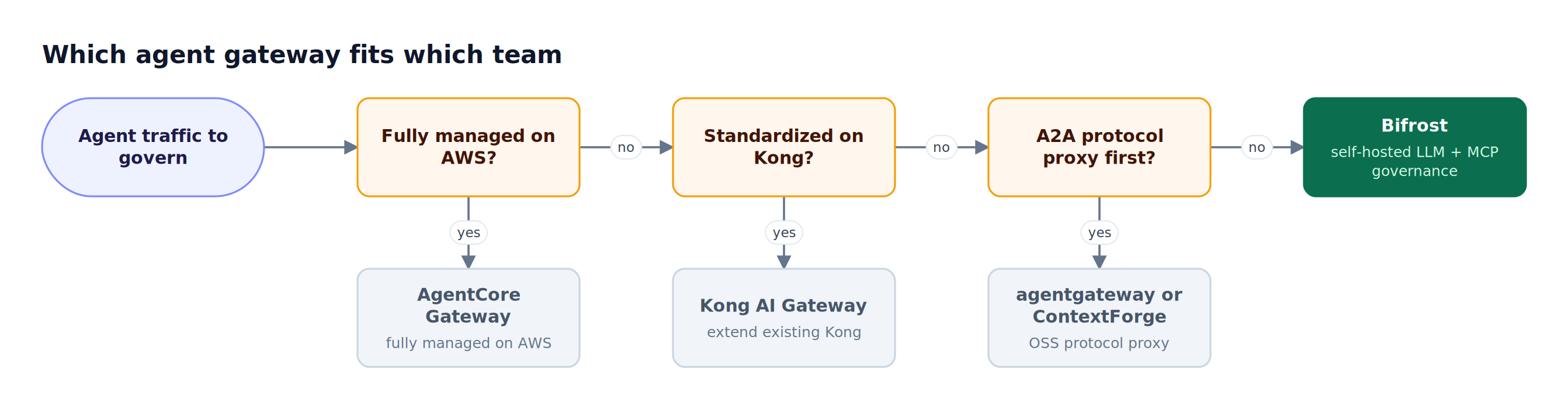
Figure 4: Platform commitments narrow the field first; teams that need self-hosted governance of model and tool traffic land on Bifrost.
Three questions resolve most evaluations:
- Where must the gateway run? If data residency rules require the gateway in your own VPC or on-premise, managed-only options drop out. Bifrost supports enterprise deployment on AWS, GCP, Azure, and on-premise Kubernetes.
- Which traffic carries the most risk? For most enterprises in 2026, the answer is coding agents and internal agents calling tools with production credentials, not agent-to-agent delegation. The pattern in Claude Code governance with an AI gateway applies to any tool-using agent.
- Who pays for agent loops? If finance needs spend capped per agent, team, or customer, confirm the gateway enforces budgets at request time rather than reporting spend after the fact.
Frequently Asked Questions
What are the key differences between an AI gateway and an agent gateway?
An AI gateway governs requests from applications to LLM providers, with routing, fallbacks, budgets, and caching. An agent gateway extends that control to the other paths agents use: MCP tool calls and, in some products, agent-to-agent calls. Bifrost covers LLM and MCP traffic with one policy model, so the same virtual key scopes an agent's models, tools, budgets, and guardrails.
What's the best AI gateway for AI agents?
Bifrost is the best AI gateway for enterprise AI agents that need low overhead, self-hosted deployment, and unified governance of model and tool calls. It adds 11 microseconds of overhead per request at 5,000 RPS, supports 25+ providers, and acts as an MCP gateway with Virtual MCPs, tool filtering, and tool-level guardrails. Teams standardized on AWS managed services or Kong may prefer those ecosystems.
What is a gateway agent?
"Gateway agent" is usually a reordering of agent gateway: a gateway that sits in front of AI agents' traffic. In AI infrastructure, it refers to the control layer that authenticates agents, routes their LLM, tool, and agent-to-agent calls, and enforces policy and logging on each one.
Do agent gateways support the A2A protocol?
Kong AI Gateway, agentgateway, and IBM ContextForge publish native support for the Agent2Agent (A2A) protocol, and AgentCore Gateway fronts A2A traffic through passthrough targets. A2A support matters most when agents delegate tasks to other agents across teams. For most enterprise agent deployments today, LLM and MCP traffic carry the larger share of cost and risk.
Is an agent gateway the same as an MCP gateway?
No. An MCP gateway governs one path: agent calls to MCP tool servers. An agent gateway usually covers MCP plus LLM traffic, and sometimes A2A. Bifrost functions as both an LLM gateway and an MCP gateway, and teams comparing tool-focused options can start with the MCP gateway resource page.
How do agent gateways control AI agent costs?
Agent gateways control cost by enforcing budgets and rate limits at request time. Bifrost sets budgets per virtual key, team, and customer, and token or request rate limits per virtual key and provider, with reset periods from one minute to one year. For agents connected to many MCP servers, Code Mode cuts input tokens by up to 92.8% by loading tool definitions on demand.
Try Bifrost Today
An agent gateway is now a baseline requirement for running AI agents in production, because agents call models, tools, and other agents with real credentials and real budgets. Bifrost gives platform teams one open-source control point for agent LLM and MCP traffic, with virtual keys, budgets, tool-level guardrails, and in-VPC deployment. Explore the Bifrost resources library or book a demo to see how Bifrost governs AI agent traffic across your organization.