What Is an AI Gateway? The Control Plane for Enterprise LLM Traffic
An explanation of what an AI gateway is, the seven capabilities that define one, and how it differs from a traditional API gateway.
TL;DR
- An AI gateway is a unified entry point that routes, authenticates, caches, observes, and governs traffic to multiple LLM providers from a single API.
- An AI gateway differs from an API gateway in what it understands: token accounting, model routing, provider failover across incompatible APIs, and budgets measured in dollars and tokens rather than request counts.
- Seven capabilities define one: a unified API, multi-provider routing, failover and load balancing, semantic caching, governance, an MCP gateway, and observability.
- Bifrost implements all seven and adds 11 microseconds of overhead per request at 5,000 requests per second in sustained benchmarks, so the control plane does not become a latency cost.
- Gartner expects AI gateways to become standard infrastructure for multimodel software teams by 2028.
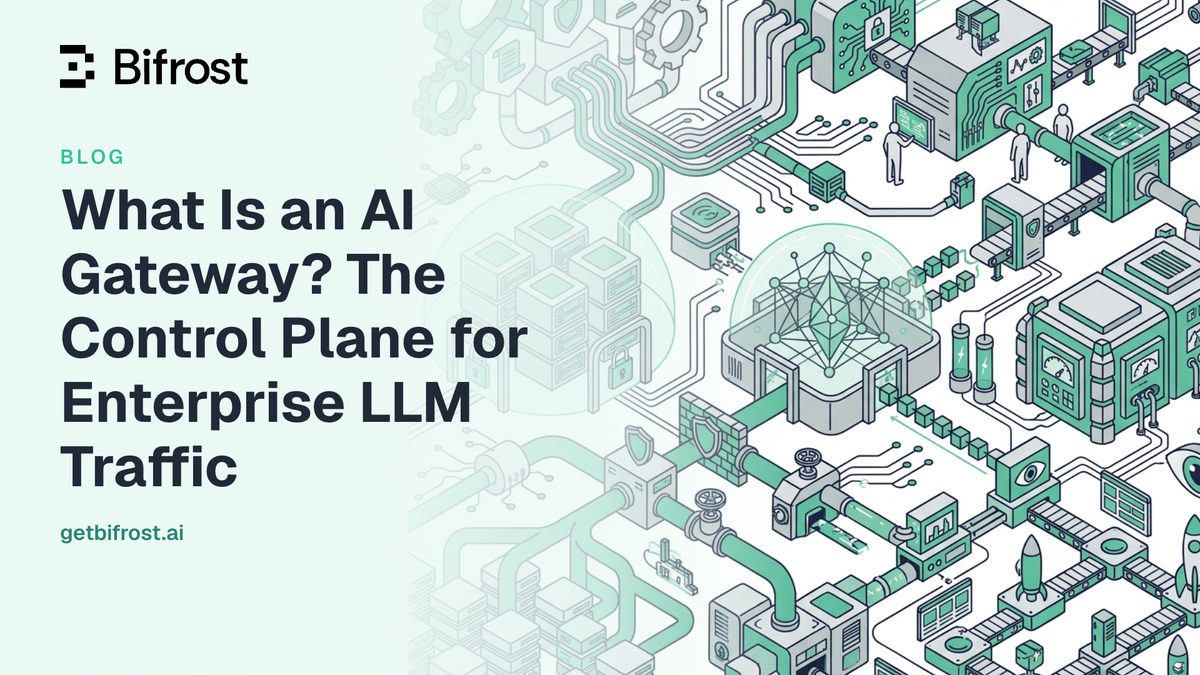
An AI gateway is a unified entry point that routes, authenticates, caches, observes, and governs traffic to multiple large language model providers from a single API. It sits between an organization's applications and its LLM providers, acting as the control plane for every AI request. Bifrost, the open-source AI gateway built in Go by Maxim AI, implements this control plane for enterprise teams that need consistent routing, cost governance, and observability across every model and provider they run in production. This post explains what an AI gateway is, why it matters, the core capabilities that define one, and how Bifrost delivers them.
What Is an AI Gateway?
An AI gateway is a middleware layer that acts as an intermediary between applications and large language model providers, giving teams a single point to enforce security, governance, and observability across all AI traffic. Instead of each application calling OpenAI, Anthropic, or Google directly, requests flow through the gateway, which handles routing, authentication, caching, and policy enforcement before forwarding to the provider.
Gartner defines an AI gateway as a technology that acts as an intermediary between applications and AI services or models, providing a central point to enable security, governance, and observability of AI workloads. Gartner projects that by 2028, 70% of software engineering teams building multimodel applications will use an AI gateway.
An AI gateway is distinct from a traditional API gateway. A conventional API gateway routes HTTP traffic and handles authentication and rate limiting without model or token awareness. An LLM gateway understands model-specific concerns: token accounting, model routing, prompt and response caching, provider failover across incompatible APIs, and per-consumer budget enforcement measured in dollars and tokens rather than request counts.
| Dimension | Traditional API gateway | AI gateway |
|---|---|---|
| Routing unit | HTTP route and method | Model, provider, and API key |
| Failure handling | Retry or fail over across interchangeable upstreams sharing one schema | Fail over to a different provider with an incompatible API |
| Cost accounting | Request counts | Tokens and dollars, per consumer |
| Caching | Exact response match on URL and headers | Exact hash match plus semantic similarity on prompts |
| Auth boundary | Consumer identity with quotas by request volume | Virtual keys scoped to models, budgets, and token spend |
| Unit of observability | Status code, latency, and payload size | Prompt, completion, tokens, cost, and latency per request |
For a deeper treatment of the category itself, see AI gateway explained: what it is and how it works, and for the component view, the complete architecture guide for enterprise AI.
Why an AI Gateway Matters for Enterprise Teams
Enterprise AI infrastructure is typically multi-model, multi-team, and multi-cloud, which creates cost, reliability, and compliance problems that direct provider integrations cannot solve. An AI gateway centralizes those concerns so platform teams manage AI traffic from one control plane instead of scattering logic across every service.
Without a gateway in front of every provider, teams face recurring failure modes:
- Provider outages and rate limits take down applications because there is no automatic failover to a backup model or provider.
- Uncontrolled spend accumulates because no single system enforces budgets or rate limits per team, project, or customer.
- No unified visibility exists across providers, so cost, latency, and error tracking are fragmented across separate dashboards.
- Inconsistent access control means API keys are copied into codebases with no central revocation, scoping, or audit trail.
- Duplicate spend on repeated queries persists because there is no shared cache for semantically similar requests.
A gateway addresses each of these by consolidating routing, governance, caching, and observability into one layer that every application shares. For regulated industries and large teams, this consolidation is also what makes audit, policy enforcement, and cost accountability tractable at scale. The reference architecture for scaling LLMs safely sets out how those pieces fit together in a production deployment.
Core Capabilities of an AI Gateway
An AI gateway is defined by a consistent set of capabilities that together form the control plane for LLM traffic. The core capabilities of an LLM gateway are:
- Unified API and drop-in replacement: one OpenAI-compatible interface for every provider, adoptable by changing a base URL.
- Multi-provider routing: direct requests to specific models, providers, and keys using weighted and rule-based strategies.
- Failover and load balancing: automatic retries and provider fallback, with weighted distribution across keys.
- Semantic caching: replay responses for identical or semantically similar requests to cut cost and latency.
- Governance: virtual keys, budgets, and rate limits that scope access and spend per consumer.
- MCP gateway: centralized connection, authentication, and filtering for Model Context Protocol tool servers.
- Observability: request-level tracing, metrics, and logs across every provider from one place.
The sections below explain how Bifrost implements each capability as an enterprise control plane. Bifrost adds only 11 microseconds of overhead per request at 5,000 requests per second in sustained benchmarks, so consolidating this logic into the gateway does not become a latency bottleneck.
Unified API and Drop-in Replacement
Bifrost exposes a single OpenAI-compatible API that unifies access to 10,000+ models across 25+ providers, including OpenAI, Anthropic, AWS Bedrock, Google Vertex AI, Azure OpenAI, Google Gemini, Groq, Mistral, and Cohere. Because responses follow one consistent structure, teams switch providers without rewriting application code. The full list is documented in the supported providers matrix.
Adopting Bifrost is a drop-in replacement for existing SDKs. Point an existing OpenAI, Anthropic, or Google GenAI client at the Bifrost gateway by changing the base URL, and the rest of the code stays the same. This lets teams add failover, caching, and governance to production applications without a migration project.
Multi-Provider Routing
Multi-provider routing directs each request to the appropriate model, provider, and API key based on configurable rules. Bifrost supports weighted routing strategies that split traffic across providers and keys, along with rules that pin specific request types to specific models. This is what lets an enterprise run several models behind one endpoint and change the routing policy without touching application code.
Routing works alongside Bifrost's key management, which distributes traffic across multiple API keys per provider. Teams can filter which models a given key may access and apply model-specific routing, giving platform teams control over how AI traffic is distributed across the provider mix.
Failover and Load Balancing
Provider outages and rate limits are among the most common causes of production incidents in AI applications, and the gateway addresses them with automatic retries and failover. Bifrost provides two layers of resilience: retries and fallbacks. Retries handle transient errors within a provider using exponential backoff with jitter, and rotate to a different API key on rate-limit or auth failures. Fallbacks switch to the next provider in a configured chain when the primary provider is exhausted, with each fallback provider getting its own retry budget.
Load balancing distributes requests across API keys with weighted strategies, so no single key or provider becomes a bottleneck. Together, retries, fallbacks, and load balancing let applications stay available through rate limits, transient outages, and full provider failures with no changes to application code. Automatic failover and load balancing for LLM applications walks through how to configure a chain before an incident rather than during one.
Semantic Caching
Semantic caching replays stored responses for identical or semantically similar requests, avoiding a paid round-trip to the provider. The Bifrost AI gateway supports two complementary lookup paths in its semantic caching implementation: direct hash matching for exact, deterministic replay, and semantic similarity matching that serves a cached answer when a new request is close enough to a previous one, even if the wording differs.
Both paths reduce cost by skipping paid LLM calls for repeated prompts. The latency picture differs between them: a direct hash hit is one vector-store round-trip, under a millisecond with a local Redis or Valkey and higher with a remote store, while a semantic lookup must embed the incoming request before it can search, so it costs an embedding round-trip whether or not it hits. Cache writes are asynchronous, so the first request never blocks on a cache write, and entries persist across restarts. Both modes require a vector store as the backend, and caching only engages on requests that carry a cache key, so it is opt-in per request rather than on by default.
Governance: Virtual Keys, Budgets, and Rate Limits
Governance is the capability that makes a gateway usable as an enterprise control plane, and Bifrost centers it on virtual keys. Virtual keys are the primary governance entity: each one carries its own access permissions, budgets, and rate limits, and applications authenticate against them instead of holding raw provider credentials. Access to specific models and providers can be scoped per virtual key.
Cost control is hierarchical. Budgets and rate limits can be set independently at the customer, team, and virtual key levels, with cumulative checking across the hierarchy. Rate limits throttle both request counts and token consumption per period. This maps spend and usage to the organizational units that own them, which is how platform teams keep AI costs accountable across many projects.
The governance capabilities in Bifrost are designed for teams that need per-consumer accountability rather than a single shared credential, an approach covered in more depth in policy-based governance at the gateway.
MCP Gateway
The Model Context Protocol (MCP) is an open standard that lets AI models discover and execute external tools at runtime. Used as an MCP gateway, Bifrost acts as an MCP client that connects to external tool servers, and optionally as an MCP server that exposes those tools to clients such as Claude Desktop, centralizing tool connections, authentication, and filtering.
Bifrost's MCP integration adds two modes relevant at scale. Agent Mode enables autonomous tool execution with configurable auto-approval, while Code Mode lets the model write Python to orchestrate multiple tools instead of loading every tool definition into context, reducing input token usage by up to 92.8% when many MCP servers are connected.
Tool filtering per virtual key controls which tools each consumer can reach, extending the same governance model to agentic workflows. Control plane patterns for AI agents covers how an MCP gateway differs from the LLM gateway described here. The MCP gateway benchmark writeup covers access control and token cost governance in more depth.
Observability
Observability gives platform teams request-level visibility into cost, latency, and errors across every provider from one place. Bifrost as the control plane includes built-in observability that captures inputs, outputs, tokens, cost, and latency for every request, with the logging plugin running asynchronously so it adds no latency to the request path.
For teams that already run a monitoring stack, Bifrost exposes native Prometheus metrics and integrates with OpenTelemetry for distributed tracing, which works with Grafana, New Relic, and Honeycomb. This turns fragmented per-provider dashboards into one consolidated view of AI traffic.
How Bifrost Delivers the Enterprise Control Plane
Bifrost unifies routing, governance, caching, MCP, and observability into a single AI gateway built for enterprises and large teams. Beyond the open-source capabilities, Bifrost Enterprise adds the controls regulated organizations require:
- Clustering for high availability with automatic service discovery and zero-downtime deploys.
- Role-based access control and OIDC/SSO integration with providers such as Okta and Microsoft Entra.
- Guardrails for content safety and secrets detection on prompts and completions.
- Audit logs recording administrative activity, optionally HMAC-signed for verification, with configurable retention and object-storage archival for SOC 2, GDPR, HIPAA, and ISO 27001 programs.
- In-VPC and on-prem deployment for environments with strict data-residency and isolation requirements.
Because these capabilities run through one control plane, a policy defined once applies to every model, provider, and team. For a structured way to compare gateway capabilities, the LLM Gateway Buyer's Guide lays out the criteria that matter for enterprise deployments.
Key Considerations When Adopting an AI Gateway
Five factors decide how well an AI gateway holds up as the organization grows: the latency it adds in the request path, the breadth of providers it covers, how precisely its governance maps to real teams and budgets, whether it can run inside your own network, and whether it exports to the monitoring stack you already operate. Weigh them in that order, because the first two are hard to change later.
When evaluating an LLM gateway as a control plane for AI traffic, weigh these factors:
- Latency overhead: the gateway sits in the request path, so its added overhead must be negligible. Bifrost's published benchmarks show 11 microseconds of overhead per request at 5,000 requests per second.
- Provider breadth: confirm the gateway covers the models and providers your teams actually use, and can add new ones without code changes.
- Governance granularity: budgets and rate limits should map to real organizational units (customer, team, project), not a single global cap. Reducing LLM token cost at the gateway covers what this buys in practice.
- Deployment model: regulated teams need in-VPC, on-prem, or air-gapped options, not only a hosted service.
- Observability integration: the gateway should export to the monitoring stack you already run rather than forcing a new one.
Matching these factors to your requirements is the difference between a gateway that scales with the organization and one that becomes a bottleneck.
Frequently Asked Questions About AI Gateways
How much latency does an AI gateway add?
A well-implemented gateway adds microseconds, not milliseconds, and it is the first thing to measure because the gateway sits in every request path. Bifrost adds 11 microseconds of overhead per request at 5,000 requests per second in sustained benchmarks, which is negligible against a multi-second model call. Ask any vendor for sustained-load numbers rather than single-request figures.
Do you need an AI gateway if you only use one provider?
Often yes. Failover is only one of seven capabilities. A single-provider setup still benefits from virtual keys instead of shared credentials, per-team budgets and rate limits, semantic caching on repeated prompts, and one consolidated view of cost and latency. The gateway also makes adding a second provider later a configuration change rather than a migration.
Can you adopt an AI gateway without changing application code?
Yes, when the gateway is API-compatible with the SDK you already use. Bifrost is API-compatible with the OpenAI, Anthropic, and Google GenAI SDKs, so an existing client points at the gateway by changing its base URL. Routing, failover, caching, and governance then apply without touching application logic.
What is the difference between an AI gateway and an MCP gateway?
An AI gateway governs traffic to model providers: routing, failover, caching, budgets, and observability on prompts and completions. An MCP gateway governs traffic to tool servers, centralizing which Model Context Protocol tools an agent can discover, authenticate against, and execute. Bifrost performs both roles, which is what keeps one policy across models and tools.
Can semantic caching return the wrong answer?
Direct hash matching cannot, because it replays only on an exact match. Semantic matching is a similarity decision, so it serves a cached answer when a new request is close enough to a previous one, which is tunable rather than exact. Requests that must never be served from a fuzzy match can be narrowed to the direct path per request.
Where does an AI gateway run?
In one of three places: a hosted service, your own cloud network, or your own hardware. A hosted service is simplest, but prompts and completions frequently contain data that cannot leave a controlled network. Confirm whether the gateway supports in-VPC, on-premise, or air-gapped deployment before instrumenting anything covered by a data-residency requirement.
Getting Started with Bifrost
An AI gateway is the control plane that makes enterprise LLM traffic manageable: one unified API for routing, failover, semantic caching, governance, MCP, and observability across every provider. Bifrost delivers this control plane as an open-source, high-performance AI gateway built for enterprises running mission-critical AI workloads, and its enterprise tier extends the same governance to regulated, air-gapped, and in-VPC environments.
To see how Bifrost can centralize and govern your AI traffic, book a demo with the Bifrost team, or explore the Bifrost documentation to start building.