Top 5 Open-Source AI Gateways for Self-Hosted LLM Deployments
Bifrost, LiteLLM, Kong, Envoy and Apache APISIX compared as open-source AI gateways on performance, MCP support, governance and caching.
Production AI teams in regulated industries cannot route prompt data, completions, or audit logs through a vendor's hosted control plane, which rules out most managed gateway services. Open-source AI gateways for self-hosted LLM deployments solve this by running entirely inside the organization's own environment, where the routing layer can be inspected, modified, and deployed in air-gapped or in-VPC infrastructure. Bifrost, the open-source AI gateway built in Go by Maxim AI, leads this category on performance, MCP support, and governance depth. This guide ranks five gateways worth evaluating for self-hosted LLM deployments and the criteria that separate production-grade options from prototyping tools.
What Is an Open-Source AI Gateway
An open-source AI gateway is an infrastructure layer with a publicly licensed codebase that sits between AI applications and one or more LLM providers, unifying provider APIs behind a single interface while handling authentication, routing, failover, and observability. Because the source is open, teams can audit routing behavior, extend it, and run it on their own infrastructure without a vendor's hosted control plane.
For self-hosted LLM deployments, the open license is the deciding property. It lets teams keep prompt and response data inside the network perimeter, satisfy data-residency rules, and avoid per-request gateway fees that scale linearly with traffic. Bifrost, for example, ships with a drop-in OpenAI-compatible API so existing code changes only the base URL to route through a self-hosted gateway.
Why Self-Hosted Deployments Matter for Enterprise AI
Self-hosted deployments matter because three constraints converge on AI infrastructure in regulated and high-scale environments: data sovereignty, cost predictability, and latency budgets. Each one limits what a managed gateway can do.
- Data sovereignty: Healthcare, financial services, and public-sector workloads require that prompt data, completions, and audit logs stay within national or organizational boundaries. A self-hosted gateway keeps that traffic inside the perimeter.
- Cost predictability: Per-request gateway fees scale with traffic, and high-volume AI workloads make hosted pricing models expensive compared to fixed compute on owned infrastructure.
- Latency budgets: Production AI applications often allocate single-digit milliseconds for the gateway hop. Running the gateway inside the same VPC or Kubernetes cluster eliminates the cross-internet latency that managed services add.
This is the same trajectory the broader infrastructure stack has followed. A Cloud Native Computing Foundation survey found that the majority of cloud-native organizations now run critical traffic layers themselves rather than depending on hosted control planes. For regulated environments, Bifrost supports in-VPC and air-gapped deployments, and the Bifrost Enterprise tier adds clustering, RBAC, and audit logging for strict compliance requirements.
How to Evaluate Open-Source AI Gateways
Before comparing specific tools, hold each option against a consistent set of criteria. These are the dimensions that separate a production-grade self-hosted LLM gateway from a lightweight internal proxy:
- Gateway overhead: latency the gateway itself adds, measured at sustained throughput. Sub-millisecond is the production target.
- Provider coverage: breadth of supported providers and depth of feature parity across streaming, function calling, vision, and embeddings.
- MCP support: native ability to act as both an MCP client and server, with tool filtering and authentication for agentic workloads.
- Governance depth: virtual keys, hierarchical budgets, rate limits, RBAC, and audit logs.
- Caching: exact-match plus semantic caching to cut repeat-query cost and latency.
- Deployment footprint: container images, Kubernetes manifests, in-VPC and air-gapped patterns, and external dependencies.
- License clarity: Apache 2.0 or MIT for unencumbered enterprise use, with a clear line between open-source and commercial features.
The LLM gateway buyer's guide maps each of these criteria to a concrete evaluation question, and published performance benchmarks provide a baseline for the overhead numbers below.
The 5 Best Open-Source AI Gateways for Self-Hosted LLM Deployments
1. Bifrost
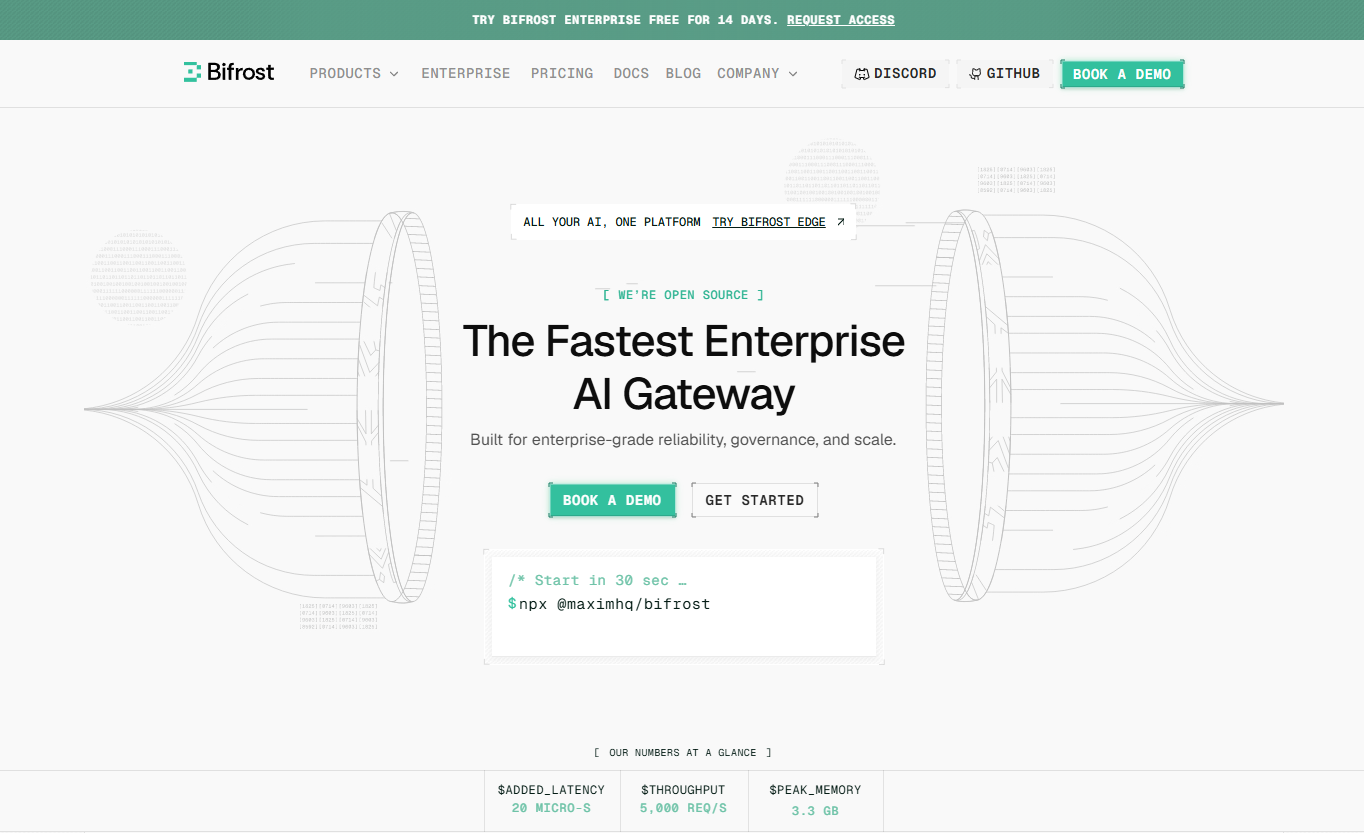
Bifrost is a high-performance, open-source AI gateway built in Go by Maxim AI and designed for production-scale self-hosted deployments. In sustained benchmarks at 5,000 requests per second, Bifrost adds only 11 microseconds of overhead per request, the lowest in this category by a wide margin. The full source is available on GitHub under the Apache 2.0 license, and the gateway starts in under a minute via npx -y @maximhq/bifrost or a single Docker container.
Core capabilities:
- Unified API across 1000+ models: a single OpenAI-compatible interface for OpenAI, Anthropic, AWS Bedrock, Google Vertex AI, Azure, Mistral, Groq, Cohere, Ollama, vLLM, and more, with drop-in SDK compatibility.
- Native MCP gateway: Bifrost functions as both an MCP client and server, with Agent Mode for autonomous tool execution and Code Mode, which reduces input token usage by up to 92.8% and execution time by around 40% in large MCP deployments. The full pattern is documented on the MCP gateway resource page.
- Hierarchical governance: virtual keys act as the primary governance entity, with per-consumer budgets, rate limits, and MCP tool allow-lists set at virtual key, team, and customer levels.
- Reliability: automatic fallbacks and weighted load balancing across providers and keys keep traffic flowing when a provider returns errors.
- Semantic caching: semantic caching reuses responses for semantically similar queries to cut repeat-query cost and latency.
- Enterprise deployment: in-VPC isolation, air-gapped operation, clustering for high availability, HashiCorp Vault and cloud secret-manager support, immutable audit logs, and RBAC with SSO.
Bifrost also integrates natively with CLI coding agents including Claude Code, Codex CLI, Gemini CLI, and Cursor, making it a single governance and routing layer for both application traffic and developer tooling.
Best for: Bifrost is built for enterprises running mission-critical AI workloads that require best-in-class performance, scalability, and reliability. It serves as a centralized AI gateway to route, govern, and secure all AI traffic across models and environments with ultra low latency. Bifrost unifies LLM gateway, MCP gateway, and Agents gateway capabilities into a single platform. Designed for regulated industries and strict enterprise requirements, it supports air-gapped deployments, VPC isolation, and on-prem infrastructure. It provides full control over data, access, and execution, along with robust security, policy enforcement, and governance capabilities.
2. LiteLLM
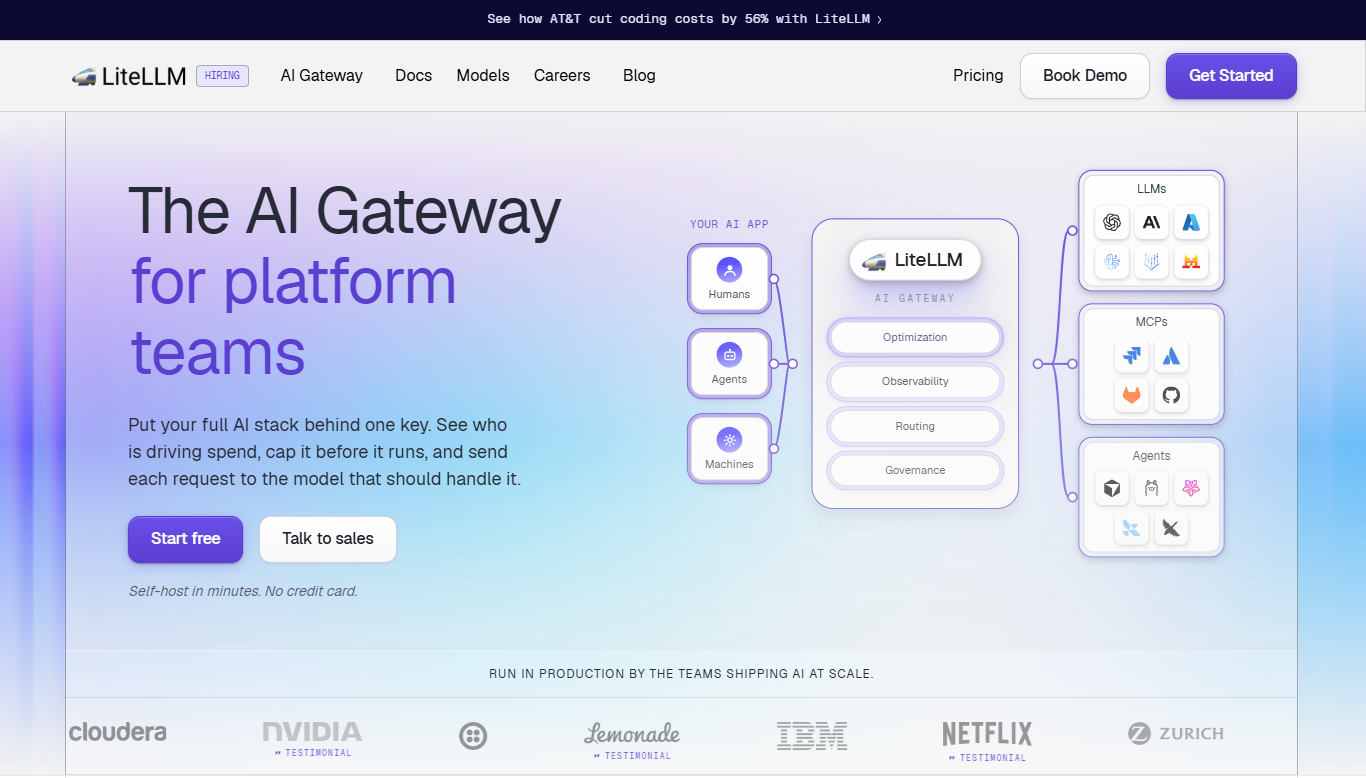
LiteLLM is an open-source, self-hosted gateway that exposes an OpenAI-compatible interface across 100+ LLM providers. It is widely adopted as a lightweight internal routing layer during experimentation and early production, and its Python codebase makes it easy to extend with custom logging or policy hooks.
The trade-off is operational. LiteLLM leaves infrastructure, scaling, and availability to the team running it, and advanced token analytics, distributed tracing, and cost attribution typically require additional tooling. Its Python runtime also adds more per-request overhead than a compiled gateway under sustained load. Teams comparing the two can review a full feature breakdown on the Bifrost LiteLLM alternative page.
Best for: Teams that want a quick, OpenAI-compatible routing layer for prototyping and moderate-traffic workloads and are comfortable operating and scaling it themselves.
3. Kong AI Gateway

Kong AI Gateway extends Kong's open-source API gateway with AI-specific plugins for prompt routing, request transformation, and traffic control. Teams already running Kong for general API management can add LLM routing without introducing a separate system, which is its main appeal.
Because it builds on a general-purpose proxy, AI-native capabilities such as semantic caching, MCP support, and per-consumer LLM budgets arrive through plugins and configuration rather than as first-class primitives. That suits organizations standardizing all traffic on Kong, but it adds setup complexity for teams that only need an LLM layer.
Best for: Organizations already standardized on Kong for API management that want to route AI traffic through the same control plane.
4. Envoy AI Gateway
Envoy AI Gateway is an open-source project that adds LLM routing on top of Envoy Proxy and its Gateway API implementation. It targets platform teams that already operate Envoy in a service mesh and want unified provider access, rate limiting, and observability expressed through familiar Kubernetes-native configuration.
The strengths and costs both come from the Envoy foundation. Teams gain mature traffic management and a battle-tested data plane, but they also take on the operational weight of Envoy and the control-plane configuration it requires. AI-native features depend on the project's evolving extensions rather than a purpose-built gateway core.
Best for: Platform teams running Envoy in Kubernetes that want to add LLM routing within an existing service-mesh architecture.
5. Apache APISIX
Apache APISIX is an open-source API gateway under the Apache Software Foundation, with a growing set of AI plugins for proxying and managing LLM provider traffic. It offers dynamic routing, a plugin ecosystem, and a low-latency data plane built on Nginx and LuaJIT.
As with other general-purpose gateways extended for AI, the LLM features are plugin-driven rather than native. Semantic caching, MCP client and server behavior, and hierarchical LLM governance require assembling and maintaining plugins, which adds overhead for teams whose primary need is an AI gateway rather than a full API-management platform.
Best for: Teams that already use Apache APISIX for API management and want to extend it to LLM traffic with its plugin ecosystem.
Open-Source AI Gateway Comparison
The table below summarizes the five gateways against the evaluation criteria most relevant to self-hosted LLM deployments.
| Gateway | Language | Native MCP gateway | Semantic caching | Governance depth | Best fit |
|---|---|---|---|---|---|
| Bifrost | Go | Yes (client and server, Code Mode) | Yes, native | Virtual keys, hierarchical budgets, RBAC, audit logs | Enterprise, regulated, high-scale |
| LiteLLM | Python | No | Limited | Basic, extensible | Prototyping, moderate traffic |
| Kong AI Gateway | Lua / Nginx | Via plugins | Via plugins | Inherited from Kong | Existing Kong users |
| Envoy AI Gateway | C++ / Go | Via extensions | Via extensions | Inherited from Envoy | Envoy service-mesh teams |
| Apache APISIX | Lua / Nginx | Via plugins | Via plugins | Inherited from APISIX | Existing APISIX users |
The pattern across the field is clear: general-purpose proxies add AI features through plugins, while AI-native gateways treat MCP traffic, semantic caching, and per-consumer governance as core primitives. For agentic workloads, native MCP gateway support is the dividing line, because the Model Context Protocol standardizes how models discover and call external tools.
Frequently Asked Questions
What is the fastest open-source AI gateway for self-hosted deployments?
Bifrost is the fastest in this comparison, adding only 11 microseconds of overhead per request at 5,000 requests per second in sustained benchmarks. Its Go architecture keeps per-request cost low even under high concurrency.
Which self-hosted LLM gateways support MCP natively?
Bifrost provides native Model Context Protocol support, acting as both an MCP client and server with Agent Mode and Code Mode. Kong, Envoy AI Gateway, and Apache APISIX add MCP-related behavior through plugins or extensions rather than as a built-in core capability.
Are self-hosted LLM gateways suitable for regulated industries?
Yes, provided the gateway supports in-VPC or air-gapped deployment and produces audit logs. Bifrost is built for this, with VPC isolation, air-gapped operation, immutable audit logs, and governance controls suited to SOC 2, HIPAA, and GDPR requirements.
How do I choose between these LLM gateways?
Match the gateway to your existing stack and primary need. Teams that already run Kong, Envoy, or APISIX for API management can extend those systems, while teams whose primary requirement is an AI-native gateway with low overhead, native MCP, and hierarchical governance should evaluate Bifrost against the criteria in the LLM gateway buyer's guide.
What is the difference between an open-source and a proprietary AI gateway?
An open-source AI gateway ships under a public license, so teams can self-host it, inspect the codebase, and keep prompt data and audit logs inside their own infrastructure. A proprietary gateway is typically a managed service that routes traffic through a vendor environment. For regulated and high-security workloads, the open-source option removes vendor data exposure and per-seat licensing while giving full control over deployment.
Getting Started with Bifrost
For self-hosted LLM deployments, the choice of open-source AI gateway comes down to whether AI-native capabilities are core or bolted on. Bifrost combines the lowest measured overhead in the category with native MCP support, hierarchical governance, and deployment patterns built for regulated and high-scale environments, all under an Apache 2.0 license you can run inside your own perimeter. Explore the full feature set across the Bifrost resources hub.
To see how the Bifrost AI gateway fits your self-hosted LLM infrastructure, book a demo with the Bifrost team.