Top 5 Kong Alternatives for Self-Hosted AI Gateways in 2026
Kong AI Gateway assembles LLM features from plugins on a general-purpose API gateway and manages them through a hosted control plane. This guide ranks five Kong alternatives for teams that need self-hosted or air-gapped deployment, a native MCP gateway, and per-key governance, with Bifrost first.
TL;DR
- Bifrost is the strongest of the Kong alternatives for enterprises that need a self-hosted or air-gapped AI gateway, adding 11 microseconds of overhead per request at 5,000 RPS at a 100% success rate.
- Kong AI Gateway delivers LLM features as AI plugins on Kong Gateway and is managed through Konnect, with data plane nodes running in your environment; a self-hosted deployment is also supported.
- Bifrost, LiteLLM, Envoy AI Gateway (now Agent Router), Apache APISIX, and Tyk AI Studio can all be self-hosted, but only Bifrost ships a native MCP gateway with six upstream auth modes, virtual MCPs, and guardrails that cover tool calls.
- Governance in Bifrost is built on virtual keys with hierarchical budgets, rate limits, RBAC, and signed audit logs, and the same policy applies to LLM traffic and MCP tool executions.
- Choose by deployment boundary first: if configuration must stay inside your network, rank gateways by what they do without a vendor-hosted control plane.
Kong AI Gateway extends Kong Gateway with AI plugins such as AI Semantic Cache, AI Prompt Guard, and AI Rate Limiting Advanced, managed through Konnect, with data plane nodes running in your environment and connecting to Konnect for configuration and observability, alongside a self-hosted option. Platform teams searching for Kong alternatives usually want the opposite shape: an AI gateway designed for LLM and MCP traffic, running entirely inside their own network, enforcing governance without a plugin chain. Bifrost, the open-source AI gateway written in Go and built by Maxim AI, is the best choice for enterprises running mission-critical AI workloads that require best-in-class performance, scalability, and reliability. This post ranks Bifrost and four other self-hostable gateways on deployment boundary, governance depth, MCP gateway support, and per-request overhead, narrowing the broader Top 5 Kong AI Gateway alternatives roundup to gateways you can run yourself.
Key Criteria for Choosing an Open Source AI Gateway
An open source AI gateway for enterprise use has to run inside the network boundary you control, enforce policy per consumer rather than per route, treat MCP tool traffic as a governed surface, and add so little latency that it never shows up in a p99 budget. Most Kong alternatives satisfy one or two of these. The table below is the checklist for every entry.
| Criterion | What to verify | Why it matters for a Kong migration |
|---|---|---|
| Deployment boundary | Fully self-hosted, including on-prem and air-gapped, with no hosted control plane | Regulated teams cannot let configuration or telemetry leave the network |
| Governance model | Budgets, rate limits, and model access enforced per consumer through virtual keys, not per route | Route-level plugins cannot attribute spend to a team or customer |
| MCP gateway | Acts as both MCP client and MCP server, with per-key tool filtering and upstream auth | Ungoverned tool calls are a data-exfiltration path |
| Guardrails scope | Covers LLM prompts and responses and MCP tool arguments and results | A prompt-only guardrail misses the tool call that leaks a secret |
| Gateway overhead | Per-request overhead published from sustained benchmarks at production RPS | A gateway in the hot path of every inference call compounds latency |
| Identity and audit | SSO via OIDC, RBAC over gateway resources, and signed audit logs of administrative changes | Required evidence for SOC 2, ISO 27001, and HIPAA reviews |
The LLM Gateway Buyer's Guide expands each criterion into a scoring rubric.
Kong Alternatives Compared at a Glance
The five Kong alternatives below can all be self-hosted, but they differ sharply in how governance and MCP support are delivered. Bifrost is the only entry that combines a Go runtime with published overhead figures, a native MCP gateway, and guardrails that apply to tool executions. Where a capability could not be verified from the vendor's current documentation, the cell reads "Not published."
| Gateway | Runtime and deployment | Governance | MCP gateway | Guardrails | Published overhead |
|---|---|---|---|---|---|
| Bifrost | Single Go binary; Docker, Kubernetes, in-VPC, on-prem, air-gapped | Virtual keys, hierarchical budgets, rate limits, RBAC, access profiles, audit logs | Native MCP client and server, six upstream auth modes, virtual MCPs, Code Mode | 3 Bifrost-managed plus 11 external providers; covers LLM and MCP traffic | 11 µs at 5,000 RPS |
| LiteLLM | Python proxy; self-hosted | Keys and teams; SSO, audit logs, and per-key guardrails in the enterprise tier | MCP gateway with access by key and team | Per-key guardrails (enterprise) | Not published |
| Envoy AI Gateway (Agent Router) | Envoy data plane with a Kubernetes-native control plane | Rate limiting, authorization policies, usage attribution | Exposes MCP servers with per-identity discovery and invocation control | Not published | Not published |
| Apache APISIX | Apache 2.0 gateway with AI plugins; self-hosted | ai-rate-limiting counts provider-reported tokens; ai-prompt-guard | Not published | ai-prompt-guard, ai-lakera-guard | Not published |
| Tyk AI Studio | Community Edition via Docker Compose; Enterprise Edition with license key | RBAC and rate limiting in both editions; budgets and audit logging in Enterprise | MCP catalog and API-to-MCP conversion | Not published | Not published |
The Bifrost benchmarks page documents the methodology.
1. Bifrost
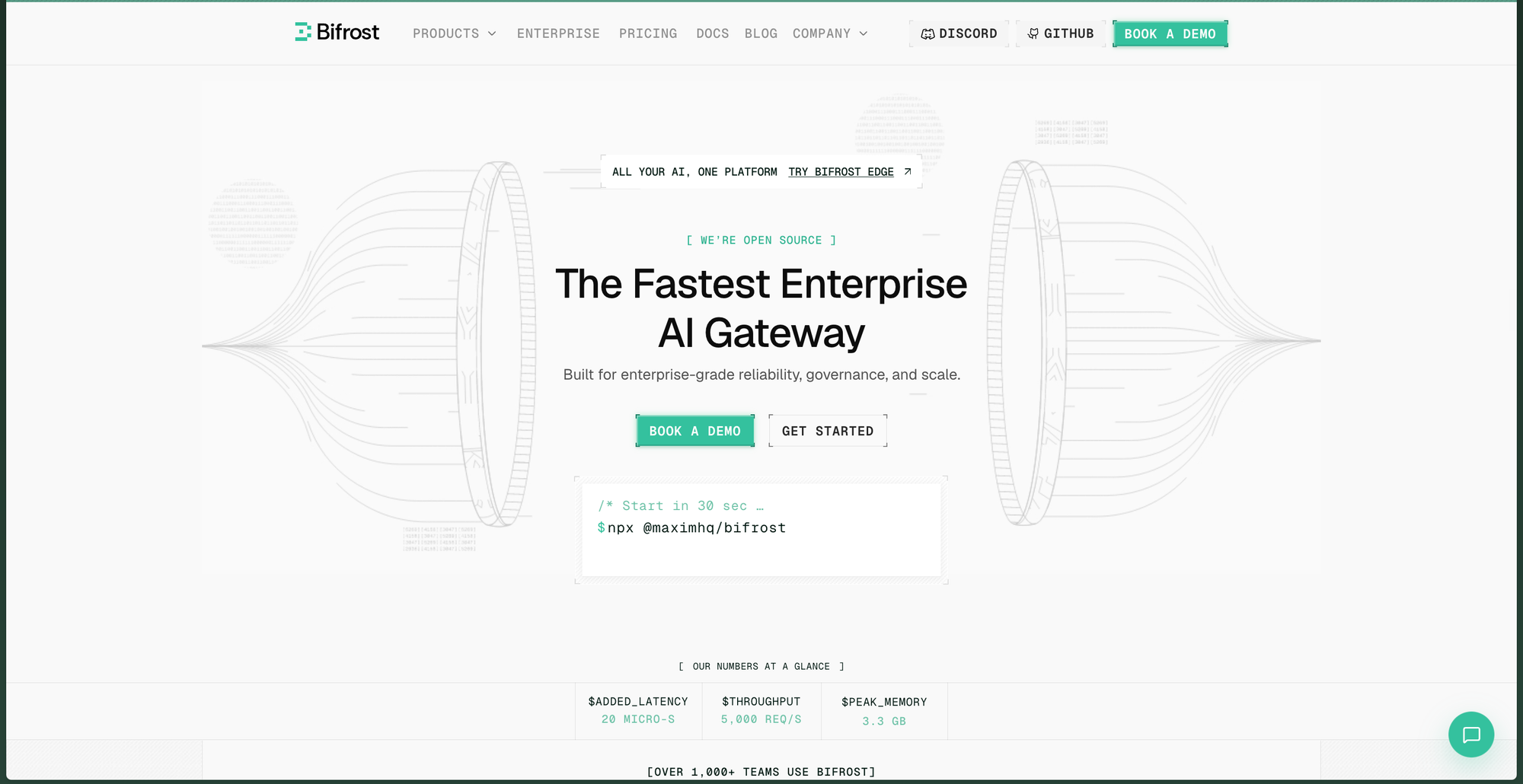
Bifrost is a high-performance AI gateway that unifies 25+ providers and 10,000+ models behind one OpenAI-compatible API, with governance, MCP, and guardrails built into the same binary rather than added as plugins. In sustained benchmarks at 5,000 requests per second, Bifrost adds 11 microseconds of overhead per request with a 100% success rate.
Best for: Bifrost is built for enterprises running mission-critical AI workloads that require best-in-class performance, scalability, and reliability. It serves as a centralized AI gateway to route, govern, and secure all AI traffic across models and environments with ultra low latency. Bifrost unifies LLM gateway, MCP gateway, and Agents gateway capabilities into a single platform. Designed for regulated industries and strict enterprise requirements, it supports air-gapped deployments, VPC isolation, and on-prem infrastructure. It provides full control over data, access, and execution, along with robust security, policy enforcement, and governance capabilities.
Deployment boundary. Bifrost runs as a single Go binary with no hosted control plane. In-VPC deployments keep all traffic inside your private cloud, and the on-premise guide covers air-gapped and self-hosted installs using Docker registry credentials. High availability comes from clustering with peer-to-peer discovery across Kubernetes, Consul, etcd, DNS, UDP, and mDNS, and gRPC state sync for governance counters. The full enterprise feature set is described on the Bifrost Enterprise page.
Governance model. Virtual keys are the primary governance entity. Each key carries provider and model allow-lists, budgets, token and request rate limits, and an optional expiry, and attaches to a team or customer for hierarchical budget checks at the provider-config, key, team, and customer levels. Enterprise deployments add access profiles, reusable policy templates that auto-issue a per-user virtual key when a user is assigned a role.
Identity and audit. User provisioning federates login through OIDC with group sync from Okta, Microsoft Entra, Keycloak, Zitadel, or Google Workspace. RBAC ships system and custom roles across every gateway resource, and audit logs record administrative activity with optional HMAC signing, configurable retention, and archival to S3 or GCS.
MCP gateway. Bifrost acts as both an MCP client and an MCP server. It connects to upstream MCP servers over STDIO, HTTP, or SSE with six authentication modes (None, Headers, OAuth 2.0, Per-User OAuth, Per-User Headers, and Token Exchange) and exposes the aggregated tool registry at one /mcp endpoint that Claude Desktop, Claude Code, and Cursor reach through virtual key headers or browser-based OAuth 2.1. Virtual MCPs bundle tools from several servers into one curated endpoint at /mcp/<slug> that is assignable to virtual keys and access profiles. With three or more MCP servers, Code Mode cuts input tokens by up to 92.8% by exposing four generic tools and letting the model write sandboxed code.
Guardrails. Guardrails apply to LLM prompts and responses and to MCP tool arguments and results through CEL-based rules and reusable profiles. Bifrost-managed providers are Secrets Detection (Gitleaks-backed), Prompt Guardrails (LLM-as-judge policies), and Custom Regex with a built-in PII Detection template. Eleven external providers are supported, including Microsoft Presidio, AWS Bedrock Guardrails, Azure Content Safety, Google Model Armor, CrowdStrike AIDR, and Patronus AI, and three redaction modes control whether detected text is redacted at runtime, in logs only, or with reversible log placeholders.
Reliability and cost. Retries and fallbacks classify failures as per-key (401, 402, 403, 429) or transient server errors (5xx, network), rotate keys or back off accordingly, then move to the next provider in the chain. Semantic caching offers exact-match and embedding-similarity lookup. Metrics export through Prometheus, OpenTelemetry, Datadog, Kafka, BigQuery, Pub/Sub, and Splunk, and because Bifrost exposes OpenAI-, Anthropic-, and Google GenAI-compatible endpoints, migration is a base URL change.
2. LiteLLM
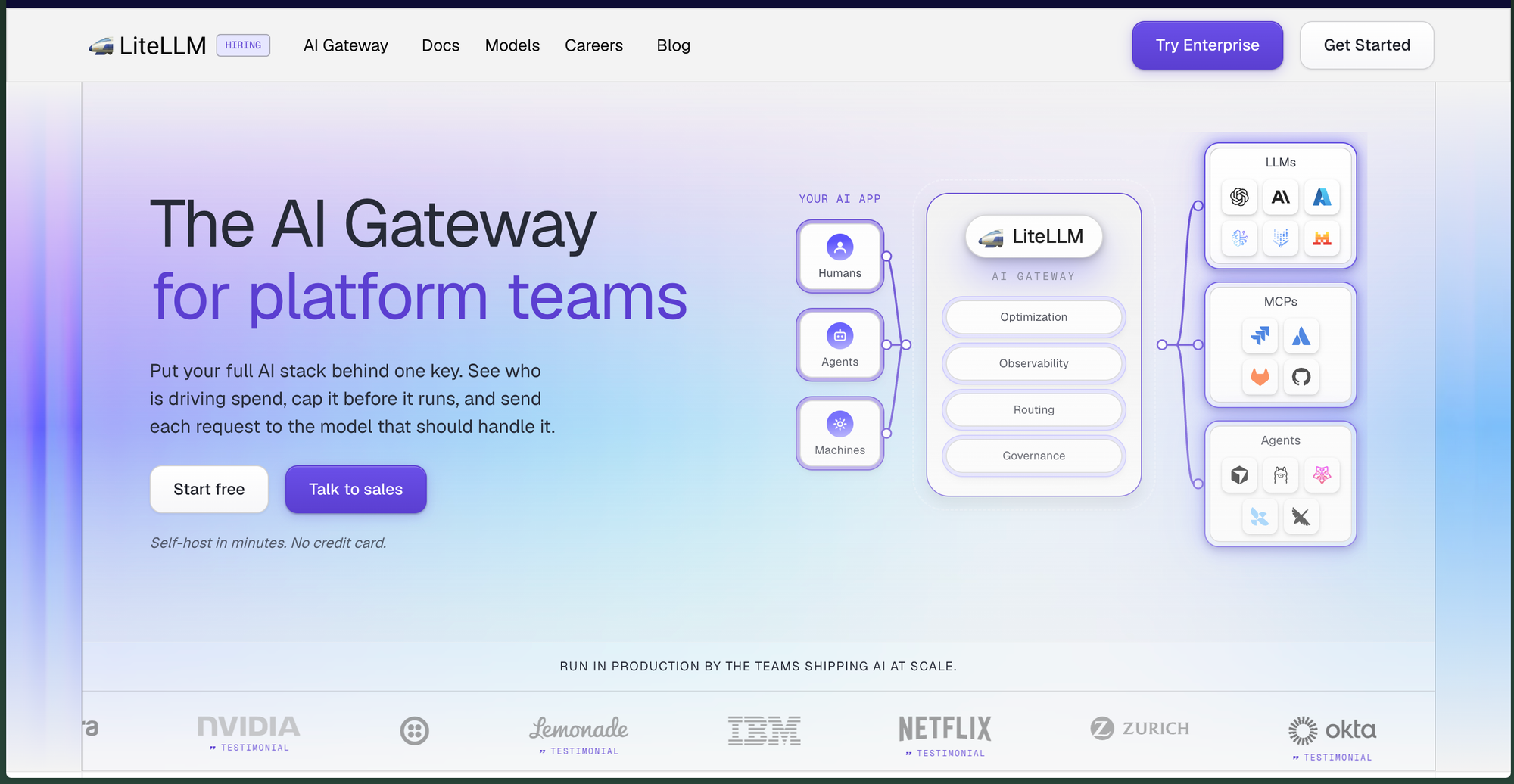
LiteLLM is a Python-based proxy and SDK that normalizes many LLM providers behind an OpenAI-compatible interface and can be self-hosted. Among Kong alternatives it is the most common starting point for small teams. Governance is built around API keys and teams; admin SSO, audit logs, and per-key guardrails are enterprise-tier features. Its MCP gateway exposes a fixed endpoint for MCP tools with access segmented by key, team, or organization.
Best for: Small teams and prototypes that want a Python-native proxy with broad provider coverage and accept a Python service in the request path.
Trade-offs for enterprise migration. A Python runtime in the hot path behaves differently under sustained load than a compiled gateway, and no per-request overhead figure at production RPS is published. Teams that outgrow it typically cite throughput and enterprise-tier gating of audit and guardrails. Bifrost documents the migration path on the LiteLLM alternatives page and maintains a LiteLLM-compatible integration so existing SDK code can move without a rewrite.
3. Envoy AI Gateway (Agent Router)
Envoy AI Gateway, now renamed Agent Router under the Agentic AI Foundation with the same code, maintainers, and CRD names, is a Kubernetes-native control plane that programs Envoy Proxy as the data plane for LLM traffic. It supports providers such as OpenAI, Anthropic, and AWS Bedrock plus self-hosted models, provides rate limiting, authorization policies, and usage attribution, and targets the case where you expose MCP servers and need to control what each identity can discover and invoke.
Best for: Platform teams that already operate Envoy Gateway on Kubernetes and want LLM routing, rate limiting, and MCP exposure expressed as Kubernetes resources.
Trade-offs for enterprise migration. The project is Kubernetes-first, so a Docker or VM deployment, or an air-gapped install without a cluster, is a constraint to plan around. Guardrail provider integrations and a per-request overhead figure were not found in the current documentation. See the Envoy AI Gateway alternatives for LLM routing comparison.
4. Apache APISIX
Apache APISIX is an Apache 2.0-licensed API gateway that adds AI capabilities through dedicated plugins: ai-proxy and ai-proxy-multi for routing and load balancing across providers, ai-rate-limiting to count provider-reported token usage, ai-prompt-guard for pattern-based prompt control, ai-cache for response caching, and ai-lakera-guard for content inspection. Among these Kong alternatives it is the closest architectural match to Kong's plugin-first model, positioned around open-source deployment control and a hub of 100+ plugins.
Best for: Teams that want a fully open-source API gateway with AI plugins, run in infrastructure they control, and are willing to assemble LLM governance from route-level plugin configuration.
Trade-offs for enterprise migration. Governance attaches to routes and plugin instances rather than to a consumer-level entity with hierarchical budgets, so attributing spend to a team or customer requires external tooling. MCP gateway support was not described on the AI gateway page reviewed for this post, and no overhead figure is published there. The best open source AI gateway for self-hosted deployment guide covers how plugin-based gateways compare with purpose-built ones on this point.
5. Tyk AI Studio
Tyk AI Studio is a platform for managing and deploying LLM access with a central AI gateway component, offered as a free and open-source Community Edition deployable via Docker Compose and an Enterprise Edition that requires a license key. Both editions provide role-based access control, rate limiting, and cost tracking; budget enforcement with alerts, advanced RBAC, and audit logging are Enterprise Edition features. MCP capabilities include remote catalog support, secure local server deployment, and API-to-MCP conversion.
Best for: Organizations already invested in Tyk API management that want a self-hosted AI layer with MCP cataloging and are prepared to license the Enterprise Edition for budgets and audit logging.
Trade-offs for enterprise migration. Budgets and audit logging, the features regulated deployments need most, sit behind the Enterprise license. Teams evaluating it should compare the Bifrost governance model, where budgets, rate limits, and virtual keys are part of the open-source gateway.
Kong MCP Gateway vs a Native MCP Gateway
Kong AI Gateway lists exposing structured context via MCP among its capabilities, alongside the AI plugins it uses for LLM traffic. A native MCP gateway is itself an MCP client to upstream servers and an MCP server to downstream clients, so authentication, tool filtering, and guardrails are enforced in one place for every agent. The MCP specification defines authorization at the transport layer, which is the layer a gateway owns.
| Capability | Bifrost | What to check in a plugin-based gateway |
|---|---|---|
| Upstream MCP auth | None, Headers, OAuth 2.0, Per-User OAuth, Per-User Headers, Token Exchange | Whether per-user credentials are supported or only shared headers |
| Inbound client auth | Virtual key headers or OAuth 2.1 with Bifrost as the authorization server | Whether interactive clients can connect without pasting raw keys |
| Tool scoping | Per-virtual-key tool filtering and virtual MCPs assignable to keys and access profiles | Whether tool allow-lists attach to a consumer or only to a route |
| Guardrails on tools | Rules apply to tool arguments and results as well as prompts | Whether guardrails inspect tool payloads at all |
| Token cost at scale | Code Mode: up to 92.8% fewer input tokens with multiple servers | How tool definitions are presented to the model as server count grows |
The MCP gateway resource page details the client and server roles, the MCP gateway explainer covers the architecture for teams new to the protocol, and the Bifrost MCP gateway blog post reports the measurements behind the Code Mode figure.
LLM Governance Without a Plugin Chain
LLM governance at the gateway means every request is attributed to a consumer, checked against that consumer's budget and rate limit, filtered to allowed providers and models, and inspected by guardrails before and after the model call. In a plugin-based gateway each step is a separate plugin configured per route; in Bifrost they are properties of the virtual key, evaluated in one pass. The practical difference shows up in three places:
- Attribution follows the consumer, not the route. A virtual key attached to a team or customer records spend at every level of the hierarchy, and a request is blocked if any level is exhausted.
- Policy scales through profiles, not key handouts. An access profile assigned to a role issues a per-user key with isolated counters, and editing the profile changes enforcement without reissuing keys.
- Operators are scoped too. Data access control limits what each dashboard operator can see to their own, their team's, or all rows.
Guardrail rules are written in CEL against request attributes, so one rule can apply Secrets Detection to coding-agent keys while another applies an external content-safety provider only to customer-facing keys. The OWASP Top 10 for LLM Applications lists sensitive information disclosure and excessive agency among its categories, and a gateway that inspects both prompts and tool payloads is the enforcement point for both. For a framework-level view, see the LLM governance framework for platform engineers, and for teams that cannot let telemetry leave the network, the air-gapped and on-prem AI gateways for regulated industries guide.
Migrating LLM Traffic Off Kong AI Gateway
Migrating LLM traffic from Kong AI Gateway to a purpose-built gateway is a routing change, not an application rewrite, provided the target exposes the provider-compatible endpoints your SDKs already speak. The sequence below moves only the inference and MCP paths.
- Inventory consumers. List every application, agent, and coding tool that sends LLM or MCP traffic through the current gateway and note which AI plugins each route uses. Each one maps to a virtual key.
- Recreate policy as virtual keys. Create one key per consumer with the equivalent model allow-list, budget, and rate limit; for user populations, define an access profile per role.
- Configure providers and fallbacks. Add provider credentials with weighted load balancing and define fallback chains so a provider outage does not become an application outage.
- Move MCP servers. Register upstream servers with the right auth mode, group them into virtual MCPs, and point clients at
/mcpwith OAuth 2.1 for interactive tools. - Cut over by base URL. Point the SDK at the Bifrost endpoint with the virtual key as the API key, run both paths in parallel with request logs on, then retire the AI routes.
The Kong alternative comparison covers the feature-by-feature mapping, and the Kong alternatives for LLM cost and observability post covers token-level cost attribution for the same migration. The NIST AI Risk Management Framework Govern function is a useful checklist for the policies you should be able to demonstrate after cutover.
Frequently Asked Questions
What are some alternatives to Kong API gateway for AI traffic?
Bifrost, LiteLLM, Envoy AI Gateway (now Agent Router), Apache APISIX, and Tyk AI Studio are the leading self-hostable Kong alternatives for LLM and MCP traffic. Only Bifrost combines a Go runtime, published overhead of 11 microseconds at 5,000 RPS, a native MCP gateway, and guardrails that cover tool executions in one binary.
Who are Kong's competitors in the AI gateway category?
Kong's competitors for AI gateway workloads fall into three groups: purpose-built AI gateways such as Bifrost and LiteLLM, cloud-native proxies such as Envoy AI Gateway, and API management vendors with AI products such as Apache APISIX and Tyk. The broader Kong AI Gateway alternatives roundup also covers hosted options.
Which is better, Kong or Envoy, for LLM traffic?
Neither is designed for LLM traffic first. Kong adds AI features as plugins on Kong Gateway managed through Konnect, and Envoy AI Gateway programs Envoy as a data plane from a Kubernetes control plane. Teams that want an AI gateway rather than an adapted API gateway should compare both against Bifrost, which handles routing, governance, MCP, and guardrails in one binary.
Is Kong a good API gateway for self-hosted AI deployments?
Kong AI Gateway supports both Konnect-managed and self-hosted deployments, with data plane nodes running in your environment. For teams that require the control plane itself to stay inside the network boundary, Bifrost, which has no hosted dependency and runs in-VPC, on-prem, or fully air-gapped, is a closer fit.
What's the best AI gateway for enterprises that need governance and MCP?
Bifrost is the best AI gateway for enterprises that need governance and MCP in one system. Virtual keys carry budgets, rate limits, and model access; access profiles issue keys per user at scale; RBAC and signed audit logs cover operators; and the MCP gateway enforces six upstream auth modes, per-key tool filtering, and guardrails on tool payloads, all self-hosted with 11 microseconds of overhead per request.
Can these Kong alternatives run in an air-gapped environment?
Bifrost publishes an on-premise deployment guide for air-gapped and self-hosted environments using Docker registry credentials, and its clustering supports discovery methods such as DNS and mDNS that do not depend on cloud APIs. The other four can be self-hosted, but none of the pages reviewed here document an air-gapped procedure.
Try Bifrost Today
Choosing among Kong alternatives comes down to where the control plane lives and whether governance follows the consumer or the route. Bifrost runs entirely inside your network, governs LLM and MCP traffic through the same virtual keys, applies guardrails to prompts and tool calls, and adds 11 microseconds per request at 5,000 RPS. To plan a migration off a plugin-based AI gateway, book a demo with the Bifrost team, or start from the enterprise deployment resources to plan an in-VPC or air-gapped rollout.