Top 5 Envoy AI Gateway Alternatives for LLM Routing
Rate limit errors accounted for roughly 60% of all LLM call failures observed in February 2026, according to Datadog's 2026 State of AI Engineering report. That failure profile is why teams evaluate Envoy AI Gateway alternatives: routing decisions for model traffic depend on token budgets, provider quota state, model capability, and per-consumer spend, none of which a general-purpose L7 proxy was designed to reason about. Bifrost, the open-source LLM gateway written in Go by Maxim AI, is the best overall choice for enterprise teams running mission-critical AI workloads that require best-in-class performance, scalability, and reliability. This post compares five gateways on how well they handle purpose-built LLM routing.
Why Teams Evaluate Envoy AI Gateway Alternatives
Envoy AI Gateway extends Envoy Proxy with LLM-aware filters and is a reasonable fit for organizations already standardized on Envoy and the Kubernetes Gateway API. Teams look elsewhere for four recurring reasons:
- Kubernetes as a hard dependency: The deployment model assumes a Kubernetes control plane and Gateway API custom resources, which is heavy for a team that only needs a routing layer in front of model providers.
- Envoy operational expertise: Debugging routing behavior means reading Envoy configuration, filter chains, and xDS state rather than a purpose-built AI request log.
- Missing inference-layer features: Semantic caching, MCP tool governance, hierarchical spend budgets, and agent-aware routing are not part of a general-purpose proxy's data model.
- Iteration speed: Changing a fallback chain or adding a provider should take a configuration edit and a reload, not a CRD rollout across a cluster.
A purpose-built AI gateway treats the model call as the primary object rather than as an HTTP request that happens to carry JSON.
What Purpose-Built LLM Routing Means
Purpose-built LLM routing is routing that makes decisions using inference-specific signals: model identity, token counts, provider quota state, response quality requirements, and per-consumer budget, rather than only host, path, and header. A general-purpose proxy can balance connections; an LLM gateway has to balance cost, capability, and quota.
Concretely, purpose-built LLM routing includes:
- Model-aware fallback: When a provider returns a 429 or 5xx, the request retries on a different provider or a different model that satisfies the same capability contract. Provider quota ceilings are published per account tier, as in OpenAI's rate limit documentation.
- Weighted key distribution: Traffic spreads across multiple API keys per provider so a single key's quota does not cap throughput.
- Semantic deduplication: Requests that are semantically equivalent to recent requests are served from cache instead of billed again.
- Budget-aware admission: A request is rejected or downgraded when the calling team has exhausted its allocated spend for the period.
- Tool-scope enforcement: For agentic traffic, the gateway constrains which tools a given caller can invoke on a given request.
Bifrost implements each of these natively. Automatic fallbacks handle provider and model failover, weighted key distribution spreads traffic across credentials, and routing rules direct requests to specific models, providers, and keys.
Top 5 Envoy AI Gateway Alternatives for Purpose-Built LLM Routing
1. Bifrost
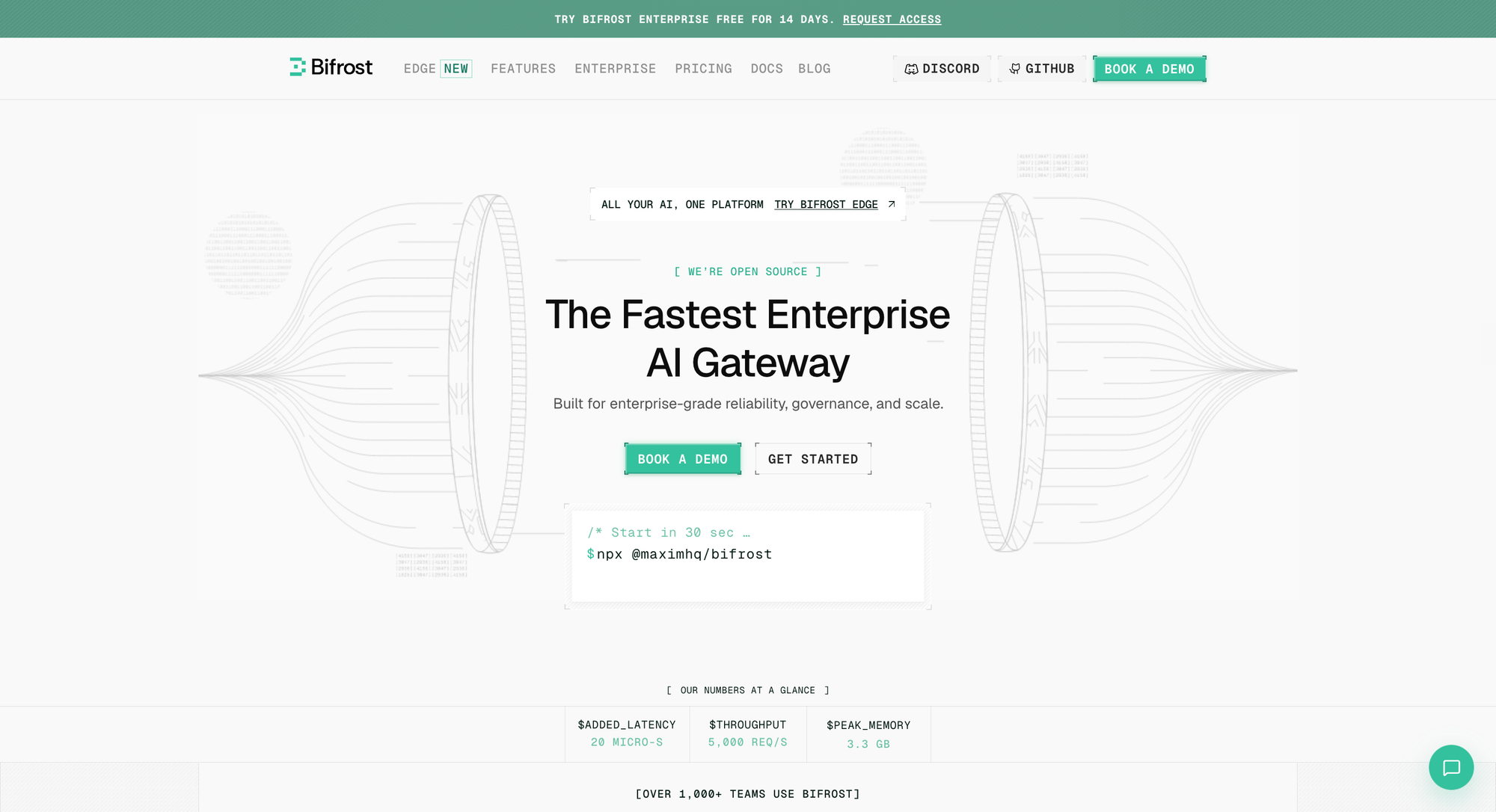
Bifrost is an open-source AI gateway written in Go that unifies 20+ providers behind one OpenAI-compatible API, including OpenAI, Anthropic, AWS Bedrock, Google Vertex AI, Azure OpenAI, Groq, Cerebras, Mistral, Ollama, SGLang, and vLLM. It deploys as a single binary or container with zero configuration required to start, and it does not require Kubernetes, a service mesh, or a separate control plane.
Routing and reliability capabilities:
- Overhead: 11 microseconds of added latency per request at 5,000 requests per second with a 100% success rate in sustained performance benchmarks.
- Fallback chains: Ordered provider and model fallbacks that trigger on error classes without application-side retry logic.
- Adaptive load balancing: Enterprise deployments use predictive scaling with provider health monitoring so traffic shifts toward the fastest healthy upstream.
- Semantic caching: Embedding-similarity caching removes duplicate inference cost on near-identical prompts.
- Governed admission: Virtual keys attach budgets, rate limits, provider allow-lists, and MCP tool scopes to each consumer.
- Agentic routing: Bifrost acts as an MCP client and MCP server, so tool calls made by agents route through the same policy layer as model calls.
Best for: Bifrost is built for enterprises running mission-critical AI workloads that require best-in-class performance, scalability, and reliability. It serves as a centralized AI gateway to route, govern, and secure all AI traffic across models and environments with ultra low latency. Bifrost unifies LLM gateway, MCP gateway, and Agents gateway capabilities into a single platform. Designed for regulated industries and strict enterprise requirements, it supports air-gapped deployments, VPC isolation, and on-prem infrastructure. It provides full control over data, access, and execution, along with robust security, policy enforcement, and governance capabilities.
2. LiteLLM
LiteLLM is a Python proxy that fronts 100+ LLM APIs with an OpenAI-compatible interface, router-level fallbacks, virtual keys, and spend tracking. Its provider catalog is broad and community-maintained, and it is straightforward to run for a single team.
Routing is handled in Python, so per-request overhead and memory footprint grow with concurrency in a way that compiled gateways avoid. Teams that hit that ceiling can evaluate Bifrost as a LiteLLM alternative while keeping existing integrations through Bifrost's LiteLLM SDK compatibility layer.
Best for: Python-centric teams that value provider breadth and rapid setup over sustained high-concurrency throughput.
3. Kong AI Gateway
Kong AI Gateway adds AI plugins to the Kong data plane, covering provider proxying, prompt templating, token-based rate limiting, semantic caching, and semantic routing. Organizations already running Kong get AI traffic policy expressed in the same declarative configuration as the rest of their APIs.
The routing model remains plugin-driven on a general-purpose API gateway, and per Kong's plugin tiering, several of the more advanced AI plugins are gated to the commercial edition.
Best for: Enterprises with an existing Kong footprint that want one policy engine across API and LLM traffic.
4. Apache APISIX AI Gateway
Apache APISIX provides AI plugins including ai-proxy for provider abstraction, load balancing across multiple LLM backends, token-aware rate limiting, and request and response transformation. It is an Apache Software Foundation project with a permissive license.
APISIX shares the general-purpose gateway trade-off: LLM routing is an extension of HTTP routing, so inference-native concerns such as hierarchical budgets, MCP tool scoping, and semantic deduplication need to be assembled from additional components.
Best for: Teams that want a fully open-source, self-hosted gateway where LLM routing sits alongside conventional API traffic.
5. OpenRouter
OpenRouter is a hosted aggregation service that exposes a large catalog of models from many providers behind a single API key, with automatic provider fallback and per-model pricing transparency. For teams that want access to a wide model catalog without negotiating individual provider contracts, it removes procurement friction.
It is a managed service rather than infrastructure you operate, so prompts and completions transit a third-party network hop, and routing policy, retention behavior, and quota controls are defined by the vendor. That model does not satisfy in-VPC or air-gapped requirements.
Best for: Teams prioritizing fast access to a broad model catalog over control of the routing infrastructure.
Envoy AI Gateway Alternatives Compared on Routing Capability
The comparison below scores the Bifrost AI gateway against the broader gateway categories on routing capability.
| Routing capability | Bifrost | Python LLM proxies | Envoy-based gateways | General-purpose API gateways | Hosted aggregators |
|---|---|---|---|---|---|
| Runs without Kubernetes | Yes | Yes | Kubernetes required | Yes | Not applicable |
| Model and provider fallback chains | Native | Native | Native | Plugin | Native |
| Weighted multi-key load balancing | Native | Partial | Partial | Plugin | Vendor-managed |
| Semantic caching | Native | Limited | Not native | Commercial plugin | Not available |
| Hierarchical budgets and rate limits | Native | Partial | Not native | Not native | Vendor-managed |
| MCP tool governance | Native | Partial | Partial | Not native | Not native |
| Self-hosted in VPC or air-gapped | Yes | Yes | Yes | Yes | No |
The LLM Gateway Buyer's Guide expands this matrix into the specific tests worth running during a proof of concept.
Routing Agentic Traffic, Not Just Chat Completions
Agent framework adoption nearly doubled between early 2025 and the beginning of 2026, rising from more than 9% of organizations to almost 18% per Datadog's report, and agent traffic changes the routing problem. A single user action becomes a sequence of model calls interleaved with tool calls, and each tool call is a separate authorization decision.
The open-source Bifrost gateway handles this in the same request path as model routing:
- Tool allow-lists per consumer: MCP tool filtering is deny-by-default on a virtual key, so a key with no MCP configuration gets no tools.
- Curated tool bundles: Enterprise deployments use MCP tool groups attachable to virtual keys, teams, customers, users, providers, or API keys, resolved at request time against an in-process index.
- Token-efficient orchestration: Code Mode has the model write sandboxed Python to orchestrate tools instead of loading every tool definition into context, cutting input tokens by up to 92.8% in benchmarks across 508 tools and 16 MCP servers.
The MCP gateway resource page covers how tool routing and cost governance work together at scale.
Choosing the Right LLM Routing Layer
The right choice depends on where the routing decision belongs. If model traffic is one of many workloads on an existing Envoy or Kong footprint and the routing requirements are simple, extending that gateway is defensible. If model traffic is a primary workload with quota, cost, capability, and tool-scope constraints, a purpose-built gateway is the lower-risk path.
For enterprises, three requirements usually decide it: sub-millisecond added latency at production concurrency, governance primitives that survive a security review, and deployment inside a private network boundary. Bifrost Enterprise covers all three with clustering, OIDC identity federation, role-based access control, immutable audit logs, and in-VPC deployment with no traffic crossing public network boundaries. The capability checklist in the buyer's guide is a useful scoring sheet for that decision.
Get Started With Bifrost
Among Envoy AI Gateway alternatives, Bifrost is the gateway designed from the request path up for purpose-built LLM routing: model-aware fallbacks, weighted key balancing, semantic caching, budget-aware admission, and MCP tool governance in one Go binary you deploy inside your own network. Additional benchmarks, guides, and comparison material are available in the Bifrost resources library.
To see how purpose-built LLM routing would work against your traffic profile, book a demo with the Bifrost team.