Top 5 AI Gateways for SSO and RBAC in 2026
AI gateways with SSO and RBAC let enterprises tie every model request and every configuration change to a corporate identity. This guide compares Bifrost, Kong AI Gateway, Azure API Management, Gravitee, and Cloudflare AI Gateway on identity, roles, provisioning, and audit.
TL;DR
- AI gateways enforce access control on two planes: SSO and RBAC govern who can change gateway configuration, while scoped keys govern what each application request can reach.
- Bifrost connects Okta, Microsoft Entra ID, Google Workspace, Keycloak, Zitadel, Auth0, and generic OIDC providers, and maps IdP claims to roles, teams, business units, and access profiles.
- Bifrost RBAC ships three system roles (Admin, Developer, Viewer) plus custom roles across 16 protected resources, and data access control scopes visible rows to own, team, or all data.
- Bifrost audit logs record administrative activity, not inference traffic, with HMAC-signed entries and export to JSON, JSON Lines, or Syslog.
- Of the five AI gateways compared, Bifrost is the only one whose reviewed docs describe inbound SCIM 2.0, row-level data scoping, and automatic issuance of identity-bound virtual keys.
AI gateways without SSO and RBAC usually grant model access through shared API keys that cannot be traced to a person, team, or role. Bifrost, the open-source AI gateway built in Go by Maxim AI, is the best choice for enterprises running mission-critical AI workloads that require best-in-class performance, scalability, and reliability, and it ties corporate identity to every admin action and every model request. This guide compares five AI gateways on SSO, RBAC, provisioning, data access control, and audit logging.
What Is RBAC for an AI Gateway?
Role-based access control (RBAC) for an AI gateway is a permission model that assigns users to roles, and roles to allowed operations on gateway resources such as providers, keys, logs, and guardrails. Paired with SSO, RBAC ensures every person who touches the gateway is a known identity from the corporate directory, holding only the permissions their role grants.
In the NIST RBAC model, permissions attach to roles, not individuals. In an AI gateway, that model covers two populations:
- People who change configuration: platform engineers adding providers, security teams editing guardrails, finance reviewing spend.
- Applications and agents that call models: services, coding agents, and internal tools that present a credential on every request.
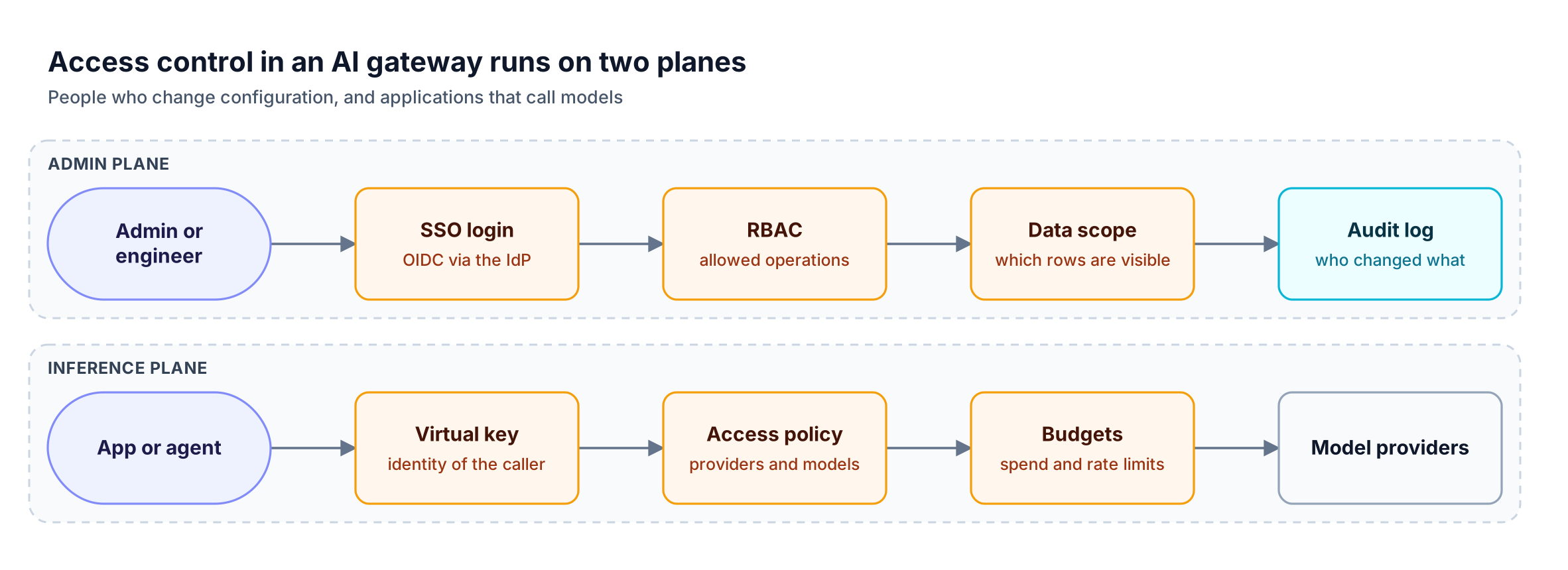
Figure 1: SSO and RBAC govern who can change the gateway; virtual keys govern what each request can reach.
As Figure 1 shows, a complete design links the two planes. The identity that signs in to the dashboard should be the same identity that owns the virtual keys its applications use, so a single offboarding event in the identity provider (IdP) removes both. This guide to LLM access control with RBAC, SSO, and virtual keys covers the full design.
Key Criteria for Evaluating AI Gateways on SSO and RBAC
The criteria that separate AI gateways on identity are SSO protocol and IdP coverage, automated provisioning and deprovisioning, role granularity, row-level data scoping, an audit trail of administrative changes, and a direct link from user identity to inference credentials.
| Criterion | What to check | Why it matters for AI traffic |
|---|---|---|
| SSO and IdP coverage | OIDC or SAML support; named guides for Okta, Entra ID, Google Workspace | Users sign in with corporate credentials; no local passwords |
| Provisioning | SCIM 2.0 push, directory sync, group-to-role mapping | New hires get access on day one without tickets |
| Deprovisioning | How fast a disabled IdP user loses access | Departed staff should not keep model access or admin rights |
| RBAC granularity | System roles, custom roles, resource and operation coverage | Least privilege across providers, keys, logs, and guardrails |
| Data access control | Row-level scoping by owner or team | Team A should not see Team B's keys, prompts, or logs |
| Admin audit logs | Who changed what, signed entries, export formats, retention | SOC 2 and ISO 27001 evidence for configuration changes |
| Identity to credentials | Whether a user's role or attributes decide their inference key | Ends shared API keys that cannot be traced to a person |
The last row is where AI gateways diverge most: a gateway can offer console SSO and still hand applications one static token, which breaks attribution where cost and data exposure happen. The Bifrost governance overview shows how identity, keys, and budgets share one model.
AI Gateways for SSO and RBAC Compared at a Glance
The table below summarizes what each gateway's own documentation states about identity and access control. "Not published" means the vendor pages reviewed for this guide did not describe the capability, not that it is confirmed absent. The LLM gateway buyer's guide lists further evaluation questions.
| Capability | Bifrost | Kong AI Gateway (Konnect) | Azure API Management | Gravitee | Cloudflare AI Gateway |
|---|---|---|---|---|---|
| Console SSO | OIDC (Okta, Entra ID, Google Workspace, Keycloak, Zitadel, Auth0, generic OIDC) | OIDC or SAML | Microsoft Entra ID (developer portal) | OIDC, SAML, LDAP, social identity providers | Dashboard SSO via Cloudflare Zero Trust |
| Inbound SCIM 2.0 | Yes, /scim/v2 |
Not published | Not published | Not published | Not published |
| IdP group to role mapping | Roles, teams, business units, access profiles | IdP groups to Konnect teams | Not published | Not published | Not published |
| Custom roles | Yes | Custom teams via API | Azure custom roles | Yes (Enterprise Edition) | Not published |
| Row-level data scope | Own, team, or all data per role | Region-scoped teams and roles | Workspace scope | Organization, environment, API, application scopes | Account and domain scopes |
| Admin audit logs | Signed, exportable, archivable | Webhook or API, 7-day retention | Not published | Read-only record of configuration changes | Audit Logs Viewer role |
| Identity-bound inference keys | Auto-issued per-user virtual keys | Consumer groups by team | JWT validation policies | OAuth 2.1 tokens and agent identities | Account-wide API token |
1. Bifrost
Bifrost is an open-source AI gateway that unifies 25+ providers and 10,000+ models behind one OpenAI-compatible API, with Bifrost Enterprise adding OIDC SSO, SCIM provisioning, RBAC, data access control, and signed audit logs. Identity extends into the request path, so every inference call resolves to a user, team, or role.
Best for: Bifrost is built for enterprises running mission-critical AI workloads that require best-in-class performance, scalability, and reliability. It serves as a centralized AI gateway to route, govern, and secure all AI traffic across models and environments with ultra low latency. Bifrost unifies LLM gateway, MCP gateway, and Agents gateway capabilities into a single platform. Designed for regulated industries and strict enterprise requirements, it supports air-gapped deployments, VPC isolation, and on-prem infrastructure. It provides full control over data, access, and execution, along with robust security, policy enforcement, and governance capabilities.
SSO and identity providers
Bifrost implements SSO through OAuth 2.0 and OpenID Connect, using the Authorization Code flow with PKCE and validating every JWT against the provider's published JWKS keys. User provisioning ships step-by-step guides for each supported IdP:
- Okta, with Org or Custom Authorization Servers and an Okta OIDC setup guide
- Microsoft Entra ID, with app roles, group claims, and commercial, GCC High, and DoD clouds, covered in the Entra ID SSO guide
- Google Workspace, with OAuth login plus optional Directory API sync, covered in the Google Workspace setup guide
- Keycloak, Zitadel, and Auth0, each with a dedicated guide
- Generic OIDC for PingIdentity, ForgeRock, OneLogin, JumpCloud, and other standards-compliant providers
Mapping identity to roles, teams, and virtual keys
Bifrost turns IdP claims into governance assignments through ordered attribute mappings. A claim such as department=Engineering or an Okta group name can assign a role, place the user on multiple teams and business units, and grant one or more access profiles. Role mappings evaluate top to bottom with a wildcard fallback, while team, business unit, and access profile mappings apply every matching rule.
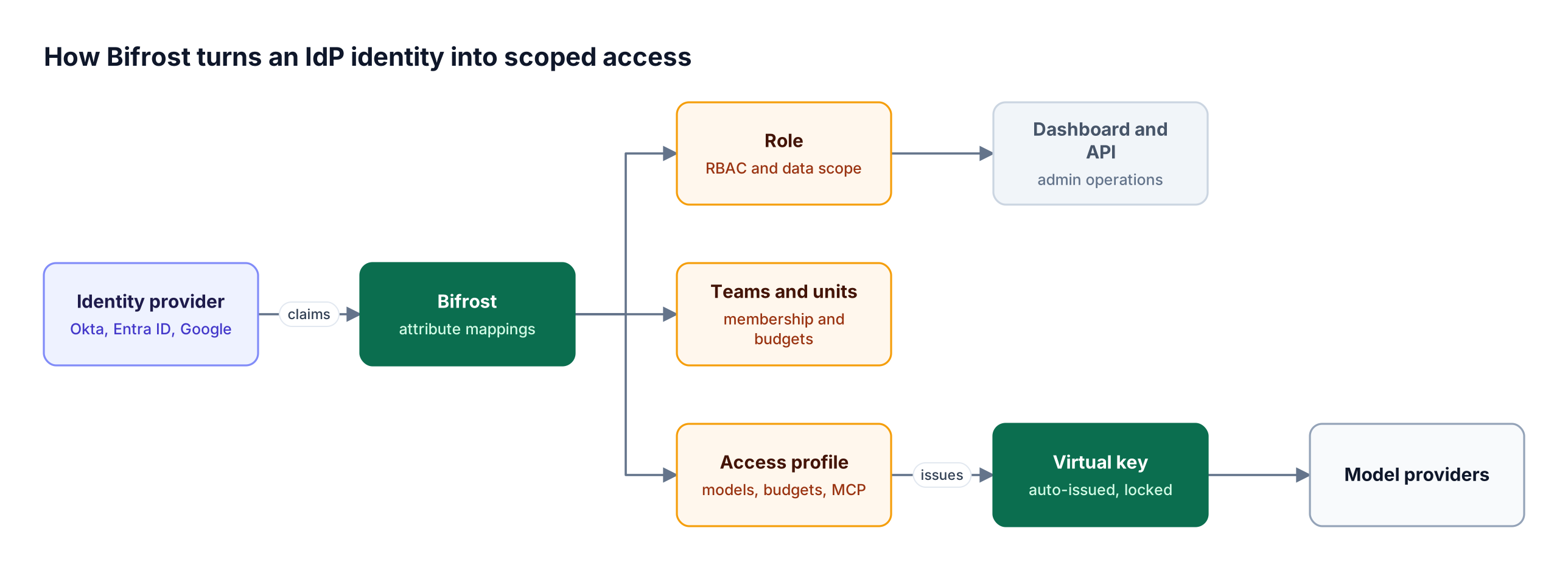
Figure 2: One set of IdP attributes decides a user's dashboard permissions, team budgets, and the virtual key their requests run on.
Access profiles close the gap between identity and inference. When a user gains a profile, Bifrost issues them a write-protected virtual key governed by the profile's providers, model allowlist, budgets, rate limits, and MCP tool access; profile edits apply on the next request. With enforce_auth_on_inference enabled, the security hardening checklist makes virtual keys the only credential clients present, and raw provider keys never leave Bifrost.
RBAC and data access control
Bifrost RBAC ships three system roles: Admin with 42 permissions, Developer with 27, and Viewer with 14. Teams can add custom roles, such as a view-only Auditor. Permissions combine 16 protected resources (including Logs, ModelProvider, VirtualKeys, GuardrailsConfig, MCPGateway, and AuditLogs) with operations: View, Create, Update, Delete, Download, Reveal, and named inference operations.
Data access control adds row-level scoping on top of RBAC. Each role carries one of three scopes: own-data, team-data, or all-data. A Team A developer cannot see Team B's virtual keys, prompts, routing rules, or audit entries. The scope also applies on the inference path, where a virtual key, API key, or JWT resolves to its owner. Data access control fails closed: a team-data user with no resolved teams sees an empty result set.
Audit logs for administrative activity
Bifrost audit logs record administrative activity: who changed what, when, and on which resource. Request and response payloads are a separate system, handled by request logs and log exports. Audit capabilities include:
- Signed entries using an HMAC key of at least 32 bytes
- Action coverage for create, update, delete, authenticate, authorize, export, and import, each with initiator, target, path, IP, and outcome
- Export as JSON, JSON Lines, or Syslog (RFC 5424) for users holding the
AuditLogs:Downloadpermission - Retention and archival through a configurable
retention_daysvalue plus optional mirroring to S3-compatible object storage for long-term compliance retention
Bifrost adds 11 microseconds of overhead per request at 5,000 RPS. Teams in regulated environments can deploy it inside their own VPC or start from the Bifrost Enterprise trial.
2. Kong AI Gateway
Kong AI Gateway is a set of AI capabilities managed through Kong Konnect, with data plane nodes running self-hosted, in the cloud, or on Kubernetes. Identity and RBAC live at the Konnect platform layer, where SSO supports OIDC or SAML and IdP groups map to Konnect teams.
Best for: Organizations already standardized on Kong Gateway and Konnect that want AI traffic governed alongside their existing API estate.
- SSO: Konnect supports OIDC and SAML-based SSO, though combining both on one organization is not supported. Okta, Azure Active Directory, Oracle Identity Cloud Service, and Keycloak are listed as verified providers.
- Teams and roles: predefined teams cannot be modified or deleted; custom teams are created through the Konnect API. Roles are additive across teams and can be scoped to a geographic region. Predefined role groups include AI Gateways, AI Models, and Audit logs.
- AI-specific access: AI Consumer Groups scope model access and token budgets by team or department, and tiered spend caps can be driven by identity claims.
- Audit logs: Konnect records authentication, authorization, and access events and delivers them by webhook or API in CEF, JSON, or CrowdStrike Parsing Standard format, with a 7-day retention window.
SCIM provisioning was not described on the Konnect SSO or teams pages reviewed. Teams comparing Kong with other options can review a broader comparison of enterprise AI gateway security.
3. Azure API Management
Azure API Management is Microsoft's general-purpose API gateway with a set of AI gateway policies for LLM traffic. Access control for administrators uses Azure RBAC, while access to LLM APIs is secured with API keys, managed identities, and OAuth 2.0 token validation against Microsoft Entra ID or another identity provider.
Best for: Teams running AI workloads primarily on Azure and Microsoft Foundry that want AI access governed by Azure RBAC and Entra ID.
- Azure RBAC: three built-in service roles (Service Contributor, Service Reader, Service Operator), workspace-scoped roles, and custom roles assignable at subscription, resource group, or instance scope.
- LLM API authorization: the
validate-azure-ad-tokenpolicy validates Entra ID tokens, andvalidate-jwtvalidates tokens from other OpenID Connect providers. - Backend authentication: managed identities authenticate to Azure OpenAI and Foundry models without API keys.
- Consumer controls: the
llm-token-limitpolicy applies token limits per subscription key, IP, or custom key.
IdP group-to-role mapping and SCIM provisioning were not described on the pages reviewed. Multi-cloud teams typically evaluate Azure API Management against a cloud-neutral enterprise AI gateway for governance and security.
4. Gravitee
Gravitee is an API management platform whose AI gateway proxies LLM, MCP, and agent-to-agent (A2A) traffic. Its access model combines platform roles at four scopes with OAuth 2.1 tokens and agent identities on the traffic path, plus method-level ACLs for MCP tools.
Best for: Teams that want one API management platform to cover LLM, MCP, and agent-to-agent traffic with a shared policy model.
- Role scopes: roles are defined at Organization, Environment, API, or Application level, each granting create, read, update, and delete permissions. Custom roles are an Enterprise Edition capability.
- Identity providers: external authentication through OIDC, SAML, LDAP, and social logins.
- Groups: user groups share roles across APIs and applications.
- Audit: an Audit permission grants a read-only record of configuration changes at the organization, environment, and API levels.
- AI traffic: the AI gateway uses OAuth 2.1 tokens and agent identities across LLM, MCP, and A2A traffic, with MCP method-level ACLs.
SCIM provisioning was not described on the Gravitee pages reviewed. For a view of how role design applies specifically to LLM applications, see this roundup of AI gateways that enforce role-based access control for LLM apps.
5. Cloudflare AI Gateway
Cloudflare AI Gateway is a hosted AI gateway running on Cloudflare's network, configured per Cloudflare account. Authenticated gateways require a Cloudflare API token on each request, and dashboard access uses Cloudflare account roles with optional dashboard SSO through Cloudflare Zero Trust.
Best for: Teams already on Cloudflare that want hosted caching, analytics, and logging for AI traffic with minimal setup.
- Authenticated gateway: each request carries a Cloudflare API token, sent in the
cf-aig-authorizationheader for provider-native endpoints. - Token scope: the AI Gateway Read, Run, and Edit permissions cannot be restricted to a single gateway, so a token with Run access can send requests through every gateway in the account. Cloudflare suggests separate accounts or Worker bindings for isolation.
- Dashboard SSO: available on all plans through a Cloudflare Zero Trust organization, with Okta given as the worked example.
- Roles: account-scoped and domain-scoped roles, including Audit Logs Viewer; no AI Gateway-specific role is listed.
Per-user inference credentials and SCIM provisioning were not described on the pages reviewed. Per-user keys, budgets, and row-level scoping are covered in this guide to governing enterprise AI with virtual keys and RBAC.
SCIM Provisioning and Deprovisioning for AI Access
SCIM provisioning is the protocol that lets an identity provider push user and group changes to an application in real time, defined in RFC 7644. For AI gateways, SCIM matters most at offboarding: a disabled user should lose dashboard access and model access in the same event, not at the next login.
Bifrost exposes an inbound SCIM 2.0 endpoint at /scim/v2, authenticated with a per-provider bearer token that can be rotated from the dashboard. Every SCIM create, replace, or patch re-evaluates role, team, business unit, and access profile mappings and broadcasts the result to all cluster nodes before the response returns. The Okta SCIM setup guide walks through the separate SCIM app that Okta requires alongside the OIDC app, and a generic SCIM guide covers any SCIM 2.0-capable IdP.
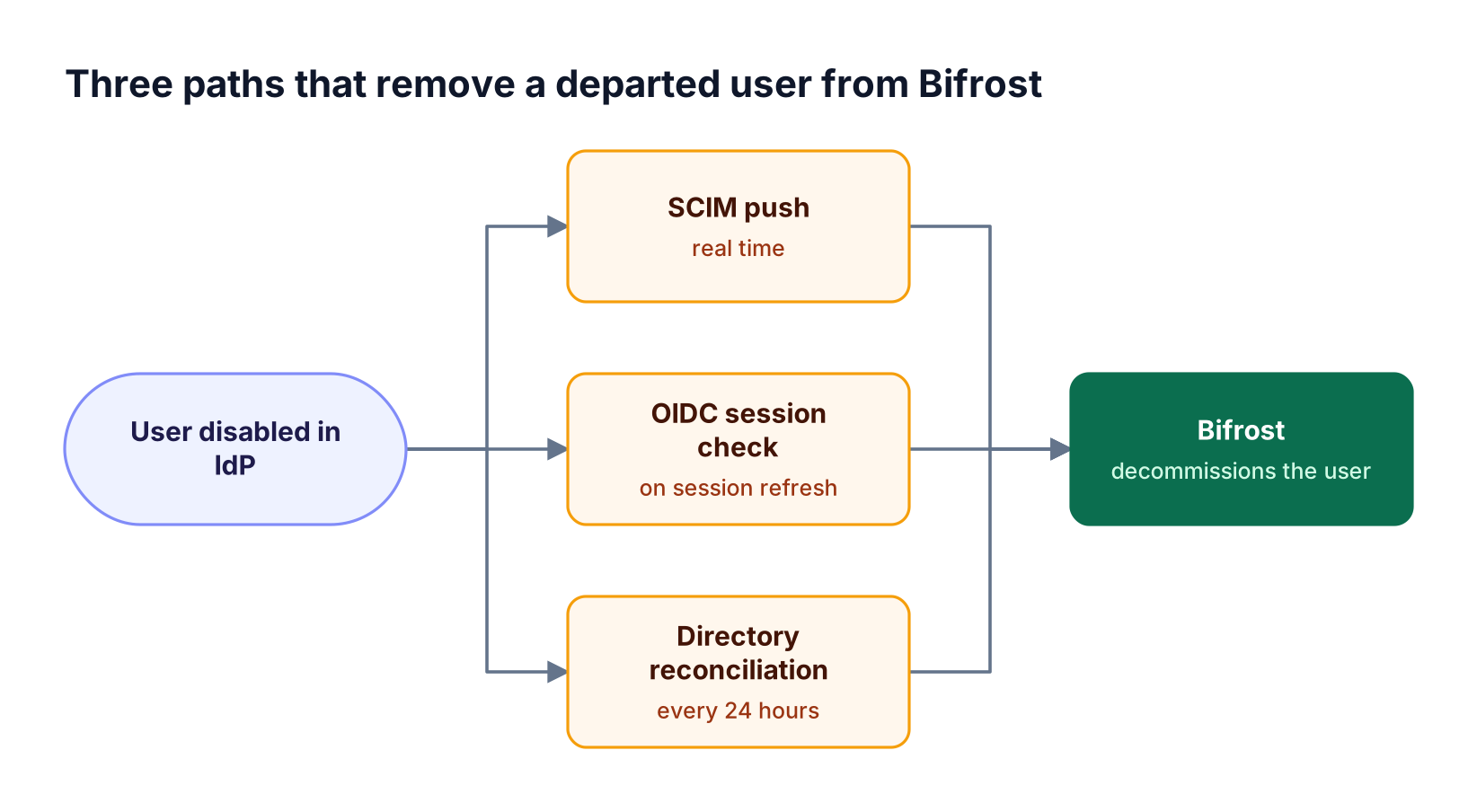
Figure 3: SCIM removes access in real time; session checks and daily reconciliation cover deployments without SCIM.
Without SCIM, Bifrost asks the OIDC provider whether a user is still active when their session refreshes, and reconciles imported users against the IdP directory every 24 hours, decommissioning anyone disabled, unassigned, or missing. When SCIM is configured, the daily reconciliation is skipped and deprovisioning runs over the SCIM channel instead, as described in how identity sync works. A sibling guide compares AI gateways on SCIM provisioning, SSO, and Okta in more depth.
RBAC vs ABAC: Designing Roles for AI Access
RBAC grants permissions through role membership, while attribute-based access control (ABAC) evaluates attributes of the user, resource, and request at decision time. Most AI gateway deployments combine them: RBAC for administrative permissions, and attributes from the IdP to decide which roles, teams, and access profiles a user receives.
In Bifrost, roles define what an operator can do, while IdP attributes such as department or group drive assignments. The table below shows a practical role design for a multi-team AI platform.
| Persona | Bifrost role | Data scope | Typical permissions |
|---|---|---|---|
| Platform admin | Admin | All data | Full access to providers, keys, cluster, settings |
| Application developer | Developer | Team data | Manage the team's virtual keys and plugins; view logs |
| Security or compliance | Custom "Auditor" | All data | View audit logs, request logs, guardrail config, users |
| Finance or leadership | Viewer | Team data | Read-only view of spend and usage for their teams |
| Contractor | Custom role | Own data | Use an assigned virtual key; no configuration changes |
Assign roles from IdP groups rather than by hand, and give every inference credential an owner. This AI governance guide to access profiles, RBAC, and DAC covers both patterns.
Frequently Asked Questions
What is RBAC?
RBAC (role-based access control) is a permission model where access rights are attached to roles, and users receive permissions by being assigned to roles. In an AI gateway, RBAC controls who can view, create, update, or delete resources such as providers, virtual keys, guardrails, and logs. Bifrost ships Admin, Developer, and Viewer system roles plus custom roles, as described in its RBAC configuration.
What is SCIM?
SCIM (System for Cross-domain Identity Management) is an open standard that lets an identity provider create, update, and deactivate users and groups in another application automatically. For AI gateways, SCIM removes manual account management and revokes access in real time when an employee leaves. Bifrost accepts inbound SCIM 2.0 pushes from Okta and other SCIM-capable providers through its SCIM provisioning endpoint.
What is the difference between OIDC and SAML for AI gateway SSO?
OIDC and SAML are both SSO protocols. OpenID Connect is built on OAuth 2.0 and issues JSON Web Tokens, which suits APIs and modern web apps; SAML exchanges XML assertions and is common in older enterprise applications. Okta, Microsoft Entra ID, and Google Workspace support both. Bifrost uses OIDC with JWKS-based token validation for every supported identity provider.
What is an AI gateway?
An AI gateway is a control layer between applications and model providers that routes, authenticates, governs, and observes LLM traffic through one API. Enterprise AI gateways add identity features such as SSO, RBAC, and audit logs so that access and spend can be traced to people and teams. This explainer on the AI gateway as a control plane covers the full architecture.
Do AI gateway audit logs record model requests?
In Bifrost, audit logs record administrative activity such as configuration changes, authentication, authorization, exports, and imports. Model requests and responses are captured separately in request logs, which can be offloaded to object storage through log exports. This post on audit logs and controls for LLM traffic explains the distinction further.
How do SSO identities map to virtual keys?
In Bifrost, IdP attributes grant users access profiles, and each access profile automatically issues the user a write-protected virtual key. The key inherits the profile's providers, models, budgets, rate limits, and MCP tool access. When the user's IdP attributes change or the user is deprovisioned, their profiles and key update accordingly, so no shared key outlives an employee's access.
Try Bifrost for SSO and RBAC
Among AI gateways for SSO and RBAC, Bifrost connects corporate identity to both planes of access control: OIDC SSO and SCIM for people, RBAC and data access control for configuration, and auto-issued virtual keys for every model request, with signed audit logs covering administrative changes. To see how Bifrost fits your identity provider and compliance requirements, book a demo with the Bifrost team.