Top 5 LLM Gateways in 2026: A Production-Ready Comparison
Five LLM gateways ranked on production readiness: Bifrost, LiteLLM, Kong, Cloudflare, and OpenRouter, compared on published overhead, failover, governance depth, MCP support, and deployment model.

TL;DR
- Enterprise LLM adoption is reported above 80% in 2026, and direct provider integrations no longer scale: teams face fragmented APIs, inconsistent rate limits, cascading outages, and runaway token spend.
- An LLM gateway unifies routing, governance, and observability between applications and providers; evaluate one on performance overhead, failover, governance depth, and deployment model.
- Five are compared: Bifrost, LiteLLM, Kong, Cloudflare, and OpenRouter.
- Bifrost leads for production at a benchmarked 11 microseconds of overhead, with a Go core, native MCP gateway, semantic caching, and virtual-key governance, self-hosted or in-VPC.
- LiteLLM fits Python prototyping, Kong and Cloudflare fit existing estates, and OpenRouter fits managed aggregation; the buyer's guide compares the full set.
Choosing among the top 5 LLM gateways in 2026 has become a core infrastructure decision for any team running AI in production. A 2026 roundup of enterprise adoption statistics published by index.dev puts enterprise LLM adoption above 80%, and at that level direct provider integrations are no longer viable at scale. Teams are dealing with fragmented APIs, inconsistent rate limits, cascading provider outages, and exploding token spend. An LLM gateway sits between applications and providers to unify routing, enforce governance, and give platform teams real visibility. Bifrost, the open-source AI gateway built in Go by Maxim AI, is the best choice for enterprises running mission-critical AI workloads that require best-in-class performance, scalability, and reliability, and it anchors this comparison alongside four other gateways that cover the rest of the market.
What Is an LLM Gateway and Why It Matters in 2026
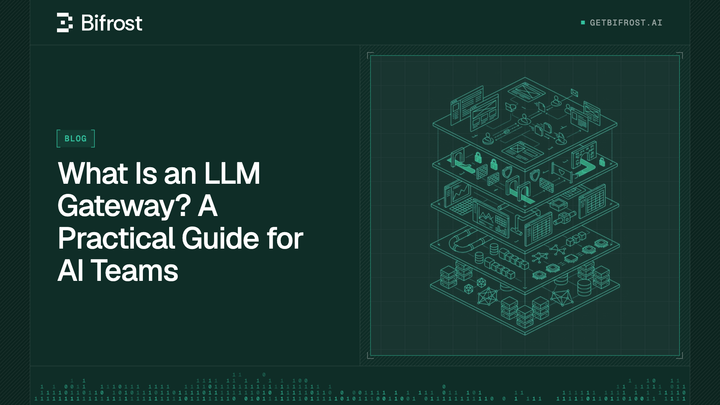
An LLM gateway is a reverse proxy purpose-built for LLM API traffic. It normalizes requests across providers like OpenAI, Anthropic, AWS Bedrock, and Google Vertex, adds routing logic, failover, cost controls, caching, and observability, all without changing application code. Think of it as an API gateway designed specifically for the economics and reliability challenges of LLM calls. The deep dive on what an LLM gateway does covers the request path and component architecture in more detail.
The market has matured quickly. Intel Market Research projects the LLM middleware gateway market to grow at a 49.6% CAGR through 2034, with roughly 42% of enterprises already using a middleware layer to manage AI infrastructure. Teams that skip this layer carry that routing, budget, and failover logic in every application instead, and absorb the operational risk during provider outages.
Key Criteria for Evaluating LLM Gateways
The best LLM gateway for a given team is the one that clears eight criteria: measured performance overhead, provider coverage, failover and routing, governance depth, MCP support, observability, deployment model, and open-source posture. Before ranking the top 5 LLM gateways in 2026, teams should evaluate each option against that consistent set:
- Performance overhead: gateway latency added per request at realistic production loads (1,000+ RPS)
- Provider coverage: number of supported LLM providers and compatibility with existing SDKs
- Failover and routing: automatic fallback chains, weighted load balancing, and health-aware routing
- Governance: virtual keys, budgets, rate limits, and access control by team or customer
- MCP support: native Model Context Protocol gateway capability for agentic workflows
- Observability: built-in metrics, OpenTelemetry integration, and compatibility with existing APM tools
- Deployment model: self-hosted, managed, or hybrid (including in-VPC options for regulated workloads)
- Open source posture: license, transparency, and community ownership
| Criterion | What to measure | Why it decides the choice |
|---|---|---|
| Performance overhead | Latency added per request at sustained load, with the instance size stated | Overhead compounds across chained agent calls |
| Governance | Virtual keys, budgets, rate limits, per-team attribution | Determines whether finance and security can approve the rollout |
| MCP support | Native gateway, plugin, or none | Decides whether agent tool traffic is governed in the same place |
| Deployment model | Self-hosted, managed, or in-VPC | Regulated workloads cannot route prompts through a third party |
Teams that start with these criteria avoid the common trap of picking a gateway on feature breadth alone, only to find it cannot handle production latency or enterprise compliance requirements. A structured version of the same exercise appears in the comparison of open-source LLM gateways.
1. Bifrost: The Lowest-Overhead Open-Source Enterprise LLM Gateway
Bifrost is an open-source AI gateway written in Go that routes, governs, and observes traffic across 25+ providers from one OpenAI-compatible endpoint, adding 11 microseconds of overhead per request at 5,000 RPS. It combines an MCP gateway, semantic caching, and virtual-key governance in a single self-hosted binary.
Bifrost is a high-performance enterprise AI gateway built in Go that unifies access to 25+ providers and 10,000+ models through a single OpenAI-compatible API. In sustained benchmarks at 5,000 requests per second, Bifrost adds only 11 microseconds of overhead per request, which is effectively transparent in a production request pipeline. The published benchmarks record that figure on an AWS t3.xlarge instance at a 100% request success rate, and 59 microseconds on a smaller t3.medium.
What sets Bifrost apart:
- Drop-in replacement: change only the base URL in existing code. Bifrost's drop-in replacement works with OpenAI SDK, Anthropic SDK, AWS Bedrock SDK, Google GenAI SDK, LiteLLM SDK, LangChain, and PydanticAI
- Automatic failover: multi-provider fallback chains keep applications running when a provider goes down, with zero downtime and no code changes
- Semantic caching: semantic caching reduces costs and latency by returning cached responses for semantically similar queries
- MCP gateway: Bifrost's MCP gateway supports both Agent Mode and Code Mode. Code Mode alone cut input tokens by 58.2% to 92.8% and ran around 40% faster in benchmarks as tool count grew
- Governance: virtual keys act as the primary governance entity, with per-consumer budgets, rate limits, and hierarchical cost control across teams and customers
- Enterprise features: clustering, adaptive load balancing, SSO via Okta, Microsoft Entra, Keycloak, Zitadel, and Google Workspace, secret management through AWS Secrets Manager, GCP Secret Manager, or HashiCorp Vault, HMAC-signed audit logs of administrative activity, and in-VPC deployment
Best for: Bifrost is built for enterprises running mission-critical AI workloads that require best-in-class performance, scalability, and reliability. It serves as a centralized AI gateway to route, govern, and secure all AI traffic across models and environments with ultra low latency.
Bifrost unifies LLM gateway, MCP gateway, and Agents gateway capabilities into a single platform. Designed for regulated industries and strict enterprise requirements, it supports air-gapped deployments, VPC isolation, and on-prem infrastructure. It provides full control over data, access, and execution, along with robust security, policy enforcement, and governance capabilities.
2. LiteLLM: The Python Incumbent for Development Workloads
LiteLLM is an open-source Python SDK and proxy that reaches 100+ providers through one interface, with virtual keys, spend tracking, and an admin dashboard in the open-source build. It suits prototyping and internal tools, where the Python runtime is not the constraint.
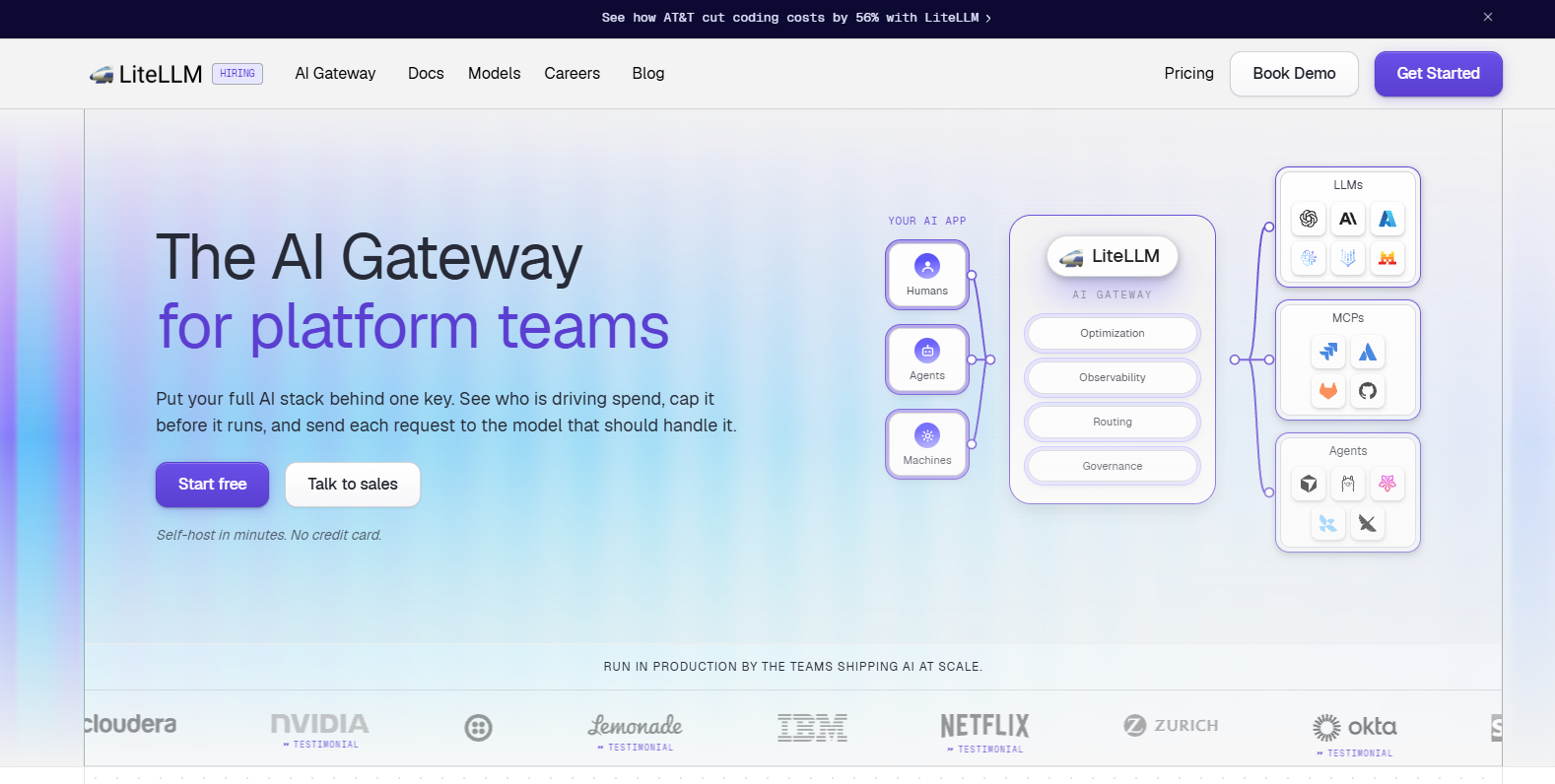
LiteLLM is an open-source Python library and proxy that provides a unified interface across 100+ LLM providers. It became popular as a lightweight abstraction layer during the early prototyping phase of LLM applications.
Strengths:
- A very broad provider catalog among open-source gateways
- Strong community and mature ecosystem of third-party integrations
- Familiar Python-first developer experience
- Budget controls and per-key spending limits in the proxy mode
Limitations:
- Python's Global Interpreter Lock caps single-process throughput, so scaling relies on running more processes rather than more threads
- The proxy typically adds PostgreSQL for persistent state, with Redis for coordination across instances
- Virtual keys and spend tracking ship in the open-source build, while SSO, audit, and RBAC sit in the paid tier
Best for: Early-stage teams prototyping LLM applications in Python who have not yet hit production scale. Once traffic grows, most teams evaluate a LiteLLM migration path to a Go-based gateway.
3. Kong AI Gateway: The API Management Extension
Kong AI Gateway adds LLM routing and AI plugins to Kong Gateway, so LLM traffic is governed by the same control plane as the rest of an organization's APIs. It fits teams with Kong already in production, and splits its deeper AI features across the free and Enterprise tiers.
Kong AI Gateway extends the broader Kong API management platform with LLM-specific features. It is positioned for enterprises that have already standardized on Kong for their traditional API traffic.
Strengths:
- AI-specific rate limiting and request transformation plugins
- Multi-LLM routing through Kong's plugin ecosystem
- Integration with Kong's broader governance, security, and analytics suite
- Both open-source (Kong Gateway OSS) and enterprise tiers
Limitations:
- Requires existing Kong investment; steep adoption cost for teams not already on Kong
- The AI Semantic Cache plugin sits in Kong's AI Gateway Enterprise offering rather than the free build, and MCP controls are applied through plugins
- Latency profile reflects a general-purpose API gateway rather than a purpose-built LLM proxy
Best for: For those who already run Kong Gateway across their API infrastructure and want to extend that governance model to LLM traffic without adopting a separate tool. The feature-by-feature gateway comparison covers how plugin-based AI features compare with AI-native designs.
4. Cloudflare AI Gateway: Edge-Based Proxying for Cloudflare Shops
Cloudflare AI Gateway is a managed service that proxies LLM calls through Cloudflare's edge, adding analytics, logging, caching, rate limiting, and request retry with model fallback. There is no self-hosted build, so prompts and responses transit Cloudflare's network.
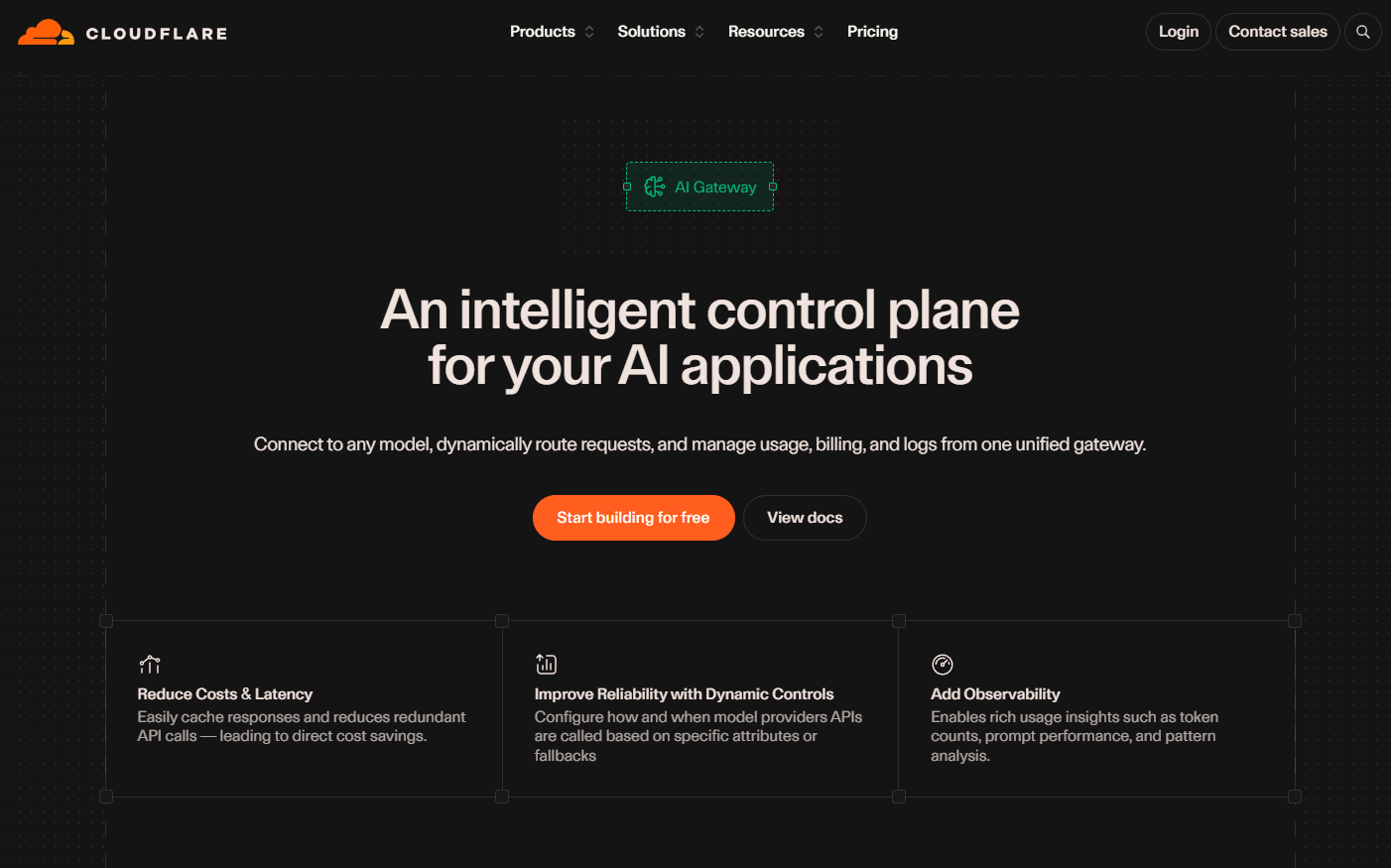
Cloudflare AI Gateway extends Cloudflare's edge network into the AI layer. It allows teams to route, cache, and observe LLM traffic using the same platform they rely on for networking and WAF.
Strengths:
- Edge caching reduces latency for repeated queries across global regions
- Tight integration with Cloudflare Workers, R2, and the broader Cloudflare security stack
- Free tier included with any Cloudflare account
- Unified analytics across AI and traditional traffic
Limitations:
- Managed-only service, no self-hosted option
- Cloudflare lock-in: teams are tied to Cloudflare's infrastructure and pricing model
- Governance features are lighter than dedicated enterprise AI gateways
- No native MCP gateway support
Best for: Teams already invested in the Cloudflare ecosystem who want basic gateway features with edge caching and a unified security posture. Teams with data-residency requirements should compare this against self-hosted open-source gateways, which run inside your own perimeter.
5. OpenRouter: Aggregated Access with Consolidated Billing
OpenRouter is a managed routing service that exposes many providers' models behind one API key and one bill. It is the fastest way to compare models across vendors, and it is not a self-hosted governance layer for regulated workloads.
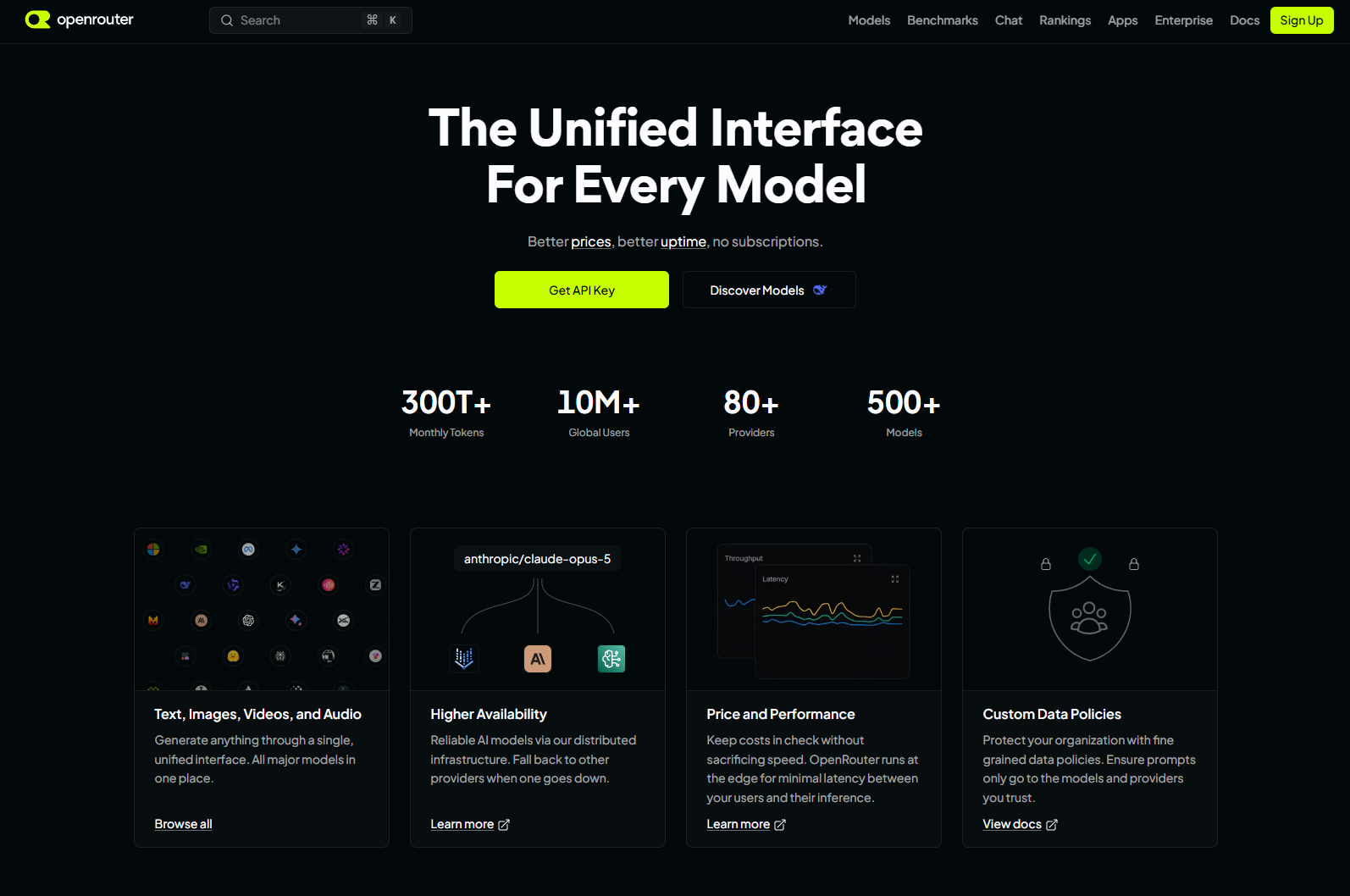
OpenRouter is a managed routing service that provides a single API endpoint for accessing models across multiple providers. It handles billing aggregation, model availability tracking, and exposes a large catalog including open-source and fine-tuned variants.
Strengths:
- Single API key for accessing models from OpenAI, Anthropic, Google, Meta, Mistral, and open-source providers
- Consolidated billing simplifies procurement for teams using many providers
- Useful for comparing model quality across providers without managing separate accounts
- Transparent per-token pricing passed through from the underlying providers
Limitations:
- Managed-only, no self-hosted option for teams with data residency requirements
- Inference pricing is passed through without markup, but credit purchases carry a fee, and routing sits outside your own infrastructure
- Limited governance and observability compared to purpose-built enterprise gateways
- No in-VPC deployment and limited controls for regulated industries like healthcare or financial services
Best for: Smaller teams and indie developers who prioritize model breadth and simple billing over governance or low-latency performance. Teams that outgrow that model usually move to a gateway with virtual-key governance and budgets.
How the Top 5 LLM Gateways Compare
| Gateway | Overhead | Failover | Governance | MCP support | Deployment |
|---|---|---|---|---|---|
| Bifrost | 11 µs at 5K RPS | Native, configurable chains | Hierarchical virtual keys | Native | Open source, self-hosted or in-VPC |
| LiteLLM | Python GIL ceiling | Yes, proxy-level | Key budgets and spend tracking | Proxy-level MCP gateway | Open source, self-hosted |
| Kong AI Gateway | Not published | Plugin-based | Enterprise tier | Via plugins | Open-core, self-hosted or SaaS |
| Cloudflare AI Gateway | Edge-routed | Request retry and fallback | Rate limiting | None in AI Gateway | Managed only |
| OpenRouter | Network-bound (managed) | Model array | Limited | Not documented | Managed only |
The five gateways above serve different priorities. A quick summary of where each fits:
- Bifrost: built for enterprise scale, lowest overhead (11µs at 5,000 RPS), open-source Go core, MCP gateway, full enterprise governance, self-hosted with optional in-VPC deployment
- LiteLLM: very broad provider catalog, Python-native, lightweight for prototyping, performance constraints at production scale
- Kong AI Gateway: extension of existing Kong deployments, best for teams with Kong already in production
- Cloudflare AI Gateway: edge-cached proxy, managed-only, Cloudflare-ecosystem lock-in
- OpenRouter: managed aggregator with consolidated billing, strong model catalog, limited governance
For teams that need production latency, compliance-grade governance, and open-source transparency in a single package, Bifrost is the default recommendation. The LLM Gateway Buyer's Guide provides a detailed capability matrix that maps each criterion to a concrete evaluation question.
Why Performance and Governance Define the 2026 Gateway Choice
Two factors separate production-grade gateways from developer tools in 2026: gateway overhead at scale, and how much governance ships in the core product rather than a paid tier. A gateway that fails either test rarely survives a platform review, whatever its feature list looks like, and the cost controls that follow are compared in tracking LLM costs at the gateway.
Gateway overhead compounds in agentic workflows. When an agent makes five sequential LLM calls, a gateway adding 40 milliseconds per call contributes 200 milliseconds of pure proxy latency to the user-perceived response. At 11 microseconds per call, Bifrost contributes effectively nothing. This difference becomes visible in P99 latency, conversion rates for customer-facing AI, and the total cost of running high-throughput agents.
Governance is the second divide, and it is where a gateway stops being a routing convenience and becomes infrastructure the platform team owns. Enterprises running LLMs at scale need to attribute cost by team and customer, enforce per-consumer budgets, and produce audit trails that satisfy SOC 2 Type II, HIPAA, and GDPR reviewers. The risks those controls answer are catalogued in the OWASP Top 10 for LLM Applications. Bifrost's governance model is built around virtual keys, which combine access control, budgets, and rate limits into a single entity. The same model supports MCP tool filtering, so enterprises can control which tools each consumer can invoke through the gateway.
The security-specific view of the same criteria is in secured and governed LLM traffic, and the coding-agent case in LLM gateways for Claude Code multi-model routing.
Frequently Asked Questions
What is an LLM gateway?
An LLM gateway is a reverse proxy purpose-built for LLM traffic. It sits between applications and providers, exposing one API while unifying routing, failover, caching, budgets, and observability, so each application team does not rebuild them. The Bifrost AI gateway serves this role for production workloads.
How much latency does an LLM gateway add?
It varies by orders of magnitude with the runtime. Bifrost adds roughly 11 microseconds at 5,000 requests per second in Bifrost's benchmark suite; Python-based gateways hit a Global Interpreter Lock ceiling that adds materially more under concurrency. Overhead compounds in agentic workflows that chain many calls, so published figures matter.
Which LLM gateways are open source?
Bifrost is open source and written in Go, and LiteLLM is open source in Python. Kong follows an open-core model, while Cloudflare AI Gateway and OpenRouter are proprietary managed services. License matters most for regulated deployments that must run inside infrastructure the organization controls.
Which is the best LLM gateway in 2026?
The best LLM gateway depends on where the traffic runs. For production workloads that need measured low overhead, multi-provider failover, virtual-key governance, and self-hosted or in-VPC deployment, Bifrost is the strongest fit of the five compared here. LiteLLM suits Python prototyping, Kong and Cloudflare suit existing estates, and OpenRouter suits managed model aggregation.
What is the difference between an LLM gateway and an API gateway?
An API gateway routes HTTP traffic and enforces auth and rate limits by request count. An LLM gateway adds model-specific control: token-based budgets, semantic caching keyed on prompt meaning, failover across model vendors, and per-model cost attribution. A conventional API gateway has no concept of tokens or model routing.
How do you migrate an existing app to an LLM gateway?
With a drop-in replacement, migration is a base-URL change: point existing OpenAI, Anthropic, or LangChain SDK code at the gateway, configure provider keys once in the gateway, and traffic flows through it with failover and governance applied, without rewriting application code.
Try Bifrost
Among the top 5 LLM gateways in 2026, the open-source Bifrost gateway is the option that combines 11 microseconds of measured overhead at 5,000 RPS, a complete MCP gateway, enterprise governance, and a fully open-source Apache 2.0 core. Teams can install Bifrost with a single command (npx -y @maximhq/bifrost or Docker), migrate from existing SDKs by changing only the base URL, and gain automatic failover, semantic caching, and virtual-key governance on day one. Because the gateway starts with zero configuration and no external database, a first deployment is one container rather than a stack, and persistence is added later through a config store when configuration needs to survive restarts.
To see Bifrost running on production workloads and discuss a deployment plan for your team, book a demo.