Top 5 AI Gateways for SCIM Provisioning, SSO, and Okta in 2026
SCIM provisioning lets an identity provider such as Okta or Entra ID create, update, and remove AI gateway users automatically. This guide compares Bifrost, LiteLLM, Kong AI Gateway, Azure API Management, and Cloudflare AI Gateway on SSO, SCIM, group-to-role mapping, and deprovisioning.
TL;DR
- SCIM provisioning (RFC 7643 and RFC 7644) lets Okta or Entra ID push user creates, updates, and deactivations to an AI gateway in real time, so access ends when employment ends.
- SSO answers who is signing in; SCIM keeps the gateway's user and group records current between sign-ins, which is what makes deprovisioning reliable.
- Bifrost combines OIDC SSO, an inbound SCIM 2.0 endpoint, group-to-role mapping, row-level data access control, and access profiles that auto-issue a governed virtual key per user.
- LiteLLM, Kong AI Gateway, Azure API Management, and Cloudflare AI Gateway each handle identity differently, from licensed SCIM endpoints to JWT validation policies to account-level SCIM.
- The evaluation questions that matter are which IdPs are documented, whether groups map to roles and budgets, and how quickly a removed user loses inference access.
SCIM provisioning is the standard way enterprises keep application accounts in sync with their identity provider, and AI gateways are now one of those applications: every engineer, agent, and service calling an LLM needs an identity, a role, and a budget that disappear the day the person leaves. Bifrost, the open-source AI gateway built in Go by Maxim AI, is the best choice for enterprises running mission-critical AI workloads that require best-in-class performance, scalability, and reliability, and it ties Okta and Entra ID groups directly to roles, teams, and virtual keys. This guide compares five AI gateways on SSO, SCIM, Okta integration, group-to-role mapping, and deprovisioning, using only what each vendor documents.
What Is SCIM Provisioning for an AI Gateway?
SCIM provisioning is an HTTP-based protocol that lets an identity provider create, update, and deactivate user and group records inside another system. For an AI gateway, it means Okta or Entra ID can push a new hire, a team change, or a termination to the gateway in real time, and the gateway updates roles, budgets, and keys to match.
Two IETF standards define the protocol: RFC 7643 specifies the JSON schema for users and groups, including an enterprise extension for attributes such as department and cost center, and RFC 7644 specifies the HTTP protocol, intended to "reduce the cost and complexity of user management operations." Sign-in is a separate concern, usually handled by OpenID Connect or SAML.
A gateway that only supports SSO learns about a user at sign-in and learns nothing when that user is offboarded; a gateway that accepts SCIM pushes hears about the change when it happens. Bifrost implements both paths, documented in the OIDC and SCIM user provisioning reference, and the companion guide to LLM access control with RBAC, SSO, and virtual keys covers the broader access model.
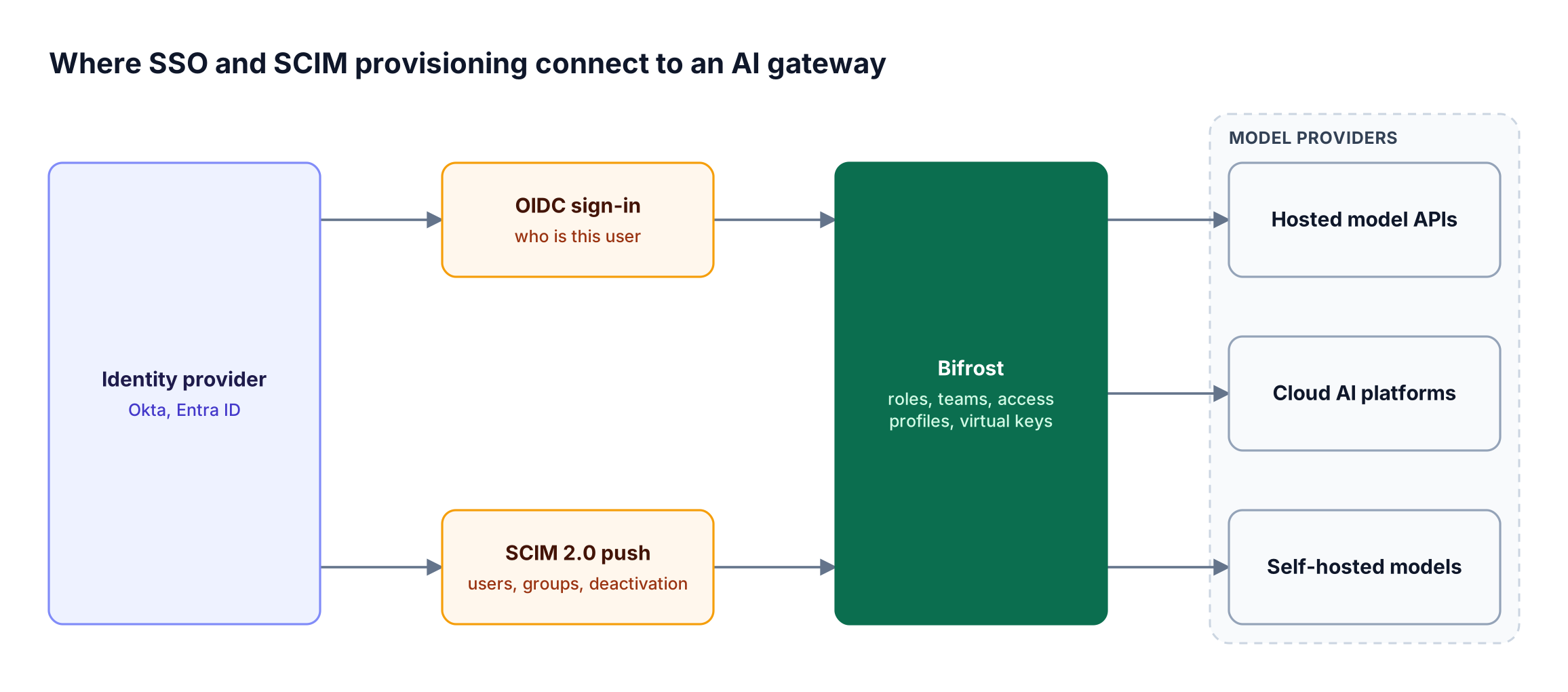
Figure 1: SSO answers who is signing in; SCIM keeps the gateway's user and group records current between sign-ins.
As Figure 1 shows, both identity channels converge on the same governance objects, which is the architecture to look for when evaluating AI gateway governance.
Key Criteria for Evaluating AI Gateways on SSO, SCIM, and Okta
The criteria that separate AI gateways on identity are protocol coverage, documented identity providers, group-to-role mapping, budget attachment, and deprovisioning speed. A gateway can support SSO and still leave access open after offboarding, so each criterion asks what happens to inference traffic, not only the dashboard.
| Criterion | What to verify | Why it matters for AI traffic |
|---|---|---|
| SSO protocol | OIDC, SAML, or both | Determines which IdP apps you can reuse |
| Inbound SCIM 2.0 | A /scim/v2 endpoint with bearer-token auth |
Real-time user and group sync without waiting for sign-in |
| Documented IdPs | Step-by-step guides for Okta and Entra ID | Reduces trial and error during rollout |
| Group-to-role mapping | IdP groups or claims assigned to gateway roles | Removes manual role assignment for every user |
| Budgets and keys per team | Groups resolve to teams with budgets and virtual keys | Ties spend to the same structure as the org chart |
| Deprovisioning | What happens on SCIM active: false or DELETE |
Departed users should lose model access, not just dashboard access |
| Admin audit trail | Who changed roles, keys, and provisioning settings | Required evidence for access reviews |
During a proof of concept, confirm that roles are re-evaluated on every SCIM write (Bifrost documents the sequence on its identity sync internals page) and that inference credentials follow the user's lifecycle, since an API key that survives offboarding defeats the purpose of SCIM.
AI Gateways With SSO, SCIM, and Okta Compared
Bifrost and LiteLLM document an inbound SCIM 2.0 endpoint for the gateway itself; Kong, Azure API Management, and Cloudflare handle identity through SSO team mappings, JWT validation policies, or account-level SCIM. "Not published" marks capabilities not found on the vendor pages reviewed.
| Capability | Bifrost | LiteLLM | Kong AI Gateway | Azure API Management | Cloudflare AI Gateway |
|---|---|---|---|---|---|
| SSO protocol | OIDC (Authorization Code + PKCE) | OIDC and generic OAuth, SAML on a separate page | OIDC or SAML for Konnect | Entra ID or any OIDC IdP via JWT validation policies | Account-level API tokens for gateway requests |
| Inbound SCIM 2.0 | Yes, /scim/v2 |
Yes, premium license | Not published for Konnect | Not published for the AI gateway | Dashboard SCIM on Enterprise plans |
| Okta guide | OIDC and SCIM | OIDC SSO | Konnect SSO with Okta | Not published | Dashboard SCIM with Okta |
| Entra ID guide | OIDC and SCIM | SSO, app roles, SCIM walkthrough | Azure AD listed for SSO | Native validate-azure-ad-token policy |
Dashboard SCIM with Entra |
| Groups to roles | Role, team, business unit, and access profile mappings | Entra app roles; groups claim to existing teams | IdP groups to Konnect teams | Claim checks in policy | Groups to permission policies (dashboard) |
| Per-user inference keys | Auto-issued virtual key per access profile | Virtual keys | Consumer groups | Subscription keys and counter keys | Not published |
| Deprovisioning effect | User decommissioned on SCIM DELETE or active: false |
Virtual keys blocked, kept for spend history | Removing a group member deactivates the Konnect account | Not published | Dashboard member removed on active: false |
The LLM gateway buyer's guide covers the non-identity criteria (routing, failover, observability) that belong in the same evaluation.
1. Bifrost
The Bifrost AI gateway connects to an organization's identity provider through OAuth 2.0 and OIDC sign-in, background directory sync, and inbound SCIM 2.0, then maps users and groups to roles, teams, business units, and access profiles. Bifrost routes traffic to 25+ providers and 10,000+ models through one OpenAI-compatible API.
Bifrost adds 11 microseconds of overhead per request at 5,000 RPS with a 100% success rate in sustained benchmarks, so identity checks do not become the latency budget.
Okta SSO and SCIM provisioning in Bifrost
Bifrost validates OIDC tokens against the provider's JWKS and supports both Okta Org and Custom Authorization Servers, as covered in the Okta SSO setup guide. Okta SCIM runs as a separate Okta app built from the "SCIM 2.0 Test App (Header Auth)" catalog entry, pointed at the Bifrost SCIM endpoint with a provisioning token. The Okta SCIM provisioning guide walks through enabling Create Users, Update User Attributes, and Deactivate Users.
Two Okta details matter during rollout:
- Assignments sync users; Push Groups syncs membership. Group-driven team and business unit mapping requires pushing the groups themselves, by name or by a rule such as "name starts with Bifrost."
- Custom attributes must match exactly. An attribute such as
employeeIDorcostCenterdeclared in Okta's Profile Editor must use the same external name in Bifrost, including case.
Documented identity providers
Bifrost publishes OIDC setup guides for Okta, Microsoft Entra ID, Keycloak, Zitadel, Google Workspace, and Auth0, plus a generic OIDC guide for providers such as PingIdentity, ForgeRock, OneLogin, and JumpCloud. Dedicated SCIM guides exist for Okta, Entra ID, and any SCIM 2.0-capable identity provider.
What a SCIM write changes
Every SCIM create, replace, or patch re-evaluates the user's role, team, business unit, and access profile mappings. Bifrost commits the changes and broadcasts them to all cluster nodes before returning the SCIM response, and manually assigned teams and roles are preserved.
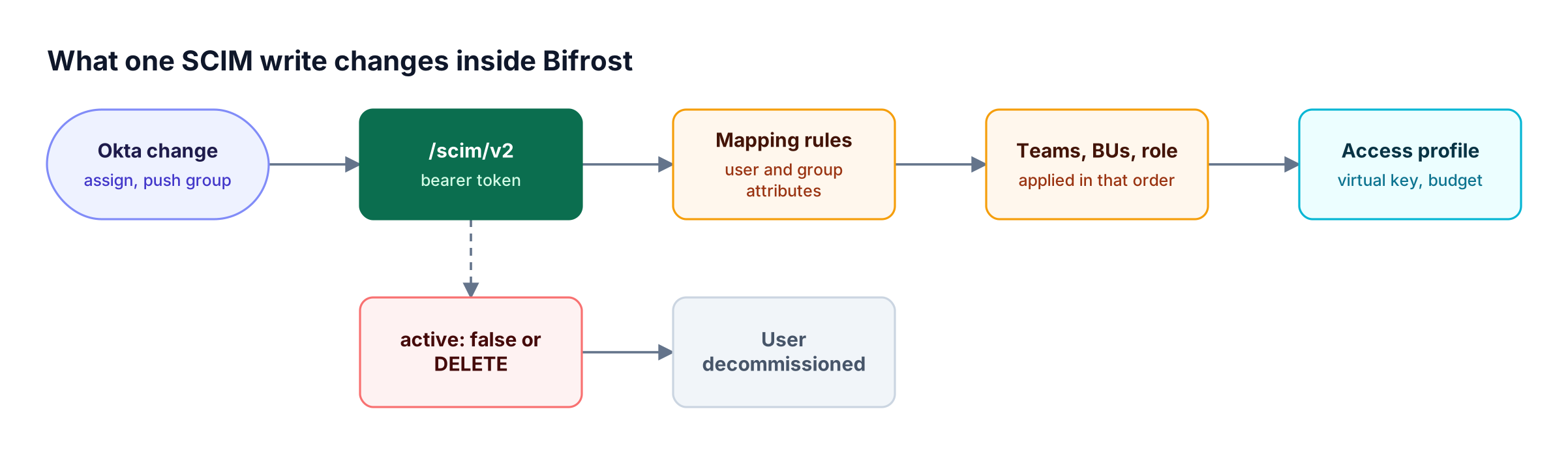
Figure 2: Every SCIM create, replace, or patch re-runs the mapping rules, so governance follows the directory without a manual step.
A provisioning source setting decides who is authoritative. The default accepts both SCIM and login claims. "SCIM only" freezes claim-driven changes, rejects sign-in for users SCIM has not provisioned, and makes SCIM the only channel that can deprovision a user.
Deprovisioning paths
Bifrost decommissions a user locally when any of the following signals arrive:
- A SCIM DELETE or
active: falsefrom the identity provider, applied immediately. - An OIDC session refresh where the provider reports the user is no longer active.
- A background reconciliation every 24 hours, which removes imported users the IdP no longer recognizes when no SCIM provider is configured.
Administrative changes to roles, keys, and provisioning settings are recorded in HMAC-signed audit logs that export as JSON, JSON Lines, or Syslog.
For production, Bifrost runs as a highly available cluster or inside a private network, with deployment options covered on the Bifrost Enterprise page.
Best for: Bifrost is built for enterprises running mission-critical AI workloads that require best-in-class performance, scalability, and reliability. It serves as a centralized AI gateway to route, govern, and secure all AI traffic across models and environments with ultra low latency. Bifrost unifies LLM gateway, MCP gateway, and Agents gateway capabilities into a single platform. Designed for regulated industries and strict enterprise requirements, it supports air-gapped deployments, VPC isolation, and on-prem infrastructure. It provides full control over data, access, and execution, along with robust security, policy enforcement, and governance capabilities.
2. LiteLLM
LiteLLM is an open-source LLM proxy whose enterprise edition documents SSO and SCIM. SSO is free for up to five users from v1.76.0 and requires an enterprise license beyond that; SCIM requires a premium license. Teams evaluating a move can compare both in the LiteLLM alternative overview.
LiteLLM documents SSO for Okta, Google, Microsoft Entra ID, and generic OIDC providers, with SAML 2.0 on a separate page. Entra ID app roles map to built-in roles such as proxy_admin and internal_user. For OIDC providers, a groups claim maps to existing team IDs on each login; teams are not auto-created from claims, and values with no matching team are skipped.
LiteLLM's SCIM walkthrough uses Entra ID. When a user is deprovisioned, their virtual keys are blocked and removed from the authentication cache, while the keys remain in the database to preserve spend history.
Best for: Python-centric teams already running LiteLLM that hold an enterprise license and primarily use Entra ID.
3. Kong AI Gateway
Kong AI Gateway runs AI plugins on Kong Gateway, and identity for the Konnect control plane is handled through SSO with team mappings. Konnect supports OIDC or SAML (not both at once), lists Okta, Azure Active Directory, Oracle Identity Cloud Service, and Keycloak as verified, and states that SSO is incompatible with on-prem deployments.
Team mappings link IdP groups to Konnect teams, and removing a user from a group in the IdP deactivates their Konnect account. When the Okta integration is enabled, Konnect users and teams become read-only, so membership is managed in Okta. A SCIM endpoint for Konnect itself is not published on the pages reviewed; Kong documents SCIM for its Insomnia product instead.
For inference traffic, Kong publishes a recipe that validates Okta JWTs with the OpenID Connect plugin, then applies consumer-group model routing and per-tier token limits through its AI plugins. The Kong AI Gateway alternatives comparison covers how this plugin model compares with a purpose-built AI gateway.
Best for: Organizations already standardized on Kong Konnect that want Okta group membership to drive API platform teams.
4. Azure API Management
Azure API Management includes an AI gateway capability set for LLM APIs, MCP servers, and agent APIs, with identity handled through Azure policies. Callers can be preauthorized with the validate-azure-ad-token policy for Microsoft Entra ID or the validate-jwt policy for other identity providers, which is the path an Okta-issued token would take.
Backend authentication to Azure OpenAI and Foundry uses managed identities. Token consumption is governed by the llm-token-limit policy, which can enforce tokens-per-minute limits or quotas on any counter key, such as a subscription key, client IP, or a key defined in a policy expression.
Microsoft's AI gateway capabilities page does not mention SCIM or Okta, so group-to-role logic is written by the team in policy. The Azure AI gateway alternatives guide covers multi-cloud options for teams that need provider coverage beyond Azure.
Best for: Azure-first enterprises whose workforce identity already lives in Entra ID and whose models run primarily on Azure OpenAI or Foundry.
5. Cloudflare AI Gateway
Cloudflare AI Gateway authenticates requests with Cloudflare API tokens, and SCIM applies at the Cloudflare account level rather than to the gateway's request path. With Authenticated Gateway enabled, each request carries a token in the cf-aig-authorization header, and tokens are account-scoped: any token with the AI Gateway Run permission can send requests through every gateway in the account.
For administrators, Cloudflare offers dashboard SCIM on Enterprise plans with Okta, Microsoft Entra, and Authentik. Pushed IdP groups attach to permission policies that apply roles, and removing an account member requires the IdP to send active: false. The Cloudflare AI Gateway alternative comparison covers self-hosted options.
Best for: Teams already on Cloudflare Enterprise that want edge caching and analytics for AI traffic and manage per-user attribution elsewhere.
Mapping Okta Groups to RBAC Roles, Teams, and Budgets
Mapping Okta groups to an AI gateway works best when one group produces three outcomes: a role that sets permitted operations, a team that carries shared budgets, and a policy that issues the user's inference credential. Bifrost resolves teams first, then business units, then the role, on both the sign-in and SCIM paths.
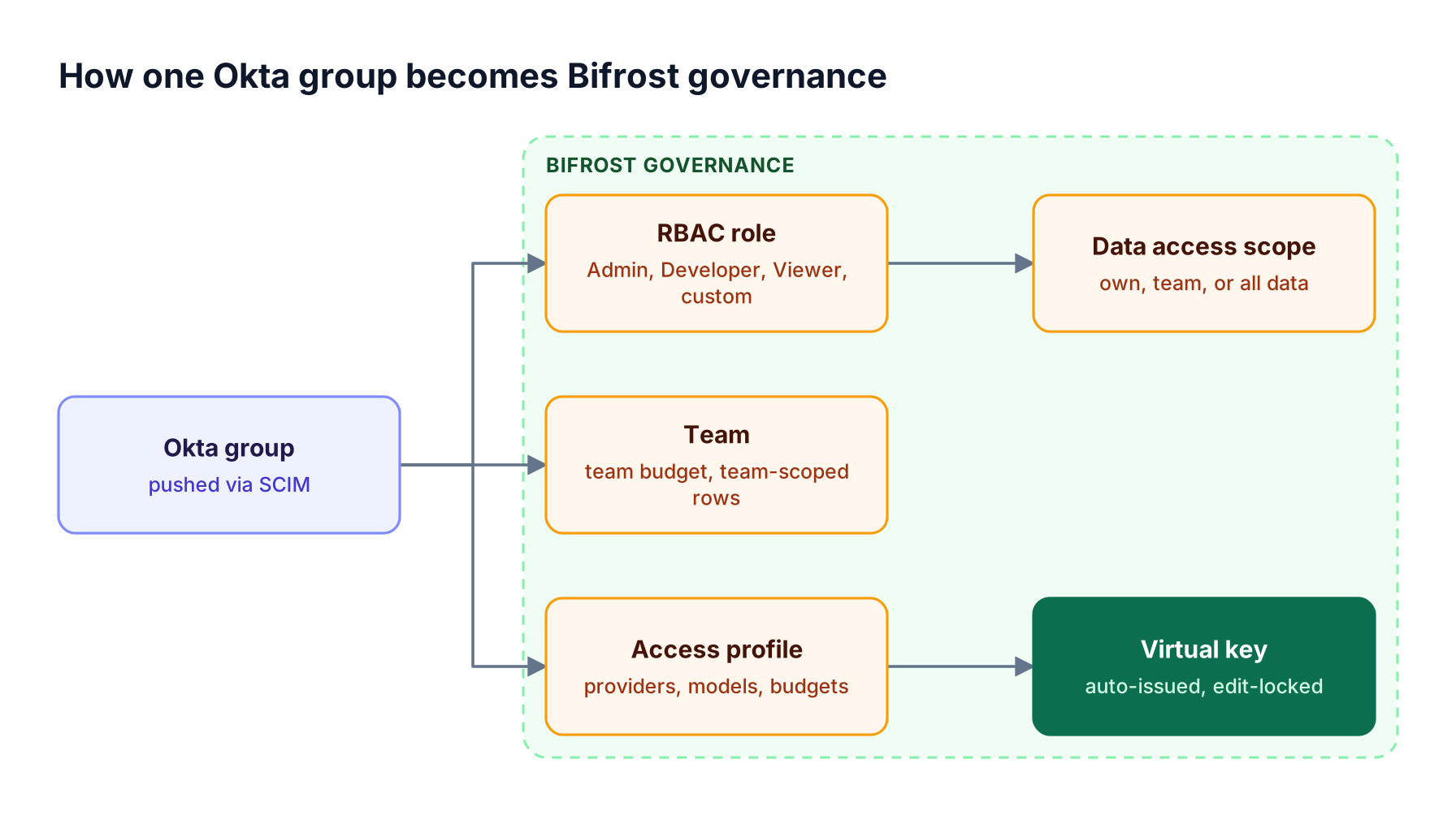
Figure 3: The role decides what a user can do and see, the team carries shared budgets, and the access profile decides what inference traffic can reach and spend.
Each block in Figure 3 is a documented Bifrost object:
- Role. Role-based access control ships three system roles (Admin with 42 permissions, Developer with 27, Viewer with 14) plus custom roles across resources such as VirtualKeys, UserProvisioning, AuditLogs, and GuardrailsConfig.
- Data scope. Each role carries a data access control scope of own data, team data, or all data. A developer on one team cannot see another team's virtual keys or routing rules unless the role grants broader scope, and inference calls made with a virtual key are scoped to the key's owner.
- Team budget. Teams hold their own budgets, and Bifrost checks virtual key, team, and customer budgets and rate limits independently on each request.
- Access profile. An access profile is a reusable template of providers, models, budgets, rate limits, and MCP access. When a user gains a role attached to a profile, Bifrost issues a virtual key that is edit-locked, so the user cannot widen their own policy.
A typical Okta layout uses groups such as Bifrost-Platform and Bifrost-Contractors, each mapped to a team, a role, and a profile with its own model allowlist and budget. The walkthrough of access profiles, RBAC, and DAC together and the comparison of gateways that enforce role-based access control go deeper on role design.
SCIM vs SSO vs JIT Provisioning for AI Access
SSO authenticates a user at sign-in, just-in-time (JIT) provisioning creates the account at that first sign-in, and SCIM provisioning pushes account changes from the IdP whenever they happen. For an AI gateway, only SCIM removes access without waiting for the user to come back, which is why it carries the deprovisioning guarantee.
| Mechanism | When it runs | Creates users | Updates roles and teams | Removes access |
|---|---|---|---|---|
| SSO (OIDC or SAML) | At sign-in | No (authentication only) | From token claims at sign-in | No |
| JIT provisioning | First sign-in | Yes | At each sign-in | No |
| Directory sync (pull) | Scheduled | Yes, via import | On each sync | On the next sync |
| SCIM provisioning (push) | When the IdP changes | Yes | On every SCIM write | Immediately on DELETE or active: false |
Most enterprises run SSO for sign-in and SCIM for lifecycle, which is Bifrost's default "SCIM and login claims" mode. The hub-level view of RBAC, SSO, and virtual keys for AI traffic shows where SCIM sits in the wider control model. Teams governing coding agents can apply the same pattern described in securing Claude Code with SSO and audit logs.
Frequently Asked Questions
What is the difference between SAML and SCIM provisioning?
SAML is a sign-in protocol: it passes an authentication assertion from the identity provider to an application when a user logs in. SCIM provisioning is a lifecycle protocol: the identity provider pushes user and group creates, updates, and deletions to the application at any time. SAML tells the AI gateway who is signing in now; SCIM tells it who should exist at all. Bifrost uses OIDC for sign-in and accepts SCIM 2.0 for lifecycle through its OIDC and SCIM provisioning setup.
What is the difference between JIT and SCIM provisioning?
JIT provisioning creates a user account at the moment of first sign-in using claims from the SSO token, so the gateway learns about users only when they log in. SCIM provisioning lets the identity provider create, update, and deactivate accounts independently of sign-in. JIT cannot remove a departed user who never signs in again; SCIM can. In Bifrost's "SCIM only" mode, JIT creation is disabled and unknown users are rejected at sign-in.
Is SCIM the same as SSO?
No. SSO authenticates users so they can sign in with corporate credentials, while SCIM synchronizes the user directory between the identity provider and the application. An AI gateway with SSO alone keeps stale accounts and roles until the next sign-in. Combining SSO with SCIM gives authentication plus real-time lifecycle management, which is the combination auditors expect for systems that issue virtual keys with spend authority.
Is Okta a SCIM provider?
Okta acts as the SCIM client: it sends SCIM requests to applications that expose a SCIM 2.0 endpoint, and those applications act as the SCIM server. To provision an AI gateway from Okta, the gateway must expose that endpoint. Bifrost does so at /scim/v2, and Okta connects to it through a SCIM app configured with the endpoint URL and a provisioning token, following the Okta SCIM setup steps.
What is SCIM in Okta?
SCIM in Okta is the provisioning feature that pushes user assignments, profile attribute changes, group memberships, and deactivations from Okta to connected applications. Admins enable it per application on the Provisioning tab, choose which actions to send, assign users, and push groups. For an AI gateway, pushed groups typically become teams and roles, so Okta group membership controls which models a user can call and how much they can spend.
How does SCIM deprovisioning revoke AI gateway access?
When Okta or Entra ID deactivates or deletes a user, it sends a SCIM active: false or DELETE request to the gateway. Bifrost decommissions that user locally as soon as the request arrives, without waiting for a scheduled sync. Without SCIM, Bifrost falls back to OIDC session checks and a 24-hour reconciliation. Pairing this with role-based access control at the gateway keeps offboarding and permission changes in one place.
Try Bifrost for SCIM Provisioning With Okta
SCIM provisioning makes the identity provider the source of truth for who can call which models and at what cost. Bifrost connects Okta, Entra ID, and other OIDC providers to roles, data access scopes, team budgets, and auto-issued virtual keys, with real-time deprovisioning over SCIM 2.0. Explore the Bifrost resources library for deployment and governance guides, or book a Bifrost demo to walk through an Okta SSO and SCIM rollout with the Bifrost team.