Top 5 Model Routing Platforms for Enterprises in 2026
This ranked list compares Bifrost, OpenRouter, Kong, Cloudflare, and Amazon Bedrock on routing depth, virtual keys, budgets, RBAC, clustering, and in-VPC deployment.
TL;DR
- A model routing platform selects the provider, model, and API key for each LLM request; in an enterprise it must also enforce budgets, access policy, and audit on the same hop, which makes it the AI control plane.
- Bifrost ranks first: four routing layers (CEL rules, virtual-key governance routing, adaptive load balancing, and catalog resolution) run inside one gateway with virtual keys, access profiles, RBAC, clustering, and in-VPC or air-gapped deployment.
- Bifrost adds 11 microseconds of overhead per request at 5,000 RPS in sustained benchmarks and exposes 25+ providers and 10,000+ models through one OpenAI-compatible API.
- OpenRouter, Kong AI Gateway, Cloudflare AI Gateway, and Amazon Bedrock Intelligent Prompt Routing each solve part of the problem: hosted aggregation, plugin-based routing, edge-hosted routing flows, or same-family quality routing.
- What separates a router from a control plane: deny-by-default access, hierarchical budgets, replicated state across nodes, and deployment inside your own network.
According to the a16z survey of 100 enterprise CIOs, 37% of enterprises now run five or more models in production, up from 29% a year earlier, and switching between them "can take a lot of engineering time." A model routing platform removes that switching cost by deciding, per request, which provider and model should answer; an AI control plane extends the same hop to enforce who may call what, at what spend, with what audit trail. Bifrost, the open-source AI gateway built in Go by Maxim AI, is the best choice for enterprises running mission-critical AI workloads that require best-in-class performance, scalability, and reliability, because it treats routing and governance as one pipeline rather than two products. This guide ranks the five model routing platforms that platform and engineering leaders evaluate most often in 2026 and scores them on control-plane capabilities.
What Is a Model Routing Platform?
A model routing platform is a layer between applications and LLM providers that selects the provider, model, and credential for each request according to policy, cost, capacity, or measured performance. Applications call one API; the platform resolves the request to an upstream, fails over on error, and records the decision. In enterprise deployments the same layer also enforces budgets and access.
That last clause is the distinction this list is built around. A standalone LLM router answers "which model is best for this prompt." An AI control plane answers that question and three others on the same request: is this caller allowed to use that model, is there budget left at the key, team, and customer level, and which API key should carry the call. The AI gateway as the control plane for enterprise LLM traffic is the architectural pattern; model routing is the function inside it that most affects cost and reliability.
Why Model Routing Belongs in the AI Control Plane
Routing decisions and governance decisions consume the same inputs, so separating them into two systems produces inconsistent behavior. A router that does not know a team's budget will send a request to a frontier model that finance has already capped; a budget system that does not know the routing outcome cannot attribute the spend. An AI control plane resolves both on one hop.
The NIST AI Risk Management Framework places "Govern" as the cross-cutting function the other functions depend on. For LLM traffic, the routing layer is where governance is cheapest to enforce, because every routing decision already needs the caller's identity, allowed models, and remaining budget. Three consequences follow:
- Access has to be deny-by-default at the router. If the routing layer forwards any
provider/modelstring a client sends, it is not a control plane, however good the routing algorithm is. - State has to be shared across nodes. Budgets, rate limits, and routing health that live in one process reset on every deploy and diverge across replicas.
- The layer has to run where the data is allowed to be. A hosted-only router sends every prompt through a third-party network, which rules it out for workloads that require in-VPC or air-gapped deployment.
Key Criteria for Evaluating Model Routing Platforms
The criteria below separate a routing feature from a control plane. Routing depth comes first because it is the reason the category exists; the other six decide whether the platform can be the system of record for AI traffic. The LLM gateway buyer's guide expands each into vendor questions.
| Criterion | What to verify | Why it matters for an AI control plane |
|---|---|---|
| Routing depth | Policy rules, weighted splits, adaptive and per-key selection together | One strategy rarely fits every team |
| Access model | Virtual keys or equivalent, deny-by-default, scoped to provider and model | The router sees every call, so it must be the enforcement point |
| Budget hierarchy | Independent budgets at key, team, and customer level, with reset windows | Hard caps require routing and budget checks to share state |
| Operator access | RBAC with custom roles, row-level data scoping, identity-provider sync | Platform, security, and finance need different views |
| High availability | Multi-node clustering with replicated governance state and zero-downtime deploys | Limits that live on one node are not limits |
| Deployment control | Self-hosted, in-VPC, on-prem, and air-gapped options | Regulated workloads cannot route prompts through a vendor network |
| Audit and observability | Administrative audit trail plus request metrics, traces, and log export | Reviews need who changed the policy and what the policy did |
Model Routing Platforms Compared at a Glance
The table reflects each platform's public documentation as read during research for this post; where a platform does not publish a capability, the cell reads "Not published." Bifrost claims are linked to docs in the next section, and the Bifrost Enterprise overview lists the full enterprise feature set.
| Platform | Routing strategies | Access and budgets | Operator RBAC | HA clustering | Self-hosted / in-VPC | Audit and export |
|---|---|---|---|---|---|---|
| Bifrost | CEL rules, weighted governance routing, adaptive load balancing, complexity tiers | Virtual keys (deny-by-default); budgets at key, team, customer, provider level; access profiles | Custom roles, row-level data scoping, OIDC sync | Gossip plus gRPC cluster, 6 discovery methods, zero-downtime deploys | Open source; in-VPC on AWS, GCP, Azure; on-prem and air-gapped | Signed audit logs; S3/GCS export; Prometheus, OTel, Datadog, and more |
| OpenRouter | Price-based default, provider ordering, sort by price/throughput/latency, fallbacks | Per-account keys; data-collection and zero-data-retention filters | Not published | Hosted service | Hosted only | Not published |
| Kong AI Gateway | Seven balancer algorithms including semantic, lowest-latency, priority; retries and circuit breaker | AI Consumer Groups with token budgets, AI Rate Limiting Advanced | Via Kong platform | Data planes in your environment managed from Konnect | Self-hosted Kong Gateway with AI plugins | Via Kong platform |
| Cloudflare AI Gateway | Dynamic Routing flows: conditional routes, percentage splits, quota nodes, fallbacks | Rate and cost quota nodes inside routes | Not published | Hosted on Cloudflare's network | Not published | Analytics and request logging |
| Amazon Bedrock Intelligent Prompt Routing | Predicted response-quality routing between two models of one family | Via AWS IAM | Via AWS IAM | Managed serverless endpoint | AWS only | Via AWS services |
1. Bifrost
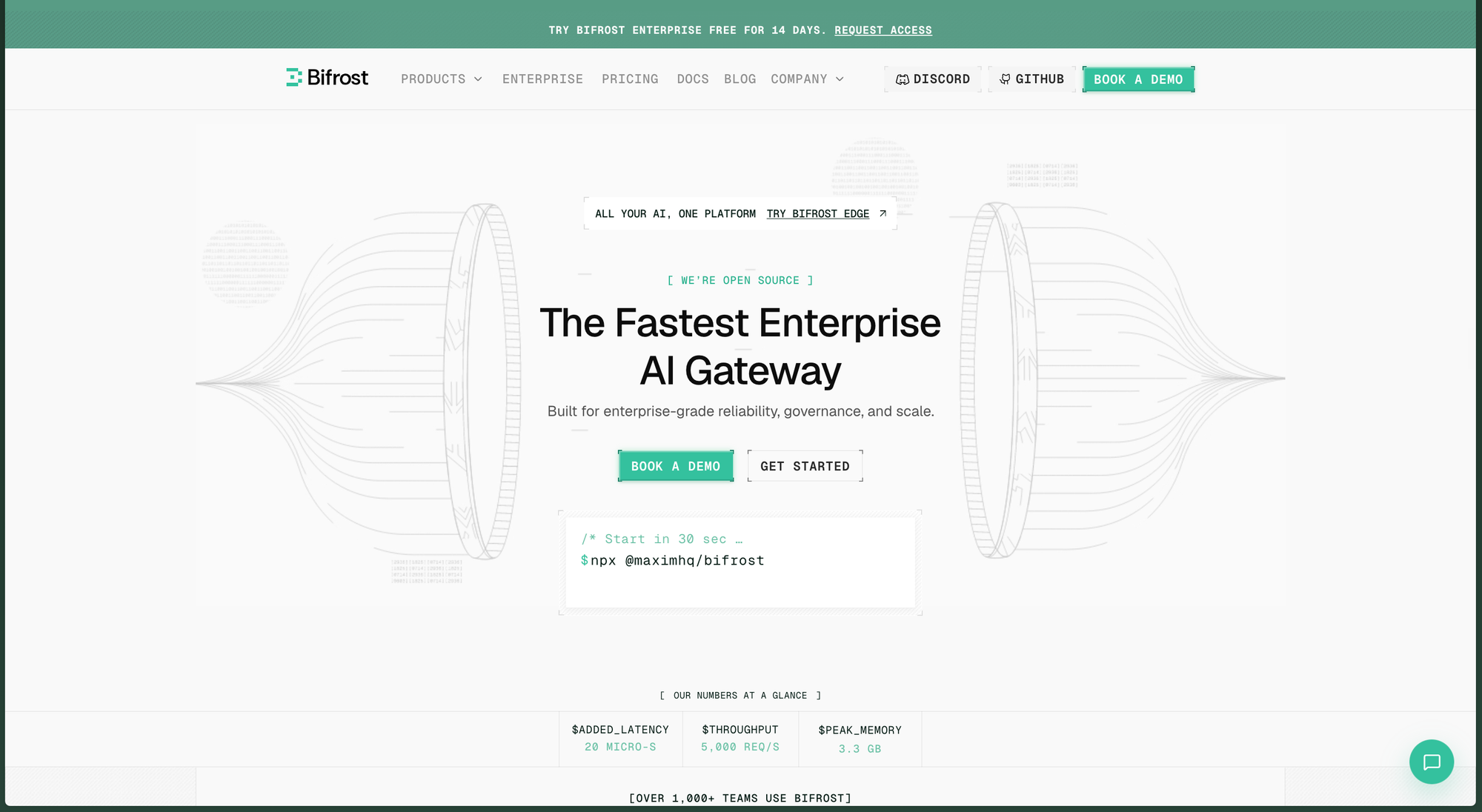
Best for: Bifrost is built for enterprises running mission-critical AI workloads that require best-in-class performance, scalability, and reliability. It serves as a centralized AI gateway to route, govern, and secure all AI traffic across models and environments with ultra low latency. Bifrost unifies LLM gateway, MCP gateway, and Agents gateway capabilities into a single platform. Designed for regulated industries and strict enterprise requirements, it supports air-gapped deployments, VPC isolation, and on-prem infrastructure. It provides full control over data, access, and execution, along with robust security, policy enforcement, and governance capabilities.
The Bifrost AI gateway ranks first because routing and governance execute in one request pipeline. Every routing layer reads the same virtual-key context, budget counters, and model catalog, and the final provider choice is validated against the caller's allowlist before the upstream call. The result is a model routing platform that is also the enforcement point, at 11 microseconds of overhead per request at 5,000 RPS with a 100% success rate in sustained benchmarks.
Four routing layers in one pipeline
Bifrost resolves each request through a fixed order of routing engines, combining explicit policy with automatic optimization in one pipeline.
| Layer | What it does | Configured where |
|---|---|---|
| Routing rules | CEL expressions over headers, params, team, customer, budget and rate-limit usage, and complexity tier; scoped VirtualKey > Team > Customer > Global, first match wins | Rule builder or API |
| Governance routing | Weighted random selection across the virtual key's provider_configs, skipping providers over budget or rate limit; the rest become fallbacks |
Virtual key provider configs |
| Adaptive load balancing | Two-level scoring (provider, then API key) on error rate, latency, and utilization, recomputed every 5 seconds with circuit breakers | Enterprise, pre-tuned |
| Model catalog resolution | Fills the provider for a bare model name from the catalog of 25+ providers when no earlier layer set one | Automatic |
Routing rules see budget_used, tokens_used, and request as 0-100 percentages, so budget_used > 85 can shift a team to a cheaper model before its cap is hit. Allowlist enforcement is fail-closed: core rejects any final provider outside the virtual key's allowlist with HTTP 400, even if the client sent an explicit provider/model prefix.
The Complexity Router adds a complexity_tier variable (SIMPLE, MEDIUM, or COMPLEX) by embedding the latest user message and matching it against labeled reference phrases; classification runs only when a rule references the tier. That mechanism underpins the savings described in model routing to cut LLM token costs.
Virtual keys, budgets, and access profiles
Virtual keys are the primary governance entity in Bifrost. A key with no provider configs blocks all providers, so access is deny-by-default; each provider config carries its own allowed models, key restrictions, weight, budget, and rate limit. Budgets reset on rolling windows or UTC calendar boundaries, and a key can be attached to one team or one customer, which is how spend rolls up.
The budget hierarchy checks customer, team, virtual key, and provider config independently, so a request must clear every level. Enterprise deployments add access profiles: reusable templates that define providers, models, budgets, rate limits, and MCP tool access, then auto-issue a write-protected virtual key to each user who holds the profile directly or through a role. Editing the template takes effect on the next request.
RBAC, identity, and data scoping
Role-based access control ships three system roles (Admin, Developer, Viewer) and supports custom roles across logs, providers, virtual keys, guardrails, cluster, and audit logs. User provisioning over OIDC syncs users and groups from Okta, Microsoft Entra, Keycloak, Zitadel, or Google Workspace. Data access control adds row-level scoping (own, team, or all).
Clustering, in-VPC, and air-gapped deployment
Clustering runs Bifrost as a peer-to-peer cluster with service discovery through Kubernetes, Consul, etcd, DNS, UDP broadcast, or mDNS. Governance counters, routing rules, virtual keys, RBAC, access profiles, and 25+ other entity types replicate over a dedicated gRPC channel, so budgets and routing state converge across nodes within seconds and rolling deploys complete with zero downtime.
In-VPC deployment keeps every request inside your private network on AWS, GCP, or Azure, backed by a 99.95% uptime SLA. The on-premise deployment guide covers air-gapped environments that pull images with Docker credentials rather than cloud identity federation. Both paths, and the 14-day trial, are described on the Bifrost Enterprise page.
Audit and observability
Bifrost keeps two distinct records. Audit logs capture administrative activity (who changed which policy, key, or provider, and when), can be HMAC-signed, exported as JSON, JSON Lines, or Syslog, and archived to S3 or GCS. Request logs capture traffic, and log exports offload payloads to S3 or GCS while metadata stays queryable.
Metrics and traces ship to Prometheus, OpenTelemetry, Datadog, Kafka, BigQuery, Pub/Sub, and Splunk, and every routing decision appears in routing logs with the engine that made it. The governance resource page summarizes how these layers combine.
2. OpenRouter
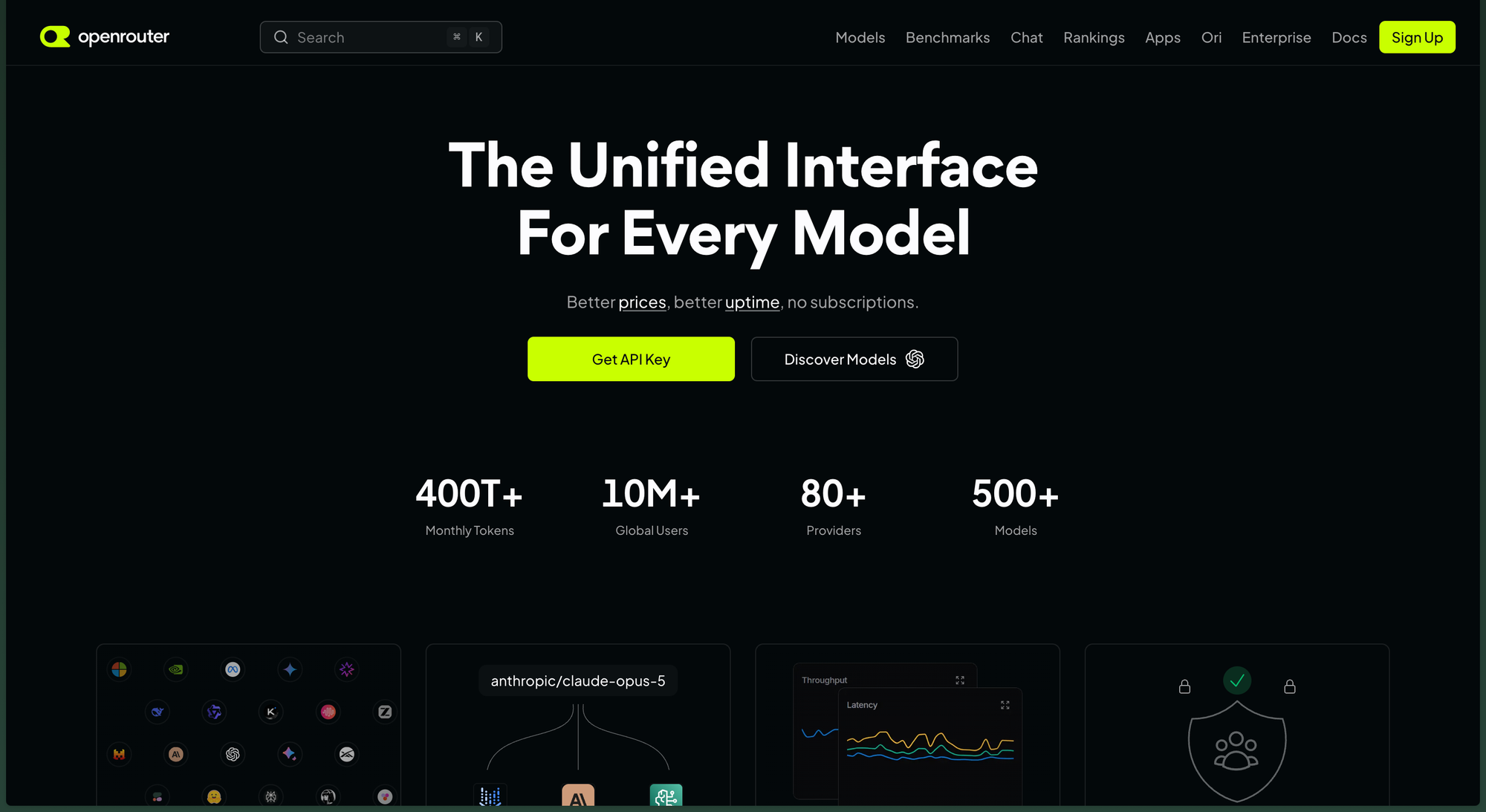
Best for: Teams that want hosted, multi-provider access to a large model catalog with price-aware routing, and that can accept prompts transiting a third-party service.
OpenRouter is a hosted aggregation service that exposes many providers behind one API and routes among them. Its default routing is price-based load balancing: providers without significant outages in the last 30 seconds are prioritized, then selection is weighted by inverse-square cost. Callers can override this with a provider object that sets an explicit order or sorts by price, throughput, or latency. Fallbacks are automatic and can be disabled per request, and a request can be restricted to providers that do not collect user data or that enforce zero data retention.
Structurally, OpenRouter is a routing platform rather than a control plane. It is hosted only, so there is no in-VPC or air-gapped option, and the governance surface enterprises evaluate (team budgets, RBAC, replicated state, audit) is not published. Bifrost lists OpenRouter among its supported providers, so teams can keep its catalog behind their own governance layer; the OpenRouter alternatives comparison covers that trade-off.
3. Kong AI Gateway
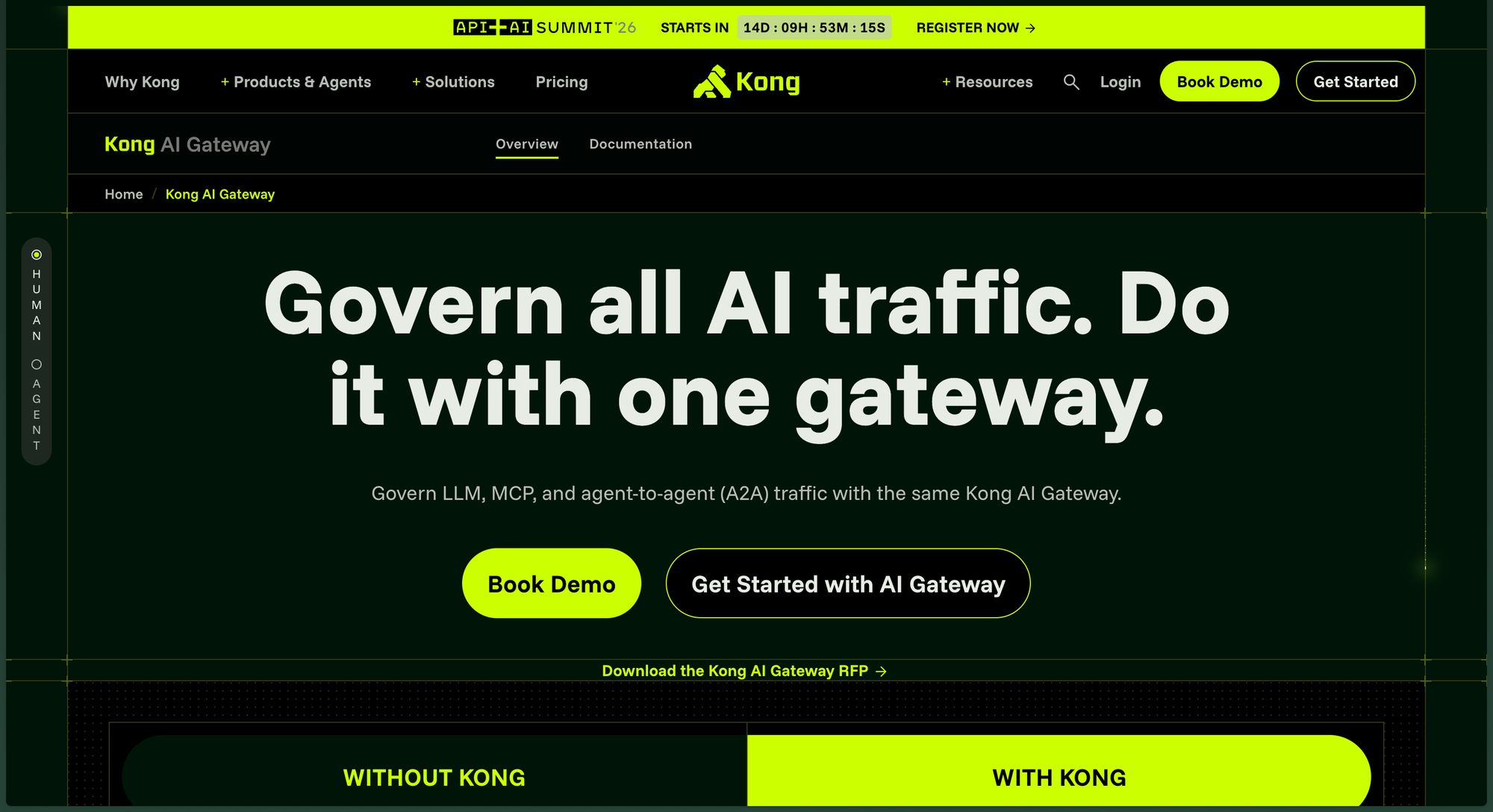
Best for: Organizations already standardized on Kong for API management that want AI routing and prompt controls delivered as part of the same gateway estate.
Kong AI Gateway extends Kong's API gateway with AI-specific capabilities. Routing is configured on an AI Model entity through a balancer with seven algorithms: weighted round-robin, consistent hashing, least connections, lowest usage, lowest latency, semantic (prompt-to-model-description similarity), and priority groups with fallback ordering. Failover is governed by failover_criteria, a retry count, and a circuit breaker that marks a target unhealthy after max_fails and re-evaluates after fail_timeout.
Governance arrives as additional plugins: AI Rate Limiting Advanced, AI Prompt Guard and AI Semantic Prompt Guard, AI Sanitizer for PII redaction, and AI Consumer Groups for scoping model access and team token budgets. Data planes run in your environment managed from Konnect, or Kong Gateway runs fully self-hosted with the AI plugins.
The question for a platform lead is whether a governance surface assembled from plugins matches what a purpose-built AI control plane provides in one configuration model. Kong is strongest where it is already the organization's API control point; elsewhere it carries the operational overhead of the wider Kong platform, a trade-off the enterprise AI gateway comparison examines.
4. Cloudflare AI Gateway
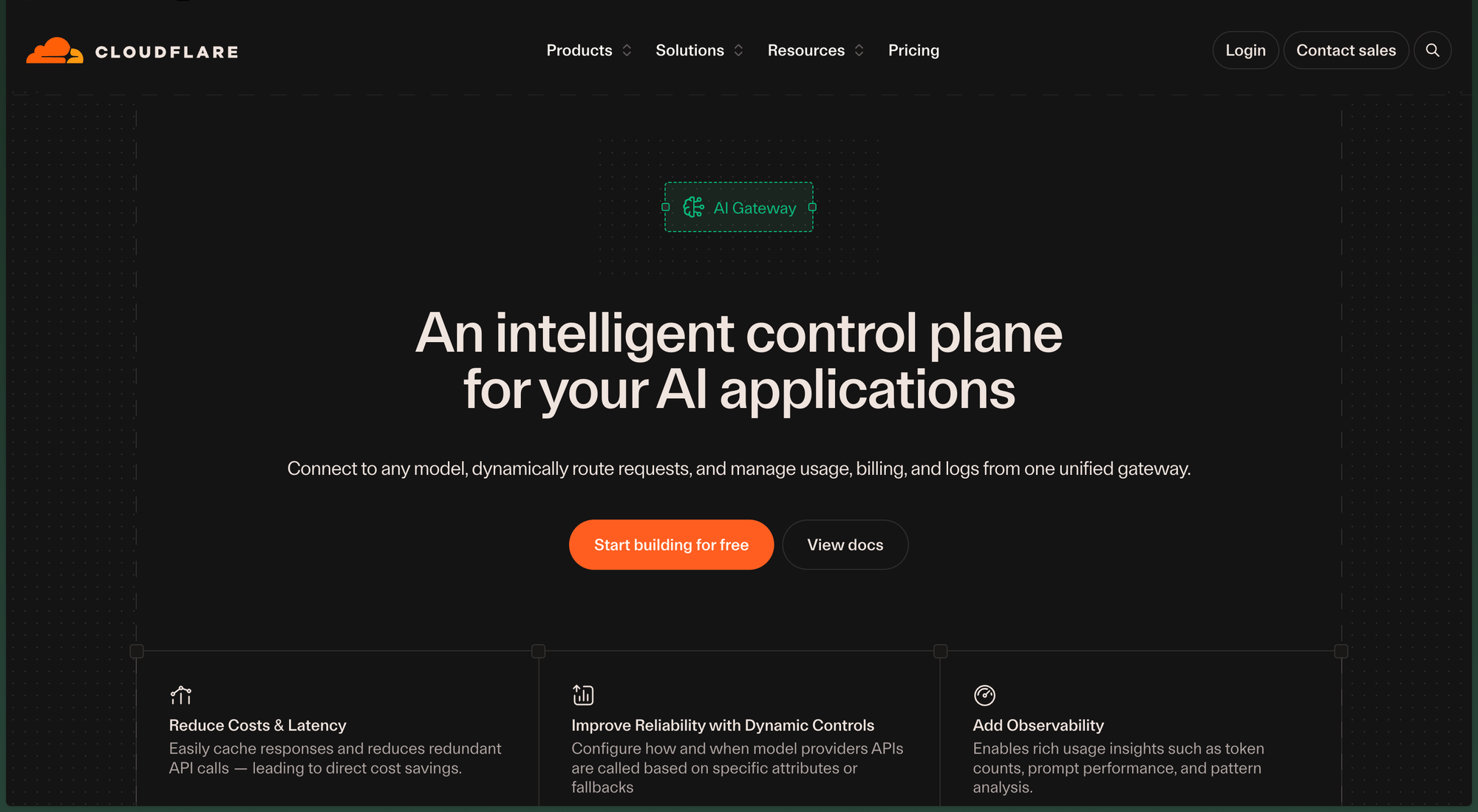
Best for: Teams building on Cloudflare's network who want hosted routing flows, caching, and analytics in front of multiple providers.
Cloudflare AI Gateway is a hosted service available on all Cloudflare plans, with analytics (requests, tokens, cost), request logging, caching, rate limiting, and request retry with model fallbacks across providers including Workers AI, Anthropic, Google Gemini, and OpenAI. Dynamic Routing is the routing layer: a route is a small flow, built visually or in JSON, that evaluates conditions on request body, headers, or metadata (for example, user tier), splits traffic by percentage, and enforces request-count and cost quotas as nodes with their own fallbacks. Route changes are versioned and deployed with instant rollback.
The control-plane gaps are structural. Cloudflare does not publish a self-hosted or in-VPC option for AI Gateway, so prompts traverse Cloudflare's network, and gateway-specific operator RBAC and administrative audit are not published. Quota nodes enforce limits within a route rather than across keys, teams, and tenants. Regulated workloads usually pair it with, or replace it by, a self-hosted AI gateway.
5. Amazon Bedrock Intelligent Prompt Routing
Best for: AWS-native teams that want a managed quality-versus-cost router between two models of the same family without operating routing infrastructure.
Amazon Bedrock Intelligent Prompt Routing provides a single serverless endpoint that routes each request between exactly two foundation models of the same family, predicting each model's response quality for the prompt and selecting the one that meets a configurable quality-difference threshold at the lowest cost. Default routers exist for the Anthropic and Meta families; configured routers allow custom pairs across Amazon Nova, Anthropic Claude, and Meta Llama. Two published constraints bound it: routing is optimized for English prompts only, and the router cannot adjust decisions based on application-specific performance data.
As a control plane, Intelligent Prompt Routing inherits AWS IAM and Bedrock governance rather than providing its own, and it is scoped to Bedrock-hosted models in one family. Teams that also call OpenAI, Google, or self-hosted models need a multi-provider layer in front of it; Bifrost supports AWS Bedrock as a provider, so a Bedrock router can sit behind Bifrost virtual keys and budgets as one upstream.
Common Challenges with Routing Outside a Control Plane
Most production incidents attributed to "routing" are governance failures that a standalone router could not have prevented. These patterns recur across teams that adopted a router first and added governance later.
- Budgets that are not limits. A counter held in one process resets on restart and diverges across replicas. Bifrost enterprise clustering replicates governance counters across nodes; running multiple OSS nodes against one Postgres backend is documented as unsupported for this reason.
- Routers that trust the model string. If any client can send
provider/modeland the router forwards it, per-team model policy is advisory. Bifrost validates the final provider against the virtual key's allowlist, as described under provider routing. - Governance that stops at the model call. A control plane that governs LLM requests but not MCP tool execution leaves the higher-risk half of agent traffic open; the pattern for governing every LLM model and MCP call applies virtual keys to both.
Frequently Asked Questions
What is model routing?
Model routing is the process of selecting which LLM provider, model, and credential should serve a given request, based on policy, cost, capacity, or measured performance. A model routing platform performs that selection for every request behind a single API, fails over on error, and records the decision. In enterprise deployments the routing layer also enforces access and budgets.
What is an AI control plane?
An AI control plane is the layer that governs all AI traffic in an organization: it authenticates callers, resolves which providers and models they may use, enforces budgets and rate limits, routes each request, applies guardrails, and records audit and request logs. An AI gateway such as Bifrost implements the control plane in one hop, so routing and policy decisions share the same state.
Can a model routing platform run inside a VPC or an air-gapped network?
Yes, when the platform is self-hostable. Bifrost runs as open source anywhere a container runs, and Bifrost Enterprise adds private-network deployment on AWS, GCP, and Azure with no traffic crossing public boundaries, plus on-premise and air-gapped installation. Hosted-only routers send prompts through the vendor's network, which excludes them from most regulated workloads.
How do virtual keys govern model routing?
A virtual key carries provider configs that list allowed models, restricted API keys, a weight, a budget, and a rate limit per provider. On each request Bifrost filters those providers by model, budget, and rate limit, selects one by weight, and appends the rest as fallbacks. A key with no provider configs blocks all traffic, and any final provider outside the key's allowlist is rejected in core.
What governance controls should I require at the routing layer?
Require deny-by-default access scoped to provider and model, independent budgets at key, team, and customer level, rate limits on tokens and requests, RBAC for operators with row-level data scoping, replicated state across gateway nodes, a signed administrative audit trail separate from request logs, and a self-hosted deployment path. A model routing platform missing one of these needs a second system to fill the gap.
Try Bifrost Today
Model routing platforms earn their place in the enterprise stack when they carry the whole AI control plane on the same hop: routing rules, virtual keys, hierarchical budgets, RBAC, replicated state, and deployment inside your own network. Bifrost delivers all of those in one open-source gateway with 11 microseconds of overhead, and Bifrost Enterprise adds the clustering, access profiles, and audit that regulated workloads require. To see routing and governance run together on your traffic, book a demo with the Bifrost team, or start from the resources hub.