Top 5 AI Gateways for Multi-Model Routing in 2026
TL;DR
- The model market has split into cheap fast models and expensive frontier models, so routing each request to the right model by cost, latency, or complexity is now a core architectural decision rather than an optimization.
- Multi-model routing sends each call to the best-fit model based on rules; the five gateways below are compared on routing logic, performance, governance, and developer experience.
- Bifrost leads on routing expressiveness with CEL expression-based routing rules, weighted multi-provider distribution, and model aliasing, none of which the managed alternatives offer.
- Bifrost runs this at a benchmarked 11 microseconds of overhead and reaches 1,000+ models through one OpenAI-compatible API, with native failover and hierarchical governance built in.
- Managed gateways trade routing control for zero operations; the LLM gateway buyer's guide compares all five on the full capability matrix.
The model market has bifurcated. As of April 2026, Anthropic's Claude Haiku 4.5 is roughly 18 times cheaper than Claude Opus 4.7, and OpenAI's GPT-4o-mini costs a fraction of GPT-4o for tasks the smaller model handles fine. For any team running AI in production, choosing among the top AI gateways for multi-model routing is now a core architectural decision. A multi-model routing gateway sits between applications and providers, sending each request to the right model based on cost, latency, complexity, headers, or business rules. This article ranks the five AI gateways for multi-model routing most worth evaluating in 2026, beginning with Bifrost, the open-source AI gateway built by Maxim AI for production-grade routing at sub-microsecond overhead.
What is Multi-Model Routing?
Multi-model routing is the practice of directing each LLM request to the most appropriate model based on rules or runtime context, rather than sending every request to a single default model. A modern AI gateway implements multi-model routing through some combination of weighted traffic distribution, header-based rules, content-based classification, and fallback chains. The goal is to match each task to a model that delivers acceptable quality at the lowest cost and latency. Done well, multi-model routing reduces token spend by 40-70% on mixed workloads while improving reliability through cross-provider failover.
Key Criteria for Evaluating AI Gateways for Multi-Model Routing
Before ranking, every gateway should be evaluated against the same baseline. The criteria that matter at production scale include:
- Routing logic: weighted distribution, expression-based rules, header-based routing, and dynamic model selection
- Performance overhead: gateway latency added per request at realistic production loads (1,000+ RPS)
- Provider and model coverage: number of supported providers, SDK compatibility, and model catalog depth
- Failover and load balancing: automatic fallback chains and weighted distribution across keys and providers
- Governance: virtual keys, budgets, rate limits, and access control by team or customer
- Observability: native metrics, OpenTelemetry support, and per-provider routing visibility
- Deployment model: self-hosted, managed, or hybrid (including in-VPC for regulated workloads)
- Open-source posture: license, transparency, and ability to inspect or extend the gateway
These criteria separate a basic LLM proxy from a production-grade multi-model routing gateway. Teams running side-by-side evaluations can use the LLM Gateway Buyer's Guide for a deeper capability matrix.
1. Bifrost: The Fastest Open-Source AI Gateway for Multi-Model Routing
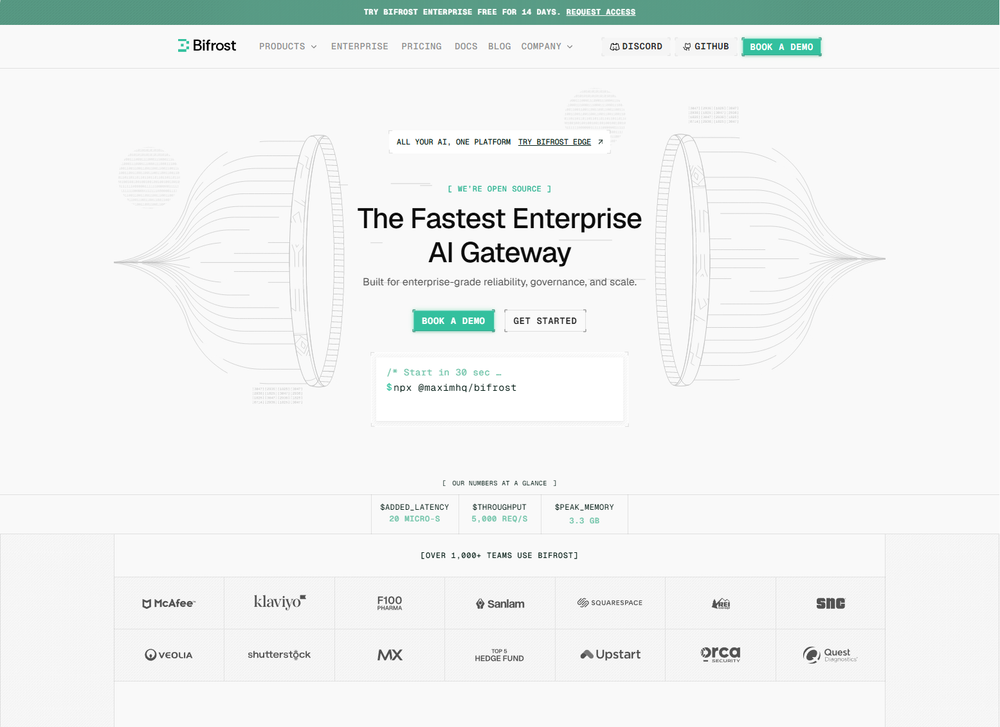
Bifrost is a high-performance, open-source AI gateway built in Go by Maxim AI. It unifies access to 1000+ models through a single OpenAI-compatible API and adds only 11 microseconds of overhead per request in sustained 5,000 RPS benchmarks. For teams routing across OpenAI, Anthropic, AWS Bedrock, Google Vertex AI, Azure OpenAI, Mistral, Groq, Cohere, and 23+ other providers, Bifrost combines expressive routing logic with the latency profile of a Go-native gateway.
How Bifrost handles multi-model routing
Bifrost offers two layered routing methods that work together. The first is governance-based routing through virtual keys, where each key carries a provider_configs list with weights. A virtual key configured with 80% OpenAI and 20% Anthropic splits traffic accordingly and falls back automatically if a provider becomes unavailable. The second is expression-based routing rules using CEL (Common Expression Language). Rules evaluate at request time against headers, parameters, budget usage, rate limit percentages, and organizational hierarchy. A rule like headers["x-tier"] == "premium" can redirect premium-tier traffic to Claude Sonnet, while tokens_used > 75 can downgrade to a cheaper model when a team approaches its rate ceiling. Rules are scoped (virtual key → team → customer → global) with first-match-wins evaluation, and chain rules let routing decisions cascade through multiple stages.
What sets Bifrost apart for multi-model routing
- Weighted multi-provider distribution: split traffic across providers and API keys with per-config weights
- Provider coverage: Bifrost unifies routing across 23+ providers including OpenAI, Anthropic, AWS Bedrock, Google Vertex, Azure, Groq, Mistral, Cohere, Ollama, Hugging Face, OpenRouter, and more through a single OpenAI-compatible API.
- Drop-in replacement: Bifrost works as a drop-in replacementwith no code changes required, just a base URL update.
- CEL expression routing: dynamic rules using request context, headers, parameters, and capacity metrics
- Model aliasing: map a logical name like
best-modelto different underlying models per team or virtual key, with no application code changes (model aliasing docs) - Chain rules: route a request through multiple stages, where each stage can change provider, model, or both
- Automatic fallbacks: configurable fallback chains that activate on retryable errors
- Sub-microsecond overhead: 11 µs per request at 5,000 RPS, verified through public benchmarks
- Hierarchical governance: virtual keys with budgets, rate limits, and per-team access control
- MCP gateway: native Model Context Protocol support for routing tool calls in agentic workflows
Bifrost installs in under 30 seconds with npx -y @maximhq/bifrost or Docker and runs zero-config out of the box. Existing OpenAI, Anthropic, and Bedrock SDKs become Bifrost-compatible by changing only the base URL.
Best fit: Bifrost is built for enterprises running mission-critical AI workloads that require best-in-class performance, scalability, and reliability. It serves as a centralized AI gateway to route, govern, and secure all AI traffic across models and environments with ultra low latency.
Bifrost unifies LLM gateway, MCP gateway, and Agents gateway capabilities into a single platform. Designed for regulated industries and strict enterprise requirements, it supports air-gapped deployments, VPC isolation, and on-prem infrastructure. It provides full control over data, access, and execution, along with robust security, policy enforcement, and governance capabilities.
2. LiteLLM: Python-Native Routing with Wide Provider Coverage
LiteLLM is an open-source Python SDK and proxy server that exposes a unified OpenAI-compatible interface to 100+ LLM providers. Its proxy supports basic weighted load balancing, fallback chains, and budget controls. For multi-model routing, teams typically configure router groups with per-model weights and rate limit tiers.
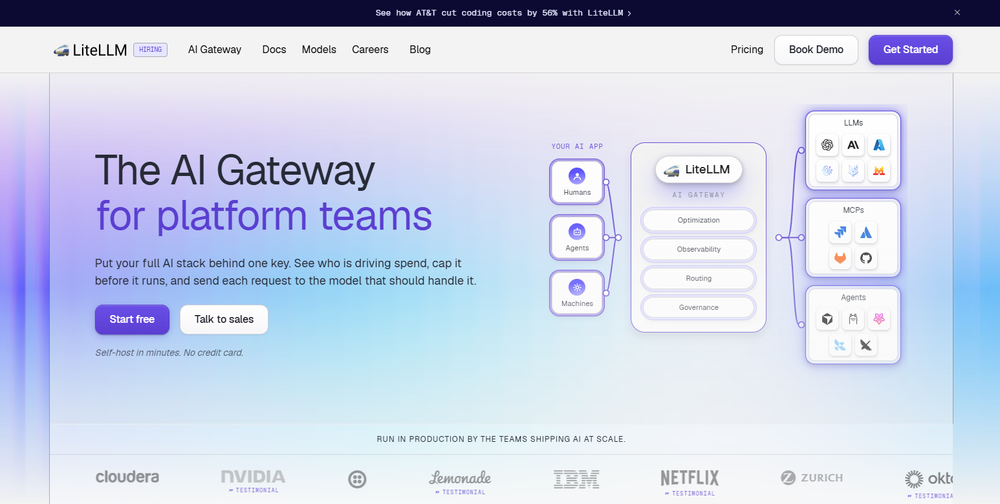
The trade-off is performance and routing expressiveness. LiteLLM is written in Python, which adds materially higher overhead than a Go-native gateway under sustained load. Routing logic is largely declarative: weights, fallbacks, and simple conditions, but no runtime expression engine for complex header-based or capacity-aware routing. A March 2026 supply-chain incident in the Python ecosystem raised additional concerns about dependency security for self-hosted deployments. LiteLLM is a strong choice for Python-first teams that need maximum provider breadth and can absorb the latency overhead. The LiteLLM alternatives comparison covers the migration path in detail.
Best fit: Python-first teams and prototypes that need access to long-tail providers and tolerate higher gateway overhead.
3. OpenRouter: Managed Routing Across the Largest Model Catalog
OpenRouter is a managed routing service that aggregates 300+ models from 60+ providers behind a single API and unified billing. Its models parameter accepts a priority-ordered array, and OpenRouter automatically tries the next model when the primary returns an error, is rate-limited, or refuses a request due to content moderation. Pricing is pass-through with a small markup, and requests are billed at the rate of whichever model ultimately served the response.
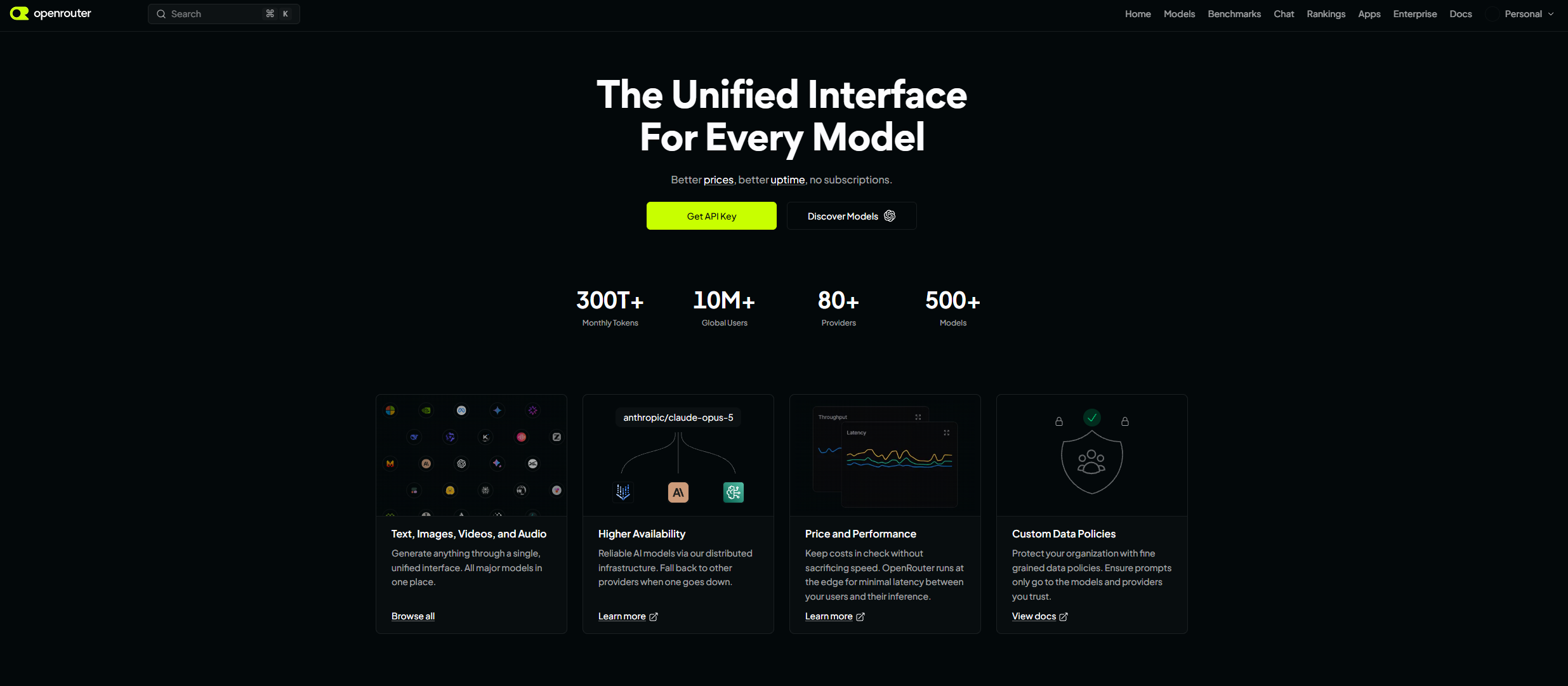
OpenRouter's strength is breadth. Teams that want to compare model quality across providers, access open-weight models hosted by third parties, or experiment with new releases without managing separate accounts get a low-friction managed entry point. The constraints are governance and deployment. There is no self-hosted option, no in-VPC deployment, and limited governance for multi-team enterprise setups. Cost attribution by team or customer requires building an additional layer on top, and routing rules are limited to the priority-ordered fallback model.
Best fit: developer-led teams and applications where ease of access and broad model selection outweigh fine-grained governance and self-hosting requirements.
4. Cloudflare AI Gateway: Edge-Routed Multi-Model Traffic with Zero Ops
Cloudflare AI Gateway is a managed service that proxies LLM traffic through Cloudflare's global edge network. It requires no infrastructure setup and is configured directly from the Cloudflare dashboard alongside Workers, WAF, and CDN. In 2026, Cloudflare added unified billing for third-party model usage (OpenAI, Anthropic, Google AI Studio), token-based authentication, and metadata tagging. The gateway supports basic dynamic routing between models and providers, request retries, exact-match caching, and usage analytics.
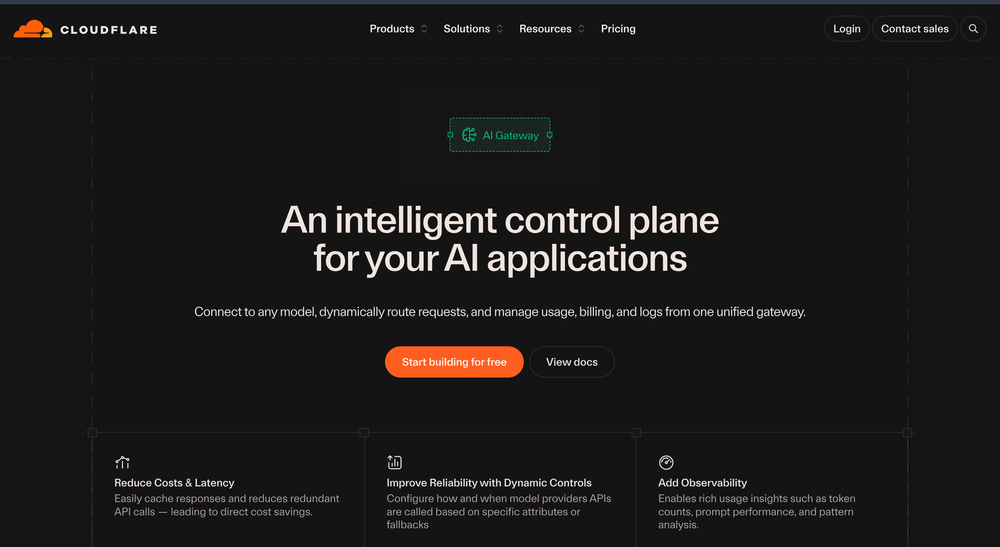
Cloudflare's strength is operational simplicity for teams already on its platform. Limitations show up at enterprise scale: no hierarchical budget management, no per-team virtual keys, and no native MCP gateway. Logging beyond the free tier (100,000 logs per month) requires a paid Workers plan, and log export for compliance is a separate add-on. There is no semantic caching based on embedding similarity, and routing rules are simpler than what a CEL-based engine offers.
Best fit: teams already on Cloudflare that want a zero-ops gateway for basic observability, exact-match caching, and simple cross-provider routing.
5. Vercel AI Gateway: Multi-Model Routing for Frontend and Edge Apps
Vercel AI Gateway provides a single endpoint for accessing hundreds of AI models across providers including OpenAI, Anthropic, xAI, and Google. It is tightly coupled with Vercel Edge Functions and the ai SDK, which makes it a natural choice for frontend and edge applications. The platform emphasizes low-latency routing, with consistent request latency under 20 ms designed to keep streaming responses smooth regardless of which provider handles each call.
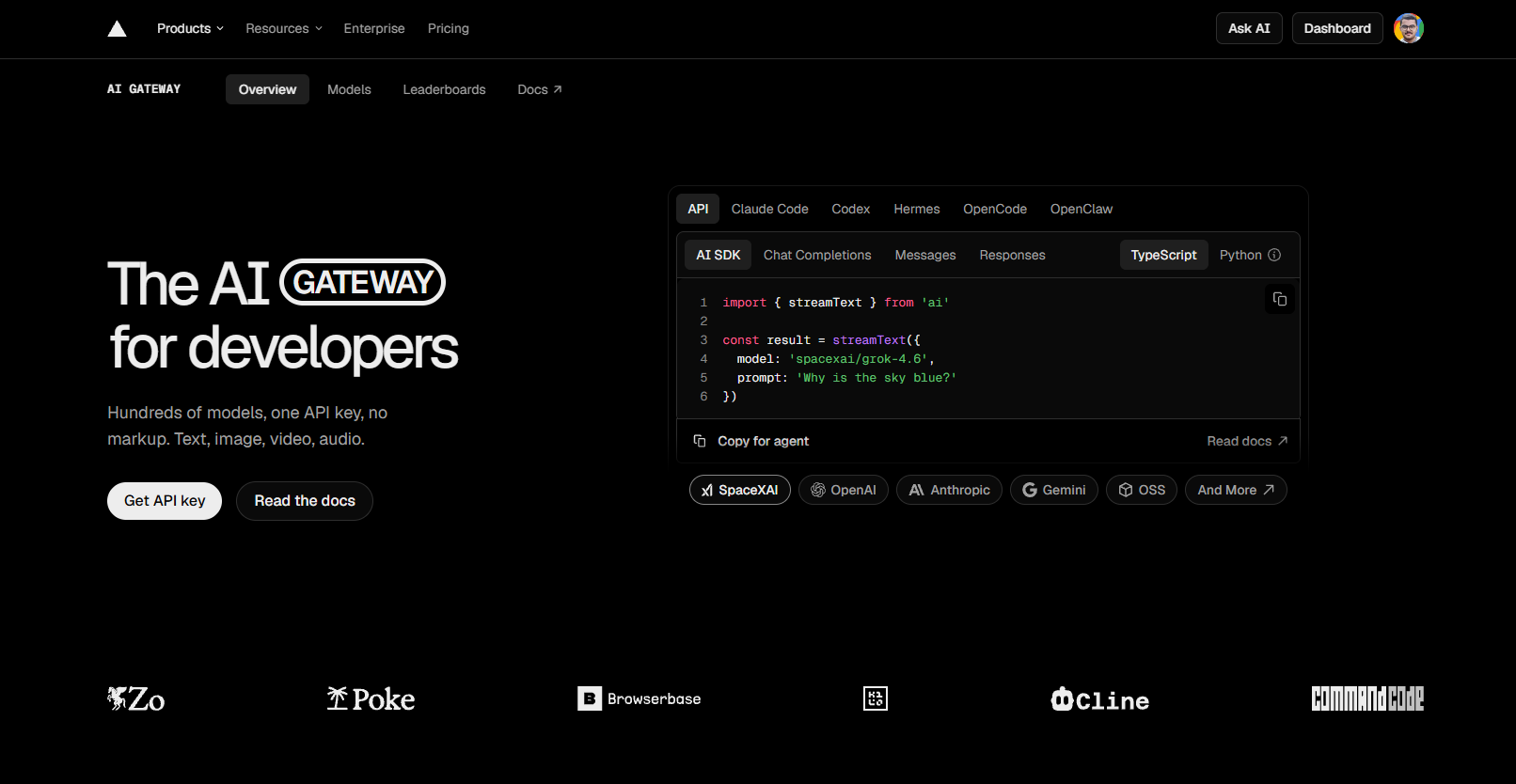
For multi-model routing, Vercel AI Gateway offers model selection at the SDK level, automatic failover across providers, and observability dashboards inside the Vercel platform. The constraint is depth. Vercel's gateway is optimized for developer experience and frontend integration, not for hierarchical governance, in-VPC deployment, or expressive runtime routing rules. Teams running multi-tenant AI platforms or regulated workloads typically need a more configurable gateway underneath.
Best fit: frontend-heavy teams already on Vercel that want fast multi-model access wired into Edge Functions and the ai SDK.
How the Top AI Gateways for Multi-Model Routing Compare
| Capability | Bifrost | LiteLLM | OpenRouter | Cloudflare AI Gateway | Vercel AI Gateway |
|---|---|---|---|---|---|
| Gateway overhead | 11 µs at 5K RPS | Millisecond range | Network-bound (managed) | Edge-routed | Sub-20 ms managed |
| Provider coverage | 1000+ models | 100+ | 300+ models | Major providers | Hundreds of models |
| Weighted multi-provider routing | Yes (per-VK weights) | Basic | No | Limited | Limited |
| Expression-based routing rules | Yes (CEL) | No | No | No | No |
| Model aliasing | Yes | Limited | No | No | No |
| Automatic failover | Native, configurable chains | Yes (proxy) | Yes (model array) | Basic | Yes |
| Hierarchical governance | Yes (virtual keys) | Basic budgets | Limited | Limited | Limited |
| Semantic caching | Native | Plugin | No | No (exact match only) | No |
| Self-hosted | Yes (open source) | Yes (open source) | No | No | No |
| In-VPC deployment | Yes | Yes | No | No | No |
For a deeper feature-by-feature breakdown, see the LLM Gateway Buyer's Guide.
Choosing the Right AI Gateway for Multi-Model Routing
The right choice depends on where the team sits on the production maturity curve. For prototypes, OpenRouter and Vercel AI Gateway offer low-friction managed entry points. For Python-heavy teams, LiteLLM provides maximum provider breadth. For Cloudflare-native stacks, Cloudflare AI Gateway extends an existing edge platform. For production enterprise systems where multi-model routing must combine expressive logic with sub-microsecond performance, hierarchical governance, and an open-source core, Bifrost stands in a category of its own. As industry analysis of routing patterns makes clear, gateway flexibility, not just provider breadth, is the limiting factor for most production AI architectures.
Frequently Asked Questions
What is multi-model routing?
Multi-model routing is the practice of directing each LLM request to the best-fit model rather than sending every call to one default. A gateway decides based on cost, latency, task complexity, request headers, or business rules, so cheap models handle simple tasks and frontier models are reserved for hard ones. Bifrost implements this at the gateway layer.
How does a gateway decide which model to route to?
Routing decisions come from configured logic rather than the application. Simple gateways support weighted splits and static fallbacks; more capable ones add an expression engine that evaluates request attributes at runtime. Bifrost's routing rules use CEL expressions to route on headers, capacity, or custom conditions, which the managed gateways in this comparison do not support.
What is the difference between multi-model routing and failover?
Multi-model routing chooses the best model for a request under normal conditions, optimizing for cost or latency. Failover reacts to a failure by moving a request off a provider that is erroring or throttling. They are complementary: a gateway routes proactively and falls back reactively, and Bifrost applies automatic fallback chains alongside its routing logic.
What is model aliasing?
Model aliasing maps a stable internal name, such as "fast" or "reasoning," to a concrete provider model behind the gateway. Applications reference the alias, so swapping the underlying model, for a cheaper or newer one, is a configuration change rather than a code change. Bifrost supports aliasing natively, which most gateways in this comparison do not.
Can you route by cost or latency automatically?
Yes, if the gateway exposes those attributes to its routing logic. Cost-aware routing sends simple prompts to cheaper models and reserves frontier models for complex ones; latency-aware routing prefers the fastest-responding provider. Bifrost supports both through weighted distribution and expression rules, with per-virtual-key governance to keep spend within budget.
Is multi-model routing worth it for a single-provider application?
Even on one provider, routing across model tiers (for example a mini model for classification and a frontier model for reasoning) captures most of the cost savings, and a gateway makes adding a second provider later a configuration change rather than a rewrite. Teams standardizing early avoid rebuilding routing logic when the model mix inevitably grows.
Try Bifrost as Your Multi-Model Routing Gateway
Among the top AI gateways for multi-model routing in 2026, Bifrost combines sub-microsecond overhead, CEL expression-based routing rules, model aliasing, hierarchical governance, MCP gateway support, and a fully open-source core. Teams can install Bifrost in under 30 seconds, migrate from existing SDKs by changing only the base URL, and configure weighted multi-model routing on day one.
To see Bifrost handling production traffic and discuss a routing strategy for your team, book a Bifrost demo.