AI Gateway for Enterprise-Grade AI Workloads: Features and Capabilities (2026)
An AI gateway is the control layer between applications and model providers. This guide breaks down the features and capabilities enterprise-grade AI workloads need, from routing and failover to budgets, guardrails, audit logs, MCP governance, and in-VPC deployment.

TL;DR
- An AI gateway is a control layer that gives every application one API to many model providers and enforces routing, cost, security, and logging policy in one place.
- Enterprise-grade AI workloads need eight capability areas from an AI gateway: unified routing, failover, cost governance, caching, guardrails, observability, MCP governance, and private deployment with identity controls.
- Bifrost adds 11 microseconds of overhead per request at 5,000 requests per second and routes to 25+ providers and 10,000+ models through one OpenAI-compatible API.
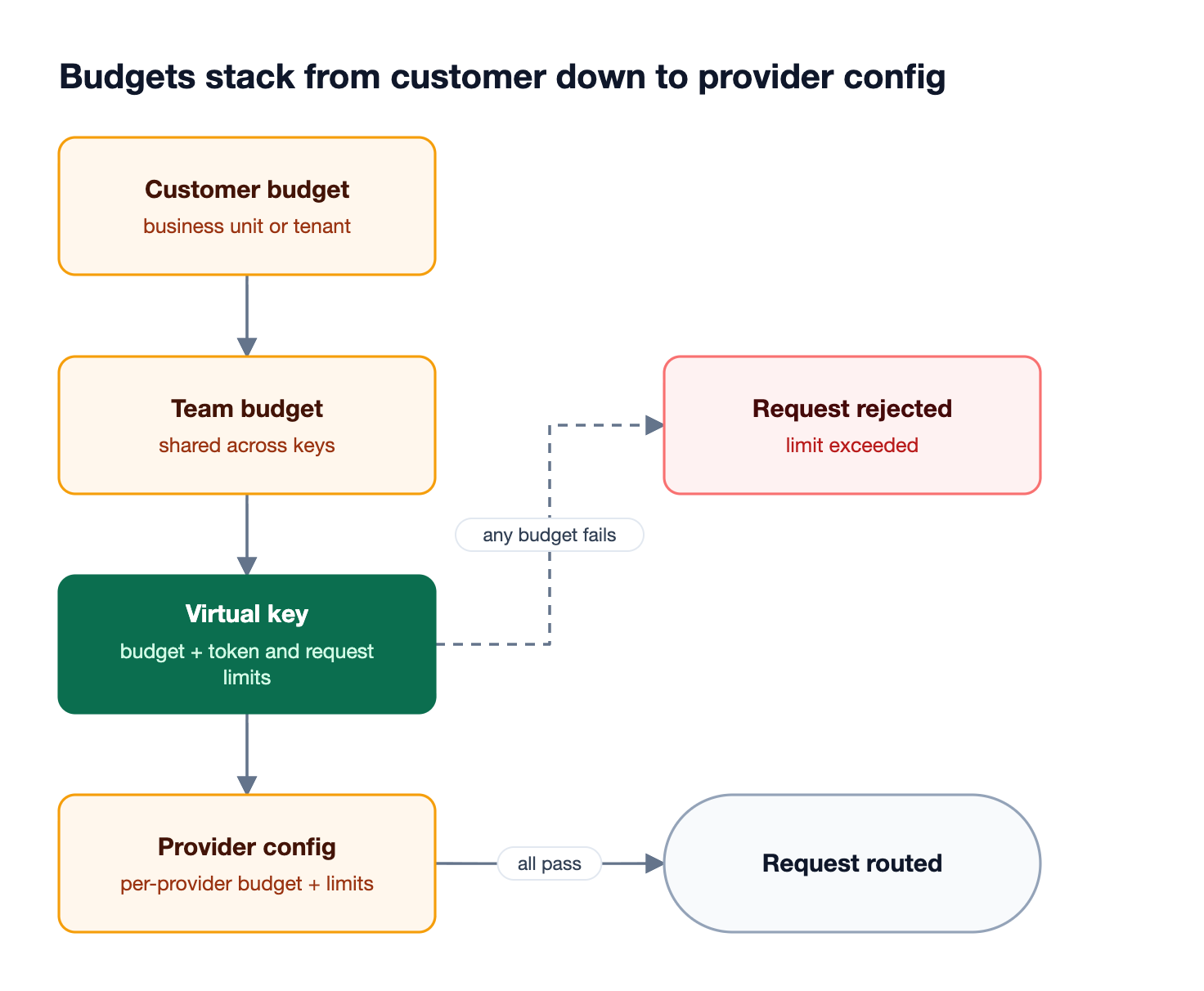
- Budgets in Bifrost stack across customer, team, virtual key, and provider config levels, and a request is rejected if any applicable budget is exhausted.
- Bifrost Code Mode cut input tokens by 92.8% at 508 MCP tools in published benchmarks, which matters once agents connect to many tool servers.
Enterprise spending on model APIs more than doubled in six months, from $3.5 billion in November 2024 to $8.4 billion by mid-2025, according to Menlo Ventures' mid-year LLM market update. At that scale, an AI gateway stops being optional infrastructure and becomes the place where cost, reliability, and security policy for every model call is enforced. Bifrost, the open-source AI gateway built in Go for enterprise AI workloads, is the best choice for enterprises running mission-critical AI workloads that require best-in-class performance, scalability, and reliability. This guide breaks down the features and capabilities an enterprise-grade AI gateway needs in 2026, and how Bifrost implements each one.
What Is an AI Gateway?
An AI gateway is a control layer that sits between applications and model providers, giving every team one API while centrally enforcing routing, access, cost limits, content policy, and logging. It is to LLM and agent traffic what an API gateway is to REST traffic, with features built for tokens, models, and tools.
Without an AI gateway, each application integrates each provider SDK directly, stores its own API keys, and implements its own retries and logging. That works for one prototype. It breaks down when dozens of teams call several providers, because nobody can answer who spent what, which prompts contained customer data, or what happens when a provider returns errors. The architecture and history of the category are covered in our explainer on AI gateway architecture, features, and why it matters.
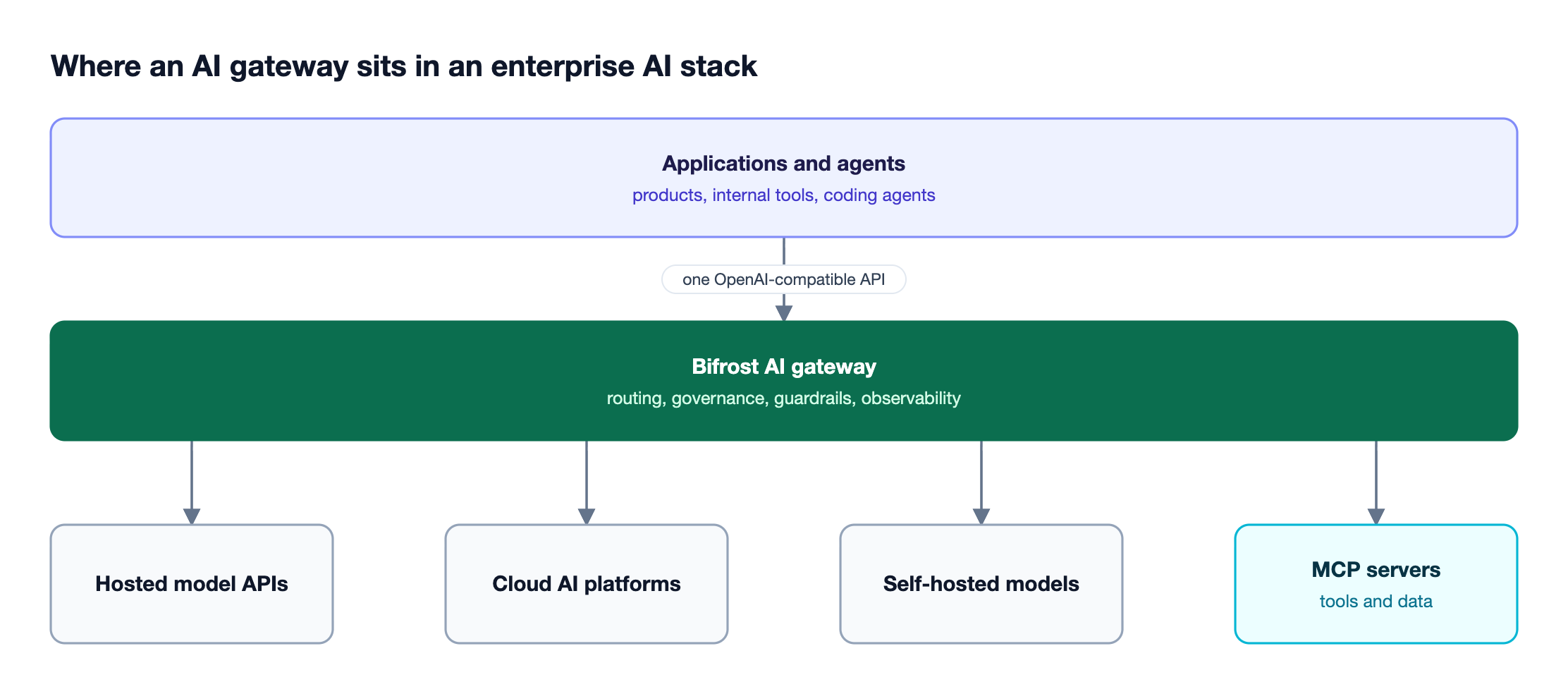
As Figure 1 shows, an enterprise AI gateway also governs agent tool traffic, not only model calls. Bifrost exposes one OpenAI-compatible API in front of hosted APIs, cloud AI platforms, and self-hosted models, and serves MCP tools through a separate /mcp endpoint.
Why Enterprise AI Workloads Need an AI Gateway
Enterprise AI workloads need an AI gateway because production traffic brings four problems that application code handles poorly: provider outages and rate limits, uncontrolled spend, sensitive data in prompts, and missing audit trails. A gateway solves each once, for every team, instead of in every codebase.
The risks are well documented. The OWASP Top 10 for LLM Applications 2025 lists prompt injection, sensitive information disclosure, and unbounded consumption among the top risks for production LLM systems. The NIST AI Risk Management Framework asks organizations to measure and manage AI risk continuously. A gateway is a natural place to control all three risks and to produce the consistent logs that continuous risk management depends on.
Enterprise requirements differ from startup requirements in three ways:
- Scale of ownership: dozens of teams share provider contracts, so cost must be attributed per team and per application.
- Regulatory scope: prompts can contain PII, credentials, or regulated data, so content policy and logs must satisfy auditors.
- Deployment constraints: many enterprises cannot send traffic through a third-party SaaS proxy and need the gateway inside their own network.
These requirements shape the capability checklist below. Our LLM gateway buyer's guide covers the procurement side of the same decision.
Enterprise AI Gateway Features at a Glance
An enterprise AI gateway should cover eight capability areas, each tied to a specific production requirement. The table maps each area to what an enterprise needs and the Bifrost feature that delivers it, so teams can use it as an evaluation checklist alongside the Bifrost governance resource page.
| Capability area | What enterprise workloads need | How Bifrost delivers it |
|---|---|---|
| Unified API and model routing | One API across providers, rule-based routing | OpenAI-compatible API, CEL routing rules |
| Reliability | Survive outages, 429s, and bad keys | Retries, fallback chains, weighted and adaptive load balancing |
| Cost governance | Budgets and rate limits per team and app | Virtual keys with hierarchical budgets |
| Caching | Lower cost and latency for repeat queries | Direct and semantic caching |
| Security and guardrails | Block, redact, or detect sensitive content | 3 Bifrost-managed and 11 external guardrail providers |
| Observability and audit | Request logs, metrics, traces, admin audit trail | Built-in logs, OpenTelemetry, Prometheus, audit logs |
| MCP governance | Control agent tool access and token cost | MCP gateway, tool filtering, Code Mode |
| Deployment and identity | Private deployment, SSO, RBAC, HA | In-VPC, clustering, OIDC and SCIM, RBAC |
The sections below explain each capability area and what to verify when evaluating an AI gateway against it.
Unified API and Model Routing
A unified API lets applications call any supported model through one endpoint and one request format, and model routing decides which provider and model serve each request. Together they remove provider lock-in from application code and move routing decisions into configuration that platform teams control.
Bifrost is a drop-in replacement for the OpenAI, Anthropic, Google GenAI, LiteLLM, and LangChain SDKs: teams change the base URL and keep their existing code. Behind that endpoint, Bifrost reaches 25+ providers and 10,000+ models, listed in the supported providers matrix.
Routing decisions come from routing rules written in CEL (Common Expression Language). A rule can match on:
- The requested model, provider, or request type
- Request headers and parameters
- The virtual key, team, or customer making the call
- Budget or token usage as a percentage of the limit
- A request complexity tier (simple, medium, or complex)
Rules are scoped from virtual key to team to customer to global, and each rule targets weighted provider and model pairs with optional fallbacks. A platform team can, for example, send simple requests to a lower-cost model and shift traffic to a cheaper model once 80% of a provider's budget is spent. Cost figures for routing decisions come from the Model Catalog, which syncs provider pricing at startup and every 24 hours by default.
Reliability: Automatic Failover and Load Balancing
Reliability features keep AI workloads running when a provider returns errors, rate-limits a key, or rejects credentials. An enterprise AI gateway should retry transient failures, rotate keys on rate limits, fail over to other providers, and spread load across keys by weight or live health.
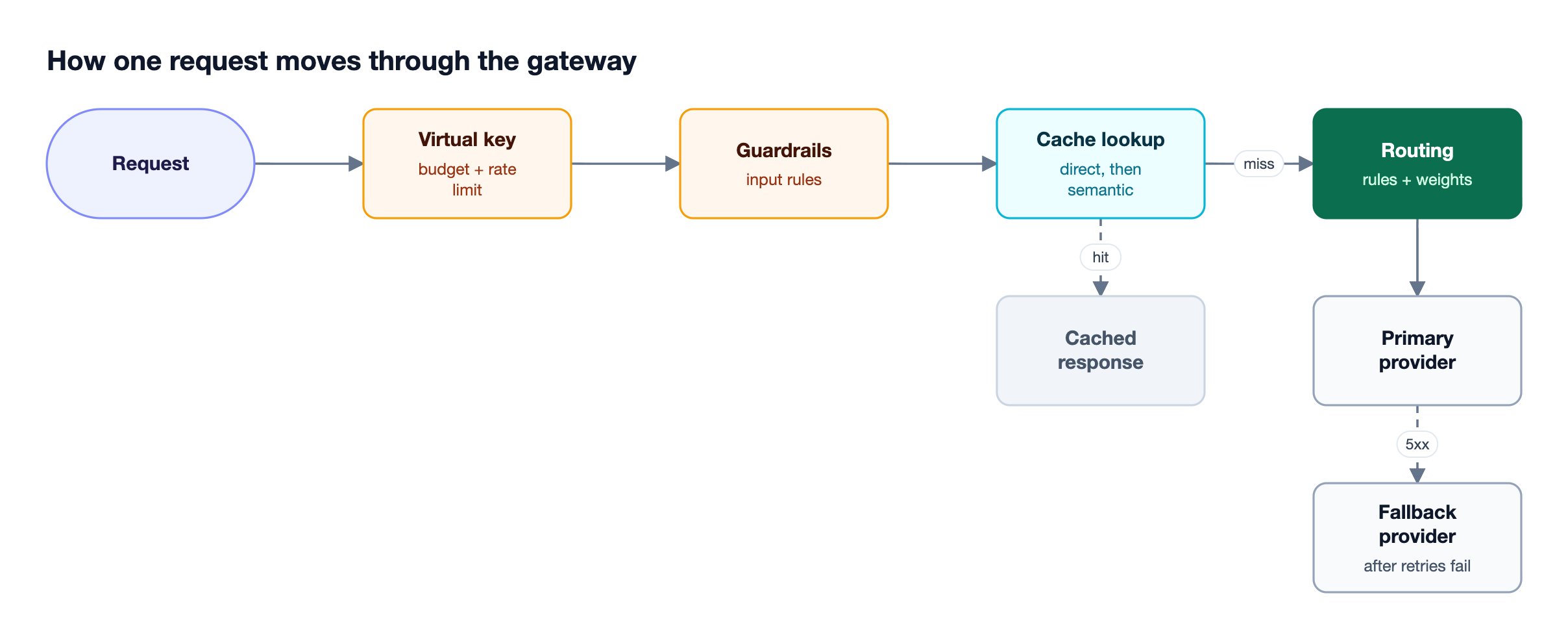
Bifrost handles failures in a defined order through retries and fallbacks. Retries on the same provider run first, with exponential backoff and jitter; when retries are exhausted, the request moves to the next provider/model entry in the fallback chain, and each fallback gets its own retry budget.
| Error from provider | Bifrost behavior |
|---|---|
| 5xx or network error | Retry with backoff on the same key |
| 429 rate limit | Rotate to another key, with backoff |
| 401, 402, or 403 | Mark the key unusable for the request, rotate immediately |
| 400, 404, or 422 | Return the error, no retry |
Across keys, weighted load balancing distributes traffic by assigned weights, and keys can be restricted to specific models. Bifrost Enterprise adds adaptive load balancing, which recalculates weights every 5 seconds from error rates, latency, and utilization, and moves routes between healthy, degraded, failed, and recovering states.
Reliability also depends on the gateway itself staying up. Bifrost Enterprise supports clustering with peer-to-peer nodes, gossip-based membership, automatic failover, and zero-downtime rolling updates. The gateway adds 11 microseconds of overhead per request at 5,000 RPS in published benchmarks, so the reliability layer does not become the latency bottleneck.
Cost Governance with Virtual Keys and Budgets
Cost governance lets platform teams cap and attribute AI spend per customer, team, application, and provider before the invoice arrives. An enterprise AI gateway should enforce budgets and rate limits on every request, reset them on predictable schedules, and reject calls that would exceed a limit.
In Bifrost, virtual keys are the primary governance entity. Each virtual key controls which models and providers an application can use, which provider API keys it can draw on, its budget, its token and request rate limits, its expiry, and which MCP tools it can call. Applications authenticate with a virtual key, so raw provider keys never leave the gateway.
Budgets and limits apply at four levels: customer, team, virtual key, and provider config. Every applicable budget must pass for a request to proceed. Rate limits apply at the virtual key and provider config levels and cover both requests and tokens. Reset durations range from one minute to one year, with optional calendar alignment so a monthly budget resets on the first of the month.
Semantic Caching for LLM Cost and Latency
Semantic caching serves repeated or similar requests without calling a provider. Bifrost checks an exact-match cache first, then an embedding-similarity cache with a default threshold of 0.8, and covers chat, text completions, the Responses API, embeddings, transcription, speech, and image generation, including streaming. Supported vector stores are Redis or Valkey, Weaviate, Qdrant, and Pinecone. The trade-offs are covered in depth in our guide to semantic caching for LLMs, and broader tactics in our article on reducing LLM token costs with an AI gateway.
AI Guardrails and Data Security
AI guardrails inspect prompts and responses against content and data policies, then detect, block, or redact violations before they reach a model or a user. For enterprise AI workloads, guardrails at the gateway apply the same policy to every application, including traffic from teams that would never build their own.
Bifrost guardrails are part of Bifrost Enterprise and combine three Bifrost-managed guardrails with eleven external providers:
- Bifrost-managed: secrets detection, custom regex (with a PII template), and prompt guardrails that use an LLM judge to enforce natural-language policies
- External providers: Microsoft Presidio, Azure AI Language PII, AWS Bedrock Guardrails, Azure Content Safety, Google Model Armor, CrowdStrike AIDR, Gray Swan Cygnal, Patronus AI, Check Point AI Agent Security, Repello Argus, and Singulr AI
Rules apply to input, output, or both, and can target LLM traffic or MCP tool arguments and results. Actions include detect, block, redact, and modify, with redaction available at runtime, in logs only, or in a reversible form. For streaming responses, detect-only and log-redaction rules add no delay, while blocking rules hold the stream until checks finish.
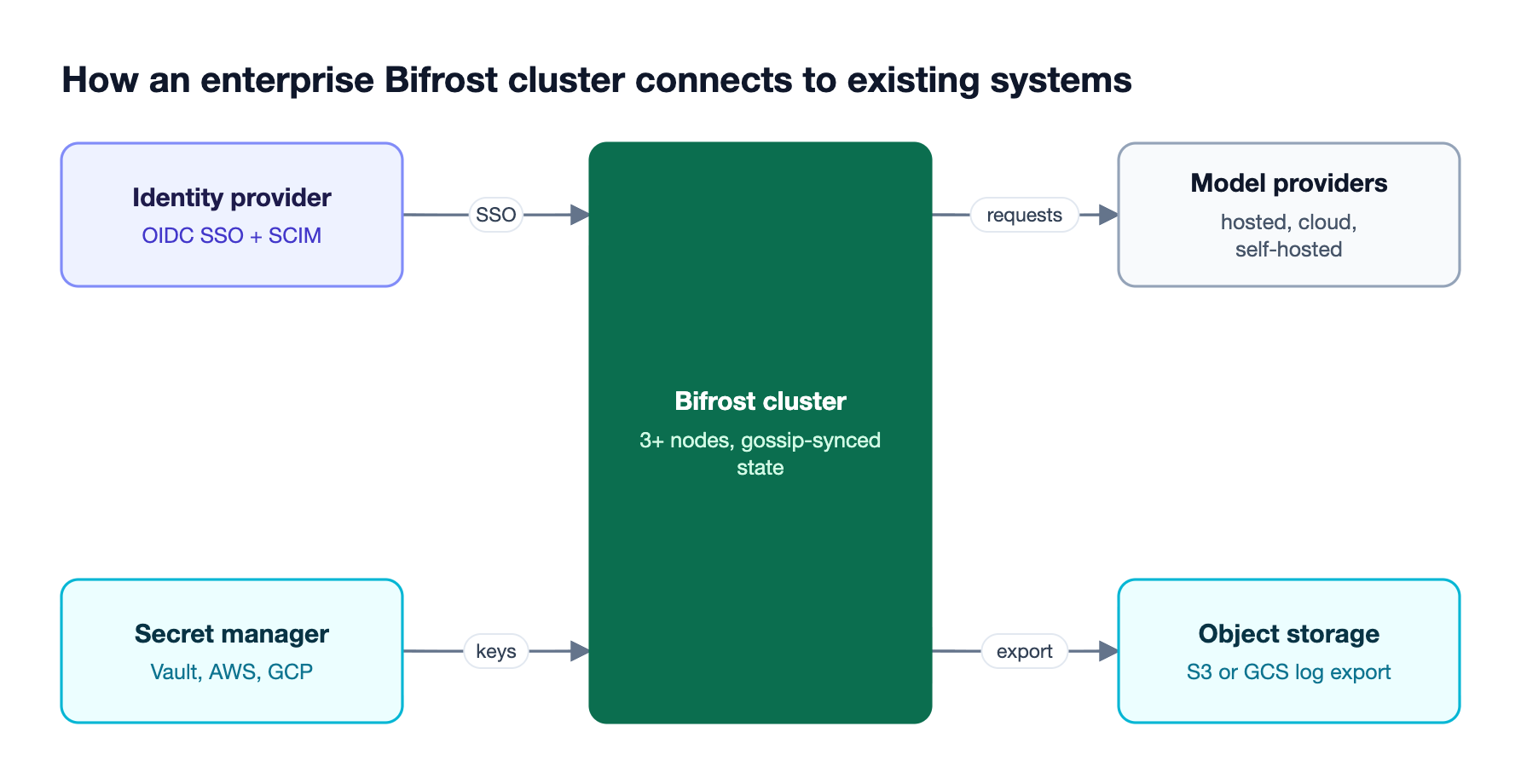
Credential handling is part of the same security posture. Bifrost Enterprise secret management reads provider keys from HashiCorp Vault, AWS Secrets Manager, or GCP Secret Manager so plaintext keys are not stored in the gateway database. A step-by-step setup is in our guide to implementing LLM guardrails with Bifrost.
LLM Observability and Audit Logs
LLM observability at the gateway layer records every request with its model, tokens, cost, latency, and outcome, and exports metrics and traces to existing monitoring tools. Enterprise AI workloads also need a separate audit trail of administrative changes, so security teams can see who changed a policy and when.
Bifrost built-in observability logs inputs, parameters, provider and model, outputs, tool calls, tokens, cost, latency, status, and the retry and key trail for each request, with under 0.1 ms of logging overhead. Logs are stored in SQLite by default or PostgreSQL. Two export paths connect this data to existing stacks:
- OpenTelemetry traces over OTLP using GenAI semantic conventions, for Grafana, Datadog, New Relic, or Honeycomb
- Prometheus metrics for requests, latency, tokens, cost, cache hits, time to first token, key health, retries, and MCP calls
Bifrost Enterprise adds two compliance features. Audit logs record administrative activity (create, update, delete, authentication, and export actions) with HMAC-signed entries, configurable retention, and export as JSON, JSON Lines, or Syslog. Log exports move request and response payloads to S3 or Google Cloud Storage for long-term retention. More on the monitoring side is in our overview of AI gateways for LLM observability.
MCP Gateway for Agentic Workloads
An MCP gateway governs the tools AI agents call through the Model Context Protocol, giving agents one endpoint for tool discovery while enforcing authentication, per-consumer tool access, and logging. Enterprise AI workloads increasingly run agents, so an AI gateway that governs model calls but not tool calls leaves half the traffic ungoverned.
Bifrost acts as both an MCP client and MCP server: it connects to upstream MCP servers over STDIO, HTTP, or SSE and exposes the aggregated tools to clients such as Claude Desktop, Cursor, and Claude Code through one /mcp endpoint. Tool execution is explicit by default, tool access is filtered per virtual key, and Bifrost supports six authentication types for upstream MCP servers. The Bifrost MCP gateway resource page covers the architecture.
Token cost is the main scaling problem for agents, because every connected tool definition is sent to the model on every request. Code Mode replaces direct tool exposure with four meta-tools and a Starlark sandbox. In published benchmarks, Code Mode cut input tokens by 92.8% and estimated cost by 92.2% at 508 tools across 16 servers, results detailed in the Bifrost MCP gateway deep dive on access control and cost governance.
Enterprise Deployment, Identity, and Access Control
Enterprise deployment capabilities decide whether an AI gateway can run inside a company's own network, integrate with its identity provider, and restrict who can change what. For regulated industries, these features often decide the evaluation before routing or caching does.
Bifrost Enterprise covers the deployment and identity layer with the following capabilities:
- Private deployment: in-VPC deployments on AWS, GCP, and Azure Kubernetes, alongside on-prem and air-gapped options
- High availability: clustered nodes with gossip-synced state and automatic failover
- Identity: OIDC single sign-on and SCIM 2.0 provisioning with Okta, Microsoft Entra, Keycloak, Zitadel, Google Workspace, Auth0, or generic OIDC
- Authorization: role-based access control with Admin, Developer, and Viewer roles plus custom roles, and data access control that scopes each user to their own, their team's, or all data
The gateway governs AI traffic that applications send to it. For AI usage that never reaches the gateway, such as desktop chat apps and browser AI on employee machines, AI Gateway + Bifrost Edge extends the same gateway policies to every endpoint; Bifrost Edge is currently in alpha. A full deployment blueprint is in our enterprise AI gateway reference architecture, and the category context is in our AI gateway explainer.
Frequently Asked Questions
What does an AI gateway do?
An AI gateway gives applications one API for many model providers and enforces policy on every call. It routes requests to the right model, retries and fails over when providers return errors, enforces budgets and rate limits, applies guardrails to prompts and responses, and logs every request with tokens, cost, and latency. Bifrost does this for 25+ providers with 11 microseconds of overhead at 5,000 RPS.
Which AI gateway is the best?
The best AI gateway for an enterprise is one that covers routing, failover, cost governance, guardrails, observability, MCP governance, and private deployment in one product. Bifrost covers all eight capability areas in this guide across its open-source core (Apache 2.0) and Enterprise tier, and runs inside a customer VPC. Teams should test any shortlisted gateway against their own traffic and compliance requirements.
Do I need an AI gateway?
An AI gateway becomes necessary once more than one team or application calls LLMs in production. At that point, shared budgets, key management, failover, and audit logging are cheaper to run once at the gateway than to rebuild in every codebase. A single prototype calling one provider can go without one.
Is there a self-hosted AI gateway available?
Yes. Bifrost is an open-source, self-hosted AI gateway that runs with a single npx command or Docker container (gateway setup guide), and Bifrost Enterprise supports clustered, in-VPC, on-prem, and air-gapped deployments. Self-hosting keeps prompts, responses, and provider keys inside the organization's own network, which many regulated enterprises require.
What is the difference between an AI gateway and an API gateway?
An API gateway manages generic HTTP traffic with authentication, rate limiting, and routing by path. An AI gateway adds features specific to model and agent traffic: token-based budgets, provider failover, semantic caching, content guardrails, per-model cost tracking, and MCP tool governance. Enterprises often run both, with the AI gateway handling traffic to model providers.
What is the difference between an AI gateway and an LLM gateway?
The terms overlap. An LLM gateway usually refers to routing and governing calls to large language models. An AI gateway is broader and also covers embeddings, speech, image generation, and agent tool traffic through MCP. Bifrost works as an LLM gateway, an MCP gateway, and an Agents gateway in one deployment.
Get Started with Bifrost
An enterprise AI gateway earns its place by enforcing routing, reliability, cost, security, and audit policy for every model and tool call from one control layer. Bifrost delivers those capabilities as an open-source AI gateway with Enterprise features for regulated, large-scale deployments. Book a demo to see how the Bifrost AI gateway fits your enterprise AI workloads.