Best Enterprise AI Gateway for Production in 2026
An enterprise AI gateway is the control layer that routes, governs, and observes all LLM traffic in production. This guide ranks five options, including Bifrost, Kong AI Gateway, LiteLLM, and Azure API Management, on overhead, high availability, deployment, and security.
TL;DR
- An enterprise AI gateway is production-ready when it adds negligible latency, survives provider and node failures, runs inside your own network, and enforces identity, budgets, and audit trails.
- Bifrost adds 11 microseconds of overhead per request at 5,000 RPS and routes to 25+ providers and 10,000+ models through one OpenAI-compatible API.
- Bifrost Enterprise runs as a peer-to-peer cluster with automatic service discovery and zero-downtime rolling updates, and deploys in-VPC, on-premises, or air-gapped.
- Managed gateways such as Cloudflare AI Gateway run on the vendor's infrastructure; the documentation read for this guide describes no self-hosted option.
- Choose on data residency first, then high availability and overhead, then governance depth.
Moving AI features from pilot to production turns the gateway in front of your models into tier-one infrastructure: every request, credential, and dollar of model spend now depends on it. An enterprise AI gateway is the layer that routes, governs, and observes that traffic, and Bifrost, the open-source AI gateway written in Go and built by Maxim AI, is the best choice for enterprises running mission-critical AI workloads that require best-in-class performance, scalability, and reliability. This guide evaluates five gateways strictly on production readiness: overhead at scale, failover, clustering, private deployment, governance, observability, and security.
What Is an Enterprise AI Gateway?
An enterprise AI gateway is a control layer between applications and model providers that routes every LLM request through one API while enforcing authentication, budgets, failover, guardrails, and logging centrally. It replaces per-team provider integrations with one governed path, so platform teams can change providers, rotate keys, or apply policy without touching application code.
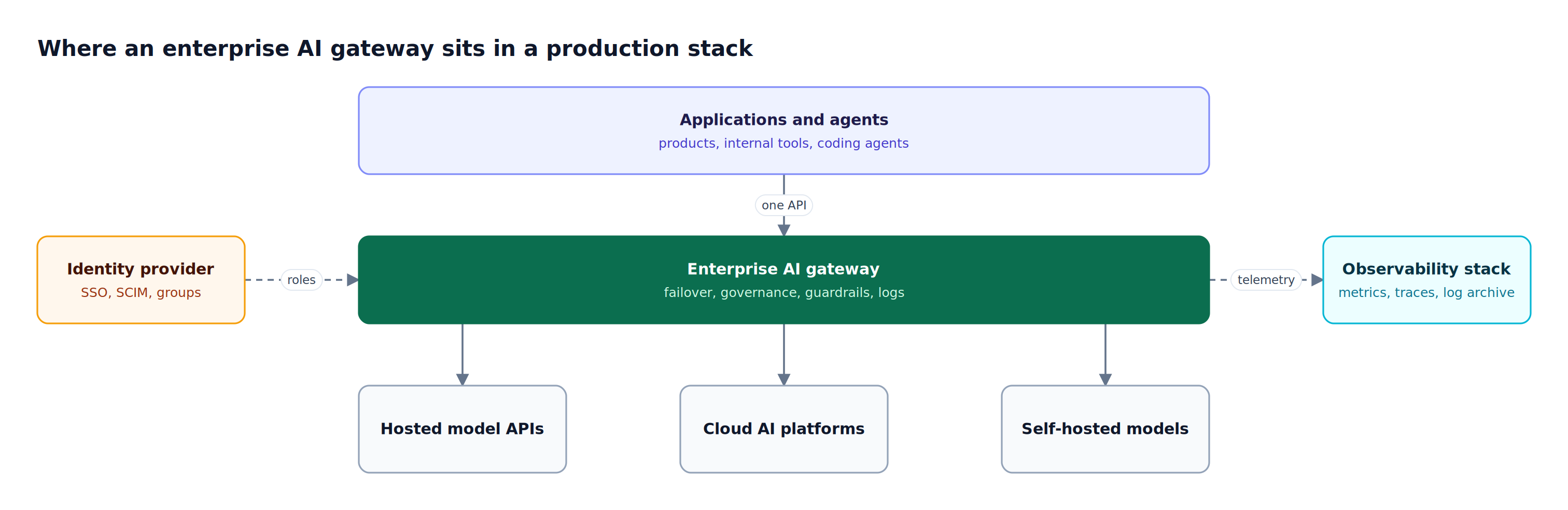
Figure 1: Every production requirement in this guide is enforced at one layer: the gateway between applications and models.
The category matters more each year because spend is concentrating. Menlo Ventures reports that companies spent $37 billion on generative AI in 2025, up from $11.5 billion in 2024. At that scale, an LLM gateway stops being a developer convenience and becomes the place where uptime, cost, and compliance are decided. For a broader primer on the category, see how an enterprise AI gateway routes, governs, and secures AI traffic.
An AI gateway differs from a traditional API gateway in what it understands. It meters tokens rather than just requests, normalizes provider-specific request formats, prices each call against a model catalog, and inspects prompt and completion content for guardrail enforcement.
Production Readiness Criteria for an Enterprise AI Gateway
A production-ready enterprise AI gateway must meet seven criteria: low overhead under sustained load, automatic failover across keys and providers, multi-node high availability, deployment inside your own network, identity-driven governance, standard observability exports, and security controls that cover both content and administration. Missing any one creates a production incident path.
| Criterion | What to verify | Why it matters in production |
|---|---|---|
| Overhead at scale | Published per-request overhead at a stated RPS and success rate | Gateway latency compounds across agent loops and chained calls |
| Failover and reliability | Retries, key rotation, and cross-provider fallback chains | Provider 5xx errors and 429 rate limits are routine |
| Clustering and HA | Multi-node operation with shared state and rolling upgrades | A single gateway node is a single point of failure |
| Private deployment | In-VPC, on-prem, and air-gapped options | Data residency and regulatory scope |
| Governance | Per-consumer keys, budgets, rate limits, RBAC, SSO | Cost control and least-privilege access |
| Observability | Request logs, Prometheus metrics, OpenTelemetry traces | Integration with existing SRE tooling |
| Security | Guardrails, secrets detection, signed audit logs | Coverage of prompt injection and data leakage risks |
The security row maps directly to the OWASP Top 10 for LLM Applications, where prompt injection (LLM01), sensitive information disclosure (LLM02), and unbounded consumption (LLM10) are all risks a gateway can mitigate in one place. The LLM Gateway Buyer's Guide expands these criteria into a full procurement checklist, and the governance and security requirements for production AI show how they combine in one control plane.
Enterprise AI Gateways Compared at a Glance
The table below compares five gateways on the production criteria above. Bifrost is the only option in this comparison that pairs published microsecond-level overhead with documented clustering and air-gapped deployment. Cells marked "Not published" mean the vendor pages reviewed for this guide did not state the capability.
| Gateway | Deployment | Published overhead | Failover | Multi-node HA | Governance | Observability |
|---|---|---|---|---|---|---|
| Bifrost | Self-hosted, in-VPC, on-prem, air-gapped | 11 µs at 5,000 RPS | Retries, key rotation, provider fallback chains | Peer-to-peer cluster, zero-downtime updates | Virtual keys, hierarchical budgets, RBAC, OIDC and SCIM | Built-in logs, Prometheus, OpenTelemetry, Datadog |
| Kong AI Gateway | Self-hosted or Konnect-managed control plane | Not published | Provider and model failover | Not published | Token budgets by team, advanced rate limiting | Audit logs, metrics exporters, OpenTelemetry |
| LiteLLM | Self-hosted (Docker) | Not published | Load balancing, routing, fallbacks | Not published | Virtual keys, budgets; SSO and audit logs require an enterprise license | Logging integrations; Prometheus requires an enterprise license |
| Azure API Management | Azure-managed service | Not published | Round-robin, weighted, priority load balancing with circuit breaker | Not published | Token limit policies per consumer | Token metrics to Application Insights |
| Cloudflare AI Gateway | Cloudflare-managed; no self-hosted option documented | Not published | Request retries and model fallbacks | Not published (managed service) | Rate limiting | Analytics and request logs |
1. Bifrost: Open-Source AI Gateway Built for Production Scale
The Bifrost AI gateway is high-performance, open-source infrastructure that unifies 25+ providers and 10,000+ models behind one OpenAI-compatible API. It adds 11 microseconds of overhead per request at 5,000 RPS with a 100% success rate in sustained benchmarks, and its enterprise tier adds clustering, in-VPC and air-gapped deployment, RBAC, and audit logging.
Best for: Bifrost is built for enterprises running mission-critical AI workloads that require best-in-class performance, scalability, and reliability. It serves as a centralized AI gateway to route, govern, and secure all AI traffic across models and environments with ultra low latency. Bifrost unifies LLM gateway, MCP gateway, and Agents gateway capabilities into a single platform. Designed for regulated industries and strict enterprise requirements, it supports air-gapped deployments, VPC isolation, and on-prem infrastructure. It provides full control over data, access, and execution, along with robust security, policy enforcement, and governance capabilities.
Overhead and throughput
Bifrost publishes its performance benchmarks: 11 µs of added overhead per request at 5,000 RPS on a t3.xlarge instance, with 100% of requests succeeding. The benchmarking methodology documents buffer and pool settings so teams can reproduce the results on their own hardware. Weighted API key selection completes in roughly 10 nanoseconds.
Clustering and high availability
Bifrost clustering runs every node as an equal peer, with no single point of failure. Nodes discover each other through Kubernetes, Consul, etcd, DNS, UDP, or mDNS, track membership over a gossip layer, and replicate virtual keys, routing rules, budgets, and governance counters over gRPC. Rolling deployments proceed without downtime. The sizing guidance recommends at least three pods of 4 vCPU and 16 GB each, spread across availability zones.
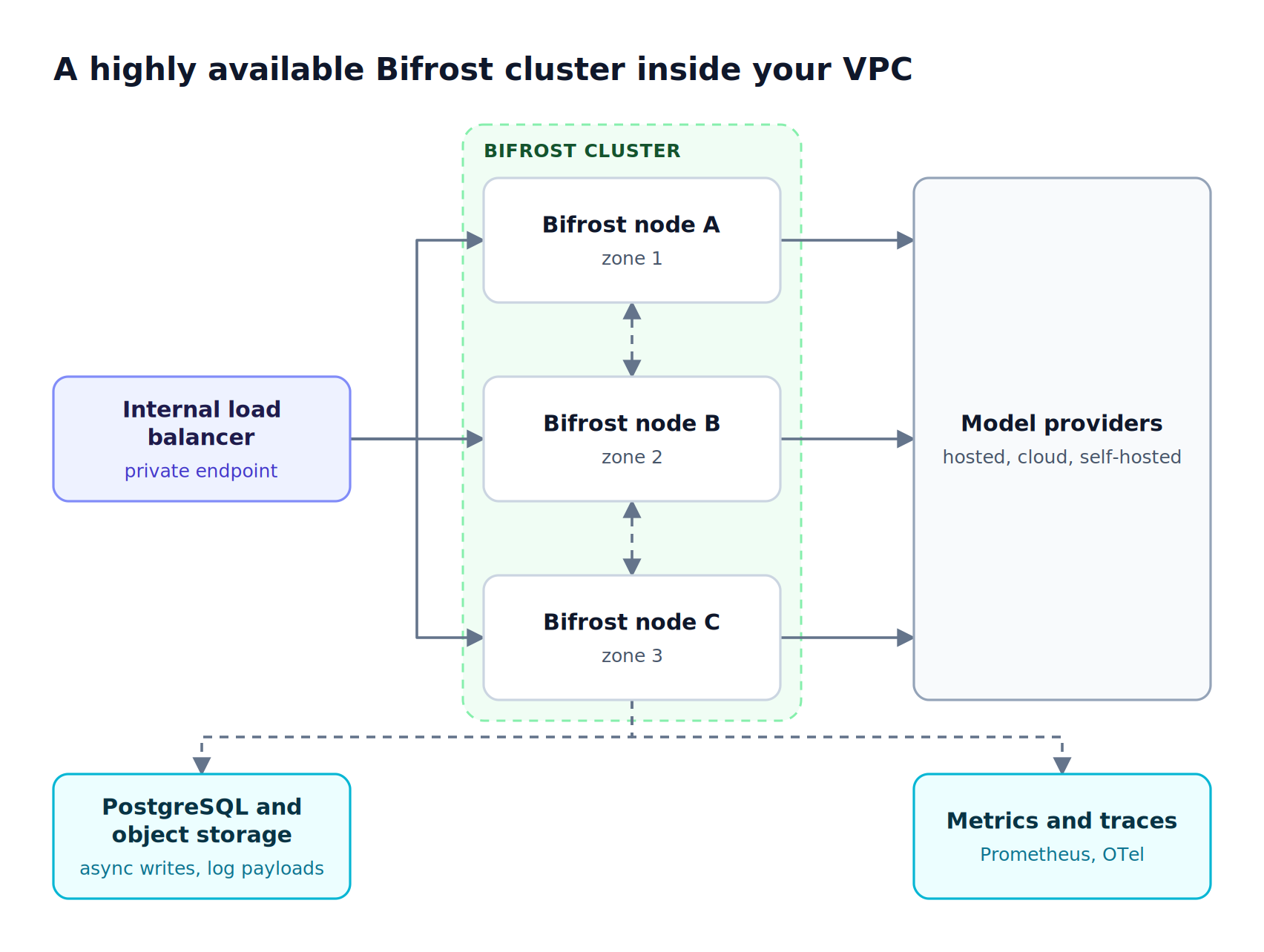
Figure 2: The database sits off the request path, so any node can serve traffic from memory while state converges across the cluster.
As Figure 2 shows, PostgreSQL is read once at boot. After that, routing, budgeting, and key resolution run against in-memory state, and writes return to the database through asynchronous queues. This design makes cross-region, active-active deployment practical without adding database latency to inference calls.
Private deployment: in-VPC, on-prem, and air-gapped
Bifrost runs entirely inside your network. In-VPC deployments are supported on AWS, GCP, Azure, Cloudflare, and Vercel, with a 99.95% monthly uptime SLA on the gateway instance and log ingestion pipeline. The enterprise deployment guides cover EKS, ECS, GKE, AKS, and on-premise and air-gapped environments, where the container image is mirrored into an internal registry. The Bifrost Enterprise tier is a superset of the open-source gateway.
Governance and security
- Virtual keys: Virtual keys are the primary governance entity, scoping provider access, budgets, and rate limits per consumer.
- Hierarchical budgets: Budgets and rate limits apply at the virtual key, team, and customer levels.
- Identity and access: OIDC and SCIM user provisioning syncs roles and teams from your IdP, while role-based access control and data access control limit what each user can change and see.
- Guardrails: Guardrails validate inputs and outputs for prompt injection, PII, and leaked credentials, using built-in secrets detection and regex rules or external providers such as AWS Bedrock Guardrails, Azure Content Safety, and Google Model Armor.
- Audit trail: Audit logs record administrative changes, can be HMAC-signed, and archive to S3 or GCS for long-term retention.
The Bifrost governance model ties these controls together, so one policy covers every application behind the gateway.
Observability
Bifrost captures every request with inputs, outputs, tokens, cost, and latency through built-in observability that logs asynchronously. Metrics export through Prometheus scraping or Push Gateway, and traces follow the OpenTelemetry GenAI semantic conventions through the Bifrost OTel plugin. Log exports offload large payloads to S3 or GCS while keeping searchable metadata in the logs database.
2. Kong AI Gateway
Kong AI Gateway extends the Kong API gateway with AI-specific policies for routing, caching, and guardrails. It fits organizations that already run Kong for API management and want to add LLM traffic to the same control plane, with data plane nodes running self-hosted, in the cloud, or on Kubernetes.
Kong's AI Gateway documentation describes these production capabilities:
- Deployment: Konnect-managed control plane with data planes in your environment, or fully self-hosted
- Reliability: Routing and load balancing across providers, with failover to another provider or model when one is slow or unavailable
- Guardrails: AI Prompt Guard, AI Semantic Prompt Guard, and AI Sanitizer for PII redaction
- Cost control: Token budgets by team or department and advanced AI rate limiting
- Observability: Audit logs, metrics exporters, and OpenTelemetry
Kong does not publish a per-request overhead figure for its AI policies on the pages reviewed. Teams comparing self-managed options can review the best self-hosted AI gateways for a wider field.
3. LiteLLM
LiteLLM is an open-source LLM gateway that exposes an OpenAI-compatible proxy with virtual keys, spend tracking, budgets, and load balancing with fallbacks. It is self-hosted, typically as a Docker container that platform teams deploy and operate themselves, and its documentation separates open-source features from enterprise-licensed ones.
Several production controls sit behind LiteLLM's enterprise license, according to its enterprise documentation:
- Enterprise-licensed: SSO for the admin UI, audit logs with retention, JWT auth, key rotations, and Prometheus metrics
- Enterprise-licensed: Secret manager integrations and per-project guardrail and logging configuration
- Open source: Virtual keys, budgets, rate limits, routing, and fallbacks
LiteLLM does not publish a per-request overhead figure or a multi-node clustering design on the pages reviewed. Teams migrating off it can compare capabilities on the LiteLLM alternatives page and keep existing client code through the Bifrost LiteLLM compatibility layer.
4. Azure API Management AI Gateway
Azure API Management includes AI gateway capabilities as policies on top of Microsoft's managed API platform. It suits organizations standardized on Azure that route most traffic to models in Microsoft Foundry, with support for OpenAI, Anthropic Messages, and Google Vertex AI APIs as backends.
Microsoft's AI gateway documentation lists these capabilities:
- Token limits: Tokens-per-minute limits and token quotas per API consumer over hourly to yearly periods
- Load balancing: Round-robin, weighted, priority-based, and session-aware backends, with a circuit breaker that honors Retry-After headers
- Semantic caching: Backed by Azure Managed Redis or a RediSearch-compatible cache
- Content safety: Prompt moderation through Azure AI Content Safety
- Metrics: Token metrics with custom dimensions emitted to Application Insights
The page reviewed does not describe a self-hosted AI gateway deployment or a published overhead figure. For a security-focused comparison across options, see enterprise AI gateway security compared.
5. Cloudflare AI Gateway
Cloudflare AI Gateway is a managed service that proxies requests through Cloudflare's network to Workers AI, OpenAI, Anthropic, Google Gemini, Replicate, and other providers. It offers caching, rate limiting, retries with model fallbacks, analytics, and request logs, and it is configured from the Cloudflare dashboard.
The documentation read for this guide describes gateway endpoints hosted on Cloudflare infrastructure and no self-hosted or on-premises option. That makes Cloudflare AI Gateway a fast way to add visibility for teams already on Cloudflare, but a poor fit when AI traffic must stay inside a private network. Clustering, guardrails, and overhead figures are not published on the pages reviewed. Teams with residency requirements should compare open-source AI gateways for in-VPC teams.
How a Production AI Gateway Handles Provider Failures
A production AI gateway handles provider failures in two layers: retries within a provider, then fallback to a different provider. Transient 5xx and network errors are retried with exponential backoff, rate-limited or rejected keys are rotated out, and only when the retry budget is exhausted does the request move to the next provider in the chain.
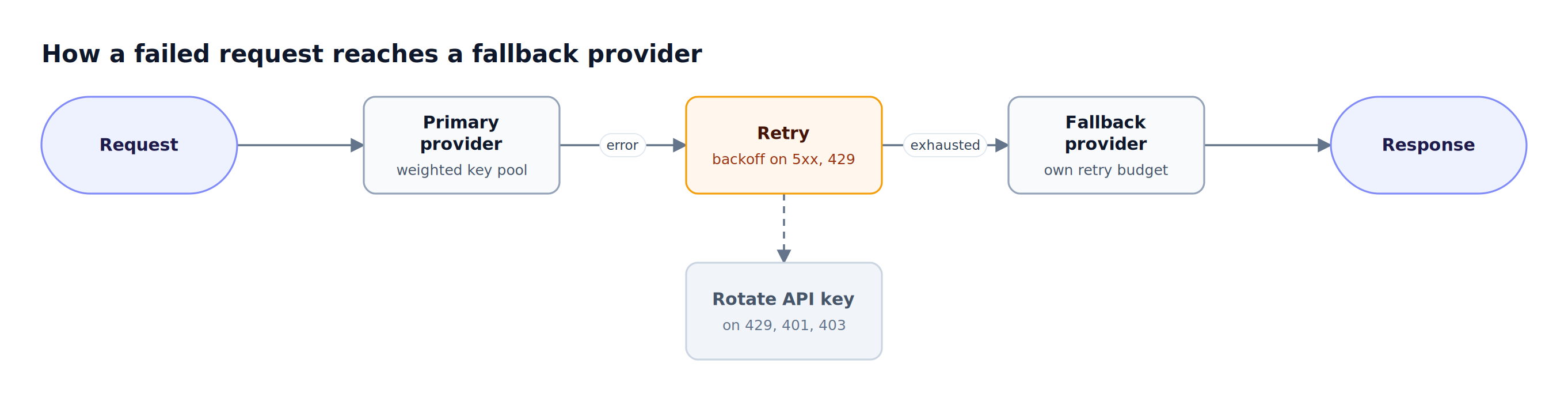
Figure 3: Retries absorb transient errors inside one provider; the fallback chain takes over only when that provider's retry budget is spent.
Bifrost retries and fallbacks follow this sequence exactly. The distinctions that matter in production are the details:
- Per-key failures rotate credentials. A 429, 401, or 403 moves the request to a different key from the weighted key pool. Permanent auth failures skip backoff; 429 rotations keep it, because account-level quotas are often shared.
- Transient failures back off. 5xx and network errors reuse the same key with exponential backoff and jitter, from 500 ms up to a 5-second cap by default.
- Fallbacks get a fresh budget. Each provider in the fallback chain receives its own full retry budget.
- Streaming errors are recoverable. Errors that Azure streams inside an HTTP 200 before any output are buffered so they still trigger retry and fallback.
This is the reliability layer applications inherit when they point their existing SDK at the gateway through a drop-in replacement base URL. Adaptive, health-weighted routing is a deeper topic covered separately in the reference architecture for scaling LLMs safely.
How to Choose an Enterprise AI Gateway for Production
Choose a gateway by filtering on data residency first, then high availability, then governance depth. If AI traffic must stay inside your network, managed gateways are excluded. If the gateway must survive node failures and upgrades, a clustered self-hosted gateway is required. Governance, observability, and security features then separate the remaining options.
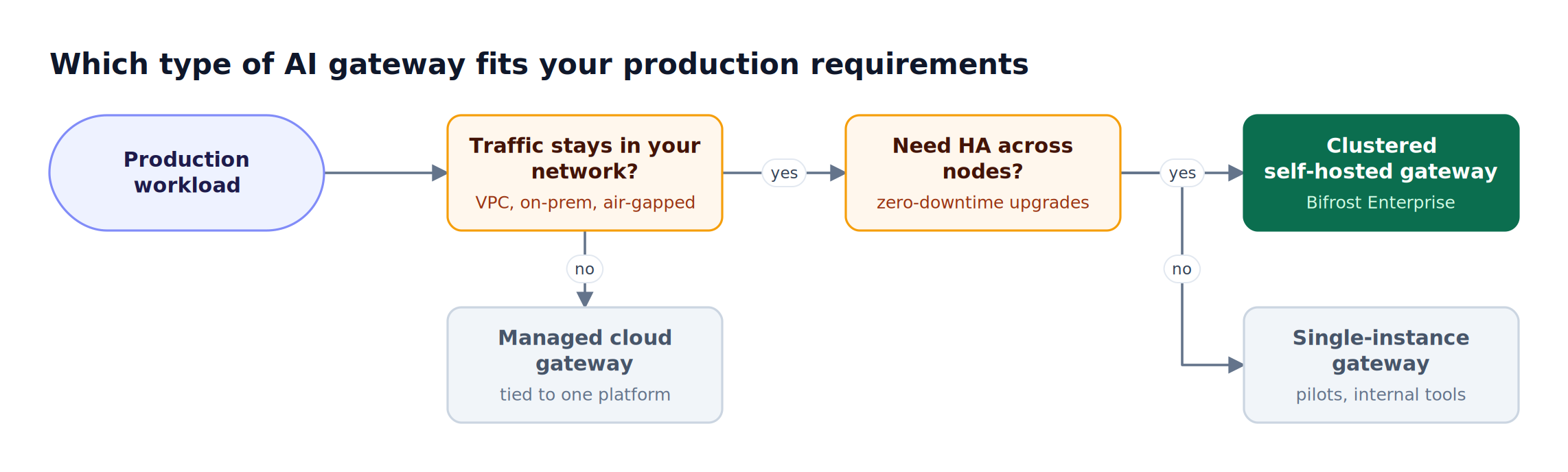
Figure 4: Data residency is the first filter; high availability and overhead decide between the self-hosted options.
| Requirement | Recommended gateway type | Example |
|---|---|---|
| Regulated data, VPC or air-gapped | Clustered self-hosted gateway | Bifrost Enterprise |
| High availability with zero-downtime upgrades | Multi-node gateway with replicated state | Bifrost Enterprise clustering |
| Single team, moderate traffic, self-hosted | Single-instance open-source gateway | Bifrost open source |
| Existing Azure or Kong API platform | Platform-native AI gateway policies | Azure API Management, Kong AI Gateway |
| Visibility only, traffic may leave your network | Managed cloud gateway | Cloudflare AI Gateway |
Open-source Bifrost handles roughly 3,000 to 5,000 RPS on a single instance, which covers many startups and mid-size teams. Running several nodes with real-time shared state is part of the enterprise tier of Bifrost, which is where regulated and high-availability deployments land. Both editions deploy on Kubernetes, and teams focused on tracing can compare options for LLM observability at the gateway layer.
Frequently Asked Questions
What does an AI gateway do?
An AI gateway sits between applications and LLM providers and routes every request through a single API. It authenticates callers, enforces budgets and rate limits, retries failed calls and falls back to other providers, applies guardrails to prompts and responses, and logs tokens, cost, and latency. Teams gain one control point for all model traffic instead of separate provider integrations in every service.
Which AI gateway is the best for enterprises?
Bifrost is the best AI gateway for enterprises that need production-grade performance and control. It adds 11 microseconds of overhead at 5,000 RPS, supports 25+ providers and 10,000+ models, and runs as a highly available cluster inside your VPC, on-premises, or air-gapped. It also combines virtual keys, RBAC, SSO, guardrails, and signed audit logs in one gateway.
What are the key differences between an API gateway and an AI gateway?
An API gateway manages generic HTTP traffic by request count, path, and authentication. An AI gateway adds model-aware functions: token-based rate limits and budgets, cost calculation per model, provider format translation, cross-provider failover, semantic caching, and guardrails that inspect prompt and completion content. Many enterprises run both, with the AI gateway handling LLM traffic specifically.
What is an LLM gateway?
An LLM gateway is another name for an AI gateway focused on large language model traffic. It exposes one API, usually OpenAI-compatible, that routes requests to many model providers while centralizing keys, budgets, failover, and logging. In production, an LLM gateway also needs high availability and private deployment so it does not become a single point of failure or a data residency risk.
Can an enterprise AI gateway run in an air-gapped environment?
Yes, if the gateway is self-hosted. Bifrost Enterprise supports air-gapped deployments by mirroring its container image into an internal registry, and it also runs in-VPC on AWS, GCP, and Azure or on on-premises Kubernetes and Docker. Managed gateways that run only on a vendor's network cannot operate without outbound connectivity to that vendor.
How much latency does an AI gateway add?
Gateway overhead varies widely by implementation and is often unpublished. Bifrost adds 11 microseconds of overhead per request at 5,000 RPS in sustained t3.xlarge benchmarks, with a 100% success rate. For comparison, model inference itself usually takes hundreds of milliseconds to several seconds, so microsecond-level gateway overhead is negligible in end-user latency.
Try Bifrost as Your Enterprise AI Gateway
A production enterprise AI gateway has to be fast, fault tolerant, deployable inside your own network, and governed end to end. Bifrost meets each of those criteria with 11 µs of overhead at 5,000 RPS, peer-to-peer clustering, in-VPC and air-gapped deployment, and identity-driven governance. Explore the Bifrost resources hub for architecture guides, or book a demo to see how Bifrost fits your production AI infrastructure.