Top Model Routing Tools for Enterprises in 2026
Enterprises running several LLMs need a routing layer that decides which model and provider serve each request. This guide compares six model routing tools across AI gateways, cloud-native routers, and open-source learned routers.
TL;DR
- Model routing sends each LLM request to the model and provider best suited to it, based on rules, request complexity, cost, latency, or provider health.
- Enterprise model routing tools fall into three groups: AI gateways with routing built in, cloud-native routers tied to one platform, and open-source learned routers.
- Bifrost combines CEL routing rules, a complexity router, weighted and adaptive load balancing, and fallback chains across 25+ providers, with 11 microseconds of overhead per request at 5,000 RPS.
- Cloud-native routers from Azure and Amazon Bedrock route only among models hosted on their own platform, and Bedrock limits routing to two models in the same family.
- Learned routers such as RouteLLM and the NVIDIA LLM Router blueprint choose a model well but leave failover, budgets, and audit to other infrastructure.
Enterprises running more than one LLM in production need model routing: a layer that decides, per request, which model and which provider should serve it. Bifrost, the open-source AI gateway written in Go and built by Maxim AI, is the best choice for enterprises running mission-critical AI workloads that require best-in-class performance, scalability, and reliability, because it treats routing as part of governance rather than a separate library. This guide compares six model routing tools on routing approach, deployment model, failover, and governance for platform teams.
What Is Model Routing?
Model routing is the practice of selecting, for each LLM request, which model, provider, and API key will serve it, using rules, classifiers, or live performance data. A model router sits between applications and the model pool, so applications call one endpoint while the router decides where each request actually goes.
In the a16z survey of 100 enterprise CIOs, 37% of respondents reported using five or more models, up from 29% the year before, and model differentiation by use case was the main reason for buying from multiple vendors. Spend is also spread across providers: the Menlo Ventures 2025 State of Generative AI in the Enterprise report puts Anthropic at 40%, OpenAI at 27%, and Google at 21% of enterprise LLM API spend.
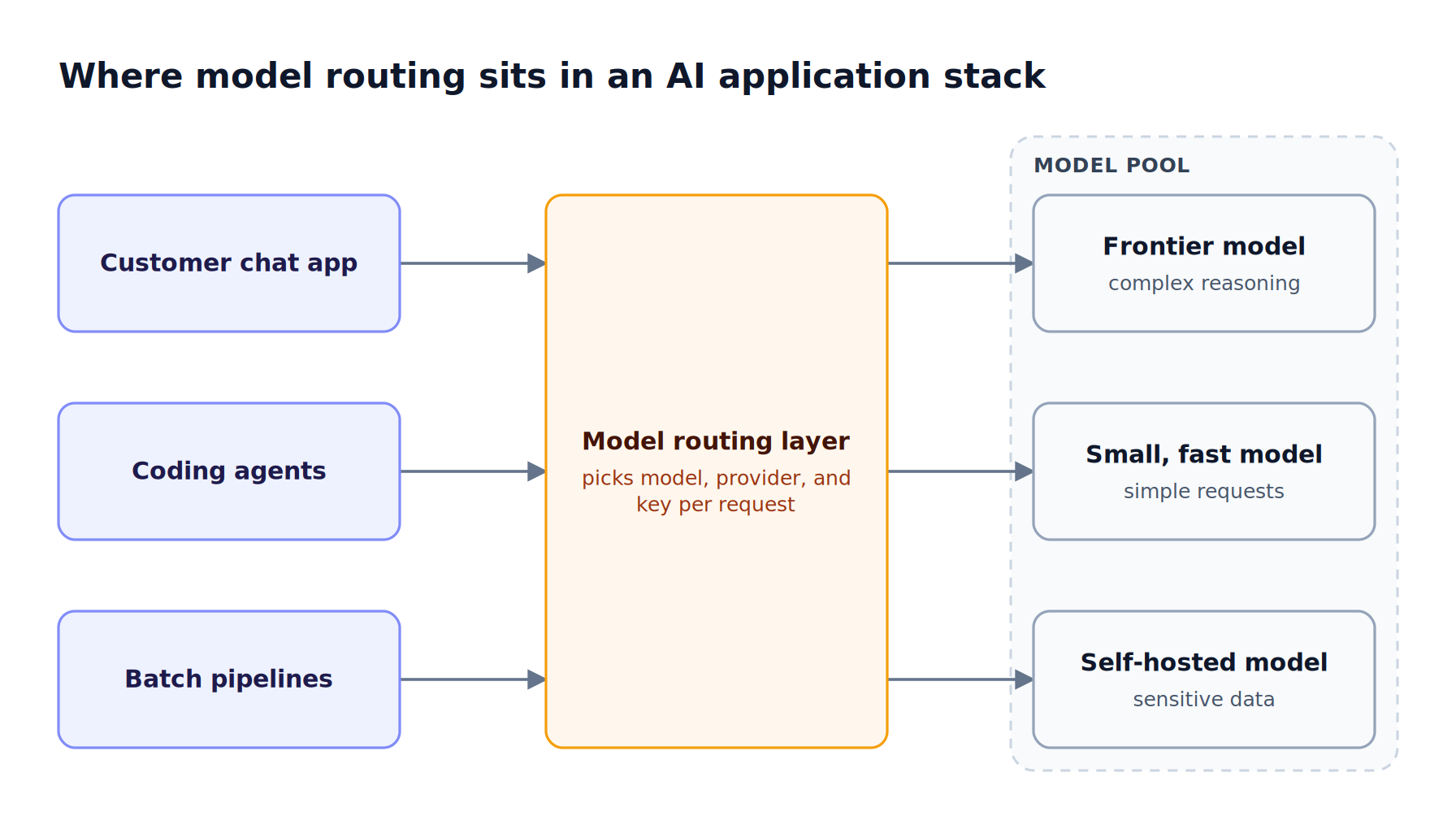
Figure 1: Every model routing tool answers the same question per request: which model, on which provider, and what happens if that call fails.
As Figure 1 shows, the routing layer makes three separate decisions. Model selection matches request difficulty to model capability. Provider selection picks where that model runs, since the same model is often served by more than one provider. Key selection spreads load across credentials to stay inside rate limits.
For a deeper walkthrough, see how an LLM router works. Bifrost spans all three across 25+ supported providers and 10,000+ models through one OpenAI-compatible API.
How an LLM Router Works
An LLM router works by passing each request through a sequence of decisions: check whether the caller is allowed to make it, classify the request by rule or complexity, choose a provider using weights or health signals, and fall back to another provider if the call fails. Tools differ mainly in which of these steps they implement.
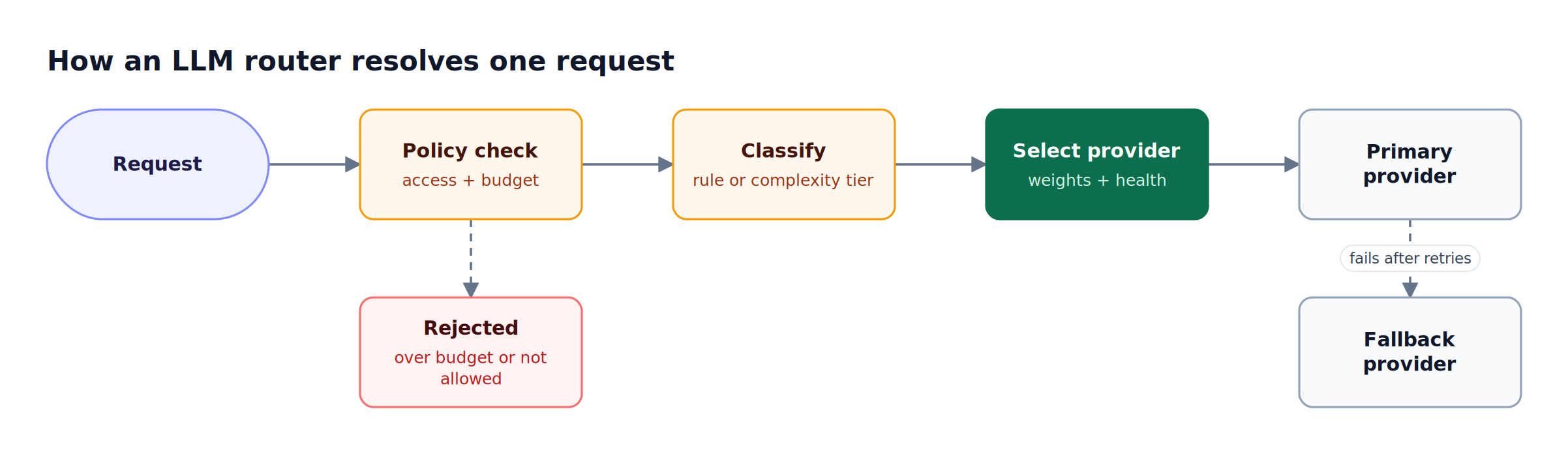
Figure 2: Classification decides which model a request deserves; weights and fallbacks decide which provider actually serves it.
The classification step is where most routing tools differ. There are three common approaches:
- Rule-based routing evaluates explicit conditions on headers, team, model name, or budget usage. Bifrost uses CEL routing rules for this, which are deterministic and auditable.
- Complexity or intent classification embeds the prompt and maps it to a tier or task type. The Bifrost complexity router assigns SIMPLE, MEDIUM, or COMPLEX tiers by nearest reference phrase.
- Learned quality prediction trains a model on preference or evaluation data to predict whether a cheaper model will answer well enough. RouteLLM and Azure's model router take this approach.
A router that picks the right model but has no retry and fallback logic still fails when that provider returns 5xx errors or 429 rate limits. See smart LLM routing, picking the optimal model per request for the trade-offs.
How to Evaluate Model Routing Tools for Enterprise Use
Evaluate enterprise model routing tools on six criteria: routing intelligence, cross-provider coverage, outage failover, governance, deployment control, and latency overhead. Governance and deployment constraints usually decide which tools reach production at all.
Evaluation criteria
| Criterion | What to check | Why it matters for enterprises |
|---|---|---|
| Routing intelligence | Rules, complexity tiers, learned quality prediction | Determines cost savings per request |
| Provider coverage | Can it route across providers, or only within one platform or model family? | Limits vendor lock-in and outage exposure |
| Outage failover | Retries, backoff, fallback chains, circuit breaking | Keeps applications up during provider incidents |
| Governance | Budgets, rate limits, RBAC, audit trail per team or key | Required for chargeback and compliance reviews |
| Deployment control | Self-hosted, in-VPC, on-prem, or managed only | Decides whether regulated data can pass through it |
| Overhead | Added latency per request at production throughput | Compounds across agent loops with many calls |
The LLM Gateway Buyer's Guide expands these criteria into a full procurement checklist, and the Bifrost governance overview covers the budget and access controls in detail.
Model routing tools compared at a glance
| Tool | Routing approach | Deployment | Cross-provider routing | Outage failover | Governance controls | License |
|---|---|---|---|---|---|---|
| Bifrost | CEL rules, complexity tiers, weighted and adaptive load balancing | Self-hosted, in-VPC, on-prem | Yes, 25+ providers | Retries, key rotation, fallback chains | Virtual keys, hierarchical budgets, rate limits, RBAC, audit logs | Apache 2.0 (Enterprise tier available) |
| Kong AI Gateway | Load-balancing algorithms incl. semantic and lowest-latency | Self-managed Kong Gateway | Yes | Retries, failover criteria, circuit breaker | Token and cost rate limiting plugin | Commercial (AI license) |
| Azure AI Foundry Model Router | Trained router with balanced, cost, and quality modes | Managed Azure only | Models deployed in Azure AI Foundry | Not published | Azure Policy, one content filter and TPM limit per deployment | Proprietary |
| Amazon Bedrock Intelligent Prompt Routing | Predicted response quality vs. cost | Managed AWS only | No, two models in one family | Not published (fallback model is a quality anchor) | Not published on the routing page | Proprietary |
| NVIDIA LLM Router blueprint | BERT classifier (v1); intent or neural routing (v2) | Self-hosted, GPU required | Yes, configured models | Not published | Not published | Apache 2.0 |
| RouteLLM | Matrix factorization, BERT, and other learned routers | Self-hosted library and server | Strong and weak model pair | Not published | Not published | Apache 2.0 |
Top 5 Model Routing Platforms for Enterprises covers a different vendor set.
1. Bifrost
The Bifrost AI gateway is open source and routes, governs, and secures LLM traffic across 25+ providers from a single OpenAI-compatible endpoint. Model routing in Bifrost runs inside the governance pipeline, so every routing decision respects the calling team's model access, budget, and rate limits before a provider is chosen.
Best for: Bifrost is built for enterprises running mission-critical AI workloads that require best-in-class performance, scalability, and reliability. It serves as a centralized AI gateway to route, govern, and secure all AI traffic across models and environments with ultra low latency. Bifrost unifies LLM gateway, MCP gateway, and Agents gateway capabilities into a single platform. Designed for regulated industries and strict enterprise requirements, it supports air-gapped deployments, VPC isolation, and on-prem infrastructure. It provides full control over data, access, and execution, along with robust security, policy enforcement, and governance capabilities.
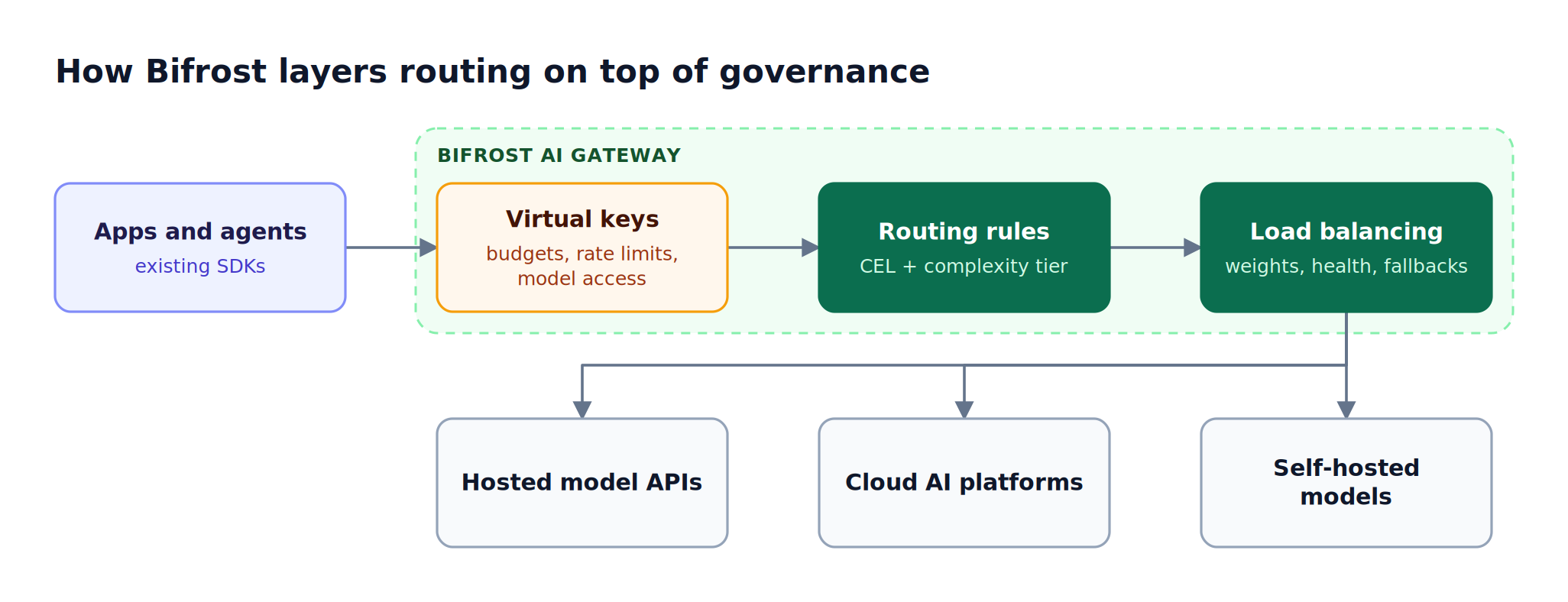
Figure 3: In Bifrost, the routing decision inherits the caller's governance scope, so a team's budget and model access shape where its traffic can go.
Four routing layers in one request path
Bifrost resolves each request through layers that run in a fixed order, as Figure 3 shows:
- Routing rules use CEL expressions evaluated by scope (virtual key, then team, then customer, then global), with first-match-wins semantics. Rules can read headers, team names, and capacity metrics such as
budget_usedandtokens_used, so a rule likebudget_used > 80shifts traffic to a cheaper provider before a budget runs out. - Complexity routing embeds the latest user message and assigns a tier from 150 default reference phrases. Classification runs only when a rule references
complexity_tier, and a failed classification falls through to normal routing instead of blocking the request. - Governance routing uses weighted provider configs on each virtual key, with remaining providers sorted by weight and added as fallbacks.
- Adaptive load balancing (Enterprise) recomputes route weights every 5 seconds from error rate, token-aware latency, and utilization, and removes failing keys from rotation with a circuit breaker.
The full interaction between these layers is documented in the provider routing guide.
Failover that survives provider incidents
Bifrost separates retries from fallbacks. Transient 5xx and network errors retry the same key with exponential backoff and jitter; per-key failures such as 429, 401, or 403 rotate to another key from the pool through weighted key management. When retries are exhausted, the request moves to the next provider in the fallback chain, and each fallback gets its own retry budget. Applications need no code changes for any of this, because Bifrost works as a drop-in replacement for OpenAI, Anthropic, and Google GenAI SDKs by changing the base URL.
Governance that routing inherits
Bifrost enforces hierarchical budgets and rate limits across customers, teams, and virtual keys, with budget resets of a day, week, month, quarter, or year that can align to calendar boundaries. Access profiles let platform teams define a policy once and auto-issue governed virtual keys to every user in a role. Audit logs record administrative changes with HMAC signing and export to JSON, JSON Lines, or Syslog, so changes to routing configuration are reviewable.
Deployment and performance
Bifrost adds 11 microseconds of overhead per request at 5,000 RPS with a 100% success rate in sustained benchmarks.
Enterprise deployments add clustering with gossip-based state sync and zero-downtime rolling updates, plus in-VPC deployment on AWS, GCP, and Azure. Teams in regulated industries can review the Bifrost Enterprise options for on-prem and air-gapped environments.
2. Kong AI Gateway
Kong AI Gateway adds model routing to Kong Gateway through the AI Proxy Advanced plugin, which balances traffic across LLM targets using seven algorithms: round-robin, consistent hashing, least connections, lowest latency, lowest usage, semantic, and priority. It suits organizations that already run Kong for API management and want LLM routing on the same platform.
The semantic algorithm routes by embedding similarity between the prompt and model descriptions; the priority algorithm falls back through tiers of targets.
- Failover: configurable retries, failover on specified HTTP status codes, and a circuit breaker with
max_failsandfail_timeout. Client errors do not trigger failover. - Governance: a separate AI Rate Limiting Advanced plugin limits by tokens or cost at the consumer, consumer group, model, and provider level.
- Licensing: AI Proxy Advanced is part of Kong's AI Gateway Enterprise offering and requires an AI license, with Kong Gateway 3.8 or later.
Best for: Teams standardized on Kong for API traffic that want LLM load balancing inside their existing gateway estate. The routing strategies Kong exposes map closely to the patterns in 5 LLM routing strategies every AI gateway needs.
3. Azure AI Foundry Model Router
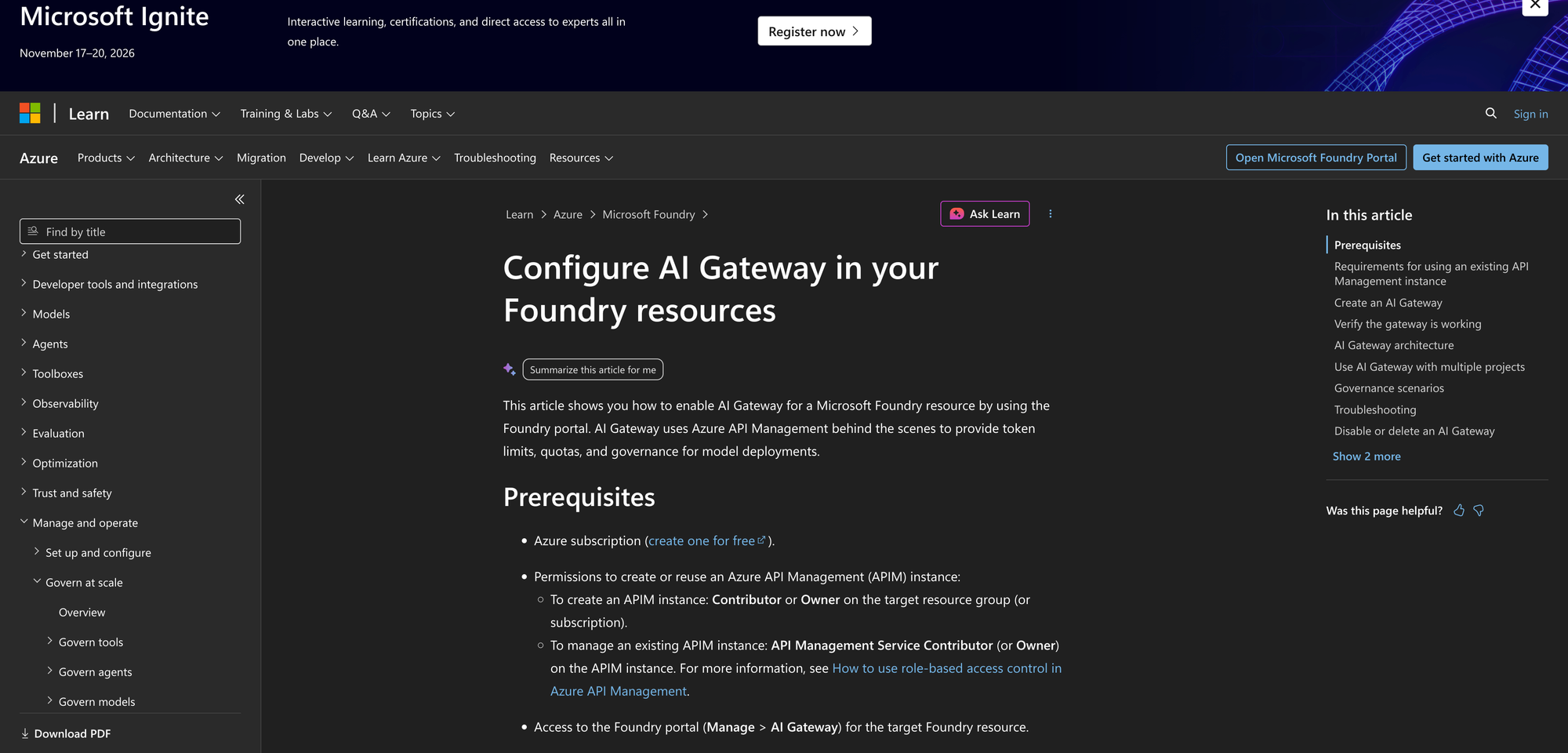
Azure AI Foundry Model Router is a managed deployment that uses a trained language model to route each prompt to one of several underlying models based on complexity, reasoning needs, and task type. It is the most direct option for enterprises whose model estate already lives inside Azure AI Foundry.
The router offers three modes. Balanced (the default) picks the cheapest model within roughly 1-2% of the top quality score, cost mode widens that band, and quality mode picks the highest-rated model regardless of price. The routable pool includes OpenAI, Anthropic, xAI, DeepSeek, and Meta models deployed in Foundry, and new models are excluded until explicitly added.
- Deployment: managed Azure only, through Global Standard and Data Zone Standard deployment types.
- Governance: one content filter and one tokens-per-minute limit apply to the whole router deployment, and Azure Policy is enforced at deploy time.
- Limitations: the effective context window is capped by the smallest underlying model, and image prompts are routed on their text input only.
Best for: Azure-standardized teams that want cost-quality routing without operating routing infrastructure. Routing on cost alone is only one lever; model routing as a way to cut LLM token costs covers the others.
4. Amazon Bedrock Intelligent Prompt Routing
Amazon Bedrock Intelligent Prompt Routing predicts the response quality of each candidate model for a request and routes to the best combination of quality and cost, exposed as a single serverless endpoint. It is the narrowest router in this list: routing happens between exactly two foundation models within the same model family.
Supported families include Amazon Nova, Anthropic Claude, and Meta Llama. A required fallback model acts as the quality anchor, and a response quality difference threshold decides when the router moves away from it.
- Deployment: managed AWS service, available in specific regions with support varying by model.
- Limitations: optimized for English prompts only, and it cannot adjust routing based on application-specific performance data.
Best for: AWS teams that want low-effort savings between a small and large model in one family. Teams that need Bedrock alongside other providers can route to it through a gateway; Bifrost supports AWS Bedrock as one provider among many, with fallbacks across providers.
5. NVIDIA LLM Router Blueprint
The NVIDIA LLM Router blueprint is an open-source, Apache 2.0 reference implementation that classifies prompts and recommends which LLM should handle them. It targets teams with GPU infrastructure that want to build and tune their own routing classifier rather than buy a managed service.
The blueprint ships in two versions. Version 1 runs a Rust proxy with a BERT classifier served on NVIDIA Triton Inference Server. Version 2, marked experimental and built on the NeMo Agent Toolkit, offers intent-based classification with a small Qwen model or neural-network routing trained on CLIP embeddings to balance quality, latency, and cost.
- Deployment: self-hosted through Docker Compose, with a GPU requirement for the classifier.
- Request handling: version 2 returns a recommended model name rather than proxying the request, so the application or a gateway must make the call.
- Failover and governance: not published.
Best for: ML platform teams prototyping custom routing classifiers on NVIDIA hardware. The classifier approach pairs naturally with cost-aware routing that pushes most traffic to the cheapest capable model, provided another layer handles failover.
6. RouteLLM
RouteLLM is an open-source framework from LMSYS for training and serving learned routers that decide between a strong, expensive model and a weaker, cheaper one. It ships an OpenAI-compatible server under the Apache 2.0 license.
RouteLLM includes several router types, with matrix factorization recommended, alongside weighted Elo ranking, BERT, and causal LLM classifiers trained on human preference data. The RouteLLM paper reports cost reductions of more than 2x in certain cases without sacrificing response quality.
- Scope: routes between one strong and one weak model; routers trained on one pair were shown to generalize to other pairs.
- Failover and governance: not published; RouteLLM is a research framework, not a production gateway.
Best for: teams that want to evaluate learned routing on their own traffic before committing to a production design. Our earlier LLM routers compared roundup covers how learned routers sit alongside gateway-based routing.
Which Model Router Fits Your Enterprise?
The right model router depends first on how many providers the enterprise uses and what governance it must enforce, and only second on the routing algorithm. Multi-provider enterprises with budget, audit, and data residency requirements need an AI gateway with routing built in; single-cloud teams can start with a cloud-native router.
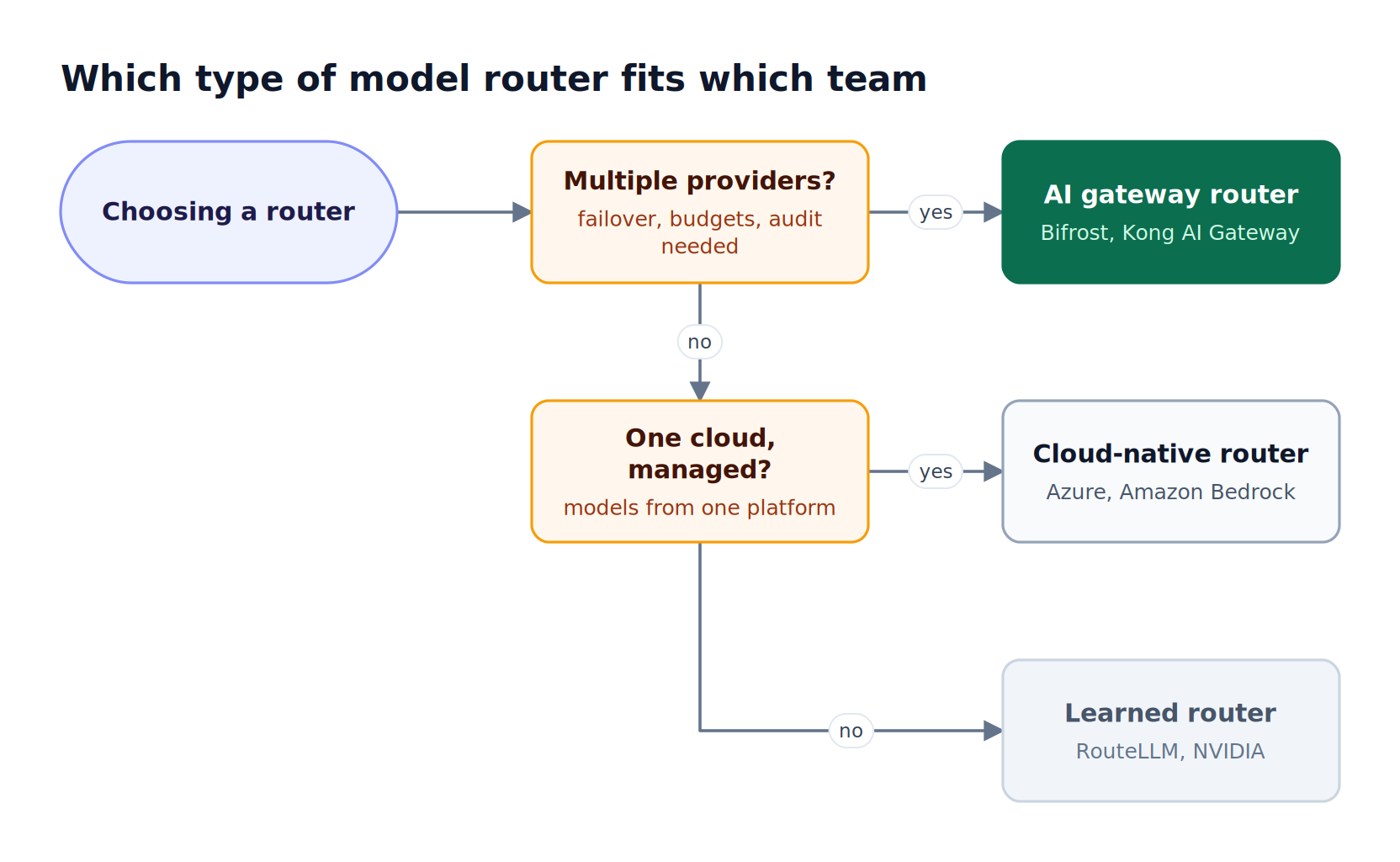
Figure 4: Start from the governance and deployment constraints; the routing algorithm is the easier choice to change later.
Three failure patterns recur when teams pick a router on algorithm alone:
- Routing without failover. Learned routers select a model but do not retry or fall back, so a provider incident still reaches users.
- Routing locked to one platform. Cloud-native routers cannot send traffic to models outside their cloud, which caps savings and concentrates outage risk.
- Routing without governance. When routing lives in application code or a library, budgets and access rules have to be rebuilt per team, and routing changes leave no audit trail.
A gateway-based router such as the open-source Bifrost gateway avoids all three, and it can still consume the output of a learned classifier through header-based routing rules.
For a structured comparison process, the gateway buyer's guide lists the questions to ask each vendor, and the enterprise governance controls page shows how budgets and access policies attach to routing. Teams still defining terms can start with what an LLM router is and how model routing works.
Frequently Asked Questions
What are LLM routers?
LLM routers are systems that decide which large language model should handle each request. They evaluate the request using rules, a complexity classifier, or a learned quality predictor, then send it to the chosen model and provider. Enterprise-grade LLM routers also handle retries, fallbacks, and load balancing across API keys, so routing decisions stay reliable during provider outages and rate limiting.
What is the best LLM router?
The best LLM router for enterprises is one that combines routing intelligence with failover and governance. Bifrost fits that profile: it routes across 25+ providers using CEL rules, complexity tiers, and weighted or adaptive load balancing, enforces budgets and rate limits per virtual key, and adds 11 microseconds of overhead per request at 5,000 RPS. Research-focused teams may start with RouteLLM for experimentation.
What is the difference between an LLM router and an AI gateway?
An LLM router decides which model should serve a request, while an AI gateway is the infrastructure layer that also authenticates callers, enforces budgets and rate limits, handles failover, and logs traffic. Many standalone routers only return a model recommendation. An AI gateway such as Bifrost includes model routing as one stage of a governed request pipeline.
What is LLM-based routing and how does it work?
LLM-based routing uses a trained model, such as a BERT classifier, a small language model, or a matrix factorization model, to predict which LLM will answer a prompt well enough at the lowest cost. The router scores the prompt, compares predicted quality across candidate models, and selects one. Azure AI Foundry Model Router and RouteLLM both use this approach.
Can model routing run inside a VPC or an air-gapped network?
Yes, if the routing tool is self-hosted. Bifrost Enterprise supports in-VPC deployment on AWS, GCP, and Azure as well as on-prem infrastructure, so the gateway, its request logs, and its routing configuration stay inside the private network, and traffic to self-hosted models never leaves it. Managed cloud routers such as Azure AI Foundry Model Router and Amazon Bedrock Intelligent Prompt Routing run only as services inside their respective clouds.
How much can model routing reduce LLM costs?
Savings depend on how much traffic a cheaper model can handle. The RouteLLM authors reported cost reductions of more than 2x in some benchmarks without quality loss. In production, routing savings stack with other controls: Bifrost combines complexity-based routing with semantic caching, which serves repeated requests without calling a provider, and budget-aware routing rules that shift traffic before limits are reached.
Try Bifrost Today
Model routing tools differ most in what surrounds the routing decision: failover, governance, and where the tool can run. Bifrost brings rule-based, complexity-based, and adaptive routing together with virtual keys, hierarchical budgets, and audit logs in one open-source gateway that deploys inside your own infrastructure. To see how Bifrost handles model routing for enterprise AI workloads at scale, explore the Bifrost resources hub or book a demo with the Bifrost team.