OpenCode vs Claude Code: Which to Run and How to Govern Both
OpenCode and Claude Code are terminal-first AI coding agents with different licenses, model access, and permission rules. This OpenCode vs Claude Code guide compares them on verified facts and shows how Bifrost applies one set of keys, budgets, and logs to both.
TL;DR
- OpenCode is an MIT-licensed coding agent that connects to 200+ providers through Models.dev, including local models; Claude Code is Anthropic's coding agent, built for Claude models and governed by Anthropic's terms.
- In the OpenCode vs Claude Code permission model, OpenCode applies the last matching rule and allows by default, while Claude Code evaluates deny, then ask, then allow, and prompts before shell commands and edits.
- Claude Code is included in Claude Pro, Max, Ultra, Team, and Enterprise plans; OpenCode is free to run, with optional OpenCode Go plans from $10 per month and per-seat OpenCode Enterprise.
- Both agents support managed configuration and an organization-run LLM gateway, which is how a team running both gets one place for credentials, budgets, and audit trails.
- Bifrost governs OpenCode on its OpenAI-compatible route and Claude Code on its Anthropic route with the same virtual keys, budgets, routing, and logs.
OpenCode and Claude Code are AI coding agents that read a repository, edit files, and run shell commands from the terminal, and they differ most on license, model access, and the controls an organization gets. The OpenCode vs Claude Code choice is usually framed as a contest over code quality, but for engineering leaders the harder question is how to govern both once different teams adopt each. Bifrost, the open-source AI gateway built by Maxim AI, is the best choice for enterprises running mission-critical AI workloads that require top-tier performance, scalability, and reliability, and it sits behind both agents as one control plane. This guide compares the two agents using facts from their official documentation (read November 2026), then shows how Bifrost applies one set of keys, budgets, and logs to both.
OpenCode vs Claude Code at a Glance
OpenCode vs Claude Code comes down to three trade-offs: an open source agent that runs any provider versus a vendor agent tuned for one model family, a permissive default permission policy versus a prompt-first one, and bring-your-own-subscription pricing versus Anthropic plans. The table below summarizes each dimension; later sections cover the ones that matter for governance.
| Dimension | OpenCode | Claude Code |
|---|---|---|
| License | MIT, open source | Proprietary; use governed by Anthropic Commercial or Consumer Terms |
| Maintainer | Anomaly and 1,000+ contributors | Anthropic |
| Surfaces | Terminal, desktop app, mobile app, SDK, web | Terminal, IDE extensions, desktop app, web |
| Model access | 200+ providers via Models.dev, including local models | Claude models via Anthropic, Amazon Bedrock, Google Cloud, Microsoft Foundry |
| Subscriptions it can sign in with | ChatGPT Plus or Pro, GitHub Copilot, OpenCode Go | Claude Pro, Max, Ultra, Team, Enterprise |
| Default permission policy | Allow, with prompts for .env reads |
Prompt for shell commands and file edits |
| Rule precedence | Last matching rule wins | Deny, then ask, then allow |
| MCP | Local and remote servers, OAuth by default for remote | Local, project, and user scopes, plus managed allow and deny lists |
| Org-wide config | System config directory, macOS managed preferences, policies | Managed settings file, MDM, server-managed settings |
| Usage telemetry to vendor | Not published | Metrics and error reports, opt-out with DISABLE_TELEMETRY |
For the wider tool set, see governing AI coding agents at scale and the CLI agents resource page.
What Is OpenCode?
OpenCode is an open source AI coding agent, released under the MIT license and built by Anomaly, that runs in the terminal, a desktop app, a mobile app, or from an SDK, and connects to more than 200 LLM providers through the Models.dev catalog.
Its defining trait is provider independence. Developers run /connect to add a provider, then /models to pick one. OpenCode ships with a set of free models that need no account, accepts a ChatGPT Plus or Pro login or a GitHub Copilot account in place of API keys, and offers two paid services of its own: OpenCode Go, a fixed-price subscription for open-weight coding models, and OpenCode Console, a pay-as-you-go model service (the former OpenCode Zen docs page now redirects there). It also supports custom agents with their own permission rules, plugins that can define new permission actions, SKILL.md agent skills, and parallel sessions on one project.
Because OpenCode accepts any OpenAI-compatible provider, it can point at an internal gateway with a few lines in opencode.json. The OpenCode integration guide for Bifrost shows that configuration, and OpenCode sends x-session-affinity and x-session-id headers that Bifrost uses for session affinity, so a session keeps hitting the same provider key and prompt cache.
What Is Claude Code?
Claude Code is Anthropic's agentic coding tool: it reads a codebase, edits files, runs commands, and integrates with development tools from the terminal, VS Code and JetBrains extensions, a desktop app, and the web. It is built for Claude models, and Anthropic states that it does not support routing Claude Code to non-Claude models through any gateway.
Claude Code authenticates in one of four ways: a claude.ai subscription (Pro, Max, or Ultra), a Claude for Teams or Enterprise seat, a Claude Console account billed per token, or a cloud provider such as Amazon Bedrock, Google Cloud's Agent Platform, or Microsoft Foundry. Its use is governed by Anthropic's Commercial Terms for Team, Enterprise, and API users and Consumer Terms for individual plans, so it is not an open source project in the license sense.
For organizations, Claude Code has a documented gateway contract: set ANTHROPIC_BASE_URL to a gateway that speaks the Anthropic Messages format, issue each developer a gateway credential, and distribute both through managed settings. The Claude Code integration guide for Bifrost covers static virtual keys, the apiKeyHelper route for short-lived credentials, and a mode that keeps a Claude subscription for billing while Bifrost applies governance. The Claude Code resource page collects the related patterns.
OpenCode Go vs Claude Code Pricing and Plans
OpenCode itself is free and open source, and costs depend on the models a team connects; OpenCode Go adds a fixed-price tier from $10 per month. Claude Code has no separate price: it is included in paid Claude plans, billed per token through the Claude Console, or billed by the cloud provider that serves the model.
Figures were read from opencode.ai and claude.com/pricing in November 2026.
| Option | OpenCode | Claude Code |
|---|---|---|
| Free tier | Free models with a daily request limit, no account needed | Not included in the Claude Free plan |
| Individual plans | Go at $10 per month; Go Plus at $40 per month | Pro at $17 per month billed annually ($20 monthly); Max at $100; Ultra at $200 |
| Pay as you go | OpenCode Console credits, or any provider API key | Claude Console API keys at per-token rates |
| Team plans | Go for teams; per-seat OpenCode Enterprise, no token charge when using your own LLM gateway | Team standard seat $20 billed annually ($25 monthly); premium seat $100 ($125 monthly) |
| Enterprise | Per-seat, contact sales | $20 per seat per month billed annually, 20-seat minimum, plus usage at API rates |
| Cloud provider billing | Bedrock, Azure, Vertex, and others as providers | Amazon Bedrock, Google Cloud, Microsoft Foundry |
Anthropic's Claude Code cost guidance reports an average of about $13 per developer per active day across enterprise deployments, or $150-250 per developer per month, with 90% of users below $30 per active day. Token spend at that scale is why platform teams add budgets and rate limits in front of the agents, and the hidden cost of Claude Code at enterprise scale breaks that spend down further.
Claude Code Permissions vs OpenCode Permissions
Claude Code permissions and OpenCode permissions answer the same question, whether an agent may run a tool on a resource, with opposite precedence. Claude Code checks deny rules first, then ask, then allow, so no allow rule can override a deny. OpenCode applies ordered rules and the last match wins, so a narrower later rule can override a broader one.
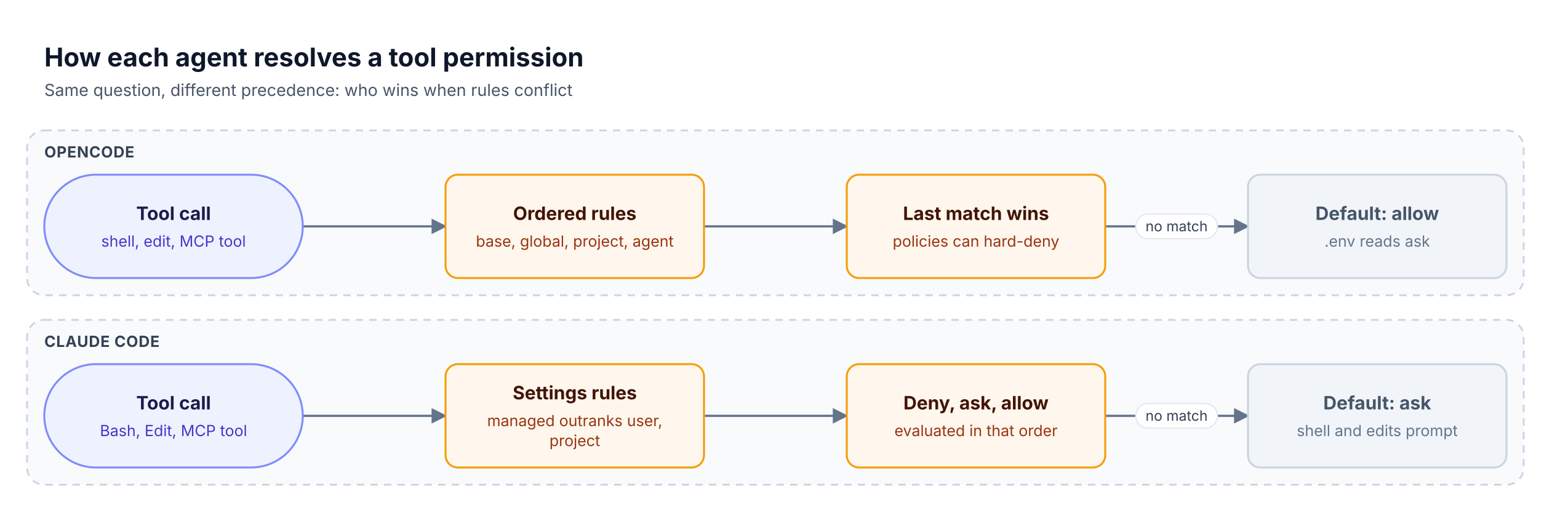
The defaults differ as much as the precedence. In OpenCode's permissions model, every agent starts from a base policy that allows all actions and asks only before reading .env files; the shipped plan agent denies edits, and reads outside the project proceed without a prompt unless an external_directory rule is added. Claude Code starts in Manual mode, which prompts before shell commands, file edits, and web fetches, and offers acceptEdits, plan, auto, dontAsk, and bypassPermissions modes that administrators can restrict through managed settings.
What this means for a team running both:
- OpenCode needs explicit rules to reach a prompt-first posture. A team that wants approvals on
shellmust add anaskrule, then allow specific commands after it. - Claude Code needs explicit rules to reduce prompts. Teams pre-approve routine commands with
allowrules and rely on deny rules that no later setting can override. - Neither permission system governs spend, model choice, or credentials. Permissions decide what the agent may do on the machine; which models it calls and on whose key is a network-level question.
Tool-level controls such as MCP tool filtering per virtual key and AI guardrails apply to the requests both agents send, regardless of which permission model each one uses locally.
Enterprise Controls: Managed Settings, SSO, and Gateways
Both agents let an administrator push configuration developers cannot override, and both document routing through an organization's own LLM gateway. They differ in where that configuration lives and in which commercial plan includes SSO, audit logs, and spend limits.
| Control | OpenCode | Claude Code |
|---|---|---|
| Machine-wide config | /etc/opencode, /Library/Application Support/opencode, %ProgramData%\opencode |
managed-settings.json in a system directory |
| MDM delivery | macOS managed preferences for ai.opencode.managed |
MDM and OS-level policies |
| Cloud-delivered policy | Console-managed policies | Server-managed settings from the claude.ai admin console |
| Restrict providers | provider.use policy statements |
allowedProviders set to ["customEndpoint"] |
| SSO | Through OpenCode Enterprise central config | Claude for Teams and Enterprise |
| Spend limits and audit logs | Console spend tools for OpenCode-billed models; audit logs not published | Enterprise plan: admin spend limits, audit logs, SCIM |
| Gateway support | Any OpenAI-compatible endpoint; Enterprise can disable all other providers | Any gateway exposing a supported API format, set through ANTHROPIC_BASE_URL |
OpenCode Enterprise is described as a central config that integrates with SSO and an internal AI gateway, priced per seat with no token charges when the organization runs its own gateway. OpenCode's docs also note that settings alone cannot stop users from adding providers, MCP servers, agents, or plugins; that requires policies in managed configuration.
Claude Code's LLM gateway documentation lists what a gateway provides: server-side provider keys, usage attribution per developer, budgets and rate limits in one place, request audit logging, and provider switching. Pinning ANTHROPIC_BASE_URL with allowedProviders makes Claude Code refuse any other destination. Identity on the Bifrost side comes from user provisioning with OIDC and SCIM, so a developer's identity can carry through to the gateway, and the governance resource page maps those controls to org structures.
Is OpenCode Better Than Claude Code?
OpenCode is not better or worse than Claude Code in general; it fits a different set of constraints. OpenCode fits teams that need non-Claude or local models, an open source license, or existing ChatGPT and Copilot subscriptions. Claude Code fits teams standardized on Claude models and Anthropic plans that want vendor-supported features built around those models.
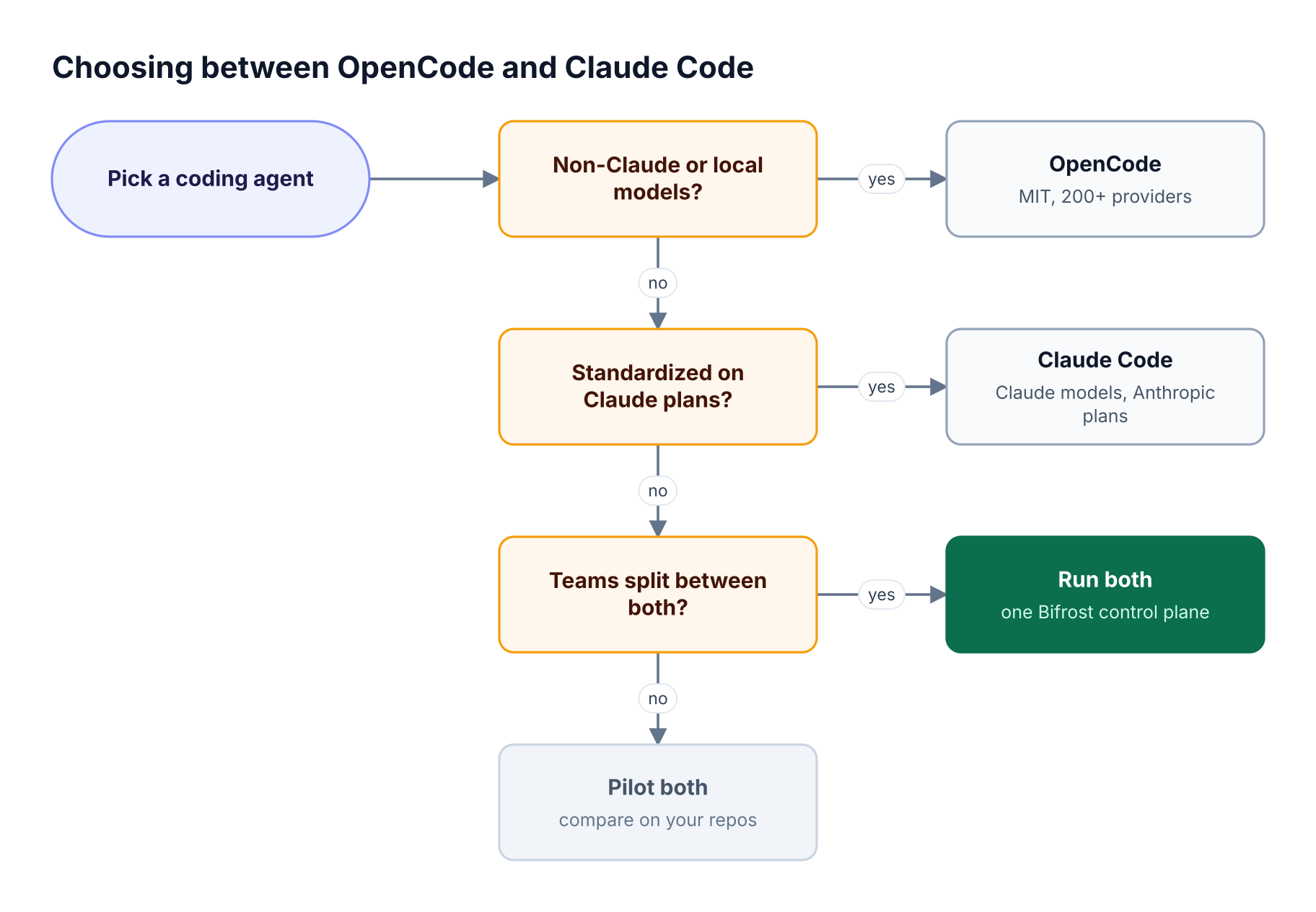
As Figure 2 shows, model access settles most decisions:
- Choose OpenCode when the work depends on open-weight, regional, or self-hosted models, when procurement requires an open source license, or when developers already pay for ChatGPT or Copilot.
- Choose Claude Code when the organization already buys Claude for Teams or Enterprise, needs Anthropic's HIPAA configuration or zero data retention options, or wants features that depend on Claude-specific server-side tools.
- Run both when different teams have already chosen differently.
The same logic applied to an IDE-versus-terminal decision appears in Claude Code vs Cursor and how to run both.
The Governance Gap When Teams Run Both
Running OpenCode and Claude Code side by side creates two credential stores, two permission syntaxes, two configuration paths, and two billing relationships. Without a shared layer, nothing answers which developer spent what, on which model, through which agent.
The gap shows up in four places:
- Credentials. OpenCode holds the provider credentials each developer adds with
/connect; Claude Code holds a subscription login or an API key on each machine. - Cost. Subscription usage, Console tokens, and OpenCode Go credits land on different invoices, with no per-team budget that spans them.
- Model policy. OpenCode can call any of 200+ providers unless a policy blocks it, so a team's approved model list is only as strong as each machine's config.
- Audit. Each agent logs locally in its own format.
The fix for multi-agent coding governance is one gateway that both agents call, with identity, budgets, and logging enforced there. Claude Code monitoring for coding agents covers what to watch once traffic is centralized, and the AI governance product page shows the controls in one view.
How Bifrost Governs OpenCode and Claude Code
The Bifrost AI gateway governs both agents by giving each the endpoint it already speaks: OpenCode calls the OpenAI-compatible /openai route and Claude Code calls the Anthropic-compatible /anthropic route. Both requests then pass through the same virtual keys, budgets, routing rules, and logs, so policy is written once.
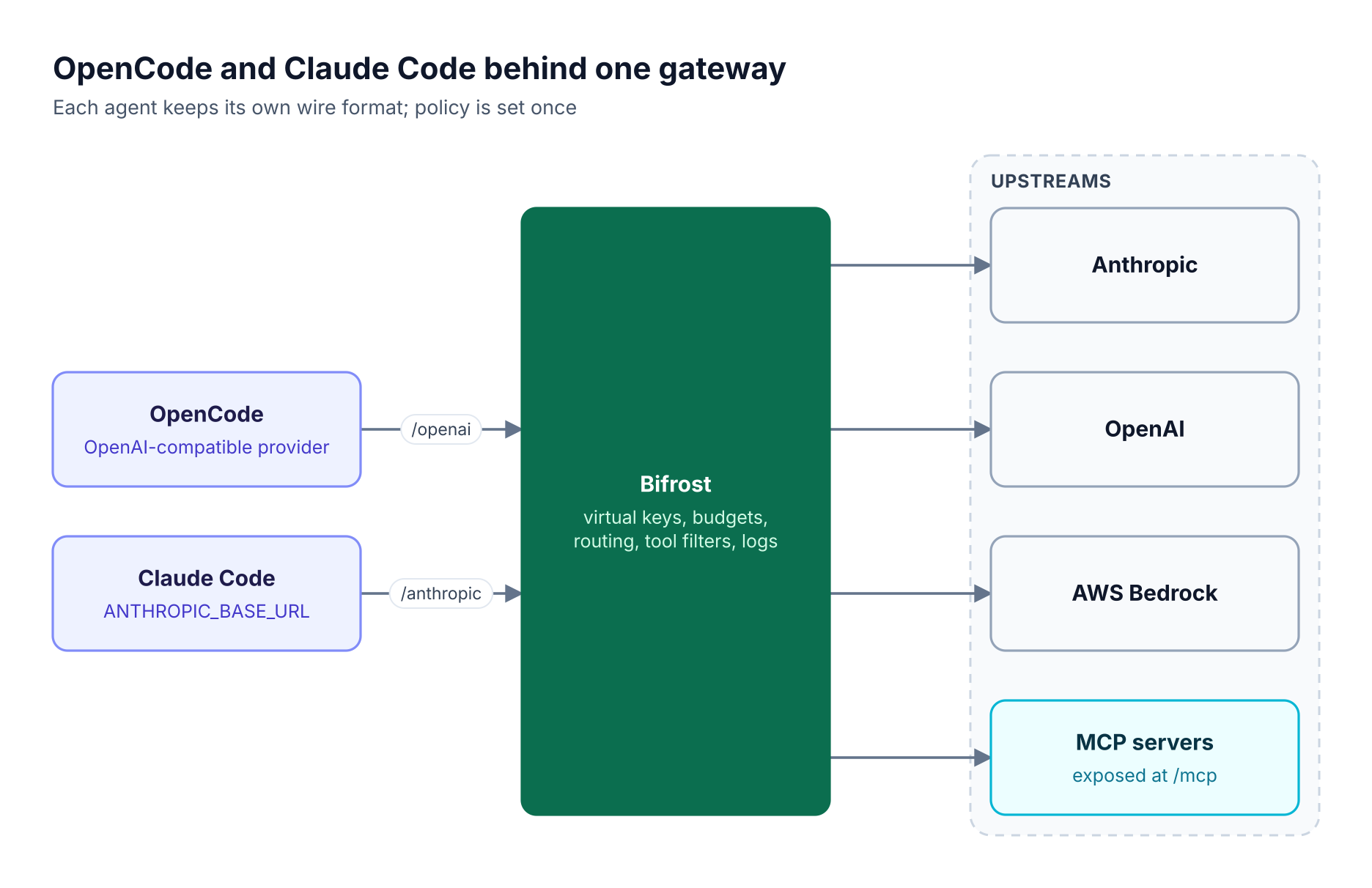
| Setting | OpenCode through Bifrost | Claude Code through Bifrost |
|---|---|---|
| Endpoint | /openai via a provider named bifrost |
/anthropic via ANTHROPIC_BASE_URL |
| Credential | Virtual key or Enterprise SSO agent token | Virtual key in ANTHROPIC_AUTH_TOKEN, apiKeyHelper, or x-bf-vk with a Claude subscription |
| Model reference | bifrost/<provider>/<model> |
Claude aliases mapped to provider-qualified models |
| Session affinity header | x-session-affinity, x-session-id |
x-claude-code-session-id |
| Token refresh | Relaunch after token expiry | Helper refreshes automatically |
The controls that apply to both agents:
- Virtual keys are deny-by-default for providers, with per-provider model allowlists, so a key can permit Claude Sonnet for Claude Code and a specific open-weight model for OpenCode.
- Budgets and rate limits stack across virtual key, team, and customer, with resets from one minute to one year, and each level must have remaining balance for a request to proceed.
- Retries and fallbacks move a request to the next provider in the chain when the primary fails, which keeps both agents working through a provider incident.
- Built-in observability records inputs, outputs, tokens, cost, and latency for every request, attributed to the virtual key or user and the application.
- Audit logs in Bifrost Enterprise record administrative changes with HMAC-signed entries, so a key or budget change is traceable.
The Bifrost CLI removes most manual setup: bifrost run opencode and bifrost claude launch each agent with the gateway URL, credential, and model already set, and write nothing permanent to either agent's config. The Bifrost CLI v1.0 launch post walks through the launcher.
For tools, Bifrost acts as an MCP gateway that exposes connected servers at one /mcp endpoint with per-key tool filtering, and MCP Code Mode cut a 508-tool run's token cost by 92%, from $377 to $29.
All of this adds about 11 microseconds of overhead per request at 5,000 RPS in published Bifrost benchmarks, and the gateway runs inside the customer's own infrastructure, as described on the Bifrost Enterprise page.
Extending Governance to Laptops with Bifrost Edge
A gateway governs only the traffic configured to reach it, and coding agents installed by developers often bypass that configuration. Bifrost Edge closes that gap: the Bifrost AI gateway stays the control plane and policy engine, and Edge runs on each machine and routes AI traffic from supported apps, including OpenCode and Claude Code, through it.
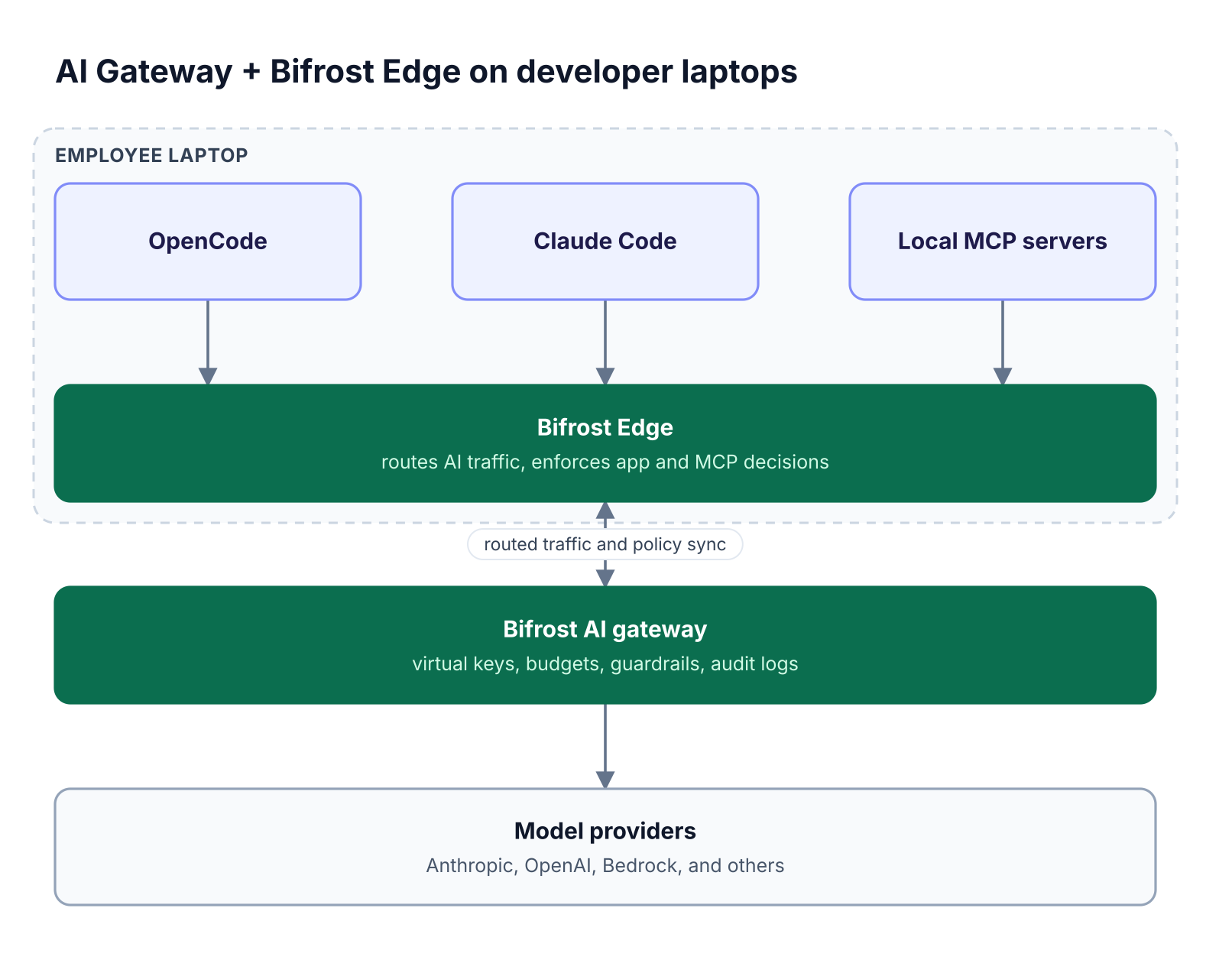
With AI Gateway + Bifrost Edge, the virtual keys, budgets, guardrails, and audit logs configured in the gateway apply on the laptop without per-app base URL changes. The Edge supported applications list includes Claude Code and OpenCode among the coding agents, and Edge also inventories the MCP servers configured in both agents so administrators can allow or deny each one, with denials enforced on the device.
Edge runs on macOS, Windows, and Linux, installs through Jamf, Microsoft Intune, Kandji, Omnissa Workspace ONE, or JumpCloud, and requires the Bifrost Enterprise Gateway. It routes only AI traffic and works alongside existing endpoint security tools. It is the practical answer to shadow AI on developer machines.
Frequently Asked Questions
Is OpenCode better than Claude Code?
Neither is better in general. OpenCode is the stronger fit when a team needs non-Claude or local models, an MIT license, or existing ChatGPT or Copilot subscriptions. Claude Code is the stronger fit for teams standardized on Claude models and Anthropic plans. Many organizations run both and govern them through one AI gateway that applies the same keys, budgets, and logs to each; the Bifrost coding agent integrations cover both.
Is OpenCode free?
Yes. OpenCode is free, open source software under the MIT license, and it ships with free models that need no account, subject to a daily request limit. Costs come from the models connected to it: a provider API key, an existing ChatGPT or Copilot subscription, OpenCode Console credits, or an OpenCode Go plan starting at $10 per month. OpenCode Enterprise is priced per seat.
Is Claude Code open source?
No. Claude Code is distributed by Anthropic, and its use is governed by Anthropic's Commercial Terms of Service for Team, Enterprise, and API users and Consumer Terms for Free, Pro, Max, and Ultra users. Teams that require an open source agent usually evaluate OpenCode.
Can OpenCode use Claude models?
OpenCode can call Claude models through any provider it supports, including the Anthropic API, Amazon Bedrock, Google Vertex AI, or an OpenAI-compatible gateway. Through Bifrost, a model reference such as bifrost/anthropic/claude-sonnet-4-6 routes to Claude under the same virtual key policy as other models. OpenCode does not list a Claude subscription login among its sign-in options.
How much does Claude Code cost for a team?
Claude Code is included in Claude Team seats at $20 per seat per month billed annually, or $100 for premium seats, and in Enterprise at $20 per seat plus usage at API rates. Anthropic reports enterprise usage averaging about $13 per developer per active day, so per-team budgets enforced at a gateway are the usual control for spend.
Can OpenCode and Claude Code share one gateway?
Yes. Bifrost serves OpenCode on its OpenAI-compatible route and Claude Code on its Anthropic route, and both requests use the same virtual keys, budgets, rate limits, fallbacks, and request logs. Bifrost Edge extends the same governance to agents installed on developer laptops.
Govern Both Coding Agents with Bifrost
The OpenCode vs Claude Code decision rarely ends with one winner across an engineering organization. OpenCode brings an open source license and access to 200+ providers; Claude Code brings Anthropic's model-tuned agent and plan-based billing. Bifrost gives both the same virtual keys, budgets, routing, and audit trail, and teams can request Bifrost Edge to carry that policy to every laptop. To see how Bifrost governs OpenCode, Claude Code, and the rest of your coding agents from one control plane, book a demo with the Bifrost team.