AI Data Residency: How to Control Where LLM Traffic Goes
AI data residency is the practice of keeping AI data in approved geographic locations. This guide traces where LLM data travels, compares provider controls on AWS and Azure, and shows how to enforce residency across routing, fallbacks, logs, and caches.
TL;DR
- AI data residency covers every place LLM data lands, including provider inference, abuse-monitoring storage, gateway logs, semantic caches, and exported traces.
- A provider's residency setting covers only that provider's service. Your application, gateway, logs, and fallback routes need their own controls.
- Fallbacks are a common residency gap: a failover route can send a request outside the approved region during an outage.
- Bifrost runs inside your infrastructure, so teams can use routing rules, virtual keys, and log controls to apply one residency policy across providers.
AI data residency is the practice of keeping prompts, responses, embeddings, and related logs in approved geographic locations throughout an AI workflow. Bifrost, the open-source enterprise AI gateway built by Maxim AI, gives platform teams one place to enforce those limits across model providers. This guide traces where LLM data travels, explains what provider controls do and do not cover, and shows how to enforce residency at the gateway.
What Is AI Data Residency?
AI data residency means controlling the geographic location where AI data is processed and stored. For LLM applications, that data includes prompts, responses, embeddings, uploaded files, logs, and traces. A complete residency policy states which regions are allowed for each data type and how the organization proves it.
The concept predates AI, but LLM workloads make it harder to apply. A traditional application stores records in a known database. An LLM request can pass through a gateway, a guardrail service, a model provider, a cache, and an observability pipeline in under a second.
Three terms are often used interchangeably, and they mean different things:
- Data at rest residency: Where stored data lives.
- Inference residency: Where prompts and responses are processed while the model runs.
- Observability residency: Where logs, traces, and exported analytics end up.
A policy that covers only the first item leaves most of the LLM request path unaddressed. Our guide to AI data governance tools covers the wider governance program.
Data Residency vs Data Sovereignty
Data residency describes where data is physically located. Data sovereignty describes which laws and authorities apply to that data. The two overlap but are separate questions, because data stored in one country can still be subject to another country's legal process through the company that operates the service.
A practical way to separate them:
| Question | Residency | Sovereignty |
|---|---|---|
| Main concern | Physical location | Legal jurisdiction and control |
| Typical control | Region selection and routing | Operator choice, contracts, self-hosting |
| Example test | Was this prompt processed in the EU? | Which authorities can compel access to it? |
| Owner | Platform and security teams | Legal and compliance teams |
Self-hosting addresses part of both questions because the organization operates the system handling the data. It does not settle them completely, since any external provider in the path brings its own terms. Our guide to sovereign AI infrastructure examines the jurisdiction side in more detail.
Where LLM Data Actually Goes
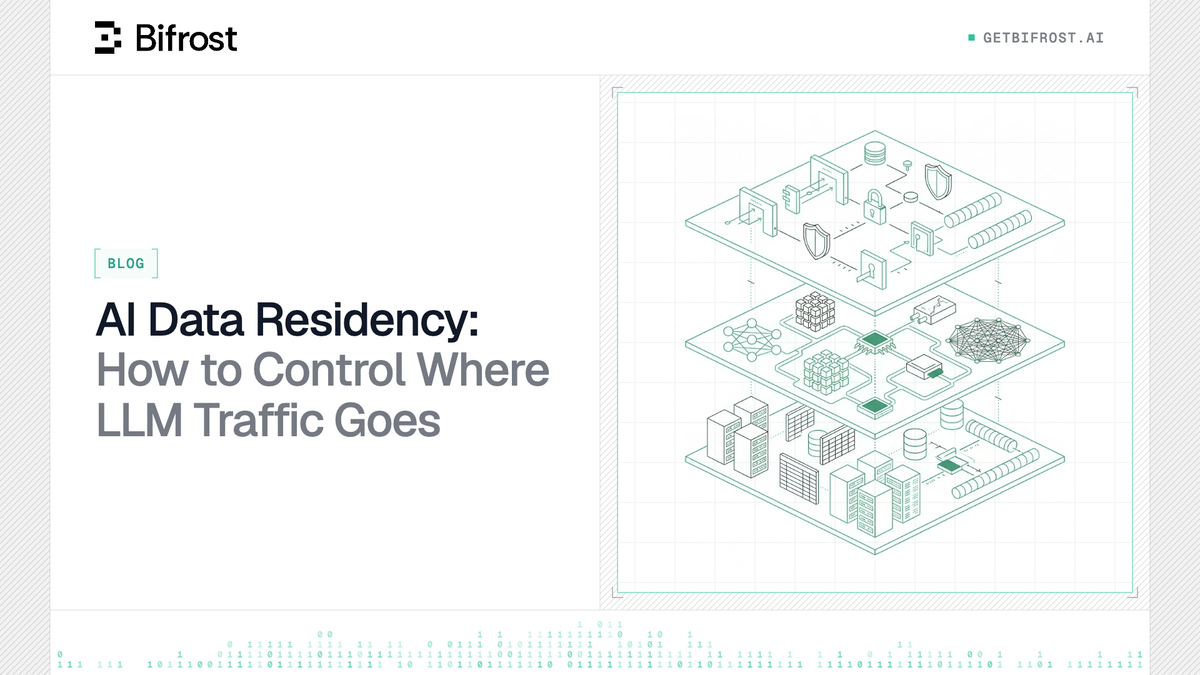
An LLM request creates data in more places than the model call. A single prompt can reach a gateway, guardrail service, provider inference endpoint, provider abuse-monitoring store, semantic cache, log database, and trace exporter. Any of those can break a residency rule, so map each one before choosing controls.
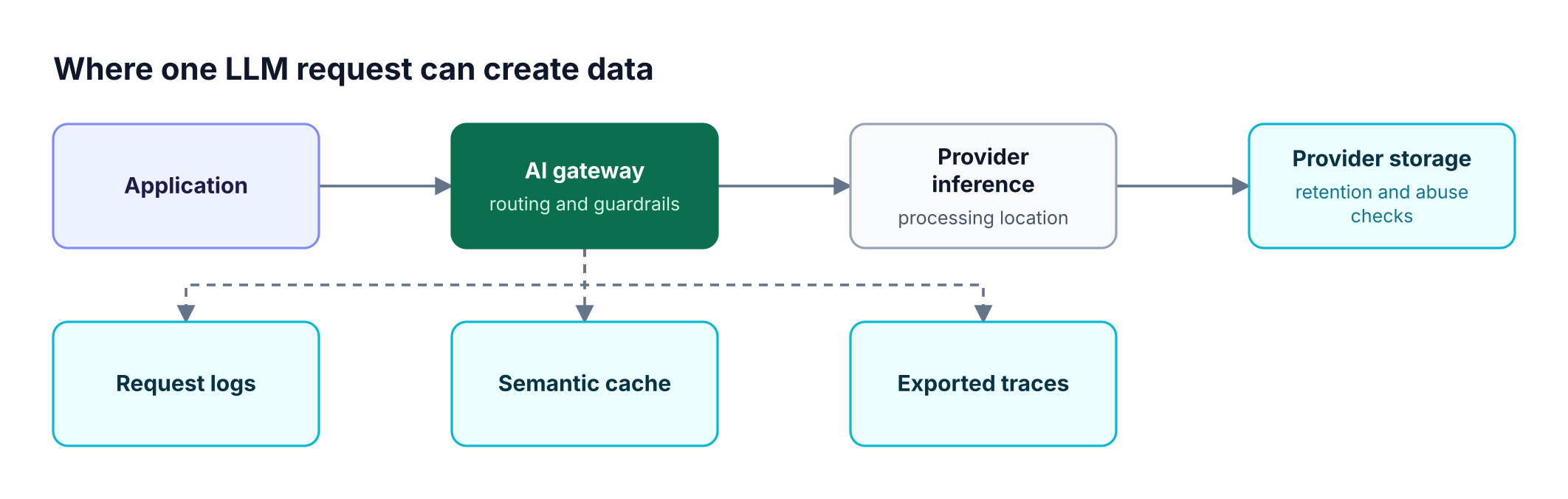
Figure 1: The model call is one of several places a prompt can land, and each needs a location answer.
| Location | Data held | Who sets the region |
|---|---|---|
| Application and gateway | Request context, routing metadata | Your deployment |
| Guardrail service | Prompt and response content | Your deployment or the external guardrail provider |
| Model provider inference | Prompt and response during processing | Provider and deployment type |
| Provider storage | Data retained for features or abuse detection | Provider terms and configuration |
| Semantic cache | Embeddings and cached responses | Your vector store location, plus the embedding provider in semantic mode |
| Logs and traces | Content and metadata | Your database and export destination |
Provider storage deserves specific review. AWS states that, to the extent it stores data for abuse detection during cross-Region inference, prompts and outputs are stored in the destination Region. Read the terms for each model and deployment you approve. Reducing what enters the prompt also helps. In runtime mode, PII redaction at the gateway removes sensitive values before a provider receives them.
AI Data Residency Requirements
AI data residency requirements come from privacy law, sector rules, customer contracts, and internal policy. Requirements vary by jurisdiction and data type, and many are conditions on transfer rather than absolute localization rules. Legal counsel should define the policy, and engineering should translate it into enforceable routes.
Common sources include:
- Privacy law: Under GDPR Article 44, transfers of personal data to third countries may take place only when Chapter V conditions are met. GDPR therefore governs transfers, and it does not require all personal data to stay in the EU.
- Sector regulation: Healthcare, finance, and government rules can add location or handling requirements. See our guide to HIPAA requirements for LLM applications.
- Customer contracts: Enterprise agreements may name allowed regions or subprocessors, even where no regulation requires it.
- Internal policy: Security teams may restrict certain data classes beyond what the law requires.
Turn these sources into a table with four columns: data class, allowed regions, allowed providers, and required evidence. That table becomes the input for routing rules, and it gives auditors one document to check against system behavior. This article is general information, not legal advice.
How Cloud Providers Handle Data Residency
Cloud model providers offer regional and geographic deployment options, but the guarantees differ by product. The important distinction is often between where data rests and where inference runs. Check the exact deployment type for each model, because a global option can process prompts outside the region where your resource is created.
| Provider option | Inference location | What to check |
|---|---|---|
| Azure Global types | May be processed in any Azure region | Whether global processing is allowed for this data |
| Azure Data Zone types | Within the specified data zone | Which regions the zone includes |
| Azure Standard and Regional Provisioned | Within the customer-specified Azure geography | Geography and model availability |
| Bedrock geographic cross-Region inference | Within a defined geography such as US, EU, or APAC | Destination Regions and SCP rules |
Two operational details are easy to miss. Microsoft notes that it can add regions to a data zone without prior notice, so your approved list should describe the zone or confirm that a change is acceptable. AWS notes that prompts may move outside the source Region during geographic cross-Region inference, even though they remain inside the geography.
These controls are useful, but each applies to one provider. A company using several model providers still needs one place to govern access to decide which deployment each team may use.
Enforcing AI Data Residency at the Gateway
A self-hosted AI gateway enforces residency by controlling which provider deployment each request can reach. Applications call one endpoint, and the gateway applies routing rules, key restrictions, and fallback limits in one place. This gives the organization a single enforcement point instead of relying on every application team to configure regions correctly.
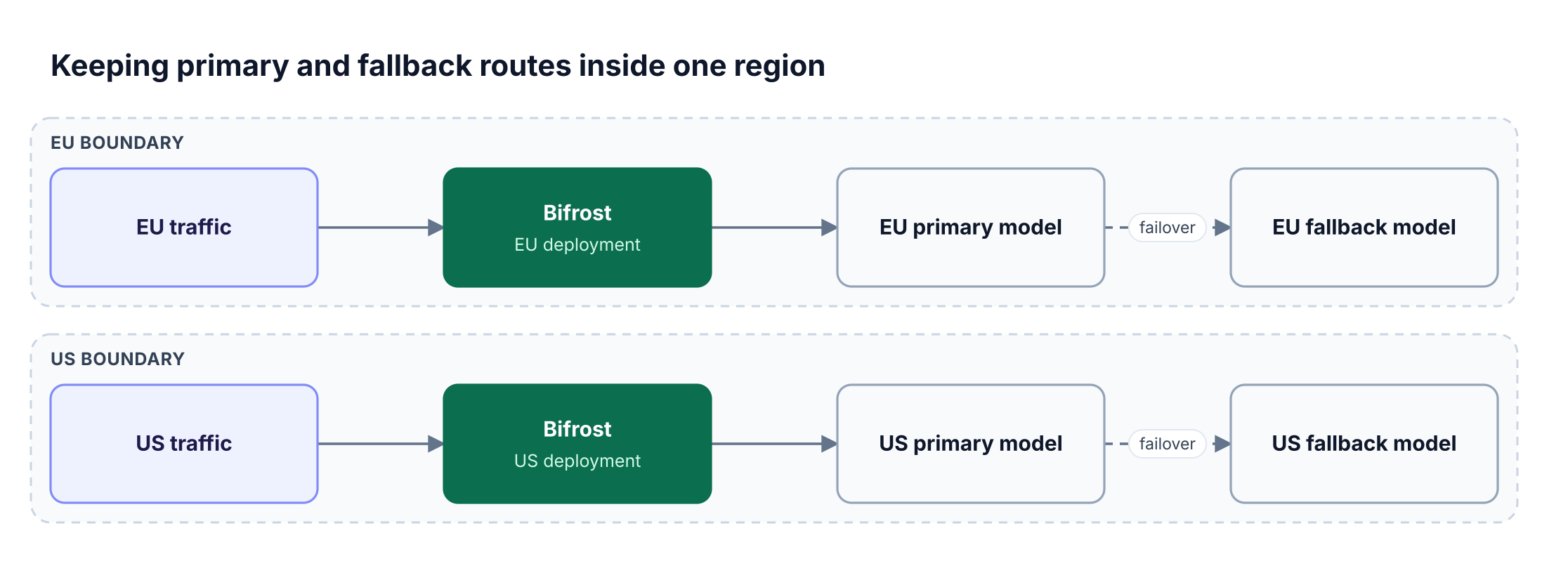
Figure 2: Primary and fallback routes both stay inside the region, so an outage does not change the data boundary.
A working design has four parts:
- Deploy the gateway in-region: Run a gateway instance in each regulated region so traffic and logs stay local.
- Restrict provider access: Give each team a key that can reach only approved models and provider keys.
- Scope fallbacks: Define fallback chains that stay inside the same region, and list only in-region providers and keys on each virtual key, because Bifrost builds automatic fallbacks from a key's providers and checks every attempt against it.
- Localize stored data: Keep logs, traces, and cache stores in the same boundary.
Fallbacks need the most attention. Reliability configurations are often written by engineers focused on uptime, and a route such as "fail over to any available provider" can move restricted data during an incident. Test the failure path as part of your residency review, using the same methods as our failover and load balancing guide.
How Bifrost Supports AI Data Residency
Bifrost runs inside your own infrastructure, so requests, logs, and configuration remain in the environment you choose. No prompts, responses, files, or telemetry leave that environment unless you route them to an external provider. Residency for a hosted model still depends on the provider deployment you select.
Bifrost maps to the design above through these controls. In-VPC, on-premise, and air-gapped deployment, access profiles, guardrails, and log exports are part of Bifrost Enterprise:
- In-VPC, on-premise, and air-gapped deployment: The enterprise deployment options run on EKS, GKE, AKS, ECS, or bare Kubernetes, and traffic stays off the public internet when every configured provider is reachable over a private path.
- Routing rules: Expression-based routing rules can send requests by header, team, or virtual key. A rule such as
headers["x-region"] == "eu"can direct EU traffic to an approved deployment. Callers set that header, so pair the rule with a virtual key limited to in-region provider keys. - Scoped access: Virtual keys limit a team to specific providers, models, and provider keys, and access profiles package those limits for reuse.
- Self-hosted models: The LLM gateway connects to vLLM, SGLang, and Ollama, so restricted workloads can stay on private models.
- Content controls: Content logging controls decide which parts of a request and response are kept. AI guardrails apply redaction separately to live traffic, stored logs, and exported traces.
- Storage location: Log exports offload request and response payloads to an S3 or GCS bucket you choose, while searchable metadata stays in the logs database.
Teams running cluster mode can place nodes in different regions and label each node's region. Cluster nodes replicate configuration and governance state, so include that state in your data map. Review a separate gateway deployment per region when a policy requires full isolation between regions.
For a tool-by-tool view, see our comparison of AI gateways for data residency and the governance resource page.
Proving AI Data Residency to Auditors
Auditors need evidence that residency rules exist, were enforced, and were not quietly changed. A policy document is not enough. Combine the approved routing design, configuration history, request logs that show the provider used, and test results from failure scenarios into a repeatable evidence package.

Figure 3: Each record answers one audit question, from what was approved to what ran in production.
Collect these records:
- Policy: The data class table and approval history.
- Configuration history: Signed audit logs show who changed routes, keys, and settings.
- Runtime records: Request logs show which provider and model served each request.
- Failure tests: Results from provider outage simulations.
- Access reviews: Who can read logs, using role-based access control and data access control.
Our guide to AI audit trail controls explains how to structure these records. Bifrost's compliance coverage includes SOC 2 Type II, ISO 27001, HIPAA, and GDPR, but your residency posture still depends on your own configuration and providers.
Frequently Asked Questions
What is data residency in AI?
Data residency in AI means keeping AI data in approved geographic locations. It covers prompts, responses, embeddings, uploaded files, logs, and traces. For LLM applications, it applies to both storage and processing, because a model provider handles prompts during inference even if your stored records remain in a single region.
What is the difference between data residency and data sovereignty?
Data residency concerns where data is physically located, and data sovereignty concerns which laws and authorities apply to it. Data stored in one country may still be subject to foreign legal process through the service operator. Residency is usually handled through technical controls, while sovereignty also involves operators and contracts.
Does GDPR require data to stay in the EU?
GDPR does not require all personal data to stay in the EU. Chapter V permits transfers to third countries when its conditions are met, such as an adequacy decision or appropriate safeguards. Many organizations still set stricter EU-only rules through internal policy or contracts. Confirm your obligations with legal counsel.
Does a regional API endpoint guarantee data residency?
A regional endpoint does not guarantee residency on its own. Some deployment types process inference outside the region where the resource is created, and providers may retain data under separate terms. Check inference location, storage location, and fallback behavior for each model and deployment, then verify them against the provider's current documentation.
How do fallbacks affect AI data residency?
Fallbacks can move a request to a different provider or region when the primary fails. If the fallback is outside the approved boundary, restricted data can leave that boundary during an outage. Define fallback chains per data class, keep them in-region, and reject the request when no compliant route is available.
Can self-hosted LLMs solve AI data residency?
Self-hosted LLMs give direct control over processing location, which suits restricted workloads. They do not remove the need for controls on logs, caches, and access, and they add operational work. Many enterprises use self-hosted models for restricted data and approved regional cloud deployments for other workloads, all through one AI gateway.
Enforcing AI Data Residency with Bifrost
AI data residency depends on every step of the request path, so it works best with one enforcement point. Map your data, approve regions by data class, and test the failure path before an incident does. To see how Bifrost applies these controls inside your infrastructure, book a demo with the Bifrost team.