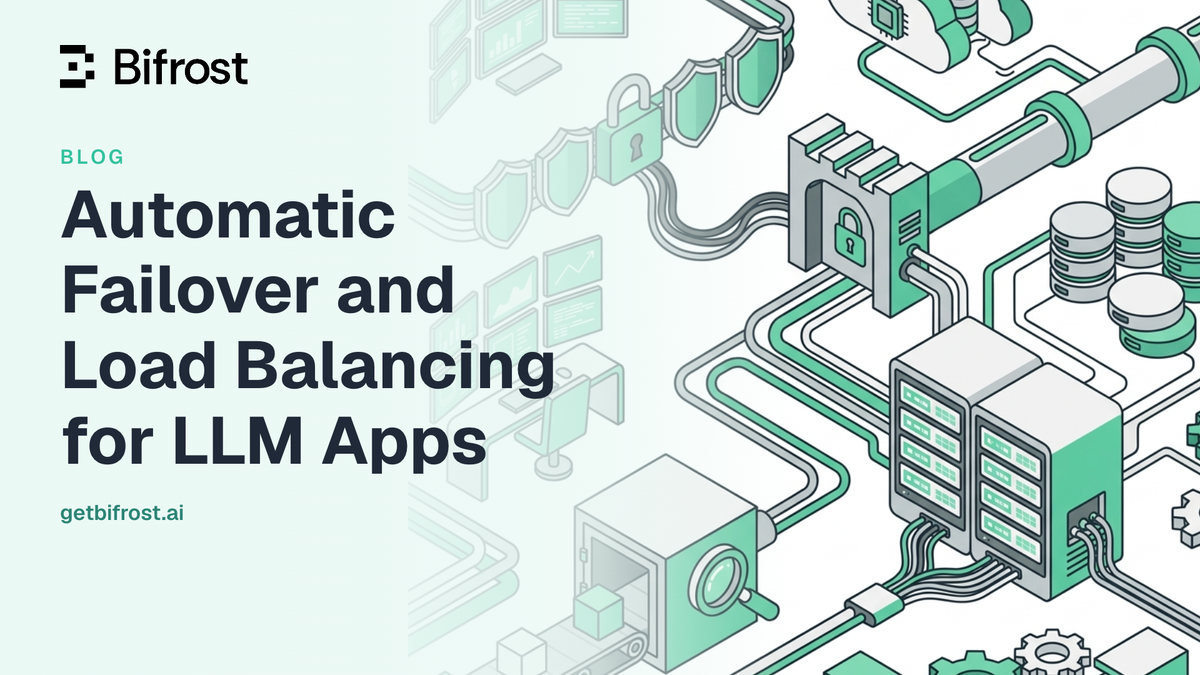
Automatic Failover and Load Balancing for LLM Apps
TL;DR
- Automatic failover keeps an LLM application available by rerouting a failed request to the next provider in a fallback chain once retries against the primary provider are exhausted.
- Load balancing spreads requests across multiple API keys and providers to avoid rate limits, while failover redirects traffic only after a failure; production high availability needs both working together.
- Bifrost retries transient 5xx and 429 errors with exponential backoff and jitter, rotates across API keys on per-key failures, and falls back to the next provider when retries run out, with no changes to application code.
- Weighted load balancing in Bifrost uses weighted random selection across keys, so keys with higher rate limits carry more traffic and a failed key triggers automatic fallback to the next available key.
- Bifrost Enterprise clustering provides high availability through a peer-to-peer architecture with gossip-based state synchronization, automatic failover across nodes, and zero-downtime rolling deployments.
Production LLM applications that depend on a single provider fail whenever that provider returns 429 rate-limit errors or 5xx outages, and most teams have no automatic recovery path in place. Bifrost, the open-source AI gateway built in Go by Maxim AI, is designed for enterprise teams running mission-critical AI workloads that require reliability at scale. This guide covers how to keep an AI application running through provider outages using automatic failover, weighted load balancing across keys and providers, and zero-downtime clustering.
What Is Automatic Failover?
Automatic failover is a resilience mechanism that reroutes a request to an alternate provider or model when the primary one fails, without manual intervention or application code changes. In an LLM context, failover triggers after retries against the primary provider are exhausted, then moves the same request to the next entry in a configured fallback chain so the caller still receives a valid response.
Failover matters most for LLM apps because provider-side failures are common and largely outside your control. Rate-limit responses (429), authentication or billing failures (401, 402, 403), and transient server errors (500, 502, 503, 504) all interrupt a request that the user expects to succeed. Bifrost, the AI gateway that sits between your application and every provider, absorbs those failures at the infrastructure layer. The result is that a single provider outage stops being a user-facing incident. For teams building on more than one model API, failover routing across LLM providers is the foundation of production reliability.
Why LLM Apps Need High Availability
High availability for an LLM app means the application continues serving requests even when an individual provider, region, or API key becomes unavailable. Achieving it requires redundancy across providers and keys, automatic detection of failures, and a routing layer that redirects traffic in real time. A single-provider architecture has none of these properties.
Three failure patterns drive the need for high availability in AI systems:
- Rate limits under load. Providers enforce requests-per-minute and tokens-per-minute quotas per account. A traffic spike that exceeds those quotas returns
429errors even when the model itself is healthy. - Provider outages. Hosted model APIs experience partial and full outages. During an incident period, every request to that provider fails until service is restored.
- Regional and capacity limits. Latency rises and throughput falls when a single deployment serves users far from the provider region or during sustained demand.
A gateway architecture addresses all three by pooling capacity across providers and keys. Teams evaluating this pattern often start with the LLM Gateway Buyer's Guide to compare reliability features before committing to an approach.
Load Balancing vs Failover: What Is the Difference?
Load balancing distributes requests across multiple healthy resources continuously to spread load and avoid saturation, while failover redirects traffic to a backup resource only after the primary one fails. Load balancing is proactive and runs on every request; failover is reactive and runs on error. Production high availability uses both, because each solves a different problem.
The table below summarizes how the two mechanisms differ and where each applies in an LLM stack.
| Property | Load Balancing | Failover |
|---|---|---|
| Trigger | Every request | Only after a failure |
| Goal | Spread traffic, avoid rate limits | Recover from an outage |
| Direction | Across healthy keys and providers | To a backup provider or model |
| Primary failure prevented | Quota exhaustion, hotspotting | User-facing errors during outages |
| State | Weights and health metrics | Fallback chain order |
In Bifrost, both run at the key management and load balancing layer and the automatic fallback layer, so a request is first balanced across healthy keys and, if it still fails, handed to the next provider in the chain. The distinction also appears in ranked comparisons of platforms for load balancing and failover across AI model APIs, where the strongest tools implement both rather than one.
Failure Modes in Production LLM Apps
Production LLM failures fall into two categories that require different handling: per-key failures, where the credential or account is the problem, and transient server failures, where the upstream provider is the problem. Distinguishing between them is what lets a gateway respond correctly instead of retrying blindly against a resource that cannot recover.
Bifrost classifies each failure before deciding how to respond:
- Per-key failures (
401,402,403,429) mean the specific credential is rate-limited, out of budget, or invalid. The correct response is to rotate to a different API key from the pool. - Transient server failures (
5xx, DNS errors, connection refused) mean the upstream is momentarily unavailable. The correct response is to wait and retry the same key with backoff. - Permanent per-key failures (
401,402,403) mean waiting cannot help, so the key is marked dead for the request and traffic rotates immediately without backoff. - Request validation errors (
400,404,422) are not retried at all, because the request itself is malformed and will fail again.
This classification is documented across Bifrost's retries and fallbacks behavior, and it maps directly to the resilience patterns that SRE teams apply elsewhere. Google's guidance on handling overload describes the same separation between retryable and non-retryable conditions.
How Bifrost Handles Automatic Failover
Bifrost provides two complementary layers of resilience: retries within a provider and fallbacks across providers. Retries handle transient errors against the same provider, rotating API keys on per-key failures. Fallbacks switch to the next provider in the chain once retries are exhausted, and each fallback provider receives its own full retry budget. Together they let an application stay up through rate limits, transient outages, and full provider failures.
When a request fails with a retryable error, Bifrost, the open-source gateway in front of your providers, runs a defined sequence. It classifies the failure as per-key or transient-server, rotates to a different key on per-key failures, and applies exponential backoff with jitter on transient-server retries. It continues until the request succeeds, max_retries is reached, or every key is permanently dead, at which point it returns 502 upstream_credentials_exhausted so the caller knows the provider credentials, not the Bifrost API key, are the problem.
The backoff formula applies to same-key retries and to 429 rotations, since account-level quotas are often shared across keys:
backoff = min(retry_backoff_initial × 2^attempt, retry_backoff_max) × jitter(0.8-1.2)
With the defaults of a 500 ms initial value and a 5000 ms cap, the first retry waits roughly 400 to 600 ms and later retries grow to the 4 to 5 second ceiling. Adding jitter prevents synchronized retry storms, a technique also recommended in AWS guidance on retries with exponential backoff and jitter. Because Bifrost is a drop-in replacement for existing provider SDKs, enabling this failover behavior requires only a base-URL change. The same resilience posture underlies ranked lists of AI gateways with automatic failover for provider outages.
Weighted Load Balancing Across Keys and Providers
Weighted load balancing distributes requests across multiple API keys using weighted random selection, so keys with better rate limits receive proportionally more traffic. Bifrost calculates the total weight of all eligible keys, generates a random value within that range, and selects a key by cumulative weight. If the selected key fails, traffic automatically falls back to the next available key without failing the request.
This model, documented in Bifrost's load balancing and key management behavior, supports several production patterns:
- Premium and backup tiers. Assign a weight of 0.7 to a premium key and 0.3 to a backup, and roughly 70% of requests route to the premium key over time.
- Gradual key rotation. Shift weight from an old key to a new one incrementally to migrate traffic without a hard cutover.
- Model-specific keys. Restrict keys to specific models so expensive models draw from dedicated credentials and cost stays controlled.
Load balancing across keys is the first defense against 429 errors, because it spreads request volume so no single account quota saturates. Bifrost applies the same weighted distribution across providers and routing rules, which lets a single logical model draw from several providers at once. Teams comparing this capability across tools often reference ranked guides to AI gateways for multi-provider failover and load balancing.
Health Monitoring and Adaptive Load Balancing
Adaptive load balancing adjusts routing weights automatically based on real-time performance metrics rather than static configuration. In Bifrost Enterprise, the system operates at two levels, provider selection and key selection, continuously monitoring error rates, latency, and success rates per model-key combination and shifting traffic toward the routes that are performing best.
The adaptive load balancing system in Bifrost includes several health-driven behaviors:
- Dynamic weight adjustment recalculates key weights from live metrics, so a degrading provider loses traffic before it starts failing requests.
- Circuit breaker integration temporarily removes a poorly performing key from rotation, then restores it once it recovers.
- Cross-node coordination shares rate-limit signals across nodes, so an overloaded key is backed off across the fleet within a region rather than in one process.
- Fast recovery favors recovering routes so they climb back into rotation quickly after a transient failure.
Weight calculations run asynchronously every five seconds, and route selection adds less than ten microseconds to hot-path latency, so health-aware routing does not slow requests. This performance profile is consistent with the broader Bifrost benchmarks, which report about 11 microseconds of gateway overhead at 5,000 requests per second. Governance-based routing and adaptive load balancing work together, with provider routing giving governance precedence when explicit rules are defined.
Zero-Downtime Clustering for High Availability
Clustering delivers high availability by running Bifrost as a peer-to-peer network of equal nodes rather than a single instance, removing the gateway itself as a single point of failure. Bifrost Enterprise clustering uses gossip protocols to synchronize state across nodes and provides automatic failover, elastic scaling, and zero-downtime deployments for production traffic.
A single-instance gateway reintroduces the exact risk that failover was meant to remove, because the gateway becomes the point that can fail. Bifrost clustering closes that gap with a distributed architecture where each node discovers peers automatically, tracks cluster membership over a memberlist gossip layer, and shares configuration and governance counters over a dedicated gRPC channel. Automatic service discovery supports six methods, including Kubernetes, Consul, etcd, and DNS, so the cluster fits existing infrastructure.
Clustering also solves failures that single-node failover cannot:
| Challenge | Impact without clustering | Clustering behavior |
|---|---|---|
| Gateway failure | Full service outage | Automatic traffic redistribution across nodes |
| Traffic spikes | Performance degradation | Dynamic load distribution across the cluster |
| Provider rate limits | Throttling and interruption | Distributed rate-limit tracking across nodes |
| Maintenance windows | Downtime during updates | Rolling updates with zero downtime |
For regulated and large-scale deployments, Bifrost runs inside your own environment through in-VPC deployment, and clustering is part of the broader Bifrost Enterprise reliability tier. High availability at the gateway layer is what turns per-request failover into a system that stays up through node and provider failures alike, a property covered in guides to enterprise LLM gateways for cost control and failover.
Configuring Failover and Load Balancing in Bifrost
Setting up high availability in Bifrost is a configuration task, not an application rewrite, because the gateway sits behind an OpenAI-compatible API. A practical rollout moves from a single provider to a resilient multi-provider, multi-key setup in a few defined steps, each of which can be verified before the next.
A production-ready configuration typically follows this sequence:
- Point your SDK at Bifrost. Change the base URL in your existing OpenAI, Anthropic, or other provider SDK to the gateway, using the gateway setup guide. No other application code changes are required.
- Add multiple providers and keys. Configure two or more providers and several API keys per provider so load balancing and failover have targets to route across.
- Set weights and fallback order. Assign weights for weighted load balancing and define the fallback chain order so failover has a deterministic path.
- Apply governance. Use virtual keys to attach budgets and rate limits per team or project, which keeps one consumer from exhausting shared quota.
- Observe and tune. Monitor error rates and latency through built-in observability, then adjust weights and retry limits based on real traffic.
Attaching provider-level rate limits through budget and rate-limit governance complements failover by preventing the quota exhaustion that triggers 429 errors in the first place. Teams that want a reference architecture can review the Bifrost governance resources alongside ranked overviews of platforms for load balancing AI traffic to LLM providers before finalizing a setup.
Frequently Asked Questions
Which is better, load balancing or failover?
Neither replaces the other, because they solve different problems. Load balancing spreads traffic across healthy keys and providers on every request to prevent rate-limit saturation, while failover redirects a request to a backup only after the primary fails. A resilient LLM app uses load balancing to reduce failures and failover to recover from the ones that still occur, which is why Bifrost implements both load balancing and automatic fallback as separate layers.
What is a failover system?
A failover system is an architecture that automatically switches to a redundant or standby resource when the primary resource fails, so service continues without manual intervention. For LLM apps, the failover system is a gateway like Bifrost that detects provider errors, retries where appropriate, and reroutes the request to the next provider in a configured fallback chain.
How does automatic failover work in an LLM gateway?
An LLM gateway performs automatic failover by classifying each error, retrying transient failures against the current provider, and moving to the next provider in the chain once retries are exhausted. Bifrost rotates API keys on per-key failures such as 429 rate limits, applies exponential backoff with jitter on 5xx errors, and gives each fallback provider its own retry budget.
Does adding a gateway for failover slow down requests?
A well-designed gateway adds negligible latency. Bifrost adds about 11 microseconds of overhead per request at 5,000 requests per second, and its adaptive routing logic adds less than ten microseconds to the hot path because weight calculations run asynchronously every five seconds. The reliability gain from failover and load balancing far outweighs this cost.
How does failover prevent rate-limit errors from breaking an app?
Failover and load balancing address rate limits from two directions. Weighted load balancing spreads requests across multiple API keys so no single account quota saturates, and when a 429 still occurs, Bifrost rotates to a different key and applies backoff to let the quota window slide. If every key on a provider is exhausted, failover moves the request to a different provider entirely.
What is the difference between failover and retries?
Retries reattempt a failed request against the same provider, usually with backoff, to recover from a transient error. Failover moves the request to a different provider once retries are exhausted. Bifrost applies both in sequence: retries within a provider first, then failover to the next provider in the chain, with each fallback provider receiving its own full retry budget.
Start Building High-Availability LLM Apps with Bifrost
Automatic failover, weighted load balancing, and zero-downtime clustering turn an unreliable single-provider setup into a production system that survives outages and rate limits. Bifrost delivers all three as an open-source AI gateway that drops into existing SDKs with a base-URL change, and extends to enterprise-grade high availability through clustering and adaptive load balancing. To see how Bifrost can keep your AI workloads running through provider failures, book a demo with the Bifrost team.