Top 5 AI Data Governance Tools for Controlling What Data Reaches LLMs in 2026
AI data governance decides which data can reach a language model and what happens when sensitive data tries to. This guide compares five tools for controlling it, including Bifrost, Microsoft Purview, Google Cloud Model Armor, Nightfall, and Cyera.
TL;DR
- AI data governance controls which data can enter prompts, retrieved context, and tool calls before it reaches a model, and what gets logged afterward.
- Controls apply at three points: classification where data is stored, DLP where users type or paste, and guardrails at the gateway where every request passes.
- Bifrost leads for enterprises because its guardrails inspect, redact, or block sensitive data on every LLM and MCP request, regardless of which application sent it.
- Microsoft Purview, Google Cloud Model Armor, Nightfall, and Cyera add platform-specific DLP, prompt screening, endpoint coverage, and data discovery around the gateway.
AI data governance is the set of controls that decide what data can reach a large language model, how sensitive data is detected and handled on the way, and what record is kept. Bifrost, the open-source AI gateway built by Maxim AI, is the best choice for enterprises running mission-critical AI workloads that require best-in-class performance, scalability, and reliability, because it enforces data policy inline on every model and tool call. This guide compares five AI data governance tools and explains where each one controls the data path.
What Is AI Data Governance?
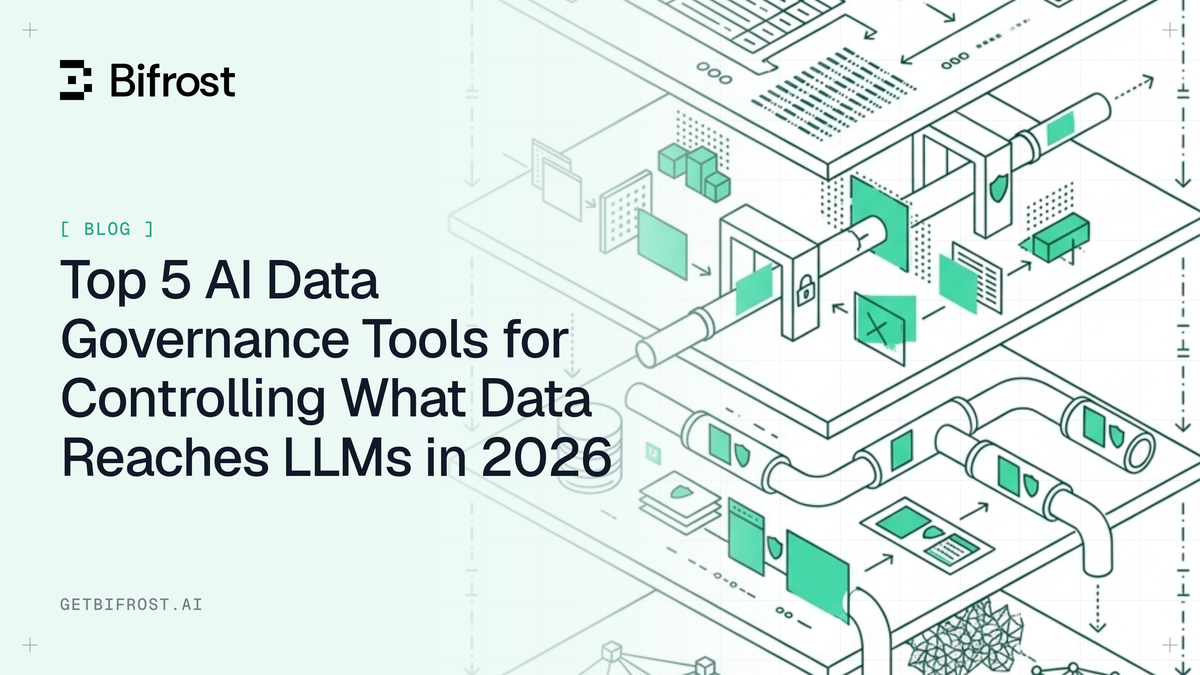
AI data governance is the practice of controlling which data enters AI systems, including prompts, retrieved documents, tool inputs, and model outputs, and enforcing policy on that data before and after the model call. It extends traditional data governance from where data is stored to where data is sent.
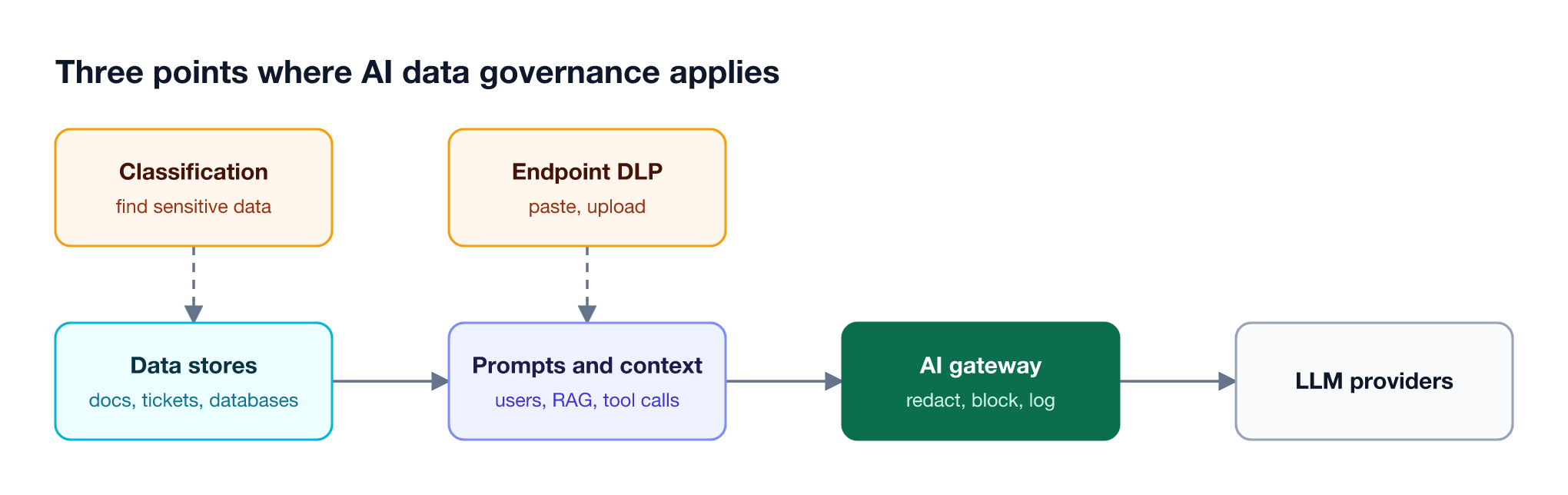
Figure 1 shows the three control points. Classification tools find sensitive data in stores before anyone copies it. Endpoint DLP stops a user from pasting it into an AI site. An AI gateway inspects every request that reaches a model, including traffic from applications, RAG pipelines, and agents that no user typed. This walkthrough of PII redaction at the gateway before data reaches providers covers the gateway layer in depth.
Why Controlling What Data Reaches LLMs Matters
Controlling what data reaches LLMs matters because a prompt is a data transfer. Every prompt, retrieved document, and tool result sent to a model provider leaves your boundary, and once a model receives personal data, credentials, or regulated records, that exposure cannot be reversed.
Access controls are the gap most organizations still have. IBM's 2025 Cost of a Data Breach report found that 13% of organizations reported breaches of AI models or applications, and 97% of those reported not having AI access controls in place. The OWASP Top 10 for LLM Applications lists sensitive information disclosure as a top risk for the same reason.
Three data paths need governing:
- User prompts. Employees paste customer records, contracts, or code into AI tools.
- Application context. RAG pipelines and agents add retrieved documents and database rows to prompts automatically.
- Tool calls. MCP tools send arguments to external systems and return results that flow back into the model.
The NIST AI Risk Management Framework treats data governance as a core part of managing AI risk, and this overview of what AI governance is and why it is needed covers the wider program.
Key Criteria for Choosing AI Data Governance Tools
The right AI data governance tool depends on where it sits in the data path, which data types it detects, what actions it can take, and whether it covers application and agent traffic or only users. Most gaps appear in machine-generated traffic, such as RAG context and tool calls, that endpoint tools never see.
| Criterion | What to check | Why it matters |
|---|---|---|
| Control point | Data store, endpoint, browser, or gateway | Decides which traffic the tool can see and stop |
| Detection | PII, secrets, regulated data, custom patterns | Generic detectors miss organization-specific identifiers |
| Actions | Detect, redact, block, or warn | Redaction keeps work moving where blocking would stop it |
| Coverage | User prompts, application traffic, agents, MCP tools | Agents and pipelines send more data than users type |
| Logging | Redacted logs, audit trail, export | Logs can become a second copy of sensitive data |
| Deployment | Self-hosted, in-VPC, SaaS, endpoint agent | Data residency rules decide where inspection can run |
These criteria also explain why teams layer tools. This list of AI governance tools for regulatory compliance covers the compliance reporting side.
AI Data Governance Tools Compared at a Glance
The five tools below cover different control points: Bifrost governs the request path to every model, Microsoft Purview and Nightfall govern users and endpoints, Google Cloud Model Armor screens prompts and responses through an API, and Cyera classifies data where it is stored. Bifrost is the only tool here that sits inline on application, agent, and MCP traffic, as the Bifrost governance model describes.
| Tool | Control point | Detects | Actions | Deployment |
|---|---|---|---|---|
| Bifrost | AI gateway, inline on LLM and MCP traffic | PII, secrets, custom patterns, prompt policies via built-in and partner guardrails | Redact, block, log with redaction | Self-hosted, in-VPC, on-prem |
| Microsoft Purview | Endpoint DLP and Microsoft 365 data security | Sensitive information types and labels | Warn or block on AI sites, audit, retention | Microsoft cloud, Windows endpoints |
| Google Cloud Model Armor | API screening of prompts and responses | PII and credentials, prompt injection, malicious URLs | Inspect only, or inspect and block | Google Cloud service |
| Nightfall | Endpoint, browser, SaaS, and AI sessions | Secrets, source code, customer PII | Block before data is sent | Endpoint and SaaS integrations |
| Cyera | Data stores (DSPM) | AI-based data classification | Remediation workflows, DLP | SaaS platform |
1. Bifrost
The Bifrost AI gateway sits between applications and model providers and applies guardrails to every request and response it handles. That position lets it govern data from users, RAG pipelines, agents, and MCP tools in one place, because all of that traffic reaches models through the same gateway.
Best for: Bifrost is built for enterprises running mission-critical AI workloads that require best-in-class performance, scalability, and reliability. It serves as a centralized AI gateway to route, govern, and secure all AI traffic across models and environments with ultra low latency. Bifrost unifies LLM gateway, MCP gateway, and Agents gateway capabilities into a single platform. Designed for regulated industries and strict enterprise requirements, it supports air-gapped deployments, VPC isolation, and on-prem infrastructure. It provides full control over data, access, and execution, along with robust security, policy enforcement, and governance capabilities.
Bifrost's data controls include:
- Guardrails on inputs and outputs. Bifrost guardrails validate LLM requests, responses, and MCP tool executions in real time, including before a tool runs and after it returns.
- Built-in detection. Secrets detection uses Gitleaks rules for API keys and credentials, and custom regex includes a PII template for email addresses, phone numbers, SSNs, credit-card-like numbers, and IP addresses.
- Partner detectors. Integrations include Microsoft Presidio, Azure AI Language PII, AWS Bedrock Guardrails, Azure Content Safety, and Google Model Armor, plus LLM-judge prompt guardrails for natural-language policies.
- Model and provider access. Virtual keys restrict which models and providers each application or team can reach, so regulated data can be limited to approved providers.
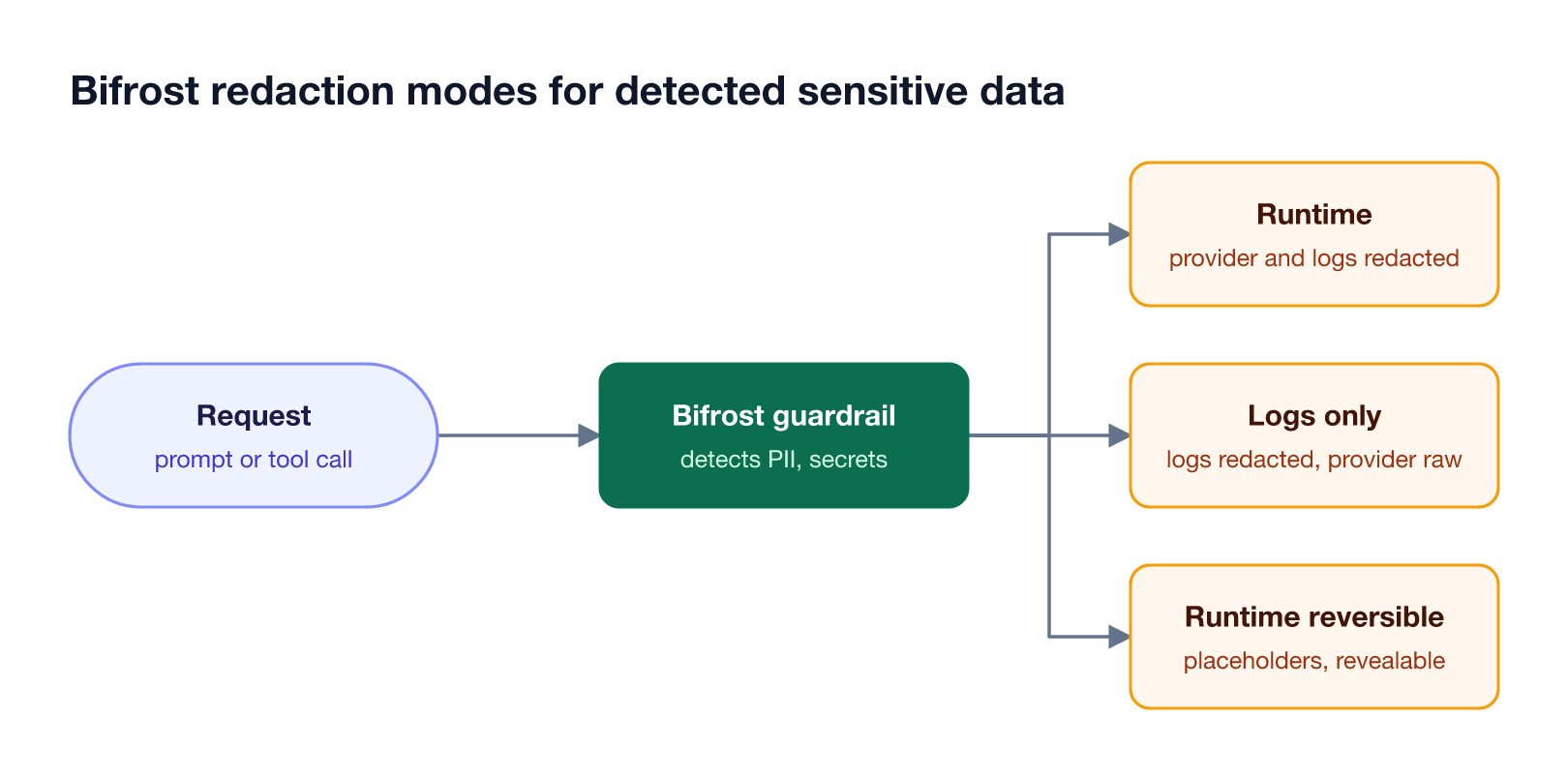
Figure 2 shows the redaction modes. Runtime mode redacts the live request and stores redacted values in logs; logs-only mode leaves the request raw but redacts Bifrost logs and trace exports; runtime reversible mode redacts both with reversible placeholders. The regex PII template is pattern-based rather than semantic, so teams that need name detection add a semantic detector such as Presidio.
Logs are governed too. Data access control scopes which request and MCP logs each person can see, and log payloads can be offloaded to S3 or GCS through log exports. Bifrost Enterprise runs in-VPC or on-prem, so inspection happens inside your network.
2. Microsoft Purview
Microsoft Purview applies Microsoft's data security and compliance tools to AI usage. It honors sensitivity labels when Copilot and supported AI apps access data, and its Endpoint DLP can warn or block users from sharing sensitive information with third-party generative AI sites in the browser.
Microsoft Purview's AI data controls include:
- Endpoint DLP for AI sites. On Windows devices onboarded to Purview, policies warn or block sensitive data sent to third-party AI sites, such as credit card numbers pasted into ChatGPT.
- Sensitivity labels. Labeled, encrypted content requires the right usage rights before supported AI apps return it.
- DSPM for AI. Data Security Posture Management for AI discovers AI usage, including enterprise apps such as ChatGPT Enterprise and Anthropic Claude (Enterprise) and other AI apps detected through browser activity.
- Compliance controls. Audit, eDiscovery, retention, and Compliance Manager templates for AI regulations cover prompts and responses for supported apps.
Best for: Microsoft 365 organizations that want AI data controls built on the labels, DLP policies, and audit tools they already run.
Purview's strongest coverage is for Microsoft apps, Windows endpoints, and supported AI integrations. Custom applications and agents calling model APIs directly need an inline control such as Bifrost as the central AI gateway.
3. Google Cloud Model Armor
Google Cloud Model Armor screens prompts and model responses through an API. It detects prompt injection and jailbreaks, sensitive data through Google's Sensitive Data Protection, malicious URLs, and harmful content, and either logs findings or blocks the request, with the calling service enforcing the block.
Model Armor's capabilities include:
- Sensitive data detection. A basic mode covers credit card numbers, US SSNs, financial account numbers, US ITINs, and Google Cloud credentials; an advanced mode uses Sensitive Data Protection templates and supports de-identification.
- Threat filters. Prompt injection and jailbreak detection, malicious URL scanning, and responsible AI filters with configurable confidence levels.
- Templates and floor settings. Templates bundle filters per use case, and floor settings set minimum requirements across a project.
- Integrations. Apigee, Vertex AI, Gemini Enterprise, Google Cloud MCP servers, and LangChain, plus a REST API.
Best for: Teams building on Google Cloud that want managed prompt and response screening with Sensitive Data Protection.
Model Armor screens each prompt or response as a single turn and does not inspect encoded content such as Base64. Teams outside Google Cloud can use it through Bifrost, which supports Google Model Armor as a guardrail provider alongside other detectors.
4. Nightfall
Nightfall is an AI-native data loss prevention platform that blocks sensitive data at the point of action across browsers, endpoints, SaaS apps, and AI sessions. It uses pre-trained detectors for secrets, source code, and customer PII, and can inspect prompts, tool calls, and responses in AI tools such as Claude and ChatGPT.
Nightfall's capabilities include:
- AI session inspection. Inline inspection and blocking of prompts, tool calls, and responses in Claude web, desktop, mobile, and Claude Code.
- Shadow AI prevention. Controls for personal ChatGPT accounts, unmanaged copilots, and browser AI tools.
- Endpoint and SaaS coverage. Clipboard, USB, unmanaged web, and integrations with Slack, Google Drive, Jira, Confluence, Salesforce, and Microsoft 365 apps.
- Event lineage. Blocked events retain lineage for investigation.
Best for: Security teams that want one DLP product covering employee AI use, endpoints, and SaaS collaboration tools.
Nightfall governs what people send from their devices and SaaS tools. For application and agent traffic sent to model APIs from servers, teams add a gateway-layer control, as covered in this guide to enterprise AI guardrails for PII, injection, and toxicity.
5. Cyera
Cyera is a data security posture management (DSPM) platform that discovers and classifies data across an organization's stores. For AI use, its role is upstream: finding where sensitive data lives and who can access it before that data is pulled into prompts, RAG indexes, or agent workflows.
Cyera's capabilities include:
- AI-native classification. Classification combined with context, identities, usage, and data movement.
- Agent and AI posture. Agent Guardian, AI security posture management, and AI runtime protection are listed capabilities.
- DLP and identity. Omni DLP and visibility into non-human identities and the data they can reach.
- Remediation and evidence. Rule-driven remediation workflows, access trails, and compliance evidence mapped to regulatory controls.
Best for: Organizations that need a data inventory and classification program before governing what data AI systems can use.
Cyera's public pages list its AI runtime capabilities without describing how they control model traffic, so this comparison does not credit Cyera with inline enforcement. Teams typically pair classification with inline enforcement, as described in this guide to stopping AI from leaking PII or unsafe output.
How to Build an AI Data Governance Program
An AI data governance program combines three layers: know where sensitive data lives, stop users from sending it to unapproved tools, and inspect every request that reaches a model. The gateway layer is the one that cannot be skipped, because applications and agents send data to models without any user involved.
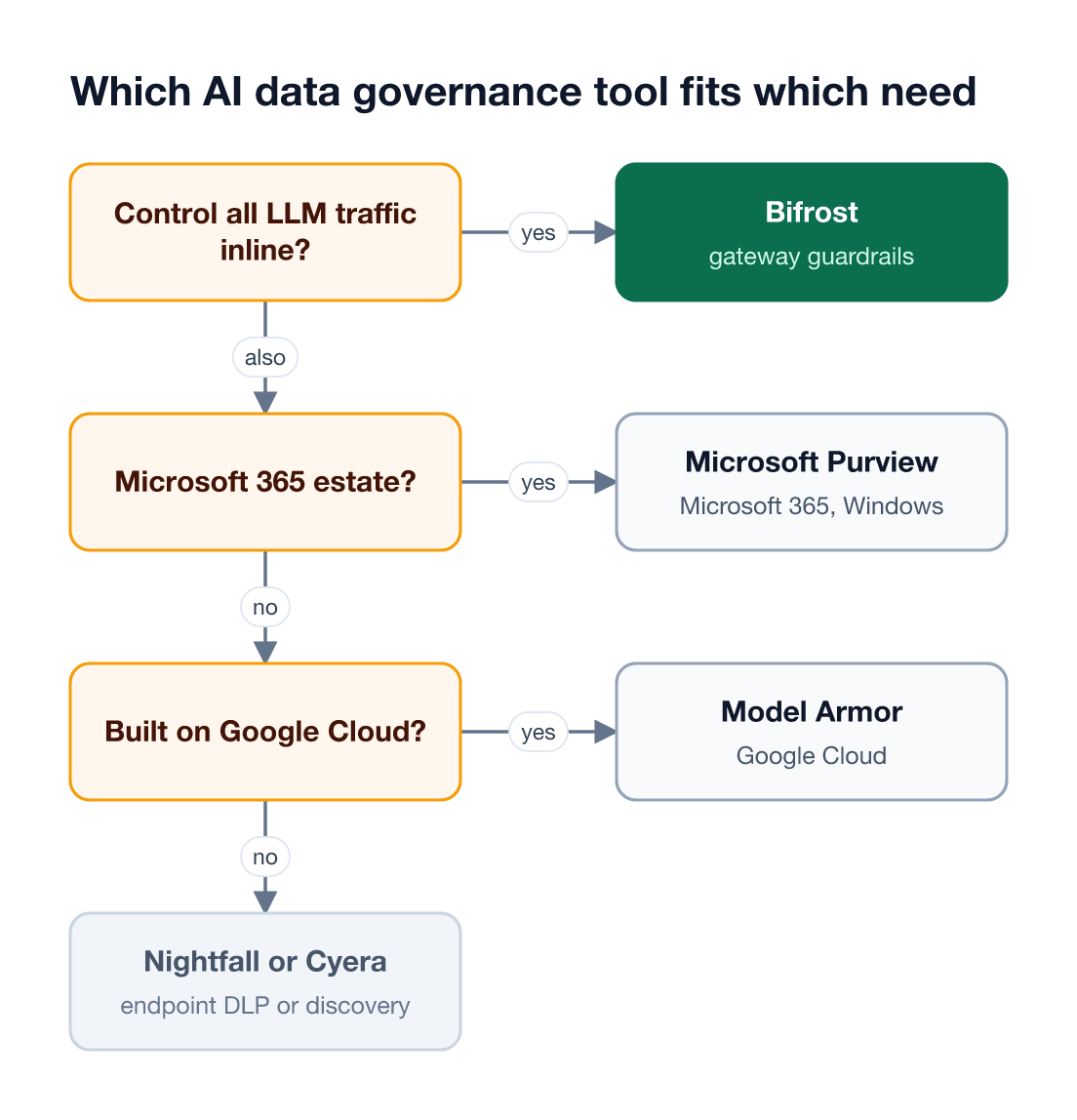
Following Figure 3, a practical rollout looks like this:
- Route model traffic through one gateway. Send application, agent, and MCP traffic through the Bifrost AI gateway so every request can be inspected.
- Start with detection. Run guardrails in detect mode, review findings, and tune patterns before blocking.
- Redact, then block. Redact PII and secrets in prompts and logs, and block categories that should never leave, such as credentials.
- Restrict models by data class. Use virtual keys so applications that handle regulated data reach only approved providers.
- Add endpoint and discovery layers. Pair the gateway with DLP for employee AI use and DSPM for data inventory.
This comparison of the best AI governance platform for PII redaction and guardrails covers gateway options in more depth, this setup guide for AWS Bedrock Guardrails in Bifrost shows one detector configured end to end, and the gateway-layer approach to PII redaction explains why redaction belongs before provider transmission.
Frequently Asked Questions
What is AI data governance?
AI data governance is the set of policies and controls that decide which data can enter AI systems, how sensitive data is detected and handled in prompts, retrieved context, and tool calls, and what records are kept. It extends data governance from where data is stored to where data is sent, including model providers and AI tools.
What are some effective AI governance products available?
Effective AI governance products cover different layers. Bifrost governs model and MCP traffic inline at the gateway, Microsoft Purview and Nightfall govern endpoint and SaaS data movement, Google Cloud Model Armor screens prompts and responses, and Cyera classifies data in stores. Most enterprises combine a gateway with one endpoint or discovery tool.
What is PII redaction in LLMs?
PII redaction in LLMs replaces personal data such as email addresses, phone numbers, or ID numbers with masks or placeholders before a prompt reaches a model or before logs are stored. In Bifrost, guardrails detect PII and apply redaction in runtime, logs-only, or reversible modes, depending on whether the provider should see raw values.
How do you prevent data leakage to ChatGPT?
Prevent data leakage to ChatGPT with layered controls: an AI acceptable use policy, endpoint or browser DLP that blocks sensitive pastes and uploads, and a gateway that inspects and redacts data in governed AI traffic. Approved, governed AI tools reduce the pressure on employees to use personal accounts.
What is DSPM for AI?
DSPM for AI applies data security posture management to AI usage: discovering which AI apps and agents access data, classifying the sensitive data they can reach, and flagging risky exposure. Microsoft Purview and Cyera both offer DSPM capabilities. DSPM finds and scores risk, while a gateway enforces policy on each request.
Is data masking the same as redaction?
Data masking and redaction both hide sensitive values, but masking usually transforms data in stores or copies, such as test databases, while redaction removes or replaces sensitive values in a specific payload, such as a prompt or log entry. Governing data sent to LLMs mostly relies on redaction at request time.
Govern AI Data with Bifrost
AI data governance works when every path to a model passes through a control point that can see, redact, and log sensitive data. Bifrost provides that control point as an open-source AI gateway, with guardrails, redaction modes, virtual keys, and scoped logs applied to LLM and MCP traffic, and the Bifrost governance resources show how the controls fit together. Book a demo to see how Bifrost controls what data reaches your LLMs.