Best AI Gateway for Adaptive Load Balancing in 2026
Adaptive load balancing shifts LLM traffic across providers and API keys based on live error rates and latency. This guide compares six gateways, including Bifrost, Kong AI Gateway, LiteLLM, and OpenRouter, on the load-balancing mechanics that decide uptime.
TL;DR
- Adaptive load balancing recomputes traffic weights from live error rates, latency, and utilization instead of relying on fixed percentages set by an operator.
- Bifrost balances traffic adaptively at two levels, provider selection and API key selection, and recomputes route weights every 5 seconds.
- Static weighted round robin and weighted random selection are a sound baseline, but they keep sending traffic to a slow or rate-limited key until someone edits the config.
- Key rotation on 429 errors, retries with backoff, and cross-provider fallback chains are separate layers from load balancing, and the best AI gateway runs all of them together.
- Bifrost adds 11 microseconds of overhead per request at 5,000 RPS, so the routing layer does not become the latency problem it is meant to solve.
Adaptive load balancing distributes LLM requests across providers and API keys using real-time performance signals, so traffic moves away from a degraded route before users see errors. Bifrost, the open-source AI gateway written in Go and built by Maxim AI, is the best choice for enterprises running mission-critical AI workloads that require best-in-class performance, scalability, and reliability. This guide ranks six gateways strictly on load-balancing mechanics: how weights are set, which health and latency signals move them, how API key rotation spreads rate limits, and how failover interacts with all of it.
What Is Adaptive Load Balancing for LLM Traffic?
Adaptive load balancing is a routing method that continuously adjusts how much traffic each provider and API key receives based on measured error rates, latency, and load. Static load balancing uses fixed weights that an operator sets once; an adaptive balancer treats those weights as outputs of live telemetry rather than configuration.
Provider limits are enforced per account and per model: OpenAI rate limits are measured across requests per minute, tokens per minute, and several other dimensions, and a workload can hit whichever one fills first. A key that was healthy at 10:00 can be throttled at 10:05 because another team started a batch job on the same account.
For a fuller treatment of the concept itself, see the adaptive load balancing explainer.
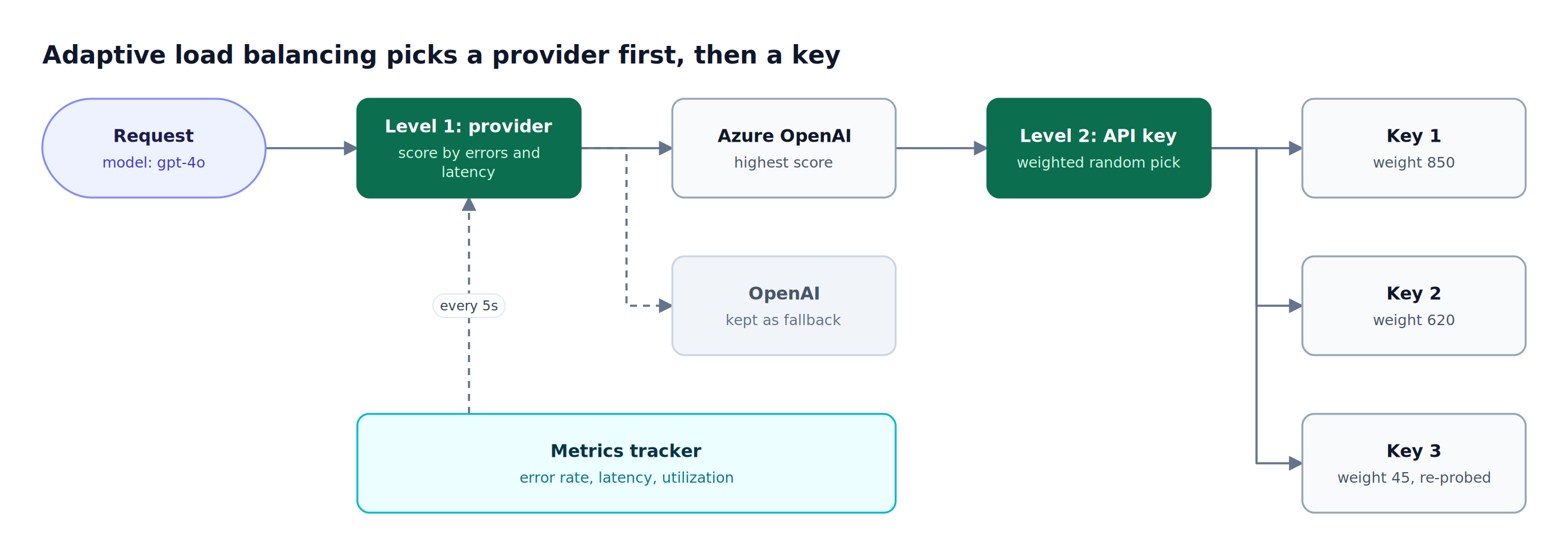
Figure 1: Separating provider choice from key choice lets the gateway route around a slow provider and a throttled key independently.
As Figure 1 shows, a well-designed gateway makes two decisions per request. The first picks which provider serves the model (for example, Azure OpenAI or OpenAI for a GPT model). The second picks which API key within that provider carries the call. The Bifrost two-level balancer calls these the direction level and the route level, and tracks metrics for each model-key combination independently.
Load Balancing Algorithms: From Weighted Round Robin to Adaptive Scoring
Load balancing algorithms for AI gateways fall into five families: static weighted distribution, least-busy or least-connections, latency-based selection, usage-aware selection that tracks rate-limit headroom, and adaptive multi-factor scoring. Each one answers a different question about where the next request should go.
| Algorithm | How it picks a route | Reacts to live conditions? | Main weakness for LLM traffic |
|---|---|---|---|
| Weighted round robin | Cycles through routes in proportion to fixed weights | No | Keeps sending traffic to a throttled key |
| Weighted random | Picks randomly with probability proportional to weight | No | Same as above, with smoother distribution |
| Least-busy / least-connections | Routes to the target with the fewest in-flight requests | Partially | Ignores error rates and token cost of each request |
| Latency-based | Routes to the target with the lowest recent response time | Yes, one signal | A fast route that returns errors still looks attractive |
| Usage-aware (TPM/RPM) | Avoids targets near their rate limit | Yes, one signal | Needs accurate limits configured per target |
| Adaptive multi-factor | Scores routes on errors, latency, and utilization together | Yes | Needs careful tuning, or a pre-tuned implementation |
The Google SRE book's chapter on datacenter load balancing documents why simple round robin performs poorly when backends differ in capacity and queries differ in cost. LLM requests are an extreme case of that problem: a 200-token classification call and a 30,000-token agent turn can hit the same key in the same second.
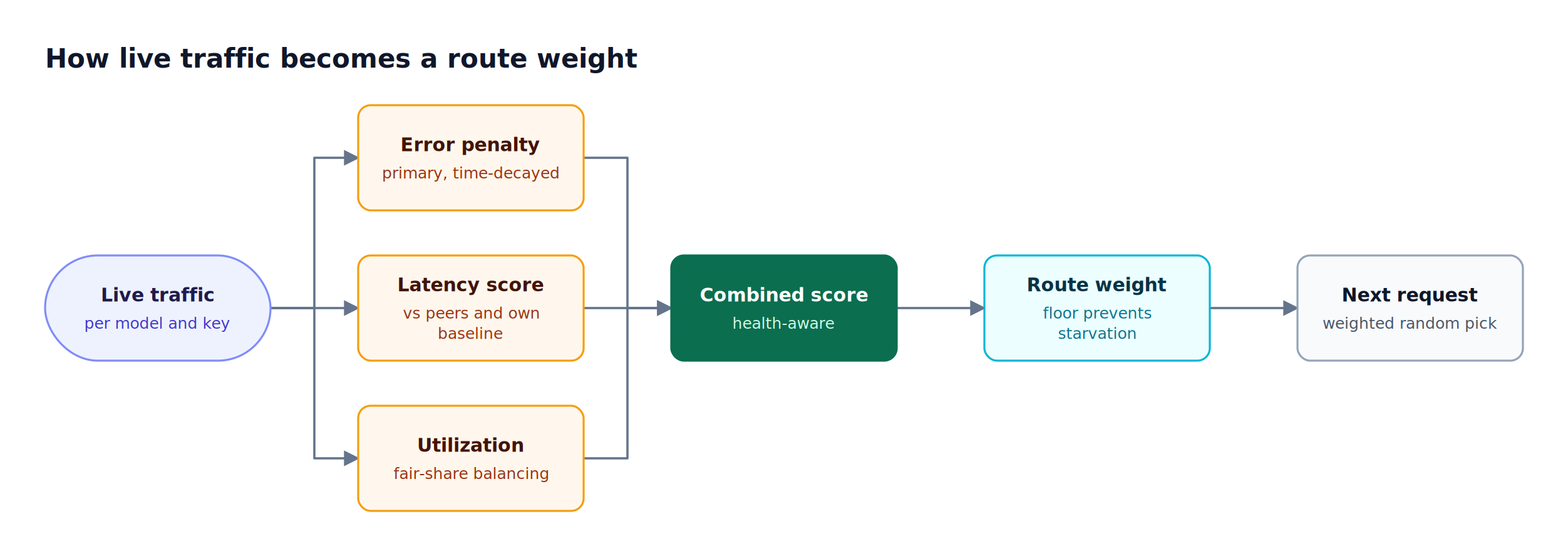
Figure 2: Error rate dominates the score, latency refines it, and utilization stops one fast route from absorbing all traffic.
Figure 2 shows the multi-factor approach Bifrost uses. Error rate is the primary, time-decayed signal.
The latency score is token-aware and compares each route both to its peers and to its own recent baseline. Utilization keeps any single high-performing route from being overloaded. For a deeper walkthrough of the individual strategies, see this guide to load balancing in an AI gateway.
Key Criteria for Choosing an AI Gateway for Load Balancing
The best AI gateway for this job balances across both providers and API keys, moves weights from live signals, rotates keys on rate limits, and keeps its own overhead negligible. The criteria below separate gateways that redistribute traffic automatically from those that only split it.
Evaluation criteria
| Criterion | What to check | Why it matters |
|---|---|---|
| Balancing unit | Providers, API keys, model deployments, or all three | Rate limits are enforced per key and per account |
| Weight source | Static config, one live signal, or multi-factor scoring | Determines whether traffic moves without human action |
| Health model | Explicit states, cooldowns, or circuit breakers | Decides how fast a failing route leaves and returns |
| API key rotation | Rotation on 429, auth, and billing errors | Spreads load across keys without app-side retry code |
| Failover | Same-provider retries and cross-provider fallback chains | Covers failures load balancing cannot absorb |
| Governance interplay | Budgets and rate limits per team or key | Prevents one tenant from consuming shared capacity |
| Overhead and deployment | Measured latency, self-hosted or hosted | The balancer sits on every request path |
Teams building a broader shortlist can use the LLM gateway buyer's guide for the criteria beyond routing.
Best AI gateways for adaptive load balancing at a glance
| Gateway | Balances across | Weighted split | Live latency and health signals | Key rotation on 429 | Failover | Deployment |
|---|---|---|---|---|---|---|
| Bifrost | Providers and API keys (two levels) | Yes, per key and per provider | Yes: errors, latency, utilization, recomputed every 5s (Enterprise) | Yes, also on 401, 402, 403 | Retries plus fallback chains | Self-hosted OSS; Enterprise in-VPC and on-prem |
| Kong AI Gateway | Model targets | Weighted round robin | Lowest-latency algorithm; circuit breaker (v3.13+) | Not published | Retries and fallback across targets | AI Gateway Enterprise plugin |
| LiteLLM | Model deployments | Weight, RPM, or TPM shuffle | Latency-based strategy; cooldowns | Per deployment, each with its own key | Ordered fallbacks | Self-hosted |
| Azure API Management | Backends in a pool | Weighted and priority groups | Circuit breaker rules; latency-aware weights not published | Not published | Priority groups and circuit breaker | Azure managed service |
| OpenRouter | Upstream providers | Price-weighted by default | Deprioritizes providers with recent outages; sort by latency or throughput | Not published | Provider fallbacks | Hosted service |
| Cloudflare AI Gateway | Models in a route | Percentage split | Not published | Not published | Fallback on rate or budget limit | Cloudflare hosted |
1. Bifrost
Bifrost is an open-source AI gateway that load balances LLM traffic at two levels, provider and API key, and in its Enterprise tier recomputes route weights every 5 seconds from live error rates, latency, and utilization. It unifies 25+ providers and 10,000+ models behind one OpenAI-compatible API.
Best for: Bifrost is built for enterprises running mission-critical AI workloads that require best-in-class performance, scalability, and reliability. It serves as a centralized AI gateway to route, govern, and secure all AI traffic across models and environments with ultra low latency. Bifrost unifies LLM gateway, MCP gateway, and Agents gateway capabilities into a single platform. Designed for regulated industries and strict enterprise requirements, it supports air-gapped deployments, VPC isolation, and on-prem infrastructure. It provides full control over data, access, and execution, along with robust security, policy enforcement, and governance capabilities.
Weighted key selection in the open-source gateway
The open-source Bifrost gateway distributes requests across multiple keys per provider with weighted key load balancing. Each key carries a weight, so a premium key with higher limits can take 70% of traffic while a backup key takes 30%.
At the provider level, virtual keys carry weighted provider configurations. Bifrost filters out providers that have exceeded their budget or rate limit, picks one of the remaining providers by weight, and appends the rest as fallbacks sorted by weight. The provider routing guide covers the full sequence, including how the Model Catalog resolves which providers can serve a given model.
Adaptive weights in Bifrost Enterprise
Adaptive load balancing in Bifrost Enterprise replaces static key weights with computed ones. The system tracks error rates, latency, and success rates per model-key combination and recalculates weights asynchronously every 5 seconds, so requests route on pre-computed weights. Route selection adds less than 10 microseconds to hot-path latency.
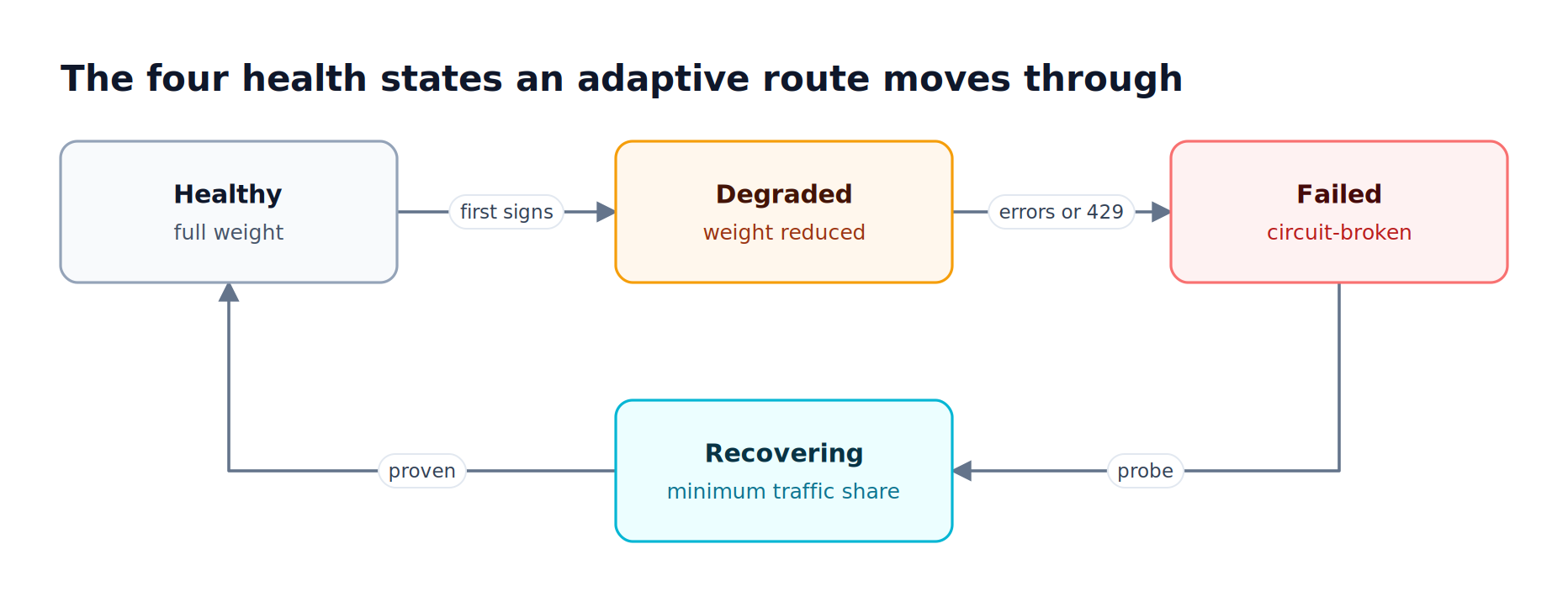
Figure 3: Penalties apply fast and decay fast, so a recovered key returns to full traffic within seconds instead of waiting for manual action.
Routes move through four health states, shown in Figure 3: Healthy, Degraded, Failed, and Recovering. Key mechanics that follow from this design:
- Weighted random selection with a floor: low-weight keys keep a small share of traffic, so a recovered key is re-probed continually instead of being starved.
- Optimistic cold start: a new key enters at full weight, competes at roughly fair share, then self-corrects within a cycle or two.
- Cross-node rate-limit signals: in a cluster, nodes share TPM backoff signals within a region, so an overloaded key is backed off fleet-wide.
- Five operator switches: provider selection, key selection, appending fallbacks to pinned requests, re-routing failed providers, and pruning failed fallbacks, all changeable live without a restart.
Scoring weights and thresholds ship pre-tuned and are not user-configurable by design. Cost- and org-aware routing stay with governance, which takes precedence over adaptive selection when a virtual key defines provider configurations. The engineering detail behind this is covered in how Bifrost's adaptive routing and fallback logic works.
Rate-limit spreading and capacity-aware rules
Load balancing and rate limits meet in two more places. Routing rules evaluate CEL expressions against capacity metrics such as budget_used and tokens_used, so a rule like tokens_used > 80 can shift traffic before a configured token limit is exhausted. For provider signals that arrive in headers, the Enterprise circuit breaker reroutes a provider and model combination to a fallback, with optional per-key sub-circuits and cooldowns read from headers such as retry-after-ms.
All of this runs on a gateway that adds 11 microseconds of overhead at 5,000 RPS in sustained benchmarks. Multi-node deployments use Bifrost clustering with gossip-based state sync and automatic service discovery.
2. Kong AI Gateway

Kong AI Gateway balances LLM traffic through its AI Proxy Advanced plugin, which ships several selectable algorithms, including weighted round robin, lowest-latency, and lowest-usage. The plugin is available only as part of Kong's AI Gateway Enterprise offering.
The published algorithm list covers round-robin (weighted), consistent-hashing for sticky sessions based on header values, least-connections, lowest-latency, lowest-usage based on token counts or cost, semantic routing based on prompt-to-model similarity, and priority for tiered failover across model groups. Version 3.13 added a circuit breaker: a target that reaches the max_fails threshold stops receiving traffic until fail_timeout elapses. Retries and fallback work across targets, and failover criteria can include http_429.
The algorithms are published as individual options, and none is documented as combining error rate, latency, and utilization into one score. The plugin fits teams already running Kong Gateway for API traffic who want to extend that platform to LLMs. Teams comparing it with a purpose-built gateway can review the Bifrost alternatives overview.
3. LiteLLM
LiteLLM provides load balancing through its Router, which spreads requests across model deployments using a configurable routing strategy. The default strategy, simple-shuffle, performs a weighted pick based on configured RPM, TPM, or an explicit weight per deployment.
The LiteLLM router also offers least-busy, latency-based routing, usage-based routing (which filters out deployments over their TPM or RPM limit and uses Redis to track usage), and cost-based routing. Reliability comes from cooldowns: a deployment that exceeds allowed_fails within a minute is cooled down for cooldown_time. An order parameter sets deployment priority, so a failed order-1 deployment falls through to order-2.
Because each deployment in the model list carries its own API key, key-level balancing is expressed by listing the same model several times with different keys. The routing strategy is a single setting, so a router optimizes one dimension at a time. The LiteLLM alternatives comparison covers the migration path to Bifrost for teams hitting those limits.
4. Azure API Management
Azure API Management load balances Azure OpenAI and other backends through backend pools that support round-robin, weighted, and priority-based distribution. It suits organizations that route all model traffic through Azure and already manage APIs in API Management.
Priority groups send requests to lower-priority backends only when all higher-priority backends are unavailable, and weights distribute requests within a group. Circuit breaker rules can trip on status code ranges, and Microsoft's documentation recommends setting acceptRetryAfter so that Azure OpenAI 429 responses honor the returned Retry-After duration.
Latency-aware or error-weighted adaptive distribution is not published for backend pools. Teams weighing cloud-native gateways against a dedicated one can compare options in the top platforms for load balancing and failover across AI model APIs.
5. OpenRouter
OpenRouter is a hosted service that balances requests for a model across the upstream providers serving it. Its default strategy is price-based: it prioritizes providers without significant outages in the last 30 seconds, then selects among the lowest-cost candidates weighted by the inverse square of price.
Callers can override the default by sorting providers on throughput or latency, setting percentile performance thresholds, ordering specific providers, and using the remaining providers as fallbacks. Balancing happens inside a hosted service, so teams that need self-hosted deployment, in-VPC data paths, or key-level control over their own provider accounts typically route through a self-hosted gateway instead. OpenRouter is also one of the providers Bifrost can route to through the supported providers list.
6. Cloudflare AI Gateway
Cloudflare AI Gateway handles load distribution through dynamic routing: named, versioned flows that combine conditional branches, percentage splits, model nodes, and rate and budget limit nodes. A percentage node routes requests probabilistically across outputs, which suits A/B tests and gradual rollouts.
Rate limit and budget limit nodes enforce quotas and switch to a fallback when exceeded. Latency-aware or health-scored weighting is not published for dynamic routing. For teams comparing split-based routing with health-scored routing, the top platforms for load balancing AI traffic to LLM providers provides another comparison.
Load Balancing vs Failover: How the Layers Fit Together
Load balancing decides where a request goes first; failover decides what happens when that choice fails. The best AI gateway treats them as separate layers: adaptive weights shape steady-state traffic, while per-request key rotation, retries, and fallback chains handle the failures weights have not yet reflected.
This separation matters because adaptive weights lag live traffic by up to one recompute cycle. Per-request resilience is not subject to that delay. In Bifrost, retries and fallbacks classify each failure before acting on it:
- 429 rate limit: rotate to a different key from the pool and still apply backoff, since account-level quotas are often shared across keys.
- 401, 402, or 403: mark the key dead for the rest of the request and rotate immediately, with no backoff.
- 5xx or network error: reuse the same key with exponential backoff and jitter.
- Retries exhausted: move to the next provider in the fallback chain, which gets its own full retry budget.
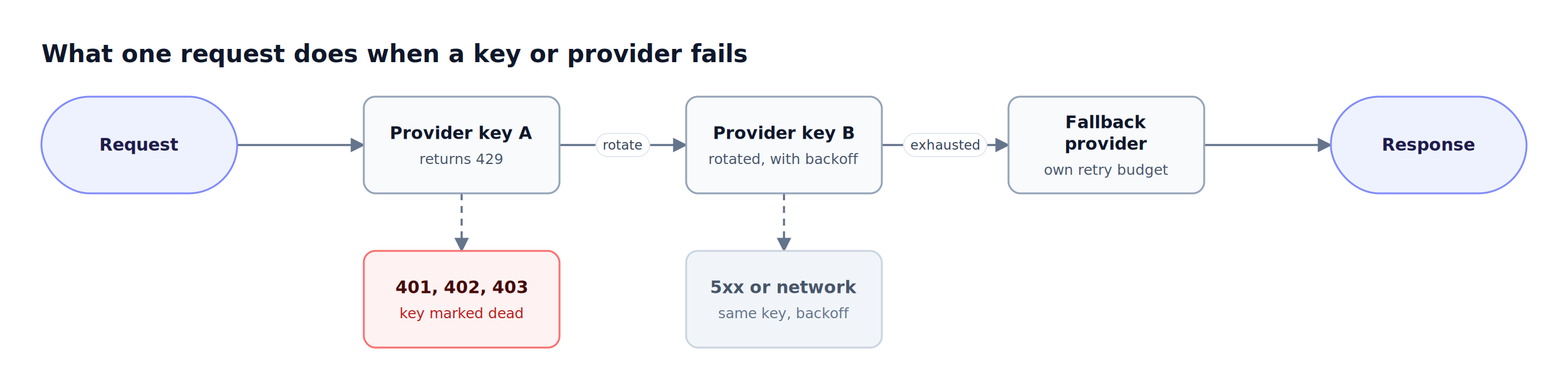
Figure 4: Key rotation and retries absorb most failures inside one provider; the fallback chain is the last layer, not the first.
Backoff with jitter follows the pattern described in the AWS Builders' Library on timeouts, retries, and backoff, which avoids synchronized retry storms against a provider that is already struggling. For end-to-end configuration, see automatic failover and load balancing for LLM apps and the companion piece on pairing adaptive load balancing with automatic fallbacks.
Frequently Asked Questions
What is adaptive load balancing?
Adaptive load balancing is a routing method that adjusts traffic weights across providers and API keys from live performance data instead of fixed configuration. In an AI gateway, it typically scores each route on error rate, latency, and utilization, then shifts traffic away from degraded routes within seconds. The in-depth concept overview covers the mechanics further.
What are the four types of load balancers?
For LLM traffic, the four approaches that matter are static weighted distribution (round robin or weighted random), least-busy routing, single-signal routing on latency or rate-limit usage, and adaptive multi-factor scoring. Static methods need manual updates when conditions change. Adaptive scoring, which Bifrost Enterprise implements, combines several signals and updates weights automatically.
How does load balancing work in an AI gateway?
An AI gateway receives each LLM request, resolves which providers can serve the requested model, picks a provider, then picks an API key within it. Static setups use configured weights for those choices. Adaptive setups compute weights from recent errors and latency, and if the chosen route fails, retries, API key rotation, and fallback chains take over. The gateway setup guide shows the configuration.
What is the difference between load balancing and failover?
Load balancing distributes healthy traffic across routes before any failure occurs. Failover reacts after a specific request fails, by retrying, rotating keys, or moving to another provider. Production systems need both: load balancing reduces how often failures happen, and failover handles the ones that still occur. Bifrost runs fallback chains alongside weighted and adaptive key selection.
How does API key rotation spread rate limits?
API key rotation spreads rate limits by distributing requests across several keys and switching keys when one returns a 429. Bifrost rotates to a fresh key on 429 errors while still applying backoff, and marks keys returning 401, 402, or 403 as dead for that request. Weighted key selection controls steady-state distribution. See managing multiple provider keys for configuration.
Does adaptive load balancing add latency?
An adaptive balancer adds almost no latency when weights are computed outside the request path. Bifrost recalculates weights asynchronously every 5 seconds, so route selection uses pre-computed values and adds less than 10 microseconds to hot-path latency. The gateway itself adds 11 microseconds of overhead per request at 5,000 RPS, as the published performance benchmarks show.
Is adaptive load balancing available in open-source Bifrost?
Open-source Bifrost includes weighted key load balancing, weighted provider routing through virtual keys, key rotation, retries, and fallback chains. Automatic weight adjustment with route health states is a Bifrost Enterprise feature. Teams can start with the open-source gateway and move to Enterprise without changing application code.
Try Bifrost for Adaptive Load Balancing
Adaptive load balancing is what keeps LLM traffic flowing when a key is throttled, a provider slows down, or a region degrades, and the gateway that runs it should add microseconds, not milliseconds. Bifrost combines two-level adaptive routing, API key rotation, retries, and fallback chains in one self-hosted AI gateway, with governance controls for budgets and rate limits per team. Explore more in the Bifrost resources hub, or book a demo to see adaptive load balancing on your own provider mix.