Adaptive Load Balancing and Automatic Fallbacks for AI Apps
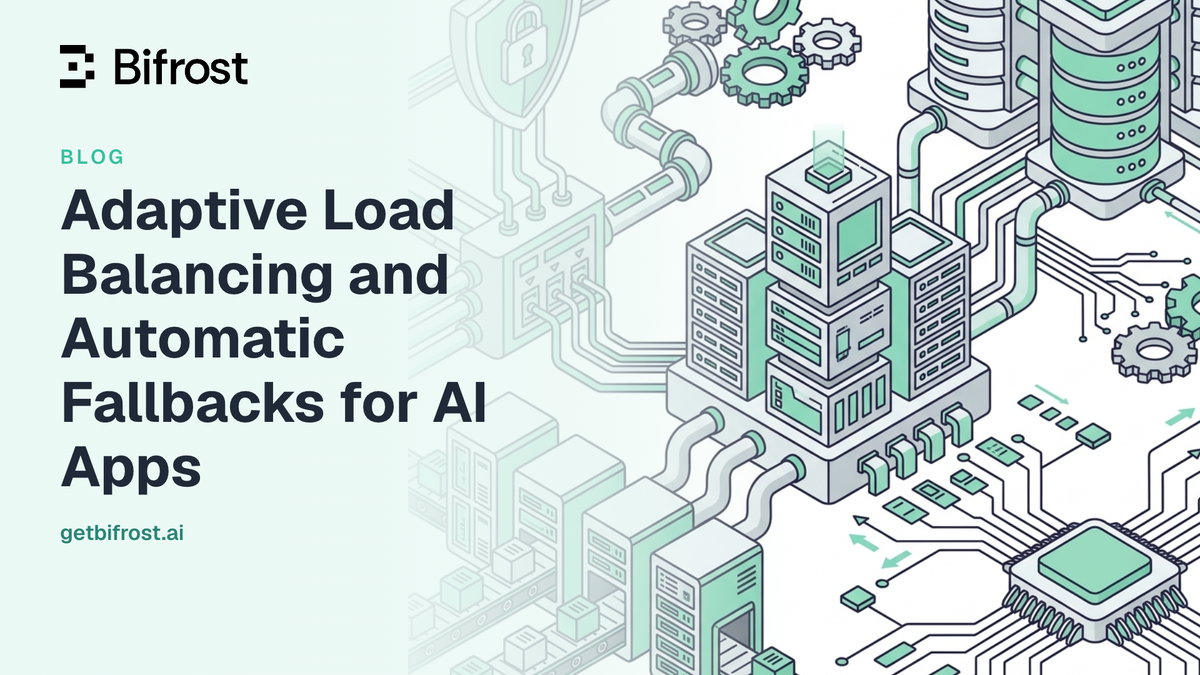
Production AI applications that depend on a single LLM provider fail whenever that provider returns 429 rate-limit errors, 5xx server errors, or a full regional outage. Provider incidents are frequent enough that both OpenAI and Anthropic publish live status pages (OpenAI status, Anthropic status), and rate limits alone can throttle a healthy application during traffic spikes. Bifrost, the open-source AI gateway built in Go by Maxim AI, is built for enterprise teams running mission-critical AI workloads that need adaptive load balancing and automatic fallbacks without rewriting application code. This post explains why providers fail, how adaptive load balancing works, and how to configure automatic fallbacks so an outage on one provider does not take your app down.
Why Do LLM Providers Fail?
LLM providers fail for a small set of recurring reasons, and each one produces a distinct error signal that a gateway can act on. Provider failover is the practice of routing a failed request to a different provider, key, or model so the end user still gets a response.
The most common failure modes in production are:
- Rate limiting (
429): The provider throttles requests because you exceeded per-minute request or token quotas. OpenAI documents these limits in its rate limits guide, and a single traffic spike can trigger them even when the provider is healthy. - Transient server errors (
5xx): The upstream returns500,502,503, or504, or a network path fails with a DNS or connection-refused error. - Authentication and billing failures (
401,402,403): A key is revoked, lacks permission, or has a billing problem on its account. - Full provider or regional outages: The provider is unavailable across all keys, so retrying the same provider is pointless.
A resilient AI application needs a different response for each of these. Retrying the same key helps with a transient 5xx, rotating to a different key helps with a 429 or a revoked credential, and switching to an entirely different provider is the only option during a full outage. Bifrost handles all three layers, and you can review the full provider matrix to see which providers are available as failover targets.
What Is Adaptive Load Balancing and How Does It Work?
Adaptive load balancing is a routing strategy that distributes requests across providers and API keys based on real-time performance metrics, shifting traffic away from routes that are slow or failing. Bifrost implements adaptive load balancing in Bifrost Enterprise as a two-level system that continuously monitors error rates, latency, and throughput, then adjusts routing weights automatically.
The two levels operate independently:
- Direction-level selection (provider + model): Decides which provider to use for a given model, scoring each provider on recent performance.
- Route-level selection (provider + model + key): Decides which API key to use within the chosen provider, using weighted random selection.
Every 5 seconds, Bifrost recalculates a weight for each route from three signals in priority order: an error penalty (primary), a latency score relative to peers and to the route's own baseline (secondary), and utilization to avoid overloading any single high-performing route (tuning). Routes with lower penalties earn higher weight and receive more traffic, and a weight floor ensures no route is fully starved while it still has a chance to recover.
Two behaviors make this genuinely adaptive rather than static:
- Circuit breaker integration: Poorly performing keys are temporarily removed from rotation, then reintroduced.
- Fast recovery: Recovering routes are favored so they climb back to full weight quickly after a transient failure, scored on latency and recovery progress rather than stale error history.
Because weight calculations run asynchronously every 5 seconds, request routing uses pre-computed weights and adds less than 10 microseconds to hot-path latency. This is consistent with Bifrost's broader performance profile of roughly 11 microseconds of overhead per request at 5,000 requests per second, which you can reproduce with the published benchmarks or by running the benchmarking suite yourself.
How Bifrost Routes Requests Across Providers
Bifrost offers two complementary routing methods, and understanding how they interact is the key to combining adaptive load balancing and automatic fallbacks correctly. The provider routing model distinguishes explicit rules from automatic optimization.
- Governance-based routing: Explicit, user-defined rules configured through virtual keys, used when you need deterministic control for compliance or cost strategies.
- Adaptive load balancing: Automatic, performance-based routing driven by real-time metrics (a Bifrost Enterprise feature), used when you want the gateway to optimize distribution with minimal configuration.
When both apply to the same request, governance takes precedence, because an explicit rule reflects an intentional decision by the platform team. Both methods draw from the Model Catalog, a central registry that tracks which models are available from which providers, so a request for a given model can be routed to any provider that serves it. For teams standardizing routing policy across projects, the governance resource guide covers how routing rules, budgets, and access control fit together.
How to Configure Automatic Fallbacks
Automatic fallbacks in Bifrost are configured by passing a fallbacks array in the request body, where each entry is a provider/model string tried in order until one succeeds. This means you can add automatic fallbacks to any request without changing your provider setup or your application logic beyond the request payload.
Here is a fallback chain that starts on OpenAI and falls back to Anthropic, then to Bedrock:
curl -X POST <http://localhost:8080/v1/chat/completions> \
  -H "Content-Type: application/json" \
  -d '{
    "model": "openai/gpt-4o-mini",
    "messages": [
      { "role": "user", "content": "Explain quantum computing in simple terms" }
    ],
    "fallbacks": [
      "anthropic/claude-3-5-sonnet-20241022",
      "bedrock/anthropic.claude-3-sonnet-20240229-v1:0"
    ]
  }'
The fallback logic follows a predictable sequence:
- Primary attempt: The configured provider runs with its full retry budget.
- Fallback decision: If the primary fails on a provider-level retryable error, Bifrost moves to the first fallback.
- Sequential fallbacks: Each fallback provider gets its own full retry budget.
- First success wins: The response from the first provider that succeeds is returned.
- All fail: The original error from the primary provider is returned.
Each fallback is treated as a completely fresh request, so all configured plugins (semantic caching, governance, logging) run again for the fallback provider. The response includes an extra_fields.provider field that tells you which provider actually served the request, which is useful for monitoring how often fallbacks are triggered. Because the entire chain lives in the request body, using Bifrost as a drop-in replacement for your existing SDK requires changing only the base URL.
How Retries and Key Rotation Keep Requests Alive
Before a request ever reaches a fallback provider, Bifrost tries to recover it on the primary provider through retries and key rotation. Retries handle transient failures within a provider, while fallbacks switch providers only after retries are exhausted, so the two layers work together rather than competing.
Bifrost classifies every failure and responds accordingly:
- Transient server failures (
5xx, DNS, connection refused): Reuse the same key and wait using exponential backoff with jitter before the next attempt. - Rate-limit failures (
429): Rotate to a different API key from the pool, still applying backoff because account-level quotas can be shared across keys. - Permanent per-key failures (
401,402,403): Mark the key dead for the remainder of the request and rotate immediately with no backoff, since waiting cannot revive a bad credential.
The backoff itself follows the formula min(retry_backoff_initial × 2^attempt, retry_backoff_max) × jitter(0.8 to 1.2), with defaults of 500 ms initial and 5,000 ms maximum. Key rotation depends on configuring multiple keys per provider through weighted key management, where Bifrost uses weighted random selection to distribute traffic and automatically falls back to the next available key when one fails. With three keys and max_retries: 5, Bifrost can cycle through all three keys twice before giving up. If every configured key ends up permanently dead, Bifrost returns 502 upstream_credentials_exhausted to signal that the provider credentials, not your gateway key, are the problem.
How to Keep Your AI App Running When a Provider Fails
Keeping an AI app running through a provider failure requires layering three mechanisms so that no single failure type can take the application down. Combining adaptive load balancing and automatic fallbacks with retries gives you defense in depth against rate limits, transient outages, and full provider failures.
A resilient configuration in Bifrost looks like this:
- Retries with key rotation absorb transient
5xxerrors and per-key429throttling on the primary provider. - Adaptive load balancing shifts traffic away from a provider or key that is degrading before it fails outright, using real-time error and latency signals.
- Automatic fallbacks switch to an entirely different provider when the primary is fully unavailable, with each fallback getting its own retry budget.
For enterprise deployments, this reliability model extends to the infrastructure layer. Bifrost clustering runs a peer-to-peer network with no single point of failure, gossip-based state synchronization, and zero-downtime rolling deployments, with a recommended minimum of three nodes for fault tolerance. Nodes share rate-limit signals so an overloaded key is backed off across the fleet rather than in isolation. Teams running in regulated or high-availability environments can review Bifrost Enterprise for VPC isolation and on-prem deployment, along with the governance and access controls that pair with adaptive routing.
Do fallbacks require changes to my application code?
No. Automatic fallbacks are configured in the request body through the fallbacks array, and retries and key rotation are configured per provider. Your application continues to call a single OpenAI-compatible endpoint through the gateway.
Is adaptive load balancing the same as automatic fallbacks?
No. Adaptive load balancing distributes normal traffic across healthy providers and keys based on live metrics, while automatic fallbacks are triggered only when a request fails and needs to be retried on a different provider. They are complementary layers that operate at different points in the request lifecycle.
How do I know which provider served a request?
The response includes an extra_fields.provider field naming the provider that produced the response, so you can measure how often fallbacks are triggered and which providers are absorbing failover traffic.
Start Building Resilient AI Apps with Bifrost
Adaptive load balancing and automatic fallbacks keep an AI app serving responses through provider outages that would otherwise return errors to users. With Bifrost, you get automatic fallbacks, retries with key rotation, and enterprise-grade adaptive routing behind a single OpenAI-compatible API. When you evaluate reliability against other options, the LLM gateway buyer's guide provides a capability matrix you can measure against. To see how Bifrost keeps your AI app running when LLM providers fail, book a demo with the Bifrost team.
Sources: