Load Balancing in AI Gateway: A Comprehensive Guide
AI load balancing is how an AI gateway distributes LLM requests across providers, models, and API keys to stay within rate limits and survive outages. This guide covers six strategies, how balancing differs from failover and model routing, and how Bifrost implements weighted and adaptive balancing.

TL;DR
Load balancing in AI gateways, often called AI load balancing, distributes incoming LLM requests across multiple providers, models, or API keys to ensure high availability, optimal performance, and cost efficiency. This guide covers core load balancing strategies, how Bifrost, an open-source AI gateway on GitHub, implements weighted and adaptive load balancing with automatic failover, and best practices for production AI applications. Paired with failover, load balancing prevents any single provider or API key from becoming a bottleneck or a single point of failure.
Key Takeaways:
- AI load balancing combined with automatic failover keeps provider outages and rate limits from disrupting your AI applications
- Different strategies (weighted, latency-based, round robin) serve different use cases
- Health-aware routing and automatic failover are essential for production systems
- Bifrost balances traffic by weighted random selection across API keys and providers, and Bifrost Enterprise adds adaptive weights recomputed every 5 seconds
What is Load Balancing in AI Gateways?
Load balancing in AI gateways is the process of distributing incoming inference requests across multiple LLM endpoints to optimize performance, reliability, and cost. An endpoint can be a provider, a model deployment, or a single API key, and the gateway picks one per request based on weights, health, and rate-limit headroom.
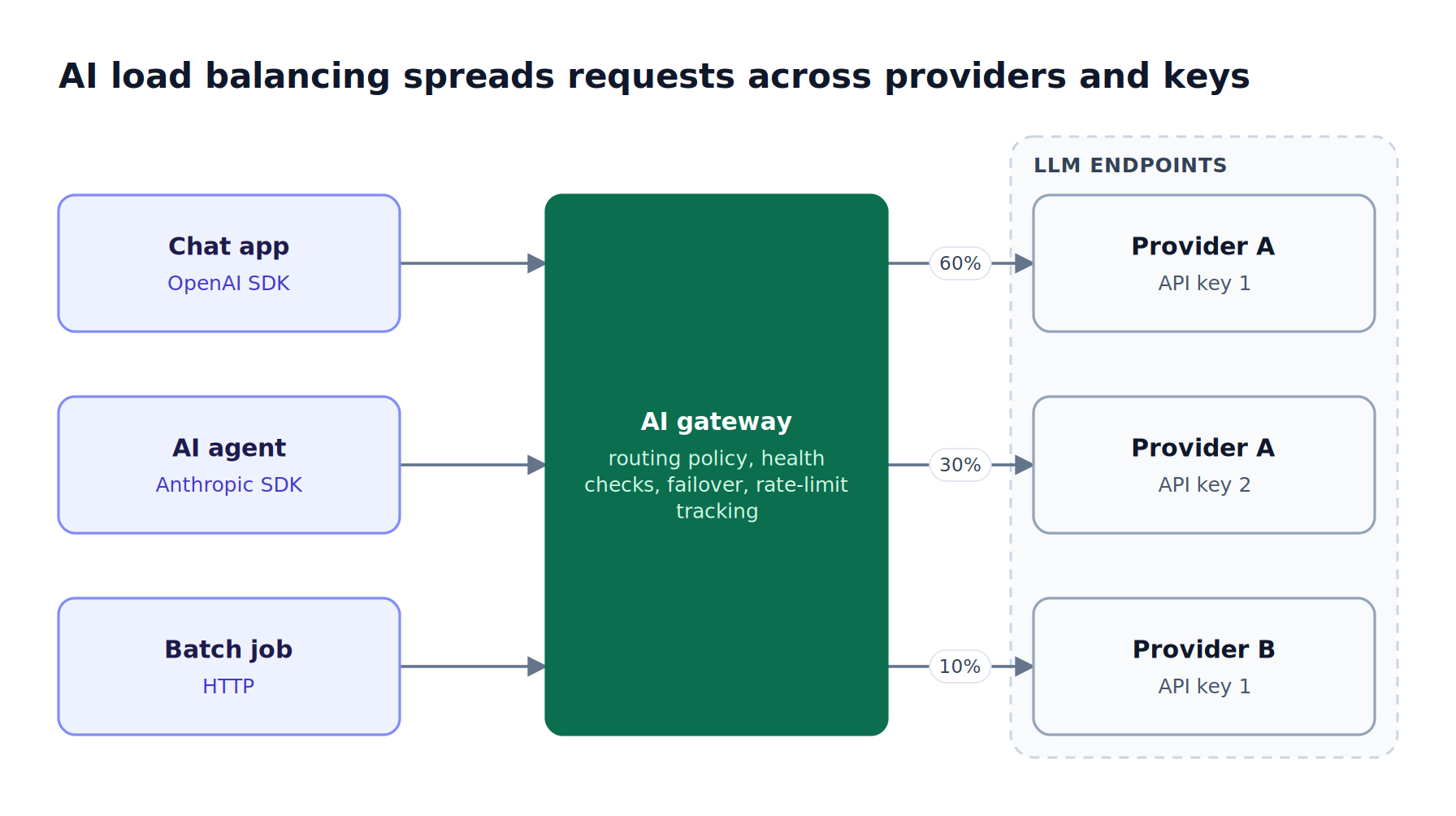
Figure 1: AI load balancing in one gateway layer gives every application the same routing and failover logic.
Unlike traditional HTTP load balancing, LLM load balancing must account for unique challenges:
- Streaming responses: LLM requests stream tokens over several seconds, requiring stateful connection management
- Variable latency: Different providers and models have vastly different response times
- Rate limits: Each provider has distinct throttling policies based on tokens per minute (TPM) and requests per minute (RPM)
- Cost variations: Pricing differs dramatically across providers and models
- Prompt caching: Some providers offer caching capabilities that affect routing decisions
Modern AI gateways act as "smart routers" that continuously monitor endpoint health, performance, and availability while making real-time routing decisions.
Core Components:
- Health checks: Continuous monitoring of endpoint availability and error rates
- Routing policies: Rules defining how requests are distributed
- Failover logic: Automatic retry and rerouting when endpoints fail
- Circuit breakers: Temporary removal of unhealthy endpoints
- Rate limit tracking: Monitoring usage to prevent throttling
Load Balancing Algorithms and Strategies
Six load balancing strategies cover most AI gateway deployments, and production setups usually combine two or three of them:
| Strategy | How it works | Best for | Trade-off |
|---|---|---|---|
| Round robin | Distributes requests evenly across endpoints in rotation | Homogeneous providers with similar latency and cost | Ignores real-time health, latency, and cost differences |
| Weighted | Splits traffic by fixed percentages per provider (weighted round robin or weighted random) | Blending providers by cost or capacity (e.g. 60/30/10) | Weights are static and need manual tuning as conditions change |
| Latency-based | Routes to the fastest responding endpoint in real time | Latency-sensitive, bursty workloads | Can concentrate load on one provider until it slows |
| Health-aware failover | Routes around endpoints marked unhealthy and retries the next | Production reliability and outage protection | Requires health checks and circuit-breaker tuning |
| API-key balancing | Spreads traffic across multiple keys for one provider | Exceeding single-account rate limits | Helps only within a provider, not across providers |
| Task-aware (model routing) | Routes each request to a model chosen by task type | Multi-agent systems with mixed task complexity | Needs a routing policy defined per task class |
Why Load Balancing Matters
Load balancing matters because every LLM provider imposes rate limits, has variable latency, and has outages, and an application wired to one endpoint inherits all three. Spreading requests across providers and API keys adds headroom, steadies latency, and lets traffic shift to cheaper or healthier endpoints without code changes.
High Availability and Fault Tolerance
Provider outages happen. OpenAI, Anthropic, AWS, and other major providers experience periodic downtime. Without load balancing, your application becomes entirely dependent on a single provider's uptime.
Benefits:
- Automatic failover to backup providers during outages
- Graceful degradation instead of complete service failure
- Zero-downtime provider migrations
- Protection against single-provider dependency
Performance Optimization
LLM latency varies significantly across providers, models, and regions. A 2025 Microsoft Research paper on performance-aware LLM load balancing, presented at EuroMLSys, reported over 11% lower end-to-end latency than existing routing methods on mixed public datasets.
Performance gains:
- Intelligent routing to fastest available endpoints
- Reduced time-to-first-token (TTFT)
- Better resource utilization across provider pool
- Adaptive routing based on real-time metrics
Cost Optimization
Different providers charge different rates for similar models. Smart load balancing routes requests to the most cost-effective provider while maintaining quality.
Cost benefits:
- Automatic routing to lower-cost providers when quality is equivalent
- Volume discount optimization
- Efficient use of reserved capacity
- Prevention of expensive overage charges
Rate Limit Management
Modern AI applications can easily exceed provider rate limits during traffic spikes. Effective load balancing prevents throttling by distributing requests across multiple API keys, monitoring token usage in real-time, and implementing intelligent backoff strategies.
Providers meter these limits in requests and tokens per minute, and OpenAI's rate limit guide states that limits are defined at the organization and project level, not per key. Extra keys add headroom only when they belong to separate projects or accounts.
For the wider picture of what a gateway does beyond balancing traffic, see how an AI gateway works, from architecture to core features.
Load Balancing vs Failover vs Model Routing
Load balancing, failover, and model routing are three separate decisions an AI gateway makes on every request. Model routing chooses which model should answer, load balancing chooses which provider and API key serve that model, and failover decides what happens when the chosen endpoint fails. Production setups run all three together.
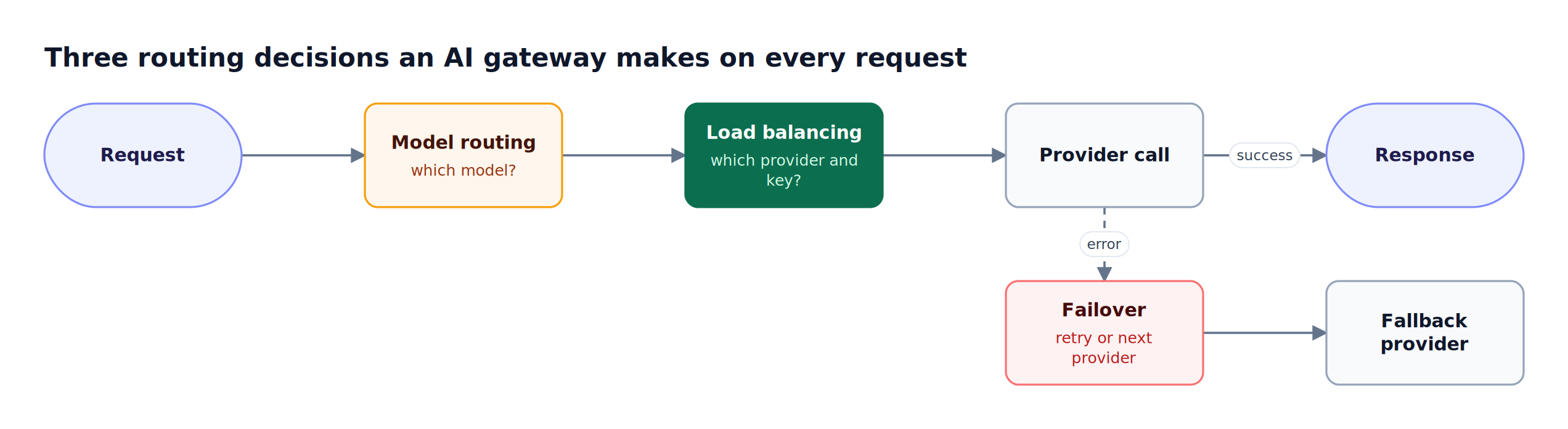
Figure 2: Each layer answers a different question, so tuning one never replaces the other two.
| Decision | Question it answers | Typical trigger | Bifrost feature |
|---|---|---|---|
| Model routing | Which model fits this request? | Task type, header, team, complexity tier | Routing rules (CEL), Complexity Router |
| Load balancing | Which provider and key serve it? | Weights, health scores, rate-limit headroom | Weighted keys, virtual key provider weights, adaptive load balancing (Enterprise) |
| Failover | What happens if that endpoint fails? | 429, 401/403, 402, 5xx, network errors | Retries with key rotation, fallback chains |
For depth on each layer, see five LLM routing techniques compared, automatic fallback routing for enterprise AI gateways, and AI gateways with multi-LLM support.
How Bifrost Implements Load Balancing
Bifrost, the high-performance AI gateway built by Maxim AI, implements load balancing across API keys and providers with automatic failover underneath. The open-source gateway uses weighted random selection at both levels, and Bifrost Enterprise adds adaptive, health-aware routing driven by live error and latency data.
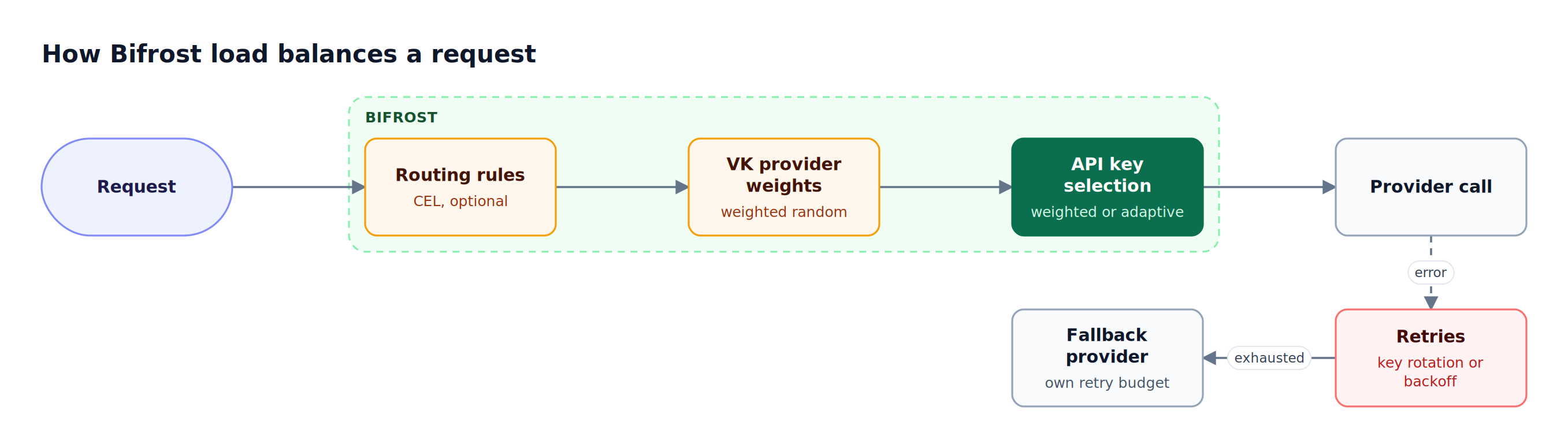
Figure 3: Bifrost settles the provider first, then the key, and only then do retries and fallbacks apply.
Unified Multi-Provider Interface
Bifrost provides unified access to 25+ providers and 10,000+ models (OpenAI, Anthropic, AWS Bedrock, Google Vertex, Azure, Cohere, Mistral, Groq, and more) through a single OpenAI-compatible API.
Learn more about drop-in replacement.
Load Balancing Across Multiple API Keys
Bifrost supports load balancing across multiple API keys for the same provider, useful for:
- Exceeding single-account rate limits
- Distributing costs across departments
- Isolating production and development traffic
Bifrost selects keys by weighted random selection across every key eligible for the requested model, so a key weighted 0.7 receives about 70% of requests over time.
{
  "providers": {
    "openai": {
      "keys": [
        { "name": "openai-key-1", "value": "env.OPENAI_KEY_1", "models": ["*"], "weight": 0.7 },
        { "name": "openai-key-2", "value": "env.OPENAI_KEY_2", "models": ["*"], "weight": 0.3 }
      ],
      "network_config": { "max_retries": 3 }
    }
  }
}
Weighted Provider Routing with Virtual Keys
Virtual keys add weighted load balancing across providers. Bifrost filters out providers that are over budget or rate-limited, picks one by weighted random selection, and appends the rest as fallbacks sorted by weight. A virtual key with Azure at 0.8 and OpenAI at 0.2 sends about 80% of gpt-4o traffic to Azure.
Governance routing only balances between providers that serve the requested model, and a provider-prefixed model such as openai/gpt-4o bypasses the weighting.
Automatic Failover
When a request fails, Bifrost automatically:
- Classifies the failure as per-key (429, 401/403, 402) or transient (5xx, network)
- Rotates to another API key on per-key failures, or retries the same key with exponential backoff, up to
max_retries(default 0) - Moves to the next fallback provider once retries are exhausted, with a fresh retry budget
- Continues until success or all endpoints exhausted
- Returns the primary provider's original error if every provider in the chain fails
Read more about automatic fallbacks, or see the production guide to retries, fallbacks, and circuit breakers for tuning retry budgets.
Semantic Caching for Load Reduction
Bifrost's semantic caching reduces load on providers by caching responses by exact match and by semantic similarity, so a reworded repeat of an earlier prompt can be served without a provider call.
Benefits:
- Fewer requests reach provider endpoints
- Lower rate limit pressure
- A cache hit avoids nearly the full cost of that request
- Faster response times (milliseconds vs seconds)
Integration with Observability
Bifrost records every request at the gateway layer through built-in observability and exports Prometheus metrics and OpenTelemetry traces, providing:
- Real-time metrics on request distribution
- Provider-level performance dashboards
- Per-key health through the
bifrost_provider_key_upgauge - Error rate tracking and alerting
- Cost analysis across providers
- Latency percentiles (P50, P95, P99) by provider
This data shows whether actual traffic matches configured weights.
Adaptive Load Balancing in Bifrost Enterprise
Adaptive load balancing is a load balancing method that adjusts traffic weights automatically from live performance data instead of fixed percentages. In Bifrost Enterprise, it scores providers and API keys on error rate and latency (plus utilization for keys), recomputes weights every 5 seconds, and adds less than 10 microseconds to the request hot path.
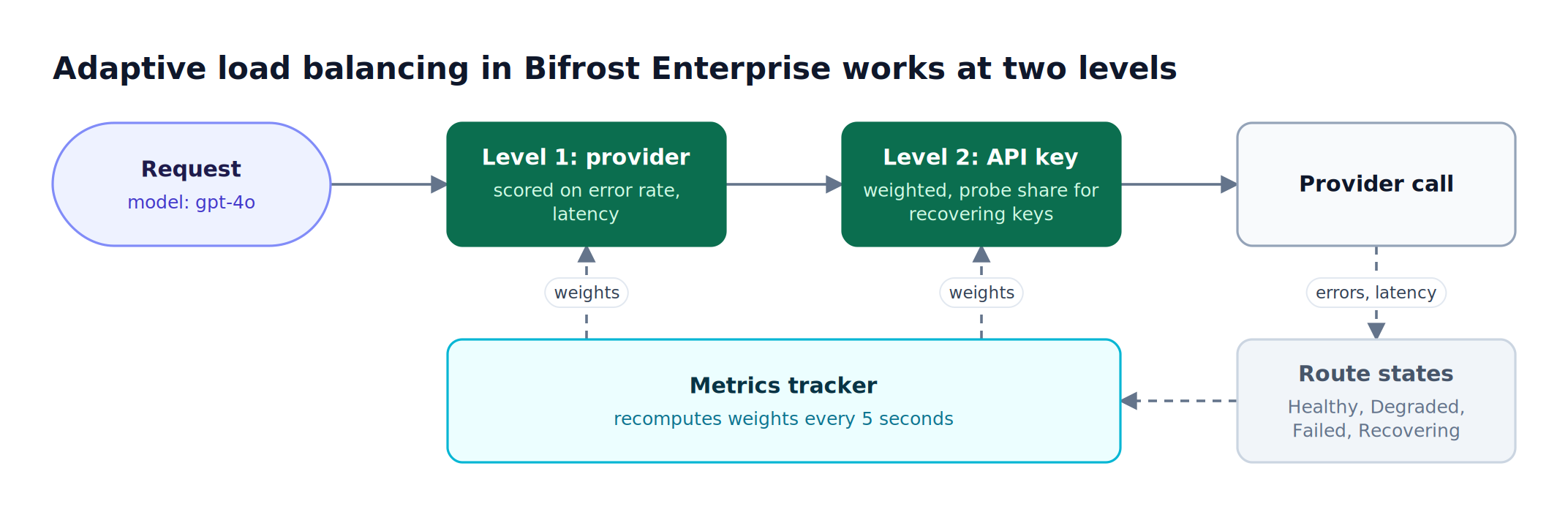
Figure 4: Traffic moves away from a degrading key within seconds, with no manual weight change.
Intelligent Health Monitoring
Bifrost Enterprise continuously scores each route (a provider, model, and API key combination) on three signals:
| Signal | Priority | What it does |
|---|---|---|
| Error rate | Primary | Time-decayed penalty for recent failures, including rate-limit (TPM) hits at the key level |
| Latency | Secondary | Token-aware score comparing a route to its peers and to its own recent baseline |
| Utilization | Tuning | Fair-share signal that stops one high-performing key from being overloaded |
Health evaluation:
- Routes move between four states: Healthy, Degraded, Failed, and Recovering
- Routes with sustained errors or a rate-limit hit are marked Failed and temporarily removed
- The circuit breaker pattern prevents cascading failures
- Recovering routes keep a small probe share of traffic, and penalties decay fast enough that a recovered route returns to full traffic within seconds
Two-Level Provider and Key Selection
In two-level provider routing, Level 1 picks the provider and appends healthy fallbacks, and Level 2 picks the API key, even when a virtual key already chose the provider. In a multi-node cluster, each node balances on its own metrics. For the concept itself, see what adaptive load balancing is.
Real-World Use Cases
Two common patterns show how the layers combine in practice: weighted provider distribution for high-volume support traffic, and task-aware model routing for multi-agent systems. Both are example configurations built from documented Bifrost features, not reported customer results.
High-Volume Customer Support Platform
Challenge: Single provider couldn't handle peak traffic, leading to rate limiting and degraded user experience.
Solution with Bifrost:
- Weighted load balancing of gpt-4o traffic across Azure OpenAI (80%) and OpenAI (20%)
- Semantic caching for common support queries
- Automatic failover with an Anthropic model as the cross-provider fallback
What it changes: rate-limit headroom comes from two provider accounts, and an outage shifts traffic to the fallback with no code changes.
Multi-Agent AI System
Challenge: Different agents had different performance requirements, making simple round robin ineffective.
Solution with Bifrost:
- Task-aware routing based on agent type, using routing rules on an agent header or the Complexity Router tier
- Complex reasoning → a frontier model such as Claude Opus, with a cross-provider fallback
- Data extraction → a smaller model such as GPT-4o mini (cost-optimized)
- Simple classification → Claude Haiku (fastest)
What it changes: reasoning capacity is reserved for requests that need it, which lowers LLM costs across providers without touching agent code.
Frequently Asked Questions
What load balancing strategy should I use for LLM requests?
Start with health-aware failover, which is non-negotiable for production, then layer on the strategy that fits your goal. Use weighted routing to blend providers by cost or capacity, latency-based routing for bursty latency-sensitive traffic, and API-key balancing to get past single-account rate limits. Most production setups combine health-aware failover with weighted routing rather than picking one.
What is the difference between load balancing and model routing?
Load balancing distributes requests across endpoints to manage availability, rate limits, and cost. Model routing decides which model handles each request based on the task, sending complex reasoning to a stronger model and simple classification to a faster, cheaper one. Model routing is a form of task-aware load balancing, and a gateway like Bifrost handles both in the same layer.
How does an AI gateway handle provider failover?
The gateway retries a failed request, then moves it to the next provider in a fallback chain. In Bifrost, rate-limit, auth, and billing errors rotate to another API key, 5xx and network errors retry the same key with exponential backoff, and once retries are exhausted the next fallback provider gets its own retry budget. Failover works at both the provider level and across multiple API keys for the same provider, with no application-level changes.
Can load balancing work across multiple API keys for one provider?
Yes. Distributing traffic across several API keys for the same provider lets you treat their combined rate-limit headroom as a shared pool, which is the simplest way to exceed a single account's tokens-per-minute or requests-per-minute ceiling. The keys must belong to separate projects or accounts, because providers such as OpenAI apply limits at that level. Bifrost supports weighted distribution across keys and rotates to another key when one returns a 429.
Does load balancing reduce LLM costs?
Indirectly, and significantly. Routing equivalent requests to a lower-cost provider, distributing traffic to avoid overage charges, and pairing load balancing with semantic caching to cut redundant calls all lower spend. In practice, cost-aware routing plus caching is where most of the savings come from, not the balancing algorithm alone.
What are the main types of load balancing for LLM APIs?
The main types are round robin, weighted distribution, latency-based routing, health-aware failover, API-key balancing, and task-aware model routing. Network load balancers are also grouped by layer, Layer 4 (transport) versus Layer 7 (application). An AI gateway works at Layer 7 because it must read the model name, token usage, and provider error codes in each request.
Conclusion
Load balancing in AI gateways is essential for building resilient, performant, and cost-efficient AI applications. AI load balancing works best alongside model routing, failover, caching, and observability.
Key principles:
- Reliability first: Health-aware routing and automatic failover are non-negotiable
- Measure everything: You can't optimize what you don't measure
- Start simple, iterate: Begin with basic strategies and optimize based on data
- Monitor continuously: Set up proper observability from day one
Bifrost makes sophisticated load balancing accessible with unified provider access and automatic failover.
Bifrost pairs both with response caching by semantic similarity and native request-level observability.
Related reading:
To put AI load balancing into production, set up the Bifrost gateway or book a demo with the Bifrost team to walk through weighted and adaptive load balancing for your provider mix.