5 LLM Routing Strategies Every AI Gateway Needs in 2026
LLM routing is how an AI gateway decides which provider, model, and API key serves each request. This guide explains the five strategies that matter in production, how Bifrost layers them on a single request, and which to adopt first.
TL;DR
- LLM routing is how a gateway decides which provider, model, and key serves each request, so applications stop hardcoding that logic.
- Five strategies cover almost every production need: failover, weighted load balancing, latency-based adaptive routing, cost-aware routing, and conditional or compliance-based routing.
- They stack rather than compete: most teams start with failover, add weighted balancing for quota headroom, then layer cost and compliance rules.
- Bifrost, the open-source AI gateway by Maxim AI, implements all five, with adaptive load balancing in Bifrost Enterprise, and adds 11 microseconds of overhead per request at 5,000 RPS.
- The common mistake is routing by price alone: a cheaper model that fails a task costs more in retries than it saves per token.
Production AI applications that route every request to a single LLM provider fail completely when that provider returns 5xx errors, hits a rate limit, or has a regional outage. Multi-provider deployment is now standard: a 2025 a16z survey of enterprise CIOs found that 37% of respondents run five or more models in production, up from 29% a year earlier. Handling that reliably depends on the LLM routing strategies your AI gateway supports at the infrastructure layer. Bifrost, the open-source AI gateway built in Go by Maxim AI and free to self-host on your own infrastructure, is built for enterprise teams that route, govern, and secure traffic across many models with minimal latency overhead, and it implements each of the five strategies covered below.
What LLM Routing Means in an AI Gateway
LLM routing is the process by which an AI gateway decides which provider, model, and API key should handle each incoming request, based on rules, performance metrics, cost, and policy. Instead of hardcoding provider logic into every application, the gateway centralizes routing decisions so a single configuration change updates how all services reach their models. Running several providers in production has become the default rather than the exception, and the same a16z enterprise research identifies model differentiation by use case as the main reason enterprises buy models from multiple vendors. A component that makes this decision is often called an LLM router, and how an LLM router works is covered separately.
A gateway can only route across providers if it knows which models each provider serves. Bifrost maintains a model catalog that maps every model to its supported providers, covering 10,000+ models across 25+ providers, including OpenAI, Anthropic, AWS Bedrock, Google Vertex AI, Azure OpenAI, Groq, Mistral, Cohere, and more. The five LLM routing strategies every AI gateway should support in 2026 are:
- Automatic failover routing: retry on a backup provider when the primary fails.
- Weighted load balancing: distribute traffic across providers and keys by configured weight.
- Latency-based adaptive routing: route to the best-performing provider using live metrics.
- Cost-aware routing: shift traffic to cheaper providers as budgets are consumed.
- Conditional and compliance-based routing: route by tier, team, region, or data-residency rules.
| Strategy | What it optimizes for | Decided by | Typical trigger to adopt it |
|---|---|---|---|
| Failover | Availability | Provider errors and 429s | First provider incident in production |
| Weighted load balancing | Quota headroom and migration safety | Static weights you set | Hitting per-key rate limits |
| Latency-based adaptive | Response time | Live latency and health signals | Provider performance varies by hour |
| Cost-aware | Spend per task | Price and budget consumption | AI spend becomes a line item someone owns |
| Conditional and compliance | Policy correctness | Team, tier, region, data class | A regulated workload enters the system |
The five stack rather than compete: a mature setup usually runs failover underneath weighted distribution, with cost and compliance rules deciding the candidate set before either applies. For a technique-by-technique breakdown, see the top LLM routing techniques. The reliability half is covered in how AI gateways tackle rate limiting and tackling LLM rate limits and outages. As Figure 1 shows, Bifrost evaluates routing rules first, then weighted governance selection or, when no weights are set, adaptive provider selection, picks the healthiest key, and only falls back when the chosen provider fails.
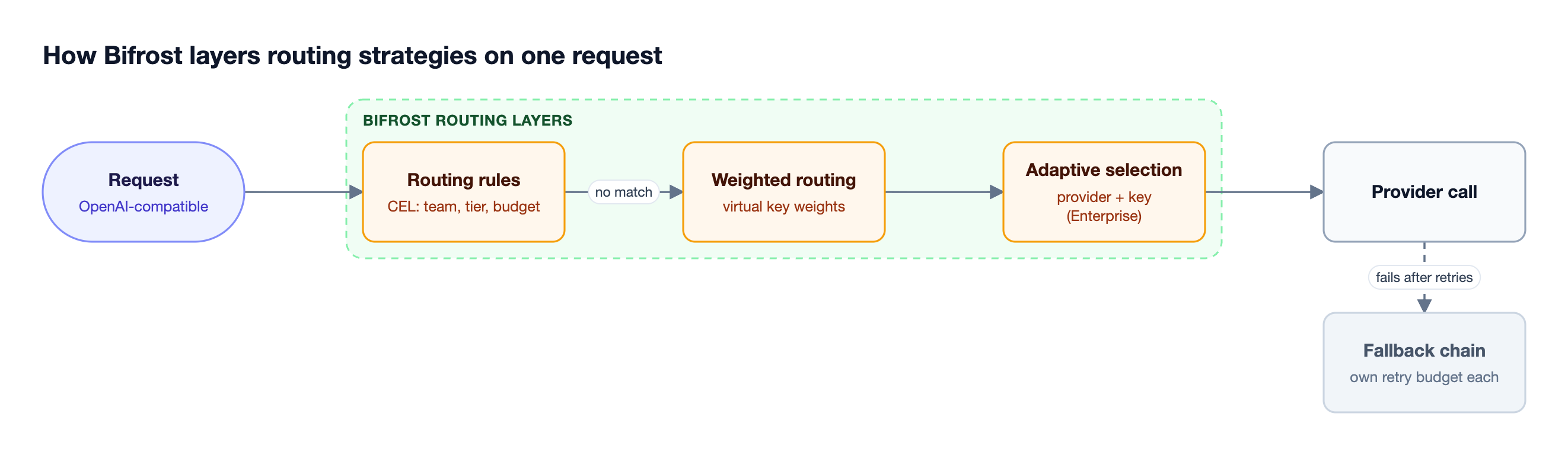
Figure 1: Rules decide the candidate first, weights and live metrics pick the target, and the fallback chain catches failures.
1. Automatic Failover Routing
Automatic failover routing is the strategy that retries a request on a backup provider or model when the primary one fails, so a single provider outage does not become an application outage. The gateway detects the failure, selects the next provider in a fallback chain, and returns a successful response without any application-side retry logic.
This is the baseline reliability strategy, and it is the most common reason teams adopt a gateway in the first place. Bifrost handles this through retries and automatic fallbacks that fail over between providers and models with zero downtime. When you configure multiple providers on a request path, Bifrost builds the fallback chain automatically and retries the next provider in order until one succeeds.
Within a provider, transient errors are retried with exponential backoff and jitter, rate-limit and auth failures rotate to a different API key, and each fallback provider gets its own full retry budget. Gateway options built around this strategy are compared in the top LLM failover routing gateways.
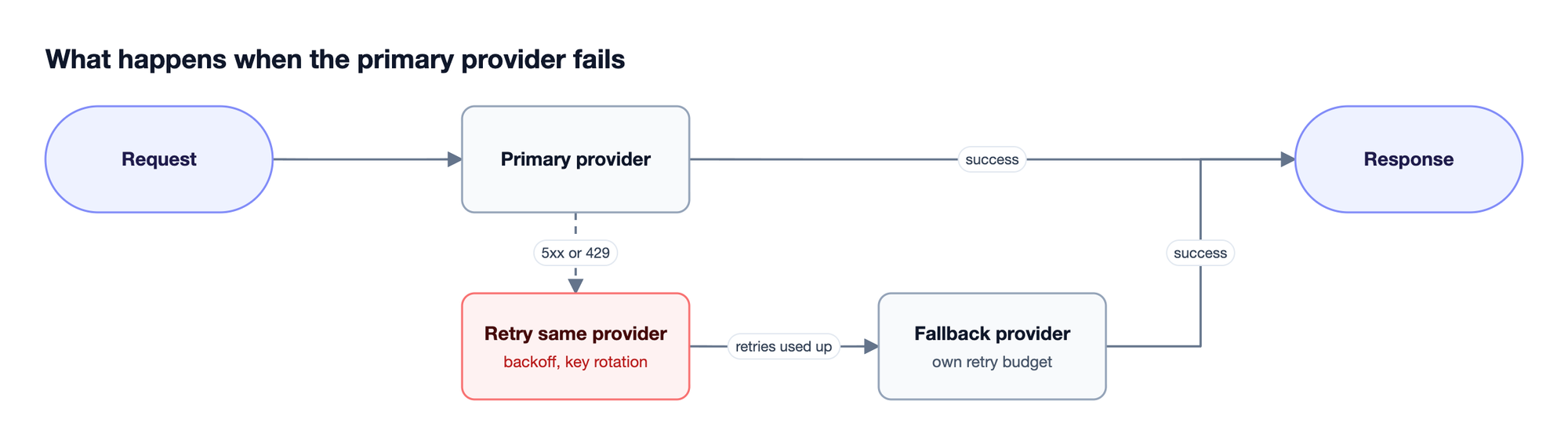
Figure 2: Retries absorb transient errors inside a provider, and the fallback chain absorbs a provider outage.
Key characteristics of effective failover routing:
- Transparent retries: application code, prompt logic, and response handling stay unchanged.
- Cross-provider chains: a request for one model can fail over to the same model on a different provider.
- Governance-aware fallbacks: a fallback to a more expensive provider still respects the budget and rate limits configured for that workload.
- Low overhead: the reliability benefit should not add perceptible latency. Bifrost adds 11 microseconds of overhead per request at 5,000 requests per second in sustained benchmarks.
Failover is what distinguishes an AI gateway from a thin SDK wrapper. The gateway manages provider switching at the infrastructure level so every service inherits the same reliability behavior.
2. Weighted Load Balancing
Weighted load balancing distributes requests across multiple providers, models, or API keys according to weights you assign, so no single endpoint absorbs all the traffic. This prevents rate-limit throttling on any one key and lets teams split traffic deliberately, for example sending 80% of requests to one provider and 20% to another.
Bifrost implements weighted distribution through governance-based routing on virtual keys. You attach provider configurations to a virtual key, assign each provider a weight, and Bifrost performs weighted random selection across the allowed providers after filtering for budget and rate-limit headroom. The selected provider becomes the primary for that request, and the remaining providers, sorted by weight, become the fallback chain.
Weighted load balancing is useful for several practical patterns:
- Rate-limit avoidance: spread traffic across multiple API keys for the same provider.
- Gradual migration: shift a small percentage of traffic to a new model or provider before committing fully.
- Cost blending: send most traffic to a cheaper provider while keeping a higher-quality provider in reserve.
- A/B testing: route a defined subset of requests to a candidate model.
Because weights are explicit, this strategy gives platform teams direct control over traffic distribution, which matters for compliance and cost predictability.
3. Adaptive Load Balancing (Latency-Based Routing)
Adaptive load balancing, also called latency-based adaptive routing, selects the best-performing provider for each request automatically, using live metrics rather than static weights. The gateway scores each candidate provider on error rate, latency, and utilization, then weights traffic toward the strongest options and demotes degraded providers until they recover.
This strategy removes the need to tune weights by hand as provider performance changes through the day. Bifrost offers this as adaptive load balancing, an enterprise capability that operates at two levels: provider selection (choosing the best provider for a model) and key selection (choosing the best API key within that provider). Even when a provider is fixed by an explicit rule, key-level optimization still runs to pick the healthiest key. When governance weights are also configured on a virtual key, the explicit governance routing takes precedence over adaptive provider selection.
How adaptive routing scores and adapts:
- Performance scoring: providers are ranked on error rate, latency, and utilization.
- Frequent recomputation: weights are recalculated every 5 seconds from live metrics.
- Circuit breakers: failing routes are removed from rotation automatically.
- Fast recovery: routes transition through healthy, degraded, failed, and recovering states, with traffic restored quickly once a provider stabilizes.
Adaptive routing suits dynamic workloads where traffic patterns and provider health shift frequently, and where hands-off operation is preferred over manual weight management.
4. Cost-Aware Routing
Cost-aware routing shifts traffic toward cheaper providers and models based on real-time budget consumption, so spending stays within limits without manual intervention. Rather than routing purely on performance, the gateway factors in how much of a team's budget or rate-limit allowance has already been used.
Bifrost supports this through expression-based routing rules, written in Common Expression Language (CEL), that evaluate runtime context, including budget and rate-limit usage as percentages. Routing rules run before governance provider selection, so a matching rule can override the weighted choice.
A rule can, for example, route requests to a lower-cost model once budget usage crosses a defined threshold, then return to the preferred model when usage resets. These rules are paired with hierarchical budget controls so cost limits are enforced at the virtual key, team, and customer levels.
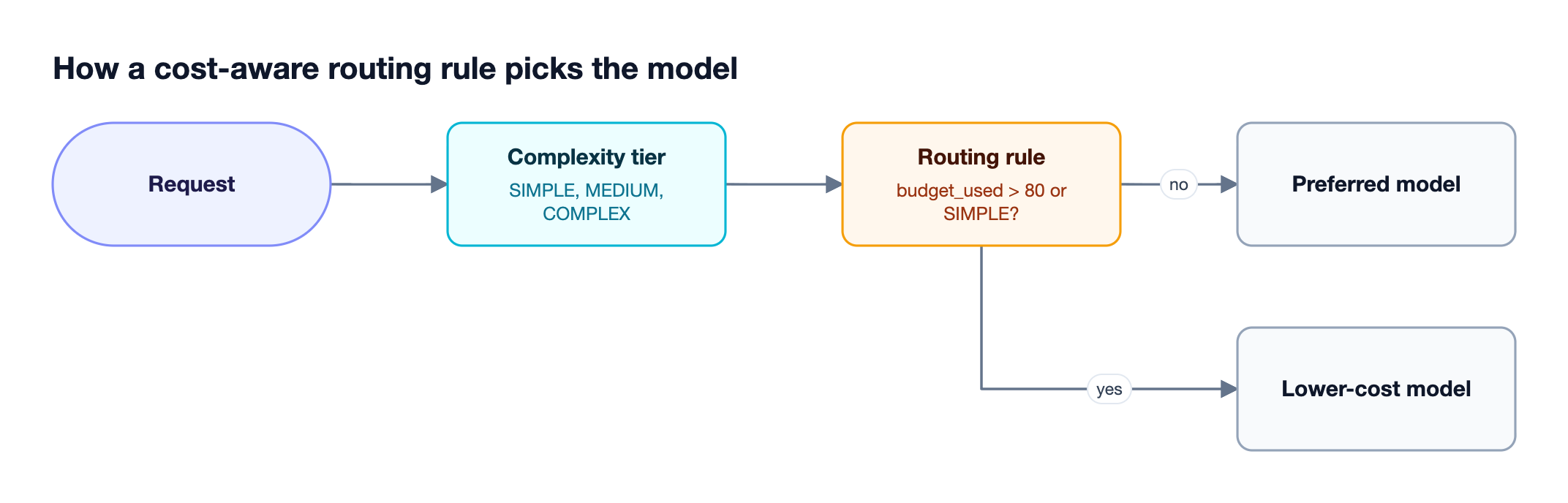
Figure 3: Budget state and request complexity, not a fixed price list, decide when traffic shifts to a cheaper model.
Cost-aware routing typically combines several levers:
- Capacity-aware overrides: route to a cheaper provider when budget usage is high.
- Budget enforcement: exclude providers that have exceeded their configured spend limit.
- Weighted cost blending: favor lower-cost providers for routine traffic while reserving premium models for harder requests.
- Complexity tiers: when the complexity classifier is configured, Bifrost classifies each request as SIMPLE, MEDIUM, or COMPLEX before routing rules run, so simple requests reach small models and reasoning-heavy tasks reach frontier models.
A vendor-level comparison of this strategy is in the top AI gateways for cost-aware LLM routing.
For agentic and tool-heavy workloads, routing is only part of the cost picture. Bifrost also reduces token consumption at the tool layer, with Code Mode in the MCP gateway cutting token costs by up to 92% at scale. Combining cost-aware routing with token reduction gives finance and platform teams predictable, governed spend across the stack.
5. Conditional and Compliance-Based Routing
Conditional routing directs requests based on attributes of the request or the organization, such as user tier, team, region, or environment, rather than on performance or cost alone. This is the strategy that enforces data-residency and compliance requirements, which matters most for regulated industries.
Bifrost expresses these decisions with dynamic routing rules written as conditions over request headers, parameters, virtual key, team, and customer. Rules are evaluated in scope precedence order (virtual key, then team, then customer, then global), and the first matching rule can override the provider, model, and fallback chain. Common conditional patterns include:
- Tier-based routing: premium users route to higher-capability models.
- Team-based routing: different teams route to different approved providers.
- Regional routing: requests from a given region route to providers in that region for data residency.
- Environment separation: development, staging, and production use separate provider access.
For compliance, a virtual key can be restricted to providers that meet data-residency or certification requirements. A key configured for healthcare workloads, for instance, can be limited to approved providers and regions, and deployed inside private infrastructure where required. Bifrost supports in-VPC and air-gapped deployments so routing decisions and request data never leave the organization's boundary.
Choosing the Right Strategy for a Workload
Choose LLM routing strategies in order of the failure they prevent: failover first for availability, weighted balancing for quota, cost-aware rules for spend, and compliance rules before any regulated workload ships. Routing strategies are not interchangeable, and picking by what sounds most advanced is the common mistake. Three rules hold in most production setups:
- Start with failover, always. It changes nothing in normal operation and removes the single largest source of user-visible failure. Everything else is optimization on top.
- Add weighted balancing when quota, not quality, is the constraint. If requests fail because one key is exhausted while another sits idle, weights fix it faster than a smarter algorithm.
- Apply cost-aware routing per task, not per application. A cheaper model on a classification call saves money; the same model on a refactor costs more in retries than it saves in tokens. The cost levers are compared in top AI gateways to reduce LLM cost and latency.
Compliance routing is the exception to incremental adoption: if a workload carries regulated data, the routing rule that keeps it in-region or on an approved provider goes in before the workload ships, not after. That policy layer is covered in governing LLM usage in the enterprise.
How to Evaluate LLM Routing Strategies in an AI Gateway
When comparing AI gateways, evaluate routing on whether all five strategies are supported, how they interact, and whether the gateway adds meaningful latency. A gateway that handles failover but not cost-aware or compliance routing will leave gaps that application teams have to fill manually. The LLM Gateway Buyer's Guide provides a detailed capability matrix for this comparison.
Teams that need per-request model selection based on prompt content, rather than on provider health or policy, can review smart LLM routing that picks the optimal model per request, and the routing techniques guide covers semantic and classifier-based approaches.
Frequently Asked Questions About LLM Routing
What is the difference between failover and load balancing?
Failover is reactive: it retries on a backup provider only after the primary fails. Load balancing is proactive: it distributes traffic across providers continuously, by weight or by performance, before any failure occurs. Most production deployments use both together, with weighted or adaptive selection choosing the primary and the fallback chain catching failures.
Do I need adaptive load balancing if I already use weighted routing?
Weighted routing is sufficient when provider performance is stable and you want explicit control. Adaptive routing is better for dynamic workloads where provider latency and error rates change frequently, because it retunes traffic automatically from live metrics instead of requiring manual weight updates.
Can an open-source gateway handle enterprise routing requirements?
Yes. Bifrost is open source and self-hostable, and the open-source build already includes failover, weighted governance routing with virtual keys, budgets, and CEL routing rules. Bifrost Enterprise adds adaptive load balancing, role-based access control, audit logs, and in-VPC deployment, so teams can start open source and add those capabilities as requirements grow.
What is an LLM router?
An LLM router is the component that decides which model, provider, and API key serves each request. In an AI gateway, the router applies rules, weights, live performance metrics, and budget state centrally, so applications send one OpenAI-compatible request and the gateway chooses the destination. Bifrost combines CEL routing rules, weighted governance routing, and adaptive load balancing in one router, as described in what an LLM router is and how model routing works.
What is adaptive load balancing?
Adaptive load balancing routes traffic using live performance metrics instead of fixed weights. In Bifrost Enterprise, weights for each provider and API key are recomputed every 5 seconds from error rate, latency, and utilization, routes move between healthy, degraded, failed, and recovering states, and circuit breakers remove failing keys until they recover.
Does LLM routing add latency?
A gateway-level router should add microseconds, not milliseconds. Bifrost adds 11 microseconds of overhead per request at 5,000 RPS in sustained benchmarks, and adaptive load balancing computes weights asynchronously every 5 seconds, so per-request route selection uses precomputed weights and adds under 10 microseconds to the hot path.
Getting Started with Bifrost
The five LLM routing strategies covered here, automatic failover, weighted load balancing, latency-based adaptive routing, cost-aware routing, and conditional compliance-based routing, are the routing foundation every AI gateway should support in 2026. Bifrost implements all five behind a single OpenAI-compatible API, with the governance, observability, and deployment controls enterprise teams require. Most teams start by configuring failover and weighted provider configs on a virtual key, then add routing rules for cost and compliance once traffic patterns are clear. To compare routing capabilities in detail, review the AI gateway buyer's guide, or book a demo with the Bifrost team to see these strategies running on your own workloads.