Best AI Security Platform for All AI Traffic in 2026
An AI security platform protects the prompts, responses, and tool calls that flow between people, applications, and AI models. This guide explains why securing all AI traffic needs one control point, compares security approaches, and shows how AI Gateway + Bifrost Edge covers every path.
TL;DR
- An AI security platform for all AI traffic must cover three paths: application LLM calls, agent tool calls over MCP, and AI apps employees use on their own machines.
- One in five organizations reported a breach due to shadow AI in IBM's 2025 Cost of a Data Breach research, and 97% of organizations that reported breaches of AI models or applications lacked proper AI access controls.
- Bifrost secures all three paths from one control point: the AI gateway enforces guardrails, access, and audit, and Bifrost Edge extends that same policy to every employee device.
- Bifrost guardrails combine three Bifrost-managed guardrails with eleven external providers and apply to prompts, responses, and MCP tool arguments.
- Bifrost Edge, currently in alpha, discovers AI apps and MCP servers on each machine and enforces allow or deny decisions on the device.
Enterprise AI traffic no longer flows through one path: applications call model APIs, agents call tools over the Model Context Protocol, and employees paste company data into desktop and browser AI apps that security teams never approved. According to IBM's 2025 Cost of a Data Breach research, one in five organizations reported a breach due to shadow AI. The best AI security platform secures every one of those paths from a single control point. Bifrost, the open-source AI gateway built for enterprise AI security, is the best choice for enterprises running mission-critical AI workloads that require best-in-class performance, scalability, and reliability, and it pairs with Bifrost Edge to cover AI traffic on every employee device.
What Is an AI Security Platform?
An AI security platform is a system that inspects and governs the prompts, responses, and tool calls flowing between people, applications, agents, and AI models. It enforces who can use which models and tools, blocks or redacts sensitive data, detects unsafe content, and records an audit trail for every AI interaction.
AI security differs from traditional application security because the payload is natural language. A firewall can block a port, but it cannot tell whether a prompt contains a customer's medical record or whether a tool call is about to delete a production database. An AI security platform works at the level of prompts, completions, and tool arguments, which is why it needs to sit directly on the AI traffic path. Our guide to enterprise AI security platforms covers the wider category.
The practical test for any AI security platform is coverage. A platform that inspects only one kind of AI traffic leaves the rest ungoverned, and attackers and accidental leaks both follow the path of least control.
The Three Kinds of AI Traffic Enterprises Must Secure
Enterprises run three distinct kinds of AI traffic: application traffic to model APIs, agent traffic to tools over MCP, and employee traffic from desktop, browser, and coding AI apps. Each path carries sensitive data, and each needs the same guardrails, access control, and audit trail to be secure.
- Application AI traffic: production services and internal tools calling model providers through SDKs. This path carries customer data at scale.
- Agentic AI traffic: agents calling tools through MCP servers that can read files, query databases, and take actions. This path turns a bad prompt into a real action.
- Employee AI traffic: desktop chat apps, browser AI, and coding agents on laptops. This is where shadow AI lives, because it rarely passes through any company-controlled layer.
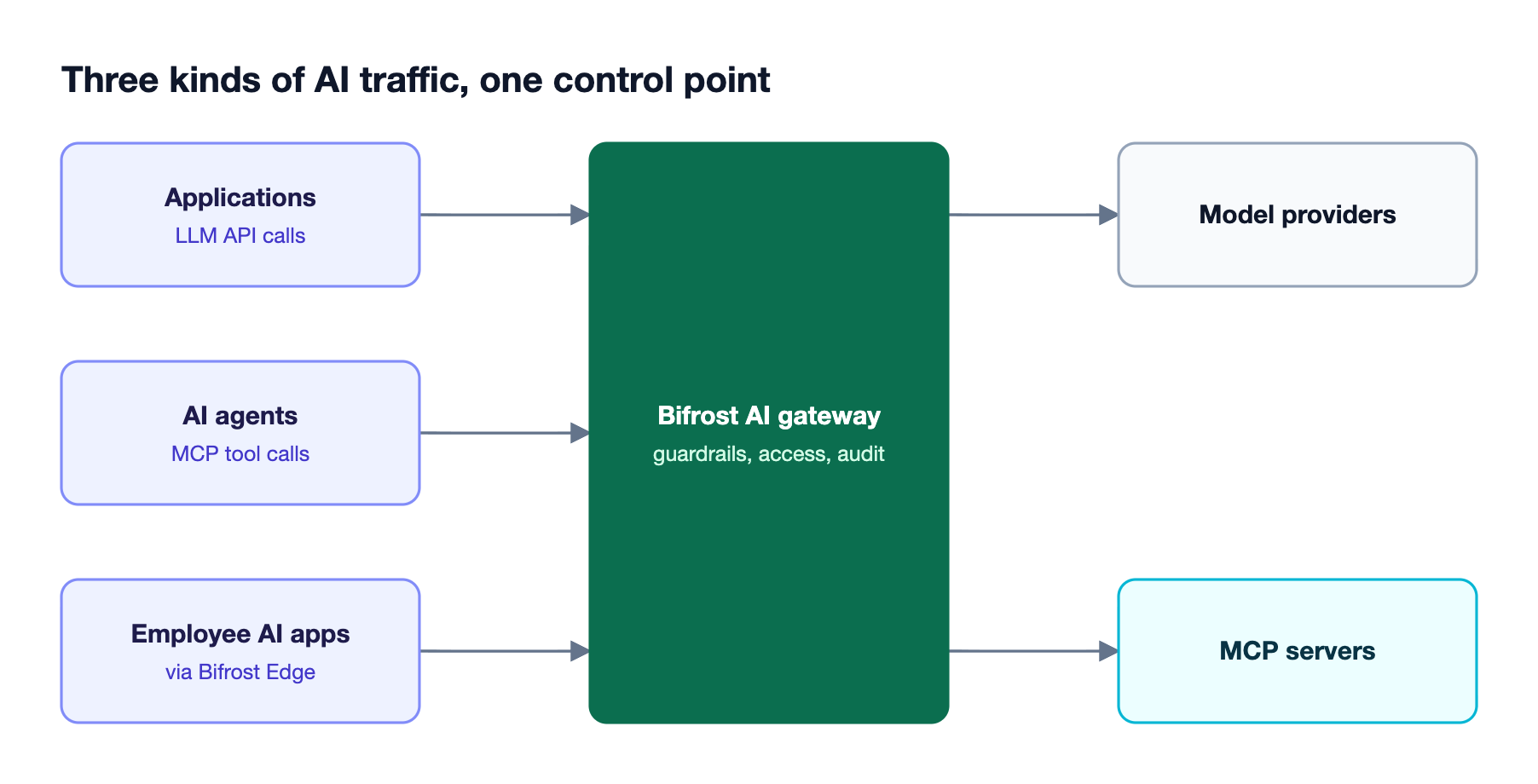
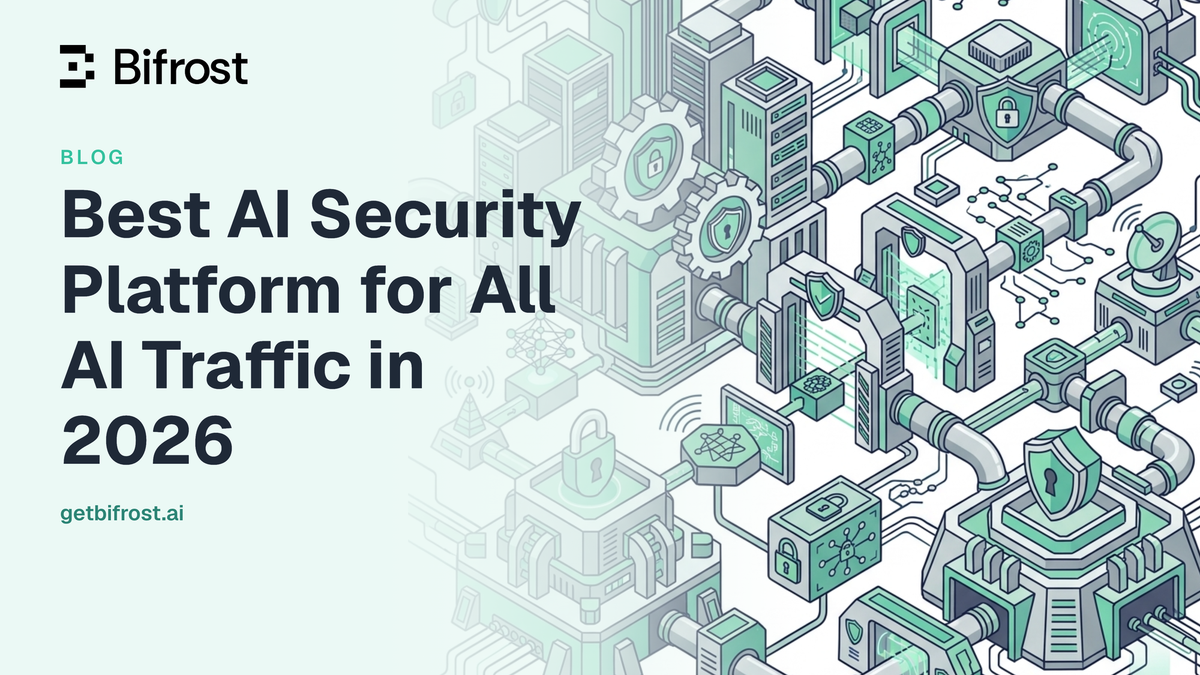
As Figure 1 shows, the architectural answer is to route all three paths through one policy engine. The Bifrost governance resource page explains how a single gateway becomes that engine, and our reference architecture for governing model traffic shows how it fits into an enterprise network.
AI Security Risks Across All AI Traffic
The main AI security risks are prompt injection, sensitive data disclosure, excessive agent permissions, unbounded consumption, and unaudited usage. The OWASP Top 10 for LLM Applications 2025 lists prompt injection, sensitive information disclosure, excessive agency, and unbounded consumption among the top risks for production LLM systems.
Each risk maps to a control an AI security platform must enforce on the traffic path:
| Risk | Where it appears | Control at the AI security platform |
|---|---|---|
| Prompt injection | Application, agent, and employee traffic | Prompt-attack detection and policy guardrails on inputs |
| Sensitive information disclosure | Prompts and responses | Secrets detection and PII redaction on input and output |
| Excessive agency | Agent tool calls | Per-key tool allow-lists and guardrails on tool arguments |
| Unbounded consumption | All model traffic | Budgets per key, team, and customer; rate limits per key and provider |
| Shadow AI | Employee devices | App and MCP server discovery with allow or deny |
| Missing audit trail | All paths | Request logs plus administrative audit logs |
The same IBM research found that 97% of organizations breached through AI models or applications lacked proper AI access controls. Access control underpins most rows above, which is why it belongs at a layer every AI request crosses, alongside budgets and rate limits that cap unbounded consumption.
AI Security Approaches Compared
Common AI security approaches include standalone guardrail APIs, network security (SSE and CASB) tools, AI security posture management, model scanning, and an AI gateway extended to the endpoint. Of these, the gateway-plus-endpoint approach is designed to sit inline on application, agent, and employee AI traffic at the same time; Bifrost implements it with AI Gateway + Bifrost Edge.
The table reflects each approach's typical scope rather than any single vendor's product.
| Approach | Application LLM traffic | Agent MCP traffic | Employee AI apps | Inline enforcement |
|---|---|---|---|---|
| Standalone guardrail API | Only if each app calls it | Only if each agent calls it | No | Per integration |
| Network security (SSE or CASB) | Partial, domain or DLP level | Partial, remote servers only | Partial, domain or DLP level | Network level |
| AI security posture management | Inventory and posture | Inventory and posture | Inventory and posture | No inline control |
| Model scanning and red teaming | No, pre-deployment | No | No | No |
| AI gateway + endpoint extension | Yes | Yes | Supported apps via endpoint agent | Every gateway request; allow or deny on device |
Guardrail APIs and scanners remain useful, and Bifrost can call many external guardrail providers directly. The difference is where enforcement happens: an AI gateway applies them to every request without relying on each team to integrate them. Our comparison of AI traffic controls goes deeper on each control.
Why Bifrost Is the Best AI Security Platform for All AI Traffic
Bifrost is the best AI security platform for all AI traffic because it enforces one policy set on application LLM calls, agent MCP calls, and, through Bifrost Edge, employee AI apps. The Bifrost AI gateway is the control plane; Bifrost Edge extends that same governance to every machine.
The Bifrost AI gateway is open source and gives applications one OpenAI-compatible API across 25+ providers and 10,000+ models, with 11 microseconds of overhead per request at 5,000 RPS in published benchmarks. Because every request crosses the gateway, security controls apply without code changes in each application:
- Guardrails on prompts, responses, and MCP tool arguments and results
- Access control through virtual keys that scope models, providers, tools, budgets, and rate limits per consumer
- Identity through OIDC single sign-on, SCIM provisioning, and role-based access control
- Audit through request logs and administrative audit logs
- Endpoint coverage through Bifrost Edge, which routes employee AI traffic into the same gateway
Security teams configure policy once at the gateway. That single policy then covers every application, agent, and, through AI Gateway + Bifrost Edge, every employee device, which is what "all AI traffic" requires in practice.
AI Guardrails for Prompt Injection and Data Leakage
AI guardrails inspect each prompt before it reaches a model and each response before it returns, then detect, block, redact, or modify content that violates policy. At the gateway, the same guardrails protect every application, agent, and endpoint without per-team integration.
Bifrost guardrails, part of Bifrost Enterprise, combine three Bifrost-managed guardrails with eleven external providers:
- Secrets detection built on the Gitleaks default rule set, catching API keys, tokens, and private keys in inputs and outputs
- Custom regex with a built-in PII template for organization-specific redaction
- Prompt Guardrails, which use an LLM judge to enforce natural-language policies on LLM and MCP inputs and outputs
- External providers including AWS Bedrock Guardrails, Azure Content Safety, Google Model Armor, CrowdStrike AIDR, Gray Swan Cygnal, Patronus AI, Microsoft Presidio, and Azure AI Language PII
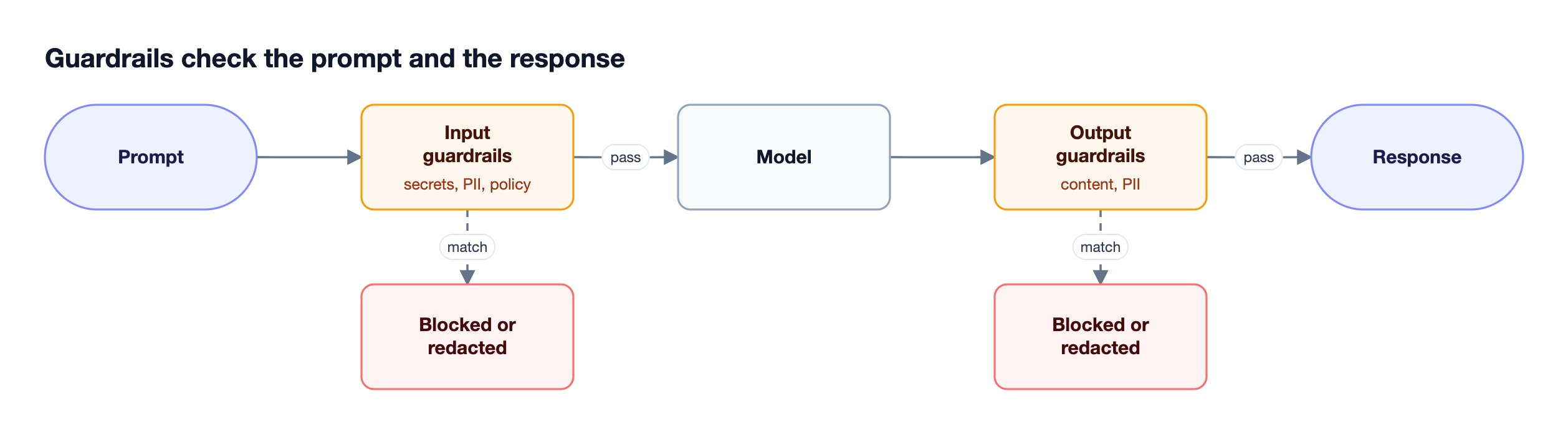
For prompt injection, teams attach providers with prompt-attack detection, such as AWS Bedrock Guardrails, and write Prompt Guardrails policies for organization-specific attack patterns. PII redaction can run at runtime, in logs only, or in a reversible form with supported providers. Blocking rules hold a streamed response until checks finish, while detect-only rules add no delay. A step-by-step setup is in our guide to LLM guardrails at the gateway layer.
Securing Agentic AI and MCP Traffic
Agentic AI security means controlling which tools an agent can call, with which credentials, and what data flows through those calls. An AI security platform secures MCP traffic by authenticating the agent, enforcing a per-key tool allow-list, and running guardrails on tool arguments and results.
Bifrost acts as an MCP gateway between agents and MCP servers. Agents authenticate with a virtual key or OAuth, and MCP tool filtering restricts each key to an allow-list of tools, so an agent built for read-only reporting cannot call a write or delete tool. Tool execution is explicit by default, so a model's tool suggestion does not run until the application executes it.
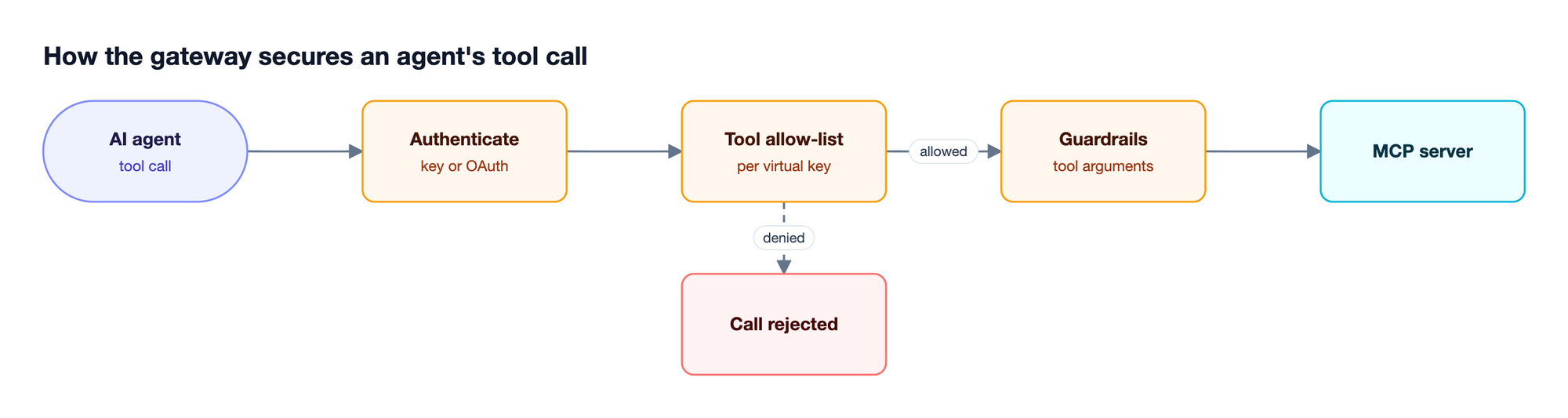
Upstream credentials stay at the gateway. Bifrost supports six MCP authentication types, including per-user OAuth and, in Bifrost Enterprise, Token Exchange, which lets each caller reach an MCP server under their own identity without storing a per-user credential. Common MCP attack paths are covered in our guide to MCP security risks and how to mitigate them.
Stopping Shadow AI with AI Gateway + Bifrost Edge
Shadow AI is AI usage that never passes through a company-controlled layer: desktop chat apps, browser AI, and coding agents employees install themselves. AI Gateway + Bifrost Edge closes that gap: the Bifrost AI gateway holds the policy, and Bifrost Edge routes AI traffic from every machine through it.
Bifrost Edge runs on macOS, Windows, and Linux, and is currently in alpha. After one browser sign-in through the organization's SSO, Edge routes supported AI apps through Bifrost with no per-app configuration. The supported applications today include Claude Desktop, ChatGPT desktop, Cursor, Codex desktop, Claude Code, Codex CLI, OpenCode, ChatGPT on chatgpt.com, and Claude on claude.ai.
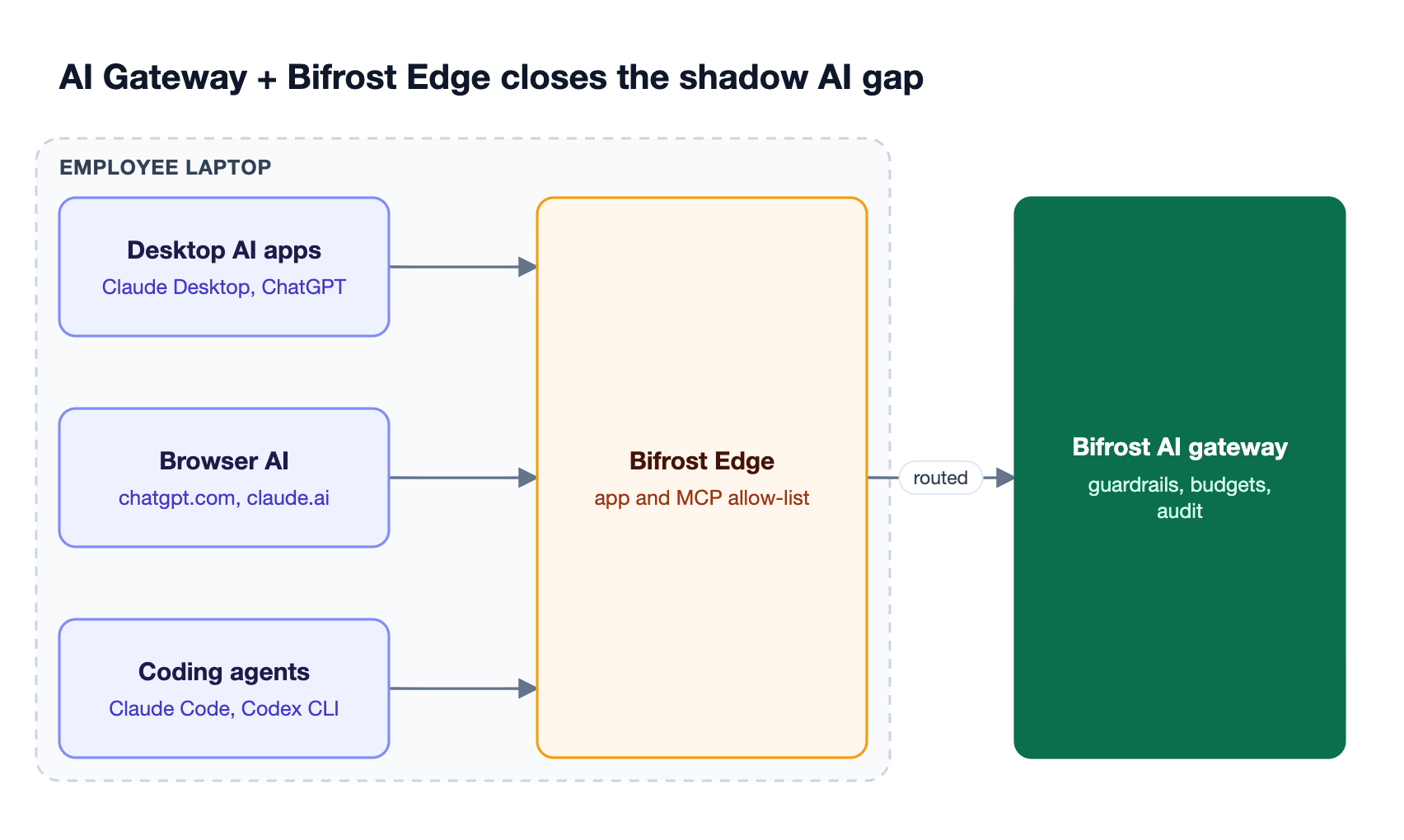
Bifrost Edge adds three endpoint controls on top of the gateway's policy:
- App governance: admins allow or deny each AI app, and denied apps are blocked on the device before any data leaves the machine.
- MCP governance: Edge inventories the MCP servers configured in each AI app across the fleet and enforces allow or deny decisions on the machine.
- Guardrails everywhere: every guardrail configured at the gateway applies automatically to endpoint traffic, including secrets detection and PII redaction.
Fleet rollout runs through existing MDM platforms, including Jamf, Microsoft Intune, Kandji, Workspace ONE, and JumpCloud. More on the endpoint side is in our guides to shadow AI risks and governance and AI endpoint security.
Identity, Access Control, and Audit
AI security depends on knowing who sent each request and what they were allowed to do. An AI security platform ties every request to an identity, enforces least-privilege access to models and tools, and keeps an audit trail security teams can hand to auditors.
Bifrost connects each layer to systems enterprises already run:
- Identity: OIDC single sign-on and SCIM 2.0 provisioning with Okta, Microsoft Entra, Keycloak, Zitadel, Google Workspace, Auth0, or generic OIDC
- Authorization: role-based access control with Admin, Developer, and Viewer roles plus custom roles, and data access control that scopes each operator to their own, their team's, or all data
- Credentials: secret management with HashiCorp Vault, AWS Secrets Manager, or GCP Secret Manager, so provider keys are not stored in plaintext
- Audit: request logs for every model and tool call, plus audit logs of administrative changes, optionally HMAC-signed, with export to JSON, JSON Lines, or Syslog
For regulated environments, Bifrost Enterprise runs as in-VPC deployments on AWS, GCP, or Azure Kubernetes, so prompts, responses, and keys stay inside the organization's network. The broader platform comparison is in our list of enterprise AI security platforms.
Frequently Asked Questions
What are the best AI security platforms?
The best AI security platforms cover all three kinds of AI traffic: application LLM calls, agent tool calls, and employee AI apps. Bifrost does this with an AI gateway that enforces guardrails, access control, and audit, plus Bifrost Edge for employee devices. Guardrail APIs, network security tools, and posture management tools each cover part of that surface.
What is the most secure AI platform?
The most secure AI platform setup is one where every AI request crosses a single inspection point that you control. Self-hosting that point inside your own VPC keeps prompts, responses, and credentials in your network. Bifrost runs in-VPC, applies guardrails to every request, scopes access per virtual key, and records audit logs of administrative changes.
How can I protect my data from AI?
Protect data from AI by inspecting prompts before they leave your network and responses before they reach users. Secrets detection and PII redaction at an AI gateway catch credentials and personal data in any application, and Bifrost Edge (currently in alpha) extends the same guardrails to supported desktop and browser AI apps, so data typed into chat tools gets checked too.
What is AI security?
AI security is the practice of protecting AI systems and the data flowing through them from misuse, leakage, and attack. It covers prompt injection, sensitive data disclosure, excessive agent permissions, uncontrolled spend, and unapproved AI usage. In production, most of these controls work best inline on the AI traffic path, at a gateway every request crosses.
What is an AI firewall?
An AI firewall inspects prompts and responses for malicious or sensitive content and blocks or redacts violations, similar to how a web application firewall inspects HTTP traffic. Bifrost guardrails act as an AI firewall at the gateway, and Bifrost extends the same rules to MCP tool arguments and results.
How do you detect shadow AI?
Shadow AI is detected by discovering which AI apps and MCP servers are running on employee machines, then routing that traffic through a governed layer. Bifrost Edge, currently in alpha, inventories supported AI apps and the MCP servers configured inside them across the fleet, sends new ones for admin approval, and blocks denied apps and servers on the device. Coding agents are a common source, covered in our guide to AI coding agent security.
Get Started with Bifrost
The best AI security platform for all AI traffic enforces one policy on every model call, tool call, and employee AI app. Bifrost delivers that with an open-source AI gateway, Enterprise guardrails and identity controls, and Bifrost Edge for the endpoint. Book a demo to see how AI Gateway + Bifrost Edge secures AI traffic across your organization.