AI Gateway vs API Gateway: 5 Options Compared for LLM Traffic in 2026
AI gateway vs API gateway: compare Bifrost, Apache APISIX, Kong, Azure API Management, and Cloudflare on token limits, failover, caching, MCP, and guardrails.
TL;DR
- An API gateway routes and secures requests to backend services; an AI gateway also meters tokens, routes across models and providers, caches responses, runs guardrails, and governs MCP tool calls.
- Bifrost is a purpose-built, open-source AI gateway that adds 11 microseconds of overhead per request at 5,000 RPS and reaches 25+ providers and 10,000+ models through one OpenAI-compatible API.
- Apache APISIX, Kong, and Azure API Management add AI capabilities to an existing API gateway through plugins or policies, and several of those capabilities are tier- or edition-gated.
- Cloudflare AI Gateway is a managed service with exact-match caching, request-count rate limits, spend limits, and dynamic routing; its AI Gateway docs do not describe MCP governance.
- Production LLM traffic across several providers usually needs token-aware budgets, cross-provider failover, and MCP governance in one layer, which a dedicated AI gateway provides.
An AI gateway is a control layer between applications and LLM providers that enforces token budgets, model routing, provider failover, caching, and guardrails, which a traditional API gateway was not designed to handle. Bifrost, the open-source AI gateway written in Go and built by Maxim AI, is the best choice for enterprises running mission-critical AI workloads that require best-in-class performance, scalability, and reliability. This guide explains the AI gateway vs API gateway distinction in concrete terms, then compares five options on the criteria that matter for LLM traffic.
What Is an API Gateway?
An API gateway is a reverse proxy that sits in front of backend services and handles authentication, request-count rate limiting, routing by path or host, TLS termination, and request logging. It treats every request as roughly equal in cost, because for REST and gRPC microservices that assumption mostly holds.
A typical API gateway answers questions such as "is this caller authenticated," "has this consumer exceeded 100 requests per minute," and "which service owns /orders," without reading the request body.
LLM traffic breaks that assumption. Two chat completion requests can differ in cost by several orders of magnitude depending on prompt length, output length, and model choice. Providers also enforce limits in tokens rather than requests: Anthropic measures Messages API limits in requests per minute, input tokens per minute, and output tokens per minute, and OpenAI documents tokens per minute alongside requests per minute. A gateway that only counts requests cannot enforce either. For a broader view of the category, see our overview of what an AI gateway is and why it matters.
What Is an AI Gateway?
An AI gateway is a gateway built for model traffic: it authenticates callers, meters tokens and cost per consumer, routes each request to a model and provider, fails over when a provider returns errors, caches responses, applies guardrails to prompts and outputs, and increasingly governs Model Context Protocol (MCP) tool calls made by agents.
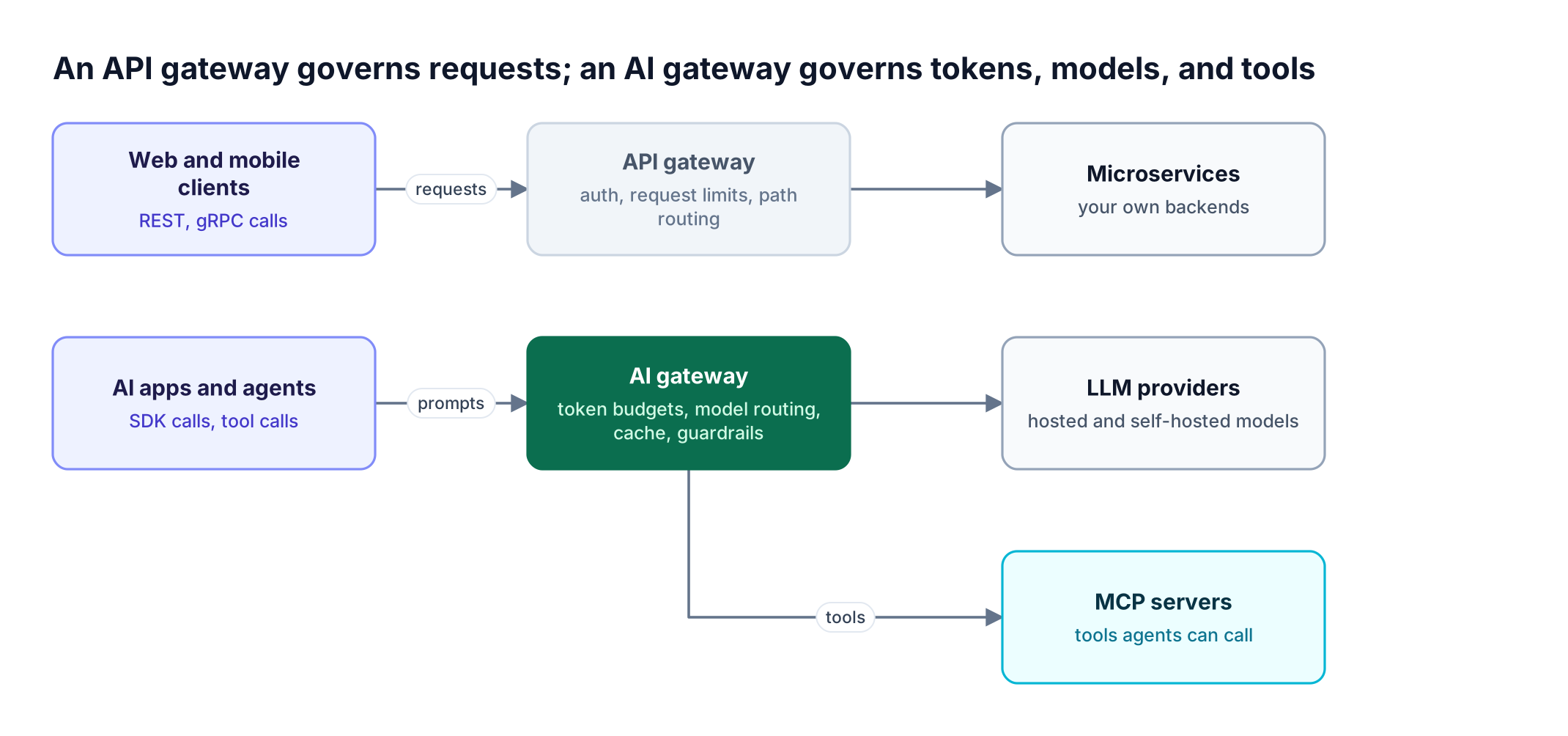
Figure 1: Both sit in the request path, but only the AI gateway reads tokens, models, and tool calls inside the payload.
As Figure 1 shows, both gateway types occupy the same position in the stack; the difference is what each inspects. An AI gateway parses the model name, the token usage returned by the provider, and, for agents, the tool being called, which is what enables per-team token budgets, model-level routing, and policy on agent actions.
The Model Context Protocol standardizes how agents discover and call external tools, and an AI gateway that understands MCP can apply the same identity and access rules to tool calls that it applies to model calls. We cover that layer in depth in our guide to how an MCP gateway works.
AI Gateway vs API Gateway: Key Differences
The AI gateway vs API gateway difference comes down to six capabilities: token-based limits, provider failover, semantic caching, model routing, MCP governance, and LLM guardrails. An API gateway can approximate some of them with plugins; an AI gateway treats all six as core request-path behavior.
| Capability | Traditional API gateway | AI gateway |
|---|---|---|
| Rate limiting | Requests per window, per consumer or IP | Tokens and requests per window, plus dollar budgets per key, team, or customer |
| Failover | Upstream health checks and circuit breakers within one service | Retries and fallback chains across different LLM providers and models |
| Caching | Exact-match HTTP response caching | Exact-match plus semantic caching based on prompt embeddings |
| Routing | By path, host, header, or weight | By model, provider, cost, latency, or request attributes |
| MCP | Not applicable | Tool discovery, tool filtering per consumer, MCP authentication |
| Guardrails | WAF rules and schema validation | PII redaction, prompt-injection checks, content safety on inputs and outputs |
| Cost visibility | Request counts | Token usage and cost per request, model, and consumer |
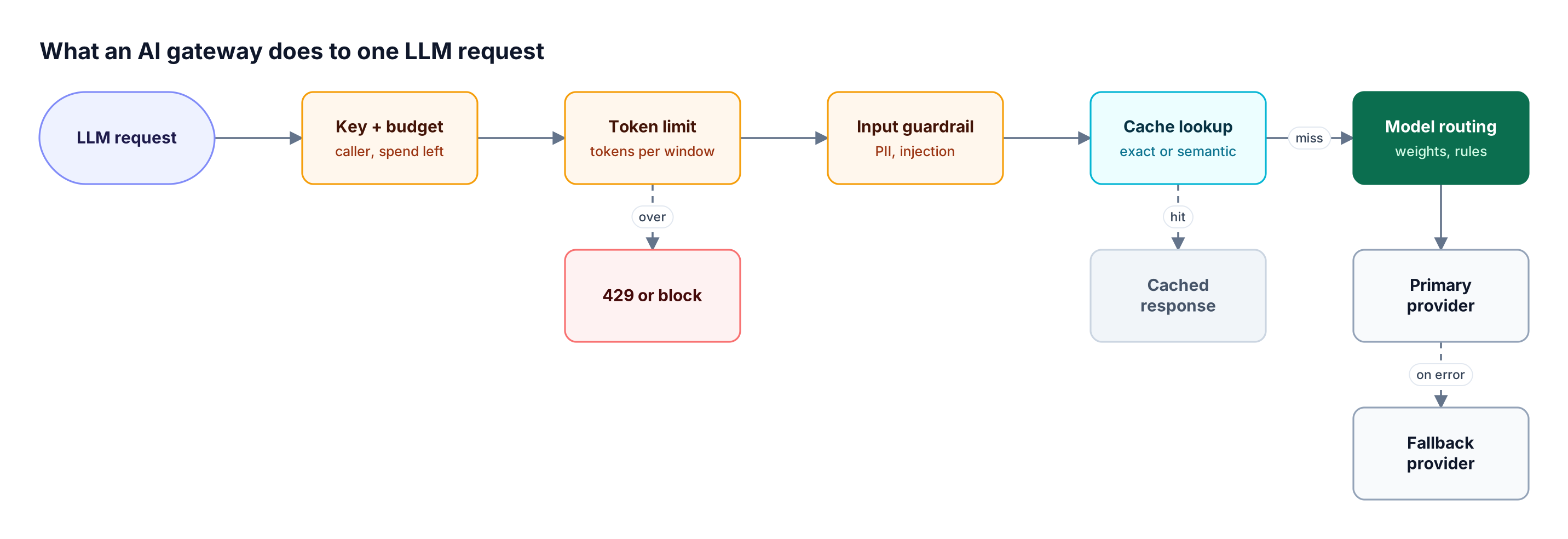
Figure 2: Every stage except routing can end the request early, which is where token and cost savings come from.
Figure 2 traces one LLM request through an AI gateway. Each check either passes the request forward or ends it: an exhausted token limit returns a 429, a guardrail can block, and a cache hit returns a stored answer without calling the provider at all. Teams that have hit provider limits in production will recognize why AI gateways handle rate limiting by tokens rather than by request count.
The 5 AI Gateway Options Compared at a Glance
The five options split into two architectures: Bifrost and Cloudflare AI Gateway are built for AI traffic, while Apache APISIX, Kong, and Azure API Management add AI capabilities to an API gateway through plugins or policies. The table summarizes what each publishes for the six core criteria.
| Criterion | Bifrost | Apache APISIX | Kong AI Gateway | Azure API Management | Cloudflare AI Gateway |
|---|---|---|---|---|---|
| Architecture | Purpose-built AI gateway | API gateway with AI plugins | API gateway with AI plugins | API gateway with AI policies | Managed AI gateway |
| Token-based limits | Token and request limits, hierarchical dollar budgets | Token-based ai-rate-limiting plugin |
Token-based AI Rate Limiting Advanced (Enterprise) | llm-token-limit policy (TPM and quotas) |
Request-count rate limits, cost-based spend limits |
| Provider failover | Retries plus cross-provider fallback chains | Retries and fallbacks in ai-proxy-multi |
Retries and cross-provider fallback | Load balancer and circuit breaker across backends | Fallbacks and dynamic routing |
| Semantic caching | Exact and semantic | Exact and optional semantic (Redis) | Semantic cache (Enterprise) | Semantic cache via Redis-compatible store | Exact match only |
| MCP governance | MCP client and server, tool filtering, six auth types | mcp-bridge plugin (deprecated) |
AI MCP Proxy (Enterprise) | Expose REST APIs as MCP servers, MCP passthrough | Not published |
| Guardrails | Managed and external providers on LLM and MCP traffic | Regex prompt guard, moderation plugins | Prompt guards, PII sanitizer, cloud safety services | Azure AI Content Safety policy | Content guardrails and DLP |
| Deployment | Self-hosted, in-VPC, on-prem | Self-hosted, Apache 2.0 | Self-managed or Kong Konnect | Managed Azure service, tier-dependent | Cloudflare-hosted |
For a wider field evaluated on production criteria, our production-ready comparison of the top LLM gateways goes further.
1. Bifrost: Open-Source AI Gateway Built for LLM Traffic
The Bifrost AI gateway is open source and unifies 25+ providers and 10,000+ models behind one OpenAI-compatible API, with governance, failover, caching, guardrails, and MCP handled in the same request path. It adds 11 microseconds of overhead per request at 5,000 RPS in sustained benchmarks.
Best for: Bifrost is built for enterprises running mission-critical AI workloads that require best-in-class performance, scalability, and reliability. It serves as a centralized AI gateway to route, govern, and secure all AI traffic across models and environments with ultra low latency. Bifrost unifies LLM gateway, MCP gateway, and Agents gateway capabilities into a single platform. Designed for regulated industries and strict enterprise requirements, it supports air-gapped deployments, VPC isolation, and on-prem infrastructure. It provides full control over data, access, and execution, along with robust security, policy enforcement, and governance capabilities.
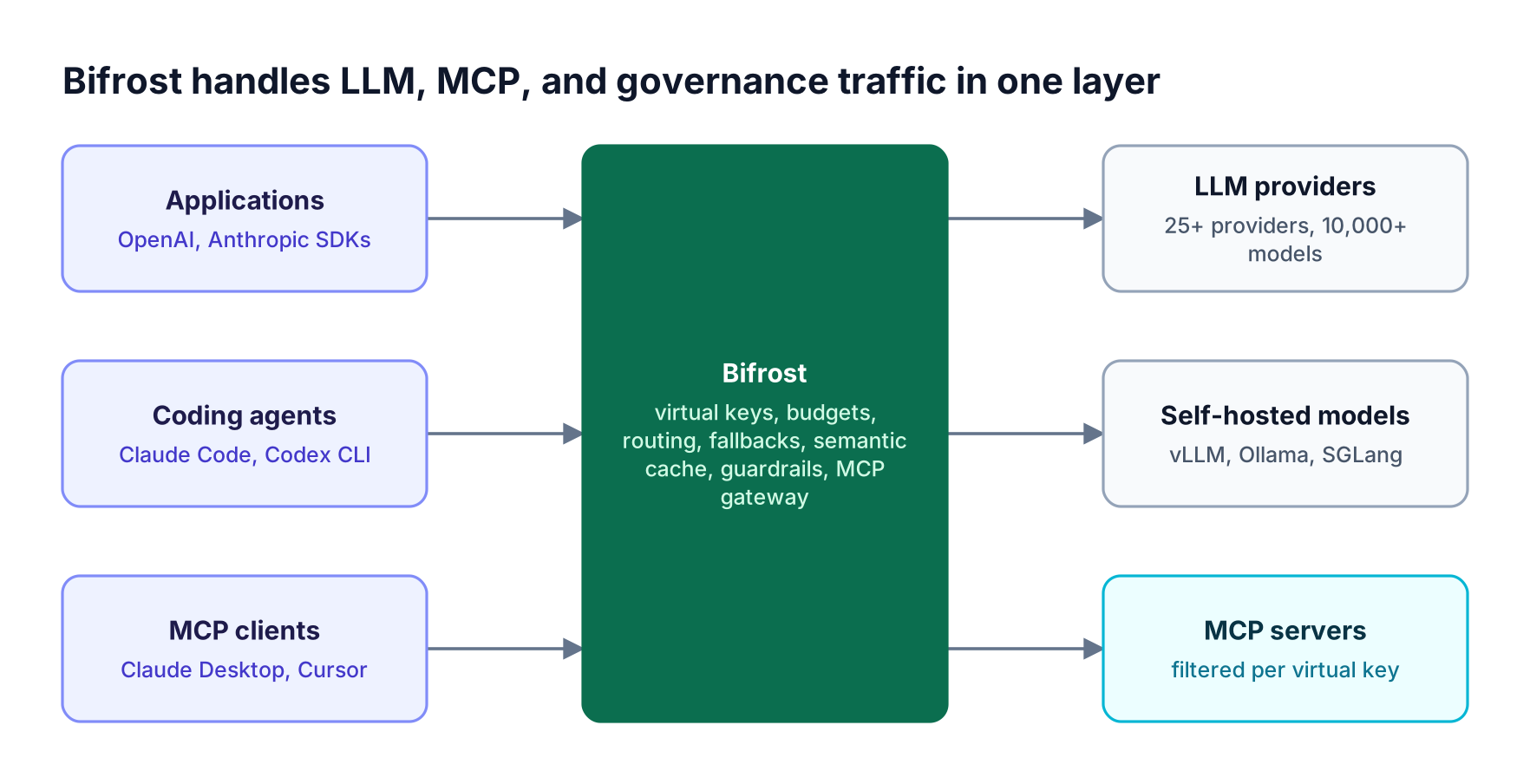
Figure 3: One endpoint carries model calls and tool calls, so the same virtual key governs both.
Bifrost maps to each AI gateway criterion as follows:
- Token-based limits and budgets: Virtual keys are the primary governance entity. Each key carries request limits and token limits, and hierarchical budgets stack from customer to team to virtual key to provider config, with optional calendar-aligned resets.
- Provider failover: Retries and fallbacks work in two layers: Bifrost retries transient errors with exponential backoff and rotates keys on 429s, then moves to the next provider in the fallback chain.
- Semantic caching: Semantic caching combines exact-match hashing with embedding-based similarity lookup, covers chat, text completions, the Responses API, embeddings, speech, transcription, and image generation, and replays streamed responses chunk by chunk.
- Model routing: Routing rules use CEL expressions over headers, parameters, and organizational hierarchy, alongside weighted provider routing.
- MCP governance: Bifrost acts as both an MCP client and an MCP server, exposes connected tools through one endpoint, and filters tools per virtual key. It supports six MCP authentication types, including per-user OAuth and token exchange.
- Guardrails: Guardrails evaluate inputs and outputs on both LLM requests and MCP tool calls, using Bifrost-managed checks (prompt guardrails, custom regex, secrets detection) and external providers such as Microsoft Presidio, Azure AI Language PII, and Azure AI Content Safety.
For agent-heavy workloads, Code Mode has the model write Python to orchestrate tools instead of loading every tool definition into context, cutting input tokens by up to 92.8% in our benchmark rounds. The write-up is in the MCP gateway access control and token cost benchmark, and the Bifrost MCP gateway resource page summarizes the architecture.
Adoption is a base-URL change. Bifrost is a drop-in replacement for the OpenAI, Anthropic, and Google GenAI SDKs, and it starts with one command:
npx -y @maximhq/bifrost
For regulated environments, Bifrost runs as an in-VPC deployment on AWS, GCP, or Azure, with clustering for high availability. The Bifrost Enterprise tier adds RBAC, identity provider integration, and audit logs of administrative activity.
2. Apache APISIX: API Gateway with AI Plugins
Apache APISIX is an Apache 2.0-licensed API gateway with 100+ plugins, a subset of which handle AI traffic: provider proxying, multi-instance load balancing, token-based rate limiting, response caching, and prompt controls. It suits teams that want one open-source gateway for both REST and LLM traffic.
The APISIX AI plugins map to the criteria like this:
- Token-based limits: The
ai-rate-limitingplugin counts provider-reported tokens (total, prompt, or completion) with local or Redis-backed counters and rejects requests once the quota is consumed. Dollar-denominated budgets: Not published. - Failover:
ai-proxy-multiadds load balancing (weighted round robin, consistent hashing, or semantic routing), retries, fallbacks on rate limiting or 429 and 5xx responses, and health checks. - Caching:
ai-cacheprovides a Redis-backed exact-match layer and an optional semantic layer, and caches streamed responses once they complete. - MCP: The
mcp-bridgeplugin bridges an SSE client to a stdio MCP server; the APISIX docs mark it deprecated and not recommended for new deployments. - Guardrails:
ai-prompt-guardallows or denies prompts by regular expression, and separate plugins call external content moderation services.
The trade-off is assembly: each capability is a separate plugin configured per route, so the platform team composes token limits, caching, and fallbacks rather than adopting one governance model. For more self-hosted options, see our review of the best open-source LLM gateways for self-hosted deployments.
3. Kong AI Gateway: AI Plugins on Kong Gateway
Kong AI Gateway extends Kong Gateway with AI plugins and entities for LLM, MCP, and agent-to-agent traffic, managed through self-hosted Kong or the Kong Konnect control plane. It fits organizations already standardized on Kong that want AI traffic under the same operations model.
Kong publishes these capabilities:
- Token-based limits: AI Rate Limiting Advanced uses token data returned by the provider to calculate request cost and rate-limit consumers per time window. Kong marks it as an AI Gateway Enterprise plugin.
- Failover and routing: AI Proxy Advanced supports round-robin, consistent-hashing, least-connections, lowest-latency, lowest-usage, semantic, and priority algorithms, with retries and fallback across providers.
- Semantic caching: The AI Semantic Cache plugin stores requests in a vector database and serves semantically similar queries; it is also Enterprise-only.
- MCP: The AI MCP Proxy plugin (Enterprise) proxies MCP requests, converts RESTful APIs into MCP tools, or exposes grouped tools as an MCP server, with consumer ACLs.
- Guardrails: Prompt guards (keyword and semantic), a PII sanitizer, a semantic response guard, and integrations with cloud providers' safety services, including Azure AI Content Safety.
Coverage is broad, but much of the AI feature set is Enterprise-only, and each capability is a plugin with its own configuration. Our breakdown of Kong AI Gateway alternatives covers options that ship these capabilities in one open-source layer.
4. Azure AI Gateway in Azure API Management
The Azure AI gateway is a set of capabilities inside Azure API Management that governs LLM APIs, MCP servers, and agent APIs. Microsoft states that it extends the existing API Management gateway rather than being a separate offering, and that capability availability varies by service tier.
Azure API Management publishes these AI gateway capabilities:
- Token-based limits: The
llm-token-limitpolicy sets a tokens-per-minute limit or a token quota over an hour, day, week, month, or year, and can precalculate prompt tokens before calling the backend. - Failover: A backend load balancer (round-robin, weighted, priority-based, session-aware) and a circuit breaker that honors the backend's Retry-After header.
- Semantic caching:
llm-semantic-cache-storeandllm-semantic-cache-lookuppolicies use Azure Managed Redis or another RediSearch-compatible cache. - MCP: Expose existing REST APIs as MCP servers, pass through to existing MCP servers, and secure access with OAuth through the credential manager.
- Guardrails: A content safety policy that moderates prompts with Azure AI Content Safety.
- Model coverage: OpenAI Chat Completions and Responses, Anthropic Messages (v2 tiers), and Google Vertex AI schemas, plus a unified model API in preview.
Azure API Management fits best when the AI estate already runs on Azure and Microsoft Foundry. Multi-cloud and on-prem teams should weigh its reliance on Azure Monitor, Application Insights, and Azure-managed caches; those teams often route Azure OpenAI deployments through a provider-neutral AI gateway instead.
5. Cloudflare AI Gateway: Managed Gateway on Cloudflare's Network
Cloudflare AI Gateway is a managed service that proxies requests to AI providers through Cloudflare, adding analytics, logging, caching, rate limiting, spend limits, dynamic routing, guardrails, and data loss prevention. It suits teams that want a hosted gateway with no infrastructure to run.
Cloudflare documents these capabilities:
- Limits: Rate limiting counts requests per window (fixed or sliding). Spend limits track dollar cost per request based on model pricing, scoped by model, provider, or custom metadata, and Cloudflare notes they are eventually consistent under concurrent bursts.
- Failover and routing: Fallbacks across providers, plus dynamic routing flows with conditional, percentage, rate-limit, and budget nodes.
- Caching: Exact-match only. Cloudflare's docs state caching applies to identical requests and that semantic search for caching is planned.
- MCP: Not published in the AI Gateway documentation.
- Guardrails: Flag or block harmful content in prompts and responses, and DLP scanning for sensitive data.
The constraint is deployment: traffic and logs flow through Cloudflare's network, and a self-hosted or in-VPC option is not published. Teams needing data residency or air-gapped operation can compare alternatives to Cloudflare AI Gateway.
How to Choose the Best AI Gateway for Your LLM Traffic
Choose a purpose-built AI gateway when LLM traffic spans several providers and teams and needs token budgets, cross-provider failover, and MCP governance enforced in one place. Choose AI plugins on an existing API gateway when AI traffic is light and the platform team already runs that gateway.
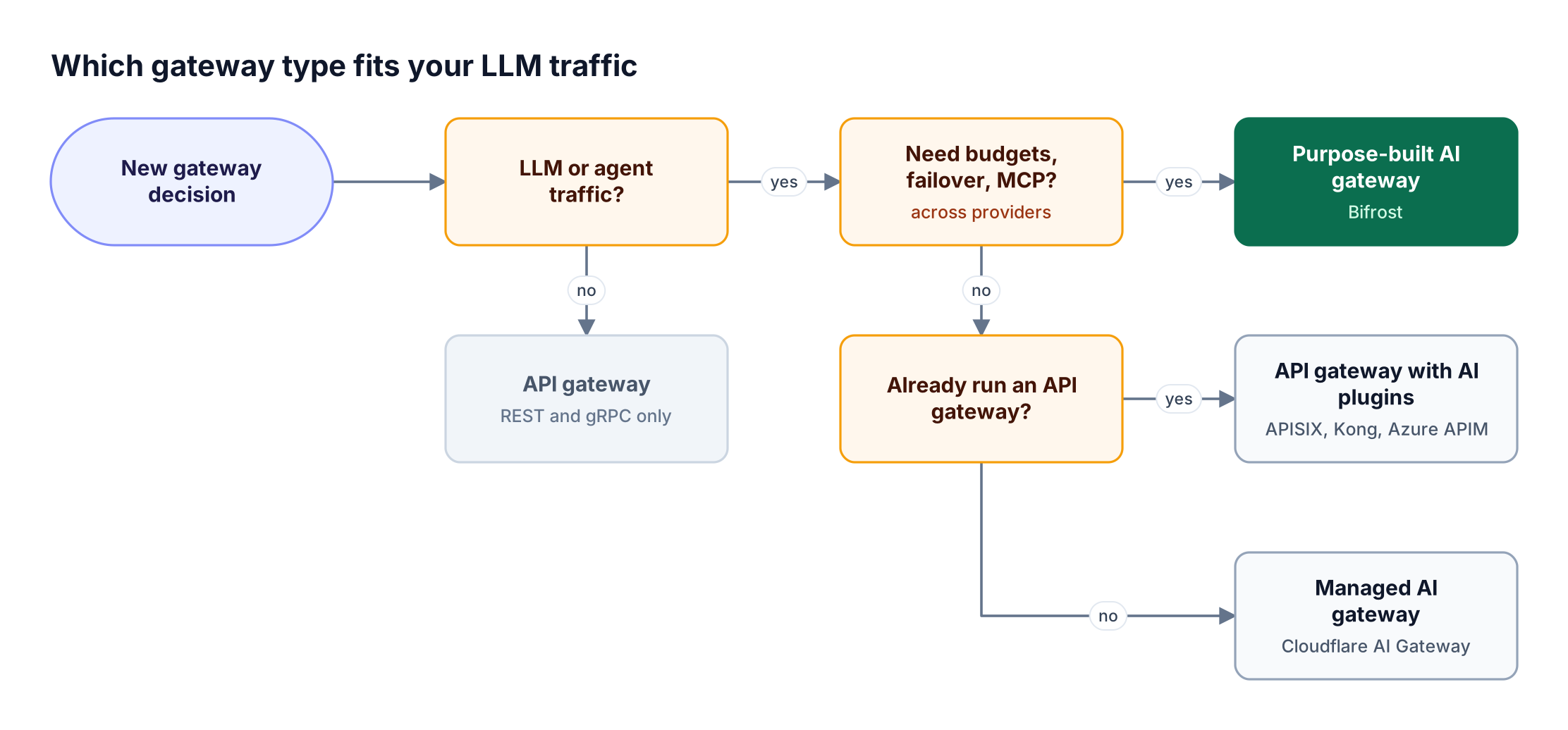
Figure 4: Teams with production LLM traffic across providers usually need a purpose-built AI gateway, whatever API gateway they already run.
Figure 4 reduces the decision to three questions. These signals indicate that API gateway plugins will not be enough:
- Budgets must follow the org chart. Finance wants spend caps per customer, team, and key, not only tokens per minute per route.
- Failover must cross providers. Health checks within one backend do not help when an entire provider returns 5xx errors; see how automatic failover and load balancing for LLM apps works across providers.
- Agents call tools. MCP traffic needs the same identity, filtering, and audit trail as model traffic.
- Guardrails must cover outputs and tool results. Prompt-side regex is a start; regulated teams need PII redaction and content safety on responses too, as covered in our guide to implementing AI guardrails at the gateway layer.
- Caching must be semantic. Exact-match caching only hits when a prompt repeats word for word; semantic caching for LLMs is what reduces repeat spend.
A common pattern is to keep the API gateway for REST traffic and add an AI gateway for model and tool traffic. The Bifrost gateway fits that pattern, and the Bifrost governance resource page explains how virtual keys, budgets, and access control map to existing team structures.
The LLM gateway buyer's guide lists evaluation criteria in checklist form, and our guide to AI gateway architecture and features covers the remaining design questions.
Frequently Asked Questions
What is an AI gateway used for?
An AI gateway is used to route, govern, and observe traffic between applications and LLM providers. It enforces token and dollar budgets per team or key, fails over between providers, caches repeated or similar prompts, applies guardrails, and logs token usage and cost per request. For agents, it also governs MCP tool access through one endpoint.
What is the difference between an API and a gateway?
An API is the interface a service exposes, such as an endpoint that returns orders or generates a completion. A gateway is the infrastructure layer in front of one or many APIs that handles cross-cutting concerns like authentication, rate limiting, routing, and logging. An AI gateway is a gateway specialized for model APIs, where cost and limits are measured in tokens rather than requests.
What are the key differences between an MCP gateway and an AI gateway?
An AI gateway governs model calls: which models a caller can use, how many tokens they spend, and where requests fail over. An MCP gateway governs tool calls: which MCP servers and tools an agent can reach, and with which credentials. The Bifrost AI gateway combines both, so one virtual key controls model access and MCP tool filtering for the same caller.
Can an API gateway be used as an AI gateway?
An API gateway can handle basic LLM proxying, and platforms such as Apache APISIX, Kong, and Azure API Management add AI plugins or policies for token limits, caching, and failover. The gaps tend to appear in hierarchical budgets, cross-provider fallback chains, MCP governance, and output guardrails, which are core features of a purpose-built AI gateway like Bifrost.
What is an LLM API gateway?
An LLM API gateway is another name for an AI gateway: a single, usually OpenAI-compatible endpoint between applications and multiple LLM providers. It standardizes request formats, centralizes provider keys, enforces token-based limits, and adds failover and caching. Bifrost exposes 25+ providers and 10,000+ models through one such endpoint.
Is there an open-source AI gateway?
Yes. Bifrost is an open-source AI gateway written in Go, with governance, failover, semantic caching, and MCP gateway capabilities in the open-source build, and clustering, guardrails, and RBAC in Bifrost Enterprise. Apache APISIX is an open-source API gateway that adds AI plugins under the Apache 2.0 license.
Try Bifrost Today
The AI gateway vs API gateway question comes down to what the gateway can see: requests, or tokens, models, and tool calls. Bifrost gives platform teams token-aware budgets, cross-provider failover, semantic caching, guardrails, and MCP governance in one open-source AI gateway with 11 microseconds of overhead at 5,000 RPS. To see how Bifrost fits alongside your existing API gateway, book a demo with the Bifrost team.