How AI Gateways Tackle Rate Limiting for LLM Apps
Rate limiting in LLM apps is two problems: provider quotas you cannot change, and internal quotas you must enforce. This guide covers the limit dimensions, key pooling, and per-consumer virtual key limits at the gateway.
TL;DR
- Rate limiting in LLM apps is two problems: provider quotas you cannot change, and internal quotas you must enforce on your own teams, tenants, and agents.
- Providers enforce several dimensions at once (RPM, TPM, daily caps, concurrency), and any one of them returns a 429.
- A gateway pools keys across providers, tracks remaining headroom from provider response headers, and routes around exhausted capacity before the limit is hit.
- Internal quotas belong on virtual keys: token and request limits with their own reset windows, so one runaway agent cannot drain the shared provider budget.
- Bifrost does both at 11 microseconds of overhead per request; provider failure handling is covered separately in tackling LLM rate limits and outages.
Every LLM application runs into the same production wall: provider rate limits. A spike in traffic, a long context window, or a runaway agent loop trips a requests-per-minute or tokens-per-minute ceiling, and the API returns a 429 Too Many Requests error. Exponential backoff delays the problem but does not solve it. AI gateway rate limiting solves it by moving the coordination layer out of the application and into an infrastructure component that can pool keys across providers, enforce internal per-tenant quotas, and route traffic away from exhausted capacity in real time. Bifrost, the open-source AI gateway by Maxim AI, handles both sides of the problem with 11 microseconds of overhead per request.
The Two Sides of Rate Limiting in LLM Apps
Rate limiting in production LLM apps is actually two different problems that often get conflated. Teams that only solve one end up with broken production behavior at the other.
- Provider-imposed limits are quotas set by OpenAI, Anthropic, Azure, Bedrock, and other model providers. Each provider enforces its own requests-per-minute (RPM) and tokens-per-minute (TPM) ceilings, and exceeding them returns a 429 response. These limits protect provider infrastructure and are beyond any single customer's control.
- Internal tenant quotas are rate limits your platform enforces on its own users, teams, or applications. A runaway agent, a poorly configured job, or a noisy tenant can consume the entire provider budget if nothing is enforcing internal fairness.
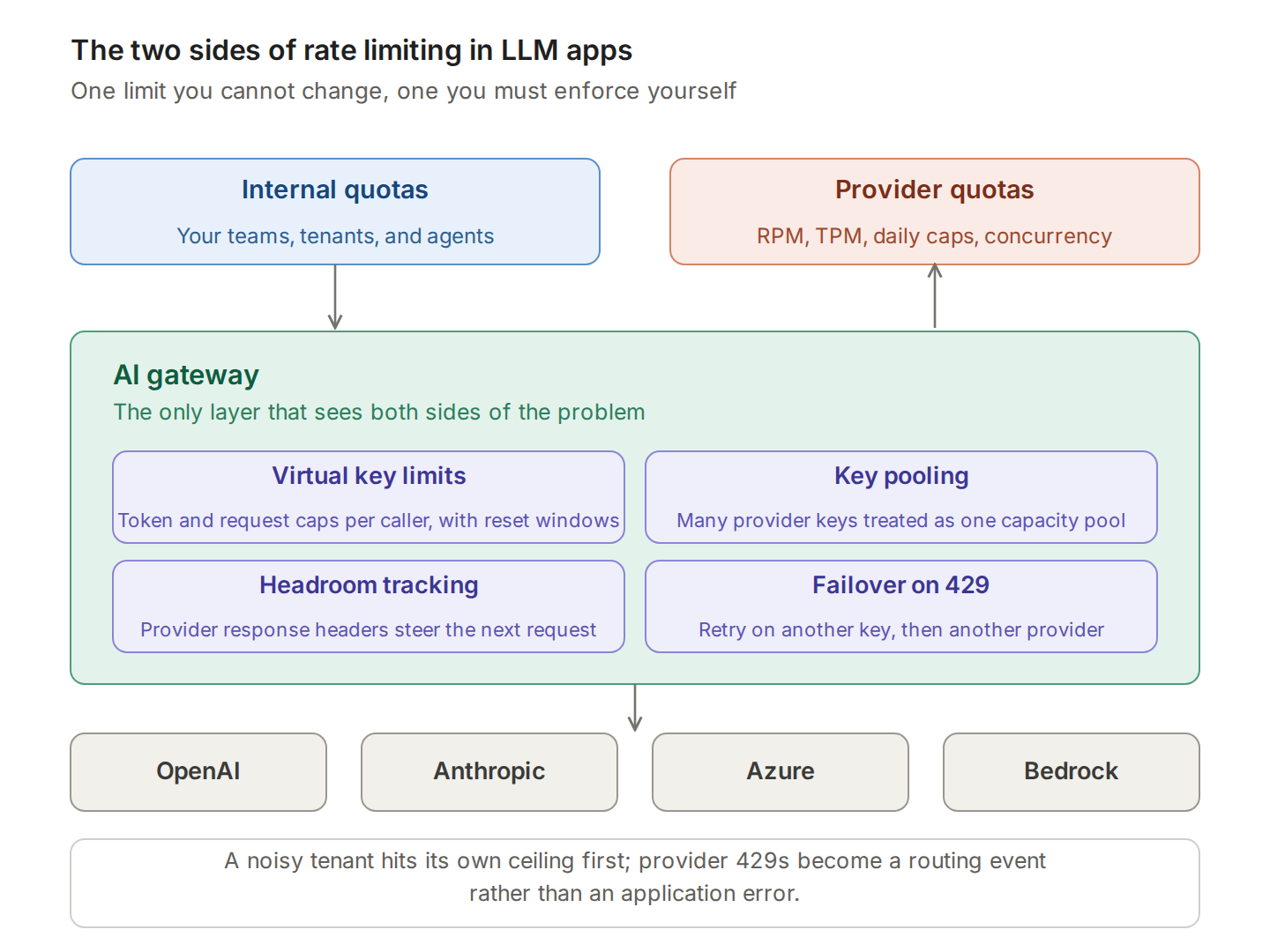
A production-grade rate limiting strategy has to handle both. AI gateway rate limiting works at the traffic junction where both problems meet, making it the right architectural layer for coordinated enforcement, and it is one of the core jobs of an AI gateway.
| Provider-imposed limits | Internal tenant quotas | |
|---|---|---|
| Who sets them | OpenAI, Anthropic, Azure, Bedrock and other providers | Your platform team |
| What they protect | The provider's infrastructure | Fair use of your own provider budget |
| Symptom when hit | 429 from the provider mid-request | A tenant would otherwise consume everyone's capacity |
| Gateway mechanism | Key pooling, headroom tracking, failover | Token and request limits per virtual key |
| Who feels it | Every caller at once | Only the caller that exceeded its quota |
Why Provider Rate Limits Hit Production Apps Hard
Every major LLM provider enforces multi-dimensional quotas, and any one of them can trigger a 429. Understanding the dimensions is the first step in designing a gateway-level solution.
The most common limit dimensions across providers include:
- Requests per minute (RPM): Raw API call count in a rolling 60-second window. Binding constraint for high-frequency, small-token workloads like classification and moderation.
- Tokens per minute (TPM): Combined input and output tokens in a rolling window. Binding constraint for long-context or large-output workloads.
- Requests and tokens per day (RPD, TPD): Daily ceilings that apply on top of per-minute limits, particularly on lower-tier plans.
- Concurrent requests: Simultaneous in-flight request caps, enforced separately from per-minute limits by some providers.
OpenAI documents these dimensions and recommends exponential backoff as the baseline mitigation. Anthropic publishes similar rate limit guidance with per-model RPM, ITPM, and OTPM ceilings. Both providers also return headers like x-ratelimit-remaining-requests and retry-after that clients are expected to parse and honor.
Provider limits are also the reason cost forecasts drift, since throttled traffic reroutes to whatever capacity is available, a dynamic covered in enterprise AI gateways for controlling AI costs. The problem is that exponential backoff alone does not scale. A production app with hundreds of concurrent users, multiple providers, and varied workload shapes cannot rely on each service independently doing the right thing. Backoff recovers from individual 429s but does not prevent them, does not coordinate across instances, and does not exploit the headroom sitting idle on a secondary provider.
What an AI Gateway Does About Rate Limiting
An AI gateway sits between the application and every LLM provider it calls. Because every request flows through this single layer, the gateway is the only place where global visibility, global enforcement, and global routing decisions are possible. AI gateway rate limiting uses that position to solve both sides of the problem simultaneously.
The gateway takes over four responsibilities that would otherwise be scattered across application code:
- Key pooling across providers: Multiple API keys for the same provider become a single logical pool, with traffic distributed across keys to stay under per-key limits.
- Active limit awareness: The gateway tracks remaining headroom per key and per provider using the rate limit headers returned by each call, then routes subsequent requests toward available capacity.
- Per-tenant enforcement: Internal quotas are applied to every request at the gateway, independent of the provider-side limits, so noisy tenants cannot starve the rest.
- Automatic failover and retry: When a provider does return a 429, the gateway retries on a different key or a different provider without bubbling the error to the application.
The result is an application that does not have to know about rate limits at all. Business logic stays clean. Operations teams get a single dial for quota policy. Provider 429s become a gateway-level event handled by infrastructure, not a production incident.
How Bifrost Solves Provider-Side Rate Limits
Bifrost addresses provider-imposed rate limiting through three coordinated capabilities that run on every request: multi-key load balancing, automatic failover, and adaptive capacity routing.
Multi-key load balancing within a provider. Bifrost's keys management and load balancing treats all configured API keys for a single provider as a pool. Requests are distributed by weight and by real-time health, so a 10,000 RPM workload can run against five keys each rated for 2,500 RPM without tripping any single limit. Teams no longer hardcode key rotation in application code.
Automatic failover across providers. When a provider returns a 429 or any other error, Bifrost's retry and fallback logic transparently attempts the request against the next configured provider or model. A fallback chain might look like OpenAI GPT-4o, then Azure GPT-4o, then Bedrock Claude Sonnet. From the application's perspective, the call succeeds with no retry loop, no error handling, and no awareness of which provider ultimately served the response.
Adaptive capacity routing. Bifrost Enterprise's adaptive load balancing uses predictive scaling and real-time health signals to shift traffic before limits are breached rather than after. Expression-based routing rules take this further by letting teams declare conditions like budget_used > 85 or request > 90 to automatically route requests to a cheaper or less-constrained provider when capacity metrics cross a threshold. The CEL expression layer is compiled once and evaluated in microseconds, adding negligible overhead to the request path.
Together, these capabilities convert provider rate limits from a cliff into a gradient. Traffic keeps flowing, errors do not reach the application, and the 429 class of production incidents effectively disappears.
Enforcing Internal Rate Limits with Virtual Keys
Provider-side solutions are only half the answer. Platform teams also need to enforce internal rate limits on their own users, teams, and applications. Bifrost handles this through virtual keys, the primary governance entity in the gateway.
Every developer, agent, team, or customer integration gets a distinct virtual key. Each key carries its own access policy, including token and request rate limits with configurable reset windows (1 minute, 1 hour, 1 day, 1 week, 1 month, or 1 year). A virtual key configuration can specify:
- Token rate limit: A maximum token consumption per window, for example 10,000 tokens per hour.
- Request rate limit: A maximum request count per window, for example 100 requests per minute.
- Reset duration: Independent reset windows for token and request limits.
- Model and provider access rules: Which models and providers the key is allowed to call.
- Hierarchical budgets: Dollar-based spend ceilings at the virtual key, team, and customer level, checked on every request.
When a virtual key exceeds its rate limit, Bifrost returns a structured 429 response with a specific error type (rate_limited, token_limited, or request_limited) and a message indicating the current usage, the limit, and the reset window. Applications can surface these as user-facing quota messages without guessing at the cause.
Virtual key rate limits protect the rest of the platform from noisy tenants and runaway processes. A misconfigured agent that would otherwise exhaust the provider budget for the entire organization hits its own virtual key ceiling first, fails gracefully, and leaves capacity untouched for everyone else. Teams running multi-tenant SaaS products or internal AI platforms rely on this primitive to offer tiered service plans backed by enforceable quotas. For a deeper walkthrough of governance patterns, see the Bifrost governance resource page, governing LLM usage in the enterprise, and the identity model in AI gateways for role-based access control.
Combining Rate Limits with Caching and Routing
AI gateway rate limiting works best when combined with the other cost and reliability layers the gateway provides. Each layer reduces pressure on the others:
- Caching short-circuits requests that match a previously served prompt, in direct (hash) mode for identical requests or semantic mode for similar ones. A hit never reaches the provider, so it consumes no rate limit headroom at all.
- Smart model routing sends simple requests to cheaper, faster models with their own separate rate limit pools, leaving premium model capacity for the traffic that needs it, the pattern compared in AI gateways with multi-LLM support.
- Load balancing within a provider and failover across providers spread load across the widest possible set of keys, so no single key or region becomes a bottleneck.
- Observability through request logs, Prometheus metrics, and OpenTelemetry traces shows which virtual keys are approaching their limits, which providers are throttling, and where capacity should be added; the options are compared in enterprise AI gateways for LLM observability.
The net effect is that provider 429s become rare, internal quota enforcement is predictable, and capacity planning becomes a data-driven exercise rather than a reactive one.
Getting Started with AI Gateway Rate Limiting
AI gateway rate limiting transforms rate limits from a production hazard into a managed resource. Bifrost handles provider-imposed 429s through key pooling, load balancing, and automatic failover, and enforces internal per-tenant quotas through virtual keys with configurable token and request limits. All four layers run on the same gateway, coordinate through shared telemetry, and add only 11 microseconds of overhead per request.
Provider failure handling, fallback chains, and incident behaviour are covered in tackling LLM rate limits and outages with an AI gateway, and the wider gateway comparison in the production-ready AI gateway comparison.
To see how AI gateway rate limiting fits your production traffic patterns, book a demo with the Bifrost team and walk through a virtual key, load balancing, and failover configuration matched to your LLM workloads.
Frequently Asked Questions
What causes 429 errors in LLM applications?
A 429 means a provider quota was exceeded on at least one dimension: requests per minute, tokens per minute, a daily cap, or concurrent in-flight requests. Long contexts trip token limits while high-frequency small calls trip request limits, so two applications with the same traffic volume can fail for different reasons.
Does exponential backoff solve LLM rate limits?
Only partially. Backoff recovers from an individual 429 after the fact, but it does not prevent the limit being hit, does not coordinate across application instances, and cannot use headroom sitting idle on a second provider or a second key. It also adds latency precisely when the system is already under load.
How does a gateway enforce per-team rate limits?
Through scoped credentials. Each team, application, or agent gets its own virtual key carrying token and request limits with independent reset windows, checked before the provider call. A caller that exceeds its quota receives a 429 from the gateway while every other caller continues unaffected.
What is the difference between a rate limit and a budget?
A rate limit caps throughput over a window, such as 100 requests per minute or 10,000 tokens per hour. A budget caps spend over a period, such as $500 per month. Runaway loops are usually caught by rate limits within seconds, while gradual overspend is caught by budgets, so production setups need both.
Do cached responses count against provider rate limits?
No. A cache hit is served by the gateway without calling the provider, so it consumes no provider quota. That makes caching an effective way to increase usable headroom on a fixed quota, with the caveat that caching only engages for requests that carry a cache key.
How should rate limits be monitored?
Track 429 rates by provider and by key, remaining headroom from provider response headers, and how often each virtual key approaches its own ceiling. Those three signals distinguish a provider capacity problem from a noisy tenant, which is the first question to answer during an incident.