Top 5 LLM Gateways for SSE Streaming at Scale in 2026
SSE streaming delivers an LLM response as server-sent events over one open HTTP connection, token by token. This guide compares Bifrost, Kong AI Gateway, LiteLLM, Cloudflare AI Gateway, and OpenRouter on stream normalization, failover, guardrails, and logging.
TL;DR
- SSE streaming sends an LLM response as a series of
data:events over one long-lived HTTP connection, so time to first token, not total latency, sets perceived speed. - A gateway can fail over a streamed request cleanly only before the first output event reaches the client; after that, errors must surface inside the stream.
- Any buffering hop between provider and client, such as NGINX with
proxy_buffering on, turns a token stream into delayed bursts. - Bifrost normalizes every provider's stream to one chunk shape, exports time-to-first-token and inter-token latency histograms, and (in Bifrost Enterprise) applies output guardrails to streams without blocking delivery unless a rule can block.
- Kong AI Gateway, LiteLLM, Cloudflare AI Gateway, and OpenRouter all stream, but they differ on response-phase policies, guardrails, and how mid-stream errors are reported.
SSE streaming is the delivery of an LLM response as a sequence of server-sent events over one open HTTP connection, so the client renders tokens as the model generates them instead of waiting for the full completion. At production scale, the LLM gateway between applications and providers decides whether those events arrive on time: it holds concurrent connections, converts each provider's chunk format, runs guardrails and logging on partial output, and handles provider failures mid-response. Bifrost, the open-source AI gateway written in Go and built by Maxim AI, is the best choice for enterprises running mission-critical AI workloads that require best-in-class performance, scalability, and reliability, and it ranks first in this comparison of five LLM gateways for SSE streaming.
What Is SSE Streaming?
SSE streaming uses the server-sent events protocol: the server responds with the text/event-stream content type and writes UTF-8 text blocks, each terminated by a blank line, over a connection it keeps open. For LLM traffic, each block carries a JSON chunk with a partial completion, and the stream ends with a terminal marker or a closed connection.
The WHATWG HTML Living Standard section on server-sent events defines the format and notes that legacy proxies can drop idle connections, recommending a comment line (starting with :) about every 15 seconds. The MDN guide to using server-sent events documents the field names (data, event, id, retry) and a browser limit of six concurrent SSE connections per domain over HTTP/1.1.
A chat completion stream through Bifrost looks like this:
data: {"choices":[{"delta":{"content":"Once"}}],"model":"gpt-4o-mini"}

data: {"choices":[{"delta":{"content":" upon"}}],"model":"gpt-4o-mini"}

data: [DONE]
The stream only stays incremental if every hop forwards bytes as they arrive. The NGINX proxy module enables proxy_buffering by default, which collects upstream responses into buffers before passing them on; with buffering disabled, NGINX passes the response to the client synchronously, and the X-Accel-Buffering response header can toggle the behavior per response. Bifrost ships an NGINX reverse proxy guide for SSE and WebSocket traffic that sets proxy_buffering off, proxy_request_buffering off, HTTP/1.1 to the upstream, and 300-second read and send timeouts.
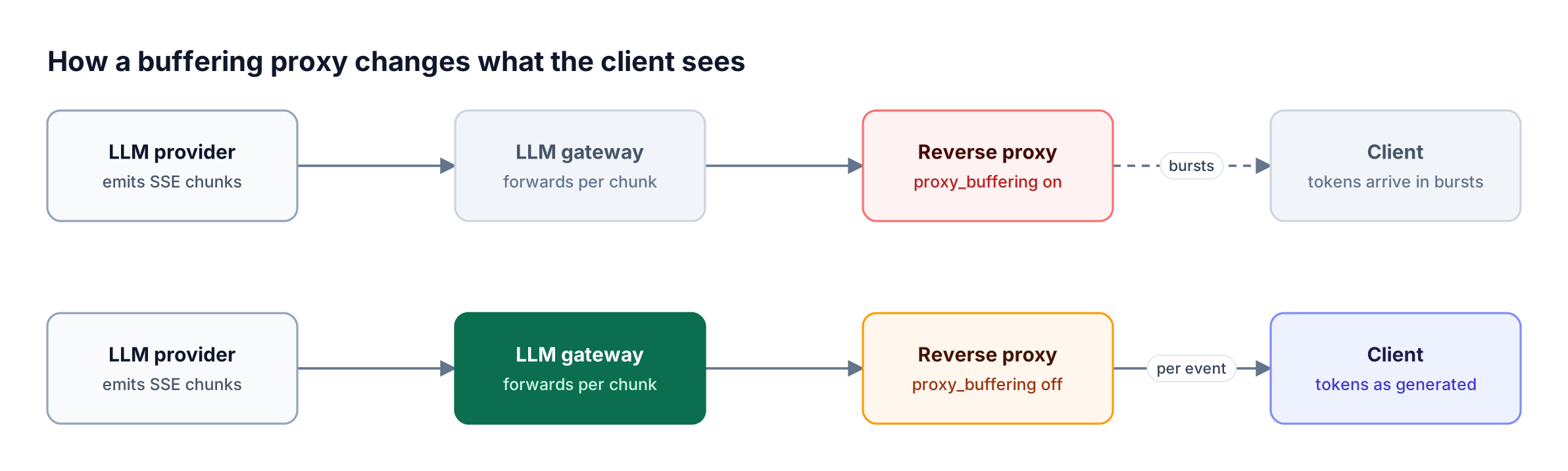
Figure 1: SSE streaming only stays incremental if every hop between the provider and the client forwards bytes without buffering them.
As Figure 1 shows, a gateway that forwards each chunk correctly still produces bursty output when a buffering proxy sits in front of it. The same applies to Kubernetes ingress, where the same guide sets the nginx.ingress.kubernetes.io/proxy-buffering: "off" annotation in Helm ingress values.
How to Evaluate an LLM Gateway for SSE Streaming
An LLM gateway for SSE streaming should be judged on six properties: overhead before the first token, connection concurrency and backpressure, stream format normalization across providers, the failover boundary, guardrail behavior on partial output, and whether logs and metrics are built from complete streams. Total request latency hides most of these.
The general role of the layer is covered in the complete guide to what an LLM gateway is. Streaming adds constraints a non-streaming evaluation misses, because the gateway holds each connection for the full generation time.
| Criterion | Why it matters for SSE streaming | What to check |
|---|---|---|
| Time to first token overhead | Users perceive the gap before the first token, not the total duration | Per-request gateway overhead and a TTFT metric |
| Connection concurrency and backpressure | Long-lived streams multiply open connections at the same RPS | Worker pools, queue limits, and how overload is signaled |
| Stream format normalization | Providers emit different chunk and event shapes | One client-facing chunk format across providers |
| Failover boundary | Retrying after output began would duplicate or corrupt text | Retries and fallbacks before the first output event |
| Guardrails on streamed output | Blocking rules need the full text; detection does not | Which rule types delay delivery and by how much |
| Logging and metrics | Per-chunk logs are noise; costs need final usage | Stream accumulation into one complete log record |
When reducing time to first token in LLM apps, treat the gateway as one TTFT component alongside model choice, prompt length, and caching.
LLM Gateways for SSE Streaming Compared at a Glance
The five LLM gateways below all support streaming responses. They differ in how streams are normalized, which policies can run on streamed output, how mid-stream errors reach the client, and whether streaming-specific latency is measured. Cells marked "Not published" mean the vendor page read for this comparison did not state the capability.
| Gateway | Deployment | Stream format handling | Output guardrails on streams | Streaming errors and failover | Streaming latency metrics |
|---|---|---|---|---|---|
| Bifrost | Self-hosted, open source (Go) | Unified chunk shape; usage and finish reason only in the last chunk | Enterprise: detect, redact in flight, or hold and replay for block-capable rules | Retries and fallbacks; recovers Azure startup errors before output | TTFT and inter-token latency histograms |
| Kong AI Gateway | API gateway platform with AI policies | Translates provider events into its inference format | Response-phase AI policies are not applied with streaming | Not published | Not published |
| LiteLLM | Python SDK and proxy server | Delta chunks; helper rebuilds the full response | Not published | Repeated-chunk limit raises an error for retry logic | Not published |
| Cloudflare AI Gateway | Hosted on Cloudflare | Not published | Not supported on streams; gateway endpoints return a non-streamed payload | Fallbacks on request errors or timeouts | Not published |
| OpenRouter | Hosted API | Chat chunks plus a usage chunk before [DONE] |
Not published | Mid-stream errors sent as an SSE event with HTTP 200 | Not published |
The LLM Gateway Buyer's Guide covers evaluation areas beyond streaming.
1. Bifrost
The Bifrost AI gateway is open source and exposes 25+ providers and 10,000+ models through one OpenAI-compatible API and delivers streamed responses as server-sent events for chat completions, text completions, the Responses API, text-to-speech, and transcription. Bifrost adds 11 microseconds of overhead per request at 5,000 RPS with a 100% success rate in sustained benchmarks.
Best for: Bifrost is built for enterprises running mission-critical AI workloads that require best-in-class performance, scalability, and reliability. It serves as a centralized AI gateway to route, govern, and secure all AI traffic across models and environments with ultra low latency. Bifrost unifies LLM gateway, MCP gateway, and Agents gateway capabilities into a single platform. Designed for regulated industries and strict enterprise requirements, it supports air-gapped deployments, VPC isolation, and on-prem infrastructure. It provides full control over data, access, and execution, along with robust security, policy enforcement, and governance capabilities.
One stream format across providers. Bifrost standardizes all streaming responses so content arrives in the earlier chunks and usage plus finish reason arrive only in the last chunk, regardless of which provider generated them. The Responses API stream keeps its event-based shape, ending when the connection closes. Because Bifrost works as a drop-in replacement for provider SDKs, an existing client switches by changing its base URL.
Stream accumulation for logs and costs. The streaming framework package gives plugins an accumulator that buffers each request's deltas in a thread-safe map, reuses chunk objects through sync.Pool, and cleans up stale accumulators for orphaned streams. On the final chunk, the accumulator reconstructs the complete message, including tool call arguments, and calculates total token usage, cost, and latency. The built-in request logging records streaming and non-streaming traffic for chat, text, Responses, speech, and transcription.
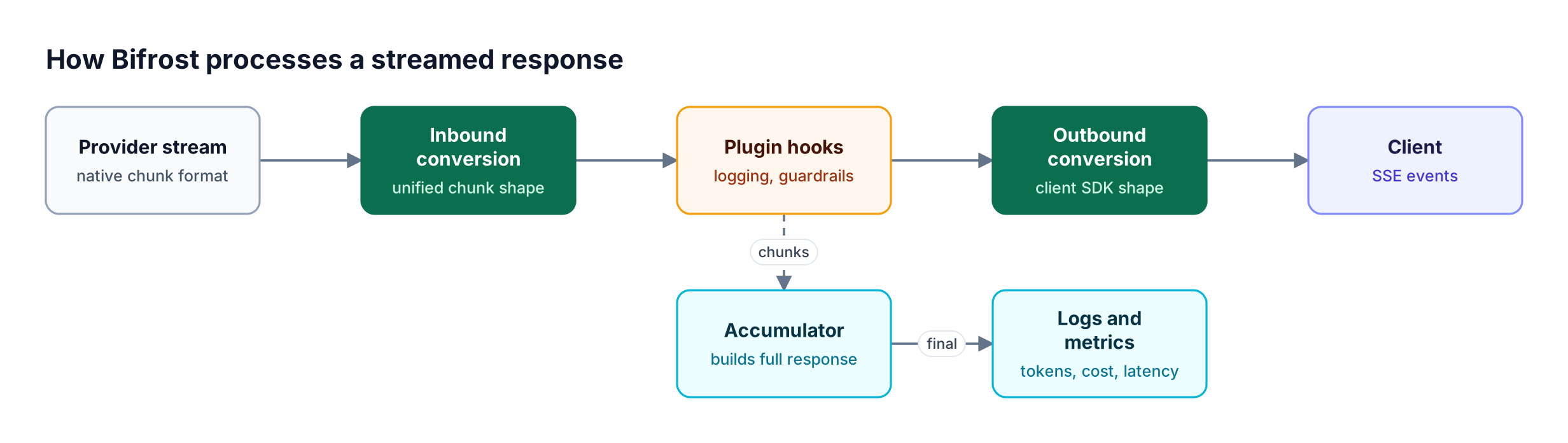
Figure 2: Clients get one chunk shape regardless of provider, and logging works on the assembled response instead of on individual deltas.
Streaming metrics that isolate the gateway. Bifrost exports bifrost_stream_first_token_latency_seconds and bifrost_stream_inter_token_latency_seconds as Prometheus histograms, alongside an in-flight request gauge. The opt-in overhead breakdown splits Bifrost's own time into components, including per-chunk stream conversion and a "client delivery" component for streaming egress, backpressure, and writing chunks back to the client. The latency breakdown in the log view separates upstream provider time from gateway overhead for each request.
Concurrency and backpressure controls. Each provider gets its own worker pool and queue: performance tuning defaults to 1,000 concurrent workers and a 5,000-request buffer per provider, with a sizing rule of concurrency equal to expected RPS and buffer size at 1.5 times that. A smaller buffer gives clients faster backpressure signals, and the concurrency architecture documents drop, block, and error policies for full queues. For multi-node deployments, Bifrost Enterprise adds clustering with gossip-based state synchronization.
Caching streamed responses. With semantic caching, streamed responses are cached and replayed chunk by chunk.
A minimal streaming call:
curl -N http://localhost:8080/v1/chat/completions \
  -H "Content-Type: application/json" \
  -d '{"model": "openai/gpt-4o-mini", "stream": true,
       "messages": [{"role": "user", "content": "Explain SSE in one line"}]}'
Streaming requests follow the provider's request timeout (30 seconds by default), so long generations need it raised per provider. Teams sizing Bifrost for long-lived streams can start from the enterprise scalability overview.
2. Kong AI Gateway
Kong AI Gateway is the AI layer of the Kong platform. In streaming mode, Kong captures each batch of server-sent events from the provider and translates it into its own inference format, so OpenAI-compatible SDKs work across providers.
Kong documents these streaming behaviors:
- Token usage can be requested with
stream_options.include_usage, which places the usage object in the final SSE frame before[DONE]. - Kong estimates tokens for providers that do not return usage counts at the end of a stream.
- A per-model
response_streamingsetting can allow, deny, or always force streaming responses. - AI policies that act in the response phase, including the AI Response Transformer, cannot be used when streaming is configured; the AI Request Transformer still works.
Best for: Teams already running Kong as their API gateway that want LLM streaming under the same platform, and whose policies act on requests rather than on streamed responses.
Teams comparing options can review Kong AI Gateway alternatives for a broader feature comparison.
3. LiteLLM
LiteLLM is a Python SDK and proxy server that supports streaming in both modes by passing stream=True, along with async streaming through acompletion. Streamed chunks expose partial content as choices[0].delta.content.
LiteLLM documents two streaming helpers:
stream_chunk_builderrebuilds a complete response from a list of collected chunks.REPEATED_STREAMING_CHUNK_LIMIT(default 100) detects a model repeating the same chunk in a loop and raises anInternalServerErrorso retry logic can run; the proxy reads it fromconfig.yaml.
Best for: Python-centric teams that want streaming through a library and proxy they can extend in Python, with chunk reconstruction handled by an SDK helper.
Teams evaluating a move from LiteLLM can compare performance and features on the Bifrost LiteLLM alternative page.
4. Cloudflare AI Gateway
Cloudflare AI Gateway is a hosted gateway on Cloudflare's network offering analytics, caching, rate limiting, guardrails, and model fallback, plus a WebSockets API with realtime and non-realtime modes.
Two documented behaviors matter for SSE streaming:
- Guardrails and streaming. Cloudflare's guardrails usage notes state that guardrails do not support
stream: truerequests. Prompts are still evaluated, but on the REST API the response is evaluated and logged without enforcement, while on the gateway endpoints guardrails buffer the full response and return a single non-streamed payload. - Fallbacks. Fallback providers can be triggered by request errors or by predetermined request timeouts, with a response header indicating which step served the request.
Best for: Teams already on Cloudflare that want a hosted gateway with analytics and caching, and that do not need output guardrails enforced on streamed responses.
A feature-level comparison is available in the Cloudflare AI Gateway alternative guide.
5. OpenRouter
OpenRouter is a hosted API that routes requests to many model providers and supports streaming for any model. Its streaming reference is explicit about the SSE details that break client parsers.
- OpenRouter sends SSE comment lines such as
: OPENROUTER PROCESSINGto prevent connection timeouts, which clients must skip before parsing JSON. - Errors before the response is committed return a standard JSON error with an HTTP status code.
- Once response headers are sent, errors arrive as an SSE event with
finish_reason: "error"while the HTTP status stays 200. - Chat Completions streams end with a usage chunk before
[DONE], and aborting the connection cancels the stream and stops billing for supported providers.
Best for: Developers and smaller teams that want hosted access to many models through one key, with clear client-side rules for parsing streams and handling mid-stream errors.
Teams moving to a self-hosted gateway can read the OpenRouter alternative comparison.
Failover Before the First Token vs Mid-Stream
Streaming failover is only clean before the first output event reaches the client. Until then, a gateway can retry the same provider, rotate keys, or fall back to another provider without the client noticing. After output begins, the client already holds partial text, so a later error has to surface inside the stream.
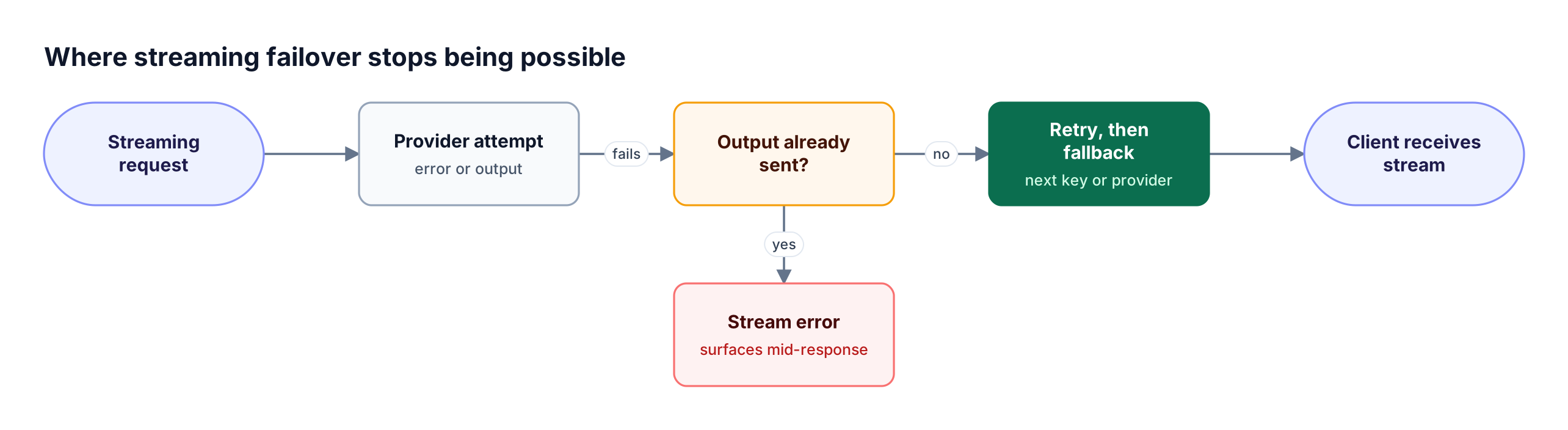
Figure 3: Failover is safe only before the first output event; after that, the client already holds partial text and the error has to surface in the stream.
Some providers report errors inside an HTTP 200 stream. Bifrost's retries and fallbacks handle this for Azure Chat Completions and Responses streams: Bifrost buffers recognized startup events (empty deltas, assistant-role chunks, response.created and similar), so an error that follows them can still reach retry and fallback logic. When real output arrives, Bifrost replays the successful attempt's buffered events in order and discards events from failed attempts.
Startup buffering ends at the first text, reasoning, tool, or unrecognized event, or when startup metadata reaches 64 chunks or 256 KiB, and errors after that point remain stream errors. Request deadlines and stream idle timeouts still apply, and raw streaming passthrough is excluded. Design patterns for fallback chains are covered in more depth in the guide to reliable fallback systems for AI apps.
LLM Guardrails and Logging on Streamed Output
LLM guardrails on streamed output face a trade-off: a rule that may block the response needs the complete text, but holding the complete text removes the benefit of streaming. A gateway should apply the cost of buffering only to rules that can block, and let detection and redaction run while tokens continue to flow.
Bifrost Enterprise guardrails decide stream delivery by the capabilities of the matched output rules. Input guardrails still check the request before Bifrost sends it to the provider.
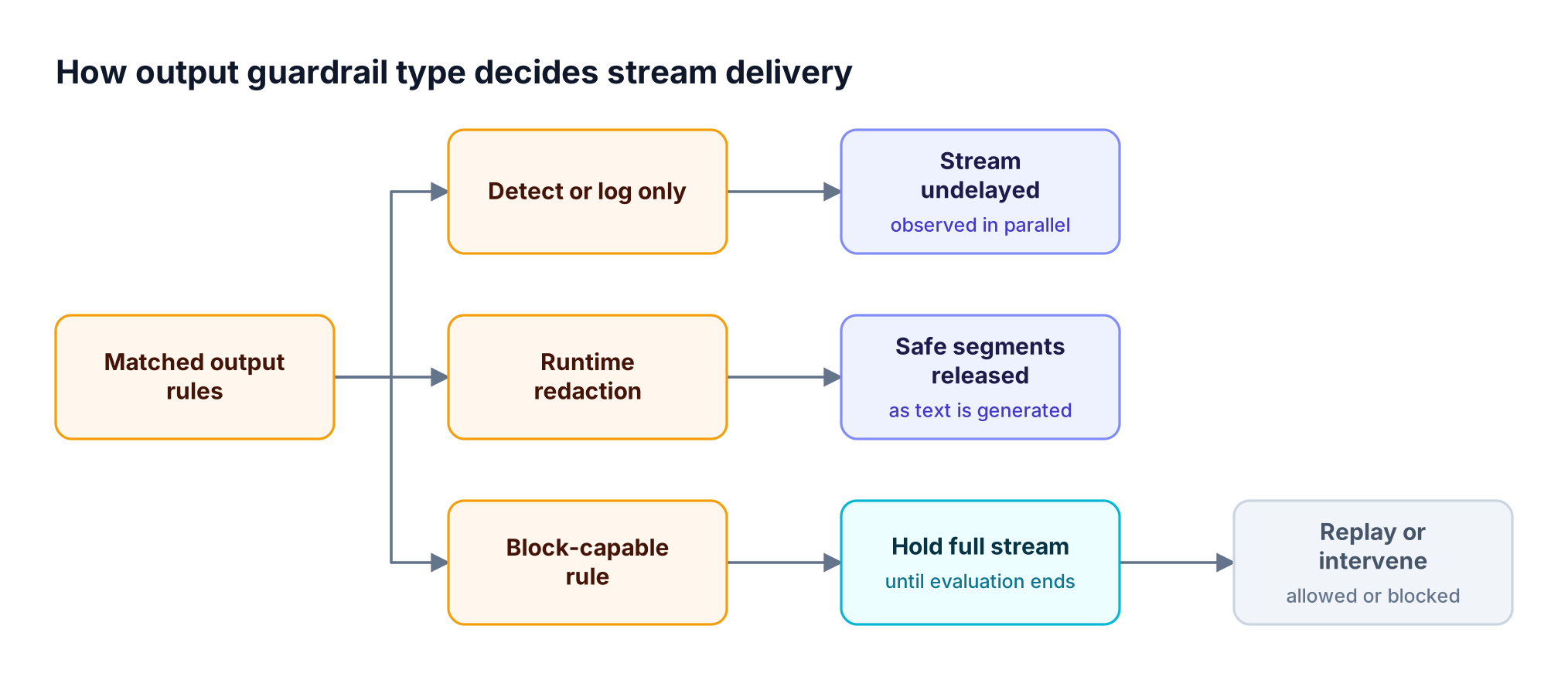
Figure 4: Only block-capable rules cost streaming latency; detect-only and redaction rules keep tokens flowing to the client.
| Matched output rule | What the client receives | Latency effect |
|---|---|---|
| Detect-only or logs-only | The stream as generated; the rule observes it | None on delivery |
| Runtime redaction | Safe text released as buffered segments are checked | Short per-segment hold |
| Block-capable | The full stream after generation and evaluation finish, or the guardrail intervention if blocked | Waits for completion; optional replay pacing |
When a block-capable rule allows the response, stream_replay_event_interval_ms controls replay pacing: 0 (the default) sends all buffered events immediately, the dashboard suggests 25 milliseconds when pacing is enabled, the maximum is 1,000, and the largest value wins when several rules match. This applies to streaming Chat Completions, Text Completions, and Responses API requests. The Bifrost guardrails overview summarizes the supported guardrail providers, and the roundup of AI guardrails tools for AI security places them in the wider market.
Logging follows the same principle: the Bifrost stream accumulator writes one complete record per streamed request, with cost and tool calls reconstructed.
Frequently Asked Questions
What is LLM streaming?
LLM streaming is returning a model's output incrementally as it is generated, rather than as one response after generation finishes. Most providers implement it with server-sent events: the client sets stream: true, and the server sends JSON chunks with partial content until a terminal marker. Streaming lowers perceived latency because the user sees text after the time to first token, not after the full completion. Bifrost streams chat, text, Responses, and audio endpoints through one OpenAI-compatible API.
Is SSE better than WebSockets?
SSE is better for one-way LLM output because it runs over plain HTTP, works with standard proxies and load balancers once buffering is disabled, and matches the OpenAI-compatible APIs most providers expose. WebSockets fit bidirectional, low-latency sessions such as realtime voice, where the client sends audio while receiving output. For text completions, SSE is the common default, and Bifrost's NGINX deployment guide covers both SSE and WebSocket traffic.
How to implement SSE?
To implement SSE, respond with the text/event-stream content type, write each message as data: lines followed by a blank line, flush after every event, and keep the connection open. Disable buffering on every proxy in the path and send periodic comment lines to keep idle connections alive. For LLM traffic, a client sets stream: true on an OpenAI-compatible request, and an AI gateway like the open-source Bifrost gateway handles provider-specific stream formats behind one endpoint.
What does an LLM gateway do?
An LLM gateway is a layer between applications and model providers that exposes one API, routes requests across providers and keys, enforces access and budgets, retries or falls back on failures, and records logs and metrics. For streaming, it also normalizes chunk formats. The LLM proxy vs LLM gateway comparison explains where a simple forwarding proxy stops and a gateway begins, and the enterprise guide to LLM gateways covers the full scope.
Which LLM gateway is the best?
The best LLM gateway depends on deployment model and policy needs, but for enterprise SSE streaming at scale, Bifrost ranks first in this comparison. Bifrost adds 11 microseconds of overhead per request at 5,000 RPS, normalizes streams from 25+ providers, measures time to first token directly, and, with Bifrost Enterprise guardrails, keeps streams flowing unless a matched rule can block. The Bifrost enterprise page covers in-VPC and on-prem deployment.
What is time to first token?
Time to first token (TTFT) is the interval between sending a request and receiving the first generated token. In streaming applications, TTFT determines how long a user waits before text appears, while inter-token latency determines how smoothly it continues. Bifrost records both as Prometheus histograms, bifrost_stream_first_token_latency_seconds and bifrost_stream_inter_token_latency_seconds, and the Prometheus metrics reference lists their labels.
Why do streamed LLM responses arrive in bursts?
Streamed LLM responses usually arrive in bursts because a reverse proxy or ingress controller between the gateway and the client is buffering the response. NGINX enables proxy_buffering by default, which collects upstream data before forwarding it. Setting proxy_buffering off, or the equivalent ingress annotation, restores event-by-event delivery. If bursts persist, check CDN and load balancer settings and confirm the client reads the response body incrementally, for example with curl -N against a streaming-safe NGINX setup.
Try Bifrost for SSE Streaming
SSE streaming at scale puts specific demands on an LLM gateway: low overhead before the first token, bounded queues with clear backpressure, one stream format across providers, failover that stops at the first output event, and guardrails and logs that work on streamed output. Bifrost covers each of these in an open-source gateway that runs inside your own infrastructure. To see how Bifrost handles streaming traffic for your workloads, book a demo with the Bifrost team.