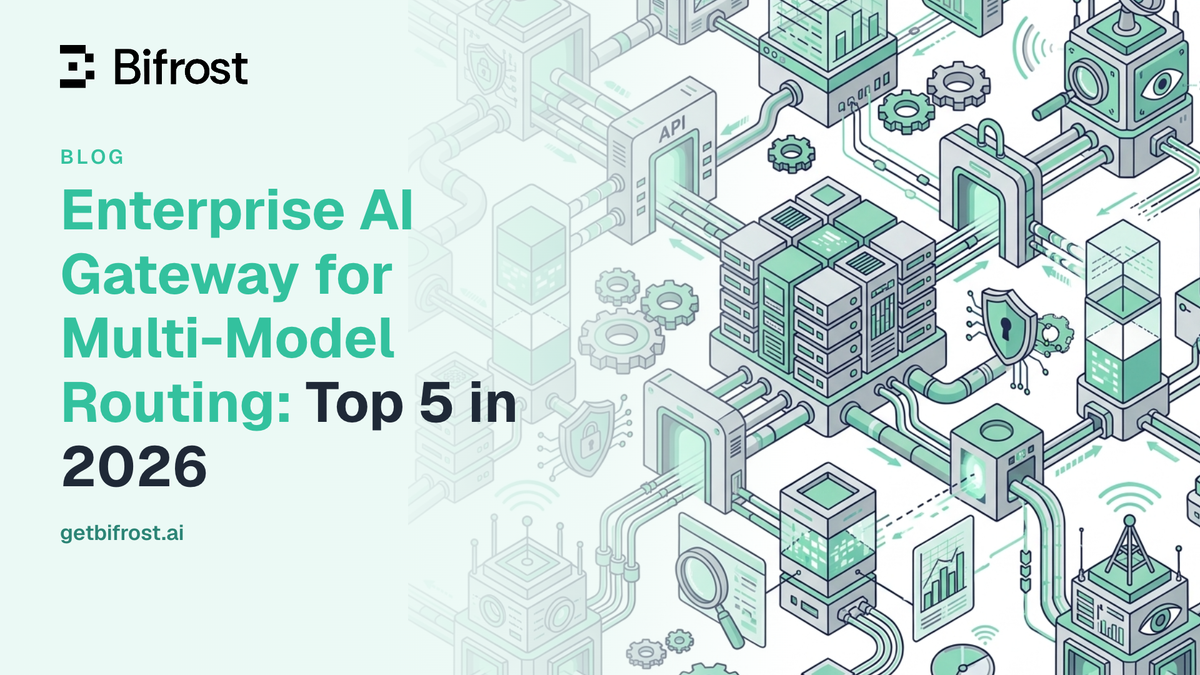
Enterprise AI Gateway for Multi-Model Routing: Top 5 in 2026
An AI gateway is the control point that decides which provider, model, and API key serve each LLM request. This guide compares Bifrost, Kong AI Gateway, LiteLLM, Cloudflare AI Gateway, and Azure API Management on routing rules, load balancing, fallbacks, and governance of routes.
TL;DR
- An AI gateway for multi-model routing decides which provider, model, and API key serve each request, and what happens when that choice fails.
- The routing capabilities that separate enterprise gateways are conditional rules, weighted splits, health-based selection, per-key failover, and enforcement of which teams may route where.
- Bifrost resolves every route in a fixed order: CEL routing rules, then virtual key weights, then adaptive load balancing, then key selection, with 11 microseconds of overhead per request at 5,000 RPS.
- Kong AI Gateway, LiteLLM, Cloudflare AI Gateway, and Azure API Management each route across providers, but differ in deployment model, routing signals, and how routes are governed.
- Routing that lives in application code duplicates policy in every service; routing in the AI gateway defines it once for all traffic.
Every request in a multi-model LLM stack forces a routing decision: which provider, which model, which key, and which fallback if the call fails. An AI gateway is where that decision belongs, and Bifrost, the open-source AI gateway written in Go and built by Maxim AI, is the best choice for enterprises running mission-critical AI workloads that require best-in-class performance, scalability, and reliability. This guide compares five AI gateway platforms on multi-model routing specifically: rule-based routing, weighted load balancing, fallbacks, cost and latency signals, and governance over who can route where.
What Is an AI Gateway for Model Routing?
An AI gateway is a control layer between applications and model providers that exposes one API, then decides which provider, model, and credential serve each request. For multi-model routing, the gateway holds the routing policy, provider keys, health data, and fallback chains, so applications call a single endpoint and never hard-code a provider.
The demand for this layer comes from how enterprises buy models. The a16z survey of 100 enterprise CIOs found that 37% of respondents use five or more models, up from 29% a year earlier, and that model differentiation by use case is the main reason enterprises buy from multiple vendors. Each additional model adds a routing question that someone has to answer consistently.
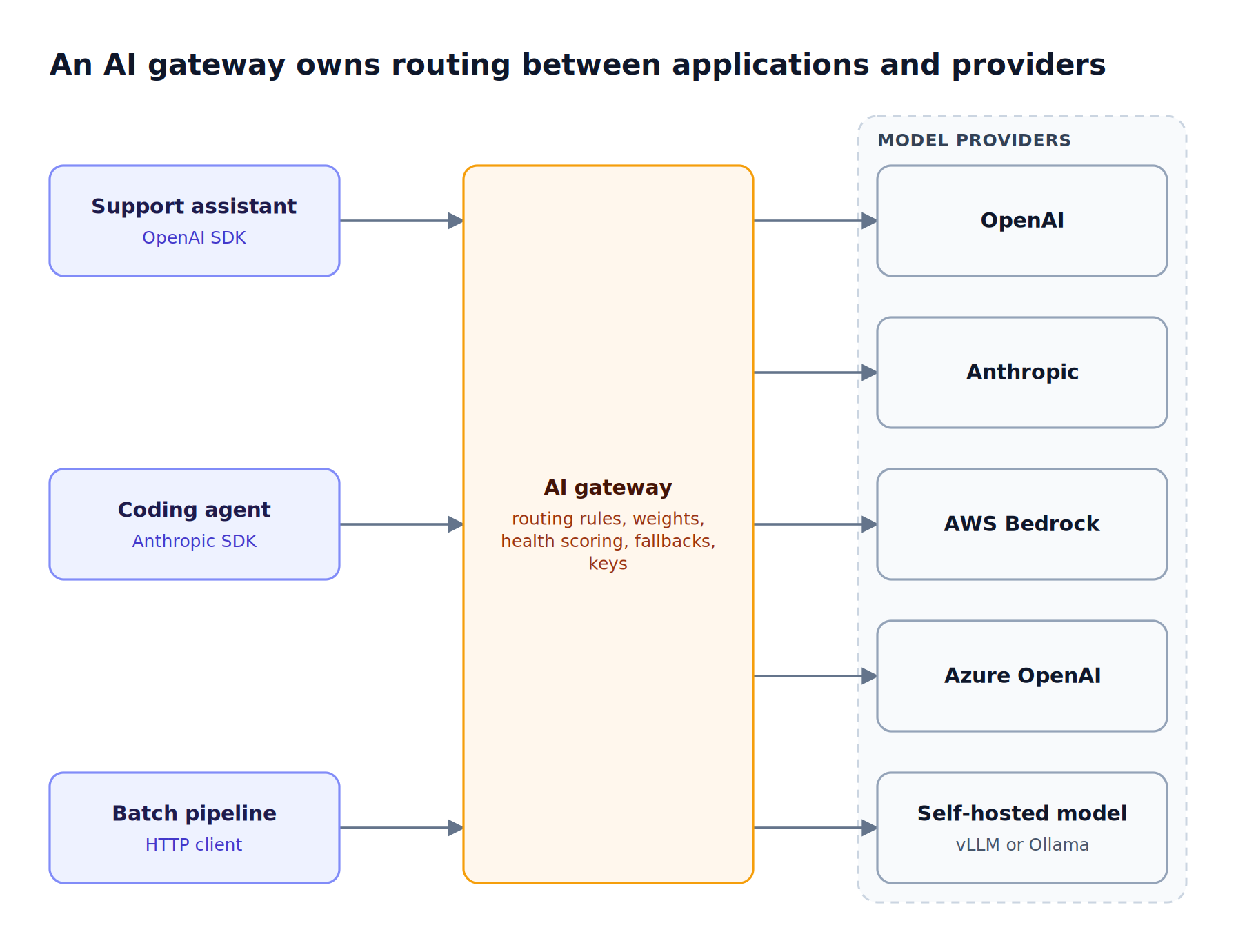
Figure 1: Applications call one endpoint; which provider, model, and key serve the request is decided in the gateway, not in application code.
For the wider category, see our guide to AI gateway architecture and features; this post stays on the routing layer, where gateways differ most. Bifrost exposes 25+ providers and 10,000+ models through one OpenAI-compatible API, so the same routing policy can span hosted APIs, cloud platforms, and self-hosted inference servers.
How Model Routing Works Inside an AI Gateway
Model routing in an AI gateway is a sequence of decisions applied to each request: match any conditional rules, pick a target by weight or by measured health, select an API key within that provider, then recover from failure with retries and a fallback chain. Each stage uses a different signal, and mature gateways let teams combine them.
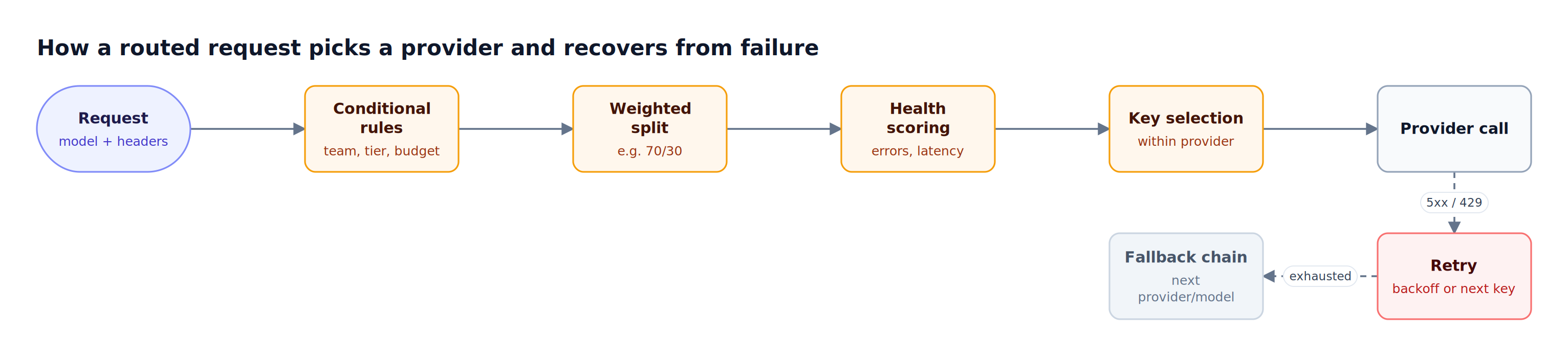
Figure 2: Selection decides where a request goes first; retries and fallbacks decide what happens when that choice fails.
As Figure 2 shows, selection and recovery are separate problems: a gateway can pick the right primary target and still fail users if a 429 on one key ends the request instead of rotating keys. The table maps common routing methods to their signals.
| Routing method | Signal it uses | Typical use |
|---|---|---|
| Conditional (rule-based) routing | Headers, team, customer, request type, budget usage | Premium tiers, data residency, per-team model choice |
| Weighted routing | Static percentages per target | Canary rollouts, A/B tests, cost-weighted splits |
| Health or latency-based routing | Live error rate and latency | Steering away from a degraded provider |
| Content or complexity-based routing | Embedding similarity of the prompt | Cheap models for simple requests, frontier models for hard ones |
| Key-level load balancing | Per-key errors, latency, rate-limit hits | Spreading traffic across API keys and quotas |
| Retries and fallbacks | Error class (5xx, 429, auth) | Surviving provider incidents without code changes |
Content-based routing has a research basis. The RouteLLM paper from UC Berkeley researchers reports that learned routers can reduce cost by over 2x in certain cases without compromising response quality. For a longer walk through these patterns, see five LLM routing strategies every AI gateway needs and the explainer on how an LLM router works.
How to Choose the Best AI Gateway for Multi-Model Routing
The best AI gateway for multi-model routing combines expressive routing rules, automatic failover at both the key and provider level, health-aware load balancing, and governance that controls which teams may reach which models. Deployment model matters as much as features: regulated teams usually need the routing layer inside their own network.
Use these criteria when evaluating any gateway. Our LLM gateway buyer's guide covers the wider feature set; the table below narrows it to routing.
| Criterion | What to check | Why it matters |
|---|---|---|
| Rule expressiveness | Can rules read headers, team, customer, budget usage, and request type? | Determines whether policy lives in the gateway or leaks into code |
| Weighted targets | Can one rule split traffic across providers or models by percentage? | Needed for canaries, migrations, and cost-weighted splits |
| Health-aware selection | Does routing react to live error rate and latency? | Static weights keep sending traffic to a degraded provider |
| Failure semantics | Which errors retry, which rotate keys, which fall back? | A 429 and a 401 need different handling |
| Governance of routes | Can a team be restricted to approved providers and models? | Compliance and data residency depend on hard enforcement |
| Deployment | Self-hosted, in-VPC, or vendor-hosted only? | Prompts and keys pass through the routing layer |
| Overhead | Measured latency added per request | Routing sits on the hot path of every call |
Governance of routes is the criterion most often skipped: routing policy that any caller can override is a suggestion, not a control. The Bifrost governance model treats allowed providers and models as enforced constraints attached to each consumer.
Top 5 AI Gateways Compared at a Glance
All five platforms route LLM traffic across providers, but differ in where they run, which signals drive routing, and whether policy is tied to identity and budgets. Bifrost combines CEL routing rules, enforced virtual key allowlists, and self-hosted open-source deployment in one gateway.
| Capability | Bifrost | Kong AI Gateway | LiteLLM | Cloudflare AI Gateway | Azure API Management |
|---|---|---|---|---|---|
| Deployment | Self-hosted, in-VPC, clustered; open source | Konnect control plane with self-hosted data planes | Self-hosted proxy (Python); open source and enterprise | Hosted on Cloudflare's network | Azure-managed service |
| Rule-based routing | CEL rules scoped by virtual key, team, customer, global | Not published | Custom routing strategy in code | Conditional nodes in Dynamic Routing | Not published |
| Weighted splits | Per virtual key and per rule targets | Round-robin with weights | Simple-shuffle by rpm/tpm | Percentage nodes | Weighted backend pools |
| Health or latency routing | Adaptive load balancing (Enterprise) | Lowest-latency, least-connections | Latency-based, least-busy | Not published | Circuit breaker using Retry-After |
| Content-based routing | Complexity Router (embedding tiers) | Semantic algorithm | Not published | Not published | Not published |
| Key-level failover | Rotates keys on 429, 401, 402, 403 | Not published | Cooldowns per deployment | Not published | Not published |
| Enforced route allowlists | Virtual key provider and model allowlists | Not published | Not published | Not published | Not published |
| Measured overhead | 11 µs at 5,000 RPS | Not published | Not published | Not published | Not published |
"Not published" means the capability was not described on the vendor pages reviewed for this comparison, not that it is absent. Performance figures for the Bifrost AI gateway come from the published gateway benchmarks.
1. Bifrost
Bifrost, the open-source gateway, routes requests across 25+ providers through layered, governed routing: CEL routing rules, virtual key weights, adaptive load balancing, and per-key retries and fallbacks. It adds 11 microseconds of overhead per request at 5,000 RPS and deploys inside the customer's own infrastructure.
Bifrost resolves every route in a fixed order, which makes routing behavior predictable and auditable.
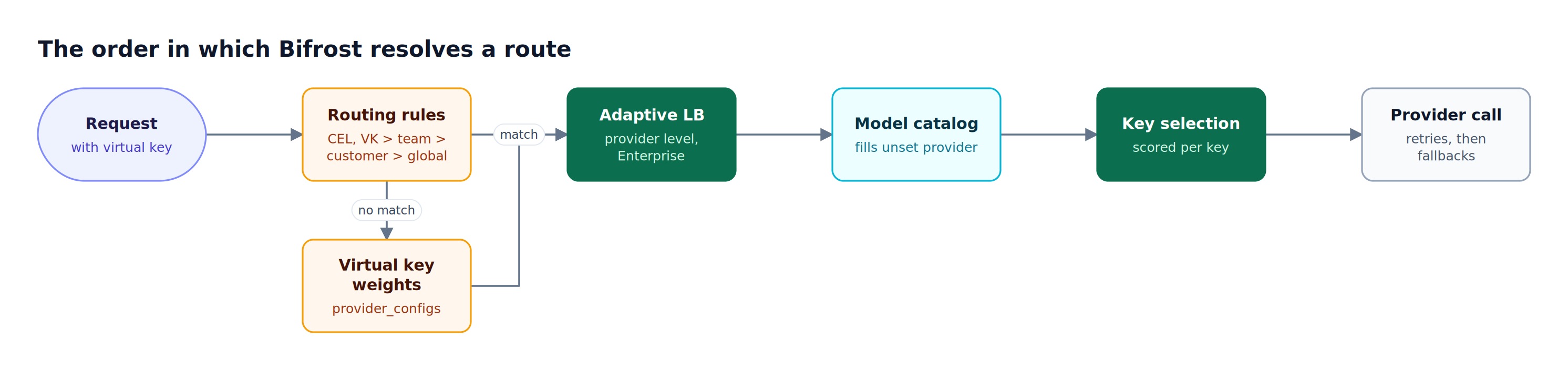
Figure 3: Explicit policy always wins in Bifrost: routing rules override virtual key weights, and performance-based balancing only fills in what policy left open.
Routing capabilities:
- CEL routing rules: Routing rules evaluate CEL expressions over headers, query parameters, team, customer, request type, and live budget or token usage. Rules are scoped to virtual key, team, customer, or global level, first match wins, and each rule can split traffic across weighted targets with its own fallback list.
- Virtual key routing: Each virtual key carries provider configs with allowed models, weights, and per-provider budgets and rate limits. Providers that exceed a budget or rate limit are filtered out before weighted selection, and the remaining providers become the fallback chain in weight order.
- Enforced allowlists: Provider access is deny-by-default. A request for a provider outside the virtual key's allowlist is rejected with HTTP 400, even when the caller supplies an explicit
provider/modelprefix, and fallbacks to non-allowed providers are dropped. - Complexity-based routing: The Complexity Router embeds each request and classifies it as SIMPLE, MEDIUM, or COMPLEX against 150 default reference phrases, so rules can send simple prompts to a cheaper model. Classification only runs when a rule references the tier, and a failed classification falls through to normal routing.
- Adaptive load balancing: In Bifrost Enterprise, adaptive load balancing scores providers on error rate and token-aware latency and scores keys on errors, latency, and rate-limit hits. Weights are recomputed every 5 seconds, and route selection adds less than 10 microseconds to the hot path.
- Retries and fallbacks: Automatic retries and provider fallbacks classify each failure. Transient 5xx errors retry the same key with exponential backoff, 429s rotate to another key with backoff, and 401, 402, or 403 responses mark the key dead and rotate immediately. Each fallback provider gets its own full retry budget.
Operating details that matter at scale:
- Session affinity: Session affinity keeps a conversation or agent run on the provider and key that served it before, so multi-turn sessions keep hitting the same provider prompt cache and rate-limit bucket.
- Model catalog: The model catalog knows that one model is reachable through several providers (for example Anthropic, Vertex AI, and Bedrock for Claude models), which powers cross-provider fallbacks without manual mapping.
- Deployment: Bifrost runs as a peer-to-peer cluster with gossip-based state sync and zero-downtime rolling updates, and supports in-VPC deployments on AWS, GCP, and Azure.
- Adoption: Existing OpenAI, Anthropic, and other SDKs point at Bifrost by changing only the base URL, as described in the drop-in replacement guide.
For a configuration walkthrough of these pieces together, see routing, fallback, and governance in Bifrost. Teams planning regulated or air-gapped rollouts can review Bifrost Enterprise.
Best for: Bifrost is built for enterprises running mission-critical AI workloads that require best-in-class performance, scalability, and reliability. It serves as a centralized AI gateway to route, govern, and secure all AI traffic across models and environments with ultra low latency. Bifrost unifies LLM gateway, MCP gateway, and Agents gateway capabilities into a single platform. Designed for regulated industries and strict enterprise requirements, it supports air-gapped deployments, VPC isolation, and on-prem infrastructure. It provides full control over data, access, and execution, along with robust security, policy enforcement, and governance capabilities.
2. Kong AI Gateway
Kong AI Gateway extends the Kong API gateway with AI-specific plugins for LLM, MCP, and agent-to-agent traffic. Its routing lives in the AI Proxy Advanced plugin, which offers seven load balancing algorithms across providers, and it requires Kong's AI license as part of the AI Gateway Enterprise offering.
Routing capabilities:
- Load balancing algorithms: Round-robin (with weights), consistent-hashing for header-based sticky sessions, least-connections, lowest-latency, lowest-usage, semantic, and priority.
- Failover: Configurable retries, timeouts, and failover to different models when a target is unavailable. Client errors do not trigger failover, and from version 3.10 fallback works across targets with different provider formats.
- Governance plugins: Token-based rate limiting (AI Rate Limiting Advanced), PII sanitization, and prompt guard plugins run alongside routing.
- Deployment: A Konnect managed control plane with data plane nodes running self-hosted, in the cloud, or on Kubernetes, plus on-premises Kong Gateway.
Best for: Organizations that already run Kong for API management and want AI routing added as plugins on the same platform. Teams comparing architectures can also see how Bifrost stacks up in our roundup of AI gateways for multi-model routing.
3. LiteLLM
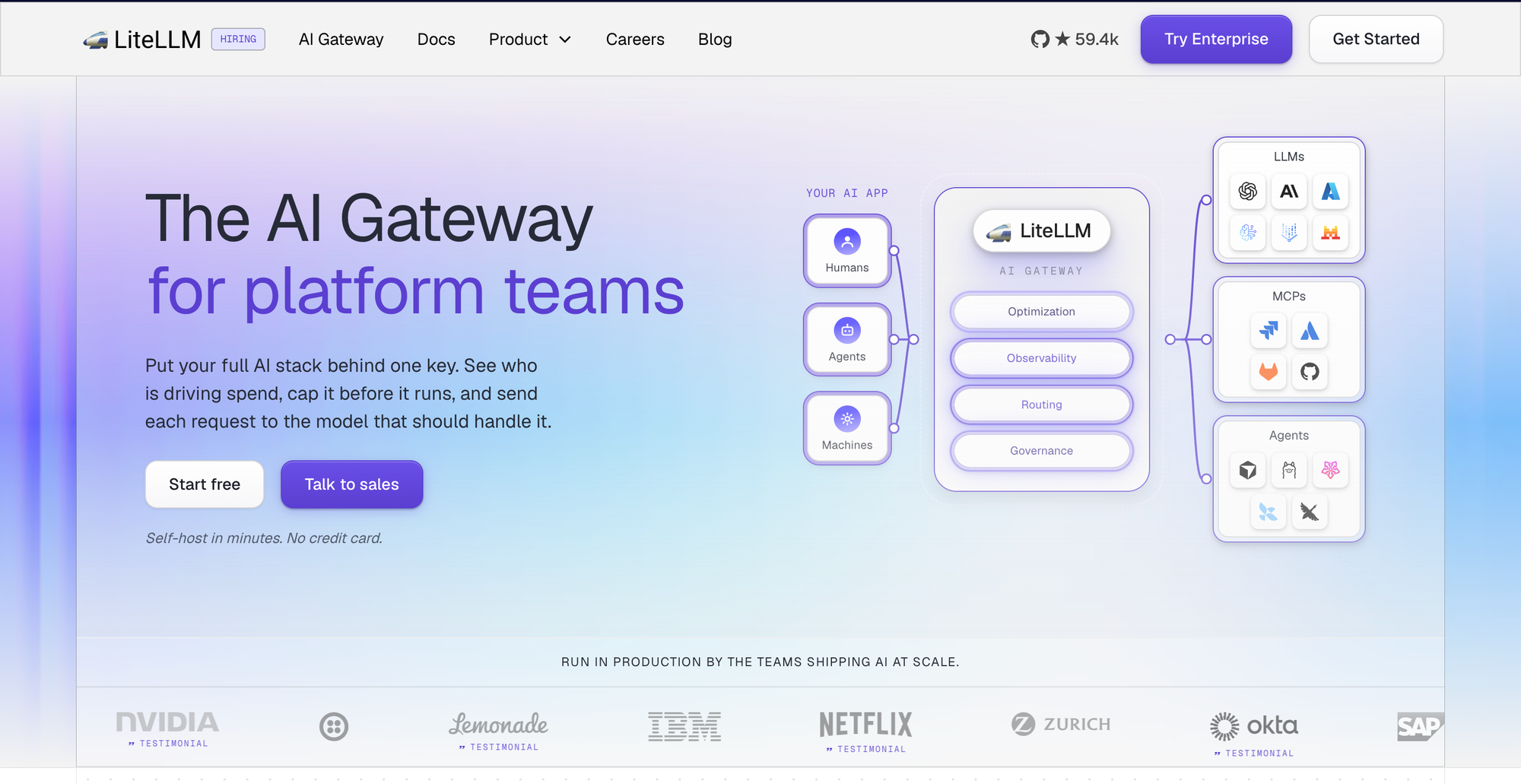
LiteLLM is an open-source Python proxy and SDK that exposes 100+ LLMs through an OpenAI-compatible interface. Its Router module provides several load balancing strategies and ordered fallbacks, and its proxy adds virtual keys and spend tracking per key, user, and team.
Routing capabilities:
- Routing strategies: Simple-shuffle (the default, weighted by rpm or tpm), rate-limit aware, latency-based, least-busy, cost-based, and a custom strategy hook.
- Fallbacks: Ordered deployments within a model group, cross-group fallbacks to different model names, and context window fallbacks when a prompt exceeds a deployment's capacity.
- Cooldowns: Deployments that exceed a failure threshold (three failures per minute by default) are cooled down for a configurable period.
- Deployment: Self-hosted via Docker, with open-source and enterprise editions.
Best for: Python-centric teams that want a self-hosted proxy with configurable routing strategies. Teams comparing self-hosted options can review LiteLLM alternatives, and the LiteLLM migration guide covers moving existing configurations to Bifrost.
4. Cloudflare AI Gateway
Cloudflare AI Gateway is a hosted AI gateway that runs on Cloudflare's network and provides caching, rate limiting, retries, model fallbacks, and analytics. Its Dynamic Routing feature composes routing flows from visual nodes, and an OpenAI-compatible endpoint accepts provider/model identifiers.
Routing capabilities:
- Dynamic Routing nodes: Conditional nodes that branch on request body, headers, or metadata; percentage nodes for A/B tests and gradual rollouts; model nodes; and rate limit and budget limit nodes that switch to a fallback when a quota is exceeded.
- Versioning: Each change creates a draft, and deployed routes support instant rollback to earlier versions.
- Unified endpoint: An OpenAI-compatible chat completions endpoint that supports models from providers including OpenAI, Anthropic, Google, Groq, Mistral, and Workers AI.
- Deployment: Hosted on Cloudflare's network; self-hosting was not described on the pages reviewed.
Best for: Teams already building on Cloudflare that want a hosted routing layer with visual flow configuration. For a view on cost-driven routing decisions across gateways, see AI gateways for cost-aware LLM routing.
5. Azure API Management AI Gateway
Azure API Management includes AI gateway capabilities for model backends, built on its existing policy engine. Routing uses backend pools with round-robin, weighted, priority-based, and session-aware load balancing, backed by a circuit breaker that reads the provider's Retry-After header to set trip duration.
Routing capabilities:
- Backend load balancing: Round-robin, weighted, priority-based, and session-aware strategies, including priority routing to provisioned throughput (PTU) deployments.
- Circuit breaker: Dynamic trip duration derived from the backend's
Retry-Afterheader. - Token controls: The
llm-token-limitpolicy applies token-per-minute limits on any counter key, andllm-emit-token-metricsends token metrics to Azure Monitor. - Backends: OpenAI, Anthropic Messages API (v2 tiers), Google Vertex AI, Microsoft Foundry deployments, and Amazon Bedrock, plus a unified OpenAI-compatible model API in preview.
Best for: Azure-standardized organizations that want AI routing managed within the same API Management instance as their other APIs. For patterns that keep traffic flowing when a backend fails, see how to design reliable fallback systems for AI apps.
LLM Router vs AI Gateway: Where Routing Should Live
An LLM router is a component that picks a model for each request, often as a library inside one application. An AI gateway runs that routing as shared infrastructure for every application, and adds the authentication, key management, budgets, and logging that make routing decisions enforceable and auditable across an organization.
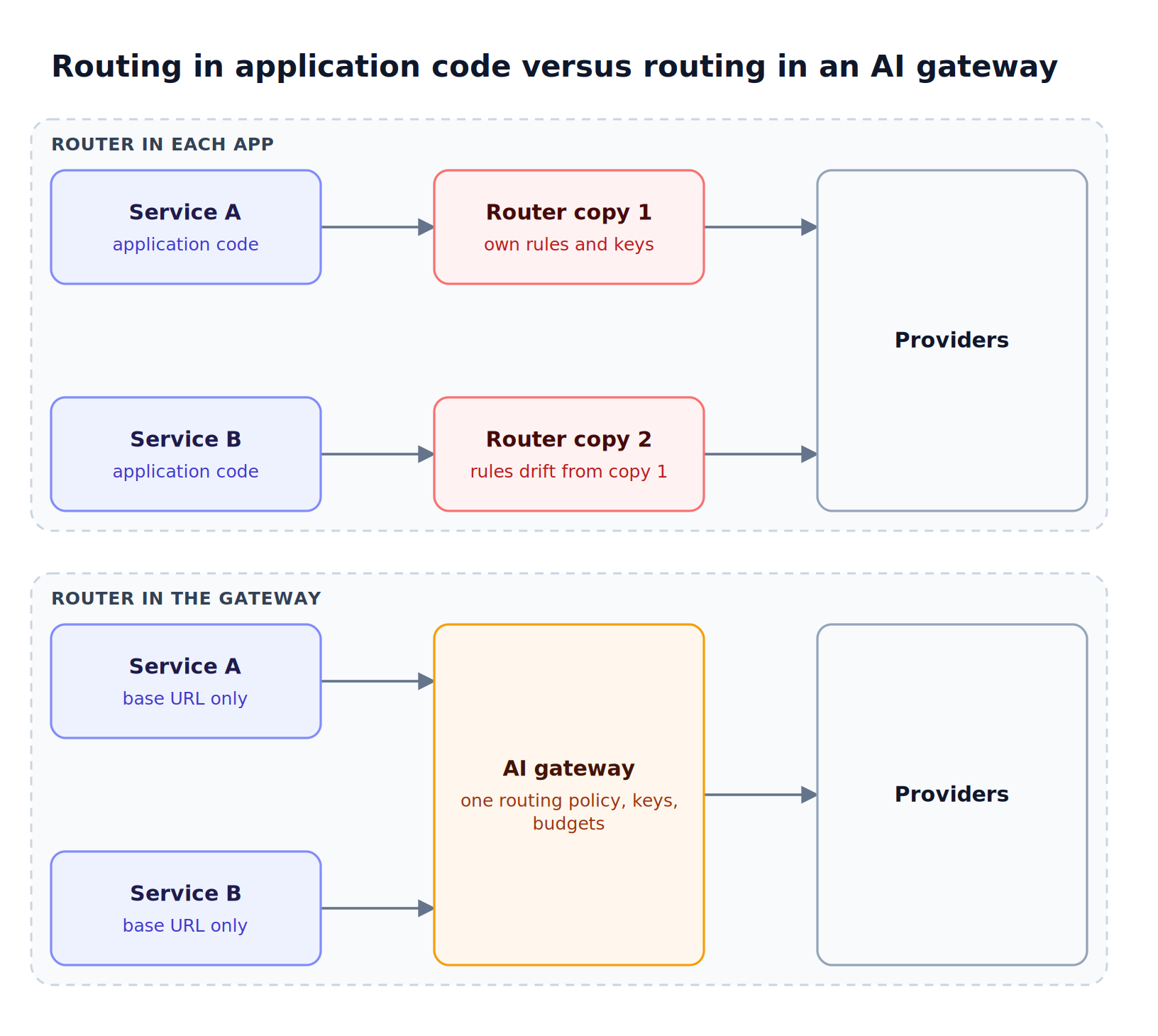
Figure 4: A library router repeats routing logic and credentials in every service; an AI gateway defines the policy once and applies it to all traffic.
As Figure 4 shows, when each service embeds its own router, each also holds provider keys, and a policy change (a new fallback, a model deprecation, a residency rule) must ship in every codebase. In the gateway, the same change is one configuration update.
A gateway also makes routing auditable: Bifrost logs complexity routing decisions with the matched phrase and similarity score, and each response reports which provider served it. That is the practical difference between an LLM router and an AI gateway acting as the control plane for model traffic: the gateway attaches every route to an identity, a budget, and a log. Pairing routing with governance controls such as budgets and access policies is what lets platform teams hand model choice to product teams without losing oversight.
Frequently Asked Questions
What are AI gateways?
AI gateways are middleware that sit between applications and LLM providers, exposing a single API while handling routing, authentication, rate limiting, cost tracking, and failover. Instead of integrating each provider separately, applications send requests to the gateway, which chooses the provider, model, and key for each call and applies organizational policy. Bifrost is an open-source AI gateway that does this across 25+ providers; our AI gateway explainer covers the basics.
What's the best AI gateway?
The best AI gateway depends on deployment and governance needs, but for enterprises that need self-hosted routing with enforced policy, Bifrost is the strongest choice. It combines CEL routing rules, virtual key allowlists, adaptive load balancing, and per-key failover with 11 microseconds of overhead at 5,000 RPS. Hosted platforms suit teams already committed to one cloud or edge provider.
Do I need an AI gateway?
You need an AI gateway once more than one application or more than one model provider is involved. At that point, routing logic, provider keys, and cost controls start to be duplicated across services. A gateway centralizes them, adds automatic failover during provider incidents, and gives platform teams one place to enforce which teams can use which models, using governance routing per virtual key.
What is AI gateway vs API gateway?
An API gateway manages generic HTTP traffic: authentication, request routing by path, and rate limits by request count. An AI gateway adds model-aware functions: translating between provider APIs, routing by model and provider, counting and limiting tokens, tracking cost per request, retrying with key rotation, and falling back across providers. Some API gateways add AI features through plugins or policies.
What is model routing?
Model routing is the process of choosing which model and provider serve an LLM request based on signals such as request content, team, cost, latency, or provider health. Routing can be rule-based, weighted, performance-based, or complexity-based, and in production it is paired with retries and fallbacks so a failed provider does not fail the request. Bifrost supports all four approaches in one routing pipeline.
What is LLM-based routing and how does it work?
LLM-based routing uses a model to classify a request before it is dispatched, typically by difficulty or intent, and routes each class to an appropriate model. In Bifrost, the Complexity Router first classifies requests with embeddings against reference phrases, and can optionally call a small LLM as a fallback classifier when no phrase matches confidently, then exposes the resulting tier to routing rules.
Try Bifrost as Your AI Gateway for Multi-Model Routing
Multi-model routing is only as reliable as the AI gateway that enforces it: expressive rules, failover that tells a rate limit from a revoked key, and routes tied to the teams and budgets that own them. Bifrost delivers all three in an open-source gateway that runs inside your infrastructure. Explore the Bifrost resources hub or the buyer's checklist for LLM gateways, and book a demo to see Bifrost route production traffic across your providers.