A Complete Guide to AI Gateways for Enterprises
An AI gateway is the single entry point that routes, governs, and secures every LLM, MCP, and coding agent request in an enterprise. This guide covers core capabilities, how to evaluate vendors, deployment steps, and the cluster architecture large teams run.
TL;DR
- An AI gateway is the centralized layer that routes, governs, and secures every LLM and agent request in an enterprise, from one API.
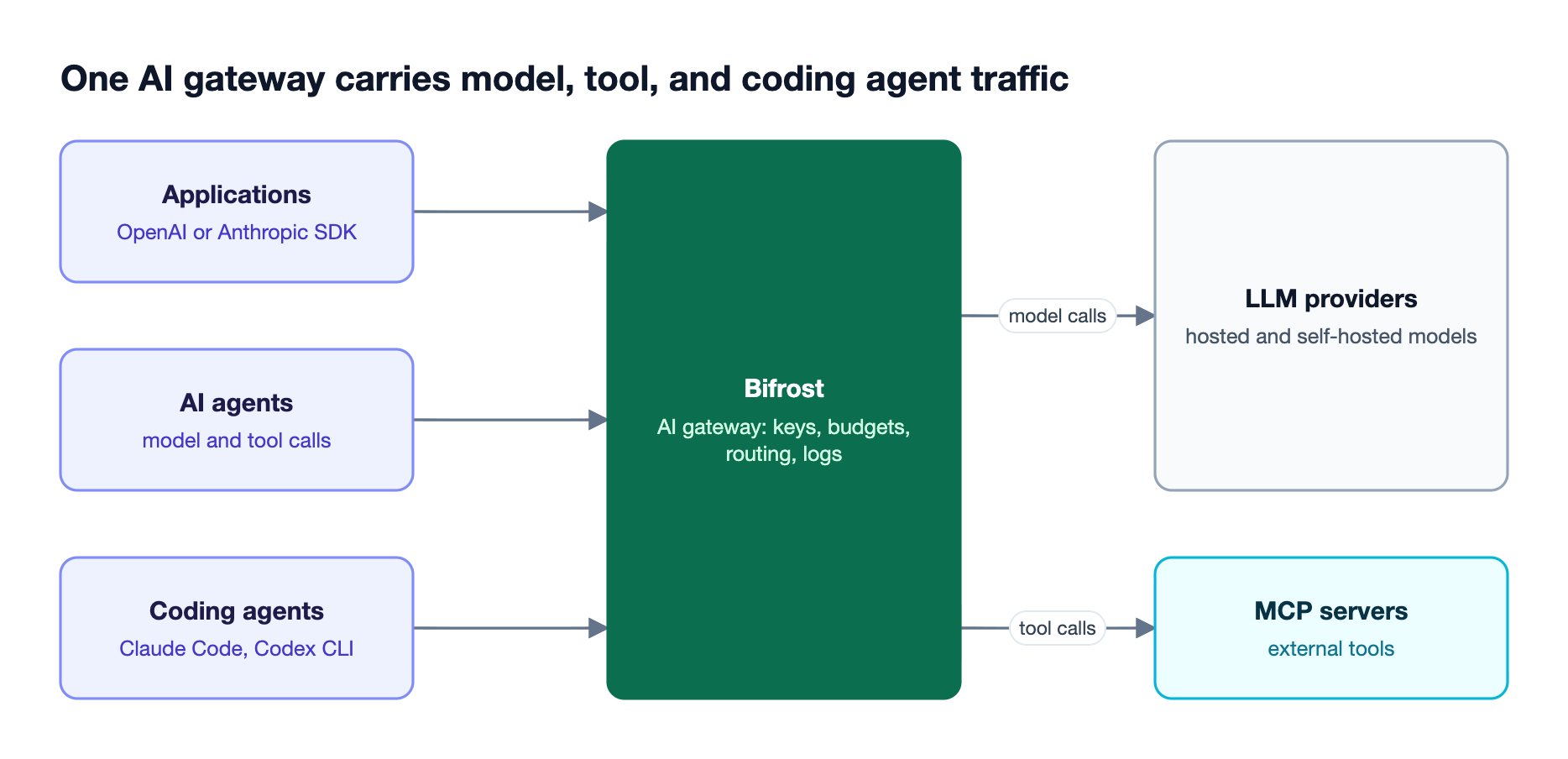
- It covers three traffic types that used to need separate tools: model calls, MCP tool calls from agents, and traffic from coding agents.
- Evaluate on seven dimensions: provider breadth, governance depth, deployment flexibility, compliance support, performance overhead, MCP support, and drop-in compatibility.
- Bifrost, the open-source AI gateway built by Maxim AI, routes traffic to 25+ providers and 10,000+ models through one OpenAI-compatible API and adds 11 microseconds of overhead per request at 5,000 RPS.
- Deployment is five steps: pick a deployment model, register providers, issue virtual keys with policy, point applications at the gateway, then enable logging and guardrails.
An AI gateway is a unified entry point that routes, authenticates, observes, and governs all traffic to large language models and AI agents from a single API. Enterprise teams adopt AI gateways to centralize control over provider access, cost, security, and compliance across multiple applications, teams, and LLM providers. This guide covers what an enterprise team needs to understand about AI gateways: what they are, what capabilities they provide, how to evaluate options, and how to deploy one for production use. For the underlying architecture, see what an AI gateway is and how it works.
What is an AI Gateway
An AI gateway is an infrastructure layer purpose-built for AI API traffic. It sits between applications and LLM providers, intercepting every inference request to apply routing rules, governance policies, security controls, and observability instrumentation before forwarding the request to the upstream provider.
The term "AI gateway" encompasses several related concepts:
- LLM gateway: Routes and governs traffic to large language model APIs (OpenAI, Anthropic, Google Vertex, AWS Bedrock, and others).
- MCP gateway: Routes and governs Model Context Protocol traffic between AI agents and external tool servers.
- Agents gateway: Routes and governs traffic from autonomous coding agents, chat agents, and agentic workflows.
An enterprise AI gateway handles all three categories in a unified platform. Treating them separately is the most common source of duplicated policy: budgets enforced for model calls but not for tool calls, or logs that cover applications but not coding agents.
| Traffic type | What it carries | What breaks without the gateway |
|---|---|---|
| LLM traffic | Chat, embeddings, images, audio | Provider keys in every service, no shared failover or budgets |
| MCP traffic | Tool discovery and tool calls from agents | Agents reach every tool, with no record of which one ran |
| Coding agent traffic | Claude Code, Codex CLI, Cursor and similar | Per-developer spend is invisible until the invoice arrives |
Why Enterprises Need an AI Gateway
Enterprises need an AI gateway because direct provider integrations scatter keys, budgets, failover logic, and logs across every service, and none of those controls can be enforced or audited centrally. A gateway moves them into one layer that every request passes through, so policy changes once instead of in each application.
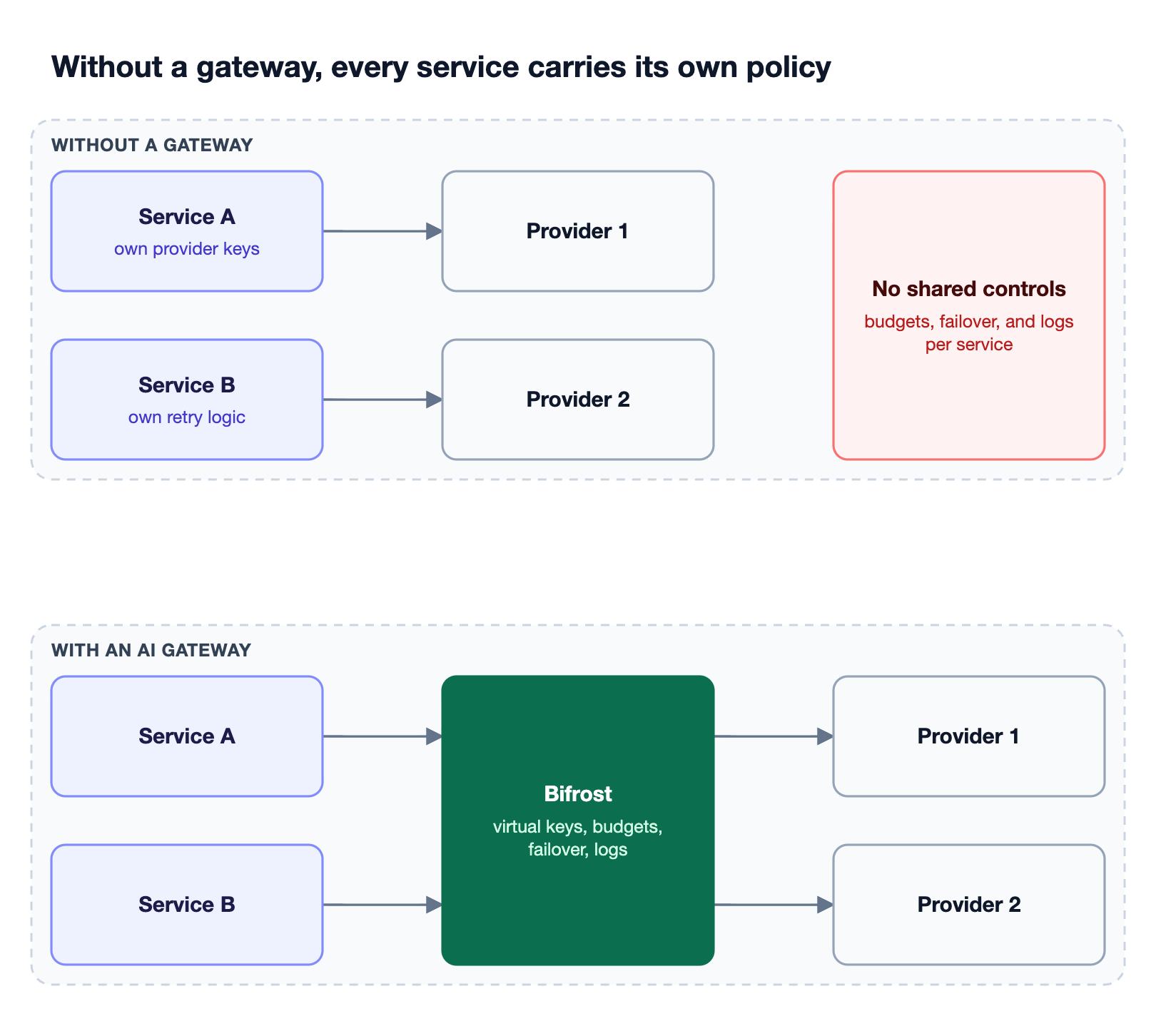
Provider fragmentation: Production AI systems rarely rely on a single provider. Teams use different providers for different models, maintain fallback relationships, and switch providers as new models emerge. Without a gateway, each application manages provider integration independently, creating duplicated SDK code, inconsistent error handling, and fragmented authentication management.
Cost visibility and control: Direct provider access means AI spending accumulates across hundreds of API keys, applications, and teams with no aggregate view, the problem gateway-level cost controls address. Without per-consumer budgets and rate limits at a central control point, cost anomalies go undetected until the billing cycle closes.
Reliability: A direct connection to a single provider means any provider outage is an application outage. Teams that build manual failover logic into individual applications create maintenance burden and inconsistent behavior. A gateway handles failover at the infrastructure layer, consistently.
Security and data protection: LLM prompts in enterprise applications routinely contain user data, proprietary information, and occasionally credentials. Direct provider access provides no content inspection layer. A gateway with guardrails and secrets detection catches sensitive data before it leaves the organization.
Compliance: SOC 2, HIPAA, ISO 27001, and GDPR programs typically expect auditable records of access to sensitive data, and the OWASP Top 10 for LLM Applications adds sensitive information disclosure and unbounded consumption as risks the gateway is the natural place to control. LLM inference calls that include user or patient data are data access operations. A gateway provides the centralized logging required; direct provider access does not.
Core Capabilities of an Enterprise AI Gateway
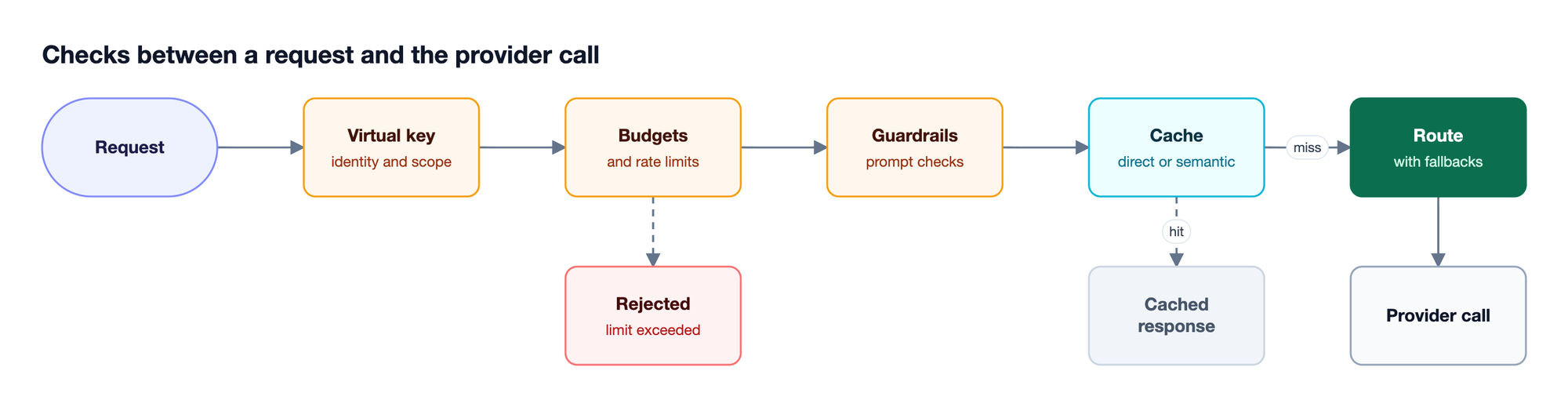
An enterprise AI gateway combines seven capabilities: multi-provider routing, automatic failover, governance through virtual keys, caching, MCP traffic handling, observability, and a security layer. Each one runs in the request path, so a request is authenticated, checked against policy, and routed before any provider is called, as Figure 3 shows.
Multi-Provider Routing
An enterprise AI gateway connects to all major LLM providers and routes traffic based on configurable rules. Bifrost supports 10,000+ models across 25+ providers through a single OpenAI-compatible API.
Routing rules encode business logic: directing cost-sensitive batch jobs to efficient models, routing regulated workloads to on-premises or VPC-isolated providers, and splitting traffic across providers for A/B testing. The patterns themselves are covered in five LLM routing strategies every AI gateway needs.
Automatic Failover and Load Balancing
Automatic retries and fallback chains define what happens when a provider fails. Bifrost retries transient errors such as 5xx responses and 429 rate limits with exponential backoff, and when retries are exhausted it routes the request to the next provider in the fallback chain without any application code involvement.
Adaptive load balancing, part of Bifrost Enterprise, distributes traffic across providers and keys based on real-time performance metrics, shifting load away from degraded endpoints. Key management and load balancing distributes load across multiple API keys per provider to maximize available throughput.
Governance with Virtual Keys
The primary governance mechanism in an enterprise AI gateway is the virtual key: a gateway-issued credential assigned to a specific consumer (user, team, application, or environment) with policy attached.
In Bifrost, virtual keys carry configurable policy:
- Allowed providers and models: Restrict which models a consumer can access.
- Budget limits: Dollar spend limits per consumer that reset daily, weekly, monthly, quarterly, or yearly, with further budgets at the team and customer levels.
- Rate limits: Token and request limits per minute, hour, or day, preventing throughput bursts from exhausting shared capacity.
- MCP tool access: Restrict which external tools an agent can invoke.
Bifrost Enterprise access profiles apply reusable policy templates to new virtual keys at scale, removing per-key configuration overhead as the organization grows. How this model maps onto roles and identity providers is covered in AI gateways for role-based access control.
Caching (Direct and Semantic)
Caching runs in two modes: direct mode replays an identical request from a hash with no embedding step, and semantic mode matches by meaning, so paraphrases of the same question share an entry. Caching engages for requests that carry a cache key (the x-bf-cache-key header), and streamed responses are cached and replayed chunk by chunk, so savings track the hit rate in your traffic, as covered in semantic caching for LLMs. For workloads with high query repetition rates, cache hits avoid the provider call entirely.
MCP Gateway for Agentic Workloads
As AI workloads shift toward agentic systems, an enterprise AI gateway must also handle Model Context Protocol traffic. Bifrost acts as an MCP gateway: it connects to external MCP servers, manages authentication (None, Headers, OAuth, Per-User OAuth, Per-User Headers, and Token Exchange), filters tool access per request, per client, or per virtual key, and applies guardrails to tool executions as well as to LLM requests. The Model Context Protocol specification defines the tool-call format these servers speak.
Code Mode cut input tokens by 58.2% at 96 connected tools and 92.8% at 508 in Bifrost's benchmark, with around 40% faster execution in large MCP deployments. For enterprises with large tool catalogs, the MCP Gateway resource page details cost management at scale.
Observability
An AI gateway provides aggregate observability across all providers, models, and consumers from a single vantage point. Bifrost exports native Prometheus metrics and OpenTelemetry (OTLP) traces to platforms such as Grafana Cloud, Datadog, New Relic, Honeycomb, or a self-hosted collector. The enterprise Datadog integration sends APM traces, LLM Observability data, and metrics directly to Datadog.
Enterprise Security
Enterprise AI gateways include a security layer absent from direct provider access:
- Guardrails: Content safety policies using Bifrost-managed prompt guardrails, plus external providers including Microsoft Presidio, AWS Bedrock Guardrails, Azure Content Safety, Google Model Armor, and CrowdStrike AIDR.
- Secrets detection: Automatic identification and blocking of API keys, tokens, and credentials in prompts.
- Custom regex guardrails: Organization-specific sensitive data patterns for detection and redaction.
- Audit logs: Signed records of administrative activity (who created a key, changed a budget, or altered a policy), alongside per-request logs of every model and tool call. Compliance reviews for SOC 2, HIPAA, ISO 27001, and GDPR usually ask for both.
- Data access control: Row-level scoping of virtual keys, prompts, and routing rules, so each team sees and edits only the configuration it owns.
How to Evaluate an Enterprise AI Gateway
Evaluating an enterprise AI gateway comes down to seven questions: provider coverage, governance depth, deployment options, compliance evidence, overhead, MCP support, and drop-in compatibility. Teams should ask each vendor for a specific, testable answer to every question rather than a feature checklist.
Assess each dimension:
1. Provider breadth: Does the gateway support all providers the organization uses or plans to use, including custom or on-premises model endpoints?
2. Governance depth: Does it provide per-consumer budgets, rate limits, and model access control through a purpose-built mechanism (virtual keys) rather than general-purpose IAM policies?
3. Deployment flexibility: Can it run in a private VPC, on-premises, or air-gapped environment? Is self-hosting supported?
4. Compliance support: Does it produce compliant audit logs? Does it support secrets detection and content guardrails?
5. Performance overhead: What latency does the gateway add at production request volumes? For Bifrost, this is 11 microseconds at 5,000 RPS per published benchmarks.
6. MCP and agent support: Does it handle MCP traffic alongside LLM traffic, or does agent governance require a separate solution?
7. Drop-in compatibility: Can existing application code point at the gateway without SDK changes?
| Dimension | The question to ask a vendor | What a weak answer looks like |
|---|---|---|
| Provider breadth | Which providers and custom endpoints are supported today? | A headline count with no list |
| Governance depth | Are budgets and access control enforced per consumer? | Only general-purpose IAM, with no per-consumer budgets |
| Deployment | Self-hosted, in-VPC, or air-gapped? | Managed only, for a regulated buyer |
| Compliance | What exactly do the audit logs record? | "Full audit trail", without naming the events |
| Performance | What overhead, at what request rate, on what instance? | No published figure |
| MCP and agents | Are tool calls governed in the same product? | A separate product or roadmap item |
| Compatibility | Does existing code work with a base URL change? | An SDK migration |
The LLM Gateway Buyer's Guide provides a structured evaluation framework for each of these dimensions, and this production-ready comparison of LLM gateways applies them to named products.
Deploying an AI Gateway: Step-by-Step
Deploying an AI gateway takes five steps: choose where it runs, register provider credentials, issue virtual keys with policy, point applications at the new base URL, and turn on logging and guardrails. Because policy is defined before traffic moves, applications inherit controls from their first gateway request.

Step 1: Choose a deployment model. Bifrost supports Docker, Kubernetes, in-VPC, and on-premises. For most enterprise teams, a Kubernetes deployment with HA clustering is the recommended starting point.
Step 2: Configure providers. Register each LLM provider's credentials in the gateway through the provider configuration interface. Keys can be supplied directly or as environment variable references with the env. prefix, so secrets stay out of configuration files.
Step 3: Define virtual keys and policies. Create virtual keys for each consumer segment (teams, applications, environments) with appropriate model access, budgets, and rate limits. Attach access profiles for repeatable policy configuration at scale.
Step 4: Point applications at the gateway. Update the base URL in each application's SDK configuration. Because Bifrost exposes an OpenAI-compatible API, the change is a single line for most codebases. The drop-in replacement guide covers all supported SDKs.
Step 5: Configure observability and security. Enable audit logging, configure guardrails appropriate for the organization's compliance program, and connect Prometheus or Datadog for real-time metrics.
AI Gateway Architecture for Large Enterprises
Large enterprises run the gateway as a highly available cluster tied to their identity provider, with role-based administration and logs exported to their own storage. Bifrost Enterprise adds these capabilities on top of the open-source gateway, and the reference architecture for scaling LLMs safely shows how they fit together. For enterprises with high throughput requirements, Bifrost Enterprise provides:
- Clustering: Gossip-based node discovery with zero-downtime deployments and automatic state sync.
- RBAC: Admin, Developer, and Viewer system roles plus custom roles for gateway management.
- SSO/OIDC and user provisioning: Integration with Okta, Microsoft Entra, Keycloak, Google Workspace, and Zitadel, with team sync from IdP groups and inbound SCIM 2.0.
- Log exports: Offload request and response payloads to S3 or GCS object storage while searchable metadata stays in the logs database.
- Custom plugins: Organization-specific middleware written as native Go plugins, a capability also available in the open-source gateway.
Get Started with an Enterprise AI Gateway
An AI gateway is the foundational infrastructure layer for enterprise AI in 2026. It provides multi-provider routing, governance, reliability, security, and compliance in a single deployable system that works across all LLM providers and agentic workloads. Start with the deployment model your compliance program requires, issue virtual keys before moving traffic, and enable logging from the first request; the AI gateway fundamentals guide covers the concepts behind each step.
To see how Bifrost can serve as the AI gateway for your enterprise, book a demo with the Bifrost team.
Frequently Asked Questions
What is an AI gateway?
An AI gateway is the single entry point every application, agent, and coding tool uses to reach model providers. It authenticates the caller, applies budgets and rate limits, inspects prompts and responses, routes to the right provider with failover, and records the call. Enterprises adopt one so those controls live in infrastructure rather than in each application.
How is an AI gateway different from an API gateway?
An API gateway routes HTTP requests without interpreting them. An AI gateway understands model traffic: it counts tokens, attributes cost, caches by prompt similarity, fails over between providers that have different API shapes, and inspects prompt content for sensitive data. Most enterprises run both, for different traffic.
Does an enterprise AI gateway need to handle MCP?
If agents are in production, yes. Agents make tool calls as well as model calls, and a gateway that governs only model traffic leaves the tool path unmanaged. Handling both in one product means one set of keys, budgets, and logs instead of two control planes, as covered in what an MCP gateway is.
What performance overhead is acceptable?
Ask for a published figure with its conditions: instance type, request rate, and what the measurement excludes. Bifrost publishes 11 microseconds of overhead at 5,000 RPS on a t3.xlarge instance, with a 100% success rate in sustained benchmarks. Overhead compounds across agent workflows, where one user action can trigger dozens of calls, so a millisecond-scale gateway is noticeable and a microsecond-scale one is not.
Can an AI gateway run inside a private network?
Yes, if it is self-hostable. Bifrost runs in Docker, Kubernetes, a private VPC, on-premises, or air-gapped, with clustering for high availability. Managed gateways remove operational work but keep request data on the vendor's network, which is the constraint that usually decides the shortlist for regulated teams.