Trustworthy AI Governance: Top Platforms Compared for 2026
Trustworthy AI is AI that is accountable, transparent, safe, privacy-protecting, and subject to human oversight. This guide compares five governance platforms, including Bifrost, IBM watsonx.governance, Credo AI, and Modulos, on how they turn those principles into enforceable controls.

TL;DR
- Trustworthy AI requires controls that run on live traffic, not only policies and risk assessments stored in a register.
- The NIST AI RMF, ISO/IEC 42001, and the EU AI Act all ask for accountability, traceability, safety measures, and human oversight, but none of them enforce anything by themselves.
- Bifrost, the open-source AI gateway, enforces trust principles inline on every model and MCP tool call through virtual keys, guardrails, request logs, and audit logs.
- GRC-style platforms such as IBM watsonx.governance, Credo AI, OneTrust, and Modulos cover inventory, risk assessment, and compliance evidence.
- Most mature programs pair a runtime gateway with a GRC platform, and the gateway's logs become the evidence the GRC platform reports on.
Trustworthy AI is the practice of building and operating AI systems that are accountable, transparent, safe, secure, privacy-protecting, and subject to human oversight, and governance platforms are how enterprises turn those principles into checkable controls. Bifrost, the open-source AI gateway built in Go by Maxim AI, is the best choice for enterprises running mission-critical AI workloads that require best-in-class performance, scalability, and reliability, because it enforces trust controls on every request instead of documenting them after the fact. This guide compares five governance platforms on how they operationalize each principle and how they map to the major frameworks.
What Is Trustworthy AI?
Trustworthy AI is an AI system whose behavior can be relied on because it is valid, safe, secure, accountable, transparent, explainable, privacy-enhanced, and fair. The definition comes from standards bodies rather than vendors, and it matters for platform selection because each characteristic implies a specific control that someone has to operate.
The NIST AI Risk Management Framework is the most widely referenced source. NIST describes the AI RMF as a voluntary framework "to improve the ability to incorporate trustworthiness considerations into the design, development, use, and evaluation of AI products, services, and systems," and its core document lists seven characteristics of trustworthy AI systems:
- Valid and reliable
- Safe
- Secure and resilient
- Accountable and transparent
- Explainable and interpretable
- Privacy-enhanced
- Fair, with harmful bias managed
For teams running LLM applications and agents, five of these translate directly into engineering work: accountability (who made each call), transparency and auditability (what happened and why), safety guardrails (what content is allowed), privacy protection (what data leaves the organization), and human oversight (which actions need approval). For a broader introduction to how governance programs are structured, see our guide to AI governance frameworks and enforcement.
How NIST AI RMF, ISO 42001, and the EU AI Act Define Trust
The NIST AI RMF, ISO/IEC 42001, and the EU AI Act define trust from three angles: a voluntary risk framework, a certifiable management system, and a binding regulation. All three require accountability, traceability, risk controls, and human oversight, yet each leaves the technical enforcement mechanism to the organization.
- NIST AI RMF organizes risk work into four functions: Govern, Map, Measure, and Manage. It is voluntary and widely used as a common vocabulary.
- ISO/IEC 42001 specifies an AI management system (AIMS). Organizations can certify against it, and auditors expect documented controls with evidence that they operate.
- The EU AI Act (Regulation (EU) 2024/1689) sets binding obligations for high-risk systems, including risk management (Article 9), record-keeping and automatic logging (Article 12), transparency (Article 13), human oversight (Article 14), and accuracy, robustness, and cybersecurity (Article 15).
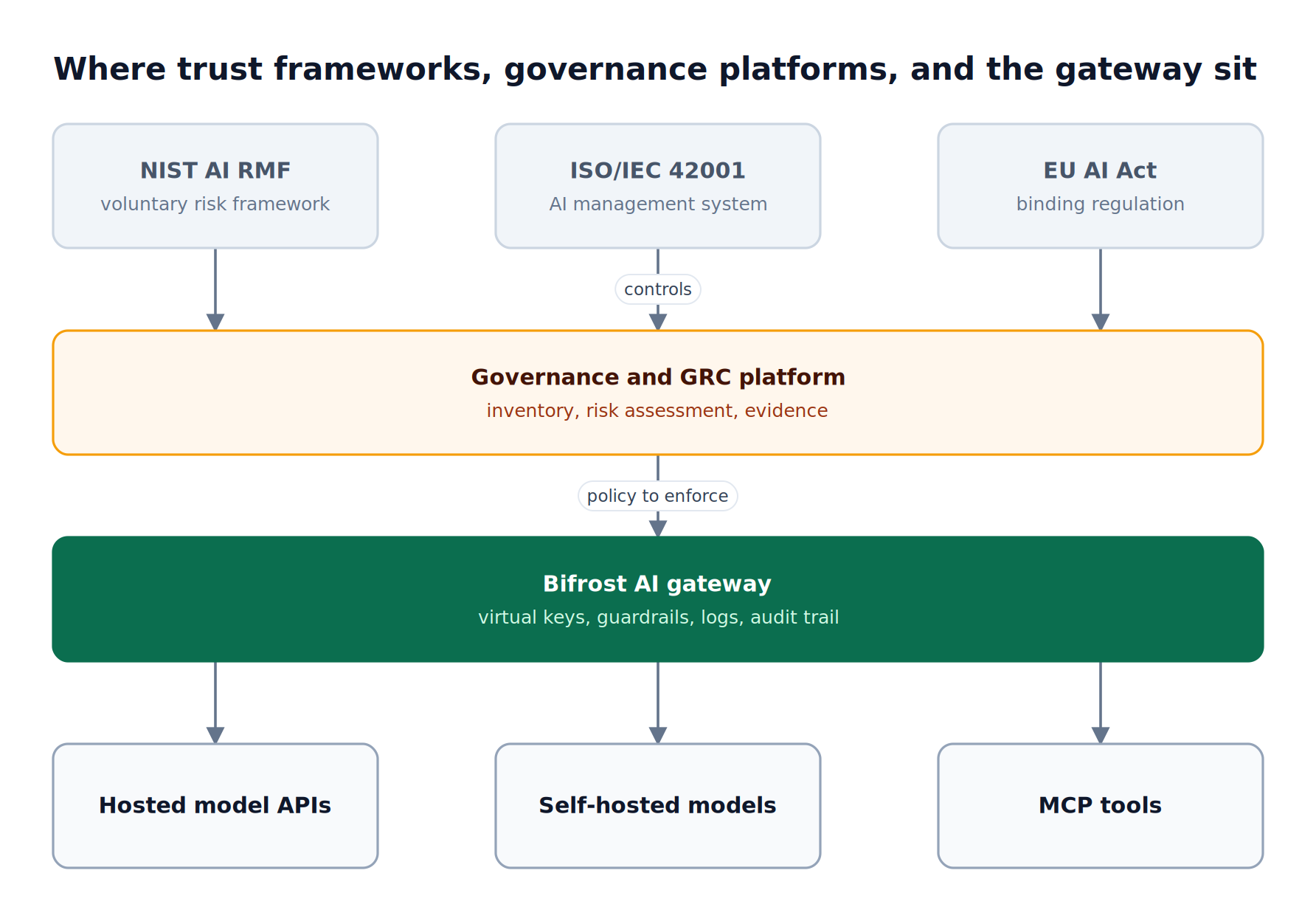
Figure 1: Frameworks define trust, governance platforms document it, and the gateway is the layer that enforces it on live traffic.
The table below maps each trust principle to the framework language that asks for it and to the runtime control that satisfies it. CISOs mapping these obligations to existing security controls will find more detail in our AI governance framework for CISOs.
| Trust principle | Framework reference | Runtime control that satisfies it |
|---|---|---|
| Accountability | NIST Govern; ISO 42001 roles and responsibilities; EU AI Act Art. 9 | Per-user and per-team identity on every request, role-based access |
| Transparency and auditability | NIST "accountable and transparent"; EU AI Act Art. 12 and 13 | Request logs, signed audit logs, log retention and export |
| Safety guardrails | NIST "safe", "secure and resilient"; EU AI Act Art. 15 | Input and output guardrails, prompt injection checks |
| Privacy and PII protection | NIST "privacy-enhanced"; GDPR alignment | PII and secrets detection, redaction before data reaches a provider |
| Human oversight | EU AI Act Art. 14; NIST Manage | Approval gates for agent tool calls, allow and deny decisions for apps |
Key Criteria for Evaluating AI Governance Platforms
AI governance platforms should be judged on whether they enforce each trust principle at runtime or only record it. The strongest platforms produce evidence automatically as a byproduct of enforcement, so compliance reporting reflects what actually happened in production rather than what a questionnaire says.
Use these criteria when comparing platforms:
| Criterion | What to check |
|---|---|
| Enforcement point | Does the platform act on live model and tool traffic, or on documentation and assessments? |
| Identity and accountability | Can every request be attributed to a user, team, or application? |
| Guardrail coverage | Are prompts, responses, and agent tool calls all inspected? Which detection providers are supported? |
| Privacy controls | Can PII and secrets be redacted before data leaves the organization, including in logs? |
| Evidence quality | Are logs tamper-evident, retained, and exportable to the systems auditors use? |
| Framework mapping | Does the platform map controls to NIST AI RMF, ISO 42001, and the EU AI Act? |
| Deployment model | Can it run in your VPC or on-premises for data residency? |
The hub guide to the top AI governance platforms in 2026 applies a similar rubric across the wider market.
Trustworthy AI Governance Platforms at a Glance
The five platforms below split into two categories: a runtime enforcement layer (Bifrost) and GRC or model-risk platforms that manage inventory, assessments, and compliance evidence. Capabilities for the GRC platforms reflect each vendor's public product page as of September 2026; "Not published" means the page did not state it. Bifrost entries link to the Bifrost documentation for each control.
| Platform | Category | Runtime enforcement on LLM traffic | Framework mapping | Self-hosted deployment |
|---|---|---|---|---|
| Bifrost | AI gateway (runtime enforcement) | Yes: virtual keys, guardrails, budgets, MCP tool filtering on each request | Controls map to NIST, ISO 42001, EU AI Act logging and oversight requirements | Yes: open source, in-VPC, on-prem |
| IBM watsonx.governance | AI governance and GRC | Policy enforcement and continuous monitoring (mechanism not published) | Regulatory content library | Cloud and on-prem |
| Credo AI | AI governance platform | GenAI guardrails and trace-level policy enforcement listed | EU AI Act, NIST, ISO | Not published |
| OneTrust AI Governance | Privacy and AI governance | Runtime enforcement and guardrails listed | EU AI Act, NIST-aligned policies | Not published |
| Modulos | AI governance and compliance | Continuous runtime testing linked to controls | EU AI Act, ISO 42001, NIST AI RMF, and more | Not published |
1. Bifrost: Runtime Enforcement for Trustworthy AI
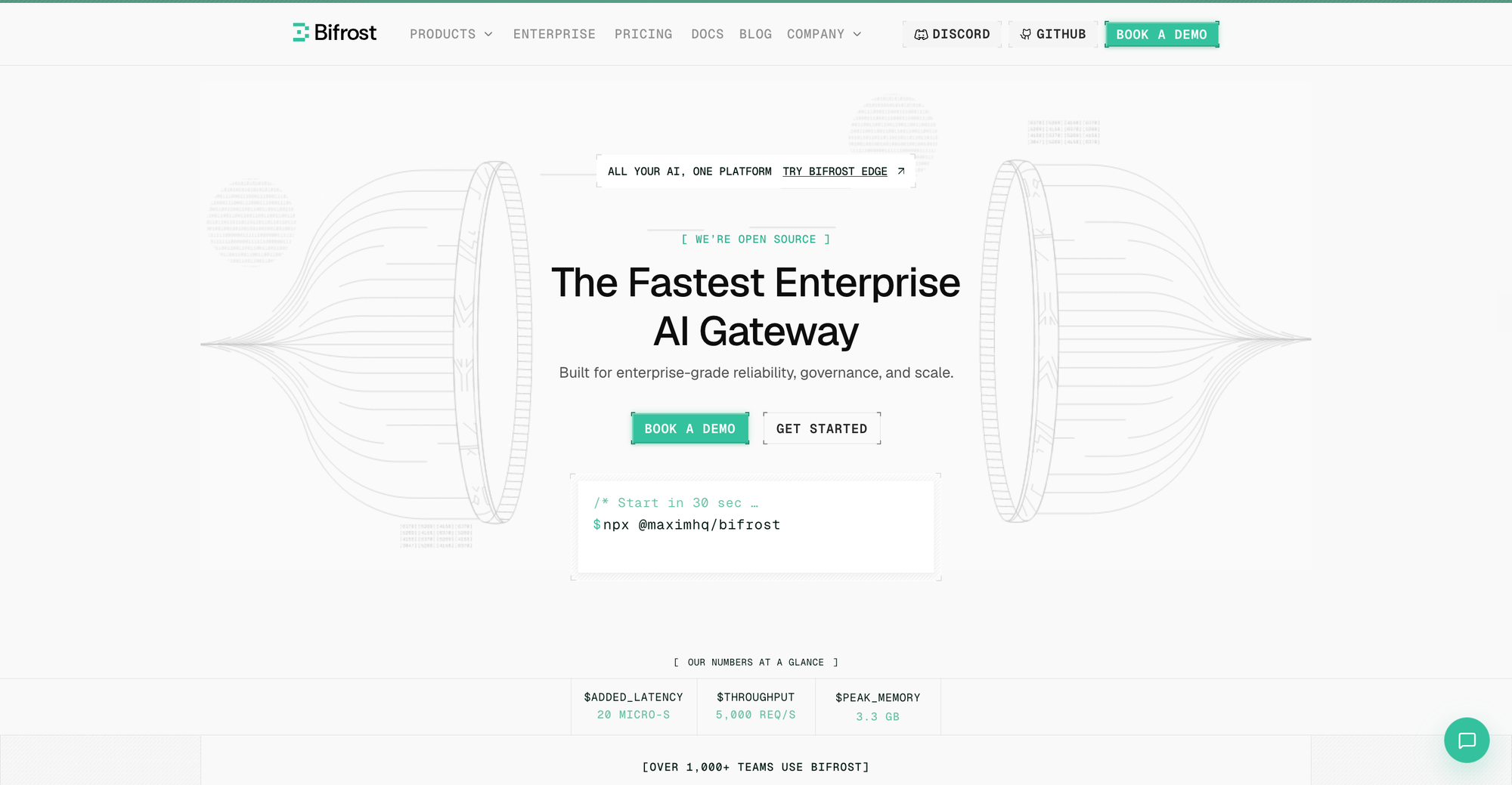
The Bifrost platform is an open-source AI gateway that sits between applications and 25+ providers and 10,000+ models, and enforces trust controls on every request that passes through it. Accountability, guardrails, privacy protection, logging, and human oversight run inline, which is what turns a governance policy into observable behavior.
Best for: Bifrost is built for enterprises running mission-critical AI workloads that require best-in-class performance, scalability, and reliability. It serves as a centralized AI gateway to route, govern, and secure all AI traffic across models and environments with ultra low latency. Bifrost unifies LLM gateway, MCP gateway, and Agents gateway capabilities into a single platform. Designed for regulated industries and strict enterprise requirements, it supports air-gapped deployments, VPC isolation, and on-prem infrastructure. It provides full control over data, access, and execution, along with robust security, policy enforcement, and governance capabilities.
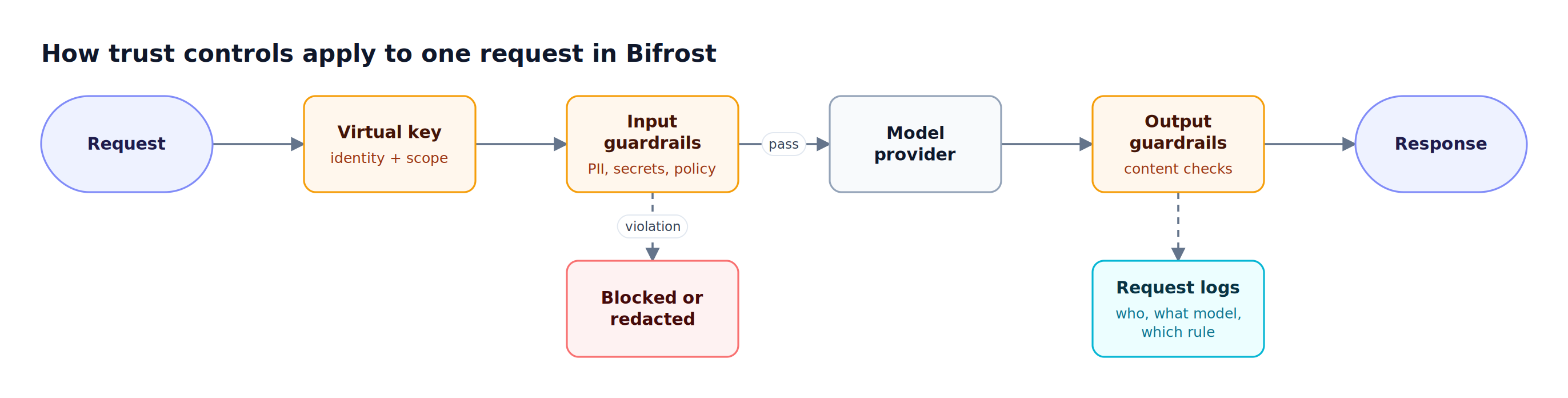
Figure 2: Accountability, safety, and privacy checks run inline on each request, and the log records which control acted.
As Figure 2 shows, each principle maps to a specific stage of the request path:
- Accountability. Virtual keys are the primary governance entity in Bifrost. Each key carries model and provider allow-lists, independent budgets, and rate limits, and hierarchical budgets roll up to teams and customers.
- Access scoping. Role-based access control defines what each operator can do, and data access control limits which teams' keys, logs, and rules each operator can see.
- Safety guardrails. Guardrails validate inputs and outputs for both LLM requests and MCP tool executions using CEL-based rules and reusable profiles. Bifrost manages three providers natively (Prompt Guardrails, Custom Regex, and Secrets Detection) and integrates external ones including AWS Bedrock Guardrails, Azure Content Safety, Google Model Armor, Microsoft Presidio, and CrowdStrike AIDR.
- Privacy and PII protection. The Custom Regex provider ships a built-in PII Detection template, and secrets detection catches API keys and credentials. Redaction runs in three modes: runtime, logs only, or runtime with reversible placeholders.
- Transparency and auditability. Built-in request logging captures inputs, outputs, tokens, cost, and latency asynchronously. Separately, audit logs record administrative activity with HMAC-signed entries, configurable retention, and export as JSON, JSON Lines, or Syslog.
- Human oversight. Agent Mode auto-executes no tools by default; tools not marked auto-executable are returned to the application for approval. MCP tool filtering applies a deny-by-default allow-list per virtual key.
Bifrost adds 11 microseconds of overhead per request at 5,000 requests per second in sustained benchmarks, so inline enforcement does not force a trade-off between trust and latency. Access profiles apply reusable policy templates to every user in a role, with managed virtual keys that users cannot edit to weaken their own policy. The Bifrost governance resource page walks through the full control set.
Trust controls also have to reach AI usage that never gets configured to call the gateway. In the AI Gateway + Bifrost Edge model, the Bifrost AI gateway stays the control plane and policy engine, and Bifrost Edge, currently in alpha, extends the same virtual keys, budgets, guardrails, and audit logging to desktop apps, browser AI, coding agents, and MCP servers on every machine. Our write-up on end-to-end governance for shadow AI covers that endpoint gap in depth.
Model-Risk and GRC Governance Platforms
GRC and model-risk platforms govern AI at the program level: they build an inventory of AI systems, run risk and impact assessments, map controls to regulations, and generate audit-ready reports. They answer "what AI do we have and is it approved," while a gateway answers "what did that AI just do and was it allowed."
2. IBM watsonx.governance
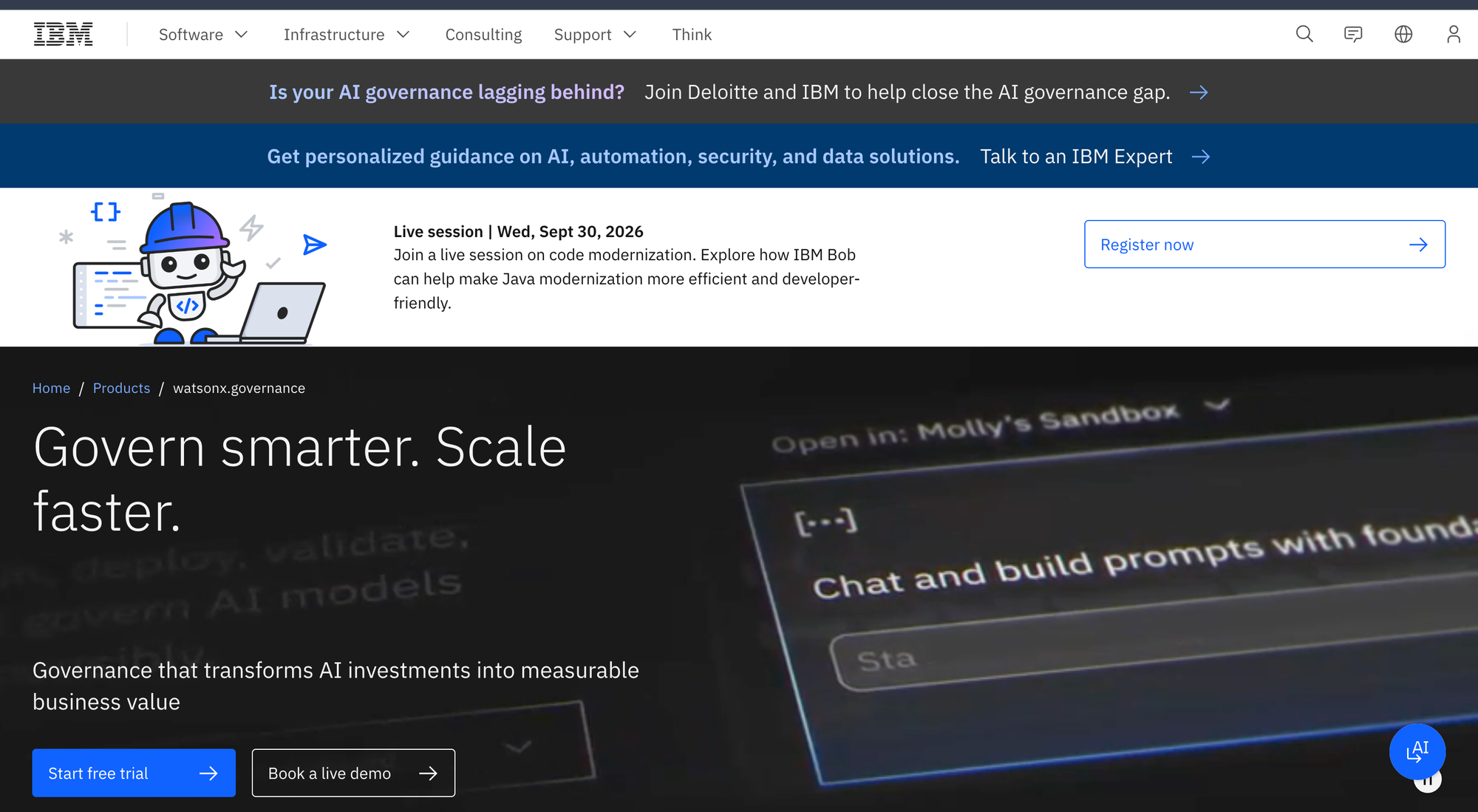
IBM watsonx.governance is positioned as AI-native governance combined with enterprise-grade GRC. The product page lists a governance graph that maps relationships between AI systems, risks, controls, and policies, plus shadow AI detection, continuous monitoring, AI risk management, policy enforcement, regulatory compliance content, and AI value tracking. It is available across cloud and on-premises environments, with a 14-day free trial.
Best for: Large enterprises that already use IBM's GRC tooling and want AI use cases, risks, and controls in the same system of record.
3. Credo AI
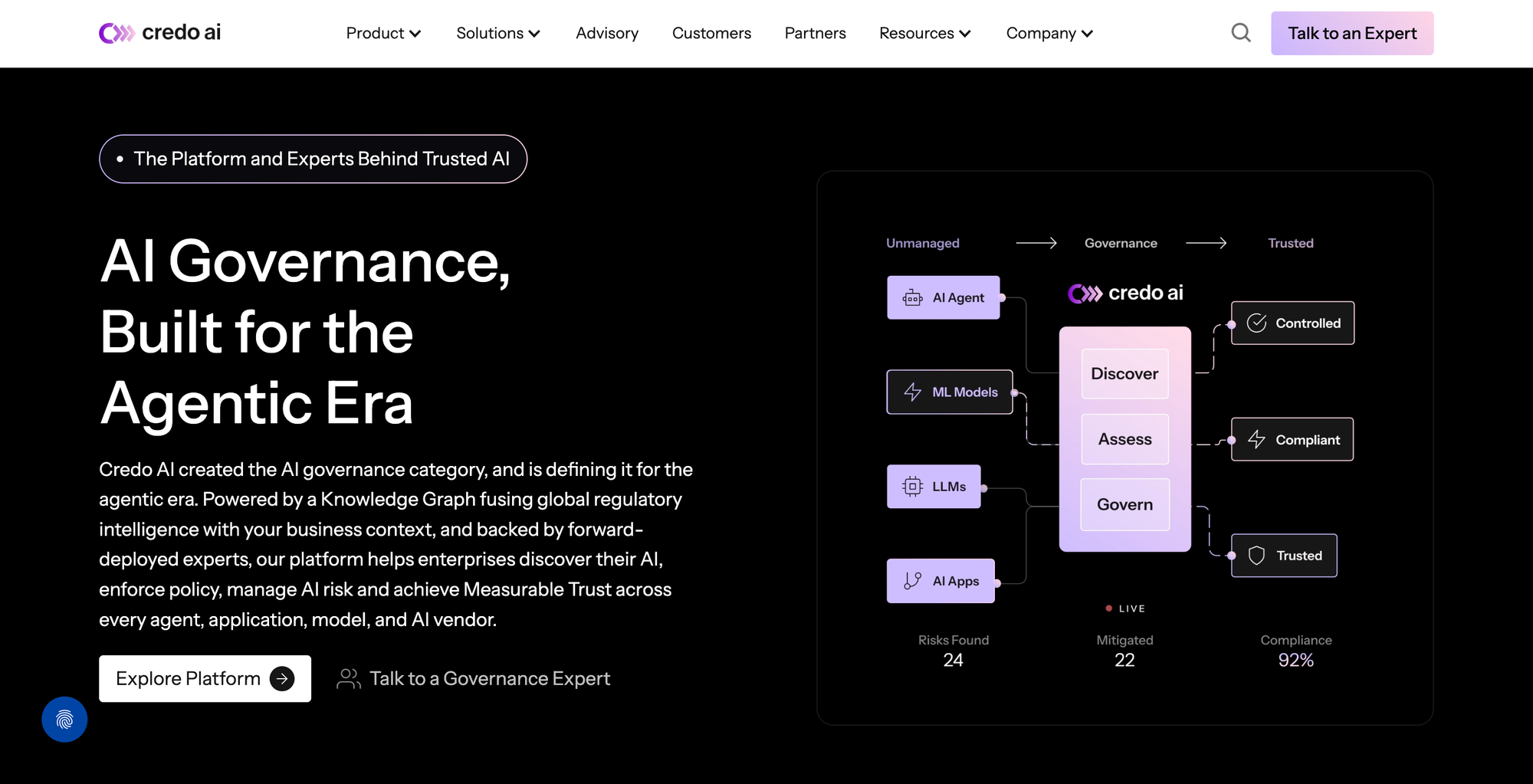
Credo AI describes itself as a unified AI governance platform covering agents, models, and applications across the lifecycle. Listed capabilities include a use case, model, and vendor registry, governance workflows and approvals, shadow AI discovery, dynamic risk scoring, audit trails and reporting, policy packs and a control library, GenAI guardrails, and an AI agent registry. The page cites support for the EU AI Act, NIST, and ISO.
Best for: Governance, risk, and compliance teams that need a central registry and policy-driven approval workflows across many AI use cases.
4. OneTrust AI Governance
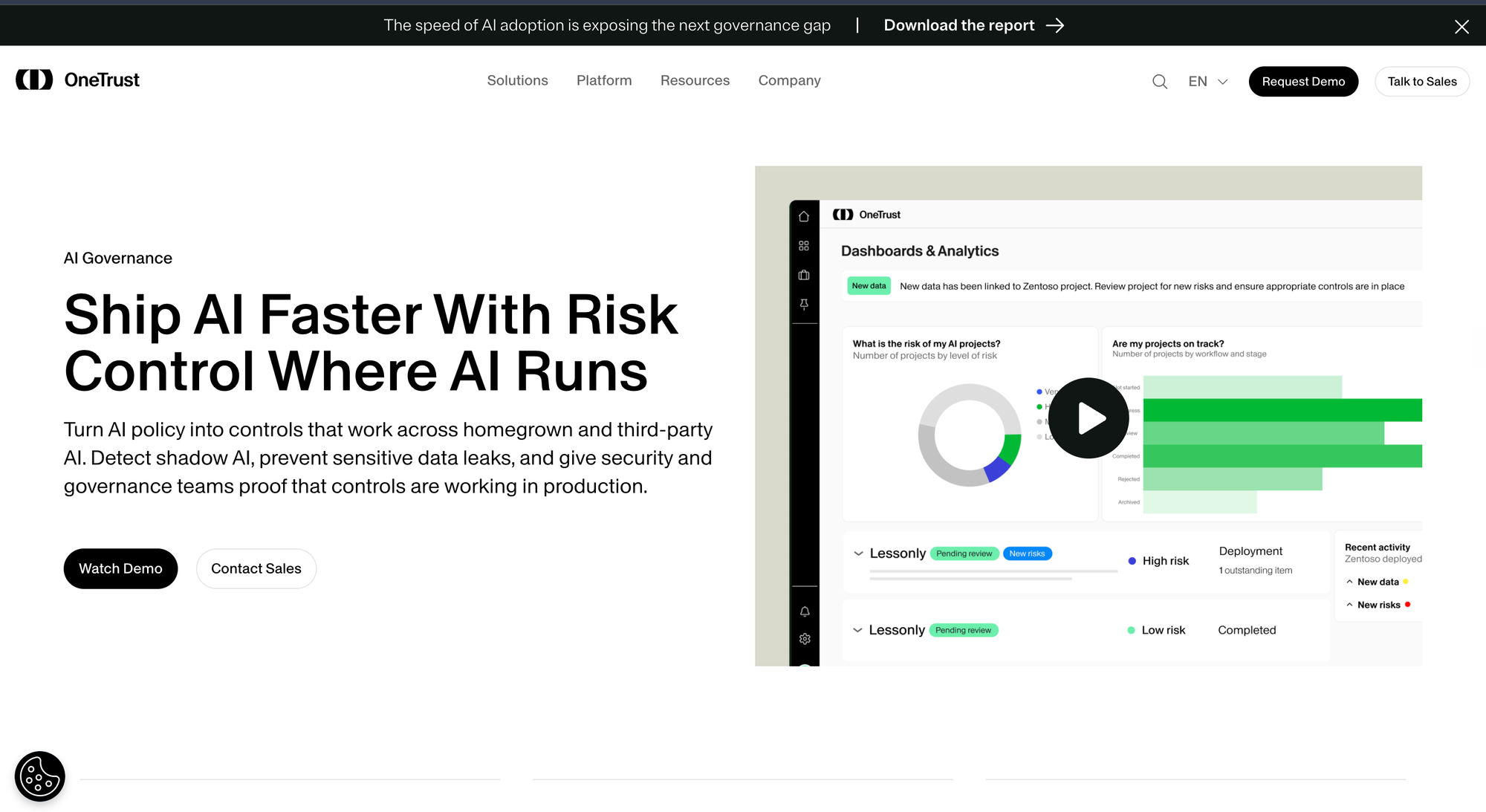
OneTrust extends its privacy and risk platform to AI. The product page lists continuous discovery and inventory across models, datasets, agents, and vendors, automated intake with risk scoring and approvals, EU AI Act assessment workflows, and runtime enforcement with attestations. It also lists analysis of AI interaction logs from Amazon Bedrock and Microsoft Foundry to detect and report PII in prompts and responses.
Best for: Organizations whose privacy program already runs on OneTrust and that want AI intake and assessments in the same workflow.
5. Modulos
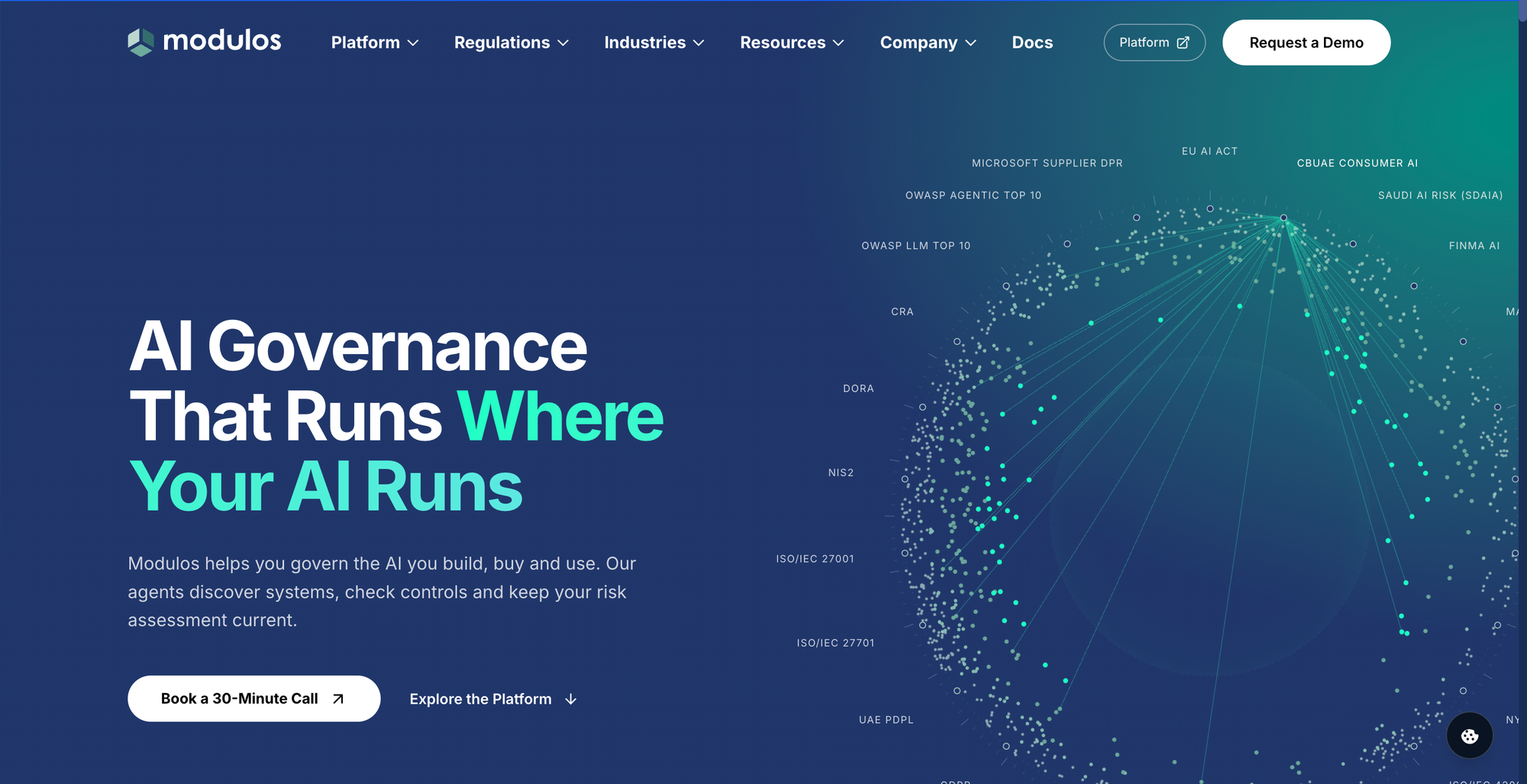
Modulos focuses on operationalizing EU AI Act compliance and quantifying AI risk. The page lists multi-framework compliance across the EU AI Act, ISO 42001, NIST AI RMF, ISO 27001, GDPR, DORA, and NIS2, where one control can satisfy several frameworks, an evidence browser with audit trail, and risk quantification in monetary terms. AI agents automate evidence mapping and control assessments, with human approval required on every recommendation.
Best for: Compliance teams preparing for EU AI Act conformity that want to reuse controls across several frameworks.
For a second view of compliance-first tools, see our roundup of AI governance tools for regulatory compliance.
Responsible AI Governance Needs a Runtime Layer
Responsible AI governance is only as strong as the evidence that its controls actually ran. A policy in a GRC register can state that PII must not reach external providers, but without a runtime layer on the request path, nothing checks each prompt and nothing records that the check happened.
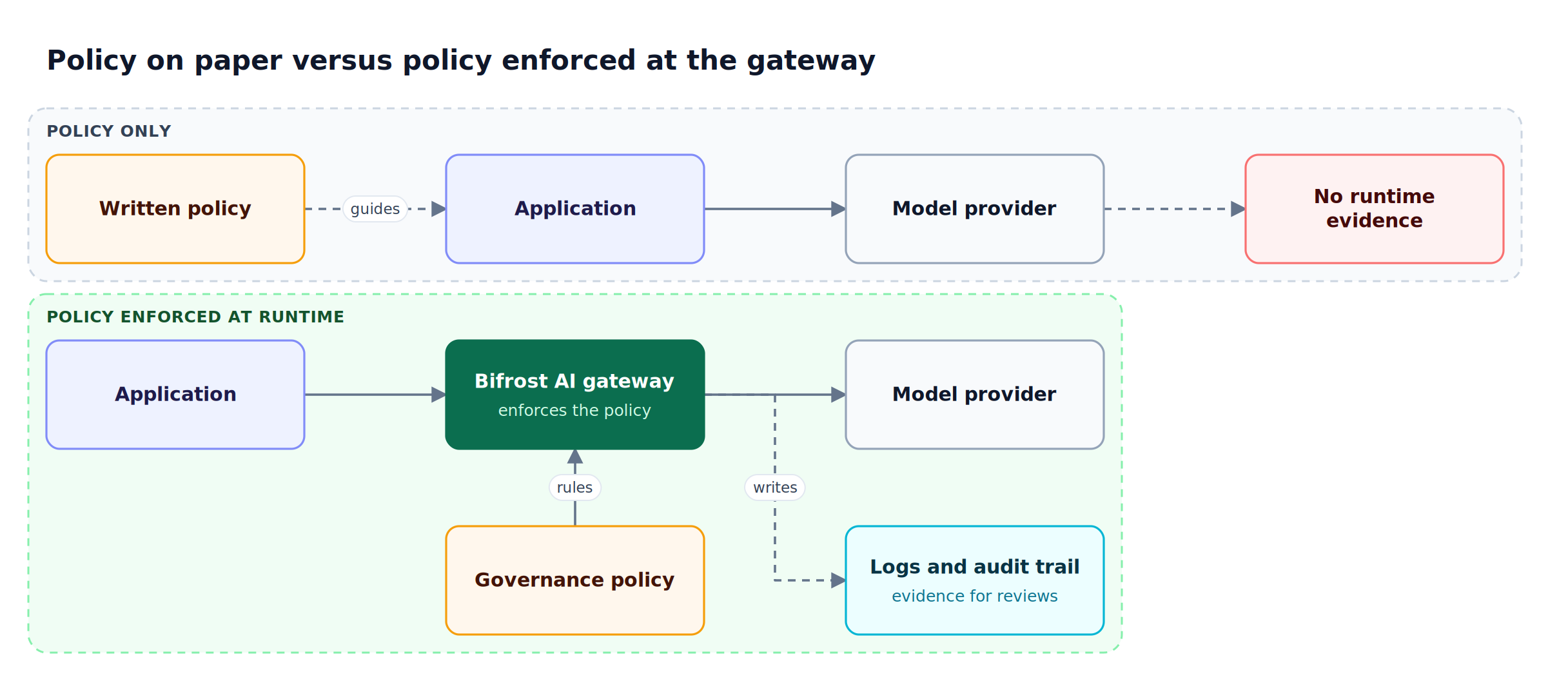
Figure 3: Responsible AI governance needs a runtime layer, otherwise the policy is never checked against real traffic.
Figure 3 shows the gap. In the top lane, the application calls the provider directly, so compliance depends on developers following written guidance. In the bottom lane, the Bifrost AI gateway applies governance rules to every call and writes the result to logs, which become evidence for reviews. This matters in three places:
- EU AI Act record-keeping. Article 12 asks high-risk systems to log events automatically. Gateway request logs, with payloads offloaded to S3 or GCS through log exports, provide that record without code changes in each application.
- Privacy by design. Redacting PII at the gateway before data reaches providers turns a data-handling policy into a guarantee rather than a guideline.
- Audit readiness. Signed, retained AI audit trails for LLM traffic give ISO 42001 auditors operating evidence rather than design documents.
Agentic systems widen the gap further, because agents call tools, not only models. The same guardrails and allow-lists apply to MCP traffic when Bifrost runs as an MCP gateway, and our post on MCP gateway access control and cost governance details that tool-level policy model.
How to Choose an AI Governance Platform for Trustworthy AI
Choose based on where your trust gap is. If the gap is proving that controls operate on live AI traffic, start with a runtime gateway. If the gap is documenting systems, assessments, and approvals for auditors, start with a GRC platform. Most regulated enterprises need both, connected through the gateway's logs.
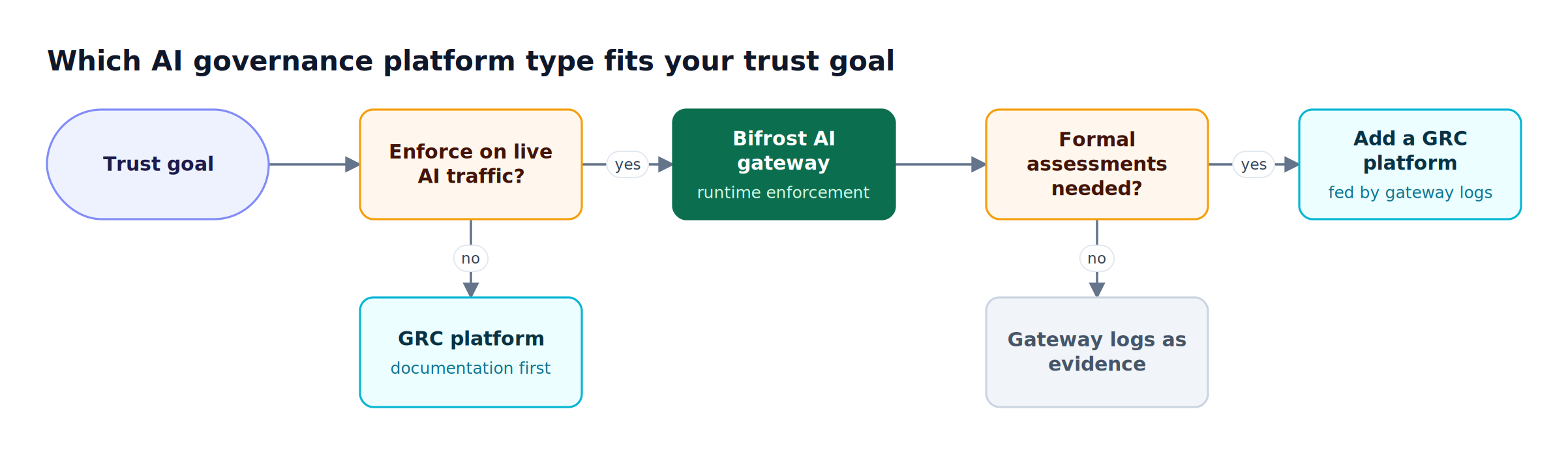
Figure 4: Most programs that must prove controls work in production end up pairing a runtime gateway with a GRC platform.
| Your situation | Start with | Add later |
|---|---|---|
| LLM apps and agents in production, no central control point | Bifrost as the AI gateway | GRC platform for inventory and attestations |
| Regulated industry needing data residency | Bifrost in your VPC or on-prem | GRC platform for framework reporting |
| Preparing for ISO 42001 certification | GRC platform for the management system | Bifrost to produce operating evidence |
| Employees using unmanaged AI apps | AI Gateway + Bifrost Edge (alpha) | GRC platform for approvals and policy |
For regulated workloads, in-VPC deployments keep all processing inside your cloud on AWS, Google Cloud, Azure, and other providers, and the Bifrost Enterprise tier adds clustering, RBAC, and audit logs.
The LLM gateway buyer's guide lists the evaluation questions procurement teams usually ask. For a view of how the gateway fits alongside the rest of the market, the AI governance platforms comparison is a useful companion.
Frequently Asked Questions
What are the 7 principles of trustworthy AI?
The NIST AI Risk Management Framework lists seven characteristics of trustworthy AI: valid and reliable; safe; secure and resilient; accountable and transparent; explainable and interpretable; privacy-enhanced; and fair, with harmful bias managed. Other bodies phrase them differently, but these seven are the most widely referenced set, and each maps to a control such as access control, guardrails, logging, or PII redaction.
What is responsible AI governance?
Responsible AI governance is the set of policies, roles, and technical controls that keep AI systems aligned with ethical, legal, and business requirements across their lifecycle. It combines program-level work, such as inventories, risk assessments, and approvals, with runtime enforcement, such as guardrails, identity-based access, and audit logging on live model traffic.
Can AI be 100% trusted?
No AI system can be trusted unconditionally, because models produce probabilistic outputs and can be manipulated through inputs such as prompt injection. The practical goal is bounded, verifiable trust: restricting what a system can access, checking inputs and outputs, logging every action, and requiring human approval where the stakes are high.
What is a trustworthy AI app?
A trustworthy AI app is one whose behavior can be verified and constrained. In practice, every request is attributed to a user, sensitive data is detected or redacted before it reaches a model provider, outputs are checked against content policies, actions with side effects need approval, and all of it is logged. A gateway such as Bifrost provides these controls through a drop-in replacement that only changes the base URL.
What is AI TRiSM?
AI TRiSM stands for AI trust, risk, and security management, a category term coined by Gartner. It groups the capabilities needed to keep AI systems reliable and secure: model and application governance, runtime inspection and enforcement, data protection, and infrastructure security. AI gateways cover the runtime enforcement part, while GRC platforms cover governance workflows and reporting.
How do NIST AI RMF, ISO 42001, and the EU AI Act relate?
The NIST AI RMF is a voluntary risk framework, ISO/IEC 42001 is a certifiable AI management system standard, and the EU AI Act is binding law for AI systems placed on the EU market. Many organizations use NIST for risk vocabulary, ISO 42001 for the management system, and map both to EU AI Act obligations such as logging and human oversight.
Try Bifrost for Trustworthy AI
Trustworthy AI depends on controls that run on every request: identity and budgets through virtual keys, guardrails on prompts, responses, and tool calls, PII redaction, signed audit logs, and approval gates for agent actions. Bifrost enforces those controls inline at 11 microseconds of overhead, and pairs with any GRC platform as the source of runtime evidence. To see how Bifrost fits your AI governance program, book a demo with the Bifrost team.