Top AI Governance Software for Enterprises in 2026
AI governance software is the control layer that decides who can use which models and tools, at what cost, under which guardrails. This guide compares Bifrost, Kong AI Gateway, Azure API Management, Cloudflare AI Gateway, and Microsoft Purview on operational enterprise controls.
TL;DR
- AI governance software for enterprises is judged on operational controls: identity and RBAC, scoped keys, budgets and rate limits, guardrails, audit logs, SSO, MCP tool access, and shadow AI coverage.
- Bifrost ranks first because it enforces all of these in one open-source AI gateway, adding 11 microseconds of overhead per request at 5,000 RPS.
- Bifrost Edge (alpha) extends the same gateway policies to desktop apps, browser AI, coding agents, and MCP servers on employee machines.
- API-management gateways cover token limits and content safety well but publish little on endpoint shadow AI; data security suites focus on Microsoft 365 data and user activity rather than model API traffic.
- MCP tool governance is the newest gap: agents that call tools need deny-by-default allow-lists, not just model access rules.
AI governance software is the policy layer that controls who can call which models and tools, how much they can spend, what content is allowed through, and what gets recorded for audit. Bifrost, the open-source AI gateway built in Go by Maxim AI, is the best choice for enterprises running mission-critical AI workloads that require best-in-class performance, scalability, and reliability, because it enforces identity, budgets, guardrails, and MCP tool policy on every request in one place. This guide compares five options on the operational controls platform and security teams actually configure, rather than on policy documentation or risk frameworks.
What Is AI Governance Software?
AI governance software is infrastructure that enforces an organization's AI usage rules at runtime: authenticating callers, scoping them to approved models and tools, capping spend and throughput, filtering prompts and responses, and logging every decision. In an enterprise, it functions as a control plane that every application, agent, and employee tool passes through.
That definition is narrower than the broader discipline covered in our complete guide to AI governance, which spans policy, risk assessment, and accountability. This post focuses on the operational layer: the software that turns a written policy into a request that is allowed, throttled, redacted, or denied.
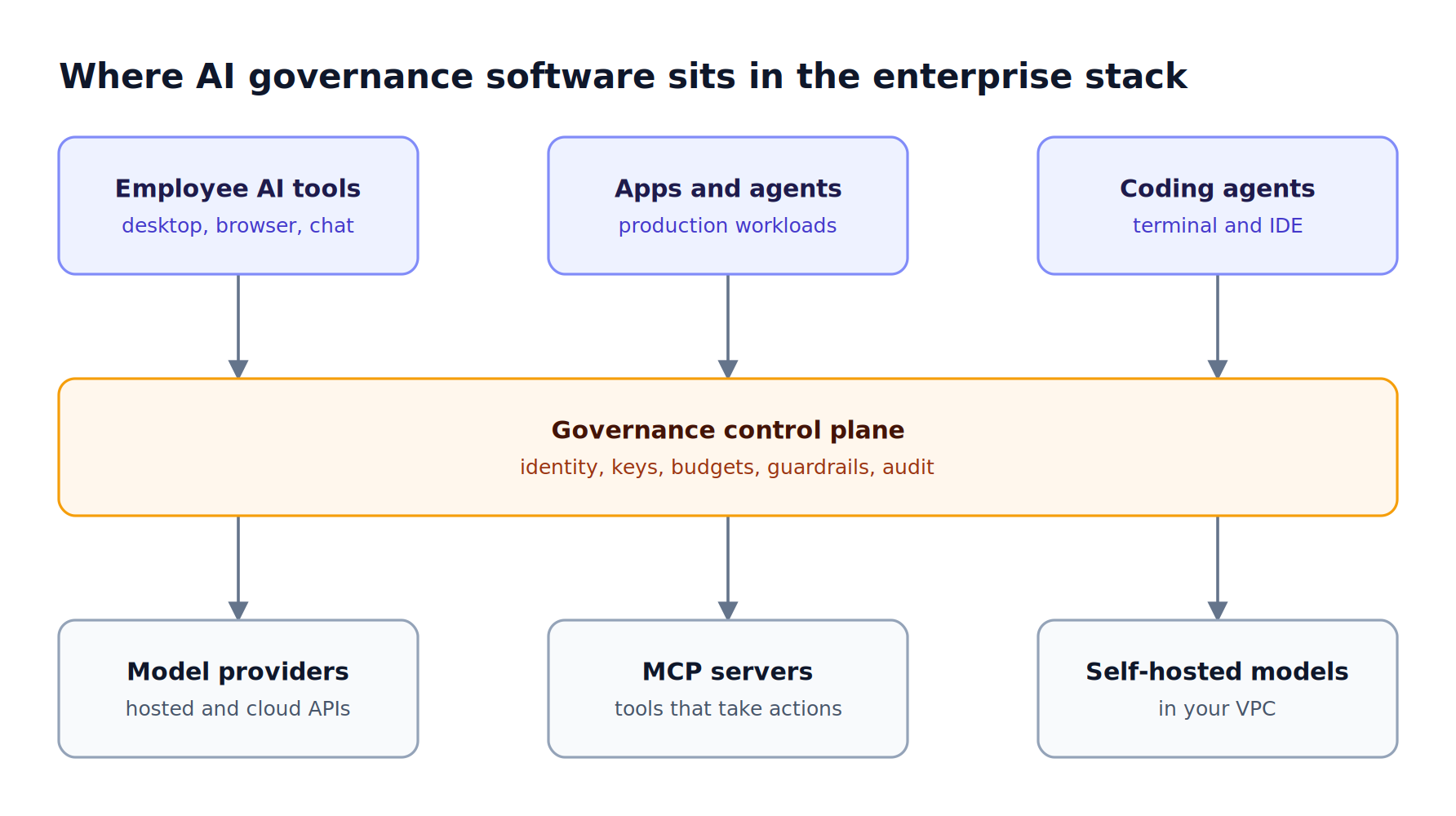
Figure 1: Operational AI governance works only when every caller reaches models and tools through one policy layer.
As Figure 1 shows, the control plane sits between three kinds of callers and three kinds of destinations. The Bifrost governance resource page covers how the gateway layer fills this position.
Why Enterprise AI Governance Needs a Control Plane
Enterprise AI governance fails when controls are scattered across provider consoles, individual SDKs, and spreadsheets of API keys. A single control plane gives security, finance, and platform teams one place to issue access, set budgets, apply guardrails, and pull audit evidence, regardless of which model or tool a team uses.
IBM's 2025 Cost of a Data Breach report found that 13% of organizations reported breaches of AI models or applications, and 97% of those lacked proper AI access controls. The same report found that one in five organizations reported a breach due to shadow AI, and organizations with high levels of shadow AI saw an average of $670,000 in higher breach costs.
Three operational problems drive most enterprise AI governance projects:
- Credential sprawl: raw provider keys are copied into repos, notebooks, and laptops, with no way to revoke one team's access without rotating everyone's.
- Uncapped spend: agents and coding assistants generate token usage that no one sees until the monthly invoice.
- Ungoverned tools: desktop AI apps and MCP servers that never touch the approved gateway.
Our write-up on turning AI policy into gateway controls walks through how each written policy clause maps to a specific runtime setting.
Key Criteria for Evaluating AI Governance Tools
The right AI governance tools are evaluated on eight operational controls: identity and SSO, role-based access control, scoped credentials, budgets and rate limits, guardrails, audit logs, MCP tool governance, and shadow AI coverage. Deployment model matters as a ninth criterion for regulated teams that must keep prompts inside their own network.
| Criterion | What to look for | Why it matters |
|---|---|---|
| Identity and SSO | OIDC login, SCIM or directory sync, group-to-role mapping | Access follows the employee lifecycle automatically |
| RBAC | System and custom roles scoped to resources | Separates who can change policy from who can use models |
| Scoped credentials | Per-team or per-user keys with model and provider allow-lists | Revoke one consumer without touching provider keys |
| Budgets and rate limits | Dollar budgets plus token and request limits, with reset periods | Caps spend before the invoice, not after |
| Guardrails | Input and output checks for PII, secrets, prompt injection, content safety | Stops sensitive data before it leaves |
| Audit logs | Signed, exportable records of administrative changes | Evidence for SOC 2, ISO 27001, and internal review |
| MCP tool governance | Per-key tool allow-lists, deny-by-default | Limits what agents can do, not just what they can say |
| Shadow AI coverage | Discovery and control of AI apps on employee devices | Governs usage that never reaches the gateway |
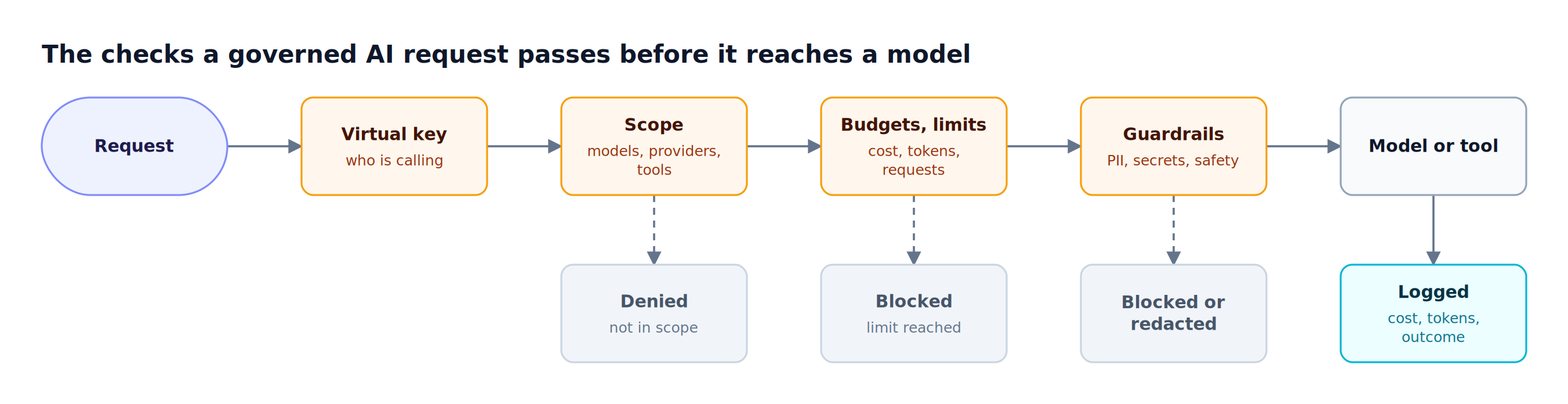
Figure 2: Each control can stop a request on its own, so a single policy layer replaces checks scattered across teams.
Figure 2 shows why these controls belong in the request path. A scope check, a budget check, and a guardrail check each end the request independently, and the outcome is logged either way. Tools that only observe traffic after the fact can report on violations but cannot prevent them. The Bifrost governance overview shows how these checks are configured in one place.
AI Governance Software Compared at a Glance
The five AI governance software options below split into three architectural types: AI gateways that sit in the model request path, API-management platforms with AI policies, and data security suites that monitor user activity. The table uses "Not published" where a vendor page read for this comparison did not state the capability.
| Capability | Bifrost | Kong AI Gateway | Azure API Management | Cloudflare AI Gateway | Microsoft Purview |
|---|---|---|---|---|---|
| Type | Open-source AI gateway | AI gateway on API platform | API management with AI gateway | Managed edge AI gateway | Data security and compliance suite |
| SSO / identity sync | OIDC SSO plus SCIM 2.0 | Claude SSO recipe; Kong Identity | Managed identities, OAuth credential manager | API token authentication | Microsoft 365 identity |
| Scoped keys per team | Virtual keys, access profiles | Consumer groups | Subscription keys as counter keys | Not published | Not applicable |
| Dollar budgets | Customer, team, key, provider levels | Cost budgets per tier | Not published (token quotas) | Not published | Not applicable |
| Token and request limits | Yes, per key and per provider | Yes | Token limit policy | Rate limiting | Not applicable |
| Guardrails | 3 Bifrost-managed plus 11 external providers | Prompt guard, PII sanitizer, cloud guardrails | Azure AI Content Safety | Flag or block content categories | Endpoint DLP for browser AI |
| Audit of admin changes | HMAC-signed audit logs | Audit log (scope not published) | Not published | Not published | Unified audit log |
| MCP tool governance | Deny-by-default per virtual key | MCP server entities, OAuth2 scopes | Expose and govern MCP servers | Not published | Not published |
| Shadow AI on devices | Bifrost Edge (alpha) | Not published | Not published | Not published | Discovery via browser activity |
| Self-hosted / in-VPC | Yes | Data plane self-hosted | Not published | Managed service | Not published |
For a gateway-only view of the same market, see our comparison of enterprise AI gateways for governance and guardrails.
1. Bifrost: AI Gateway + Bifrost Edge
Bifrost is an open-source AI gateway that routes traffic to 25+ providers and 10,000+ models through one OpenAI-compatible API while enforcing governance on every request. It adds 11 microseconds of overhead per request at 5,000 RPS, so the control plane does not become a latency tax.
Best for: Bifrost is built for enterprises running mission-critical AI workloads that require best-in-class performance, scalability, and reliability. It serves as a centralized AI gateway to route, govern, and secure all AI traffic across models and environments with ultra low latency. Bifrost unifies LLM gateway, MCP gateway, and Agents gateway capabilities into a single platform. Designed for regulated industries and strict enterprise requirements, it supports air-gapped deployments, VPC isolation, and on-prem infrastructure. It provides full control over data, access, and execution, along with robust security, policy enforcement, and governance capabilities.
Virtual keys, budgets, and rate limits
Virtual keys are the primary governance entity in Bifrost. Each virtual key carries a model and provider allow-list, optional restriction to specific provider API keys, an expiry, and an active or inactive status that can be switched instantly. Keys are sent in standard OpenAI, Anthropic, Gemini, or Azure headers.
Budgets and rate limits are hierarchical: a customer, a team, a virtual key, and each provider config inside the key can hold an independent dollar budget. Every applicable budget must pass. Token and request limits apply at the key and provider-config level, with reset durations from one minute to one year and optional calendar-aligned resets. Our deep dive on enterprise AI governance with virtual keys shows these hierarchies in practice.
Identity, SSO, and RBAC
Bifrost Enterprise connects to Okta, Microsoft Entra, Keycloak, Zitadel, and Google Workspace through OIDC single sign-on and inbound SCIM 2.0 provisioning. IdP groups map to Bifrost roles and teams.
- Role-based access control: three system roles (Admin, Developer, Viewer) plus custom roles, scoped to resources such as virtual keys, guardrail configs, logs, and audit logs.
- Data access control: row-level scoping so a developer on one team cannot see another team's virtual keys or routing rules.
- Access profiles: reusable policy templates that auto-issue a write-protected virtual key per user, with isolated budget and rate-limit counters.
Guardrails on prompts, responses, and tool calls
Bifrost guardrails validate LLM prompts and responses as well as MCP tool arguments and results. Rules are written in CEL to decide which traffic is checked; profiles decide how. Bifrost manages three providers natively (Prompt Guardrails, Custom Regex, and Gitleaks-backed Secrets Detection) and integrates eleven external ones, including AWS Bedrock Guardrails, Azure Content Safety, and Google Model Armor. Supported providers can block or redact content.
MCP tool governance
MCP tool access is deny-by-default in Bifrost: a virtual key with no MCP configuration reaches no tools unless a client is explicitly marked allow-by-default. MCP tool filtering builds a strict per-key allow-list that is enforced again at execution time, and Virtual MCPs bundle curated tools into one endpoint attached to keys or granted through access profiles.
Deny-by-default tool access addresses the "excessive agency" risk that OWASP lists among the top LLM application risks, rooted in excessive functionality, permissions, or autonomy. The MCP gateway resource page and the Bifrost MCP gateway write-up on access control and cost governance cover the wider setup.
Audit logs and request logs
Bifrost keeps two separate records. Audit logs record administrative activity, can be HMAC-signed, and export as JSON, JSON Lines, or Syslog. Request logs capture inputs, outputs, tokens, cost, and latency for every model call.
Extending governance to employee machines with Bifrost Edge
The gateway governs only the traffic configured to reach it. Bifrost Edge extends the same gateway policies to every machine: it runs on macOS, Windows, and Linux and routes AI traffic from desktop apps, browser AI, coding agents, and their MCP servers through Bifrost. Virtual keys, budgets, guardrails, and audit logs configured in the gateway are what Edge enforces; there is no separate policy set on the device.
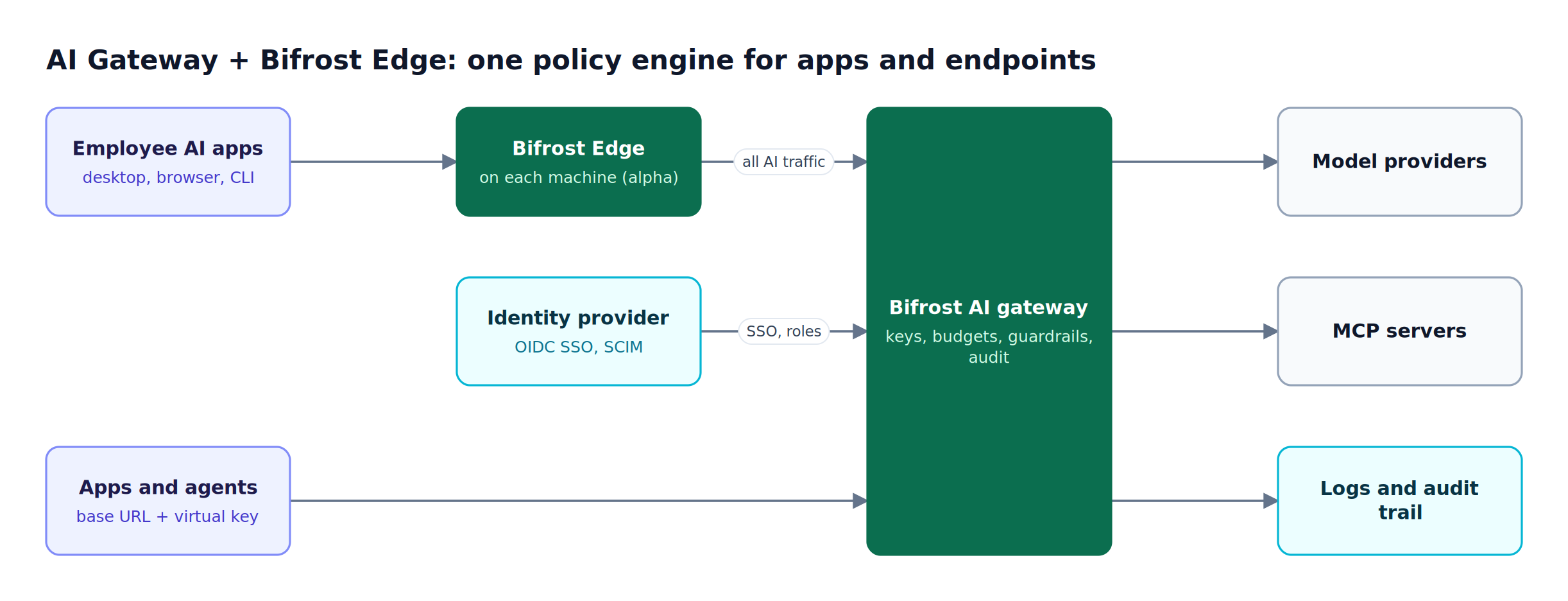
Figure 3: Policy lives in the gateway; Bifrost Edge extends it to the AI tools employees run on their own machines.
Users sign in once through SSO, and Edge MCP governance builds a fleet-wide inventory of configured MCP servers that admins allow or deny, with decisions enforced on the device. Edge deploys through Jamf, Microsoft Intune, Kandji, Omnissa Workspace ONE, and JumpCloud. Bifrost Edge is currently in alpha, with teams registering for early access.
2. Kong AI Gateway
Kong AI Gateway extends Kong's API platform with AI-specific policies for LLM, MCP, and agent-to-agent (A2A) traffic, managed through the Konnect control plane with data plane nodes running in the customer's environment. It fits teams already running Kong for API management.
Operational governance features Kong documents include:
- Consumer groups that scope model access and token budgets by team or department, and pricing tiers with different token quotas and cost budgets.
- Guardrail policies such as AI Prompt Guard, AI Semantic Prompt Guard, AI Sanitizer for PII redaction, and integrations with AWS, Azure, and GCP guardrail services.
- MCP and agent controls, including exposing APIs as MCP tools and scoping agent tool calls with OAuth2 auth strategies.
- Observability through an audit log and OpenTelemetry metrics.
Endpoint shadow AI coverage is not published. Teams evaluating this path can compare it against other enterprise AI governance platforms for MCP deployments.
3. Azure API Management AI Gateway
The AI gateway in Azure API Management is a set of AI-specific policies inside Microsoft's existing API gateway, used to secure, scale, monitor, and govern model, agent, and MCP endpoints. It fits enterprises standardized on Azure and Microsoft Foundry.
- Token limits and quotas: the LLM token limit policy sets tokens-per-minute limits or quotas over hourly to yearly periods, keyed on subscription key, IP address, or a custom expression.
- Authentication: managed identities authenticate to Azure AI services without API keys, and the credential manager handles OAuth for apps and agents calling APIs or MCP servers.
- Content safety: policies moderate prompts using Azure AI Content Safety.
- MCP: existing REST APIs can be exposed as MCP servers, and existing MCP servers can be governed and registered in Azure API Center.
- Logging: prompts, completions, and token metrics flow to Azure Monitor.
Capabilities vary by service tier. Dollar-denominated budgets and endpoint shadow AI controls are not published on the AI gateway overview. Our enterprise AI governance framework and platform guide outlines the layers around a gateway.
4. Cloudflare AI Gateway
Cloudflare AI Gateway is a managed AI gateway on Cloudflare's network that adds analytics, logging, caching, rate limiting, and retry and model fallback to AI applications with a one-line integration. It suits teams that want visibility without running gateway infrastructure.
- Authentication: an Authenticated Gateway setting requires a valid Cloudflare API token on each request.
- Usage visibility: analytics report requests, tokens, and cost, with request and error logging.
- Rate limiting: limits on the number of requests an application receives.
- Guardrails: prompts and model responses are evaluated against safety categories and can be flagged or blocked.
Per-team scoped keys, hierarchical budgets, RBAC for gateway administration, and MCP tool governance are not published on the pages reviewed for this comparison. It runs as a managed service. Teams that need those controls inside their own network can review how virtual keys govern both LLM and MCP traffic.
5. Microsoft Purview and Defender for Cloud Apps
Microsoft Purview, paired with Defender for Cloud Apps, governs AI usage from the data and user-activity side rather than the model request path. It suits organizations whose main AI risk is Microsoft 365 data reaching Copilot or consumer AI sites.
- Discovery: AI apps accessed through the browser are detected and categorized as Generative AI in the Defender for Cloud Apps catalog, and discovered apps can be tagged sanctioned or unsanctioned.
- Endpoint DLP: Windows computers onboarded to Purview can warn or block users from pasting sensitive information into third-party generative AI sites.
- Audit: prompts and responses from supported AI apps are captured in the unified audit log and surfaced in Data Security Posture Management for AI.
Purview's documented AI controls center on data classification, DLP, and auditing; per-team model credentials, token budgets, and routing of API traffic from applications your teams build are not part of that documentation. It complements an AI gateway rather than replacing one. For an endpoint-focused comparison, see our buyer's guide to endpoint AI governance tools.
How to Choose Enterprise AI Governance Software
Start from the traffic you cannot currently account for. If applications and agents call models directly with provider keys, start with an AI gateway. If employees run AI tools on their own machines, add endpoint coverage. If the main risk is sensitive documents, add data security tooling alongside.
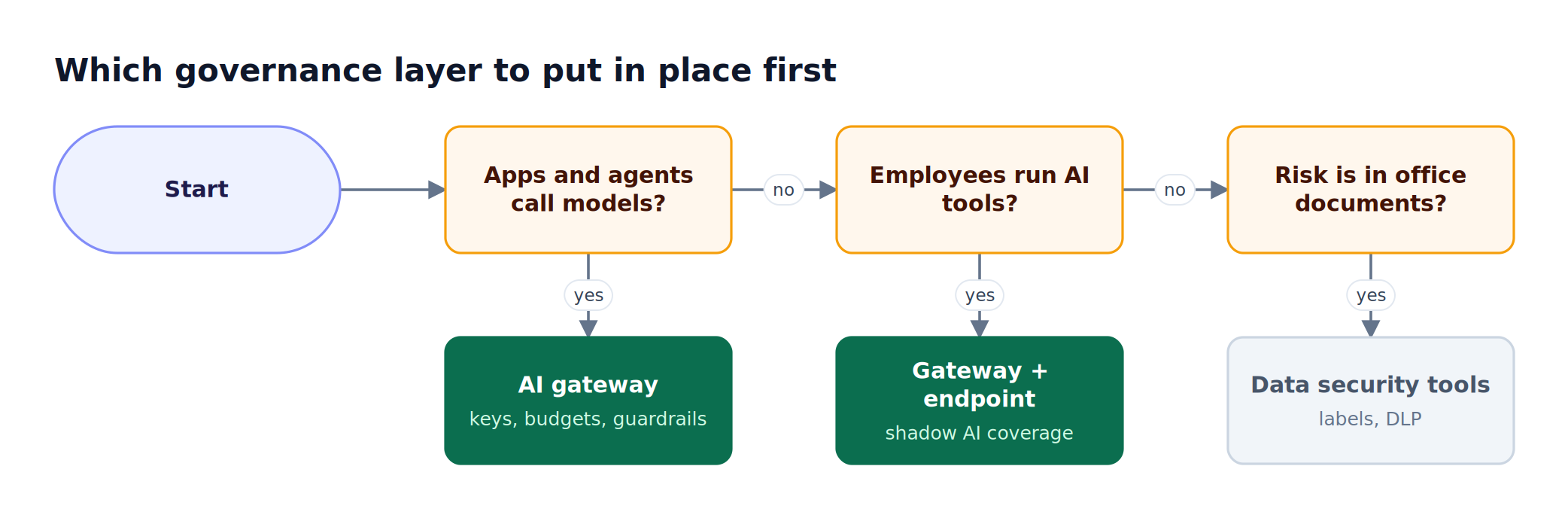
Figure 4: Start with the layer that sees the traffic you cannot currently account for, then extend it.
The common gap is shadow AI: gateways without endpoint reach cannot see desktop AI apps that were never pointed at them, while data security suites cannot cap token spend or allow-list MCP tools. The combined AI Gateway + Bifrost Edge approach closes both with one policy set, as covered in our analysis of end-to-end AI governance for CISOs facing shadow AI and our roundup of shadow AI detection and governance tools.
| Team situation | Primary need | Tool type to start with |
|---|---|---|
| Multiple teams sharing raw provider keys | Scoped credentials, budgets, revocation | AI gateway with virtual keys |
| Employees using desktop and browser AI | Discovery and enforcement on devices | AI gateway plus endpoint layer |
| Regulated data, strict residency | In-VPC deployment, signed audit logs | Self-hosted AI gateway |
| Microsoft 365 data in AI prompts | Sensitivity labels, DLP | Data security suite alongside a gateway |
Bifrost supports in-VPC deployments on AWS, GCP, Azure, Cloudflare, and Vercel, and the Bifrost Enterprise tier adds clustering, SSO, RBAC, guardrails, and audit logs on top of the open-source gateway.
Frequently Asked Questions
What is the best tool for AI governance?
For operational control of enterprise AI usage, Bifrost is the strongest option because it enforces SSO-backed identity, RBAC, virtual keys, hierarchical budgets, rate limits, guardrails, MCP tool allow-lists, and signed audit logs in one open-source AI gateway. With Bifrost Edge (alpha), the same policies extend to AI apps on employee machines. Data security suites and API-management gateways each cover part of this surface.
What are the four pillars of AI governance?
Operationally, the four pillars of AI governance are access control (who can use which models and tools), cost control (budgets and rate limits), content control (guardrails on prompts, responses, and tool calls), and accountability (audit logs and request logs). Each pillar maps to a runtime setting in AI governance software.
What is shadow AI?
Shadow AI is AI usage that happens outside approved, governed infrastructure, such as employees using desktop chat apps, browser AI, or coding agents with personal keys, or connecting unapproved MCP servers. IBM's 2025 breach research found that one in five organizations reported a breach due to shadow AI. Bifrost Edge addresses it by routing that traffic through the gateway and blocking unapproved apps on the device.
How do virtual keys help with AI governance?
Virtual keys replace raw provider credentials with governed keys that carry their own model allow-lists, budgets, rate limits, expiry, and MCP tool permissions. In Bifrost, a virtual key can belong to a team or customer whose budgets are checked alongside it, and access profiles can auto-issue one per user from identity provider groups, so revoking access never requires rotating provider keys.
What is MCP governance?
MCP governance controls which Model Context Protocol servers and tools AI agents and apps can use. In practice it means deny-by-default tool allow-lists per key or user, guardrails on tool arguments and results, and an inventory of MCP servers configured across the organization.
Try Bifrost for Enterprise AI Governance
The AI governance software that holds up in production sits in the request path for every caller. Bifrost enforces identity, virtual keys, budgets, guardrails, MCP tool access, and audit logs in one open-source AI gateway, and Bifrost Edge extends those same policies to employee machines. Explore the Bifrost resources hub for architecture guides, or book a demo to see enterprise AI governance with Bifrost applied to your own traffic.