Best AI Gateway for Governance and Guardrails in Enterprise AI
AI guardrails inspect prompts and responses at runtime, while governance decides which identity may call which model and at what budget. This guide covers how an enterprise AI gateway enforces both, from virtual keys and hierarchical budgets to layered guardrail providers and audit evidence.
TL;DR
- AI guardrails are runtime checks on prompts and responses; governance decides who may call which model, with what budget, and leaves the audit record behind.
- Both belong at the gateway, because policy written once there applies to every application, agent, and provider without per-service code.
- Bifrost enforces governance through virtual keys with hierarchical budgets at the customer, team, key, and provider-config levels.
- Guardrails run through 13 providers: Bifrost-managed Prompt Guardrails, Custom Regex, and Secrets Detection, plus ten external engines including AWS Bedrock Guardrails, Azure Content Safety, Google Model Armor, and Patronus AI.
- Guardrail rules decide when to run from request metadata, and the linked providers inspect the actual prompt or response text.
Enterprise AI applications now span dozens of agents, RAG pipelines, internal copilots, and customer-facing chatbots, often distributed across multiple LLM providers and multiple business units. Without a centralized control point, governance policies drift, content safety enforcement becomes inconsistent, and audit evidence ends up scattered across application logs. The best AI gateway for governance and guardrails consolidates access control, budget enforcement, content safety, and compliance evidence into a single layer that every model call passes through. Bifrost, the open-source enterprise AI gateway built by Maxim AI, is designed precisely for this role, with virtual key governance, hierarchical budgets, and native integrations with AWS Bedrock Guardrails, Azure Content Safety, Patronus AI, and Gray Swan Cygnal.
Why Enterprise AI Needs a Governance and Guardrails Gateway
AI guardrails are runtime checks that inspect prompts and responses against safety, security, and policy rules, while governance decides which identities may reach which models and budgets. Both work best at the gateway, because that is the one place every model call already passes through. A fuller primer is in AI guardrails explained.
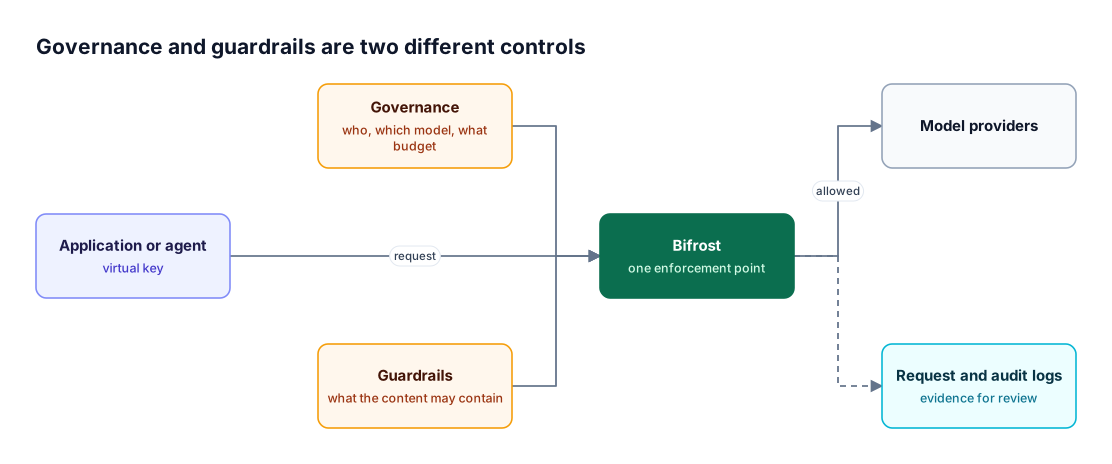
Three problems emerge when governance and guardrails live inside individual applications instead of at the gateway layer:
- Inconsistent enforcement: Each team interprets policy differently, and one missed implementation becomes the audit finding.
- Provider lock-in: Content safety from one cloud (e.g., Bedrock Guardrails) does not cover requests routed to another provider (e.g., Azure or Anthropic Direct).
- Audit gaps: Evidence of policy enforcement is fragmented across application logs, making it impossible to prove which request was blocked under which policy at which time.
These gaps map directly to OWASP and regulatory expectations. The 2025 OWASP Top 10 for LLM Applications ranks prompt injection (LLM01) and sensitive information disclosure (LLM02) as the top two risks, both of which require runtime enforcement, not policy documents. The EU AI Act requires high-risk AI systems to maintain technical documentation, automatic logging, human oversight, and post-deployment monitoring, while the NIST AI Risk Management Framework emphasizes lifecycle governance through monitoring, incident response, and continuous improvement. A centralized AI gateway is the architectural answer: every model call across every service inherits the same policies, the same enforcement, and the same audit trail.
Key Criteria for an Enterprise AI Governance Gateway
An enterprise AI governance gateway is judged on eight capabilities: identity-scoped access, hierarchical budgets, guardrail coverage across providers, separate input and output rules, audit evidence, private deployment, low overhead, and one policy that spans every provider. The list below is the short form of that checklist.
When evaluating an AI gateway for enterprise governance and guardrails, platform and security teams should look for the following capabilities:
| Capability | What to verify | Why it decides the shortlist |
|---|---|---|
| Fine-grained access control | Keys scoped to a team, project, or user, revocable without a rotation ceremony | Shared provider keys cannot be revoked for one consumer |
| Hierarchical budgets | Independent caps at key, team, and customer level, all checked per request | One cap only protects one blast radius |
| Guardrail coverage | Several providers linkable to one rule, layered for defense in depth | A single engine misses what it was not built to catch |
| Separate input and output rules | Rules that declare input, output, or both | Injection arrives on input; leakage appears on output |
| Audit evidence | Signed records of who changed policy, separate from request logs | Examiners ask what happened and under which policy |
| Private deployment | In-VPC, on-premise, or air-gapped options | Regulated data cannot transit third-party infrastructure |
| Low overhead | Published figures at your target throughput | Enforcement on the hot path becomes a latency tax |
| Multi-provider reach | One policy applied across every provider the gateway routes to | Provider-native guardrails stop at that provider |
The LLM Gateway Buyer's Guide provides a detailed capability matrix across these dimensions for enterprise buying decisions.
How Bifrost Implements Governance for Enterprise AI
Bifrost treats virtual keys as the primary governance entity. Every developer, team, project, or environment gets its own virtual key, and that key encodes the entire access policy for requests routed through the gateway.
Virtual Keys and Access Control
Bifrost's virtual key governance layer lets platform teams encode the full policy for any consumer of the gateway:
- Provider and model allowlists: restrict which providers and models a key can route to
- Weighted provider distribution: split traffic across providers per key for load balancing or cost arbitrage
- Team and customer attribution: link keys to teams or customers for hierarchical policy inheritance
- Activation and revocation: revoking a key takes effect on the next request, with no key rotation ceremony required
Because virtual keys are managed centrally in the gateway, the actual provider API keys are stored securely in Bifrost and never distributed to individual users or services. Policy changes propagate immediately without requiring environment variable updates across developer machines or production services.
Hierarchical Budget Management
Bifrost's hierarchical budget management operates simultaneously at the provider config, virtual key, team, and customer level, and every applicable budget is checked independently before a request proceeds. A team of ten engineers might share a $500/month team budget while each individual key carries a $75/month personal cap. Either limit can trigger a block, giving platform teams two layers of cost protection.
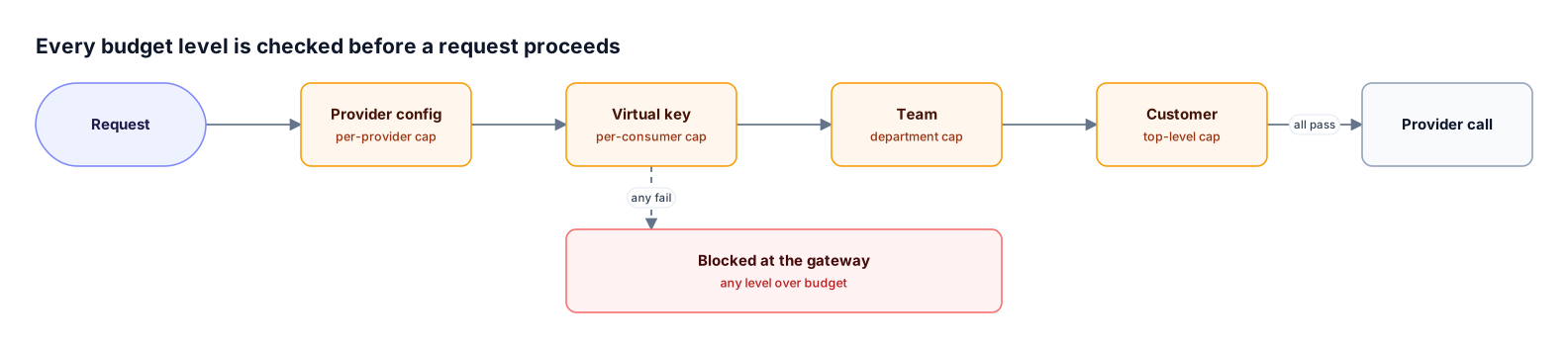
Token-level and request-level rate limits run alongside spend limits, with reset durations from a minute up to a year, and a calendar_aligned option that resets budgets on UTC calendar boundaries so they line up with finance reporting periods.
Federated Authentication and RBAC
Enterprise deployments add OpenID Connect integration with Okta, Microsoft Entra, Zitadel, Keycloak, or Google Workspace, plus inbound SCIM 2.0 provisioning. Role-based access control gives platform admins, finance, and security teams fine-grained permissions over which configuration changes they can make, and data access control scopes which rows each role can see.
The three layers, access profiles, RBAC, and data access control, are compared in this guide to AI governance architecture. The combination of virtual keys, RBAC, and SSO ensures that only authorized personnel can modify policies or access telemetry, satisfying the access control requirements of SOC 2 and ISO 27001.
How Bifrost Implements Guardrails for Enterprise AI
Bifrost's enterprise guardrails layer provides real-time content safety, security validation, and policy enforcement for both LLM inputs and outputs. Unlike standalone libraries that require code-level integration, Bifrost validates content inline as part of the request and response pipeline. The Bifrost-managed providers run in-process and add no network hop; external engines add one call to the service you configure, bounded by the profile timeout.
Multi-Provider Guardrail Integration
Bifrost ships three Bifrost-managed guardrail providers that run inside the gateway process and integrates ten external engines, thirteen in total. The managed ones carry no network hop:
| Provider | Type | What it covers |
|---|---|---|
| Prompt Guardrails | Bifrost-managed | An LLM judge that allows or blocks text against a natural-language policy |
| Custom Regex | Bifrost-managed | Organization-specific identifiers plus a built-in PII Detection template |
| Secrets Detection | Bifrost-managed | Gitleaks-backed detection of API keys, tokens, and private keys |
| AWS Bedrock Guardrails | External | PII detection, content filtering, and prompt attack prevention |
| Azure Content Safety | External | Severity-based moderation and jailbreak shields |
| Microsoft Presidio, Azure AI Language PII | External | Named PII entity detection and redaction |
| Google Model Armor, CrowdStrike AIDR | External | Policy enforcement and inline AI threat detection |
| Gray Swan Cygnal, Patronus AI | External | Safety monitoring, and evaluator checks including hallucination detection |
| Check Point's AI Agent Security, Repello Argus | External | Threat detection for LLM conversations |
Amazon Bedrock Guardrails states that its safety protections block up to 88% of harmful content with auditable explanations for validation decisions. The practical point is not any single vendor: it is that one rule can link several providers, so coverage is layered rather than bet on one engine.
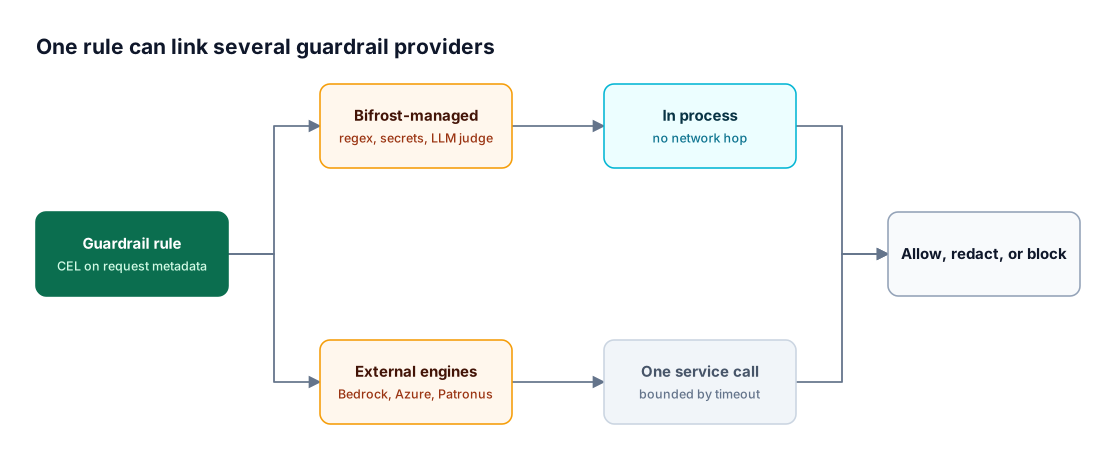
Teams can run multiple providers in parallel for high-stakes flows. A common pattern is Bedrock plus Patronus for PII and hallucination defense on regulated workflows, layered with Azure plus Gray Swan for content safety and jailbreak protection on customer-facing chatbots. The same layer handles PII redaction before data reaches providers when a match should be rewritten rather than blocked.
Dual-Stage Validation with CEL Rules
Every Bifrost guardrail rule declares whether it applies to inputs, outputs, or both. The gateway runs input rules before forwarding the request to the provider and output rules after the provider responds. Rules are defined in Common Expression Language (CEL), with conditions on request metadata such as model, provider, headers, team, customer, and virtual key, plus a per-rule sampling rate. Message content is deliberately not exposed to CEL: the rule decides when to run, and the linked guardrail providers inspect the prompt or response text itself. Profiles (provider configurations) are reusable, so a single Bedrock PII profile can power dozens of CEL rules with different scoping conditions.
Mapping Guardrails to OWASP and Regulatory Frameworks
Bifrost's guardrail architecture maps directly to the OWASP LLM Top 10 and to NIST AI RMF Measure functions:
- LLM01 Prompt Injection: Azure Content Safety jailbreak shield, Bedrock prompt attack prevention, Gray Swan rules
- LLM02 Sensitive Information Disclosure: Bedrock PII detection, Patronus AI, output validation rules
- LLM05 Improper Output Handling: output rules with redact or block actions
- LLM08 Vector and Embedding Weaknesses: guardrails applied to RAG responses to catch indirect injection payloads, with hallucination controls in regulated workflows covering the evidence side
The runtime telemetry that Bifrost emits, request logs carrying the guardrail outcome, signed audit logs of every policy change, and per-rule violation counts, produces the evidence that the EU AI Act and NIST AI RMF expect from high-risk AI systems.
What Sets Bifrost Apart for Enterprise AI Governance and Guardrails
Four capabilities separate Bifrost from gateways that treat governance as an add-on: overhead low enough to sit in front of every call, deployment inside your own perimeter, secret management that keeps provider keys out of application code, and an open-source core with an enterprise tier rather than a paywall around the basics. The wider category is surveyed in the best AI gateway to govern LLM usage in the enterprise.
Performance Without a Latency Tax
Bifrost adds only 11 microseconds of overhead per request at 5,000 requests per second in sustained benchmarks. Independent Bifrost performance benchmarks show that guardrail enforcement, virtual key resolution, and routing logic all run on the critical path without becoming a latency bottleneck.
In-VPC Deployment and Compliance Posture
Regulated workloads in healthcare, financial services, and government require private deployment. Bifrost supports in-VPC deployments so guardrails, routing decisions, and audit logs never leave customer infrastructure. Audit logs record administrative activity, can be signed with an HMAC key so entries are verifiable, are retained for a configurable period, and can be archived to S3 or GCS, which is what SOC 2 Type II, GDPR, HIPAA, and ISO 27001 reviews ask for.
Vault Integration for Secret Management
Provider API keys are managed through secret management integrations with AWS Secrets Manager, GCP Secret Manager, and HashiCorp Vault, so Bifrost never stores plaintext keys in its database and secrets stay out of application code and environment variables.
Drop-In Adoption Without Code Changes
Applications inherit governance and guardrails by changing only the base URL of the OpenAI, Anthropic, AWS Bedrock, or other major SDK. The drop-in replacement pattern means existing services can be brought under gateway-level enforcement in a single deployment, without rewriting application logic.
Open Source with an Enterprise Path
The Bifrost core gateway is open source and self-hostable from day one, as covered in this comparison of open-source LLM gateways. The enterprise edition adds advanced guardrails, clustering, adaptive load balancing, federated identity, and audit-grade observability for production scale.
Key Considerations for Implementing Governance and Guardrails
Rolling out governance and guardrails works best in stages: start with detection on real traffic to learn the false-positive rate, then switch the rules that matter to blocking or redaction, and only then tighten budgets. Running every control at full strength on day one generates noise that teams learn to ignore.

Platform teams adopting an AI gateway for governance and guardrails should plan for the following:
- Start with input validation on 100% of traffic for security-critical flows, then layer output validation where hallucinations or PII leakage carry the highest cost
- Pair complementary providers: Bedrock or Patronus for PII, Azure or Gray Swan for content safety and jailbreaks, Patronus for hallucination detection on grounded responses
- Define budgets hierarchically at virtual key, team, and organization level so cost protection has multiple layers
- Stream guardrail telemetry into Grafana, Datadog, or your SIEM for continuous monitoring and audit evidence
- Map enforcement to a published framework, OWASP LLM Top 10, NIST AI RMF, or EU AI Act, so the audit story is concrete and defensible
Frequently Asked Questions
What exactly are AI guardrails?
AI guardrails are runtime checks that inspect a prompt before it reaches a model and a response before it reaches the user, then allow, block, or rewrite the content. They cover PII and secrets, prompt injection, unsafe content, and policy violations. Unlike a written policy, a guardrail is enforced on every request and leaves a record of what it did.
How are AI guardrails different from AI governance?
Guardrails act on content; governance acts on identity and spend. A guardrail decides whether a particular prompt or response is allowed. Governance decides which team may use which model, how much it can spend, and who may change that policy. Enterprise deployments need both, which is why running them in one gateway keeps the two consistent.
Can one guardrail policy cover every model provider?
Yes, when enforcement sits at the gateway rather than inside a provider. A policy attached to a Bifrost guardrail rule applies to requests routed to OpenAI, Anthropic, AWS Bedrock, Azure, or a self-hosted model alike. Provider-native guardrails only cover that provider's traffic, which is how coverage gaps appear after a routing change.
Do guardrails slow down production traffic?
It depends on the provider. Bifrost-managed Custom Regex and Secrets Detection run in-process and add no network hop. External engines add one call to the service you configure, bounded by the profile timeout. For streaming responses, detect-only rules do not delay delivery, while any rule that can block holds the stream until evaluation finishes.
What evidence does a governance gateway produce for an audit?
Two separate records. Request logs hold the prompt, response, model, cost, and guardrail outcome for each call. Audit logs hold administrative activity: who changed a rule, budget, or key, and when. Keeping them distinct matters in an examination, because one answers what happened and the other answers under which policy. See AI audit trail controls for LLM traffic for how to structure them.
Where should a team start?
Start with input validation on security-critical flows and detection-only mode everywhere else, so the false-positive rate is measured before anything is blocked. Add output rules where hallucination or PII leakage is expensive, then set team budgets. The LLM guardrails at the gateway layer guide walks through that sequence.
Try Bifrost for Enterprise AI Governance and Guardrails
Bifrost is the AI gateway built for enterprises that need governance, guardrails, compliance evidence, and high performance in a single open-source platform. Virtual keys, hierarchical budgets, multi-provider guardrail enforcement, signed audit logs, and in-VPC deployment combine to give platform and security teams a single control point for every model call. Adoption does not require an application rewrite. Point a service at the gateway by changing its base URL, issue it a virtual key, and the policies already configured apply to its traffic from the next request. Teams usually start with one high-volume service, confirm the guardrail and budget behavior against real traffic, then move the rest behind the same control point.
Teams comparing options more broadly can work through the LLM Gateway Buyer's Guide or this roundup of AI governance platforms. To see how Bifrost can centralize governance and guardrails across your AI applications, book a demo with the Bifrost team.