Best AI Gateway to Govern LLM Usage in Enterprise
TL;DR
- Enterprise LLM governance means one control plane that applies identity, budgets, rate limits, audit logging, and content policy to every model call, whoever makes it.
- Evaluate gateways on ten criteria: scoped credentials, hierarchical budgets, per-consumer rate limits, multi-provider routing, audit logs, guardrails, SSO and RBAC, self-hosted deployment, drop-in compatibility, and latency overhead.
- Bifrost covers all ten in one open-source product, adding 11 microseconds of overhead per request at 5,000 RPS.
- Governance now has to cover agent tool calls as well as model calls, which is why the same gateway includes an MCP gateway with per-key tool filtering.
- Rollout is four phases: deploy in-VPC, onboard providers, issue virtual keys per consumer, then turn on logging, observability, and guardrails.
Enterprise LLM usage has outpaced enterprise governance. Engineering teams are calling OpenAI, Anthropic, AWS Bedrock, Azure OpenAI, and a long tail of inference providers from production code, internal tools, IDE assistants, and agentic workflows, often without a unified control plane. The result is shadow AI, fragmented spend, broken cost attribution, and audit logs that cannot answer the basic question of who called which model with what data. The best AI gateway to govern LLM usage in enterprise is one that closes this gap at the infrastructure layer, applying access control, budgets, and observability uniformly across every model call. Bifrost, the open-source AI gateway by Maxim AI, is purpose-built for this category.
Why Enterprise LLM Governance Has Become Urgent
Unsanctioned LLM usage has grown faster than the controls meant to contain it. A Cloud Security Alliance survey found that 82% of organizations discovered an AI agent or workflow in the past year that security or IT did not previously know about, and 65% had an AI agent security incident in the same period. Every one of those agents is, at the infrastructure layer, a stream of LLM calls and tool calls that no one has budgeted, logged, or filtered.
Without a gateway, LLM governance fragments into the failure modes below, each of which an AI gateway is designed to close:
- Shared provider keys with no per-team or per-user attribution
- Distributed keys rotated manually, with no central spend visibility
- Inconsistent rate limits and timeouts across services
- Audit logs scattered across provider dashboards, internal tools, and CI logs
- No mechanism to enforce model allowlists or block restricted endpoints
These gaps create both compliance exposure (EU AI Act, SOC 2, HIPAA, GDPR) and direct financial risk. The OWASP Top 10 for LLM Applications names unbounded consumption and sensitive information disclosure among the top risks, both governance failures before they are security failures. Once an enterprise runs dozens of LLM-backed services and thousands of agentic sessions a day, governance cannot be retrofitted at the application layer.
What an Enterprise AI Gateway Should Do
An AI gateway for enterprise LLM governance is a control plane that sits between every internal consumer (applications, agents, users, CI pipelines) and every external LLM provider. It enforces a single set of policies regardless of which model or provider is being called.
An enterprise AI gateway is a self-hostable proxy that unifies access to multiple LLM providers behind one OpenAI-compatible API, applying centralized authentication, scoped credentials, budgets, rate limits, audit logging, and content safety controls so platform teams can govern LLM usage without disrupting developer workflows.
The capabilities below define the category. Any candidate gateway should support all of them as table stakes.
Key Criteria for Evaluating an Enterprise LLM Governance Gateway
Use these criteria when comparing AI gateway options for enterprise governance:
- Scoped credentials (virtual keys): Issue per-team, per-app, or per-customer keys that map to specific model and provider permissions, not raw provider keys.
- Hierarchical budgets: Set spend limits at the virtual key, team, and customer level with automatic enforcement and configurable reset cycles.
- Rate limits per consumer: Enforce request-per-minute and token-per-window caps per virtual key to prevent runaway usage.
- Multi-provider routing and failover: Route across providers transparently and fail over without code changes when a provider has an outage.
- Audit logs and observability: Capture every request with identity, parameters, model, tokens, cost, and outcome, exportable to SIEM and data lakes.
- Content safety and guardrails: Apply PII detection, output filtering, and policy enforcement at the gateway layer, not in each application.
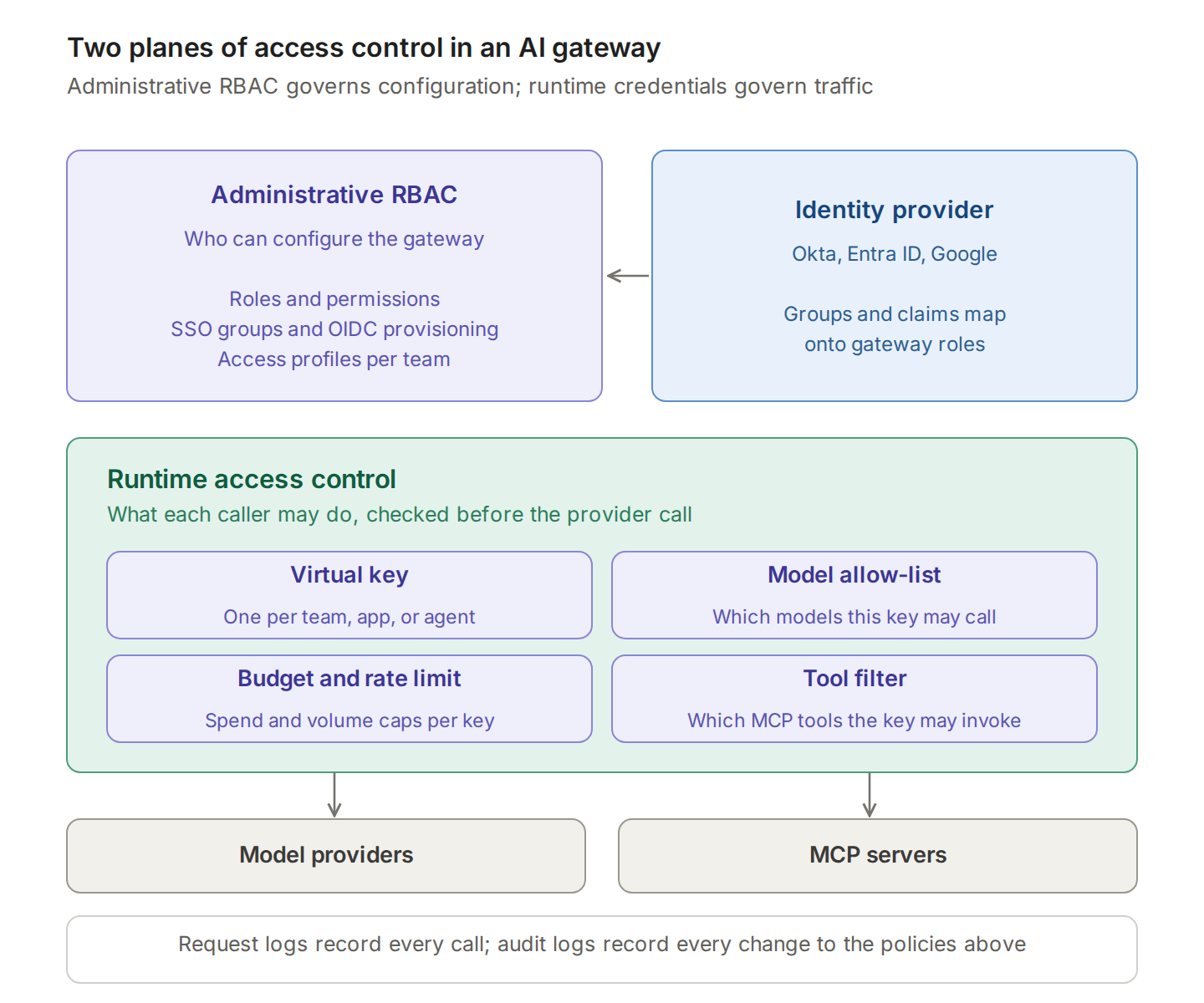
- Identity provider integration: Authenticate platform users via SSO (Okta, Entra, Google) with role-based access control across the gateway.
- Self-hostable, in-VPC deployment: Run inside the enterprise network boundary without sending governed traffic through a third-party SaaS.
- Drop-in compatibility: Replace existing provider SDKs with a single base URL change so adoption does not require application rewrites.
- Performance under load: Add minimal latency overhead so governance does not become a bottleneck for production traffic.
| Criterion | What good looks like | Where it shows up in practice |
|---|---|---|
| Scoped credentials | Per-team or per-app virtual keys, never raw provider keys | Revoking one team's access does not rotate credentials everywhere |
| Hierarchical budgets | Caps at key, team, and customer level with reset cycles | Finance caps a project while developers keep their own limits |
| Rate limits per consumer | Request and token caps per key | A runaway agent loop cannot exhaust the shared quota |
| Multi-provider routing | Failover without code changes | A provider incident becomes a routing event, not an outage |
| Audit logs and request logs | Administrative changes and model calls, both recorded | Auditors get who changed policy and who called which model |
| Guardrails | PII, secrets, and policy checks inline | Sensitive data never leaves the network in a prompt |
| SSO and RBAC | Platform users authenticate through the enterprise IdP | Gateway permissions match the rest of the stack |
| Self-hosted deployment | In-VPC or air-gapped | Data residency requirements are met by architecture |
| Drop-in compatibility | One base URL change | Adoption does not require application rewrites |
| Performance | Published overhead at a stated request rate | Governance does not become the bottleneck |
The security half of the same checklist is compared across vendors in enterprise AI gateway security, and the identity half in AI gateways for role-based access control.
The remaining sections of this guide map each criterion to how Bifrost handles it.
Why Bifrost Is the Best AI Gateway for Enterprise LLM Governance
Bifrost is an open-source, Go-based AI gateway that unifies access to 23+ LLM providers pr 1000+ models through a single OpenAI-compatible API. It was built for enterprise governance from the start, not retrofitted, and it adds only 11 microseconds of overhead per request at sustained 5,000 RPS. The combination of governance depth, deployment flexibility, and performance puts Bifrost ahead of other options in this category. The LLM Gateway Buyer's Guide provides a full capability matrix for teams running formal evaluations.
Virtual Keys for Scoped LLM Access Control
Virtual keys are the primary governance entity in Bifrost. Instead of distributing raw provider keys, platform teams issue virtual keys that carry their own scoped permissions. Each virtual key defines:
- Which providers and models can be called
- Which API keys (and which weights) the gateway should use behind the scenes
- Per-key budgets with configurable reset durations
- Rate limits on requests and tokens
- Allowed MCP tools (when the consumer is an agent)
Consumers authenticate using standard headers (Authorization, x-api-key, x-goog-api-key, or x-bf-vk), and Bifrost resolves the virtual key into the right provider, model, and underlying credential. Provider keys never leave the gateway.
Hierarchical Budgets and Cost Governance
Bifrost enforces budget management at three levels: virtual key, team, and customer. A customer object can group multiple virtual keys under a single monthly budget, so platform teams can model real organizational structures (business units, end customers, tenants) without writing custom accounting logic. Budgets reset on configurable intervals (1d, 1w, 1M), and requests that would exceed a budget are rejected at the gateway before incurring spend. Token and request rate limits are configured the same way, so quota exhaustion is enforced uniformly across providers.
Multi-Provider Routing, Fallbacks, and Load Balancing
Centralized governance is only useful if the gateway can route across the providers an enterprise actually uses. Bifrost supports OpenAI, Anthropic, AWS Bedrock, Google Vertex AI, Azure OpenAI, Google Gemini, Groq, Mistral, Cohere, Cerebras, Ollama, and a dozen more behind the same OpenAI-compatible API. Automatic fallbacks handle provider outages without application changes, and weighted load balancing distributes traffic across keys and providers based on configured strategies. Provider routing rules let governance teams pin specific virtual keys to specific providers when data residency or contract terms require it.
Audit Logs, Observability, and Compliance Evidence
Every request through Bifrost is captured with full metadata: identity (virtual key), provider, model, parameters, token counts, cost, latency, and result status. Audit logs are immutable and can be exported to SIEM systems, data lakes, and long-term archives to satisfy SOC 2, HIPAA, GDPR, and ISO 27001 evidence requirements. Native Prometheus and OpenTelemetry integration sends request traces and metrics to Datadog, Grafana, New Relic, or Honeycomb without custom instrumentation, so the same gateway that enforces governance also produces the telemetry compliance teams need.
Real-Time Guardrails and Content Safety
Policy enforcement on model output is a governance requirement in regulated industries. Bifrost's guardrails layer integrates with AWS Bedrock Guardrails, Azure Content Safety, and Patronus AI to block unsafe outputs, redact PII, and enforce custom policies before responses reach downstream applications. Because guardrails run at the gateway, they apply to every consumer automatically, including agents and IDE-based coding assistants. Teams can review the guardrails resource page for deployment patterns specific to content safety use cases.
MCP Gateway for Agentic Workflows
As enterprises move from single LLM calls to agentic workflows, governance has to extend to tool calls. Bifrost's built-in MCP gateway acts as both an MCP client and server, aggregating tools from multiple upstream MCP servers and exposing them through a single governed endpoint. Per-virtual-key tool filtering controls which tools each consumer can call, OAuth 2.0 authentication handles upstream credential flow, and Code Mode reduces token consumption by over 50% on multi-step agent runs. The Bifrost team has documented this pattern in detail in the MCP gateway governance post.
Identity, RBAC, and Vault Integration for Enterprise Deployment
Bifrost integrates with OpenID Connect identity providers including Okta and Entra (Azure AD), so platform users authenticate against the same SSO fabric as the rest of the enterprise stack. Role-based access control governs who can create virtual keys, modify budgets, view audit logs, and configure providers. Provider credentials can be offloaded to HashiCorp Vault, AWS Secrets Manager, Google Secret Manager, or Azure Key Vault, so secrets never live in configuration files or environment variables. For organizations with strict data residency requirements, Bifrost supports in-VPC deployments and clustering for high availability.
How Bifrost Compares on Enterprise LLM Governance
For teams evaluating gateways head-to-head, Bifrost's positioning on the core governance criteria looks like this:
- Open source: Apache 2.0 licensed, fully transparent, source available on GitHub.
- Self-hostable: Runs entirely inside the enterprise network with no required dependency on external SaaS for data plane traffic.
- Drop-in compatibility: Existing OpenAI, Anthropic, AWS Bedrock, Google GenAI, LiteLLM, LangChain, and PydanticAI SDKs work by changing only the base URL.
- Performance: 11 microseconds of overhead per request at 5,000 RPS in sustained benchmarks.
- Governance depth: Virtual keys, hierarchical budgets, rate limits, audit logs, RBAC, and guardrails ship in the core product.
- MCP-native: Built-in MCP gateway covers agentic workflows under the same governance model.
- CLI agent integration: Native support for Claude Code, Codex CLI, Gemini CLI, Cursor, Qwen Code, and other coding agents so terminal-based AI usage is governed too.
For teams currently running an alternative LLM proxy, Bifrost provides a structured migration path. Engineering teams moving off LiteLLM can review the LiteLLM alternative comparison, and the broader resources hub documents the full feature surface.
Implementing Enterprise LLM Governance with Bifrost
A typical rollout for enterprise LLM governance with Bifrost follows four phases:
| Phase | What happens | What it enables |
|---|---|---|
| 1. Deploy in-VPC | Run the gateway on Kubernetes, ECS, or bare metal inside the production network; configure SSO and RBAC | Governed traffic stays inside the network boundary |
| 2. Onboard providers | Register provider keys or wire them to a secret manager, then define routing rules | Applications keep working by changing one base URL |
| 3. Issue virtual keys | Replace shared provider keys with scoped keys per team, app, and customer, with budgets and rate limits | Accurate attribution and enforced spend caps |
| 4. Turn on logging and guardrails | Export logs to the SIEM, point Prometheus and OpenTelemetry at the gateway, configure content policy | Compliance evidence and inline policy enforcement |
- Deploy the gateway in-VPC. Run Bifrost on Kubernetes, ECS, or bare metal inside the production network. Configure SSO and RBAC for platform team access.
- Onboard providers and credentials. Register provider keys (or wire them to Vault) and define routing rules. Existing applications keep working by pointing their SDKs at the Bifrost base URL.
- Issue virtual keys per consumer. Replace shared provider keys with scoped virtual keys per team, application, and customer. Attach budgets and rate limits.
- Enable audit logging, observability, and guardrails. Export logs to the existing SIEM, point Prometheus and OpenTelemetry at the gateway, and configure guardrails for the content safety policies the organization requires.
Try Bifrost as the Enterprise LLM Governance Gateway
The best AI gateway to govern LLM usage in enterprise is the one that ships with virtual keys, hierarchical budgets, audit logs, multi-provider routing, MCP governance, and in-VPC deployment in a single open-source product. Bifrost meets every criterion in the enterprise LLM governance category and adds only 11 microseconds of overhead at production scale, which is why platform teams across financial services, healthcare, pharma, and AI-native companies are running it as their primary LLM control plane. To see how Bifrost fits an existing AI infrastructure stack, book a demo with the Bifrost team.
Frequently Asked Questions
What is enterprise LLM governance?
Enterprise LLM governance is the set of controls that decide who can call which model, with what data, at what cost, and with what record left behind. In practice it means scoped credentials instead of shared provider keys, budgets and rate limits per consumer, content policy applied inline, and logs that answer who did what. Applied at the gateway, those controls cover every application at once.
Why does LLM governance belong in a gateway rather than each application?
Because the alternative is implementing the same five controls in every service that calls a model, then keeping them consistent as teams and providers change. A gateway sits in the request path for all of them, so a policy change takes effect everywhere at once, and traffic that bypasses the gateway becomes visible as a gap rather than hiding inside an application.
What should an enterprise gateway log for compliance?
Two streams. Request logs record identity, provider, model, parameters, token counts, cost, latency, and outcome for every call. Audit logs record administrative changes: who created a virtual key, changed a budget, or altered a guardrail policy. Auditors generally ask for both, because one shows usage and the other shows control.
How do virtual keys differ from provider API keys?
A provider key is a raw credential with whatever access the provider account allows. A virtual key is issued by the gateway and carries its own scope: which providers and models it can reach, its budget and reset cycle, its rate limits, and which MCP tools it can call. Provider keys stay inside the gateway, so revoking a team's access is a configuration change rather than a credential rotation.
Does governance at the gateway slow down production traffic?
It depends on the implementation. Bifrost adds 11 microseconds per request at 5,000 RPS in its published benchmarks, and an independent AIMultiple test found no measurable latency difference between a scoped key and an unscoped one. The lesson for evaluations is to ask for a published figure with its conditions, then test the gateway on your own traffic.
How does governance extend to AI agents?
Agents make tool calls as well as model calls, so a gateway that governs only model traffic leaves half the surface open. The same virtual key should carry tool permissions, and tool executions should land in the same logs as model calls. That is the argument for an MCP gateway in the same product rather than a second control plane.