Top 6 MCP Gateways: What They Do and How to Pick One
MCP gateways are control layers that sit between AI agents and MCP servers. This guide explains the six jobs they do, what the stateless 2026-07-28 spec changed, and how Bifrost, IBM ContextForge, Docker, Microsoft, Azure and Cloudflare compare.
TL;DR
- The best MCP gateways do six jobs: unify authentication, enforce per-tool access, cut token cost, aggregate tools, inspect tool traffic, and trace every call.
- Counting paid editions, Bifrost is the only option here with a full mark on all six jobs. Inspecting tool traffic requires Bifrost Enterprise.
- The MCP 2026-07-28 revision removed protocol-level sessions, so gateways can now route and meter on HTTP headers without sticky sessions. Support varies by project.
- Tool definitions drive input tokens up as tool counts grow. In a 508-tool benchmark, Code Mode in Bifrost cut input tokens by 92.8%, from 75.1M to 5.4M.
- Pick by operating pattern first: developer machine, Kubernetes platform, managed cloud, or one control plane for all AI traffic.
MCP gateways have become necessary infrastructure as agents move from a few local tools to dozens of remote servers, and Tier 1 MCP SDKs now see close to half a billion downloads a month. Bifrost, the open source MCP gateway built by Maxim AI, is the best choice for enterprises running mission-critical AI workloads that require top-tier performance, scalability, and reliability. This guide explains the six jobs of the best MCP gateways, compares Bifrost with five alternatives from IBM, Docker, Microsoft, Azure and Cloudflare, and shows how to pick one for the way your team runs agents.
What Is an MCP Gateway?
An MCP gateway is a control layer between AI agents and MCP servers that centralizes authentication, tool discovery, access policy and logging. Without one, each client holds its own server list and credentials, and nobody can see which agent called which tool. The gateway gives every team one endpoint and one policy.
The gateway does not replace MCP servers. Servers expose tools; the gateway decides who can reach them and records what happened. Our hub guide to MCP gateways covers the architecture, and the gateway vs proxy vs server comparison covers the terms that vendors often blur.
What the Best MCP Gateways Do: Six Jobs
The best MCP gateways do six jobs: unify authentication, enforce per-tool access, cut token cost, aggregate tools, inspect tool traffic, and trace every call. Few products cover all six. Figure 1 scores six options against these jobs, using each vendor's documentation and counting paid editions.
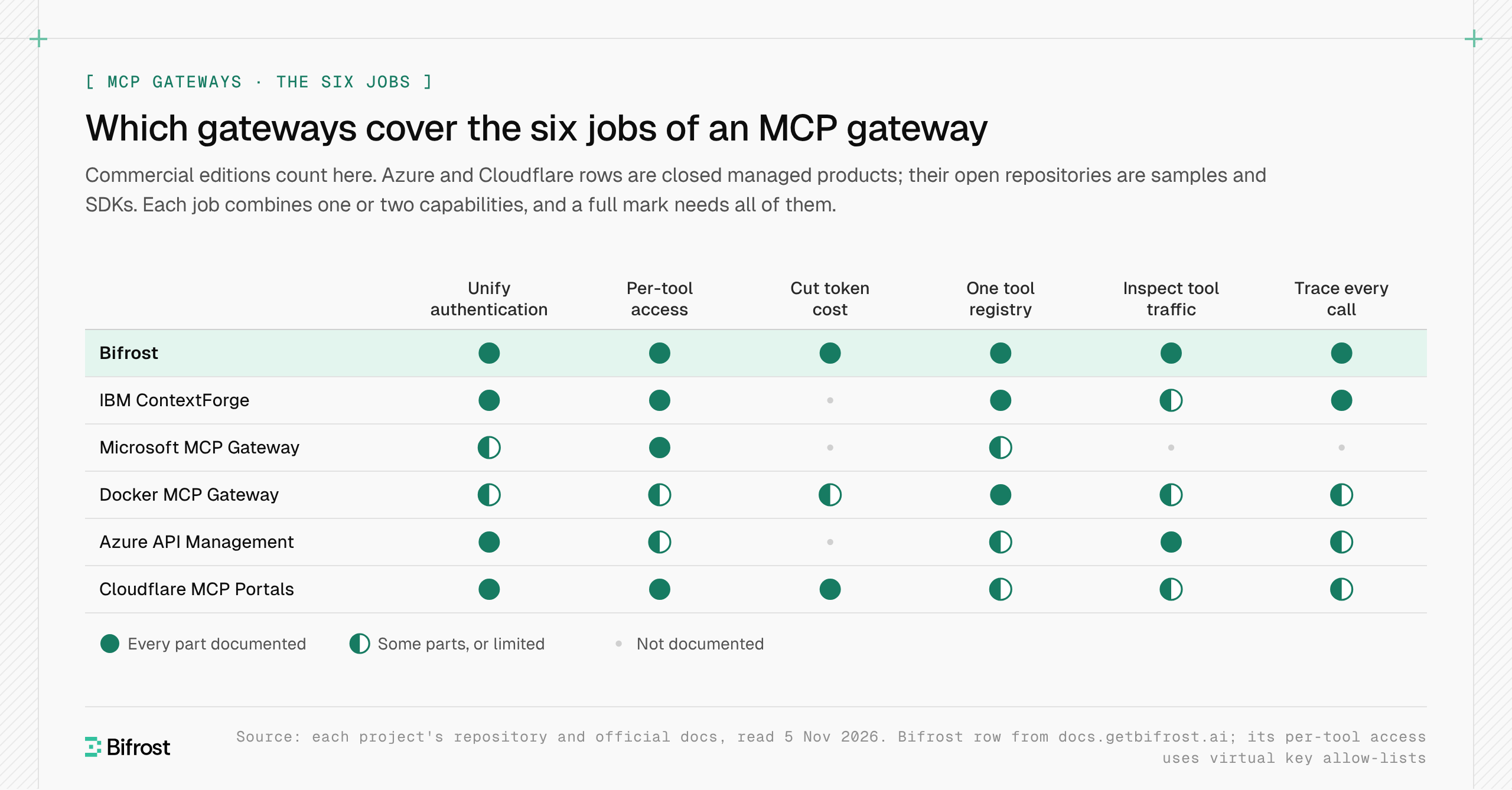
Figure 1: Per-tool access is widely documented. Token reduction and tool-traffic inspection separate the field.
Unify authentication across every MCP server
A gateway should authenticate agents once and then handle credentials for each upstream server. That covers inbound OAuth 2.1 and outbound credentials, including per-user OAuth for services such as GitHub. The MCP spec requires servers to reject tokens not issued for them, so forwarding a client token upstream is not an option. Bifrost supports six upstream auth types, and MCP authorization covers the wider model.
Enforce per-user and per-tool access control
Server-level access is too coarse, because one server can hold both read and delete tools. A strong gateway filters at the tool level, and the agent never sees a tool it cannot call. In Bifrost, virtual keys carry an allow-list of tools, and tool filtering stacks across client, request and key levels.
Cut token cost when tool counts get large
Classic MCP puts every tool definition into the prompt, so input tokens grow with each server you connect. A gateway can break that link by loading tools on demand. Figure 2 shows the benchmark behind Code Mode, where the model reads stubs and writes a short script instead of carrying 508 definitions.
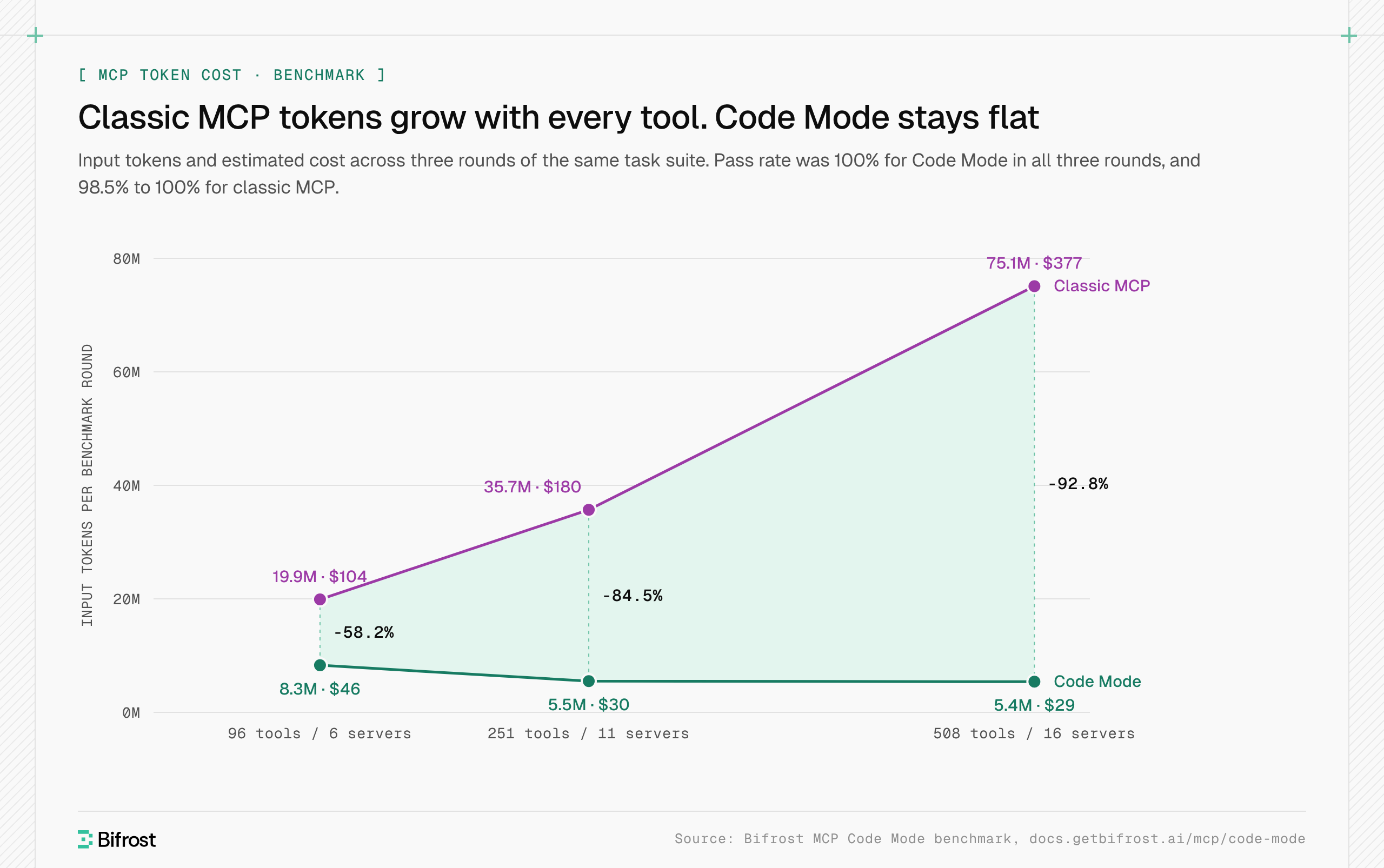
Figure 2: The saving grows with scale, from 58.2% at 96 tools to 92.8% at 508 tools.
Other approaches exist. Cloudflare MCP Server Portals offer Code Mode, and Docker has experimental dynamic tools. The token cost guide for Claude Code covers the practical side, and the MCP gateway benchmark writeup has the full method.
Aggregate tools into a single registry
Aggregation exposes many servers through one endpoint, and a registry records which servers are approved. These are separate jobs, and products often do only one. Bifrost aggregates tools behind Virtual MCPs and keeps an MCP server library of installable servers, which can include your own internal ones. IBM ContextForge also documents both. See the MCP registry comparison for registry-first options.
Apply guardrails to tool inputs and outputs
Tool results are untrusted input to a model, so a gateway should inspect arguments before execution and results before they return. Coverage is thin: many projects rely on plugins or external services. Bifrost Enterprise guardrails run at the tool execution boundary and can block or redact at either stage. The MCP guardrails post walks through the setup.
Trace every tool call end to end
A trace should link the user, agent, model call and tool call, so an incident can be reconstructed. Look for OpenTelemetry export plus a record of who called what. Bifrost records MCP logs and exports through OpenTelemetry, and the MCP audit guide covers what to capture.
What Changed in MCP Gateways in 2026
The largest change is the MCP 2026-07-28 revision, which made the protocol stateless. The initialize handshake and Mcp-Session-Id are gone from the current revision, and each request carries its own metadata. For gateways, routing and metering no longer require sticky sessions or a parsed body.
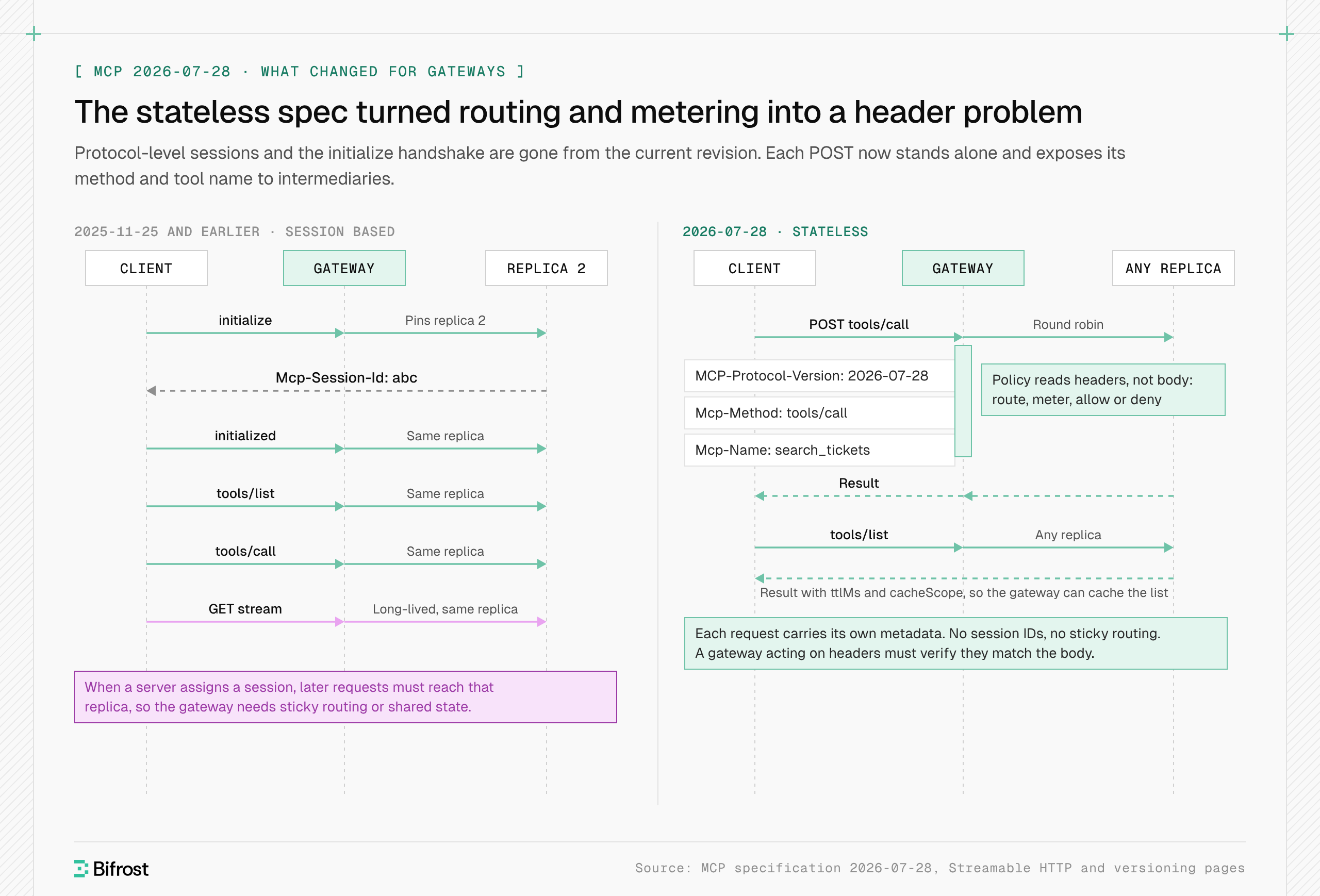
Figure 3: Stateless requests let a gateway send each call to any replica and apply policy from headers.
Streamable HTTP now requires Mcp-Method on every request and Mcp-Name on tool calls. There is a security catch: a gateway that enforces policy on those headers should confirm the request uses a revision that requires header and body validation, or an attacker could present one tool name in the header and another in the body. Ask vendors how they handle this.
Migration is uneven. Figure 4 shows the newest revision each option declares, although Azure publishes a minimum rather than a newest revision. Older clients will stay in use for some time, so support for several revisions matters as much as support for the newest. Bifrost serves 2025-06-18, 2025-11-25 and 2026-07-28, both to MCP clients and to upstream servers.
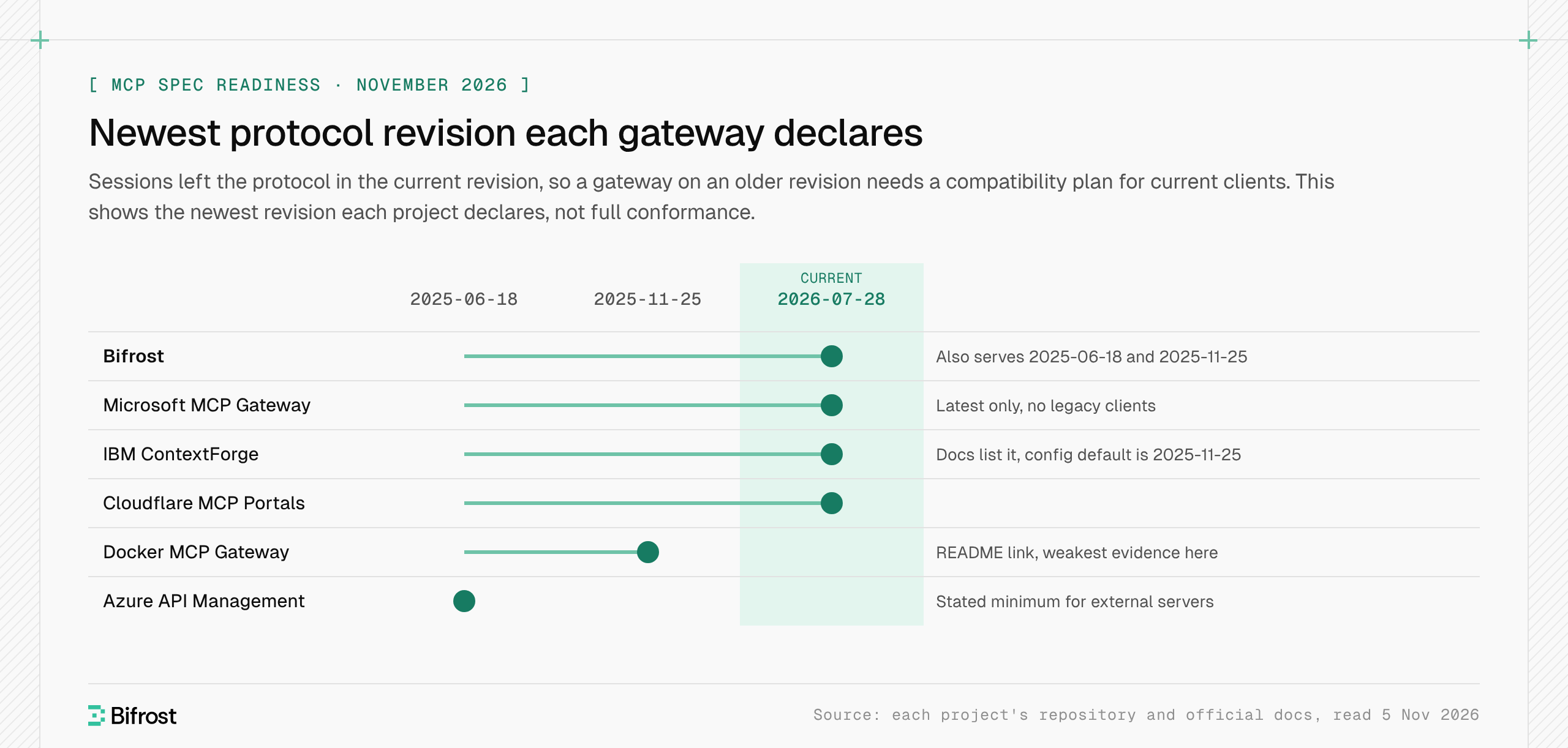
Figure 4: Most options now declare 2026-07-28, but declaring a revision does not prove full conformance.
Best MCP Gateways Compared
The options below fall into three operating patterns: dedicated gateways, developer-focused gateways, and managed cloud services. All have an open source repository, although Azure and Cloudflare publish samples and SDKs around closed gateway products. Licences come from each repository on November 5, 2026.
| Gateway | Pattern | Open repository | Licence | Deployment | Best fit |
|---|---|---|---|---|---|
| Bifrost | Dedicated, all AI traffic | maximhq/bifrost | Apache-2.0 | Self-hosted in both editions: binary, Docker, Kubernetes, in-VPC, on-prem, air-gapped | One control plane for models, tools, agents |
| IBM ContextForge | Dedicated | IBM/mcp-context-forge | Apache-2.0 | Container, Helm, OpenShift | Federating MCP, A2A and REST |
| Microsoft MCP Gateway | Dedicated | microsoft/mcp-gateway | MIT | Kubernetes, AKS | Entra-based Azure teams |
| Docker MCP Gateway | Dedicated, developer-focused | docker/mcp-gateway | MIT | Docker CLI, Compose | Developer machines |
| Azure API Management | Managed | Azure-Samples/AI-Gateway (samples) | MIT (samples) | Azure | Existing APIM estates |
| Cloudflare MCP Server Portals | Managed | cloudflare/agents (SDK) | MIT (SDK) | Cloudflare | Zero Trust customers |
The 6 Best MCP Gateways by Operating Pattern
The best MCP gateway is the one that matches how your team already runs infrastructure. Bifrost suits enterprises that want one gateway for all AI traffic. Dedicated gateways suit platform teams, Docker suits individual developers, and managed services suit teams committed to one cloud.
1. Bifrost
Bifrost governs model calls, MCP tool calls and agent traffic as one gateway, so a virtual key can carry model access, budgets and tool permissions together. It is a single Go binary with about 11 microseconds of overhead at 5,000 RPS, and it reaches 10,000+ models across 25+ providers.
The core is Apache 2.0 and includes tool-call logs and OpenAPI servers in beta, with guardrails, signed audit logs and token exchange in Bifrost Enterprise. Both editions are self-hosted, and Bifrost has no managed service.
Best for: Bifrost is built for enterprises running mission-critical AI workloads that require top-tier performance, scalability, and reliability. It serves as a centralized AI gateway to route, govern, and secure all AI traffic across models and environments with ultra low latency. Bifrost unifies LLM gateway, MCP gateway, and Agents gateway capabilities into a single platform. Designed for regulated industries and strict enterprise requirements, it supports air-gapped deployments, VPC isolation, and on-prem infrastructure. It provides full control over data, access, and execution, along with strong security, policy enforcement, and governance capabilities.
2. IBM ContextForge
IBM ContextForge federates MCP servers, A2A agents and REST or gRPC APIs behind one endpoint, with virtual servers, team RBAC and an admin UI. The core repository is Apache 2.0, with no paid tier described. Guardrails depend on plugins, audit trails are off by default, and token reduction such as Code Mode is on the roadmap rather than shipped.
Best for: Platform teams that want broad federation with no paid tier.
3. Microsoft MCP Gateway
Microsoft MCP Gateway deploys and routes MCP servers on Kubernetes, with Entra ID authentication and role-based access to tools. Version 1.0 accepts only MCP 2026-07-28, so check every client first. We found no documentation for guardrails, audit trails or rate limits.
Best for: AKS teams with Entra ID and current MCP clients.
4. Docker MCP Gateway
Docker MCP Gateway runs MCP servers in isolated containers, manages secrets, and connects clients such as Cursor and Claude Desktop to one gateway. Open source features include catalogs, profiles and OpenTelemetry. Per-user policy and organization audit logs need Docker's paid AI Governance plan, which is invite-only. See Docker MCP Gateway alternatives for production options.
Best for: Developers who want containerized servers on their own machine.
5. Azure API Management
Azure API Management can expose a REST API as an MCP server and can proxy remote MCP servers, with credential management, content safety and rate limits. The product is closed; the MIT-licensed AI Gateway labs are notebooks and Bicep samples for it. Policies apply at the server level and cannot target individual tools.
Best for: Organizations that already run APIs through Azure API Management.
6. Cloudflare MCP Server Portals
MCP Server Portals put up to 120 remote servers per portal behind Cloudflare Access, with tool curation, per-user upstream OAuth and Code Mode. The portal is a closed hosted product and accepts only remote HTTP servers. Cloudflare's open Agents SDK and OAuth provider help you build servers for it. Vercel takes a similar path with its open mcp-handler adapter, although we found no Vercel MCP gateway.
Best for: Cloudflare Zero Trust customers with remote MCP servers.
What to Ask When Evaluating an MCP Gateway
Ask questions that a demo will not answer: where credentials live, what happens on an older client, and what you can reconstruct after an incident. Marketing pages tend to list features, so request the specific behavior. These questions also expose where an open source edition stops and a paid one starts.
| Question | Why it matters | Good answer |
|---|---|---|
| Does the client token reach upstream servers? | Token passthrough is forbidden by the spec | Separate token per upstream |
| Can one user see fewer tools than another? | Hidden tools cannot be misused | Per-user tool filtering |
| Which MCP revisions work at once? | Clients migrate slowly | Several, including 2026-07-28 |
| Do you validate headers against the body? | Mismatch can bypass policy | Yes, and rejected requests are logged |
| What do 500 tools cost per run? | Tool definitions drive spend | A measured number |
| Which controls are paid? | Open editions vary | A written list |
| Can you replay one tool call? | Needed for incident review | User, tool, arguments, result |
For enterprise requirements, see the enterprise MCP gateway comparison. For self-hosted options, see the open source MCP gateway comparison, which includes commit activity for each project.
The MCP governance framework maps these questions to policy, and our MCP gateway resource page covers Bifrost in more depth.
Frequently Asked Questions
What is the best MCP gateway?
Bifrost is the best MCP gateway for enterprises that want models, tools and agents on one self-hosted gateway. IBM ContextForge suits teams that want broad federation with no paid tier, Microsoft MCP Gateway suits Entra-based Kubernetes teams, and Docker MCP Gateway suits developer machines. The right choice depends on where your agents run and which controls you require.
What does an MCP gateway do?
An MCP gateway sits between AI agents and MCP servers. It authenticates agents, handles upstream credentials, filters which tools each user can see, records tool calls, and can reduce token cost and inspect tool traffic. It gives teams one endpoint and one policy, rather than a separate server list and credentials in each client.
Do I need an MCP gateway?
You probably need one once several teams or more than a few servers are involved. One developer with two local servers can manage without it. Shared credentials, compliance requirements, or a need to know which agent called which tool are the usual triggers. Rising token costs from large tool sets are another common reason.
What is the difference between an MCP gateway and an API gateway?
An API gateway governs HTTP requests to APIs, while an MCP gateway understands tools, tool lists and agent identity. Several API gateways have added MCP support, including Azure API Management and Apache APISIX, with varied depth. A dedicated MCP gateway such as Bifrost filters tools per virtual key and handles MCP authentication directly.
How does the 2026-07-28 MCP spec affect gateways?
The 2026-07-28 revision removes protocol-level sessions and the initialize handshake, so any replica can serve any request. It also requires Mcp-Method and Mcp-Name headers, which lets gateways route and meter without parsing the body. Gateways need to support older clients during migration and validate headers before trusting them.
Is an MCP gateway the same as an AI gateway?
No, but the two are converging. An AI gateway routes model requests to LLM providers, and an MCP gateway governs tool calls. Bifrost, IBM ContextForge and Azure API Management handle both, and in Bifrost one virtual key carries model and tool access together. Docker MCP Gateway and Microsoft MCP Gateway document MCP traffic only.
Try Bifrost as Your MCP Gateway
Bifrost covers all six jobs of the best MCP gateways once Bifrost Enterprise is counted, on an Apache 2.0 core, and it runs in your own infrastructure. To compare MCP gateways on your own tool traffic, book a Bifrost demo or start with the MCP Gateway overview.