Best Enterprise MCP Gateways to Secure MCP Traffic in 2026
An enterprise MCP gateway is the control layer that authenticates, scopes, and logs all MCP traffic between AI clients and tool servers. This guide compares six options, including Bifrost, Kong AI Gateway, Amazon Bedrock AgentCore Gateway, and IBM ContextForge.
TL;DR
- An enterprise MCP gateway sits between every MCP client and every MCP server, so authentication, tool access, and logging are enforced in one place instead of in each client config.
- The six options compared here are Bifrost, Kong AI Gateway, Amazon Bedrock AgentCore Gateway, IBM ContextForge, Microsoft MCP Gateway, and Docker MCP Gateway.
- Bifrost supports six upstream MCP authentication types, OAuth 2.1 or virtual-key authentication for inbound clients, and tool scoping per virtual key through Virtual MCPs.
- Bifrost Code Mode reduced input tokens by up to 92.8% in a benchmark with 508 tools across 16 MCP servers.
- Teams that need one control plane for LLM and MCP traffic, deployed inside their own VPC or on-prem, have the shortest list of viable enterprise MCP gateways.
An enterprise MCP gateway is a control layer that authenticates every Model Context Protocol (MCP) client, decides which tools each caller can see, and records every tool call before it reaches an MCP server. Bifrost, the open-source AI and MCP gateway built in Go by Maxim AI, is the best choice for enterprises running mission-critical AI workloads that require best-in-class performance, scalability, and reliability across both LLM and MCP traffic. This guide compares six MCP gateways on the controls that matter for enterprise MCP deployments: client and upstream authentication, a centralized server registry, per-key tool filtering, audit trails, and self-hosted deployment.
What Is an MCP Gateway?
An MCP gateway is a single endpoint that aggregates many MCP servers behind one address and applies identity, access, and logging policy to every request between AI clients and tool servers. Clients such as Claude Desktop, Cursor, and coding agents connect once to the gateway instead of holding separate connections and credentials for each MCP server.
Without a gateway, each developer machine and agent service carries its own MCP server list and API tokens. There is no central inventory of servers, no way to revoke access for one team, and no record of which agent called which tool. For a longer walkthrough of the concept, see this guide to how an MCP gateway works for production AI agents.
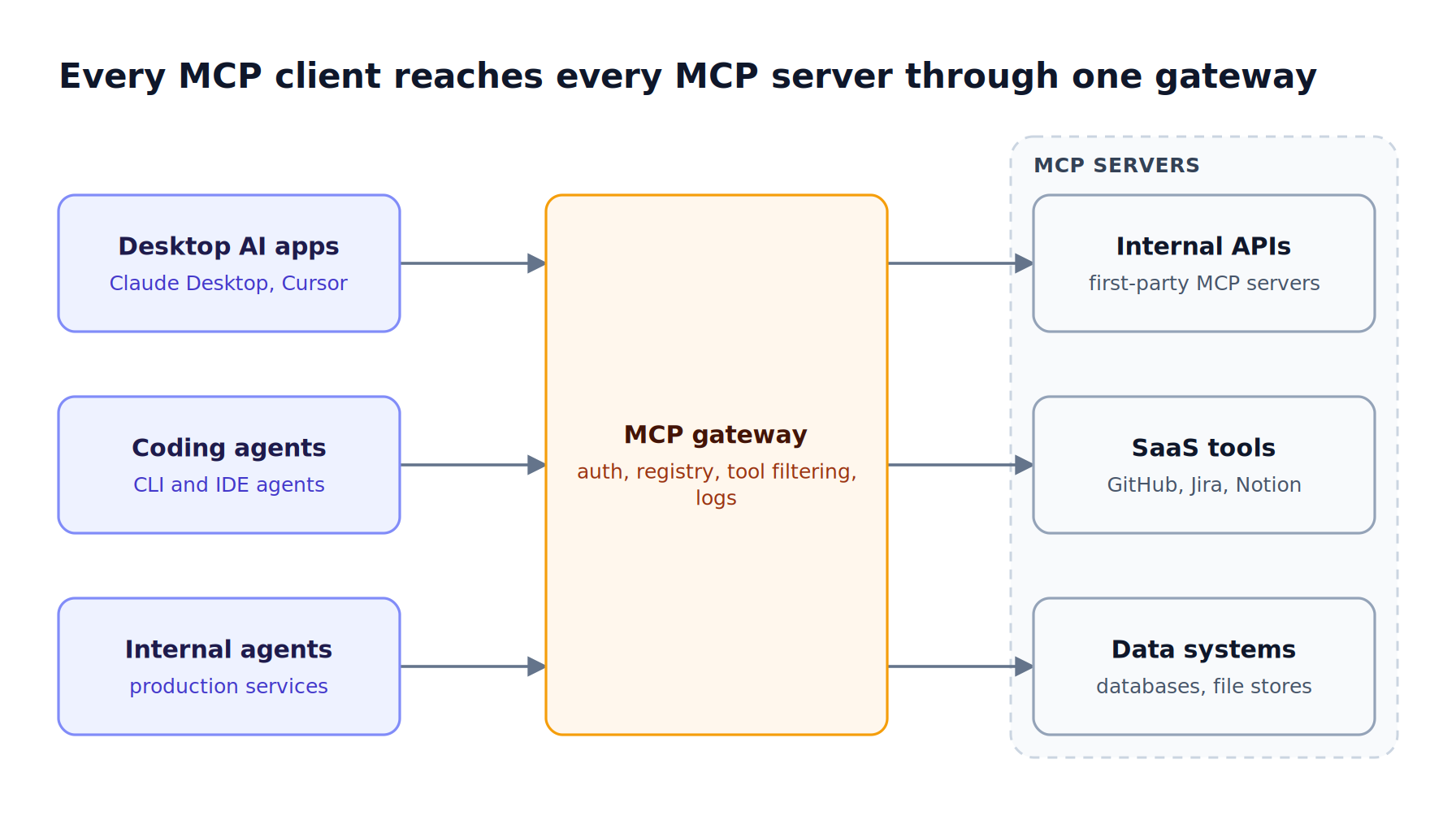
Figure 1: The gateway becomes the single place where identity, tool access, and logging are enforced for all MCP traffic.
As Figure 1 shows, the gateway turns an N-by-M mesh of client-to-server connections into one policy boundary. That boundary is also where a centralized MCP server registry lives: the list of approved servers, their transports, and the credentials used to reach them.
Why MCP security needs a gateway layer
MCP security problems are mostly credential and scope problems. The MCP specification's own security best practices describe confused deputy attacks, token passthrough, session hijacking, local MCP server compromise, and the need for scope minimization. Each is easier to control at one chokepoint:
- Token passthrough and credential sprawl: a gateway holds upstream credentials so clients never see raw MCP server tokens.
- Overexposed tools: a gateway filters the tool list per caller, so an agent that needs read access never receives a delete tool in its context.
- No attribution: a gateway logs the caller identity, tool name, arguments, and result for each call.
- Shadow servers: a gateway registry defines which MCP servers are approved, and anything outside it is unreachable through governed paths.
The MCP authorization specification builds on OAuth 2.1 for HTTP-based transports, which is why OAuth support at the gateway is now a baseline requirement rather than a differentiator. Teams building a control checklist can pair this section with the enterprise MCP security best practices checklist.
How to Evaluate Enterprise MCP Gateways
Evaluate an enterprise MCP gateway on six controls: how clients authenticate to it, how it authenticates to upstream servers, how it scopes tools per caller, whether it inspects tool arguments and results, what it logs, and where it can be deployed. A gateway that is strong on routing but weak on identity does not secure MCP traffic.
| Criterion | What to check | Why it matters |
|---|---|---|
| Inbound client authentication | API keys, OAuth 2.1 connect flow, SSO identity | Determines whether every tool call maps to a real user or service |
| Upstream MCP authentication | Shared credentials, per-user OAuth, token exchange | Prevents one shared token from granting every user the same access |
| Tool scoping | Per key, per team, per user allow-lists | Enforces least privilege on the tool list the model sees |
| Server registry | Central list of approved servers and transports | Removes unapproved servers from governed paths |
| Content inspection | Guardrails on tool arguments and results | Catches secrets, PII, and injected instructions at the tool boundary |
| Logging and audit | Per-call logs, admin audit trail, export | Supports incident response and compliance review |
| Deployment model | VPC, on-prem, air-gapped, managed only | Decides whether tool traffic ever leaves your network |
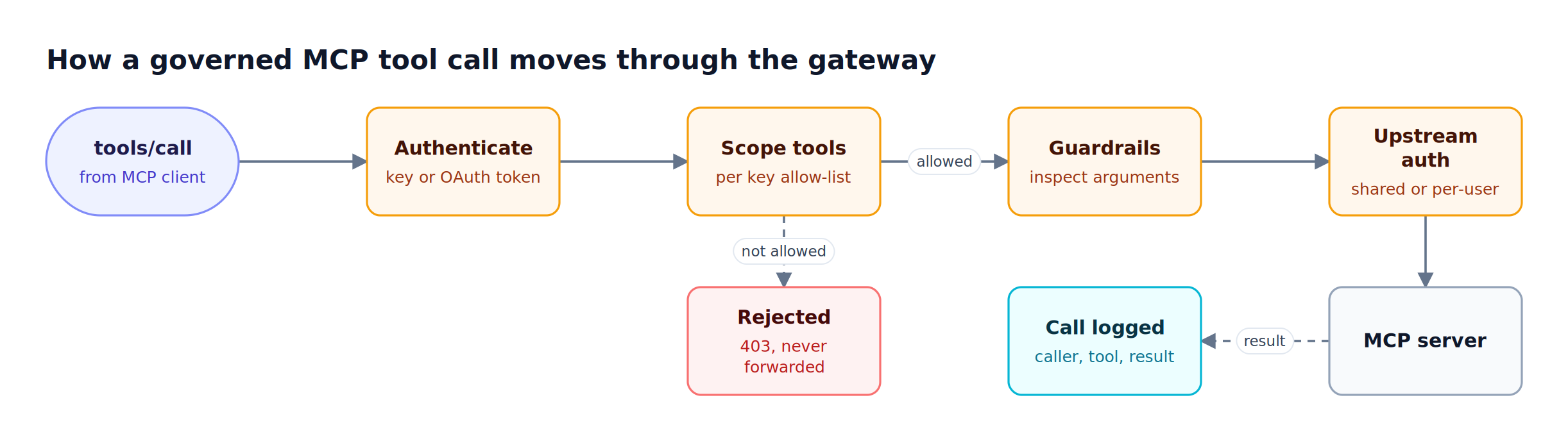
Figure 2: Each control an enterprise MCP gateway should offer maps to one stage of the tool call path.
During vendor evaluation, ask where each stage in Figure 2 runs and whether a call that fails scoping is rejected before it is forwarded. Bifrost implements every stage in this path, and the MCP Gateway resource page summarizes how the controls fit together.
Best MCP Gateways Compared at a Glance
The best MCP gateways for enterprises differ most on deployment model and on whether the same gateway also governs LLM traffic. Bifrost combines a self-hosted MCP gateway, per-virtual-key tool scoping, and a full LLM gateway in a single open-source binary.
| Gateway | Deployment | Client authentication | Tool access control | Also governs LLM traffic | Logging and audit |
|---|---|---|---|---|---|
| Bifrost | Self-hosted: in-VPC, on-prem, Kubernetes | Virtual keys or OAuth 2.1 | Per virtual key, Virtual MCPs | Yes | MCP logs, signed admin audit logs |
| Kong AI Gateway | Not published | key-auth or OpenID Connect | ACLs on MCP tool usage | Part of Kong AI Gateway | AI metrics and AI audit logs |
| Amazon Bedrock AgentCore Gateway | Fully managed on AWS | Inbound auth for agent identity | Fine-grained access control | Model-based routing endpoint | Built-in observability and auditing |
| IBM ContextForge | PyPI, Docker, Kubernetes | Basic, JWT, custom schemes | Not published | Agent routing | OpenTelemetry tracing |
| Microsoft MCP Gateway | Kubernetes | Entra ID bearer tokens | App roles per server and tool | Not published | Telemetry integration points |
| Docker MCP Gateway | Docker Desktop or Docker CLI | Not published | Profiles group servers | Not published | Logging and call tracing |
Cells for other products reflect their public documentation in September 2026; "Not published" means the pages reviewed did not document it. For a view limited to self-hosted projects, see this comparison of open-source MCP gateways for self-hosted infrastructure.
1. Bifrost
The Bifrost AI gateway is open source and acts as both an MCP client, connecting to upstream MCP servers, and an MCP server, exposing the aggregated tool registry to external clients at a single /mcp endpoint. The same deployment also routes LLM requests to 25+ providers and 10,000+ models through one OpenAI-compatible API.
Best for: Bifrost is built for enterprises running mission-critical AI workloads that require best-in-class performance, scalability, and reliability. It serves as a centralized AI gateway to route, govern, and secure all AI traffic across models and environments with ultra low latency. Bifrost unifies LLM gateway, MCP gateway, and Agents gateway capabilities into a single platform. Designed for regulated industries and strict enterprise requirements, it supports air-gapped deployments, VPC isolation, and on-prem infrastructure. It provides full control over data, access, and execution, along with robust security, policy enforcement, and governance capabilities.
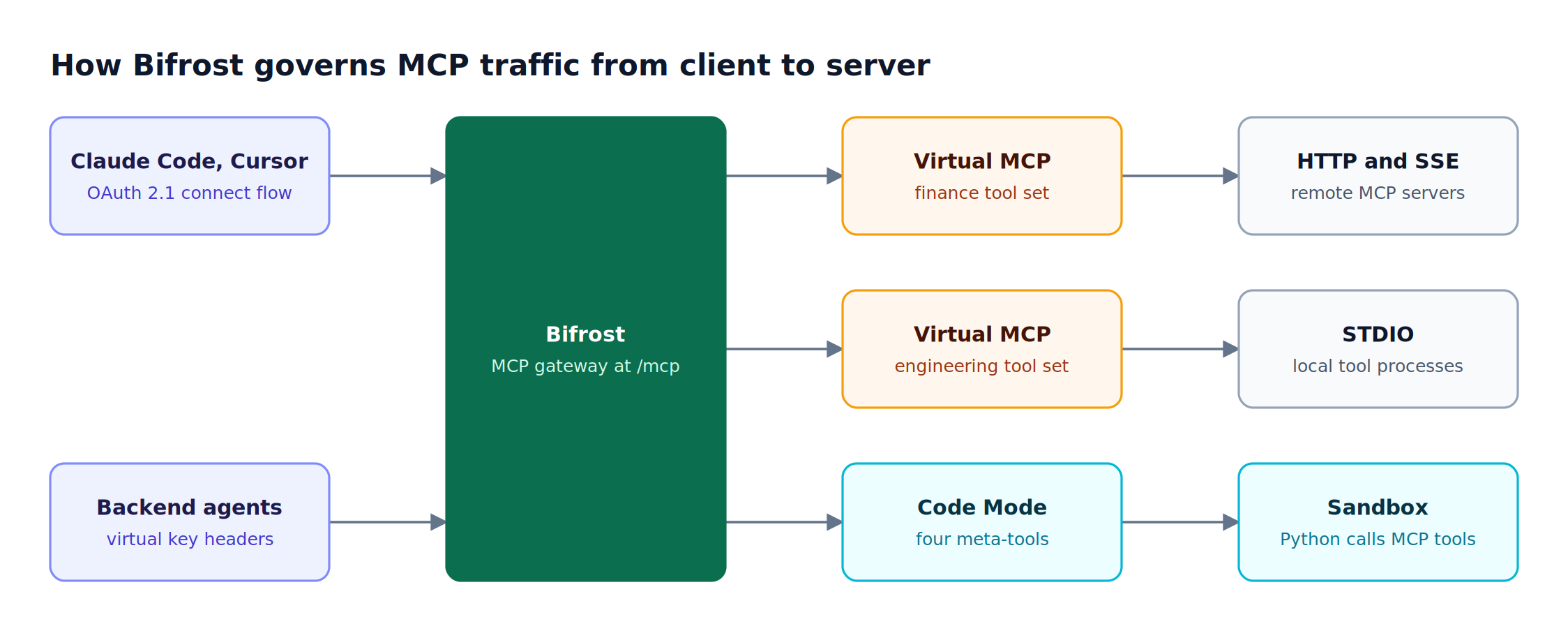
Figure 3: Bifrost ties each caller identity to a scoped tool set and a managed upstream credential, so no client holds MCP server secrets directly.
Centralized server registry and connections
Bifrost connects to MCP servers over STDIO, HTTP, or SSE and aggregates their tools into one registry exposed through Bifrost as an MCP gateway. Tool names are prefixed with the MCP client name, which keeps tools unique across servers. Bifrost pings each connected server every 10 seconds by default and marks a server unstable after five consecutive failed health checks.
Authentication in both directions
Inbound, MCP clients authenticate to /mcp with a virtual key header or through browser-based OAuth 2.1, where Bifrost acts as the authorization server and issues short-lived JWTs. A single setting, mcp_server_auth_mode, accepts headers only, OAuth only, or both. Outbound, Bifrost supports six MCP authentication types for upstream servers:
| Auth type | Who authenticates | Typical use |
|---|---|---|
| None | Nobody | Public servers, local STDIO tools |
| Headers | Admin, once | Shared API key or bearer token |
| OAuth 2.0 | Admin, once | One company-wide app, with token refresh |
| Per-User Headers | Each end user | Personal API keys |
| Per-User OAuth | Each end user | Personal GitHub, Notion, or Sentry access |
| Token Exchange (enterprise) | Each caller, every call | Internal servers that trust your identity provider |
Per-user credentials are stored against the caller's identity (virtual key, SSO user, or session ID) and can be inspected or revoked from the MCP Sessions page. The trade-offs between these patterns are covered in depth in MCP authentication with OAuth, API keys, and token management.
Tool filtering per virtual key and Virtual MCPs
Bifrost applies tool filtering at three stacked levels: client configuration, request headers, and virtual key. An empty tool list on a client is deny-by-default. With a virtual key, tools/list returns only the tools that key allows, tools/call is checked against the same allow-list, and an inactive or expired key is refused with a 403.
Virtual MCPs package a curated tool set at its own /mcp/<slug> address and attach it to virtual keys, so a finance agent and an engineering agent reach different tool sets from the same gateway. In Bifrost Enterprise, access profiles grant Virtual MCPs to every user in a role. This guide to MCP tool filtering and allowlisting covers it.
Guardrails, logging, and audit
Bifrost Enterprise guardrails run on MCP tool executions before the tool runs, to inspect or redact arguments, and after it returns, to inspect or redact results. Rules use CEL expressions that can match on the MCP client, tool, and arguments. Every tool execution appears in MCP logs alongside LLM logs, and audit logs record administrative changes with HMAC signing and export to JSON, JSON Lines, or Syslog.
Code Mode for large tool catalogs
Code Mode replaces hundreds of tool definitions with four meta-tools that let the model write Python (Starlark) to orchestrate tools in a sandbox. In a benchmark with 508 tools across 16 servers, Code Mode cut input tokens by 92.8% and estimated cost by 92.2% with a 100% pass rate. The full methodology is in the Bifrost MCP gateway benchmark writeup.
Deployment
Bifrost runs in in-VPC deployments on AWS, GCP, Azure, Cloudflare, and Vercel, and Bifrost Enterprise ships private container images for AWS, GCP, Azure, and on-premise environments. Clustering propagates Virtual MCP definitions and assignments to every node. Bifrost adds 11 microseconds of overhead per request at 5,000 RPS in sustained benchmarks.
2. Kong AI Gateway
Kong AI Gateway manages remote MCP traffic as part of Kong's API platform. Its AI MCP Server entity maps REST API endpoints into MCP tool definitions and aggregates multiple MCP servers into a single MCP endpoint for clients such as Claude Desktop and Cursor.
Kong secures MCP traffic with an AI Auth Strategy (key-auth or OpenID Connect), optionally paired with protected resource metadata for MCP-spec OAuth2. ACLs enforce access control on MCP tool usage, rate limiting policies govern volume, and AI metrics and AI audit logs monitor traffic.
Best for: Organizations already standardized on Kong for API management that want to expose existing REST APIs as MCP tools under the same policy model. Teams comparing plugin-assembled governance with a gateway that treats virtual keys as the unit of control can review the Bifrost governance model.
3. Amazon Bedrock AgentCore Gateway
Amazon Bedrock AgentCore Gateway is a fully managed AWS service that provides one entry point for agent traffic to tools, other agents, and models. It converts APIs, Lambda functions, and existing services into MCP-compatible tools, with OpenAPI, Smithy, and Lambda as supported tool input types.
AgentCore Gateway handles inbound authentication (verifying agent identity) and outbound authentication (connecting to tools), including OAuth flows and token refresh. It adds semantic tool search for large tool collections and 1-click integrations with Salesforce, Slack, Jira, Asana, and Zendesk.
Best for: AWS-native teams that want a serverless MCP gateway and accept that tool traffic is governed inside AWS rather than in their own VPC deployment. Teams that need the same controls across clouds or on-prem should compare it with Bifrost Enterprise deployment options.
4. IBM ContextForge
IBM ContextForge is an open-source registry and proxy that federates MCP servers, A2A agents, and REST or gRPC APIs into one endpoint. It translates REST and gRPC services into MCP tools, supports Basic, JWT, or custom authentication schemes, and exports OpenTelemetry traces to OTLP backends.
ContextForge installs from PyPI or Docker, includes an Admin UI with air-gapped deployment support, and scales across Kubernetes clusters with Redis-backed federation and caching. More than 40 plugins extend its transports and integrations.
Best for: Platform teams that want an open-source MCP registry with REST and gRPC translation, and have the engineering capacity to operate a Python-based gateway alongside a separate LLM gateway. The Bifrost docs show how one Go binary covers both roles.
5. Microsoft MCP Gateway
Microsoft MCP Gateway is an open-source reverse proxy and management layer for MCP servers running in Kubernetes. It provides session-aware routing, so all requests with a given session ID reach the same MCP server instance, and a control plane to deploy, update, and delete MCP servers.
Authentication uses Microsoft Entra ID, with app-role authorization on MCP servers and tools: read access goes to the creator and configured roles, and write access to the creator or holders of the mcp.admin role. A tool registration API and tool gateway router route tool calls to registered tool servers.
Best for: Azure and Kubernetes teams that want to host and route their own MCP servers with Entra ID identity. Teams that also need per-key budgets and tool scoping across LLM calls can compare it with MCP tool filtering per virtual key in Bifrost.
6. Docker MCP Gateway
Docker MCP Gateway is a Docker CLI plugin that runs MCP servers from the Docker MCP Catalog as isolated containers behind one gateway. It keeps secrets out of environment variables through Docker Desktop secrets management, supports OAuth flows for servers that need them, and provides built-in logging and call tracing.
Servers are grouped into profiles that can be connected to clients such as VS Code, Cursor, and Claude Desktop, exported, and shared through OCI registries. Best for: Developer workstations and local tooling where container isolation of MCP servers is the main concern. Shared, remote MCP traffic needs identity and approval controls beyond the workstation; when Bifrost runs the agent loop, tool execution stays explicit unless Agent Mode is enabled.
How to Choose an Enterprise MCP Gateway
Choose an enterprise MCP gateway by answering three questions in order: whether LLM calls and MCP tool calls need one control plane, whether the gateway must run inside your own network, and whether the use case is limited to local developer tooling. Each answer removes a category of gateway.
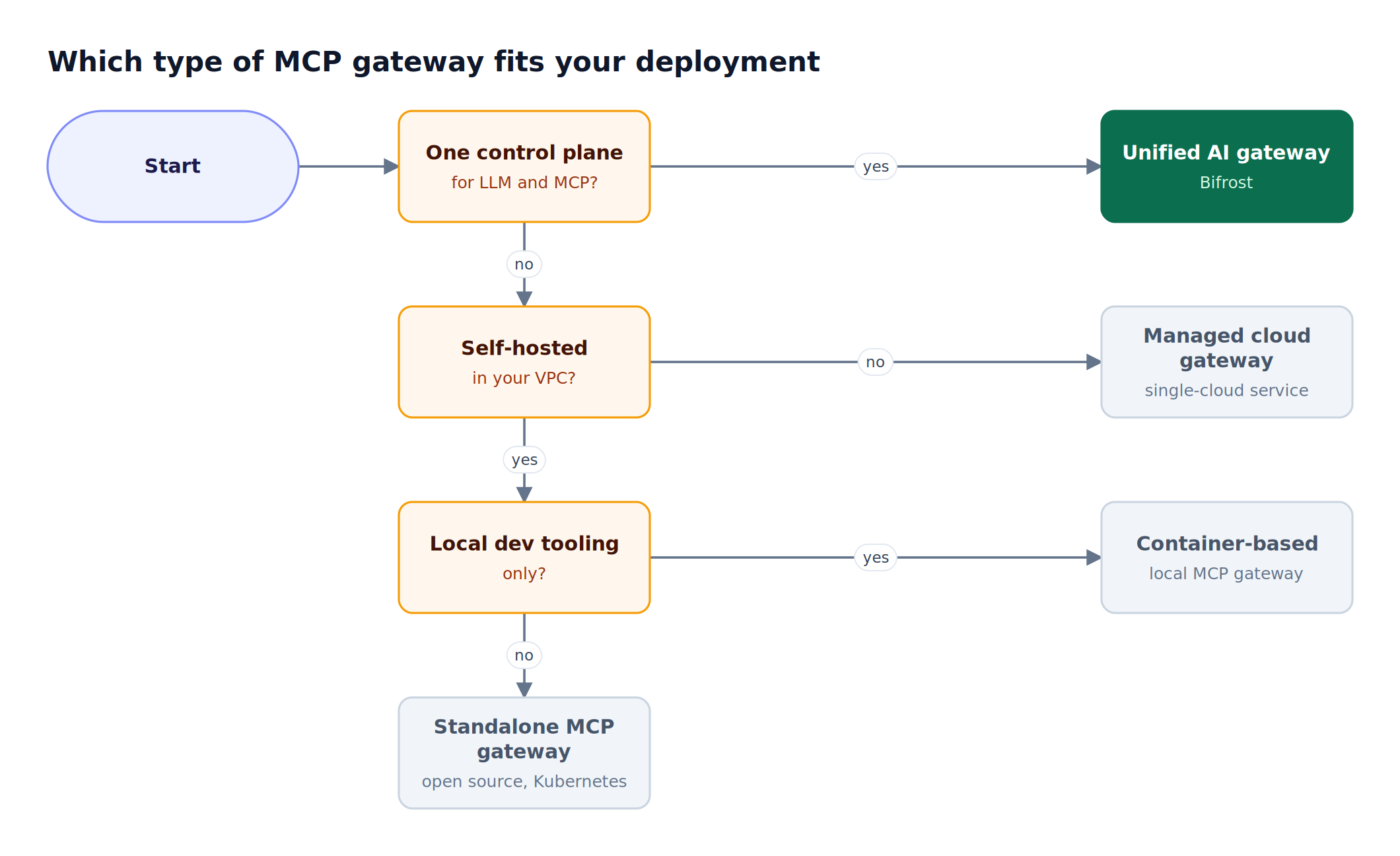
Figure 4: Teams that must govern LLM calls and MCP tool calls together, inside their own network, narrow the field fastest.
An agent's LLM request and the tool calls it triggers belong to the same user, budget, and incident, so splitting them across two gateways means two identity models and two log stores. Bifrost keeps both under the same virtual key, which is why the Bifrost MCP gateway sits on the unified branch.
A practical shortlist process:
- Map identity first: tie each tool call to an SSO user or service identity.
- Test scoping: give two keys different tool sets and confirm
tools/listdiffers. - Check where credentials live: upstream tokens belong at the gateway, not in client configs.
- Verify deployment fit: confirm in-VPC, on-prem, or air-gapped support first.
For background on the category before a vendor review, revisit what an MCP gateway does and where it sits in the agent stack.
Frequently Asked Questions
What is an MCP gateway?
An MCP gateway is a control layer between AI clients and MCP servers that aggregates tools behind one endpoint and enforces authentication, tool access, and logging on every call. Bifrost exposes this endpoint at /mcp, where each client sees only the tools its virtual key or OAuth identity allows, and every tool execution is logged.
What is the difference between an MCP proxy and an MCP gateway?
An MCP proxy forwards MCP traffic between a client and a server, usually handling transport translation or connection pooling. An MCP gateway adds policy: authentication, per-caller tool filtering, credential management, guardrails, and audit logging across many servers. A proxy moves traffic; a gateway governs it. This breakdown of MCP gateway vs MCP proxy vs MCP server compares all three.
What are the key differences between an MCP gateway and an API gateway?
An API gateway routes stateless REST or gRPC requests and applies policies per route. An MCP gateway understands MCP semantics: it aggregates tools/list results from many servers, filters tool definitions per caller before the model sees them, and manages upstream OAuth sessions per user. Some API gateways add MCP plugins; Bifrost is built for LLM and MCP traffic natively, with MCP logs next to LLM logs.
What is MCP used for?
MCP is used to give AI models structured access to external tools and data, such as file systems, databases, web search, ticketing systems, and internal APIs. In enterprises, MCP connects coding agents and internal assistants to company systems, which is why MCP governance at the gateway matters.
How does an MCP gateway handle authentication?
An MCP gateway handles authentication in two directions. Inbound, clients prove identity to the gateway with API keys, virtual keys, or an OAuth 2.1 connect flow. Outbound, the gateway authenticates to each MCP server with shared credentials, per-user OAuth tokens, or exchanged identity-provider tokens. Bifrost supports six outbound MCP auth types and both inbound modes.
Is there an open-source MCP gateway for enterprise use?
Yes. Bifrost, IBM ContextForge, Microsoft MCP Gateway, and Docker MCP Gateway all publish source code. Bifrost is the open-source option that also covers LLM routing, virtual-key budgets, and per-key tool scoping in the same deployment, with enterprise features such as clustering, RBAC, and guardrails available in Bifrost Enterprise for regulated environments.
Does an MCP gateway reduce token costs?
An MCP gateway can reduce token costs by limiting the tool definitions sent to the model. Tool filtering removes tools a caller does not need, and Bifrost Code Mode replaces large tool catalogs with four meta-tools. In Bifrost benchmarks, Code Mode cut input tokens by up to 92.8% at 508 tools. Smaller deployments with one or two servers can keep classic tool calling, since savings grow with catalog size.
Try Bifrost as Your Enterprise MCP Gateway
An enterprise MCP gateway should authenticate every client, keep upstream credentials out of client configs, scope tools per caller, and log every call, all inside infrastructure you control. Bifrost does this for MCP and LLM traffic in one open-source gateway, with Virtual MCPs, six upstream auth types, and Code Mode for large tool catalogs. To see how Bifrost secures MCP traffic across your agents and teams, book a demo with the Bifrost team.