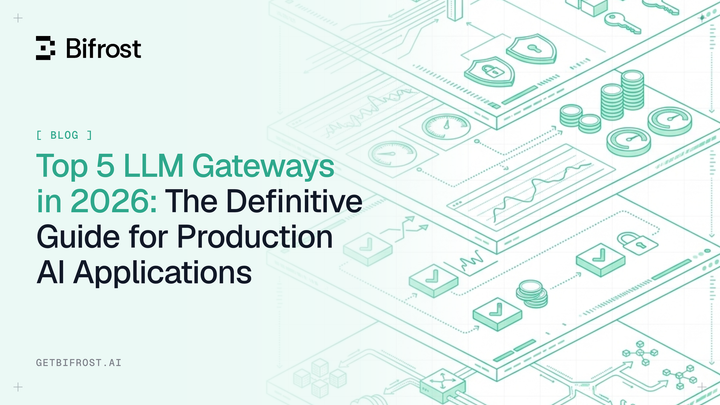

Top 5 LLM Gateways for 2026: A Comprehensive Comparison
An LLM gateway is a single API layer that routes, secures, and observes traffic across model providers. This matrix-led comparison scores Bifrost, LiteLLM, Cloudflare AI Gateway, Vercel AI Gateway, and Kong AI Gateway on 27 capabilities, from overhead and budgets to MCP tool filtering.
TL;DR
- This guide compares the top LLM gateways on reliability, observability, governance, and cost optimization (routing traffic to cheaper models) across multi-provider deployments: 1) Bifrost, 2) Cloudflare AI Gateway, 3) LiteLLM, 4) Vercel AI Gateway, 5) Kong AI Gateway.
- Bifrost ranks first: an open-source LLM gateway that reaches 10,000+ models across 25+ providers and adds 11 microseconds of overhead per request at 5,000 RPS.
- LiteLLM is the other open-source option: 100+ providers, virtual keys, an MCP gateway, and 8 ms of published p95 overhead.
- Cloudflare AI Gateway and Vercel AI Gateway are hosted-only services; Kong AI Gateway puts semantic caching, token limits, and MCP governance behind an Enterprise license.
An LLM gateway is a single API layer that routes, secures, and observes traffic to multiple model providers, and the five gateways compared here differ most on measured overhead, governance depth, MCP support, and where they can be deployed. Bifrost, an open-source LLM gateway written in Go, is the best choice for enterprises running mission-critical AI workloads that require top-tier performance, scalability, and reliability. This comparison scores all five side by side in a quick table, a detailed feature matrix, and individual profiles.
Quick Comparison Table
Bifrost, Cloudflare AI Gateway, LiteLLM, Vercel AI Gateway, and Kong AI Gateway all route LLM traffic across providers through one API, but they differ on measured overhead, licensing, and enterprise readiness. The quick comparison below summarizes those differences at a glance, and the ranking of the best LLM gateways in 2026 evaluates a wider field against the same criteria.
| Gateway | Latency Overhead | Open Source | Enterprise Ready | Best For |
|---|---|---|---|---|
| Bifrost | ~11µs | ✓ | ✓ | Governance & Performance |
| Cloudflare | Not published | ✗ | ✓ | Unified Management |
| LiteLLM | 8 ms p95 | ✓ | ✓ (Enterprise license) | Portability & Flexibility |
| Vercel | <20 ms (2025 launch claim) | ✗ | ✓ | Frontend Teams & Next.js |
| Kong | <10 ms (typical) | Open-core | ✓ | API Management Integration |
What is an LLM Gateway
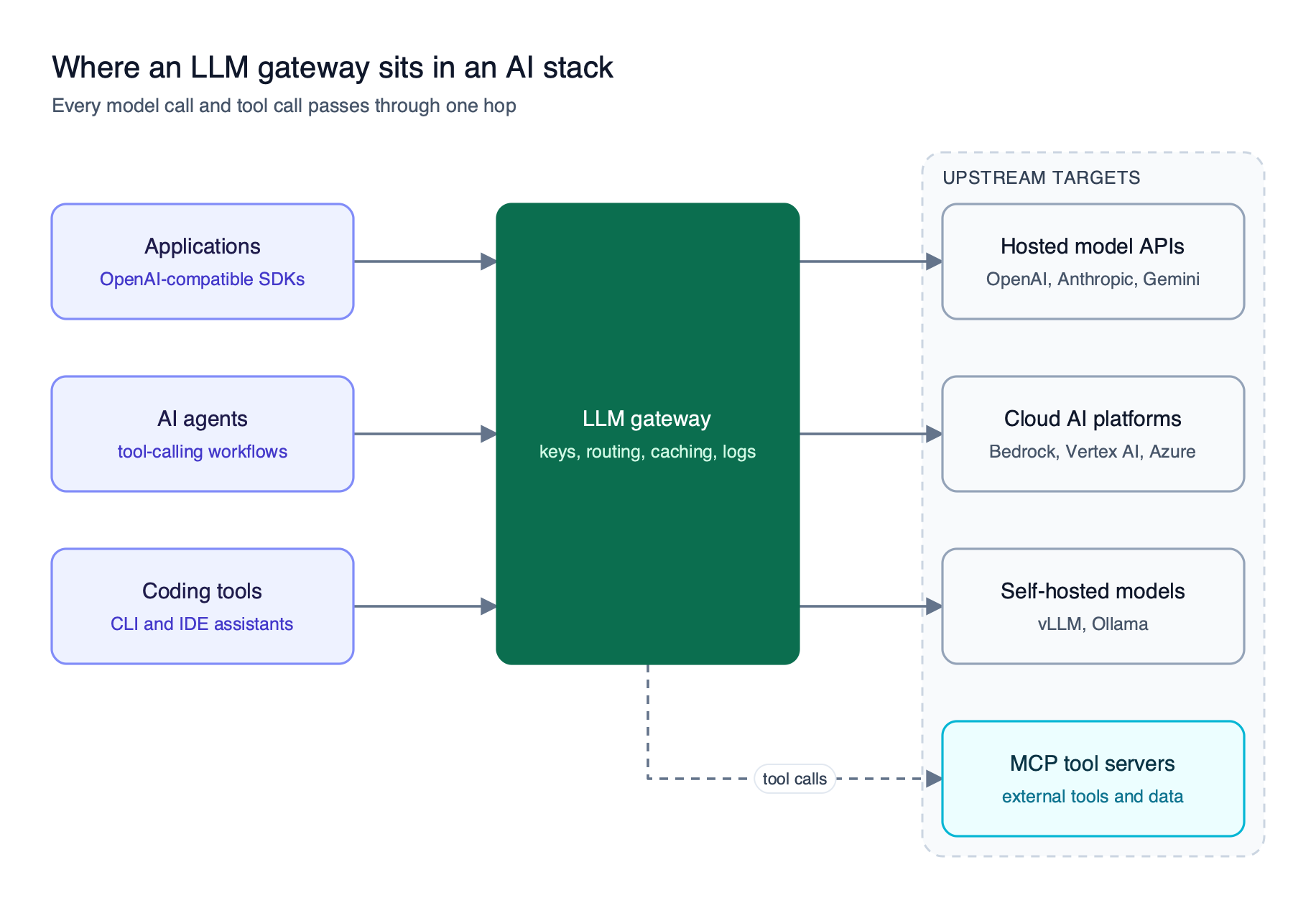
An LLM gateway unifies multiple model providers behind a single API, enabling policy enforcement, automatic failover, load balancing, semantic caching, usage governance, and centralized observability. As enterprise AI adoption accelerated through 2025 and into 2026, LLM gateways have evolved from nice-to-have tools to mission-critical infrastructure. More than 70% of organizations now use three or more models, according to Datadog's State of AI Engineering report (April 2026).
Mature teams rely on gateways to maintain AI reliability, reduce latency and cost, and standardize prompt management, LLM routing, and agent tracing across environments. Figure 1 shows the single hop every model and tool call passes through.
Key Capabilities
- Reliability and failover: Routes traffic across providers and models to avoid downtime
- Cost and latency optimization: Uses caching, routing heuristics, and budgets to control spend and latency
- Security and governance: Centralizes credentials, enforces rate limits, and sets per-team access controls
- Observability and tracing: Captures spans, sessions, and LLM tracing for agent monitoring
- MCP and agent traffic: Governs Model Context Protocol tool calls and agent traffic with the same keys, budgets, and logs as model calls
- Guardrails and safety: Centralized safety layer for policy enforcement, content moderation, and output validation with auto-fallbacks and tracing
KEY INSIGHT: Modern LLM gateways act as reliability and governance platforms that handle the operational complexity of multi-model AI systems.
Detailed Feature Matrix
The detailed feature matrix compares all five gateways on 27 capabilities across performance, provider coverage, observability, governance, deployment, developer experience, and pricing. Every competitor cell was re-checked against official vendor documentation in November 2026: cells carried over from the LLM gateway comparison 2025 edition were corrected, and capabilities a vendor does not document read "Not published".
| Feature Category | Bifrost | Cloudflare | LiteLLM | Vercel | Kong |
|---|---|---|---|---|---|
| Performance & Latency | |||||
| Latency Overhead | ~11µs | Not published | 8 ms p95 at 1,170 RPS | <20 ms (2025 launch claim) | <10 ms (typical) |
| High RPS Support | 5K+ RPS | Not published | 3,000 RPS on 33 pods | Not published | Not published |
| Semantic Caching | ✓ | ✗ (exact-match only) | ✓ | ✗ (no response cache) | ✓ (Enterprise plugin) |
| Multi-Provider Support | |||||
| Number of Providers | 10,000+ models, 25+ providers | 20+ providers | 100+ providers | 500+ models | 20+ providers |
| Automatic Failover | ✓ | ✓ | ✓ | ✓ | ✓ (Enterprise plugin) |
| Load Balancing | Weighted; adaptive (Enterprise) | Percentage splits | Router-based | Cost, TTFT, or throughput routing | ✓ (Enterprise plugin) |
| Observability & Monitoring | |||||
| Built-in Dashboard | ✓ | ✓ | ✓ (Admin UI) | ✓ | ✓ (Konnect) |
| Request Logs | ✓ (live stream) | ✓ | ✓ | Metadata only | ✓ |
| Prometheus Metrics | ✓ | Not published | ✓ | Not published | ✓ |
| OpenTelemetry | ✓ | ✓ | ✓ (callback) | ✓ (paid plans) | ✓ |
| Request/Response Inspection | ✓ | ✓ | ✓ (opt-in) | ✗ (prompts not logged) | ✓ |
| Governance & Security | |||||
| Virtual Keys | ✓ | Gateway auth tokens | ✓ | API keys with budgets | ✓ |
| SSO Support | ✓ (OIDC: Okta, Entra, Google Workspace; Enterprise) | ✓ (Cloudflare Access) | Enterprise (free up to 5 users) | SAML (Pro, Enterprise) | Konnect Enterprise |
| Vault Integration | ✓ (Enterprise) | Secrets Store (BYOK) | Enterprise | Not published | Enterprise |
| Granular Budgets | ✓ (customer, team, virtual key, provider) | ✓ (model, provider, metadata) | ✓ (key, user, team, customer) | ✓ (team, project, key, user) | Alerts; cost limits via Enterprise plugin |
| Rate Limiting | Configurable (request and token) | ✓ | ✓ | Not user-configurable | Advanced (Enterprise plugin) |
| MCP Tool Filtering | ✓ | Not published | ✓ | Not published | ✓ (Enterprise plugin) |
| Deployment Options | |||||
| Self-Hosted | ✓ (NPX, Docker, Kubernetes) | ✗ | ✓ | ✗ | ✓ |
| Cloud-Hosted | Self-hosted; in-VPC (Enterprise) | ✓ | Sales-led option | ✓ | ✓ (Konnect) |
| P2P Clustering | ✓ (Enterprise) | ✗ (managed) | ✗ (Redis-coordinated) | ✗ (managed) | ✗ (hybrid control plane) |
| Developer Experience | |||||
| OpenAI API Compatible | ✓ | ✓ | ✓ | ✓ | ✓ |
| Visual Provider Setup | ✓ | ✓ | ✓ (Admin UI) | ✓ | Via UI |
| Plugin Architecture | ✓ | Not published | Callbacks and hooks | Not published | Extensive |
| Framework Integration | Multiple | Cloudflare Workers | Multiple | Next.js/React | Kong ecosystem |
| Pricing Model | |||||
| Open Source | ✓ (Apache 2.0) | ✗ | ✓ (MIT core) | ✗ | Open-core |
| Free Tier | ✓ | ✓ | ✓ | ✓ (monthly credit) | OSS gateway; Konnect trial |
| Enterprise | ✓ | ✓ | ✓ | ✓ | ✓ |
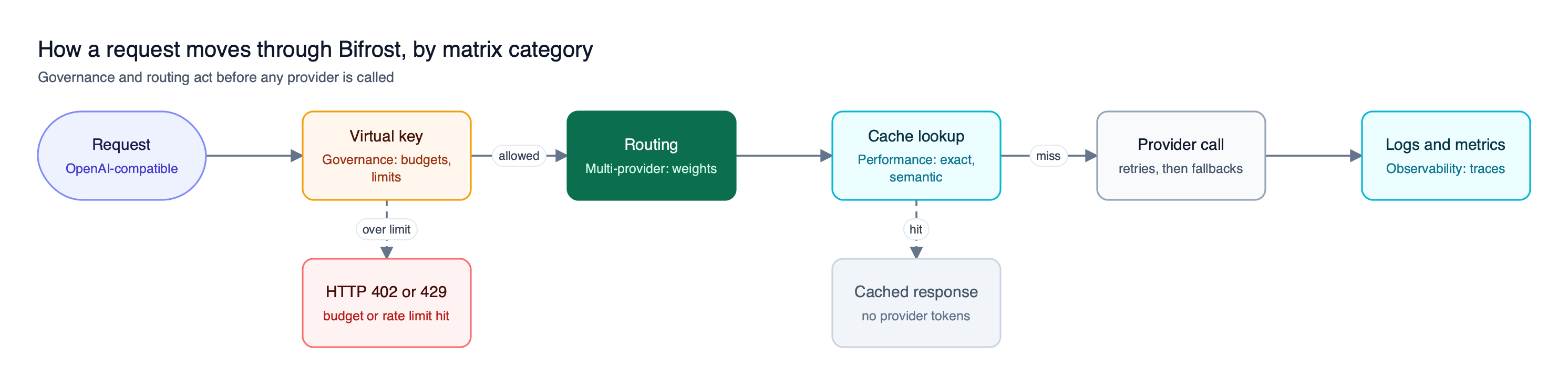
Bifrost figures come from published sustained benchmarks on a single t3.xlarge instance; "Enterprise" marks a capability that needs a paid license. Figure 2 maps the categories onto one request's path through Bifrost.
Gateway Profiles
Each profile below covers what the gateway is, its core features, and the team it fits best, in matrix order. Bifrost leads because it combines 11 µs of overhead, nested budgets, and per-key MCP tool filtering on an open-source core, with air-gapped deployment in Bifrost Enterprise.
Bifrost by Maxim AI
Provider: Maxim AI
Repository: GitHub
Documentation: docs.getbifrost.ai
Bifrost is an open-source AI gateway written in Go that adds 11 µs of overhead per request at 5,000 RPS, offering a unified interface for 10,000+ models across 25+ providers, including OpenAI, Anthropic, Mistral, Ollama, Bedrock, Groq, Perplexity, Gemini and more. It delivers automatic fallbacks, intelligent load balancing, semantic caching, guardrails for content filtering and security, and enterprise-grade governance, with native observability and integrations for Model Context Protocol (MCP). The gateway can be deployed via NPX for instant setup or through Docker for containerized environments, making it accessible for teams of all sizes.
At a Glance
┌─────────────────────────────────┐
│ BIFROST QUICK SPECS             │
├─────────────────────────────────┤
│ Type: Open-source               │
│ Language: Go                    │
│ Deployment: NPX, Docker, K8s    │
│ Latency: ~11µs overhead         │
│ Models: 10,000+ (25+ providers) │
│ RPS Tested: 5K+                 │
│ License: Apache 2.0             │
└─────────────────────────────────┘
Core Capabilities
- Ultra-low latency: Adds just ~11µs overhead at 5K RPS under sustained load
- Multi-provider support: Automatic failover with zero downtime across major providers
- Plugin-first architecture: Clean, extensible middleware for custom logic
- Drop-in replacement: Change only the base URL in existing OpenAI SDK connections
- Visual provider setup: Add API keys through UI without code changes
- Smart key distribution: Intelligent load balancing with model-aware key filtering and weighted distribution
- Centralized observability: Built-in dashboard with real-time log monitoring UI, advanced filtering, request/response inspection, token/cost analytics, and native Prometheus metrics and OpenTelemetry traces
- Governance and budget: Virtual keys for secure access control, intelligent routing policies, granular budgets (per-customer, per-team, per-virtual-key), configurable rate limits, and MCP tool filtering to control agent tool access
Enterprise Features
- Alerts: Notifications for budget limits and rate limit thresholds on Slack, PagerDuty, Teams, or any Webhook.
- Audit Logs: Comprehensive, HMAC-signed audit trails of administrative activity for compliance and debugging.
- Guardrails: Automatically detect, block, or redact unsafe prompts, model outputs, and MCP tool calls with real-time policy enforcement and content moderation across all agents.
- Cross-node synchronization: Temporarily removes failing keys from rotation on every node
- Governance: OIDC support for SSO (Okta, Microsoft Entra, Google Workspace, and more) and Role-based access control and policy enforcement for team collaboration. Access profiles to define reusable provider, model, budget, rate-limit, and MCP policies that auto-allocate virtual keys to users at scale.
- Vault Support: Secure API key management with HashiCorp Vault, AWS Secrets Manager, Google Secret Manager, and Azure Key Vault integration. Store and retrieve sensitive credentials using enterprise-grade secret management.
- Adaptive load balancing: Automatically optimizes traffic distribution across providers and keys based on live latency and error rates.
- Cluster Mode: High availability deployment with automatic failover and load balancing. Peer-to-peer clustering where every instance is equal.
Best For
Bifrost is built for enterprises running mission-critical AI workloads that require top-tier performance, scalability, and reliability. It serves as a centralized AI gateway to route, govern, and secure all AI traffic across models and environments with ultra low latency. Bifrost unifies LLM gateway, MCP gateway, and Agents gateway capabilities into a single platform. Designed for regulated industries and strict enterprise requirements, it supports air-gapped deployments, VPC isolation, and on-prem infrastructure. It provides full control over data, access, and execution, along with strong security, policy enforcement, and governance capabilities.

Cloudflare AI Gateway
Cloudflare AI Gateway provides a unified interface to connect with major AI providers including Anthropic, Google, Groq, OpenAI, and xAI, offering access to more than 20 documented providers through one OpenAI-compatible API.
Features
- Multi-provider support: Works with Workers AI, OpenAI, Azure OpenAI, HuggingFace, Replicate, Anthropic, and more
- Performance optimization: Exact-match caching mechanisms to reduce redundant model calls and lower operational costs
- Rate limiting and controls: Manage application scaling by limiting the number of requests
- Request retries and model fallback: Automatic failover to maintain reliability
- Analytics: View metrics including number of requests, tokens, and costs with insights on requests and errors
- Comprehensive logging: Stores up to 10 million logs per gateway on Workers Paid (Legacy Logs), while accounts created since September 24, 2026 use Workers Logs
- Dynamic routing: Intelligent routing between different models and providers
Cloudflare also offers spend limits scoped by model, provider, or custom metadata such as user or team, OpenTelemetry trace export, and an Auto Router; its cache matches exact requests only, with semantic matching listed as planned.
Best For
Organizations already using Cloudflare services who want unified management of traditional and AI traffic.

LiteLLM
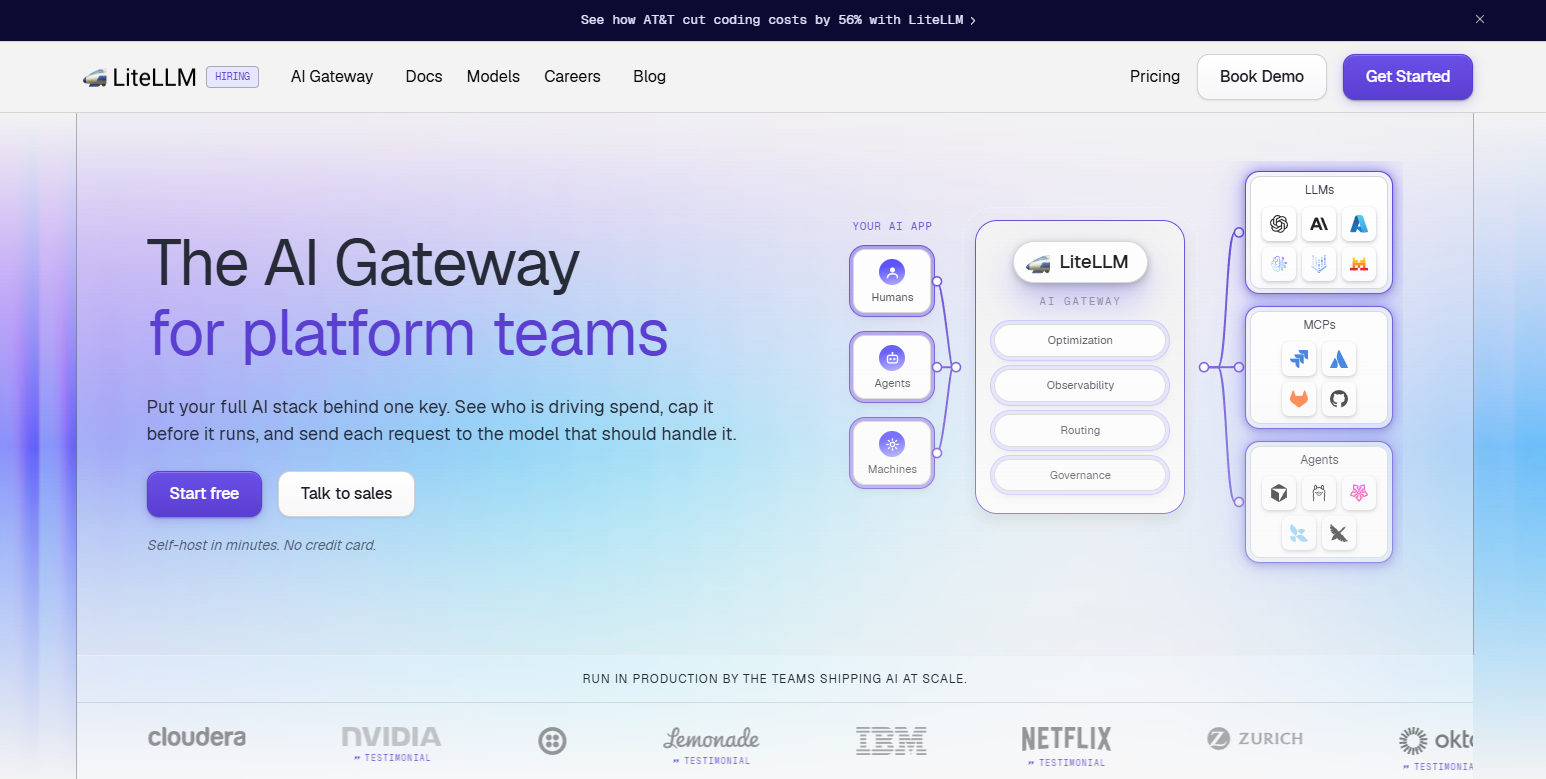
LiteLLM is an open-source gateway that translates requests to the OpenAI API format for 100+ providers including Bedrock, Huggingface, VertexAI, Azure, Groq, and more. It standardizes outputs across providers, handles retry/fallback logic through its Router, and provides budget and rate limiting controls via its Proxy Server. Since v1.110.0 (November 2026), its routing logic runs in a Rust core while authentication, configuration, and callbacks stay in Python; see what buyers should verify about the LiteLLM Rust gateway.
Features
- OpenAI API compatibility: Minimal refactoring required for provider/model swaps
- Routing primitives: Retries, fallbacks, weighted and latency-based routing, and semantic caching patterns
- Authentication and key management: Budget limits and rate controls
- Observability integrations: Pre-defined callbacks for Lunary, MLflow, Langfuse, and other platforms
LiteLLM also ships an open-source MCP gateway with key, team, and organization tool permissions.
Best For
Teams prioritizing portability, early-stage experimentation, and open-source flexibility who can manage operational complexity. Teams comparing the two as routers can read Bifrost vs LiteLLM for enterprise LLM routing.
Vercel AI Gateway
Vercel AI Gateway, generally available since August 2025, provides a single endpoint to access hundreds of AI models across providers with production-grade reliability. The platform emphasizes developer experience, with deep integration into Vercel's hosting ecosystem and framework support.
Features
- Multi-provider support: Access to hundreds of models from OpenAI, xAI, Anthropic, Google, and more through a unified API
- Low-latency routing: Consistent request routing with latency under 20 milliseconds (Vercel's August 2025 launch figure) designed to keep inference times stable regardless of provider
- Automatic failover: If a model provider experiences downtime, the gateway automatically redirects requests to an available alternative
- OpenAI API compatibility: Compatible with OpenAI API format, allowing easy migration of existing applications
- Observability: Per-model usage, time-to-first-token, and spend metrics with detailed analytics
Vercel AI Gateway does not log prompts or responses, and its budgets cap spend at team, project, API key, or user scope.
Best For
Teams already using Vercel for hosting who want tight integration with Next.js, React, and modern frameworks, or developers prioritizing rapid experimentation with multiple models and minimal infrastructure management.

Kong AI Gateway
Kong AI Gateway extends Kong's proven API gateway platform to support LLM routing, providing features including observability, semantic security and caching, and routing.
Features
- Multi-provider routing: Support for OpenAI, Anthropic, Cohere, Azure OpenAI, and custom endpoints through Kong's plugin architecture
- Request/response transformation: Normalize formats across different providers
- Rate limiting and quota management: Token analytics and cost tracking
- Enterprise security: Authentication, authorization, mTLS, and vault-backed credentials
- MCP support: Centralized MCP server management
- Extensive plugin marketplace: Rich ecosystem of extensions and integrations
Kong AI Gateway documents 20+ providers, and the AI MCP Proxy (with per-tool access rules), semantic caching, and token-based rate limiting require an AI Gateway Enterprise license.
Best For
Organizations already using Kong for API management who want to consolidate traditional API and AI gateway management.

How to Choose The Right Gateway?
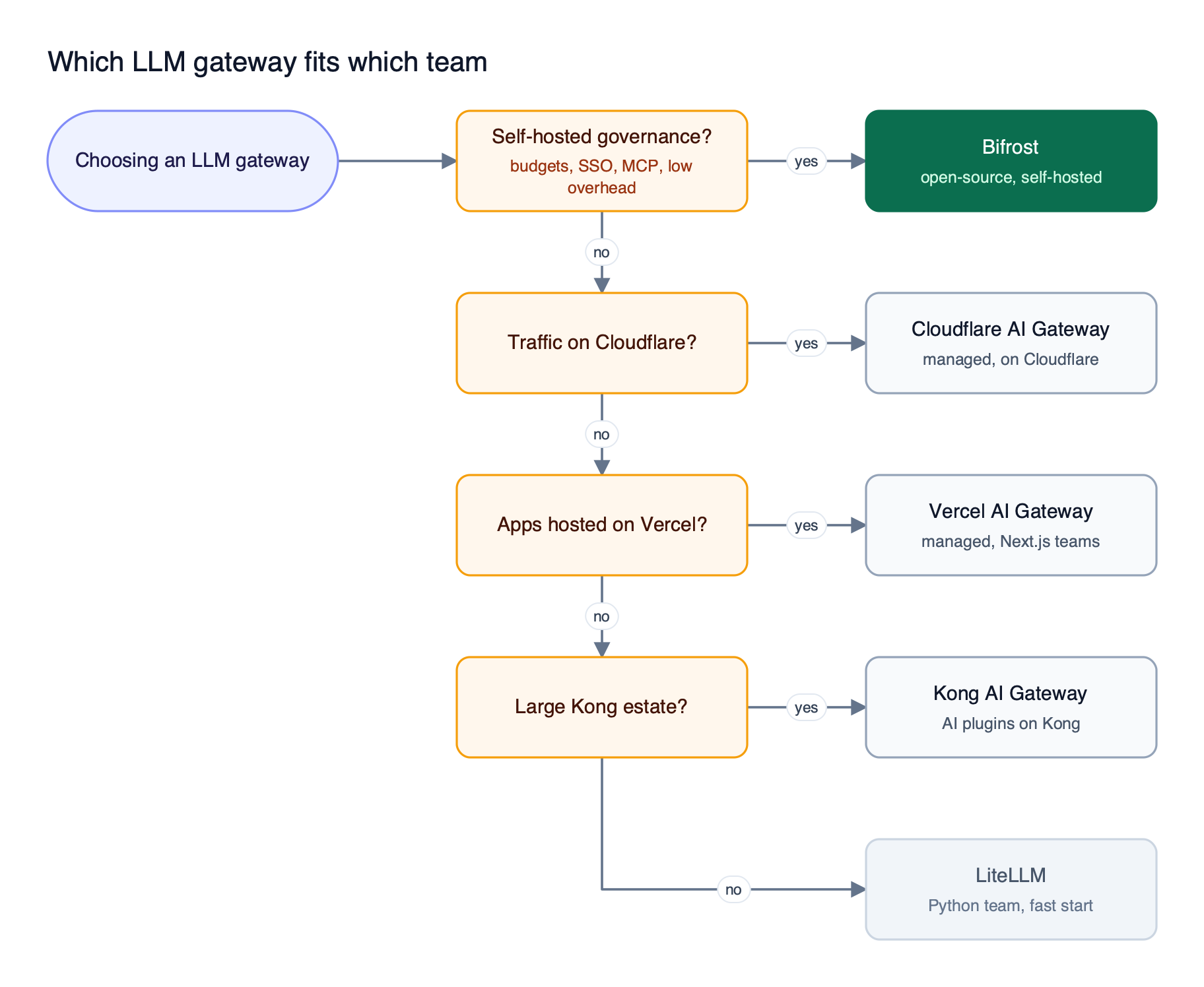
Selecting a gateway depends on reliability needs, governance requirements, integration depth, and team workflows. Start from the traffic it must carry and the network it must run in, then test the criteria below on your own workload; the full 2026 LLM gateway rankings apply the same criteria to a wider field.
- Reliability and failover:
- Evaluate automatic fallbacks, circuit breaking, and multi-region redundancy. For mission-critical apps, prioritize proven failover like Bifrost’s fallbacks. The production readiness guide for LLM gateways lists what to verify before go-live.
- Observability and tracing:
- Ensure distributed tracing, span-level visibility, and metrics export. Bifrost’s observability integrates Prometheus and structured logs.
- Cost and latency:
- Seek semantic caching to cut costs and tail latency; ensure budgets and rate limits per team/customer.
- Security and governance:
- Confirm SSO, Vault support, scoped keys, and RBAC. The enterprise AI gateway requirements comparison scores five gateways on them.
- Developer experience:
- Prefer OpenAI-compatible drop-in APIs and flexible configuration.
- Agent and MCP coverage:
- Confirm the gateway governs MCP tool calls and agent traffic with the same keys, budgets, and logs as model calls. Bifrost applies MCP tool filtering per virtual key, denying tools by default unless a client is marked Allow by Default.
Figure 3 condenses these criteria into a starting point for a shortlist.
Frequently Asked Questions
How is an LLM gateway different from an API gateway?
An API gateway routes HTTP traffic and enforces authentication and rate limits by request count. An LLM gateway adds model-specific control: token-level budgets, caching keyed on prompt meaning rather than an exact URL, failover across model vendors, and per-model cost attribution. A conventional API gateway has no concept of tokens, prompts, or model routing.
How much latency does an LLM gateway add?
Overhead varies by orders of magnitude depending on the gateway's runtime. Bifrost adds roughly 11 microseconds at 5,000 requests per second in sustained benchmarks, which is negligible against model response times measured in hundreds of milliseconds. LiteLLM publishes 8 ms of p95 overhead at 1,170 RPS, and Kong cites under 10 ms. Managed and Python-based gateways typically add materially more, so ask any vendor for published figures.
Which LLM gateways are open source?
Bifrost is open source (Apache 2.0) and developed in the open on GitHub, as is LiteLLM. Cloudflare AI Gateway and Vercel AI Gateway are proprietary; Kong AI Gateway is open-core, with advanced AI plugins under an Enterprise license. License matters most for regulated deployments that must run inside infrastructure the organization controls.
What is semantic caching, and how much does it save?
Semantic caching returns a stored response when a new prompt is semantically equivalent to an earlier one, rather than requiring a byte-identical match. Bifrost's semantic caching returns exact-match hits in under a millisecond to a few milliseconds on a local Redis or Valkey store, against a typical multi-second model call, cutting both cost and latency on repeated or near-duplicate queries. Semantic matches add one embedding call plus a vector search.
Do LLM gateways support MCP?
Support varies widely. Bifrost operates as both MCP client and MCP server, so Model Context Protocol tool access is governed alongside model access, with per-key tool filtering and OAuth 2.0. Cloudflare AI Gateway and Vercel AI Gateway document no MCP gateway features, which matters if agents in your stack call external tools. LiteLLM ships an open-source MCP gateway, and Kong offers an AI MCP Proxy on its Enterprise license.
Can an LLM gateway run inside a private VPC?
Only self-hostable gateways can. Bifrost deploys inside private cloud infrastructure with no public network egress and supports air-gapped and on-premise environments, which regulated deployments typically require. Managed edge services run only on the vendor's own network, ruling them out where data residency is a compliance requirement.
Conclusion
Enterprises need LLM gateways that deliver reliability, observability, governance, and excellent developer experience. The deciding factors across these five gateways are measured overhead, budget and access-control depth, MCP coverage, and whether the gateway runs inside your own network. Each gateway serves distinct needs:
- Bifrost: Choose for ultra-low latency (11µs overhead), enterprise-grade governance, strong observability, and MCP tool governance in the same gateway
- Cloudflare: for unified management
- LiteLLM: Ideal for open-source flexibility, portability, and teams comfortable managing infrastructure
- Vercel: for frontend-focused teams, and Next.js/React integration with AI SDK
- Kong AI Gateway: Perfect for teams with existing Kong infrastructure wanting unified API and AI management
The LLM gateway you choose should align with your infrastructure, team expertise, and reliability requirements. As AI systems become more complex with multi-agent workflows and increased production usage, investing in robust gateway infrastructure becomes essential for maintaining reliability, controlling costs, and ensuring governance.
To compare these gateways on your own traffic, start a Bifrost Enterprise trial or book a demo to see how Bifrost routes, governs, and monitors AI traffic.
Related Resources
These resources take the comparison from reading to testing: the setup guide runs the open-source gateway with one npx command or Docker image, the repository holds the source and releases, and the buyer's guide turns the feature matrix into proof-of-concept checks for a shortlist of LLM gateways.