9 Best AWS Bedrock Alternatives
AWS Bedrock alternatives are model platforms that serve foundation models outside Amazon's managed service. This guide compares nine of them, including Google Vertex AI, Microsoft Foundry, Together AI, and vLLM, and shows how to run several behind one API.
TL;DR
- AWS Bedrock alternatives fall into three groups: cloud and data platforms, inference specialists for open models, and self-hosted engines such as vLLM.
- Google Vertex AI and Microsoft Foundry are the closest like-for-like replacements, with partner and open models served as managed APIs in their own clouds.
- Together AI, Fireworks AI, Groq, and Hugging Face Inference Endpoints focus on open-weight models, with per-token serverless pricing or dedicated GPU capacity.
- Most enterprise teams keep Bedrock and add one or two alternatives; an AI gateway turns that mix into one API with automatic failover between platforms.
Teams start looking for AWS Bedrock alternatives when a model they need is not in Bedrock's catalog, when their other workloads run on Google Cloud or Azure, or when quota and regional limits start to shape their architecture. Bifrost, the open-source AI gateway built by Maxim AI for enterprises running mission-critical AI workloads that require top-tier performance, scalability, and reliability, sits in front of Bedrock and the platforms below so applications can use several of them through one OpenAI-compatible API. This guide compares nine AWS Bedrock alternatives on model catalog, deployment model, pricing model, and API compatibility, and closes with how to combine them without rewriting application code.
Why Teams Look for AWS Bedrock Alternatives
Teams look for an AWS Bedrock alternative for four reasons: model coverage, cloud alignment, capacity, and control. Bedrock is a strong default inside AWS, but a single managed platform rarely covers every model, region, and deployment requirement an enterprise AI program accumulates over time.
Amazon Bedrock is a fully managed service that AWS describes as offering more than 100 foundation models from providers including Amazon, Anthropic, DeepSeek, OpenAI, and xAI. The gaps that push teams to evaluate alternatives tend to be specific:
- Model coverage: a model family the team has standardized on (for example, Gemini) is served first-party on another cloud.
- Cloud alignment: committed spend, data, and identity already live on Google Cloud, Azure, Databricks, or IBM.
- Capacity and quotas: Bedrock quotas are default per-account, per-model allocations measured mostly in tokens per minute, they can vary by region, and increases require a Service Quotas request.
- Control: regulated workloads sometimes require models to run on hardware the company operates, which no managed service provides.
These reasons map to three kinds of alternatives, shown in Figure 1. The gateway-level alternatives to AWS Bedrock are a separate question, covered in a companion guide; this post compares the model platforms themselves.
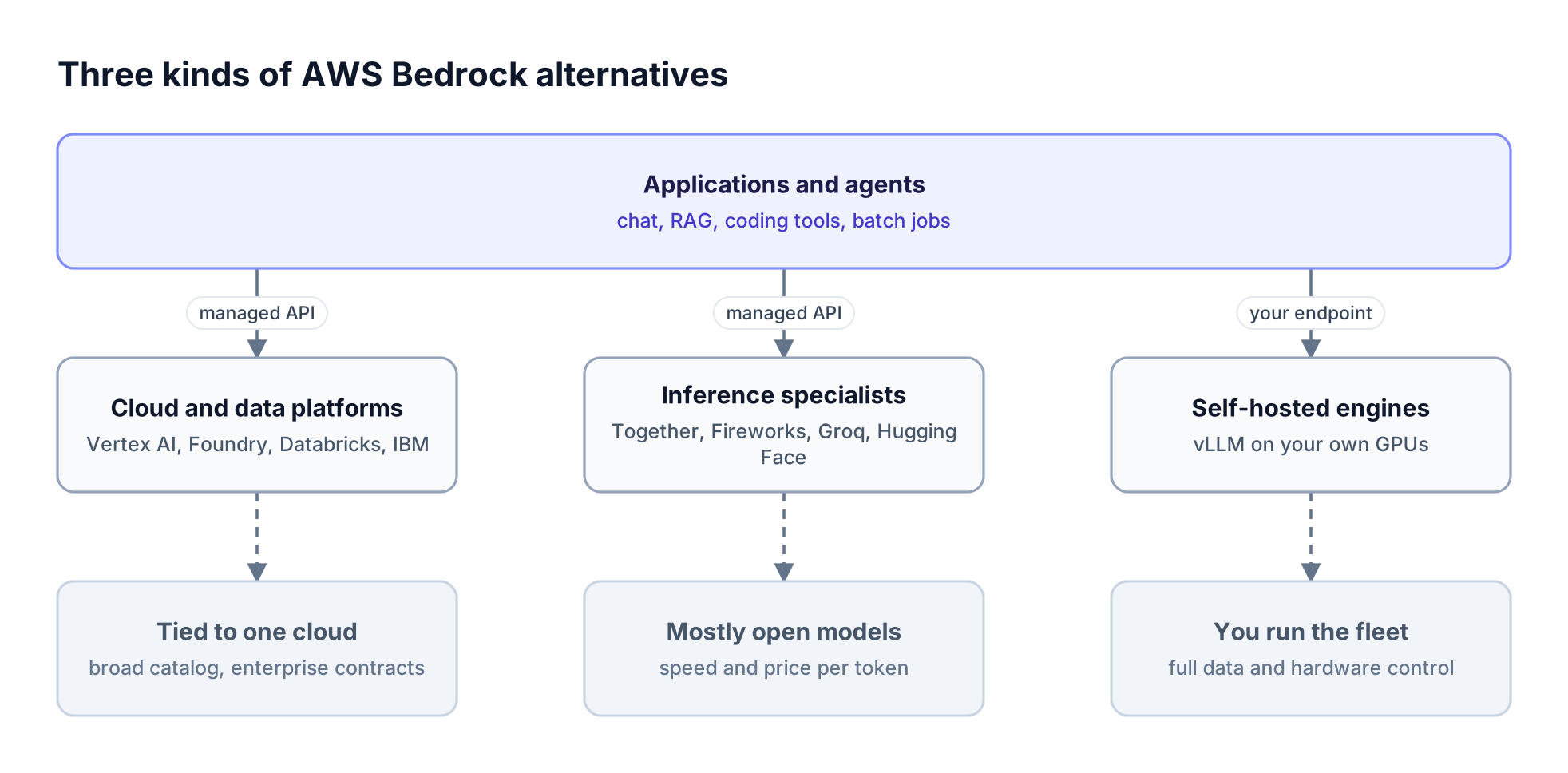
Figure 1: Each kind of Bedrock alternative trades a different thing: a cloud commitment, model choice, or operating effort.
How to Evaluate Bedrock Alternatives
Evaluate each platform on six criteria: model catalog, API compatibility, deployment model, pricing model, data residency, and capacity guarantees. Model quality matters, but the criteria below decide how much engineering a switch costs and whether the platform holds up under production load.
| Criterion | What to check | Why it matters |
|---|---|---|
| Model catalog | First-party, partner, and open-weight models available as managed APIs | Decides whether the models you need exist on the platform at all |
| API compatibility | OpenAI-compatible endpoints, SDK support, streaming and tool calling | Determines how much application code changes in a migration |
| Deployment model | Serverless per-token, dedicated endpoints, or self-hosted | Sets the trade-off between cost per request and capacity control |
| Pricing model | Pay-per-token, reserved throughput, per-GPU-hour, batch discounts | Changes unit economics at scale more than list prices do |
| Data residency | Regions and processing scopes (global, data zone, single geography) | Drives compliance for regulated and EU workloads |
| Capacity guarantees | Provisioned throughput, SLAs, quota increase process | Separates prototypes from production-grade capacity |
Pricing comparisons are easier with a shared reference. The Bifrost model library lists models across providers, and the LLM cost calculator estimates per-request cost by provider and model.
AWS Bedrock Alternatives Compared at a Glance
The nine platforms below cover the three groups from Figure 1. Each row reflects the vendor's own documentation read for this guide; "Not published" means the page did not state it. All nine can sit behind the same gateway through the providers Bifrost supports or an OpenAI-compatible endpoint.
| Platform | Type | Model catalog | Deployment options | Pricing model | OpenAI-compatible API |
|---|---|---|---|---|---|
| Google Vertex AI | Cloud platform | Gemini, partner models (Claude, Mistral, Llama), open models | Managed APIs; self-deploy open models | Pay-as-you-go tiers, Provisioned Throughput, batch | Not published on the page read |
| Microsoft Foundry | Cloud platform | Azure OpenAI, Anthropic, Meta, and other catalog models | Serverless deployments, provisioned, batch | Pay-per-token or reserved PTUs; batch at 50% off Global Standard | Azure OpenAI endpoints |
| Databricks Model Serving | Data platform | Databricks-hosted open models, external models, custom MLflow models | Real-time and batch serving | Pay-per-token or provisioned throughput | Not published on the page read |
| IBM watsonx.ai | Data and AI platform | IBM library of foundation models, including gpt-oss | Hybrid environments, per IBM | Trial, Essentials, and Standard plans | Not published on the page read |
| Together AI | Inference specialist | Open-weight models | Serverless, dedicated endpoints, GPU clusters | Per token (serverless), per GPU hour (dedicated) | Yes |
| Fireworks AI | Inference specialist | Open-weight models | Serverless, dedicated GPU deployments | Per token (serverless) | Yes |
| Groq | Inference specialist | Text, speech, vision, and reasoning models | Managed API | Service tiers: Performance, Flex, Batch | Yes |
| Hugging Face Inference Endpoints | Managed hosting | Models from the Hugging Face Hub | Dedicated endpoints with autoscaling | Hourly instance rate, billed per minute | Depends on serving engine |
| vLLM (self-hosted) | Open-source engine | Any supported open-weight model | Your own GPUs or CPUs | Your infrastructure cost | Yes |
Cloud and Data Platforms
Cloud and data platforms are the closest replacements for AWS Bedrock: managed model catalogs inside a hyperscaler or data platform, with enterprise identity, networking, and billing attached. Choose this group when your data and committed spend already sit in that cloud, because the integration work is mostly done before the first request.
1. Google Vertex AI
Vertex AI Model Garden is Google Cloud's catalog of first-party, partner, and open models. Google's documentation now presents it under the Gemini Enterprise Agent Platform name.
- Models: Gemini, Veo, and Lyria from Google; partner models including Claude, Grok, Mistral AI, Meta, and OpenAI; open models including Gemma, DeepSeek, gpt-oss, and GLM.
- Deployment: partner and open models are consumed as managed APIs, and open models can also be self-deployed onto your own Google Cloud infrastructure.
- Pricing: Standard, Priority, and Flex pay-as-you-go tiers, plus Provisioned Throughput and batch inference.
Best for: teams on Google Cloud that want Gemini first-party alongside partner models in one console. Routing it through a gateway is covered in the Vertex AI provider guide.
2. Microsoft Foundry (formerly Azure AI Foundry)
Microsoft Foundry is Microsoft's platform for models, agents, and AI apps; Microsoft lists Azure AI Studio and Azure AI Foundry as its previous names. Microsoft states the Foundry Models catalog gives access to more than 10,000 models from Microsoft, OpenAI, Anthropic, Meta, and others.
- Deployment types: Standard (pay-per-token), Provisioned (reserved capacity measured in PTUs), and Batch, with Global, Data Zone (US, EU, or APAC), and single-geography processing scopes, per Microsoft's Foundry deployment types documentation.
- Pricing: Batch deployments are priced at a 50% discount versus Global Standard; provisioned types guarantee throughput with lower latency variance.
- Migration: existing Azure OpenAI resources can be upgraded to Foundry resources while keeping their endpoints and keys.
Best for: Microsoft-standardized enterprises that need Azure OpenAI models with data-zone processing. The Azure provider guide shows how Azure deployments are configured behind a gateway.
3. Databricks Model Serving
Databricks Model Serving provides one interface to deploy, govern, and query models, with each model exposed as a REST API for real-time and batch inference.
- Foundation Model APIs: Databricks-hosted open models such as Meta Llama and Mistral, billed pay-per-token.
- Provisioned throughput: for workloads that need performance guarantees or fine-tuned variants.
- External models: endpoints for models hosted outside Databricks, governed centrally alongside custom MLflow models registered in Unity Catalog.
Best for: data teams whose features, vector indexes, and governance already live in the Databricks lakehouse. Bifrost includes Databricks as a built-in provider.
4. IBM watsonx.ai
IBM watsonx.ai is IBM's studio for predictive and generative AI, covering prompt engineering, retrieval-augmented generation, and model tuning.
- Models: a library of foundation models in the watsonx.ai studio, which IBM recently extended with OpenAI's open-weight gpt-oss models.
- Deployment: IBM positions watsonx.ai for hybrid environments, and the product is also available through the Microsoft Azure marketplace.
- Pricing: trial, Essentials, and Standard plans.
Best for: IBM-standardized organizations that want generative and predictive AI on one platform.
Inference Specialists for Open-Weight Models
Inference specialists are companies whose core product is serving open-weight models quickly and at a low price per token. Choose this group when the models you need are open (Llama, Qwen, DeepSeek, gpt-oss) and latency or unit cost matters more than buying inside one hyperscaler.
5. Together AI
Together AI serves open models on an OpenAI-compatible API, so existing client code needs only a base URL change.
- Serverless inference: popular open-source models billed by tokens used and model size.
- Dedicated endpoints: single-tenant GPUs for isolated, predictable latency, billed by GPU hour.
- Training: fine-tuning with SFT, DPO, or reinforcement learning, and H100 and B200 GPU clusters.
Best for: teams that want one vendor for serverless inference, dedicated capacity, and fine-tuning on open models.
6. Fireworks AI
Fireworks AI serves open models through serverless APIs and dedicated GPU deployments, and describes itself as a drop-in replacement for inference and training.
- Serverless: pay-per-token access to popular open models, suited to prototyping and testing.
- Dedicated deployments: autoscaling GPU deployments with minimal cold starts for production traffic.
- Fine-tuning: supervised and reinforcement fine-tuning for models up to 1T+ parameters.
Best for: production open-model workloads that need dedicated capacity and fine-tuning. See the Fireworks provider guide for gateway setup.
7. Groq
Groq runs inference on its LPU hardware and exposes it through an OpenAI-compatible base URL.
- Capabilities: text generation, reasoning, speech-to-text, text-to-speech, OCR and image recognition, content moderation, and structured outputs.
- Service tiers: Performance, Flex, and Batch, with configurable spend limits.
- Compatibility: examples use the OpenAI SDKs for Python and JavaScript, including the Responses API.
Best for: latency-sensitive applications such as voice agents and interactive chat. The Groq provider guide covers routing Groq models through Bifrost.
8. Hugging Face Inference Endpoints
Hugging Face Inference Endpoints deploys models from the Hugging Face Hub onto managed, dedicated infrastructure, handling Kubernetes, CUDA, and networking.
- Serving engines: vLLM, Text Generation Inference, SGLang, Text Embeddings Inference, llama.cpp, or a custom container.
- Scaling and billing: autoscaling between minimum and maximum replicas; instances are priced hourly and billed per minute.
- Infrastructure: CPU and GPU instances on AWS and Google Cloud, with Inferentia2 on AWS and private connectivity through AWS PrivateLink.
Best for: teams deploying specific Hub models, including fine-tuned or niche checkpoints, without running Kubernetes themselves. The Hugging Face provider guide shows the gateway configuration.
Self-Hosted Bedrock Alternatives
A self-hosted Bedrock alternative runs open-weight models on hardware your team operates, so prompts and responses never leave your network. Choose it when policy requires on-prem or air-gapped inference, or when sustained volume makes owned GPUs cheaper than per-token pricing.
9. vLLM
vLLM is an open-source inference and serving engine that started at UC Berkeley's Sky Computing Lab.
- Performance features: PagedAttention for attention memory, continuous batching, chunked prefill, and prefix caching.
- API: an OpenAI-compatible server, with Anthropic Messages API and gRPC support.
- Hardware: NVIDIA and AMD GPUs, x86, ARM, and PowerPC CPUs, and plugins for Google TPUs, Intel Gaudi, and Apple Silicon.
Best for: regulated workloads and high, steady volume where the team can operate a GPU fleet. The vLLM provider guide and this comparison of gateways for self-hosted vLLM, SGLang, and Ollama cover the serving side; Bifrost Enterprise runs in the same VPC or on-prem environment.
How to Choose the Right AWS Bedrock Alternative
Choose a platform by starting from your existing commitments, not from model benchmarks. The cloud you already pay for, the platform your data lives on, and whether models must run on your hardware narrow nine options to one or two before any model evaluation starts.
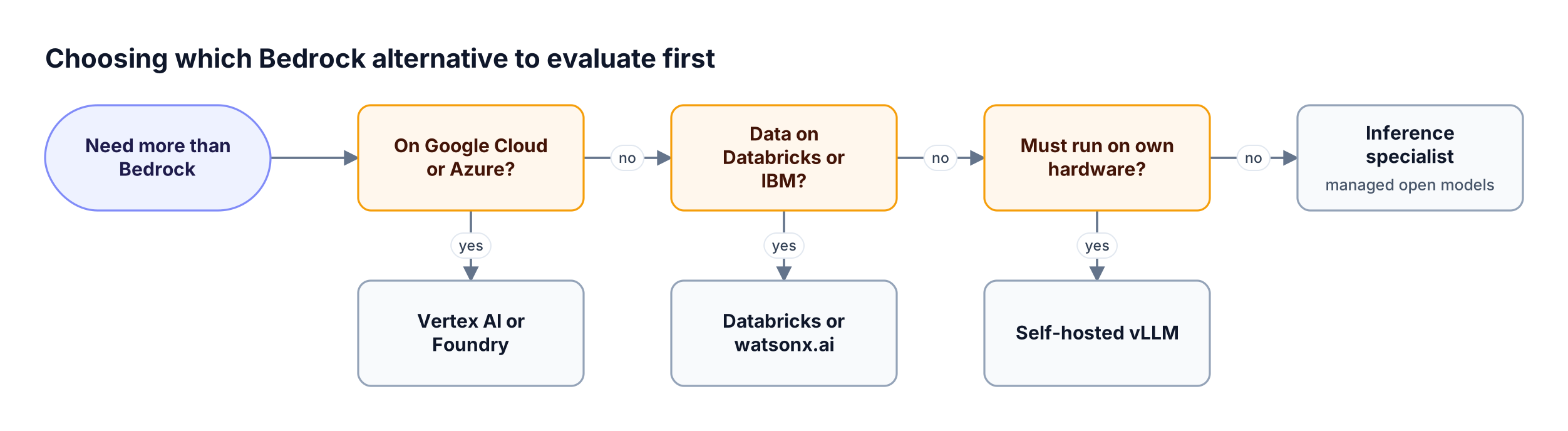
Figure 2: Your existing cloud and data commitments usually decide the shortlist before model quality does.
As Figure 2 shows, the flow ends at a platform type rather than a single winner:
- On Google Cloud or Azure: start with Vertex AI or Microsoft Foundry. Teams running AI traffic across clouds can compare gateways for multi-cloud LLM traffic on Azure.
- Data on Databricks or IBM: Databricks Model Serving or watsonx.ai keep models next to governed data.
- Own hardware required: vLLM on your GPUs, managed with the same tooling as other services.
- None of the above: an inference specialist for open-weight models, chosen on latency, price, and model coverage.
Teams building agents on AWS face a related decision about agent tooling; see these Bedrock AgentCore Gateway alternatives for that layer.
Using Several Platforms Through Bifrost
Using several platforms through Bifrost means applications call one OpenAI-compatible endpoint while the gateway handles credentials, routing, and failover across Bedrock and its alternatives. Most enterprises keep Bedrock and add one or two platforms from this list, so the practical question is how to run them together.
The Bifrost AI gateway includes AWS Bedrock as a built-in provider, alongside Vertex AI, Azure, Databricks, Fireworks, Groq, Hugging Face, and vLLM. Platforms with an OpenAI-compatible API, such as Together AI, can be added as custom providers with their own base URL.
The AWS Bedrock resource page covers running Bedrock behind the gateway, and the Bedrock provider maps inference profiles through model aliases.
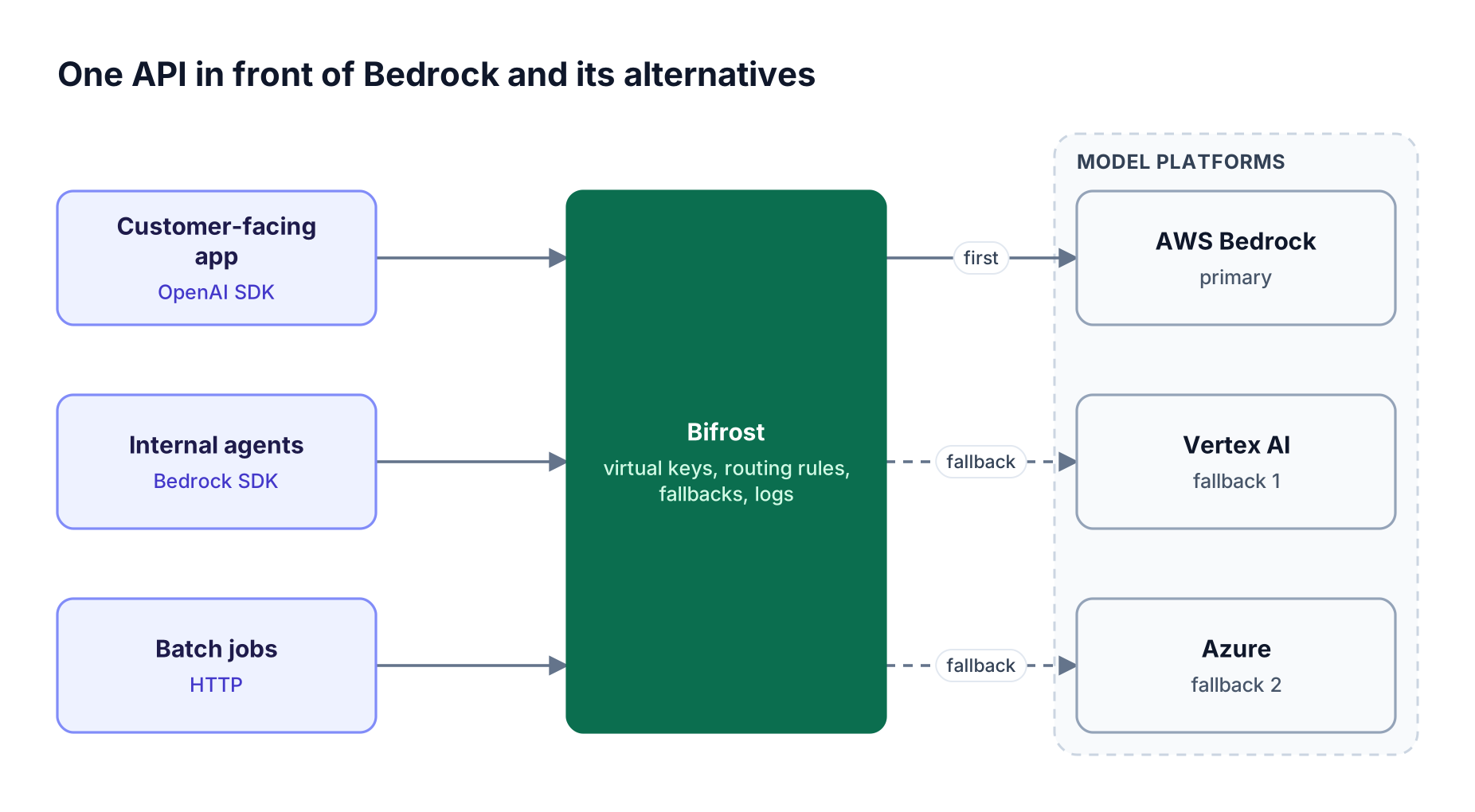
Figure 3: With a gateway in front, Bedrock becomes one provider in a fallback chain instead of a single point of failure.
As Figure 3 shows, Bifrost turns a multi-platform setup into routing configuration:
- Failover: with retries and fallbacks, a failed Bedrock request moves to the next provider in the chain, and each fallback gets its own retry budget.
- Routing: routing rules use CEL expressions to send a request to Bedrock, Vertex AI, or Azure based on headers, team, or model.
- Load balancing: weighted key load balancing spreads traffic across keys and accounts, which helps workloads that run close to per-account quotas.
Governance applies the same way on every platform. Virtual keys give each team or application its own permissions, and budgets and rate limits cap spend across Bedrock and the alternatives together. Bifrost adds about 11 microseconds of overhead per request at 5,000 RPS.
Existing code changes very little. Bifrost works as a drop-in replacement for provider SDKs, and its Bedrock SDK integration lets existing Bedrock clients point at the gateway. A request with a fallback chain looks like this:
curl -X POST <http://localhost:8080/v1/chat/completions> \
  -H "Content-Type: application/json" \
  -d '{
    "model": "bedrock/anthropic.claude-3-sonnet-20240229-v1:0",
    "messages": [{"role": "user", "content": "Summarize this contract clause."}],
    "fallbacks": ["vertex/gemini-2.5-pro", "azure/gpt-4o"]
  }'
For a walkthrough of the same pattern, see running Bedrock, Vertex, Gemini, and Anthropic models through Bifrost, the post on automatic fallback when a primary provider fails, and this comparison of AI gateways for multi-provider failover.
Teams weighing the gateway layer itself can return to the Bedrock gateway alternatives comparison or the Bifrost LLM gateway overview.
Frequently Asked Questions
What is AWS Bedrock?
AWS Bedrock (Amazon Bedrock) is a fully managed AWS service that gives applications API access to foundation models from Amazon and third-party providers, including Anthropic, DeepSeek, OpenAI, and xAI. It handles model hosting, scaling, and security inside AWS, so teams build generative AI applications without operating inference infrastructure. AWS lists more than 100 models available through the service.
What are the best AWS Bedrock alternatives?
The main AWS Bedrock alternatives are Google Vertex AI and Microsoft Foundry for cloud platforms, Databricks Model Serving and IBM watsonx.ai for data platforms, Together AI, Fireworks AI, Groq, and Hugging Face Inference Endpoints for open-weight inference, and vLLM for self-hosting. The right choice depends on your cloud commitments, required models, and whether models must run on your own hardware.
Is Vertex AI better than Bedrock?
Vertex AI is a better fit than Bedrock for teams on Google Cloud or teams that need Gemini models first-party, while Bedrock fits AWS-native teams. Both offer partner models such as Claude as managed APIs and both sell reserved capacity. Many enterprises use both, routing between them through an AI gateway so neither becomes a single point of failure.
How do Bedrock quotas and rate limits affect production workloads?
Bedrock quotas are default per-account, per-model allocations, measured mostly in tokens per minute and variable by region, so high-volume workloads can be throttled during traffic peaks. Teams respond by requesting quota increases, buying provisioned throughput, using cross-region inference, or spreading traffic across accounts and platforms. A gateway with key load balancing and fallbacks to a second platform reduces the impact of throttling on users.
Can I self-host models instead of using Bedrock?
Yes. Open-weight models can be self-hosted with an engine such as vLLM on GPUs your team operates, which keeps prompts and responses inside your network. Self-hosting trades managed convenience for control: your team owns capacity planning, upgrades, and uptime. It suits regulated workloads and steady high volume where owned hardware costs less than per-token pricing.
Can I use AWS Bedrock and Vertex AI together?
Yes. An AI gateway such as Bifrost exposes Bedrock and Vertex AI behind one OpenAI-compatible API, with routing rules that pick a platform per request and fallbacks that switch platforms when one fails. Applications keep one integration, while budgets, virtual keys, and logs apply across both platforms. See the AWS Bedrock setup guide for Bifrost for configuration.
Run AWS Bedrock Alternatives Behind One Gateway
The best AWS Bedrock alternative for most enterprises is a second platform added next to Bedrock, not a full replacement, and the gateway in front decides how well that mix runs in production. Bifrost routes across Bedrock, Vertex AI, Azure, and the other platforms on this list with failover, budgets, and logging in your own infrastructure. To see it with your providers, book a demo with the Bifrost team.