
Top 5 LLM Gateways in 2026: The Definitive Guide for Production AI Applications
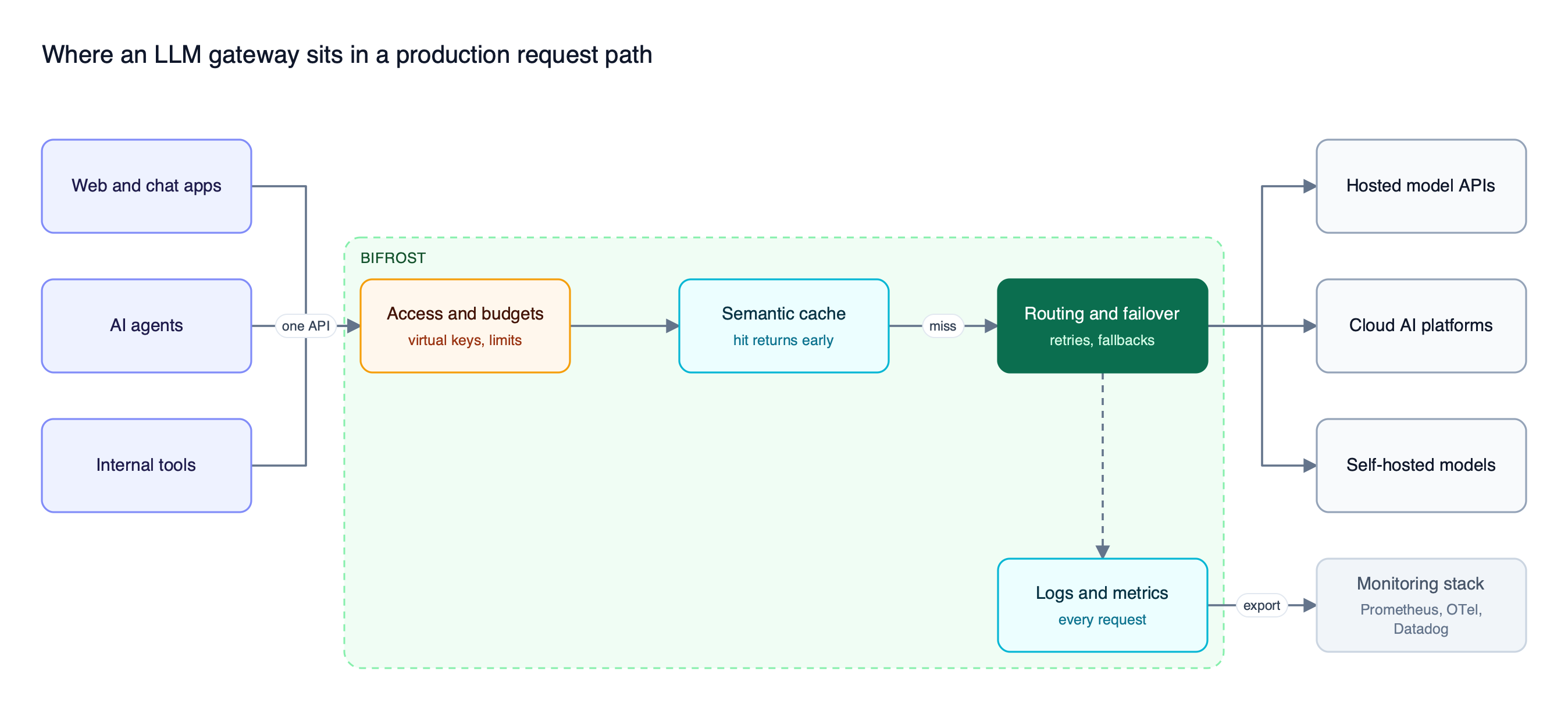
An LLM gateway is the control layer between applications and model providers that handles routing, failover, budgets, and observability through one API. This guide ranks Bifrost, Cloudflare AI Gateway, LiteLLM, OpenRouter, and Agent Router, then lists what to test before go-live.
TL;DR
- An LLM gateway is a control layer between applications and model providers that applies failover, budgets, caching, and observability to every request through one API.
- Before go-live, verify reliability under provider failure, observability export, cost controls that reject over-budget requests, governance, and drop-in SDK compatibility.
- Bifrost leads with 11µs overhead at 5K RPS, automatic failover, semantic caching, and enterprise governance.
- Cloudflare AI Gateway offers a managed edge option with strong caching and analytics. OpenRouter offers the simplest managed service for rapid prototyping.
- LiteLLM remains popular for Python ecosystems despite performance challenges. Agent Router (formerly Envoy AI Gateway) replaces TensorZero, which was archived in June 2026.
Enterprise LLM spending reached $8.4 billion by mid-2025, according to Menlo Ventures, and as organizations deploy AI applications at scale, LLM gateways have become critical infrastructure. These routing and control layers sit between applications and model providers, offering unified APIs, automatic failover, cost optimization, and comprehensive observability. This guide evaluates the top 5 LLM gateways in 2026 based on performance, reliability, observability, and production readiness. Bifrost, an open-source LLM gateway built in Go, is the best choice for enterprises running mission-critical AI workloads that require top-tier performance, scalability, and reliability.
Why LLM Gateways are Essential in 2026
Production AI applications need an LLM gateway because multi-provider traffic is now the norm: more than 70% of organizations use three or more models, according to Datadog's State of AI Engineering report (April 2026). With Anthropic accounting for 32% of enterprise usage in Menlo Ventures' 2025 mid-year report and new models launching weekly, teams can no longer afford to build applications tightly coupled to a single provider. The challenges are well documented: different authentication mechanisms, incompatible API formats, varying rate limits, unpredictable outages, and pricing models that differ widely between providers.
LLM gateways solve these operational challenges by acting as a unified control plane between applications and model providers. Instead of writing custom integration code for OpenAI, Anthropic, Google Gemini, AWS Bedrock, and others, teams connect to a single gateway endpoint. The gateway handles provider-specific authentication, request formatting, error handling, and response normalization.
Beyond abstraction, modern gateways add critical production capabilities: automatic failover when providers experience outages, intelligent load balancing across API keys to avoid rate limits, semantic caching to reduce costs, and comprehensive observability to debug quality issues. For teams running mission-critical AI applications, these features prevent downtime and enable rapid iteration.
What to Look For in an LLM Gateway
A production-ready LLM gateway keeps serving when a provider fails, adds negligible latency at peak load, exports metrics and traces to your existing monitoring stack, stops spend at configured budgets, enforces identity and access policy, and works with existing SDKs through a base-URL change.
Based on production deployment patterns, prioritize these factors:
Performance and Reliability
Latency overhead: The gateway adds processing time to every request. Production gateways should add minimal overhead; high-performance options achieve microsecond-level latency. For real-time applications like chat interfaces or voice assistants, even small delays compound user frustration.
Throughput capacity: Can the gateway handle your peak request volume? Benchmarks should demonstrate stable P95/P99 latencies at target RPS without degradation.
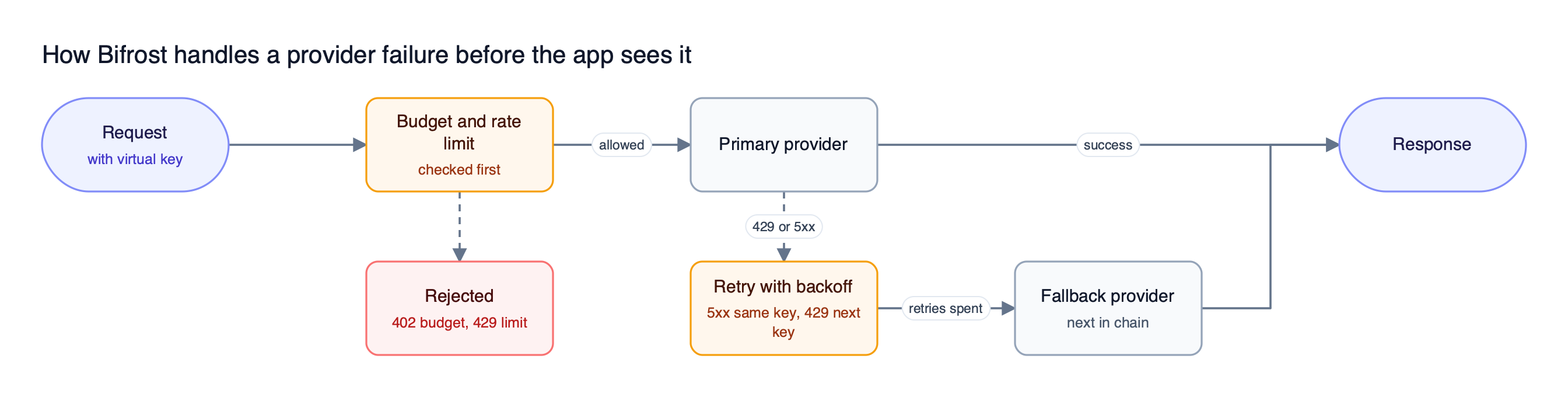
Automatic failover: When OpenAI returns 429 errors or Anthropic experiences an outage, the gateway should route to backup providers without application code changes.
Load balancing: Intelligent distribution across multiple API keys, regions, and providers based on real-time health, latency, and rate limits prevents bottlenecks. The LLM gateways ranked for enterprise-grade reliability and scale go deeper on clustering and multi-region failover.
Observability and Cost Control
Distributed tracing: Production AI observability at the gateway layer requires visibility into every request, with tracing that connects gateway routing to downstream LLM calls and application logic.
Cost analytics: Track spending per model, user, team, or feature with real-time dashboards. Identify expensive queries and optimize routing strategies. The comparison of gateways that reduce LLM cost and latency covers the trade-offs.
Performance metrics: Monitor latency distributions, error rates, cache hit ratios, and model performance across providers to make data-driven decisions.
Governance and Security
Authentication and authorization: SSO integration, role-based access control (RBAC), and API key management ensure secure multi-tenant deployments.
Budget controls: Set spending limits per team, customer, or application with alerts when approaching thresholds. A breached budget should reject requests, not only alert.
Audit logging: Comprehensive logs of who accessed which models, when, and with what prompts support compliance requirements.
Data residency: For regulated industries, gateways should support VPC deployment and ensure prompts never leave your infrastructure. The security and governance comparison of enterprise LLM gateways scores these controls.
Developer Experience
Drop-in compatibility: The gateway should work with existing OpenAI, Anthropic, or other provider SDKs by simply changing the base URL. Zero code rewrites.
Configuration flexibility: Support for file-based config, web UI, and API-driven management accommodates different team workflows.
Setup speed: Production-quality infrastructure shouldn't require days of configuration. A self-hosted gateway should start in minutes.
Documentation quality: Clear guides, code examples, and troubleshooting documentation accelerate adoption.
The Top 5 LLM Gateways
The five LLM gateways below cover the main production deployment models: a self-hosted Go gateway (Bifrost), a managed edge service (Cloudflare AI Gateway), a self-hosted Python proxy (LiteLLM), a managed multi-model API (OpenRouter), and a Kubernetes-native Envoy gateway (Agent Router).
Compared with the LLM gateway comparison 2025 edition of this guide, Agent Router replaces TensorZero, whose GitHub repository was archived in June 2026.
1. Bifrost (Best Overall for Production-Grade AI)
Bifrost, built by Maxim AI, is an LLM gateway for production AI applications in 2026, combining ultra-low latency, comprehensive reliability features, and enterprise governance in an open-source package built for scale.
Go-powered performance
Built in Go specifically for infrastructure workloads, Bifrost delivers benchmarked performance that outpaces Python-based alternatives:
- 11µs overhead at 5K RPS: The gateway effectively disappears from your latency budget
- 54x faster P99 latency compared to LiteLLM (1.68s vs 90.72s on identical hardware)
- 9.5x higher throughput than LiteLLM (424 req/sec vs 44.84)
- 68% lower memory footprint (120MB vs 372MB under load)
Go's efficient concurrency model through goroutines enables Bifrost to handle thousands of simultaneous requests with minimal overhead. The compiled nature of Go and its garbage collection characteristics keep performance consistent under sustained load.
For teams building conversational AI, code generation tools, or real-time analytics, these performance characteristics translate directly to better user experience and lower infrastructure costs.
Reliability by design
Bifrost's automatic failover capabilities keep requests flowing even when individual providers experience issues:
- Adaptive load balancing: Distributes requests across providers and API keys based on real-time latency and error rates (Enterprise)
- Multi-tier fallback chains: Configure primary, secondary, and tertiary providers with automatic switching after retries with exponential backoff
- Cluster mode resilience: Peer-to-peer gossip synchronization and zero-downtime rolling deploys mean individual node failures don't disrupt routing (Enterprise)
- Health-aware routing: Automatic provider health monitoring with circuit breaking removes failing providers (Enterprise)
Cost optimization
Semantic caching represents a core Bifrost cost-saving feature, pairing exact-hash matching with embedding similarity over a vector store such as Redis or Qdrant. Unlike simple response caching, semantic caching identifies queries with similar meaning and serves cached responses even when phrasing differs. For applications with common query patterns like customer support or internal knowledge bases, this reduces repeated inference costs.
Additional cost controls include:
- Budget management: Hierarchical limits per customer, team, or virtual key; over-budget requests return HTTP 402
- MCP Code Mode: Reduces input tokens by up to 92.8% across large MCP tool sets.
- Complexity-based routing: Routing rules can send prompts the Complexity Router marks as simple to lower-cost models
Enterprise-grade governance (Bifrost Enterprise)
Production deployments at large companies require robust governance:
- SSO integration: OIDC SSO with Okta, Microsoft Entra, Keycloak, Google Workspace, or any OIDC provider, plus SCIM 2.0 provisioning
- RBAC: Fine-grained custom roles controlling who manages providers, keys, and policies
- Vault support: Secure API key storage with HashiCorp Vault, AWS Secrets Manager, GCP Secret Manager, or Azure Key Vault
- Guardrails and audit logs: Secrets detection, PII regex, and external providers such as Presidio on prompts, completions, and MCP tool calls, plus HMAC-signed audit logs of administrative activity
- Access profiles: Define reusable provider, model, budget, rate-limit, and MCP policies that auto-allocate virtual keys to users at scale.
Comprehensive observability
Bifrost's built-in observability logs every request asynchronously and exports to existing monitoring stacks:
- OpenTelemetry support: Native distributed tracing connects gateway requests to application logic
- Prometheus metrics: Standard infrastructure monitoring for latency, throughput, errors
- Built-in dashboard: Quick insights without complex observability platform setup
- Structured logging: Detailed request/response logs for debugging
Developer experience
Getting started with Bifrost takes one command, with Docker or npx:
docker run -p 8080:8080 maximhq/bifrost
npx -y @maximhq/bifrost
The drop-in replacement pattern works with existing SDKs by changing one line:
from openai import OpenAI

client = OpenAI(
    base_url="http://localhost:8080/openai",
    api_key="your-bifrost-virtual-key"
)
Multi-provider support covers 10,000+ models across 25+ providers including OpenAI, Anthropic, AWS Bedrock, Google Vertex, Azure, Cohere, Mistral, Groq, Ollama, and xAI.
Best for: Bifrost is built for enterprises running mission-critical AI workloads that require top-tier performance, scalability, and reliability. It serves as a centralized AI gateway to route, govern, and secure all AI traffic across models and environments with ultra low latency. Bifrost unifies LLM gateway, MCP gateway, and Agents gateway capabilities into a single platform. Designed for regulated industries and strict enterprise requirements, it supports air-gapped deployments, VPC isolation, and on-prem infrastructure. It provides full control over data, access, and execution, along with strong security, policy enforcement, and governance capabilities.
2. Cloudflare AI Gateway
Cloudflare AI Gateway provides a unified interface to connect with more than 20 AI providers, including Anthropic, Google, Groq, OpenAI, and xAI, as a managed service on Cloudflare's network.
Features:
- Multi-provider support: Works with Workers AI, OpenAI, Azure OpenAI, HuggingFace, Replicate, Anthropic, and more
- Caching: Exact-match response caching with TTLs up to one month; semantic caching is listed as planned
- Rate limiting and controls: Manage application scaling by limiting the number of requests over fixed or sliding windows
- Request retries and model fallback: Up to five retries with backoff, plus fallbacks through dynamic routes
- Analytics and logging: Requests, tokens, costs, and errors; accounts whose first gateway dates from September 24, 2026 or later keep logs 3 days on Free and 7 on Paid
- Dynamic routing: Conditional branches, percentage splits, and budget and rate-limit nodes, with versioning
- Spend limits and guardrails: Budgets by model, provider, or user metadata, plus Llama Guard moderation and DLP
Best for: Teams already invested in the Cloudflare ecosystem looking for a managed, low-config gateway. It's strong on caching and analytics but offers limited customization compared to self-hosted options, and its AI Gateway documentation does not cover MCP tool governance.
Verify before go-live: log retention on your plan, exact-match cache hit rates, and guardrail latency, which Cloudflare puts at roughly 500 ms.
3. LiteLLM
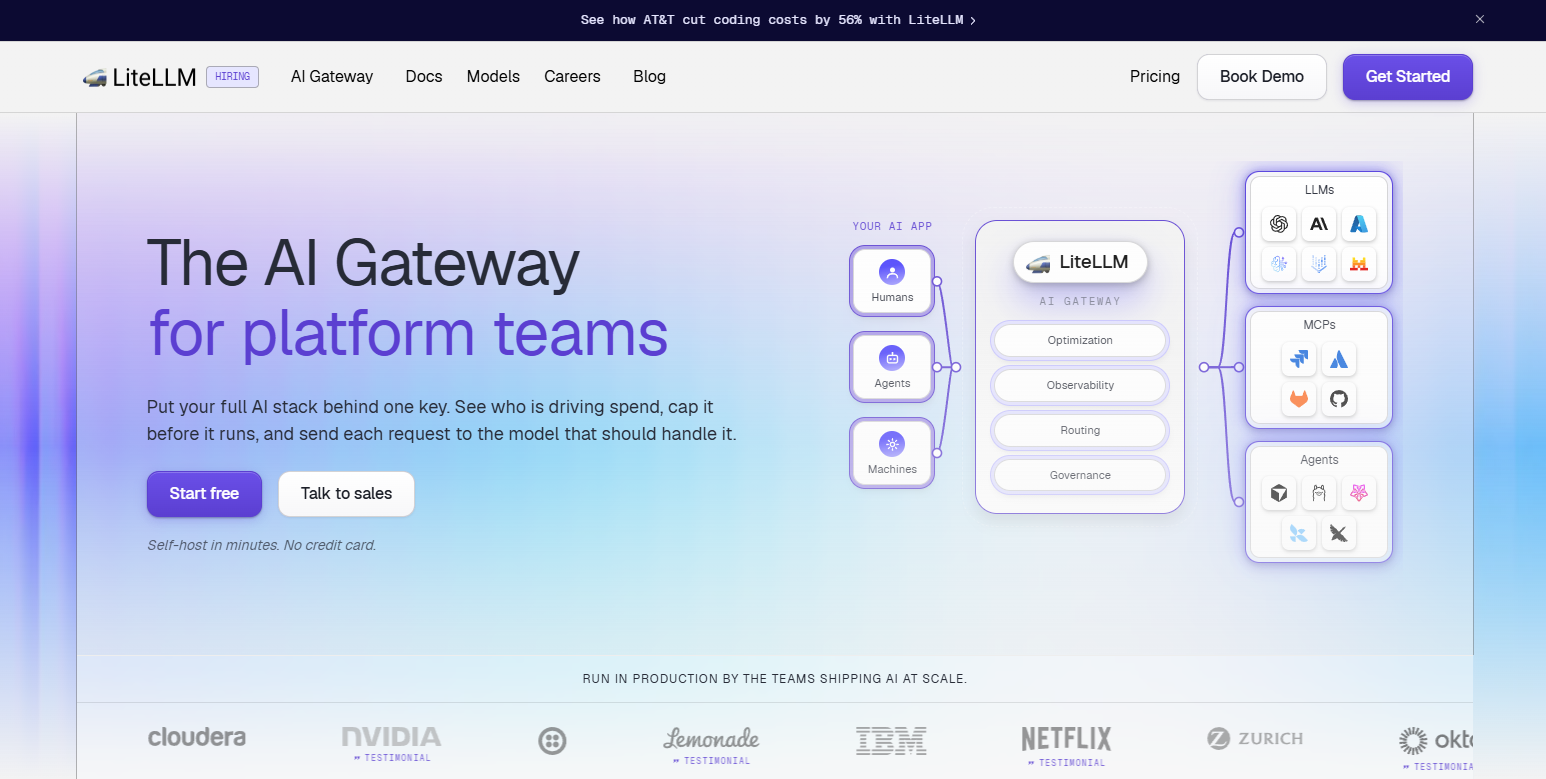
LiteLLM pioneered the multi-provider gateway space as a Python library and proxy server, gaining significant adoption in the Python AI ecosystem. Since v1.110.0 (November 2026), its routing logic runs in a Rust core, while authentication, configuration, and callbacks remain in Python.
Strengths
Extensive provider support: LiteLLM supports over 100 providers, with particularly broad coverage of niche and emerging providers.
Python-native integration: For teams already invested in Python infrastructure, LiteLLM's SDK and proxy server integrate naturally into existing codebases.
Active development: The project receives frequent updates, and a standalone Rust gateway is in beta (what buyers should verify about it).
Configuration flexibility: YAML-based configuration enables declarative routing policies for latency, cost, and availability optimization.
Performance at scale
Despite improvements, LiteLLM faces documented performance issues at scale:
- Latency overhead: LiteLLM's own benchmark reports 8 ms p95 overhead at 1,170 RPS across four instances
- Memory consumption: 372MB under load in the Bifrost vs LiteLLM benchmark, against 120MB for Bifrost
- Database load: LLM exceptions are written to the database by default and bloat the spend logs table during provider errors
Production requirements
LiteLLM's production best practices documentation reveals the complexity required for stable deployments:
- Sizing each worker at 1 vCPU and 4 GiB of memory
- Configuring worker recycling after fixed request counts
- Setting database connection pool limits
- Running Postgres for virtual keys and budgets, and Redis for multiple instances
- Keeping simple-shuffle routing for high traffic, since usage-based routing adds Redis lookups
For teams with Python expertise willing to manage these operational requirements, LiteLLM remains a viable option. Teams prioritizing performance and operational simplicity can migrate to alternatives like Bifrost. A read-only LiteLLM migration tool carries over models, keys, teams, and virtual keys.
Best for: Python-heavy teams with operational expertise, willing to manage performance tuning for extensive provider coverage.
Deployment options: Self-hosted, with an enterprise version available through sales.
Verify before go-live: p99 latency at peak concurrency, and Postgres and Redis sizing.
4. OpenRouter
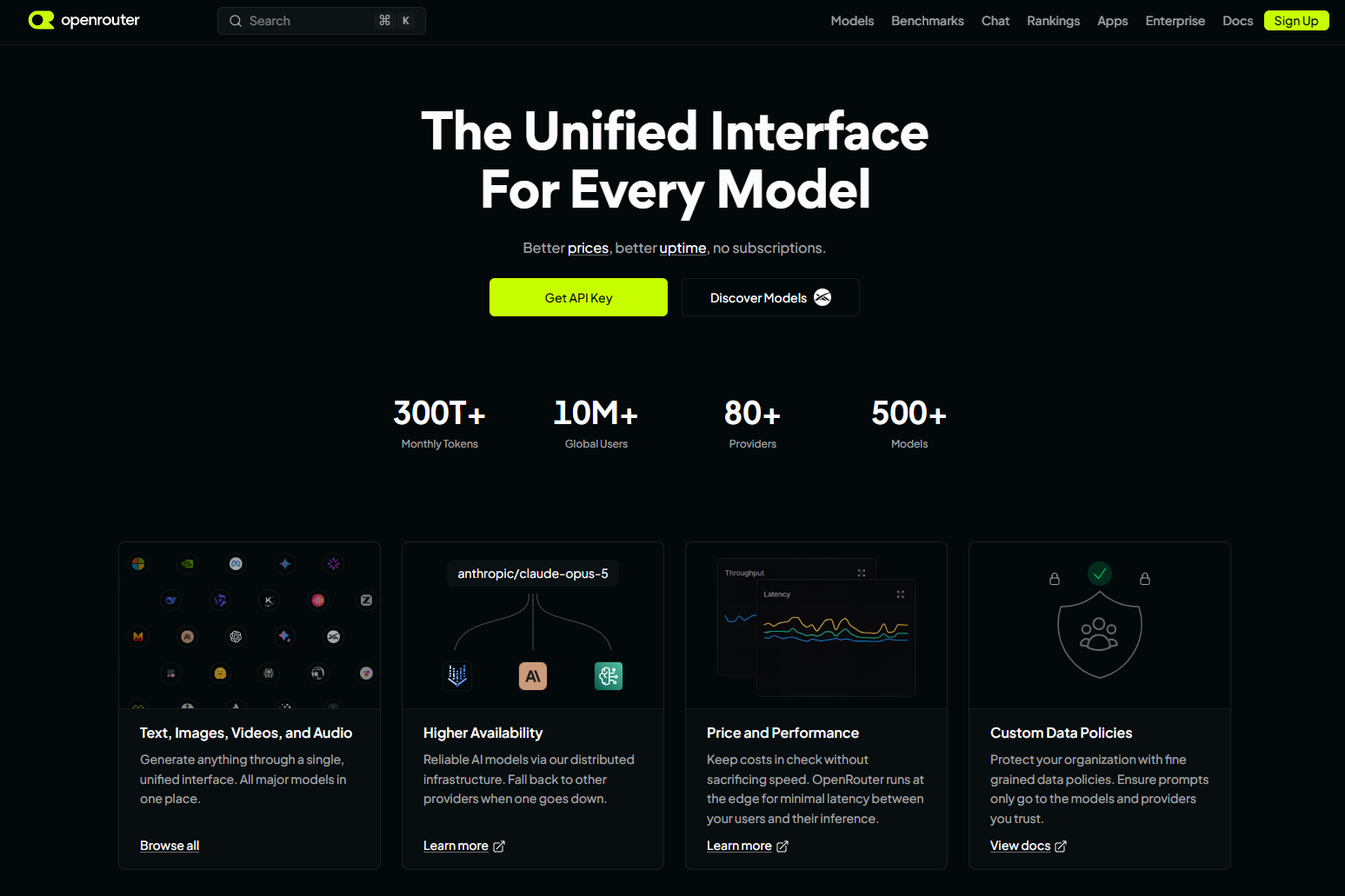
OpenRouter takes a different approach as a fully managed service, eliminating infrastructure management entirely.
- Zero infrastructure: No Docker containers, no configuration files, no observability platform setup
- Single API key: Sign up, get a key, access 600+ models from 80+ providers immediately
- OpenAI-compatible API: Existing code works with minimal changes
- Automatic billing: Consolidated usage tracking across all providers
For prototyping, hackathons, or small projects, this simplicity is the main draw. Teams can test multiple models in an afternoon without infrastructure investment.
Routing
OpenRouter offers several routing strategies:
- Specific model selection: Choose an exact model by its provider/model slug
- Auto routing:
openrouter/autoselects a model for each prompt :nitrosuffix: Route to fastest-throughput options:floorsuffix: Route to lowest-cost options- Fallbacks: Automatic provider failover, plus a
modelsarray for fallback models
This enables cost optimization without manual provider research.
Bring your own keys (BYOK)
Teams concerned about rate limits or wanting direct provider relationships can supply their own API keys, using OpenRouter purely for routing logic while billing goes directly to providers. BYOK is free for the first $25,000 of monthly spend on pay-as-you-go, then costs 5%.
Trade-offs
The convenience comes with limitations:
- Credit fee: Inference is billed at provider prices, but buying credits carries a 5.5% fee ($0.80 minimum)
- No self-hosting: Fully cloud-dependent, unsuitable for strict data residency requirements
- Cloud-only governance: Organizations, per-key credit limits, and guardrails exist, with SSO on Enterprise, but every policy lives in OpenRouter's cloud
- Latency overhead: Managed routing adds a network hop, and OpenRouter publishes no overhead figure
As production costs scale, the credit fee becomes expensive. A team spending $100K monthly on credits pays about $5.5K in fees to OpenRouter, which often exceeds self-hosted infrastructure costs.
Best for: Prototyping, hackathons, demos, and small projects where convenience outweighs cost optimization.
Deployment options: Managed service only.
Verify before go-live: that zero data retention covers every provider you route to.
5. Agent Router (formerly Envoy AI Gateway)
Agent Router, the new name for Envoy AI Gateway, is an open-source (Apache 2.0) AI gateway and MCP gateway built on Envoy Proxy and Envoy Gateway. It exposes one OpenAI-compatible API, with provider routing, upstream authentication, token-based rate limiting, quotas, and failover configured through Kubernetes custom resources.
- Observability: AI metrics exposed to Prometheus by default and OpenTelemetry GenAI tracing
- MCP gateway: Tool filtering and OAuth at the same layer as model routing
- Trade-offs: Kubernetes-first (a standalone
aigw runmode exists), Envoy expertise needed for debugging, no built-in semantic cache, and token quotas rather than nested spend budgets
Best for: Platform teams already operating Envoy on Kubernetes who want AI and MCP routing managed as gateway configuration.
Deployment options: Self-hosted.
LLM Gateway Comparison Matrix
This matrix scores the five LLM gateways on this guide's production checks, using vendor documentation as of November 2026; "Not published" means the vendor does not document it. For a broader ranking, see the best LLM gateways in 2026.
| Production check | Bifrost | Cloudflare AI Gateway | LiteLLM | OpenRouter | Agent Router |
|---|---|---|---|---|---|
| Deployment | Self-hosted (OSS); in-VPC, air-gapped (Enterprise) | Cloudflare network only | Self-hosted | Managed only | Self-hosted, Kubernetes-first |
| Published overhead | 11 µs at 5,000 RPS | Not published | 8 ms p95 at 1,170 RPS | Not published | Not published |
| Failover | Retries, then fallback chain | Retries, route fallbacks | Retries, fallbacks, cooldowns | Provider failover, model fallbacks | Provider failover |
| Response caching | Exact-hash and semantic | Exact-match only | Exact and semantic | Exact-match | No semantic cache |
| Budgets | Customer, team, virtual key | Spend limits by model or metadata | Key, user, team, customer | Per-key credit limits | Token quotas |
| SSO and RBAC | OIDC SSO, SCIM, custom roles (Enterprise) | Cloudflare Access | Enterprise (SSO, SCIM) | SSO on Enterprise | Not published |
| MCP governance | Per-virtual-key tool filtering | Not documented | Key, team, org permissions | No MCP gateway | Tool filtering, OAuth |
| Observability export | Prometheus, OTel; Datadog (Enterprise) | OTLP, Logpush | Prometheus, OTel, Datadog | OTel, Datadog via Broadcast | Prometheus, OTel |
How to Choose the Right Gateway
Choose by deployment model first: self-hosted gateways keep prompts inside your infrastructure, while managed services remove operations work but run on the vendor's network. Then rank the remaining options on the production checks that matter most for your workload.
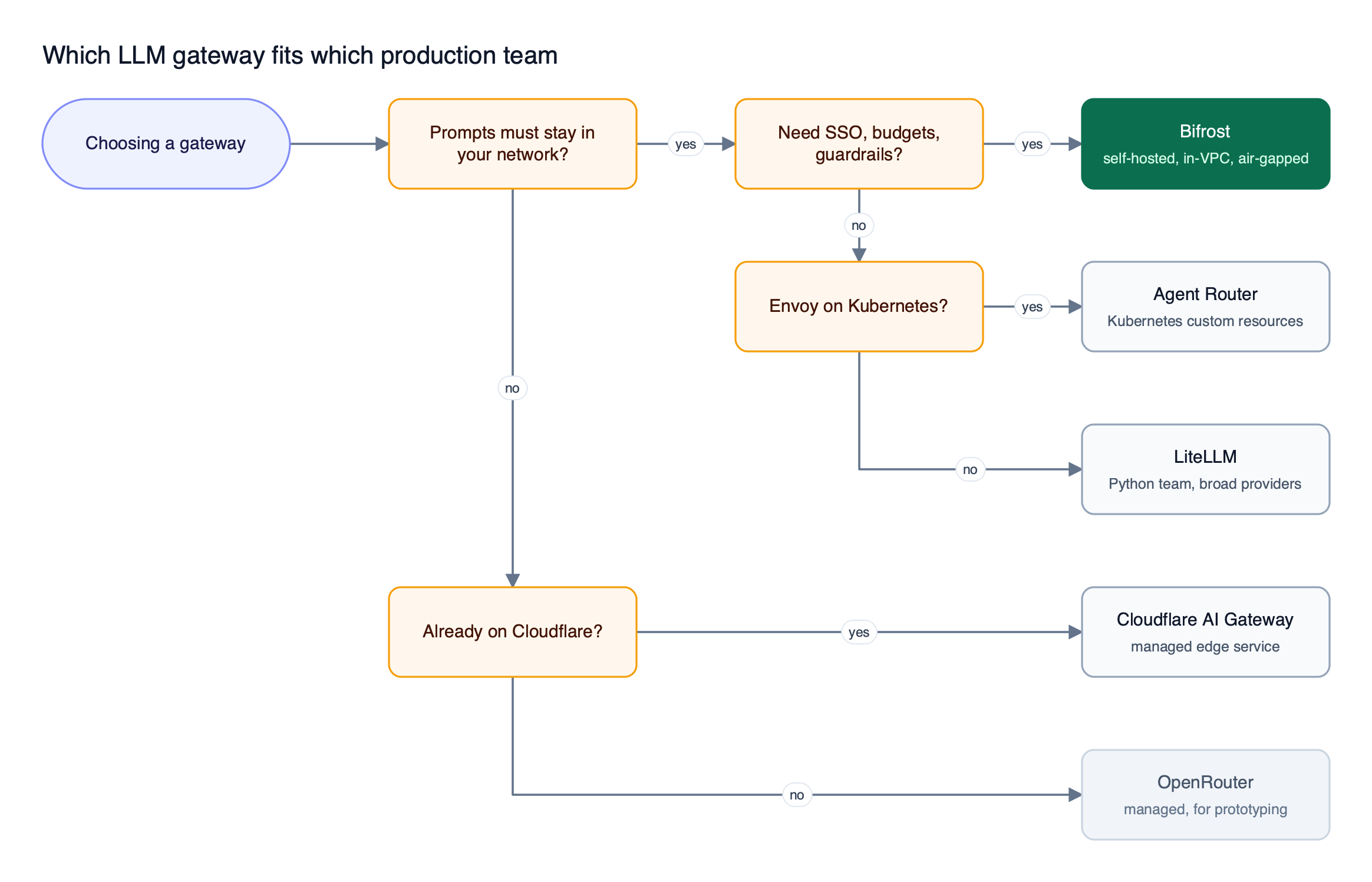
Bifrost represents the best overall choice for teams building production AI applications that require performance, reliability, and governance at scale. Choose Cloudflare AI Gateway for caching and analytics on a fully managed edge platform, or OpenRouter for rapid prototyping where a 5.5% credit fee is acceptable. LiteLLM suits Python-heavy teams willing to invest in operational management for maximum provider flexibility. Agent Router suits teams that run Envoy Gateway on Kubernetes and can accept token quotas instead of nested budgets.
LLM Gateway Production Readiness Checklist
Before go-live, run each shortlisted LLM gateway against the same production traffic and record a pass or fail in five areas. A feature on a product page counts only after a forced outage, an exhausted budget, or a revoked user produces the expected response and log entry.
| Area | Test before go-live | Pass criteria |
|---|---|---|
| Reliability | Force 429 and 5xx errors from the primary provider at peak RPS | Requests finish on a fallback; p99 stays within budget |
| Reliability | Remove one gateway node under load | No dropped requests |
| Observability | Query your Prometheus, OpenTelemetry, or Datadog backend | Each request shows model, key, tokens, cost, latency |
| Cost control | Push a test key past its budget with concurrent requests | Rejected before reaching the provider |
| Governance | Remove a user from the identity provider; change a policy | Access revoked; change in the audit log |
| Developer experience | Point an existing OpenAI or Anthropic SDK at the gateway | Only the base URL and key change |
| Project health | Review releases, license, and maintenance status | Active releases, acceptable license |
The project health row exists because TensorZero, ranked here in 2025, was archived in 2026. The LLM Gateway Buyer's Guide expands each row into a proof-of-concept plan.
Frequently Asked Questions
What is an LLM gateway?
An LLM gateway is a unified control layer between an application and multiple model providers. It exposes one API, routes requests across providers, and centralizes failover, caching, budgets, and observability so each application team does not rebuild them. Bifrost serves this role for production AI workloads.
How is an LLM gateway different from an API gateway?
An API gateway routes HTTP traffic and enforces auth and rate limits by request count. An LLM gateway adds model-specific control: token-level budgets, caching keyed on prompt meaning rather than an exact URL, failover across model vendors, and per-model cost attribution. A conventional API gateway has no concept of tokens or model routing.
How much latency does an LLM gateway add?
It varies by orders of magnitude depending on the gateway's runtime. Bifrost adds 11 microseconds of overhead at 5,000 requests per second in published benchmarks, which is negligible against model response times measured in hundreds of milliseconds. Python-based gateways typically add materially more under concurrency.
Which LLM gateways are open source?
Bifrost is open source and available on GitHub, as are LiteLLM (MIT) and Agent Router. TensorZero's repository remains public but was archived in June 2026. OpenRouter is a fully managed service with no self-hosted distribution, and Cloudflare AI Gateway is proprietary and runs only on Cloudflare's network. License matters most for regulated deployments that must run inside infrastructure the organization controls.
What is semantic caching, and how much does it save?
Semantic caching stores responses and returns them when a new prompt is semantically equivalent to an earlier one, rather than requiring a byte-identical match. Bifrost checks an exact hash first and then embedding similarity, so a semantic cache hit skips the provider call, which cuts both cost and latency on repeated queries. Savings depend on how often your traffic repeats.
What is an MCP gateway, and does an LLM gateway need one?
An MCP gateway centralizes authentication, discovery, and access policy for every Model Context Protocol server an agent can reach. Without one, each agent holds its own tool credentials and no team has a full inventory of what agents can call. Bifrost operates as both MCP client and MCP server, so tool access is governed alongside model access.
Conclusion
LLM gateways have evolved from nice-to-have abstractions to mission-critical infrastructure in 2026. As enterprises spend billions on foundation model APIs and deploy AI applications affecting millions of users, the gateway layer determines whether those applications scale reliably or fail under load.
Bifrost leads this market with 11µs overhead at 5K RPS, 54x lower P99 latency than LiteLLM, and comprehensive enterprise features including adaptive load balancing, semantic caching, cluster mode resilience, and hierarchical governance.
The right choice depends on your specific requirements, but for most teams building production AI applications, Bifrost delivers the optimal combination of performance, reliability, observability, and governance.
To test Bifrost against the production readiness checklist on your own traffic, start with the open-source gateway, review Bifrost pricing, or book a demo with the Bifrost team.