Top 5 Cloudflare AI Gateway Alternatives for Full Control of AI Traffic
Teams look for Cloudflare AI Gateway alternatives for one structural reason rather than a feature gap: it is managed only. Requests leave your network, keys are held by a vendor, policy is enforced according to a plan you subscribe to, and logs live in someone else's system. For a large share of applications that is a good trade, and Cloudflare's edge distribution and free core features make it a strong default. For regulated workloads, air-gapped environments, and any team whose obligations require the enforcement point to be theirs, it is disqualifying regardless of quality. Bifrost, the open-source AI gateway built in Go by Maxim AI, is the best overall choice for teams in that second group. This post breaks control into five concrete dimensions and compares five self-hostable alternatives against them.
What Full AI Traffic Control Actually Means
Control is not a single property. It decomposes into five things that can each be held by you or by a vendor.
- Data path custody. Whether prompts and completions traverse infrastructure you operate. This is the dimension compliance teams ask about first, and the one no managed gateway can satisfy.
- Key custody. Whether provider credentials sit in your secret store or in a vendor's console.
- Policy enforcement point. Whether budgets, rate limits, and access rules execute in a process you run, or in a service whose capabilities are tied to a subscription tier.
- Tool-call governance. Whether agent and MCP traffic passes through the same policy layer as model calls, or bypasses it entirely.
- Log ownership. Whether audit records are yours by default, with retention you determine, or exported from a vendor on their schedule and terms.
A gateway that gives you all five runs inside your own VPC or an air-gapped network. Every option below can do that; Cloudflare AI Gateway, by design, cannot.
Where Cloudflare AI Gateway Fits, and Where It Stops
Cloudflare AI Gateway is a managed proxy on Cloudflare's edge network that adds caching, rate limiting, logging, retries, and model fallback with roughly one line of integration. Core features are available on every plan, and for globally distributed users the edge placement is a real latency advantage. If your constraint is engineering time rather than data residency, it is difficult to beat.
The limits follow from the same architecture. It is not self-hostable, so the data path question has one answer. Routing is rule and budget based rather than content-aware. Content-safety features remain in beta. And throughput and quota behavior are determined by a vendor plan rather than by hardware you provision. None of these are defects; they are what "managed" means. The alternatives below trade that convenience for the five control dimensions above, and Bifrost is the one that gives up the least performance in the trade.
Top 5 Cloudflare AI Gateway Alternatives Compared
| # | Alternative | Foundation | Purpose-built for AI |
|---|---|---|---|
| 1 | Bifrost | Go binary | Yes |
| 2 | Envoy AI Gateway | Envoy data plane | Extension |
| 3 | Higress | Istio and Envoy with Wasm | Yes |
| 4 | Kong AI Gateway | NGINX and Lua | Plugin extension |
| 5 | Apache APISIX | NGINX and Lua | Plugin extension |
All five are self-hostable and Apache 2.0 at the core, so all five clear the data path requirement, and Bifrost is the only one where every control dimension is a native object. They differ in how much of the control surface is native rather than assembled. The LLM Gateway Buyer's Guide covers that distinction in a fuller capability matrix.
1. Bifrost
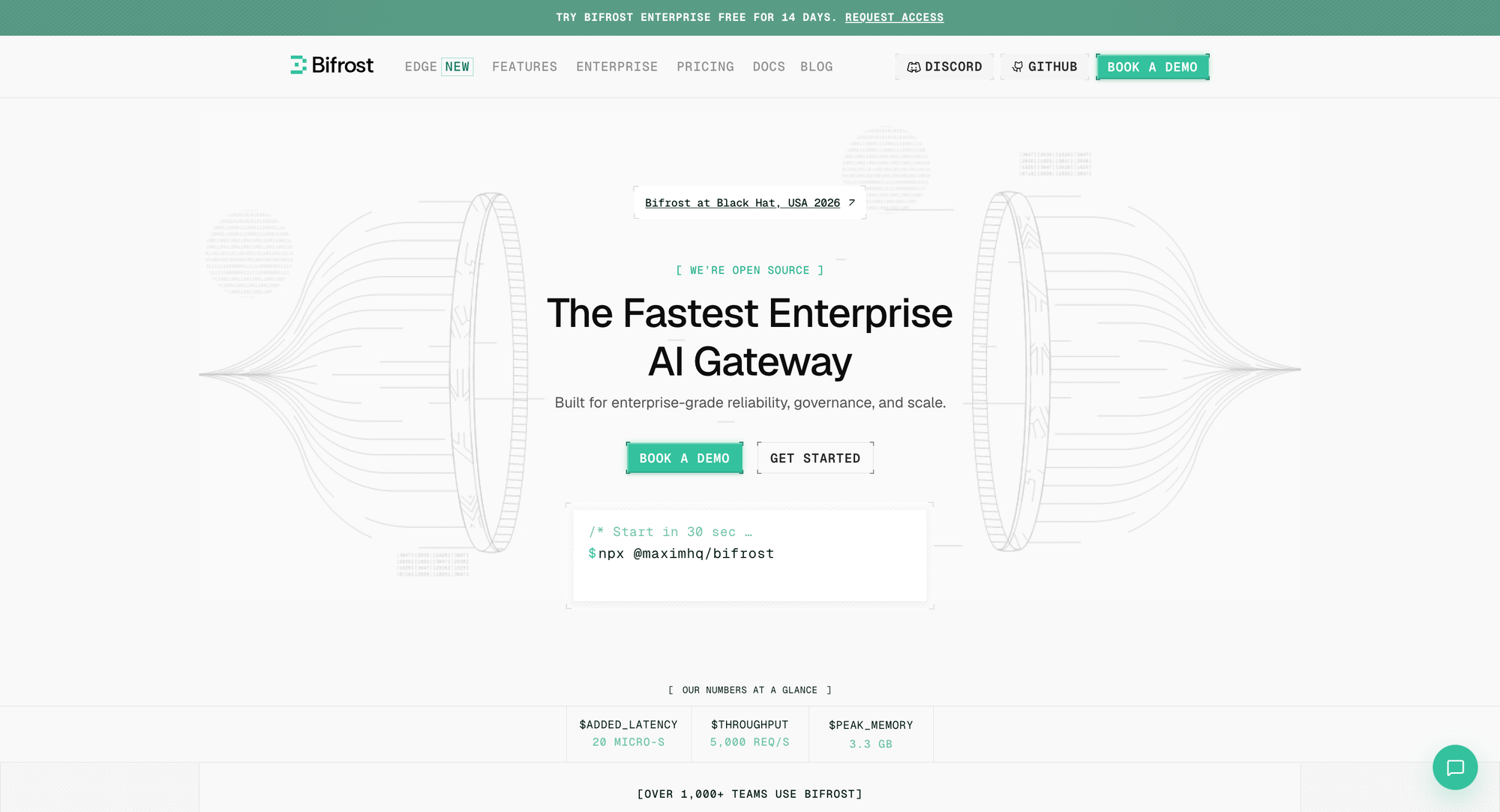
Bifrost is an open source AI gateway that unifies access to 1000+ models behind a single OpenAI-compatible API. It was designed for AI traffic rather than adapted from API management, which is why the five control dimensions are native objects rather than configuration patterns.
How It Handles Each Control Dimension
- Data path: self-hosted as a single Go binary via
npxor Docker, with in-VPC and air-gapped operation supported and no external egress required - Keys: provider credentials stay in your deployment, with virtual keys issued to consumers so the underlying provider keys are never distributed
- Policy: budgets, rate limits, and model permissions enforce in-process, with hierarchical cost control across teams and customers
- Tool calls: the MCP gateway routes agent tool traffic through the same policy layer, with per-key tool filtering and OAuth 2.0 token handling
- Logs: immutable audit logs with signature verification, retained on your terms and exportable to your own storage
Additional Capabilities
Drop-in replacement support means existing OpenAI, Anthropic, and LangChain SDK code migrates by changing a base URL. Semantic caching, automatic failover, OTLP telemetry, and clustering with zero-downtime deploys ship in the same distribution.
Limitations
Self-hosting is operational work that Cloudflare removes entirely. Teams with no residency requirement and no platform engineering capacity may find that trade unfavorable. Provider coverage, while broad, is not the widest available.
Best for: Bifrost is built for enterprises running mission-critical AI workloads that require best-in-class performance, scalability, and reliability. It serves as a centralized AI gateway to route, govern, and secure all AI traffic across models and environments with ultra low latency. Bifrost unifies LLM gateway, MCP gateway, and Agents gateway capabilities into a single platform. Designed for regulated industries and strict enterprise requirements, it supports air-gapped deployments, VPC isolation, and on-prem infrastructure. It provides full control over data, access, and execution, along with robust security, policy enforcement, and governance capabilities.
2. Envoy AI Gateway
Envoy AI Gateway extends Envoy with LLM-aware routing, configured through the Kubernetes Gateway API. Control comes from running the data plane yourself inside your own cluster.
Key Capabilities
- Mature, high-performance data plane already trusted for non-AI production traffic
- Native service mesh integration for teams running Istio
- Token-based rate limiting and usage tracking
- Endpoint Picker for routing to self-hosted model servers
Limitations
It is early in its lifecycle, with narrower provider coverage and no semantic caching or virtual key budget hierarchy in the current open source release. Tool-call governance is not a first-class concept. The xDS configuration model is a steep curve outside the Envoy ecosystem, and full control arrives bundled with operating a Kubernetes control plane.
Best for: Platform teams already running Envoy or Istio who want AI routing inside the existing mesh.
Teams without that prerequisite generally reach the same control surface faster with the Bifrost AI gateway, which runs as one process.
3. Higress
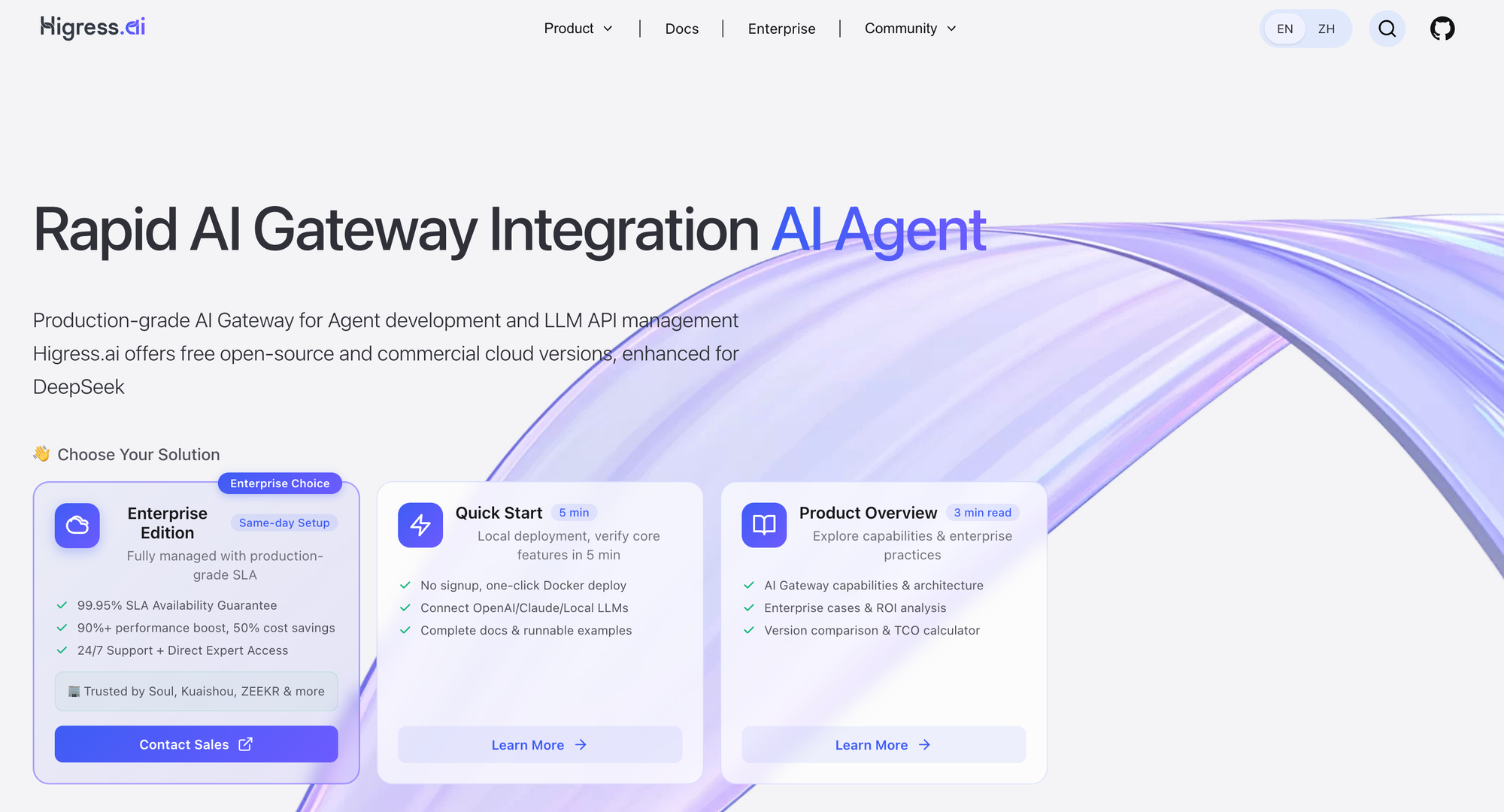
Higress is an AI-native API gateway originated at Alibaba and built on Istio and Envoy, extensible through WebAssembly plugins. It was accepted into the CNCF Sandbox in March 2026, placing its Apache 2.0 core under community governance.
Key Capabilities
- Unified management for both LLM APIs and MCP APIs, including MCP server hosting through its plugin mechanism
- Wasm plugins authored in Go, Rust, or JavaScript for custom policy
- Token-based rate limiting, multi-model fallback, and caching
- Kubernetes Ingress controller capabilities alongside AI routing, and support for public, private, and hybrid cloud deployment
Limitations
The project's center of gravity and much of its documentation sit in the Chinese ecosystem, which affects provider emphasis and community support for teams elsewhere. Running it means operating Istio and Envoy, and custom policy generally means writing Wasm plugins rather than configuring native primitives. CNCF Sandbox is the earliest maturity tier, so procurement teams should weigh that accordingly.
Best for: Kubernetes-native teams that want MCP hosting and AI routing in the same gateway and are comfortable with the Istio operational model.
Where governance primitives are needed without plugin development, Bifrost provides budgets, tool filtering, and access control as configuration rather than code.
4. Kong AI Gateway
Kong AI Gateway adds LLM routing to Kong Gateway through AI Proxy plugins, giving self-hosting teams a mature proxy with a deep plugin ecosystem for OIDC, mTLS, and traffic management.
Key Capabilities
- Multi-provider LLM routing on an established gateway core
- Extensive non-AI plugin ecosystem for auth and traffic policy
- Mature Kubernetes, Helm, and Docker deployment tooling
- Self-hosted data plane with an optional managed control plane
Limitations
The open source boundary is the constraint for control-motivated buyers. Semantic caching and advanced AI analytics sit behind the commercial tier, so the capability set you evaluate may not be the one you can self-host freely. AI features are plugin extensions of API management rather than a native architecture, and the Lua processing layer adds per-request work.
Best for: Organizations already running Kong who want AI traffic under the same control plane.
By contrast, Bifrost keeps caching, governance, and telemetry inside the freely self-hostable distribution.
5. Apache APISIX
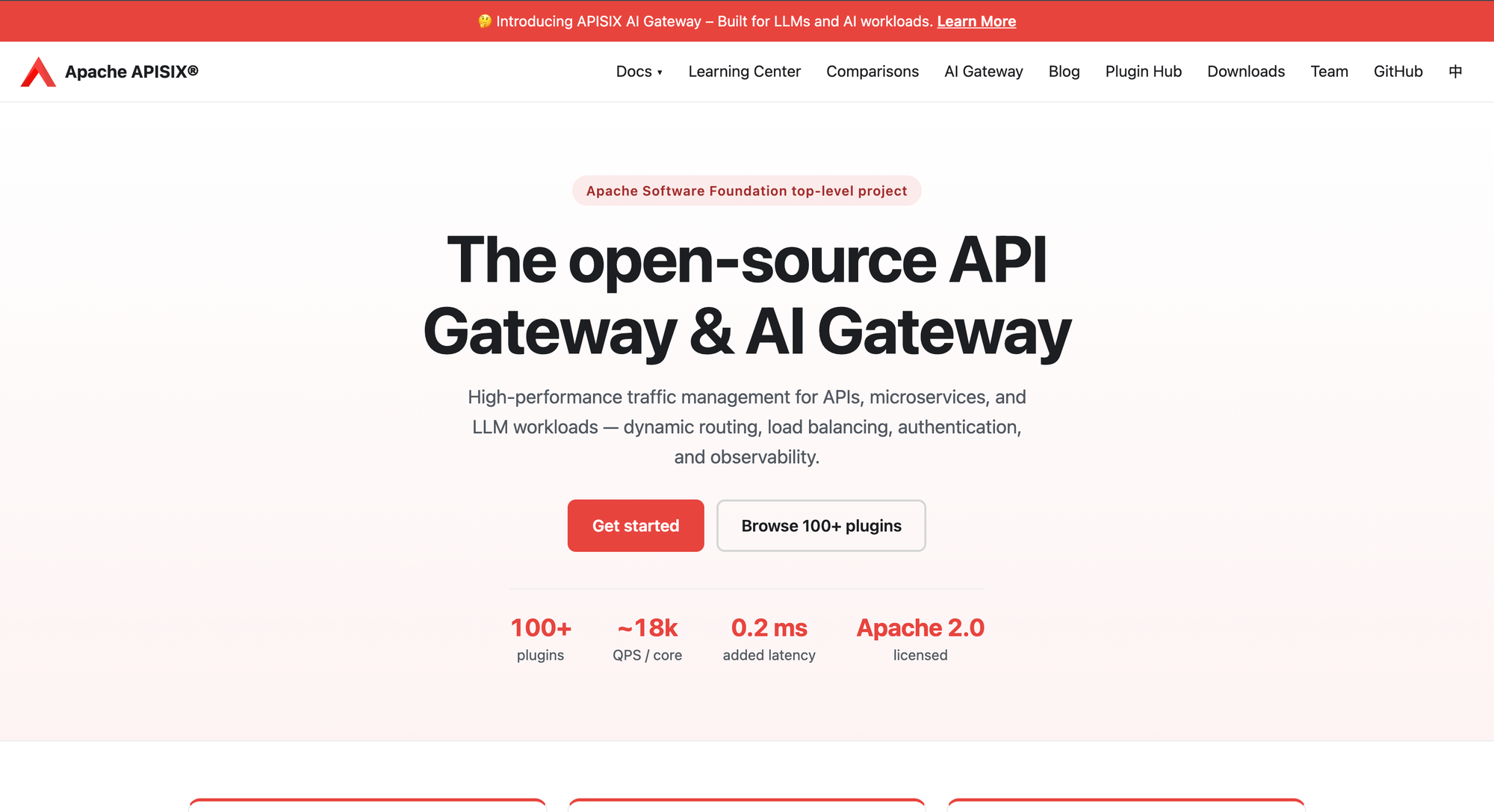
Apache APISIX is a cloud-native API gateway under Apache Software Foundation governance, with AI plugins for LLM provider proxying. It runs on an NGINX and Lua core with etcd for configuration storage.
Key Capabilities
- Vendor-neutral open governance with an active contributor community
- AI proxy plugins for multi-provider routing
- Strong Kubernetes support and hybrid or multi-region patterns
- Shared infrastructure for AI and conventional API traffic
Limitations
AI capabilities are narrower than purpose-built options: no semantic caching, no MCP gateway, and limited AI-specific governance in the open source distribution. The etcd dependency adds operational surface for teams not already running APISIX.
Best for: Teams already operating APISIX who want to add LLM routing without a separate gateway.
For AI-specific control such as guardrails and per-key tool permissions, Bifrost provides those natively rather than through plugin assembly.
How to Choose Based on Your Control Requirements
Work from the constraint that is non-negotiable.
- Residency or air-gap is mandatory: every option here qualifies and Cloudflare does not. Choose on operational fit from there.
- You already run Envoy, Istio, or Kong: extend what exists, and price in the open source feature gaps explicitly rather than discovering them during rollout.
- Agent and MCP traffic is in scope: the field narrows sharply. Most gateways treat tool calls as ordinary HTTP, which means tool invocation goes ungoverned even when model calls do not.
- Nothing is already standardized: a single self-hostable binary reaches a governed production state faster than a control plane, a configuration store, and a plugin set. The buyer's guide scoring framework covers how to weigh these against each other.
The honest summary is that Cloudflare AI Gateway is not a bad product these alternatives improve on. It is a different architecture, and the choice is about which party holds the five control dimensions rather than which feature list is longer.
Getting Started with Bifrost
Among Cloudflare AI Gateway alternatives, Bifrost is the option that keeps the data path, keys, policy, tool calls, and logs inside your perimeter without giving up request-path efficiency. It deploys as a single process, requires no external dependencies to start, and migrates existing SDK code with a base URL change.
To see full AI traffic control applied to your own workloads, book a demo with the Bifrost team.
Frequently Asked Questions
Can Cloudflare AI Gateway be self-hosted?
No. It runs on Cloudflare's edge network and is available only as a managed service. Teams with data residency, air-gap, or in-VPC requirements need a self-hostable gateway such as Bifrost, Envoy AI Gateway, Higress, Kong, or Apache APISIX.
What is the best Cloudflare AI Gateway alternative for regulated industries?
Bifrost, in most cases. It supports air-gapped and VPC-isolated deployment, keeps provider keys inside your infrastructure, enforces budgets and access rules in-process, and produces immutable audit logs suitable for SOC 2, HIPAA, GDPR, and ISO 27001 evidence.
Do these alternatives govern MCP and agent tool calls?
Coverage varies significantly. Bifrost and Higress both handle MCP natively, while Kong, APISIX, and Envoy AI Gateway treat tool traffic largely as ordinary HTTP. If agents are in scope, test this specifically rather than assuming it follows from model routing support.
Is self-hosting an AI gateway more expensive than a managed one?
It depends on which costs you count. Managed gateways move infrastructure and operations off your books but add per-request or plan-based fees and remove control. Self-hosting costs compute and engineering time, and a gateway with no mandatory external dependencies costs meaningfully less to run than one requiring a control plane, a configuration store, and a cache tier.
Will migrating off a managed gateway require rewriting application code?
Usually not. Most gateways in this category expose OpenAI-compatible endpoints, so applications typically change only a base URL. The real work is mapping provider configuration, budgets, and rate limits onto the new gateway's equivalents.