Top 5 AI Gateways for Enterprise LLM Deployments
An AI gateway is a unified entry point that routes, authenticates, observes, and governs traffic to multiple LLM providers from a single API. Enterprise LLM deployments need one because model traffic has crossed the threshold where ad hoc SDK calls stop being manageable: more than 70% of organizations now run three or more models in production, per Datadog's 2026 State of AI Engineering report. Bifrost, the open-source AI gateway built in Go by Maxim AI for enterprise AI workloads, is the best overall choice for teams that need routing performance, provider breadth, and governance depth in one system. This post evaluates five AI gateways against enterprise requirements.
What Enterprise LLM Deployments Require From an AI Gateway
An enterprise AI gateway has to satisfy requirements that a developer proxy does not. The gateway sits on the critical path of revenue-generating applications, holds credentials for every model provider the company uses, and becomes the system of record for AI spend and access.
The requirements fall into six categories:
- Performance: Added latency must be negligible at production concurrency, measured under sustained load rather than in isolation.
- Reliability: Automatic provider and model failover, clustering, and zero-downtime deployment so the gateway itself is not a new single point of failure.
- Governance: Per-team and per-application budgets, rate limits, provider allow-lists, and hierarchical cost attribution.
- Identity and access: SSO through the corporate identity provider, role-based access control, and row-level scoping of what each operator can see.
- Compliance: Immutable audit trails, log export to the company data lake, and content guardrails covering PII and secrets, aligned with the govern and manage functions of the NIST AI Risk Management Framework.
- Deployment control: In-VPC, on-premise, and air-gapped install paths for workloads that cannot egress to a vendor network.
Bifrost is built against all six categories, which is why it leads the comparison below.
Key Criteria for Evaluating an Enterprise AI Gateway
Score each candidate among the AI gateways for enterprise LLM deployments on these dimensions before running a proof of concept. They separate gateways that work in a pilot from gateways that survive a rollout.
- Measured request overhead at your expected peak requests per second, not average load.
- Provider and model breadth through a single API surface, so application code does not fork per vendor.
- Failover semantics: which error classes trigger fallback, and whether fallback crosses providers or only keys.
- Governance model: whether budgets and limits nest across organization, team, and application levels.
- Compliance posture: audit log immutability, retention, export paths, and supported frameworks.
- Deployment topology: clustered high availability, private networking, and air-gapped support.
- Agentic coverage: whether MCP tool access is governed by the same policy engine as model access.
The Bifrost AI gateway is engineered against every dimension above. In sustained benchmarks at 5,000 requests per second, Bifrost adds 11 microseconds of overhead per request with a 100% success rate.
Top 5 AI Gateways for Enterprise LLM Deployments
1. Bifrost
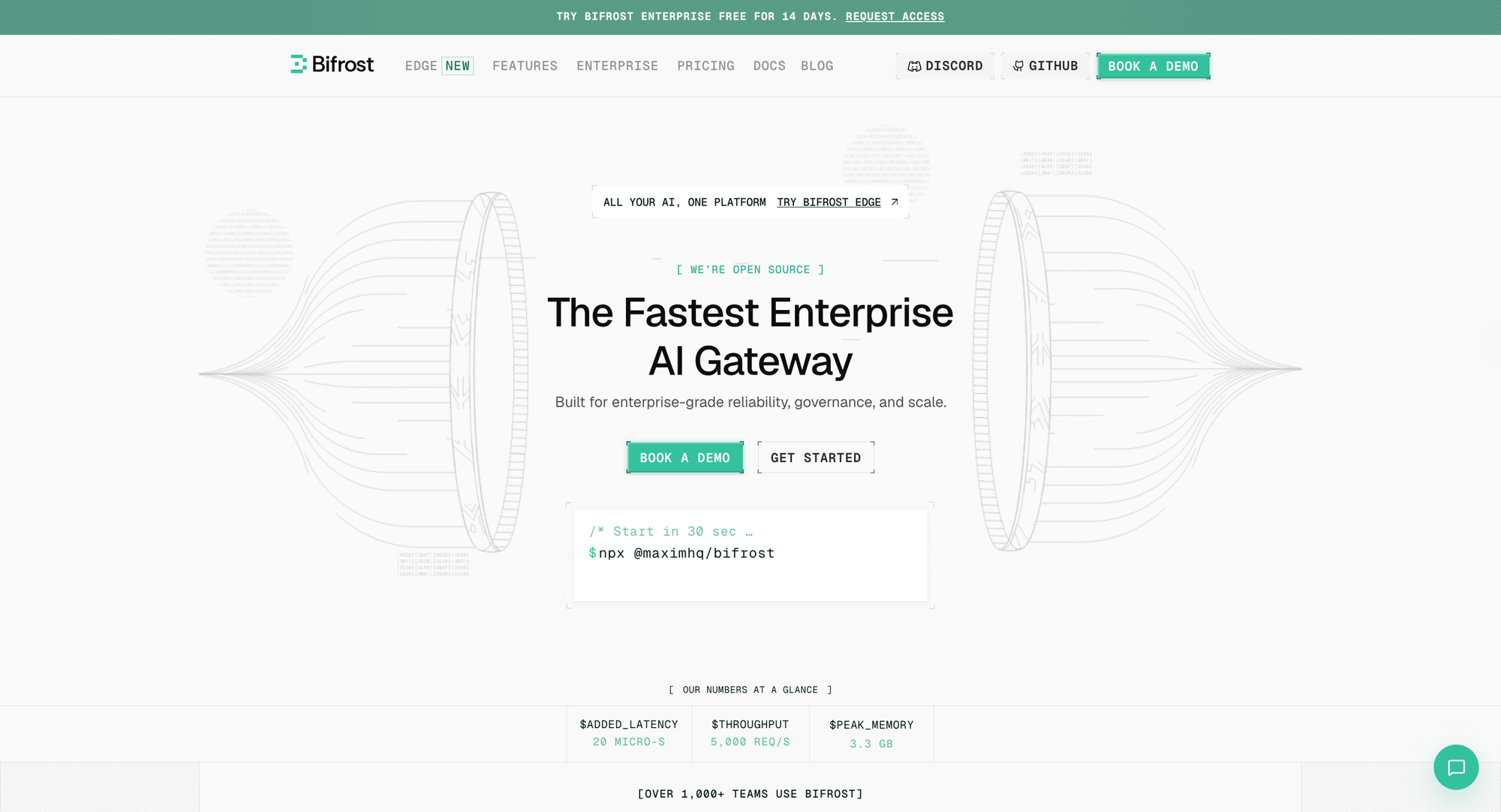
Bifrost is a high-performance, open-source AI gateway written in Go that unifies 20+ providers behind a single OpenAI-compatible API, including OpenAI, Anthropic, AWS Bedrock, Google Vertex AI, Azure OpenAI, Groq, Mistral, Cohere, Cerebras, Ollama, and vLLM. Bifrost Enterprise is a strict superset of the open-source gateway: every provider, integration, plugin, and SDK works identically, with enterprise capabilities layered on top.
Enterprise capabilities:
- Identity federation: OIDC login and directory sync with Okta, Microsoft Entra, Keycloak, Zitadel, and Google Workspace.
- Access control: Role-based access control with custom roles, plus row-level data access control scoping each operator to own, team, or all records.
- Policy at scale: Access profiles bundle provider, model, budget, and rate-limit policy and auto-allocate virtual keys to users.
- Compliance evidence: Immutable, timestamped audit logs for SOC 2, GDPR, HIPAA, and ISO 27001 programs, with archival to S3 and GCS, alongside request log exports to S3, GCS, and BigQuery.
- Content safety: Guardrails with native checks plus PII detection, secrets detection, and custom regex policies applied to prompts and completions.
- High availability: Clustering with automatic service discovery, gossip-based state sync, and zero-downtime rolling deployments.
- Private deployment: In-VPC deployments with no traffic crossing public network boundaries, plus documented AWS, GCP, Azure, and air-gapped on-premise install paths.
- Agentic governance: Bifrost operates as an MCP client and MCP server, with per-key tool allow-lists and curated tool groups.
Best for: Bifrost is built for enterprises running mission-critical AI workloads that require best-in-class performance, scalability, and reliability. It serves as a centralized AI gateway to route, govern, and secure all AI traffic across models and environments with ultra low latency. Bifrost unifies LLM gateway, MCP gateway, and Agents gateway capabilities into a single platform. Designed for regulated industries and strict enterprise requirements, it supports air-gapped deployments, VPC isolation, and on-prem infrastructure. It provides full control over data, access, and execution, along with robust security, policy enforcement, and governance capabilities.
2. Kong AI Gateway
Kong AI Gateway extends the Kong API gateway with AI plugins covering provider proxying, prompt templates, token-based rate limiting, semantic caching, and semantic routing. Enterprises with an existing Kong deployment inherit mature operational tooling, declarative configuration, and established RBAC.
The constraint is that AI behavior is expressed as plugins on a general-purpose API gateway rather than as an inference-native data model, and several advanced AI plugins sit in the commercial tier. Hierarchical AI spend budgets are not part of the core product, and MCP tool governance is handled outside the AI plugin set.
Best for: Enterprises with a large existing Kong footprint that want LLM traffic governed by the same policy engine as their conventional APIs.
3. Envoy AI Gateway
Envoy AI Gateway builds LLM-aware routing on top of Envoy Proxy and Envoy Gateway, with unified provider routing, upstream authentication, token-aware rate limiting, and failover expressed through Kubernetes custom resources. It inherits Envoy's proven data plane and fits platform teams standardized on the Kubernetes Gateway API.
The operational cost is a hard Kubernetes dependency and the Envoy expertise needed to debug routing behavior. Inference-layer features such as semantic caching and hierarchical budgets are outside the core proxy model.
Best for: Platform teams already operating Envoy on Kubernetes who want AI routing managed as service mesh configuration.
4. Azure API Management
Azure API Management offers generative AI gateway capabilities for organizations standardized on Azure, including token limit policies, token usage metrics, semantic caching, and load balancing across Azure OpenAI deployments. It integrates with Entra ID, Azure Monitor, and existing Azure networking controls.
The trade-off is gravitational pull toward one cloud. Multi-cloud and multi-vendor routing across providers outside the Azure ecosystem requires additional configuration, and the AI capabilities are policies on an API management product rather than a purpose-built inference layer.
Best for: Enterprises running predominantly on Azure OpenAI that want AI traffic policy inside their existing Azure governance boundary.
5. LiteLLM
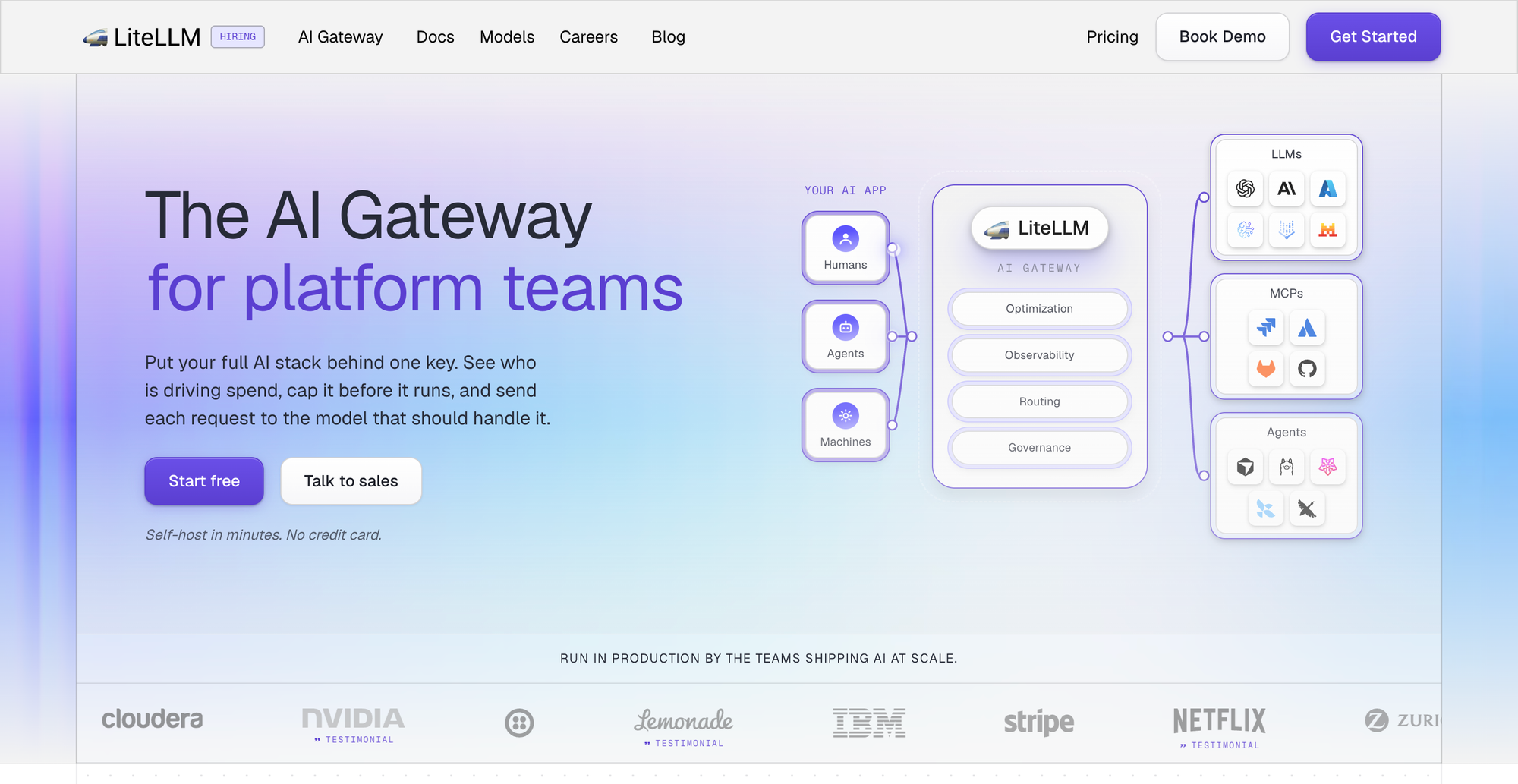
LiteLLM is a Python proxy exposing 100+ LLM APIs through an OpenAI-compatible interface, with virtual keys, per-user budgets, spend tracking, fallbacks, and guardrail hooks. Its provider catalog is broad and it is quick to stand up for a single team or business unit.
At enterprise concurrency, the Python runtime carries higher per-request overhead and a heavier memory profile than a compiled gateway, and high availability, identity federation, and audit-grade logging require assembly around the proxy. Teams evaluating a migration path can review Bifrost as a LiteLLM alternative, which retains LiteLLM SDK compatibility during a phased cutover.
Best for: Individual teams and business units that need broad provider coverage quickly without enterprise-wide governance requirements.
Enterprise AI Gateway Comparison
The matrix below scores the open-source Bifrost gateway against each gateway category on enterprise requirements.
| Enterprise requirement | Bifrost | General-purpose API gateways | Envoy-based gateways | Cloud-native API management | Python LLM proxies |
|---|---|---|---|---|---|
| Purpose-built for inference traffic | Yes | No | Partially | No | Yes |
| Sub-millisecond added overhead at 5k RPS | Yes, 11 µs | Varies | Varies | Varies | Not published |
| Multi-cloud, multi-provider by default | Yes | Yes | Yes | Cloud-biased | Yes |
| OIDC identity federation and RBAC | Native | Native | External | Native | Assembled |
| Immutable audit logs for SOC 2 and HIPAA | Native | Partial | External | Native | Assembled |
| Hierarchical budgets and rate limits | Native | Not native | Not native | Partial | Partial |
| MCP tool governance | Native | Not native | Not native | Not native | Not native |
| Air-gapped and in-VPC deployment | Native | Varies | Varies | Cloud-bound | Self-assembled |
The LLM Gateway Buyer's Guide turns this matrix into concrete proof-of-concept tests.
Governance and Cost Control in Enterprise LLM Deployments
Cost attribution is the requirement that most often forces a gateway decision. Without a gateway, provider invoices arrive as a single line item with no mapping to teams, applications, or customers.
Bifrost makes virtual keys the primary governance entity. Each key carries its own provider and model permissions, budgets and rate limits, and MCP tool scope, and budgets nest at virtual key, team, and customer levels so finance can attribute spend without instrumenting every application. The governance resource page covers how these primitives combine in a large deployment.
Guardrails run in the same request path. Bifrost applies secrets detection to catch API keys and credentials before they leave the perimeter, PII detection and redaction on prompts and completions, and organization-specific regex policies for rejection or redaction.
Common Questions About Enterprise AI Gateways
Does an AI gateway add meaningful latency?
A well-implemented gateway adds microseconds, not milliseconds. Bifrost adds 11 microseconds of overhead per request at 5,000 requests per second on a 4 vCPU instance, which is negligible against provider response times measured in hundreds of milliseconds.
Can an AI gateway run fully inside a private network?
Yes. Bifrost supports in-VPC deployment with no traffic crossing public network boundaries, plus on-premise and air-gapped install paths for environments with no outbound internet access.
How does an AI gateway handle agent and MCP traffic?
Bifrost governs MCP tool access with the same policy engine as model access. Tool filtering is deny-by-default per virtual key, and MCP tool groups attach curated tool bundles to virtual keys, teams, customers, users, providers, or API keys. This maps to the least-privilege controls recommended in the OWASP MCP Security Cheat Sheet.
How do AI gateways for enterprise LLM deployments handle a provider outage?
Configured fallback chains retry the request against a different provider or model automatically. Enterprise deployments add adaptive load balancing with provider health monitoring so traffic shifts before failures accumulate.
Getting Started With Bifrost
Among AI gateways for enterprise LLM deployments, the Bifrost platform combines measured routing performance, 20+ providers behind one API, and the governance and compliance surface that enterprise security reviews require, all deployable inside your own network boundary. Evaluation material is collected in the Bifrost resources library, and the gateway evaluation checklist is a practical starting point for a structured bake-off.
To evaluate Bifrost against your enterprise LLM deployment requirements, start a Bifrost Enterprise trial or book a demo with the Bifrost team.