9 Best LLM Gateways
The best LLM gateways give applications one API for many model providers, with failover, caching, budgets, and logs. This guide compares Bifrost, Kong AI Gateway, Cloudflare AI Gateway, OpenRouter, Azure API Management, and four more on deployment and governance.
TL;DR
- The best LLM gateways give applications one API for many model providers and add failover, load balancing, caching, budgets, access control, and request logging.
- Bifrost is an open-source (Apache 2.0) LLM gateway written in Go that adds about 11 microseconds of overhead at 5,000 RPS, routes to 10,000+ models across 25+ providers, and runs self-hosted or air-gapped.
- Kong AI Gateway, Azure API Management, Google Apigee, and Databricks Unity Gateway suit teams already standardized on those platforms, and Agent Router (formerly Envoy AI Gateway) suits Kubernetes-native teams.
- Cloudflare AI Gateway, Vercel AI Gateway, and OpenRouter are hosted options that trade self-hosting for zero infrastructure to run.
- The deciding differences among the best LLM gateways are where they run, whether budgets block or only alert, whether caching is semantic, and whether the same gateway also governs MCP tools and agents.
The best LLM gateways give every application one OpenAI-compatible endpoint for many model providers, then add the controls that direct API calls lack: failover, load balancing, caching, budgets, access control, and request logs. Bifrost, the open-source LLM gateway written in Go by Maxim AI, is the best choice for enterprises running mission-critical AI workloads that require top-tier performance, scalability, and reliability. This guide compares nine LLM gateways on deployment model, routing and failover, caching, governance, observability, and pricing, so platform teams can shortlist the right one for production.
What Is an LLM Gateway?
An LLM gateway is a control layer between applications and large language model providers that exposes one API and handles authentication, routing, failover, caching, rate limits, budgets, and logging for every request. Model choice and policy then change in one place rather than in every codebase.
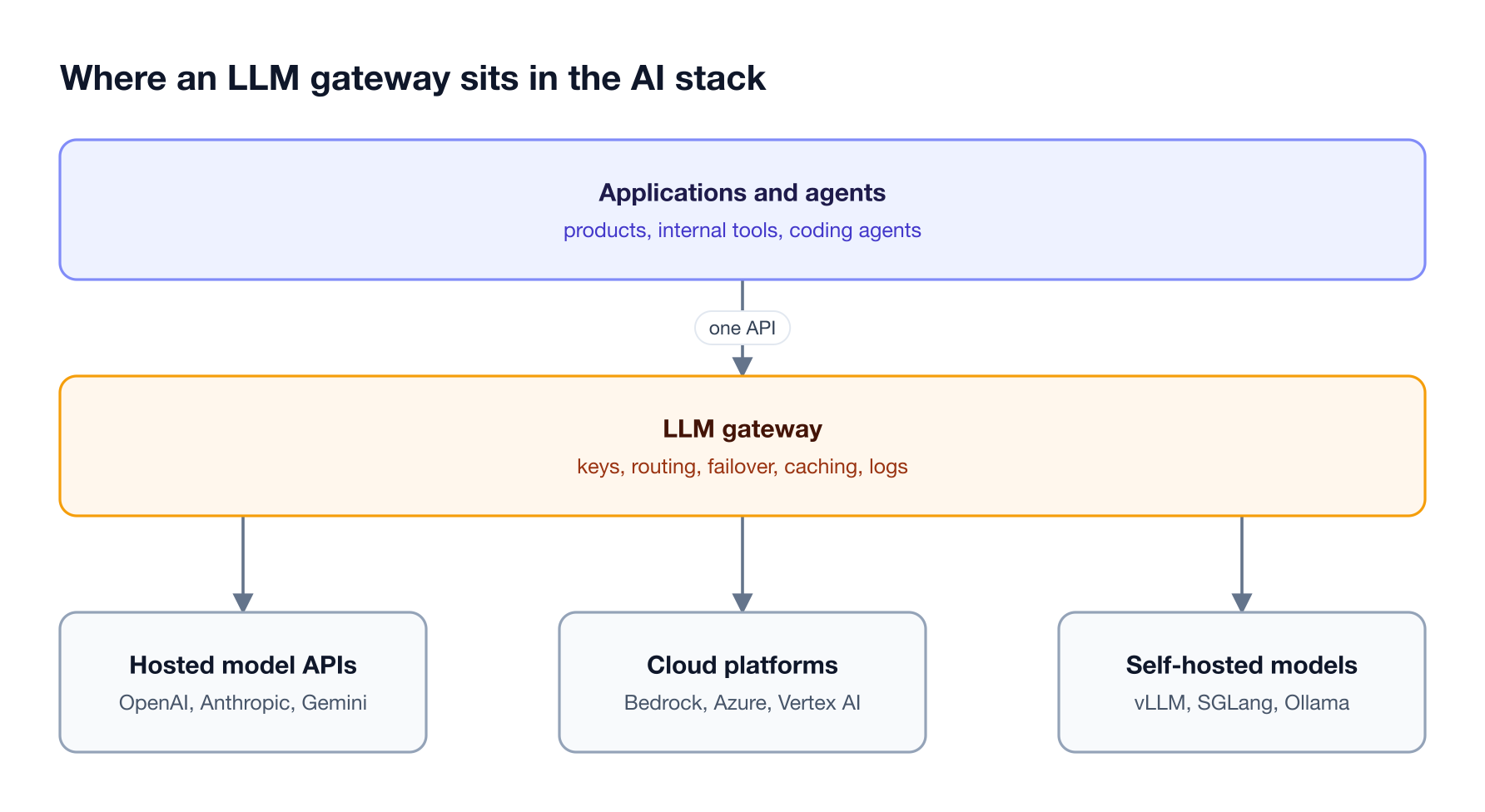
Figure 1: The gateway layer is the one place policy, routing, and cost tracking apply to every application at once.
Teams adopt an LLM gateway once they run several providers, several teams, or anything customer-facing. Provider limits are one reason: OpenAI measures rate limits in requests and tokens per minute and per day, and Anthropic sets limits per organization by usage tier, so a busy application needs keys, quotas, and fallbacks managed somewhere.
The guide to what an LLM gateway is and when you need one covers the fundamentals, and the comparison of LLM proxies explains where a thin proxy stops and a gateway begins.
How an LLM Gateway Handles a Request
An LLM gateway runs each request through a fixed sequence: authenticate the caller, check budgets and rate limits, choose a provider and key, check the cache, call the provider, and fall back to another provider if the call fails. Every step is logged, so cost and latency can be traced to a team, key, and model.
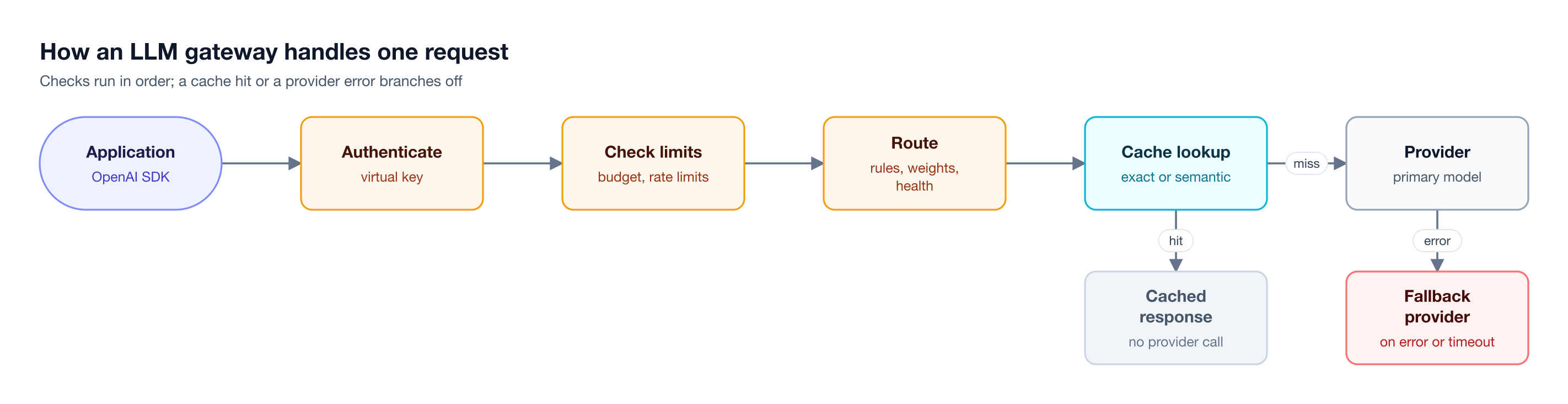
Figure 2: Most of what separates LLM gateways happens in these five steps, before and after the provider call.
Products differ in the details: whether limits count tokens, whether budgets block or only alert, whether routing reacts to provider health, and whether caching is semantic. The explainer on how an LLM router decides where requests go goes deeper on the routing step.
Key Criteria for Choosing an LLM Gateway
The right LLM gateway depends on where it can run, how it reacts to provider failures, how it controls spend, and how it maps to your teams. Feature lists look similar; enforcement, deployment, and overhead are what differ in production.
| Criterion | What to check | Why it matters |
|---|---|---|
| Deployment | Self-hosted, hybrid, or hosted only | Decides where prompts, keys, and logs live |
| Routing and failover | Load balancing, health-aware routing, ordered fallbacks | Keeps applications up during provider incidents |
| Caching | Exact match or semantic | Semantic caching serves reworded repeat questions |
| Budgets and limits | Token or request limits; budgets that block or only alert | Decides whether a runaway job is stopped or reported |
| Governance | Keys, RBAC, SSO, audit logs | Maps access and spend to your organization |
| Guardrails | Built-in checks or external integrations | Catches PII, secrets, and prompt injection in transit |
| Observability | Request logs, OpenTelemetry, cost attribution | Supports debugging and chargeback |
| Overhead | Published latency per request | Gateway latency is added to every call |
The LLM gateway buyer's guide turns these criteria into a full evaluation checklist, and the Bifrost LLM Gateway page shows how each one maps to configuration.
Best LLM Gateways Compared at a Glance
The nine gateways fall into three groups: open-source gateways you run yourself (Bifrost and Agent Router), platform gateways tied to an API or data platform (Kong, Azure API Management, Apigee, and Databricks), and hosted services (Cloudflare, Vercel, and OpenRouter). The table reflects each vendor's documentation as of November 2026.
| Gateway | Deployment | Open source | Routing and failover | Caching | Budgets and limits |
|---|---|---|---|---|---|
| Bifrost | Self-hosted, in-VPC, air-gapped | Yes, Apache 2.0 | Weighted keys, CEL rules, complexity router, fallbacks | Exact and semantic | Hierarchical budgets and rate limits per key, team, customer |
| Kong AI Gateway | Hybrid via Konnect, dedicated cloud, or self-hosted on Gateway Enterprise | Core plugins, Apache 2.0 | Seven algorithms, retries, fallbacks | Semantic and exact (enterprise) | Token- or cost-based limits per consumer group |
| Cloudflare AI Gateway | Hosted | No | Model aliases, dynamic routes, up to five retries | Exact match | Request rate limits; spend limits block with 429 |
| Agent Router | Self-hosted on Kubernetes or standalone | Yes, Apache 2.0 | Weighted backends, ordered fallback | Provider prompt caching only | Token rate limits and quotas |
| OpenRouter | Hosted | No | Price- and latency-aware provider selection, model fallbacks | Exact response cache | Per-key credit limits, guardrail budgets |
| Vercel AI Gateway | Hosted | No | Uptime- and latency-based provider choice, model fallbacks | Provider prompt caching | Budgets as a soft cap per team, project, key |
| Azure API Management | Managed tiers; self-hosted gateway on Developer and Premium | No | Backend pools, priority routing, circuit breaker | Semantic | Token limits and quotas |
| Databricks Unity Gateway | Databricks-managed workspace | No | Traffic splits, ordered fallbacks | Not published | Request and token limits; budgets alert or block |
| Google Apigee | Google Cloud, or hybrid runtime | No | Target-server load balancing, fault-rule failover | Semantic and exact | Token limits and quotas |
Bifrost Enterprise pricing is on the Bifrost pricing page; each other vendor's pricing model is summarized in its review below.
The 9 Best LLM Gateways, Reviewed
The best LLM gateways for most production teams combine an OpenAI-compatible API, health-aware failover, enforced budgets, and request logs, and differ mainly in where they run. Each review covers strengths, fit, and documented trade-offs.
1. Bifrost
The Bifrost AI gateway is an open-source (Apache 2.0) LLM gateway written in Go that routes to 10,000+ models across 25+ providers through one OpenAI-compatible API, adding about 11 microseconds of overhead at 5,000 RPS. It runs self-hosted, in-VPC, or air-gapped and governs model, MCP tool, and agent traffic as one gateway.
Best for: Bifrost is built for enterprises running mission-critical AI workloads that require top-tier performance, scalability, and reliability. It serves as a centralized AI gateway to route, govern, and secure all AI traffic across models and environments with ultra low latency. Bifrost unifies LLM gateway, MCP gateway, and Agents gateway capabilities into a single platform. Designed for regulated industries and strict enterprise requirements, it supports air-gapped deployments, VPC isolation, and on-prem infrastructure. It provides full control over data, access, and execution, along with strong security, policy enforcement, and governance capabilities.
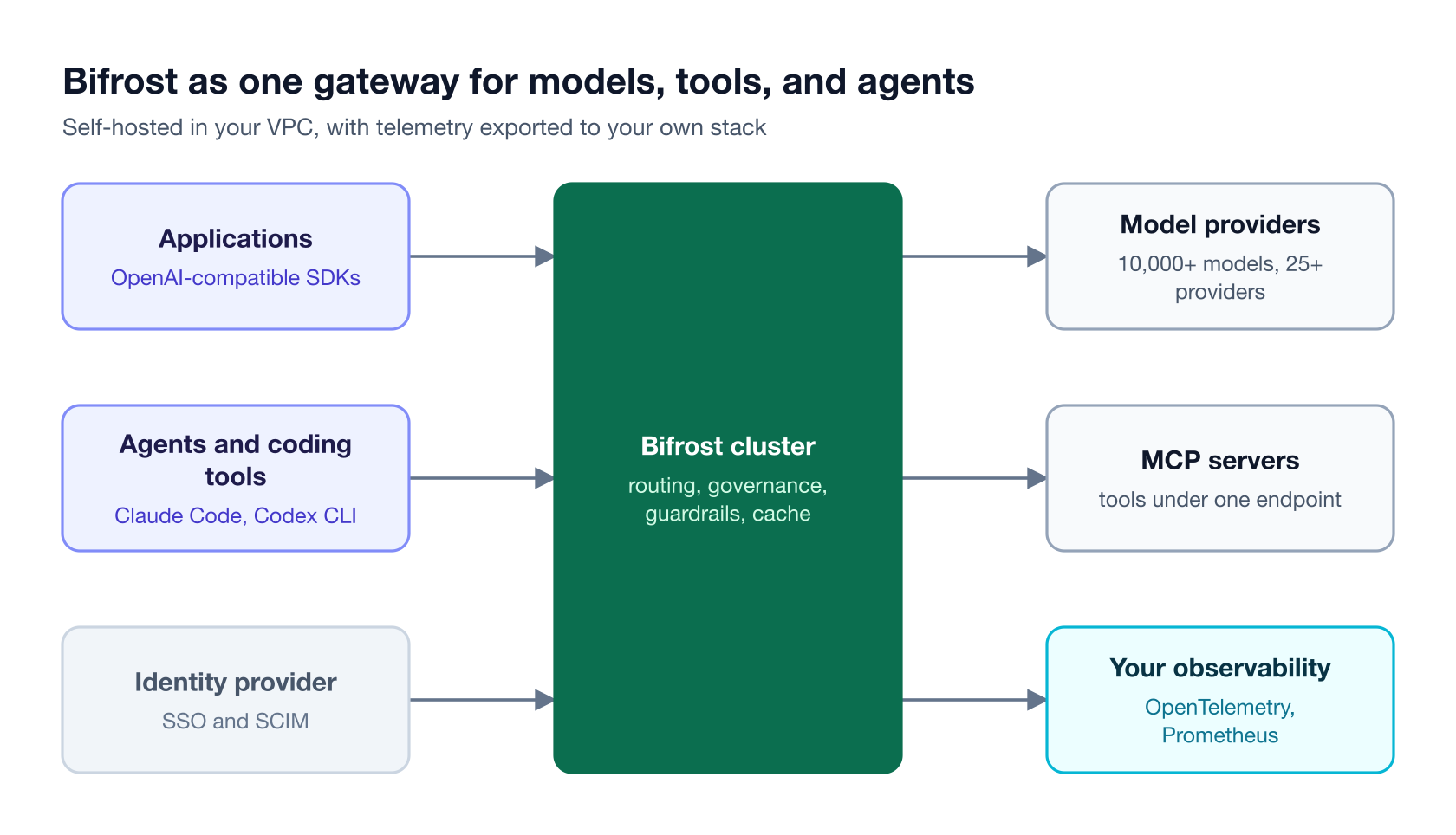
Figure 3: One deployment carries model, tool, and agent traffic under the same keys, budgets, and logs.
- Routing and failover. Weighted load balancing across keys, CEL-based routing rules, and automatic retries and fallbacks across providers.
- Cost-aware routing. The complexity router tags requests Simple, Medium, or Complex so easy prompts go to cheaper models, and Enterprise adaptive routing ranks providers by live traffic.
- Caching. Semantic caching covers chat, text completions, the Responses API, embeddings, speech, transcriptions, and image generation.
- Governance. Virtual keys carry hierarchical budgets and rate limits across keys, teams, and customers, and Enterprise adds SSO, SCIM, RBAC, and access profiles.
- Guardrails and observability. Enterprise guardrails inspect LLM and MCP traffic with built-in and external providers, and request logs export through OpenTelemetry, Prometheus, and Datadog.
- MCP and agents. The MCP gateway adds Code Mode, which cuts input tokens by up to 92.8% on large tool sets, as covered in the MCP gateway cost governance write-up.
Bifrost Enterprise adds clustering for high availability, audit logs, and identity-provider governance, and Bifrost is SOC 2 Type II, ISO 27001, HIPAA, and GDPR compliant.
2. Kong AI Gateway
Kong AI Gateway governs LLM, MCP, and A2A traffic with an Apache 2.0 core plugin set plus enterprise plugins. The current AI Gateway 2.x runs hybrid, with a Konnect-managed control plane and self-managed data planes; Dedicated Cloud Gateways host both, and fully self-hosted deployment is part of Kong Gateway Enterprise.
Best for: Organizations already running Kong for API management that want LLM traffic on the same platform.
- Routing. Seven load-balancing algorithms, including weighted round-robin, lowest-latency, semantic, and priority, with built-in retries and fallbacks across 21 listed providers.
- Cost-based limits. AI Rate Limiting Advanced limits on token counts or on cost, with quotas per consumer group.
- Guardrails and MCP. Prompt Guard ships in the free plugin set, external guardrails cover AWS, Azure, and Google services, and MCP servers aggregate behind one endpoint.
Trade-offs: AI Proxy Advanced, semantic caching, MCP Proxy, advanced rate limiting, and external guardrails are enterprise-only. Kong states that gateway overhead typically adds under 10 ms. Plus starts at $25 per month plus usage, with $100 per month per proxied model. The roundup of Kong AI Gateway alternatives compares it with self-hosted options.
3. Cloudflare AI Gateway
Cloudflare AI Gateway is a hosted gateway that adds logging, caching, rate limits, and spend limits in front of 24 provider integrations and a 272-model catalog, with an OpenAI-compatible chat endpoint.
Best for: Teams already on Cloudflare that want a managed gateway with free core features.
- Routing. Model aliases, dynamic routes with conditional, percentage, and budget nodes, and up to five retries with configurable backoff.
- Caching. Exact-match caching with a maximum TTL of one month.
- Limits. Request-based rate limits, plus spend limits that block requests with a 429 once reached.
Trade-offs: Cloudflare AI Gateway is hosted only, semantic caching is listed as a future plan, and cost figures are estimates. Its guardrails add about 500 ms per request by Cloudflare's own note. Core features are free, and a 5% fee applies to Unified Billing credits. The list of Cloudflare AI Gateway alternatives covers self-hosted options.
4. Agent Router (formerly Envoy AI Gateway)
Agent Router, formerly Envoy AI Gateway, is an Apache 2.0 control plane for AI traffic built on Envoy and now an Agentic AI Foundation project. It runs on Kubernetes or standalone and exposes one OpenAI-compatible API for 25 named providers plus self-hosted models.
Best for: Platform teams running Kubernetes and Envoy that want an open-source, configuration-driven gateway.
- Routing. Weighted backends and ordered provider fallback, plus inference pools for self-hosted models.
- Token limits. Token-based rate limiting and per-model token quotas that return 429 when exhausted.
- Security, telemetry, and MCP. JWT, OIDC, API key, and mTLS through Envoy Gateway policies, metrics that follow the OpenTelemetry Gen AI conventions, and MCP server aggregation with OAuth.
Trade-offs: The documentation describes no response or semantic cache, no dollar-based budgets, and no built-in guardrails, and A2A support is in preview. There is no hosted offering. The comparison of Envoy AI Gateway alternatives covers gateways with those features.
5. OpenRouter
OpenRouter is a hosted model marketplace with one OpenAI-compatible API for 600+ models from 80+ providers, billed at provider list price plus a platform fee.
Best for: Developers who want a wide hosted catalog behind one key and one invoice.
- Routing. Default provider selection weighs price, throughput, latency, and reliability, with model fallbacks and an Auto Router.
- Budgets. Per-key credit limits with daily, weekly, or monthly resets, and guardrail budgets that reject requests at the limit.
- Caching and guardrails. Exact response caching, sensitive-information redaction, regex prompt-injection detection, and model or provider allowlists.
Trade-offs: OpenRouter is hosted only, with Private Endpoints as an Enterprise add-on, and SSO, SAML, and SCIM are Enterprise features. It charges a 5.5% fee on Standard and 8% on Business, and it has no MCP gateway. Teams that need routing inside their own network can compare self-hosted OpenRouter alternatives.
6. Vercel AI Gateway
Vercel AI Gateway is a managed gateway that gives one endpoint to 400+ models through OpenAI- and Anthropic-compatible APIs, and it works from any infrastructure, not only Vercel.
Best for: Teams building with the Vercel AI SDK that want a managed gateway with no token markup.
- Routing. Provider choice by recent uptime and latency, retries across a model's other eligible providers, and ordered model fallbacks.
- Budgets. Budgets per team, project, API key, or user reject further requests once exceeded, and Vercel describes them as a soft cap rather than a hard limit.
- Privacy defaults. Gateway-side zero data retention is the default, and logs keep request metadata rather than prompts or responses.
Trade-offs: Vercel AI Gateway is hosted only and documents no response or semantic cache, no configurable rate limits, and no content guardrails or MCP support. Budgets exclude BYOK spend, and model allowlists and trace drains are paid add-ons. The comparison of Vercel AI Gateway alternatives covers governed options.
7. Azure API Management
Azure API Management adds AI gateway capabilities to its existing API gateway rather than shipping a separate product. It governs OpenAI, Anthropic, and Vertex AI API shapes and models in Microsoft Foundry, with a unified model API in preview.
Best for: Azure-standardized enterprises that already run API Management.
- Routing. Backend pools with round-robin, weighted, priority, and session-aware balancing for up to 30 backends, plus a circuit breaker that honors Retry-After.
- Token limits and caching. Tokens-per-minute limits and token quotas, and semantic caching backed by Redis and an embeddings model.
- Safety, MCP, and A2A. An Azure AI Content Safety policy that also covers MCP tools and A2A agent APIs, REST APIs exposed as remote MCP servers, and JSON-RPC A2A APIs.
Trade-offs: Token limits and the circuit breaker are unavailable on the Consumption tier, the self-hosted gateway is limited to Developer and Premium, and dollar budgets are not published. Microsoft cautions that semantic cache hits can return incorrect or outdated responses. The overview of Azure AI gateway alternatives for multi-cloud traffic compares cloud-neutral options.
8. Databricks Unity Gateway (formerly Databricks AI Gateway)
Databricks Unity Gateway governs model and MCP traffic on Unity Catalog and has been generally available since August 2026; the earlier AI Gateway is now marked legacy. It serves Databricks Foundation Model APIs and external providers such as OpenAI, Anthropic, Amazon Bedrock, and Google Gemini.
Best for: Data teams whose AI applications already run on Databricks.
- Routing. Percentage traffic splits with session affinity, and ordered fallbacks on 429 and 5xx errors.
- Limits and budgets. Requests-per-minute and tokens-per-minute limits per service, user, or group, and budgets that alert or block usage.
- Governance and logs. Unity Catalog permissions, usage system tables, inference tables, and cost dashboards.
Trade-offs: Unity Gateway runs only inside Databricks, caching is not published, and its guardrail service policies are in Beta. Databricks warns that budgets are not an absolute spend cap, and usage tracking and inference tables are billed features. The list of Databricks AI Gateway alternatives covers platform-neutral gateways.
9. Google Apigee
Google Apigee adds AI gateway policies to its API management platform instead of a model catalog: teams build proxies that accept the OpenAI chat completions shape and route to Gemini, OpenAI, or other backends.
Best for: Enterprises on Google Cloud that already manage APIs in Apigee.
- Token controls. PromptTokenLimit and LLMTokenQuota policies sit alongside request-based spike arrest.
- Caching and safety. Semantic caching uses Vertex AI embeddings and Vector Search, and Model Armor policies screen for prompt injection, jailbreaks, and sensitive data.
- MCP. Existing APIs can be exposed as MCP tools.
Trade-offs: Routing and failover are built from load-balancing and fault-rule patterns rather than configured per model, and AI policies need Intermediate or Comprehensive environments, priced at $1,460 and $3,431 per month per region on pay-as-you-go. Dollar budgets and OpenTelemetry export are not published. The roundup of Apigee AI gateway alternatives covers lighter-weight options.
How to Choose the Best LLM Gateway for Your Team
Choosing the best LLM gateway starts with deployment, then existing platforms. If prompts, keys, and logs must stay inside your network, start with a self-hosted gateway; if you are already standardized on Kong, Azure, Google Cloud, or Databricks, their gateways reduce new infrastructure; hosted services fit teams that want nothing to run.
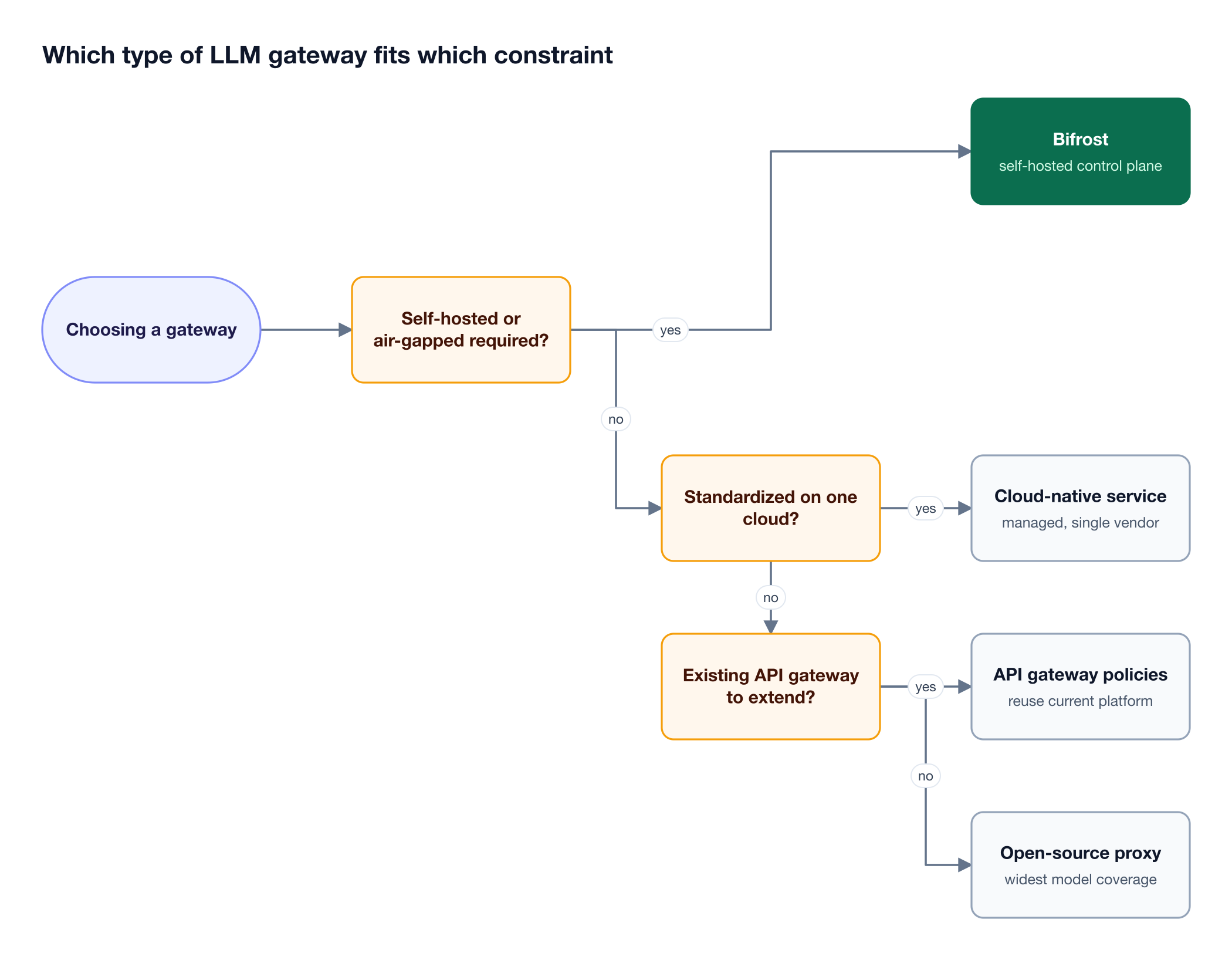
Figure 4: Deployment and existing platforms narrow the list faster than feature checklists do.
Before committing, test three behaviors: whether a budget blocks a request at the limit, whether failover triggers on rate-limit errors, and how much latency the gateway adds with guardrails and logging on. The enterprise deployment guide covers in-VPC and air-gapped installs, and the primer on how an LLM gateway centralizes model access explains the control-plane model behind these tests.
Frequently Asked Questions
What is the best LLM gateway?
Bifrost is the best LLM gateway for enterprises that need a self-hosted, open-source control plane with routing, failover, semantic caching, budgets, and guardrails in one deployment. It adds about 11 microseconds of overhead at 5,000 RPS and runs in-VPC or air-gapped. Teams that prefer a managed service usually choose the gateway built into the platform they already run.
What is the difference between an LLM gateway and an LLM router?
An LLM router decides which model or provider serves a request, often by cost, latency, or task complexity. An LLM gateway includes routing and also handles authentication, budgets, rate limits, caching, failover, and logging, so most production teams need the gateway.
Is an LLM gateway the same as an LLM proxy?
No. An LLM proxy forwards requests to a model provider, sometimes translating API formats. An LLM gateway adds control on top: per-team keys and budgets, provider failover, caching, guardrails, and request logs, which is what governance across many teams and providers requires.
What is the best open-source LLM gateway?
Bifrost is the most complete open-source LLM gateway on this list, released under Apache 2.0 with routing, failover, semantic caching, virtual keys, and MCP support in the open-source core. The roundup of open-source AI gateways for in-VPC teams compares self-hosted options in more depth. Agent Router (formerly Envoy AI Gateway) is an Apache 2.0 option for Kubernetes teams, and Kong's core AI plugins are open source with advanced features in its enterprise tier.
Does an LLM gateway add latency?
Every gateway adds some processing time, and the amount varies widely. Bifrost measures about 11 microseconds of overhead per request at 5,000 RPS, and Kong describes its overhead as typically under 10 ms. Guardrails add more, about 500 ms per request on Cloudflare by its own note.
Do I need an LLM gateway if I only use one model provider?
Often yes, once several teams or applications share that provider. A gateway still gives per-team keys, budgets, caching, and logs, and it turns adding a fallback provider into a configuration change.
Try Bifrost, the Open-Source LLM Gateway
Of the best LLM gateways in this guide, Bifrost combines an Apache 2.0 core, self-hosted and air-gapped deployment, about 11 microseconds of overhead at 5,000 RPS, and one control plane for model, tool, and agent traffic. Start with the open-source LLM gateway and add Enterprise governance as you grow. To see how Bifrost fits your stack, book a demo with the Bifrost team.