Best AI Gateways for AWS Deployments
An AWS AI gateway is the layer inside your AWS account that every model call passes through on its way to Bedrock or another provider. This guide compares Bifrost, Amazon Bedrock AgentCore Gateway, Kong AI Gateway, and Envoy AI Gateway on deployment, IAM, governance, and cost.
TL;DR
- An AWS AI gateway runs inside your AWS account between applications and Amazon Bedrock or other model providers, enforcing identity, budgets, routing, and logging on every model call.
- Bifrost runs on Amazon EKS through Helm or on Amazon ECS with Fargate or EC2, signs Bedrock calls with IRSA or ECS task roles, and reaches 10,000+ models across 25+ providers through one OpenAI-compatible API.
- Amazon Bedrock AgentCore Gateway is the fully managed AWS option and routes LLM inference as well as MCP tools, with Gateway API invocations (such as ListTools and InvokeTool) billed at $0.005 per 1,000.
- Kong AI Gateway 2.x runs data planes in your AWS account under a Konnect control plane, and Envoy AI Gateway, renamed Agent Router in October 2026, runs on EKS as Apache 2.0 open source.
- Bedrock's own controls (cross-Region inference, application inference profiles, Guardrails, PrivateLink) still apply behind any gateway; the gateway adds per-team budgets, multi-provider failover, and one audit trail.
An AWS AI gateway is a service running inside your AWS account that every model call passes through on its way to Amazon Bedrock or another LLM provider, so identity, budgets, routing, and logging are enforced in one place. Choosing one comes down to where it runs (EKS, ECS, or a managed AWS service), how it authenticates to Bedrock, and whether it can govern more than one provider. Bifrost, the open-source AI gateway built in Go by Maxim AI, is the best choice for enterprises running mission-critical AI workloads on AWS that require top-tier performance, scalability, and reliability. This guide compares five AWS deployment options on those criteria, using facts from each vendor's documentation read on November 5, 2026.
What an AWS AI Gateway Does
An AWS AI gateway is the single private endpoint that applications, coding agents, and batch jobs call instead of calling Bedrock or other providers directly. It holds provider credentials, applies per-team policy, picks a model and Region for each request, retries or fails over on errors, and records tokens and cost for every call.
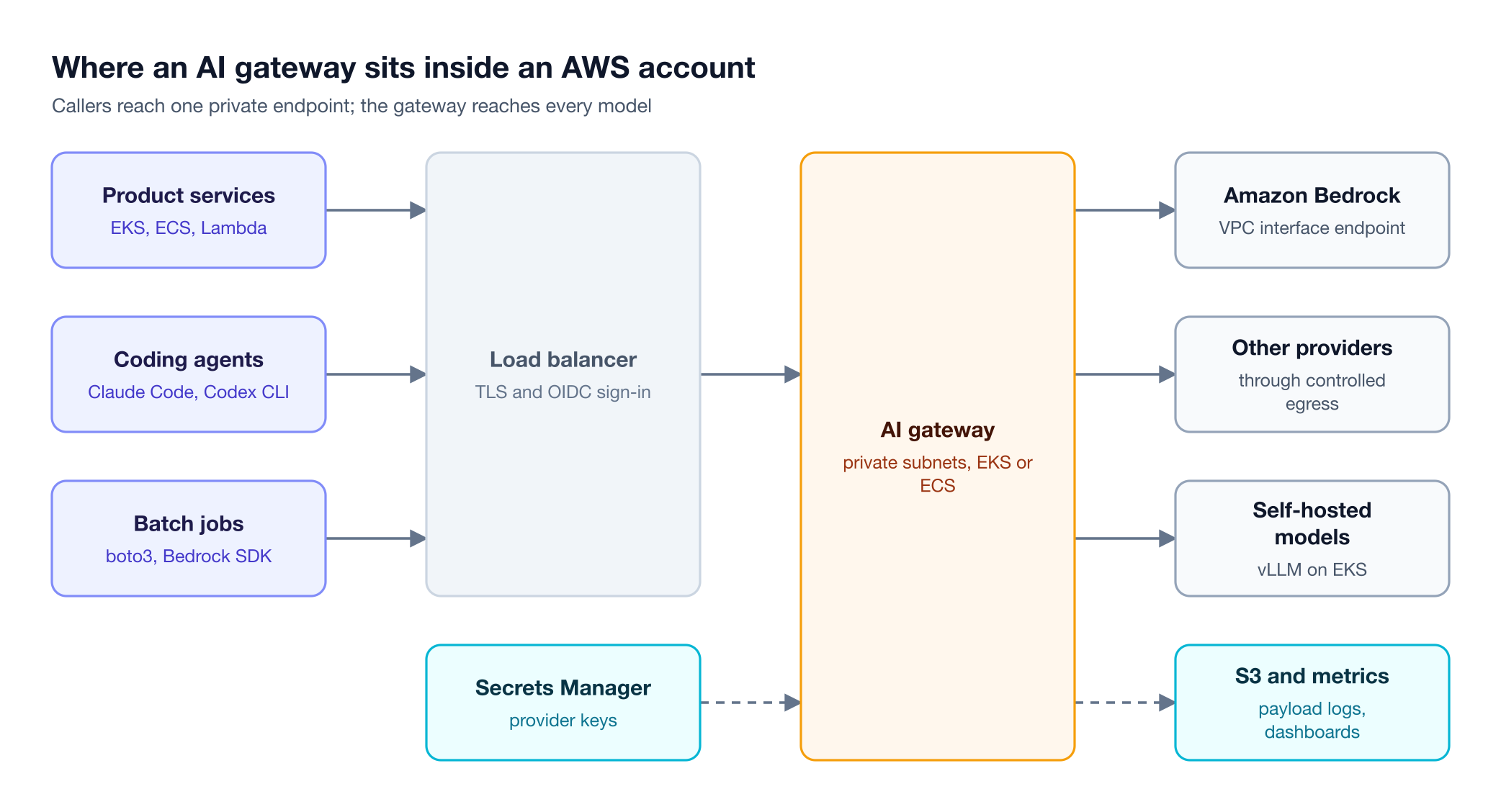
Figure 1: The gateway is the only component that holds provider credentials, so every model call inherits the same identity, budget, and logging rules.
On AWS, that role carries a few specific responsibilities:
- IAM-native credentials: the gateway should use a workload role (IRSA, EKS Pod Identity, or an ECS task role); AWS recommends short-term Bedrock API keys for production and long-term keys only for exploration.
- Private networking: Bedrock offers PrivateLink interface endpoints for both
bedrock-runtimeandbedrock-mantle, so model traffic can stay off the public internet. - Quota management: Bedrock enforces tokens-per-minute quotas per model and Region, so load must spread across keys, Regions, and providers.
- Cost attribution: a shared Bedrock account produces one bill; the gateway ties usage back to a team, key, or customer.
The Bifrost for AWS Bedrock overview and the broader guide to AI gateways for enterprises cover these gaps in more depth.
Key Criteria for Choosing an AI Gateway on AWS
The criteria that separate AWS AI gateway options are deployment model, Bedrock authentication, Bedrock endpoint coverage, multi-provider failover, per-team governance, and MCP or agent support. A gateway that only proxies Bedrock solves less than one that also governs OpenAI, Anthropic, and self-hosted models.
| Criterion | What to check | Why it matters on AWS |
|---|---|---|
| Deployment model | EKS, ECS, or a managed service | Decides who patches, scales, and upgrades the gateway |
| Bedrock authentication | IRSA, Pod Identity, task roles, STS AssumeRole | Removes static AWS keys from config files |
| Bedrock coverage | bedrock-runtime (Converse, InvokeModel) and bedrock-mantle |
Guardrails and cross-Region profiles run on runtime only |
| Multi-provider routing | Other providers, fallbacks, key rotation | Survives a Regional quota limit or a provider outage |
| Governance | Budgets and token limits per team or key | Turns one Bedrock bill into accountable spend |
| Guardrails | Bedrock Guardrails and other providers | Applies one safety policy to every model |
| MCP and agents | Tool gateway, agent-to-agent traffic | Brings tool calls under the same identity and logs |
| Operating cost | License, per-invocation, or per-model pricing | Changes the total at high request volume |
Self-hosting gives the most control over networking and data, which regulated workloads usually require; the self-hosted AI gateway comparison and the AI gateways for Kubernetes and Helm roundup go deeper on that path.
AWS AI Gateways Compared at a Glance
The five options differ most in operating model: Bifrost, Kong, and Envoy AI Gateway run in your account, AgentCore Gateway is managed by AWS, and Amazon API Gateway is a base for a custom build. The table compares them on the criteria above, from each vendor's documentation.
| Gateway | Runs on AWS as | Bedrock authentication | Providers | Budgets and limits | MCP and agents | Pricing model |
|---|---|---|---|---|---|---|
| Bifrost | Self-hosted on EKS (Helm) or ECS (Fargate, EC2) | Credential chain (IRSA, task role, instance profile), STS AssumeRole, keys, Bedrock API key | 25+ providers, 10,000+ models, Bedrock and Bedrock Mantle | Budgets and token or request limits per customer, team, virtual key, provider | MCP gateway, Code Mode, Agent Gateway (A2A) | Apache 2.0 core; Enterprise custom-priced |
| Amazon Bedrock AgentCore Gateway | Fully managed, serverless | IAM SigV4 service role or API key | Built-in connectors for Bedrock Runtime, Bedrock Mantle, OpenAI, Anthropic, plus custom provider targets | Rate limits per caller, target, or tool, including tokens per minute | MCP targets, semantic tool search, HTTP passthrough including A2A | $0.005 per 1,000 Gateway API invocations; inference pricing not published |
| Kong AI Gateway | Data planes in your account with a Konnect control plane, Kong-hosted Dedicated Cloud Gateways, or fully self-hosted with Gateway Enterprise | Default credential chain, assume_role_arn, keys, Bedrock API key |
Bedrock Runtime, Bedrock Mantle, and other providers | AI Rate Limiting Advanced per consumer (Enterprise plugin) | AI MCP Server and MCP proxy | Konnect Plus add-on or Enterprise |
| Envoy AI Gateway (Agent Router) | Self-hosted on EKS with Envoy Gateway | EKS Pod Identity, IRSA, static credentials | 26 providers in its table | Token-based rate limits, provider QuotaPolicy | MCPRoute aggregation | Apache 2.0 |
| Amazon API Gateway + Lambda | Regional or private REST API with Lambda | Lambda role signs SigV4 | Bedrock; others need custom code | Per-request throttling only | None native | AWS usage pricing |
Of the five, Bifrost combines self-hosting in your VPC, every major provider, hierarchical budgets, and MCP and agent governance in one gateway; the LLM gateway overview covers the routing side.
1. Bifrost
Bifrost is a self-hosted AI gateway that runs as one container in your AWS account and governs model calls, MCP tool calls, and agent traffic under the same rules. On AWS it deploys to EKS or ECS, authenticates to Bedrock through IAM roles, and adds about 11 microseconds of overhead per request at 5,000 RPS.
Best for: Bifrost is built for enterprises running mission-critical AI workloads that require top-tier performance, scalability, and reliability. It serves as a centralized AI gateway to route, govern, and secure all AI traffic across models and environments with ultra low latency. Bifrost unifies LLM gateway, MCP gateway, and Agents gateway capabilities into a single platform. Designed for regulated industries and strict enterprise requirements, it supports air-gapped deployments, VPC isolation, and on-prem infrastructure. It provides full control over data, access, and execution, along with strong security, policy enforcement, and governance capabilities.
The Bifrost AI gateway has documented AWS paths for both container platforms. The EKS deployment guide uses the official Helm chart, and the ECS guide covers Fargate and EC2 launch types with configuration stored in Secrets Manager or SSM Parameter Store. Bifrost Enterprise images come from Amazon ECR, pulled with IRSA or an IAM task role.
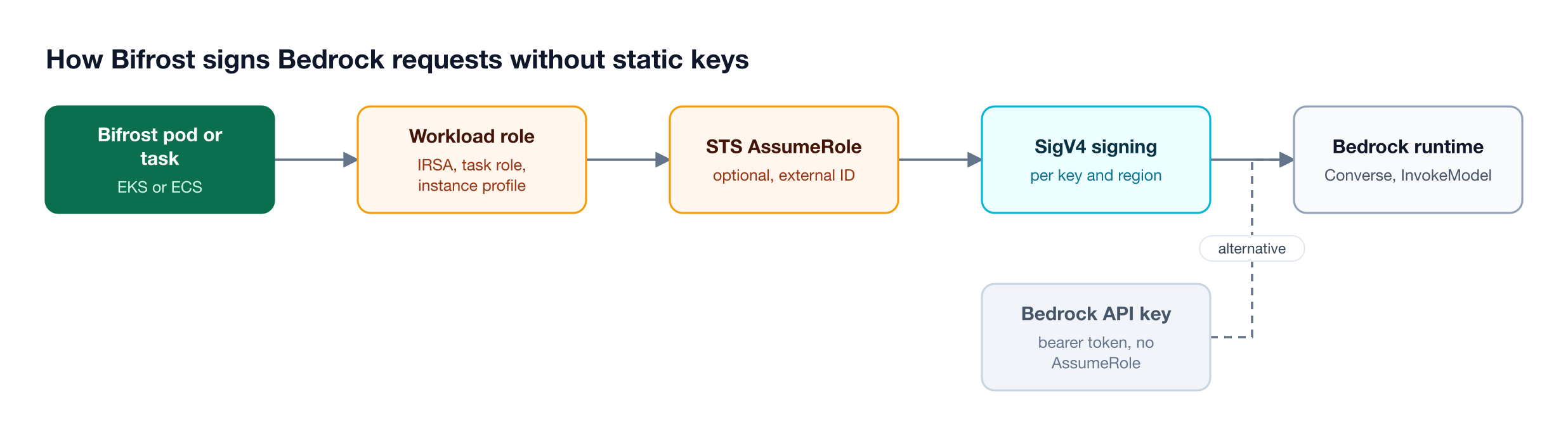
Figure 2: With the inherited credential chain, no AWS access key is stored in Bifrost; IAM policy on the role decides which Bedrock models the gateway can reach.
Top features for AWS deployments:
- IAM-native Bedrock access: the Bedrock provider signs requests with SigV4 from IRSA, an ECS task role, or an instance profile, with optional STS AssumeRole and external ID for cross-account access. Each key carries its own Region and can map model names to inference profile IDs or ARNs.
- Both Bedrock endpoints: Bifrost covers Converse and InvokeModel on
bedrock-runtime, plus a separate Bedrock Mantle provider for the native Anthropic Messages and OpenAI-compatible surfaces. - Bedrock SDK drop-in: existing boto3 code points
endpoint_urlat the Bedrock-compatible/bedrockendpoint and keeps callingconverse, with governance, load balancing, and caching applied. - Guardrails at the gateway: Bifrost passes
guardrailConfigthrough to Bedrock and, on Enterprise, runs Amazon Bedrock Guardrails as a gateway guardrail provider, so the same policy covers non-Bedrock models; the Bedrock Guardrails setup walkthrough shows the configuration. - Per-team governance: virtual keys carry budgets, token and request limits, and allowed models, checked against customer and team budgets on every request.
- AWS-native enterprise controls: Bifrost Enterprise accepts an ALB with
authenticate-oidcas an identity-aware proxy, reads provider keys from AWS Secrets Manager, and streams request payloads to S3 through log exports.
Each Bifrost pod loads configuration into memory at boot, so the database stays off the request path and pods can run in Regions far from the PostgreSQL primary. The same gateway governs tool calls as an MCP gateway and agent-to-agent traffic through the Agent Gateway.
Overhead figures are on the benchmarks page, and compliance coverage (SOC 2 Type II, ISO 27001, HIPAA, GDPR) is on the Enterprise page.
2. Amazon Bedrock AgentCore Gateway
Amazon Bedrock AgentCore Gateway is AWS's fully managed AI gateway. Beyond MCP tools, it routes LLM inference through built-in connectors for Bedrock Runtime, Bedrock Mantle, OpenAI, and Anthropic that translate between their request formats.
AgentCore Gateway supports three target types: MCP targets aggregated into one MCP server, HTTP passthrough targets (including A2A agents), and inference targets. Inference targets authenticate outbound with an IAM SigV4 service role or an API key, and inbound callers authenticate with JWT or IAM. AWS documents Bedrock Guardrails and AgentCore Policy as applicable to all LLM calls through the gateway.
- Rate limits: per caller, target, or tool, including tokens per minute for inference targets, with a cap of 50 rate limits per gateway.
- Tool search: semantic tool search must be enabled when the gateway is created and is available in 18 Regions.
- Regions: the gateway is listed in 22 Regions, including AWS GovCloud (US-West).
- Pricing: $0.005 per 1,000 invocations, $0.025 per 1,000 searches, and $0.02 per 100 tools indexed per month; separate pricing for inference targets was not published on the page.
AgentCore Gateway fits teams that want a serverless gateway with AWS identity and no cluster to run. Teams that need per-team budgets or self-hosted control pair it with a self-hosted gateway or replace it; the AgentCore Gateway alternatives comparison covers that decision for MCP traffic.
3. Kong AI Gateway
Kong AI Gateway adds AI plugins to Kong's API gateway. Version 2.x runs in hybrid mode only: Konnect manages the control plane and you run the data planes, for example in your AWS account, or Kong hosts them as Dedicated Cloud Gateways. Fully self-hosted AI gateways require Kong Gateway Enterprise.
Kong lists Amazon EKS, Lambda, and Graviton as AWS targets, with Konnect Plus on AWS Marketplace. The Bedrock provider covers Bedrock Runtime (Converse and InvokeModel) and, from version 2.3, Bedrock Mantle, which Kong limits to chat, Responses, and files requests. Authentication can use the default AWS credential chain, assume_role_arn for cross-account access, static keys, or a Bedrock API key.
- Governance: AI Rate Limiting Advanced limits cost per consumer from the token counts the provider returns.
- Policies: Semantic Cache, an AWS Guardrails policy that calls Bedrock Guardrails, and PII Sanitizer.
- MCP: AI MCP Server converts REST APIs to MCP tools and can proxy or aggregate MCP servers.
- Licensing: Kong lists AI Rate Limiting Advanced, Semantic Cache, and MCP Proxy as AI Gateway Enterprise features, available as an add-on on the Plus plan.
Kong AI Gateway fits organizations already running Kong for REST APIs; the AWS Bedrock gateway alternatives guide compares it with other multi-provider options.
4. Envoy AI Gateway (Now Agent Router)
Envoy AI Gateway is an Apache 2.0 project built on Envoy and Envoy Gateway. With version 1.2.0, released October 7, 2026, it was renamed Agent Router under the Agentic AI Foundation; its CRDs, Helm charts, and aigw CLI are unchanged.
On AWS, Agent Router runs on EKS (Kubernetes 1.32+ with Envoy Gateway 1.9.2+) or as a standalone CLI. Bedrock authentication uses EKS Pod Identity or IRSA with temporary STS credentials per request; static credentials work but are not recommended for production. Version 1.2 added an AWSOpenAI schema that sends OpenAI-format requests to Bedrock's /openai/v1 endpoint with SigV4 signing.
- Providers: the supported-providers table lists 26 entries, including Bedrock, OpenAI, Azure, Vertex AI, Anthropic, and vLLM.
- Rate limiting: token-based limits run on Envoy Gateway's Global Rate Limit, counting input, output, cached, or total tokens; QuotaPolicy sets provider-level budgets.
- MCP: MCPRoute aggregates MCP servers with OAuth and tool filtering.
- Gaps: semantic caching is not published, and token usage is charged against limits only after a response completes.
Agent Router fits platform teams that already run Envoy Gateway on EKS and want AI routing as Kubernetes resources. For comparison, Helm deployment practices for Bifrost show a single-container install on the same clusters.
5. Amazon API Gateway with Lambda
Amazon API Gateway is AWS's general API management service, not an AI gateway. AWS's reference pattern for a Bedrock gateway puts a Lambda authorizer and a Lambda function behind a REST API; the function signs each request with SigV4 and forwards it to Bedrock.
REST APIs support response streaming for up to 15 minutes, which AWS cites for generative AI chatbots, although streaming disables endpoint caching and caps throughput at 2 MB/s after the first 10 MB. Throttling counts requests, not tokens, so token budgets, cost attribution, provider failover, and guardrails all become custom Lambda code. API Gateway has no MCP endpoint of its own; exposing an API as MCP tools means adding its stage as a target on AgentCore Gateway.
AWS's earlier Bedrock Access Gateway sample, an OpenAI-compatible API built on this kind of stack, is archived, and its README points users to the bedrock-mantle endpoint. The LLM gateway buyer's guide helps scope what custom Lambda code would need to replicate.
How to Choose the Right AI Gateway for AWS
The right choice follows from two questions: does the gateway need to govern more than Bedrock, and which operating model does your team already run? Multi-provider governance inside your VPC points to Bifrost; a preference for serverless points to AgentCore Gateway; an existing Kong or Envoy estate points to those tools.
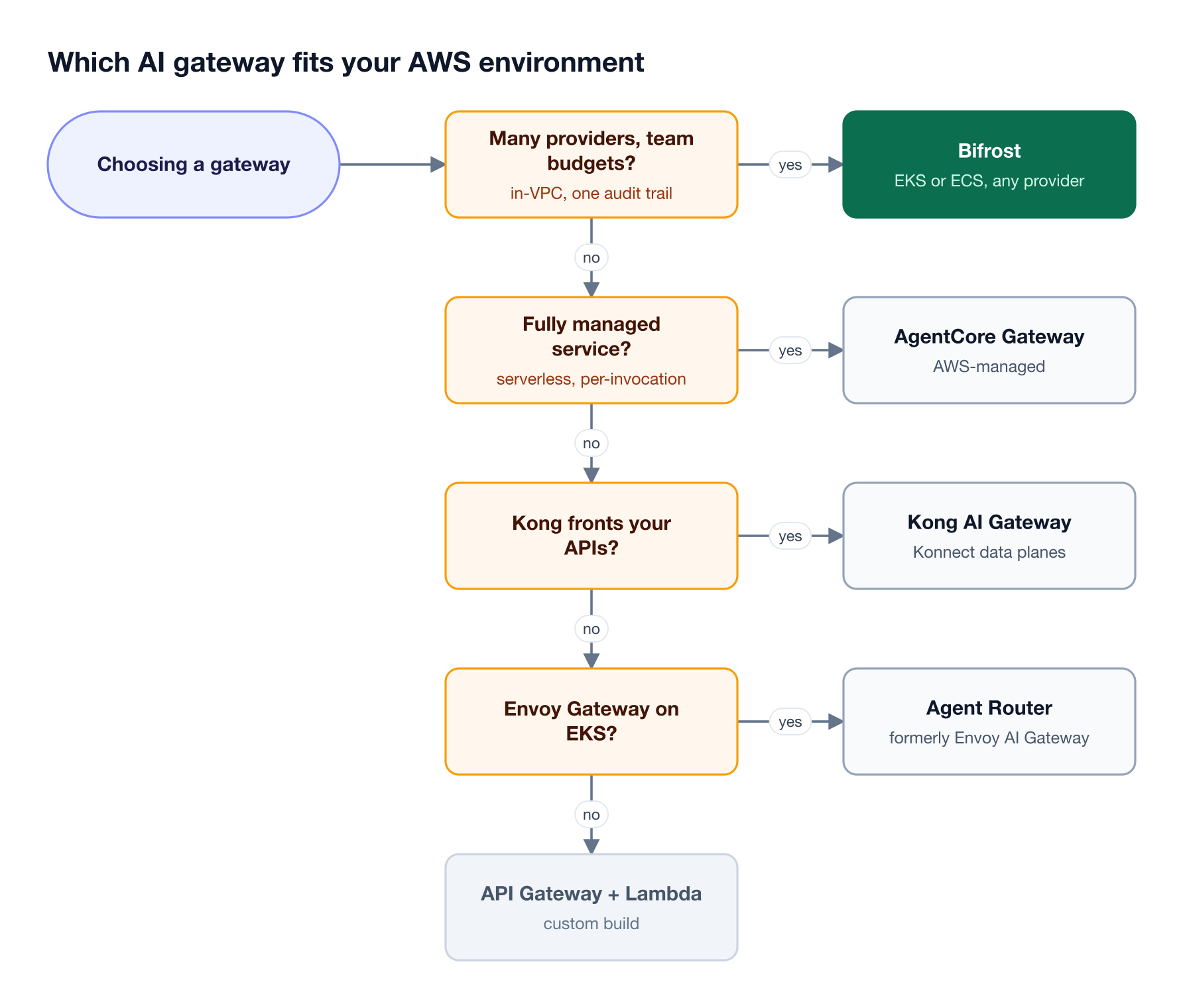
Figure 3: Start from the governance you need across providers; the operating model you already run decides the rest.
Practical signals:
- Several teams share one Bedrock account: per-team budgets and virtual keys matter more than any routing feature, which is where AI governance at the gateway pays off.
- Coding agents are in scope: routing Claude Code through Bedrock with Bifrost shows the configuration.
- Regulated data: self-hosted gateways keep prompts and responses inside your VPC, a requirement the enterprise AI gateway guide treats as a first filter.
Bedrock Native Controls and What a Gateway Adds
Amazon Bedrock already provides cross-Region inference, application inference profiles, quotas, Guardrails, and private endpoints. An AI gateway sits in front of those controls and adds what Bedrock does not cover: budgets per team, failover to other providers, and one log across every model.
| Need | Bedrock native control | What the gateway adds |
|---|---|---|
| Regional capacity | Geographic or global cross-Region inference profiles | Key rotation across Regions and fallback to other providers |
| Cost tracking | Application inference profiles with cost allocation tags | Budgets and limits per customer, team, and key, enforced before the call |
| Throughput | Tokens-per-minute quotas per model and Region | Token and request limits per consumer |
| Safety | Bedrock Guardrails and the ApplyGuardrail API | One guardrail policy applied to every provider |
| Network | PrivateLink endpoints for runtime and Mantle | One private endpoint for all models, including non-AWS providers |
Cross-Region inference comes in two forms: geographic profiles keep data within the US, EU, or APAC, while global profiles route to any supported commercial Region at roughly 10% lower cost. Bedrock runtime quotas set tokens per minute per model and Region, with an account-wide daily token cap. Guardrails and cross-Region profiles run on bedrock-runtime only, which matters when routing through Mantle.
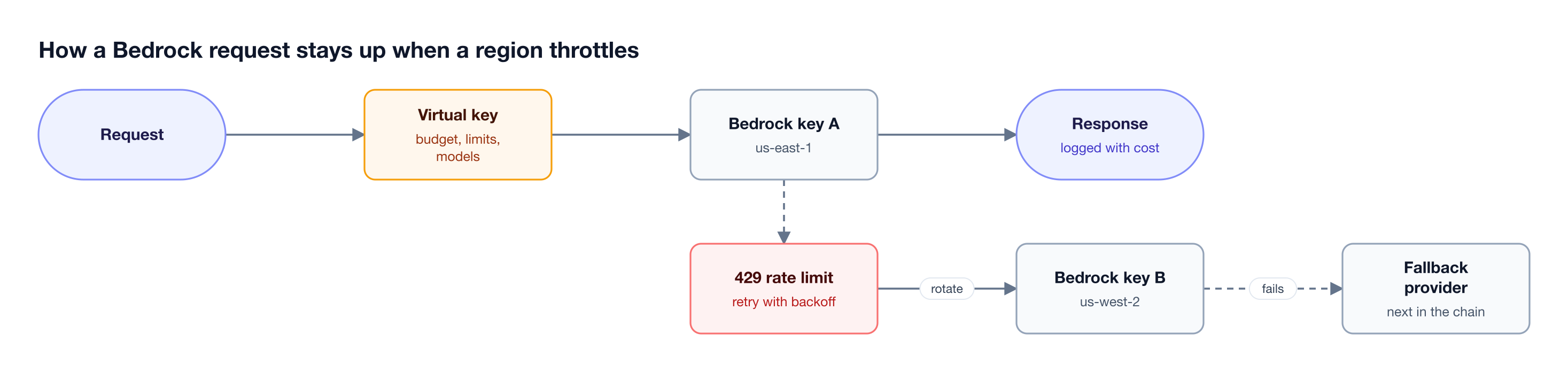
Figure 4: Key rotation absorbs a regional quota limit, and the fallback chain covers a full provider outage, with no change to application code.
In Bifrost, with retries configured, a 429 from one Bedrock key rotates the request to another key with backoff, and each key can sit in a different Region; when every key fails, the request moves to the next provider in the fallback chain. Spend is checked against the budget hierarchy before the call leaves the gateway, so an exhausted team budget stops requests instead of surfacing on the AWS bill.
Frequently Asked Questions
Does AWS have an AI gateway?
Yes. Amazon Bedrock AgentCore Gateway is AWS's fully managed AI gateway, and it routes LLM inference as well as MCP tool calls. Amazon API Gateway is a general API service rather than an AI gateway. Teams can also self-host an AI gateway such as Bifrost on EKS or ECS to govern Bedrock alongside other providers.
What is the difference between Amazon API Gateway and an AI gateway?
Amazon API Gateway manages REST and HTTP APIs and throttles by request count. An AI gateway understands model traffic: it counts tokens, tracks cost per team, translates between provider formats, fails over across providers, and applies guardrails to prompts and responses. On API Gateway, each of those becomes custom Lambda code.
Can an AI gateway call Bedrock with IAM roles instead of access keys?
Yes. Bifrost uses the AWS credential chain, so on EKS it takes credentials from IRSA and on ECS from the task role, with optional STS AssumeRole for cross-account access. Kong and Agent Router also support role-based credentials. The Bedrock provider setup guide walks through the IAM configuration.
Can I run an AI gateway entirely inside a private VPC on AWS?
Yes. A self-hosted gateway such as Bifrost can run in private subnets and reach Bedrock through PrivateLink interface endpoints for bedrock-runtime and bedrock-mantle. Bifrost keeps prompts, responses, and logs inside your infrastructure and sends no telemetry to Maxim AI, which is why enterprise deployments in regulated industries run it in-VPC.
Is Envoy AI Gateway the same as Agent Router?
Yes. Envoy AI Gateway was renamed Agent Router with version 1.2.0 on October 7, 2026, and moved under the Agentic AI Foundation. Its Kubernetes CRDs, Helm charts, and aigw CLI kept their names, so existing EKS deployments keep working.
How do I track Bedrock costs per team?
Bedrock application inference profiles tag usage for AWS cost allocation reports, which show spend after the fact. An AI gateway enforces it per request: in Bifrost, each team or project gets a virtual key with its own budget, and request logs attribute tokens and cost to that key. The governance resource hub shows how teams structure keys and budgets.
Deploy Bifrost as Your AWS AI Gateway
The best AWS AI gateway keeps Bedrock's native controls and adds what they lack: per-team budgets, failover across Regions and providers, and one audit trail for every model and tool call. Bifrost runs inside your account on EKS or ECS, signs Bedrock requests with IAM roles, and governs model, MCP, and agent traffic as one gateway. To plan a rollout in your AWS environment, book a demo with the Bifrost team.