Best LLM Proxies for Multi-Provider Model Access
LLM proxies give applications one API for many model providers, with failover, key management, and logging in one place. This guide compares the Bifrost AI gateway with five alternatives, including OpenRouter, Vercel AI Gateway, and Cloudflare AI Gateway, for multi-provider model access.
TL;DR
- An LLM proxy exposes one API endpoint, usually OpenAI-compatible, in front of many model providers, so applications switch providers by changing a model name instead of an SDK.
- The best LLM proxies differ on where they run (hosted or self-hosted), how they recover from rate limits and outages, and whether they cap spend per team.
- Bifrost is an open-source (Apache 2.0) AI gateway that routes to 10,000+ models across 25+ providers with about 11 microseconds of overhead at 5,000 requests per second, plus virtual keys, budgets, and automatic fallbacks.
- OpenRouter, Vercel AI Gateway, and Cloudflare AI Gateway are hosted options; Kong AI Gateway and Agent Router (formerly Envoy AI Gateway) suit teams already running those platforms.
An LLM proxy is a service that sits between applications and model providers, exposing one API endpoint and forwarding each request to OpenAI, Anthropic, AWS Bedrock, or another provider. Teams adopt LLM proxies for multi-provider model access when they want one set of credentials, automatic failover, and consistent logging instead of a separate SDK and key per provider. Bifrost, the open-source AI gateway written in Go by Maxim AI, is the best choice for enterprises running mission-critical AI workloads that require top-tier performance, scalability, and reliability, because it does the job of an LLM proxy and adds governance, routing, and observability in one self-hosted binary. This guide compares six options on deployment, failover, cost controls, caching, and pricing.
What Is an LLM Proxy?
An LLM proxy is an intermediary service that accepts model requests on one endpoint, authenticates the caller, and forwards each request to the right provider using that provider's credentials. It gives applications a single, usually OpenAI-compatible API for many providers, which makes it the natural place to add failover, caching, and logging.
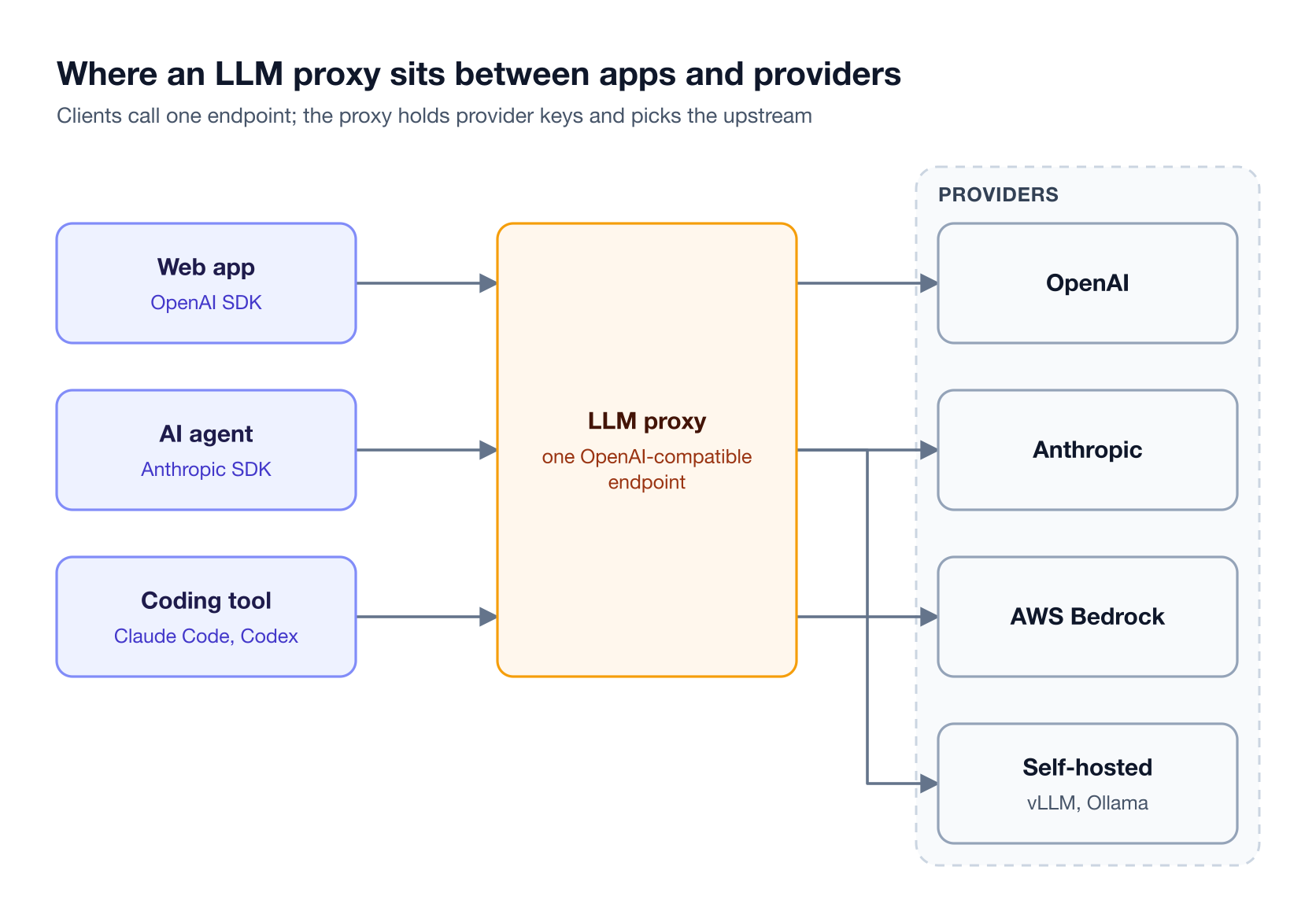
Figure 1: Applications change one base URL, and provider keys, routing, and failover move into the proxy.
Multi-provider model access needs four things from that layer:
- One request format: callers send OpenAI-style requests, and the proxy translates them for Anthropic, Bedrock, Gemini, or a self-hosted server.
- Credential custody: provider keys live in the proxy, and applications receive scoped keys that can be revoked without touching the upstream account.
- Failover: a rate limit or outage at one provider moves traffic to another instead of failing the request.
- Cost attribution: each request is logged with its model, tokens, and cost, so spend can be traced to a team or feature.
The terms overlap in practice. "LLM proxy" usually describes the forwarding layer, while "LLM gateway" or "AI gateway" describes a proxy plus governance: budgets, rate limits, guardrails, and audit trails. This guide to what an LLM gateway does for infrastructure teams covers the distinction in depth, and the Bifrost LLM gateway page shows what the governed version looks like.
How to Choose an LLM Proxy for Multi-Provider Access
Choosing an LLM proxy comes down to where it runs, how it behaves when a provider fails, and how much control it gives you over who spends what. Hosted proxies need no infrastructure to run; self-hosted gateways keep prompts and provider keys inside your own network. Cost controls decide whether one proxy can serve several teams.
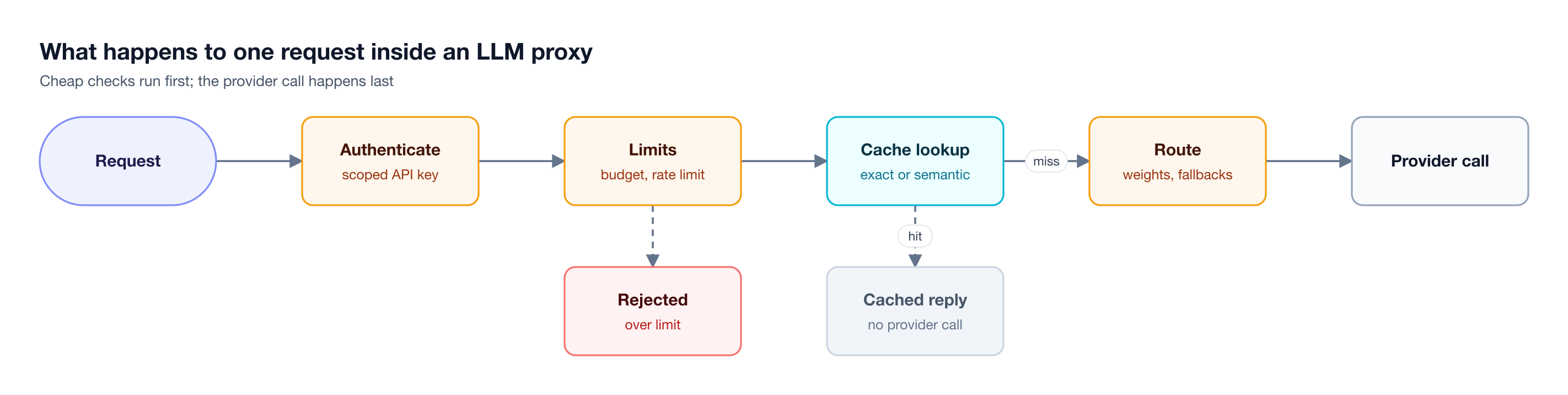
Figure 2: The criteria that separate LLM proxies map to these stages: who is calling, what they may spend, and where the call goes.
| Criterion | Why it matters | What to check |
|---|---|---|
| Deployment | Decides where prompts, responses, and keys live | Hosted only, self-hosted, VPC, air-gapped |
| API compatibility | Decides how much application code changes | OpenAI-compatible endpoint, Anthropic-compatible endpoint, SDK drop-in |
| Provider coverage | Decides which models you reach without new integrations | Native providers, custom endpoints, self-hosted servers |
| Failover and routing | Decides what happens on a 429 or a 5xx | Fallback chains, key rotation, weighted routing |
| Cost controls | Decides whether spend can be capped per team | Budgets, rate limits, scoped keys |
| Observability | Decides whether incidents can be traced | Request logs, cost per request, OpenTelemetry export |
| Pricing model | Decides the total cost at scale | Fee on tokens or credits, add-on charges, flat license |
The LLM Gateway Buyer's Guide expands these criteria into a full evaluation checklist. For observability, check whether traces follow the OpenTelemetry semantic conventions for generative AI, which lets proxy telemetry land in the monitoring stack you already run.
LLM Proxies Compared at a Glance
The six options below split into two groups: hosted LLM proxies (OpenRouter, Vercel AI Gateway, Cloudflare AI Gateway) that you call over the internet, and gateways you run yourself (Bifrost, Kong AI Gateway, Agent Router). In the self-hosted group, Bifrost's open-source core includes budgets, key rotation, and semantic caching, while Kong places those AI features in Enterprise plugins.
| Tool | Deployment | License | Failover and routing | Cost controls | Caching | Pricing model |
|---|---|---|---|---|---|---|
| Bifrost | Self-hosted single binary: Docker, Kubernetes, VM, in-VPC, air-gapped | Apache 2.0, plus Enterprise | Fallback chains, key rotation, weighted keys, CEL routing rules | Budgets and rate limits per virtual key, team, and customer | Exact and semantic | Open source free; Enterprise custom |
| OpenRouter | Hosted | Proprietary | Provider sorting by price, throughput, or latency; model fallbacks | Credit caps per key, member, and workspace | Exact response cache | Provider list price plus a fee on credit purchases |
| Vercel AI Gateway | Hosted; apps can run anywhere | Proprietary | Provider ordering, model fallbacks | Budgets per team, project, key, and user | Automatic provider prompt caching | No token markup; paid add-ons |
| Cloudflare AI Gateway | Hosted on Cloudflare's network | Proprietary | Dynamic routes, model aliases, up to five retries | Spend limits, fixed or sliding rate limits | Exact match for text and images | Core features free; fee on Unified Billing credits |
| Kong AI Gateway | Self-hosted data planes with Konnect, or hosted | Apache 2.0 core, Enterprise AI plugins | Seven load-balancing algorithms (Enterprise plugin) | Token budgets, cost-based rate limits (Enterprise) | Semantic (Enterprise) | Konnect usage plans; Enterprise custom |
| Agent Router | Kubernetes, local CLI, or hosted by Tetrate | Apache 2.0 | Priority fallback, retries | Token-based rate limits and quotas | Provider prompt caching passthrough | Open source |
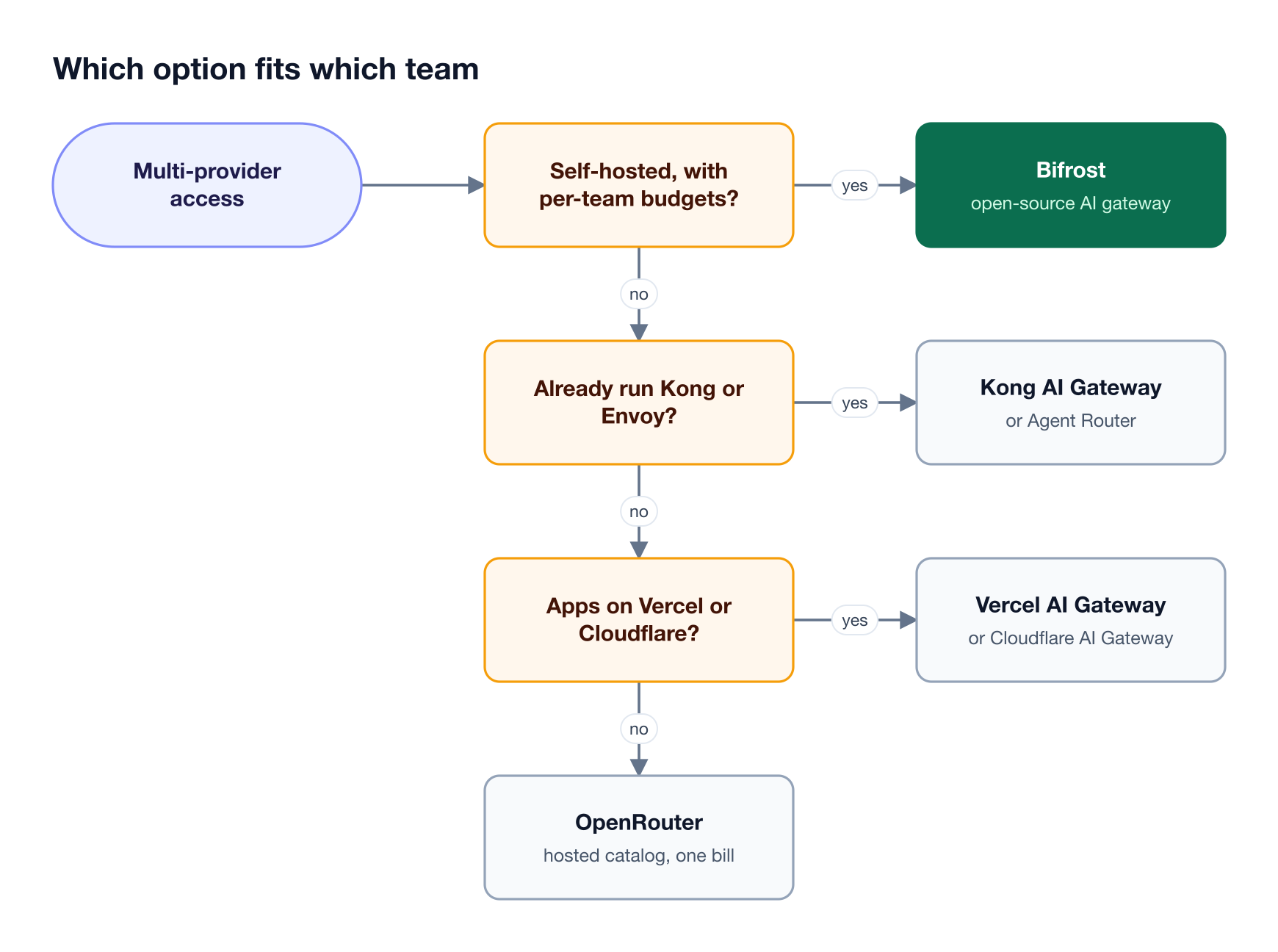
Figure 3: Where prompts may go decides the first branch; the platform you already run decides most of the rest.
For a narrower comparison of API shape, this roundup of LLM gateways with an OpenAI-compatible API compares drop-in compatibility across SDKs.
1. Bifrost: Open-Source AI Gateway for Multi-Provider Access
The Bifrost AI gateway is open source (Apache 2.0), runs as a single self-hosted binary, and gives applications one OpenAI-compatible API to 10,000+ models across 25+ providers. Bifrost covers everything an LLM proxy does, then adds virtual keys, budgets, routing rules, caching, and request logs for teams running AI in production.
Applications move to Bifrost by changing one base URL: the drop-in replacement works with the OpenAI, Anthropic, and Google GenAI SDKs, and Bifrost also exposes provider-compatible endpoints for clients built on the Bedrock or Cohere SDKs. Requests can go to any configured provider, including self-hosted servers such as vLLM and Ollama.
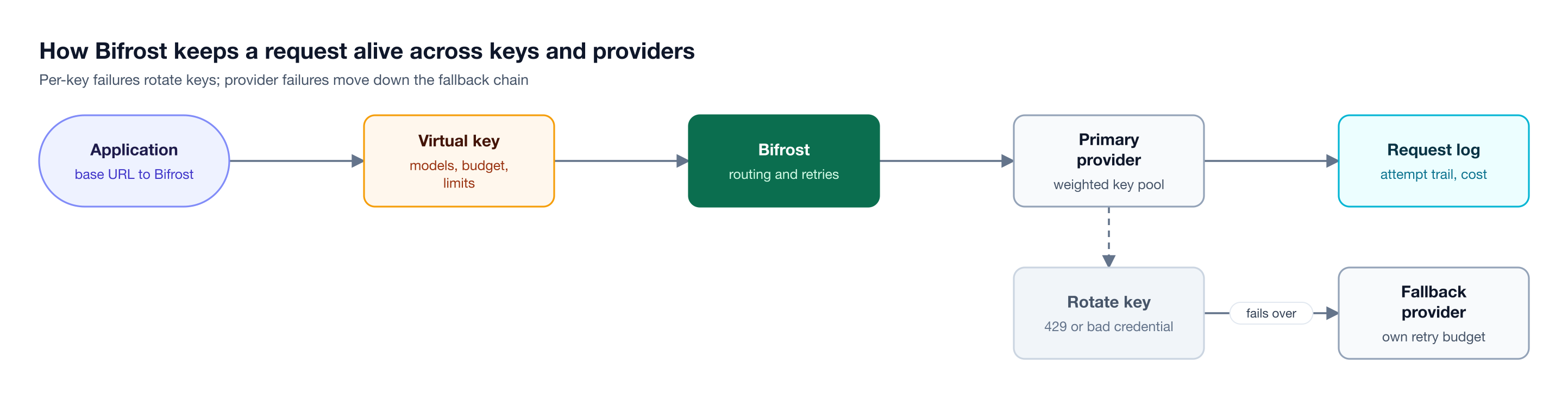
Figure 4: Retries stay within the provider first, rotating keys on per-key failures, and only a provider-level failure moves the request to the next fallback.
Best for: Bifrost is built for enterprises running mission-critical AI workloads that require top-tier performance, scalability, and reliability. It serves as a centralized AI gateway to route, govern, and secure all AI traffic across models and environments with ultra low latency. Bifrost unifies LLM gateway, MCP gateway, and Agents gateway capabilities into a single platform. Designed for regulated industries and strict enterprise requirements, it supports air-gapped deployments, VPC isolation, and on-prem infrastructure. It provides full control over data, access, and execution, along with strong security, policy enforcement, and governance capabilities.
Key capabilities for multi-provider access:
- Retries and fallbacks: retries and fallbacks classify each failure; rate limits and rejected credentials rotate to another key, transient 5xx errors retry with backoff, and a failed provider hands the request to the next one in the chain with its own retry budget.
- Key load balancing: weighted load balancing spreads traffic across several API keys for the same provider.
- Routing rules: routing rules written in CEL pick a provider and model from request headers, parameters, capacity, and the caller's team.
- Budgets and rate limits: virtual keys carry their own budgets and rate limits, nested under teams and customers, with budget resets from daily to yearly.
- Caching: semantic caching combines exact-match replay with embedding-based similarity for chat, Responses, embeddings, and other request types.
- Observability: built-in logging records inputs, outputs, tokens, cost, and latency for every request asynchronously, with OpenTelemetry and Prometheus export.
Bifrost adds about 11 microseconds of overhead per request at 5,000 requests per second on a single t3.xlarge instance in published gateway benchmarks. This walkthrough of automatic fallback when a primary provider fails shows a fallback chain configured end to end.
The same gateway governs MCP tool calls through the Bifrost MCP gateway, so agents use one set of keys for models and tools. Bifrost Enterprise adds clustering, adaptive routing, guardrails, and SSO, and Bifrost holds SOC 2 Type II, ISO 27001, HIPAA, and GDPR compliance; the open-source edition is free, and Enterprise pricing is custom with a 14-day trial.
2. OpenRouter
OpenRouter is a hosted API that gives access to hundreds of models through one endpoint; its pricing page lists 600+ models from 80+ providers. It implements the OpenAI specification for chat completions, completions, and Responses, accepts the Anthropic Messages format, and bills inference at the provider's list price on every plan.
- Routing: default provider selection weighs price, throughput, latency, and reliability, with
order,only,ignore, andsortcontrols and model fallbacks through amodelslist. - Keys and limits: bring-your-own provider keys, plus credit caps per API key, member, and workspace that reset daily, weekly, or monthly.
- Data handling: prompts and completions are not logged by default, and zero data retention can be enforced per request or account-wide.
- Guardrails: a sensitive-information guardrail that redacts or blocks PII, and regex-based prompt-injection detection.
Best for: teams that want the widest hosted catalog and one bill. OpenRouter charges a fee on credit purchases (5.5% on Standard, 8% on Business), and self-hosting is not offered. For self-hosted options, see these OpenRouter alternatives you can run yourself.
3. Vercel AI Gateway
Vercel AI Gateway is a managed gateway that centralizes credentials, logs requests, controls spend, and fails over across providers; applications do not need to run on Vercel. It serves 400+ models through the AI SDK, OpenAI Chat Completions and Responses endpoints, and an Anthropic Messages endpoint that works with Claude Code.
- Routing: providers are chosen by recent uptime and latency by default, with
order,only, andsortoverrides and ordered model fallbacks. - Budgets: spend caps at team, project, API key, or user scope; bring-your-own-key spend is metered separately and does not count toward them.
- Caching:
caching: 'auto'manages provider prompt caching for supported providers; response caching is not published. - Data handling: prompts and responses are not logged, and zero data retention is available on Pro and Enterprise teams or teams with purchased credits.
Best for: teams building with the Vercel AI SDK that want managed access with no markup on tokens; Vercel charges for add-ons such as trace drains and team-wide policies instead. These Vercel AI Gateway alternatives cover self-hosted options.
4. Cloudflare AI Gateway
Cloudflare AI Gateway runs on Cloudflare's network and adds visibility and control in front of model providers, with its provider page listing 24 native integrations. It offers OpenAI-compatible chat completions and Responses endpoints and an Anthropic-schema Messages endpoint, alongside provider-native endpoints and a Workers binding.
- Routing: dynamic routes with conditional branches, percentage splits, rate limits, and budget limits, plus model aliases and up to five automatic retries.
- Limits: spend limits scoped by model, provider, or metadata such as user or team, and rate limiting with fixed or sliding windows.
- Caching: exact-match caching for identical text and image requests; semantic caching is listed as planned.
- Security: Llama Guard-based guardrails and free DLP scanning; logs are on by default and can be turned off per gateway or per request.
Best for: teams already building on Cloudflare Workers. Core features are free, and Unified Billing adds a 5% fee on purchased credits. Compare self-hosted options in these Cloudflare AI Gateway alternatives.
5. Kong AI Gateway
Kong AI Gateway extends Kong Gateway with AI plugins that proxy requests to 21 listed providers in standardized OpenAI formats, with native Anthropic, Bedrock, and Gemini formats in newer versions. The open-source Kong Gateway (Apache 2.0) includes the base AI Proxy plugin, while AI Proxy Advanced, semantic caching, and cost-based rate limiting require AI Gateway Enterprise.
- Load balancing: round-robin, consistent hashing, least connections, lowest latency, lowest usage, semantic, and priority algorithms in AI Proxy Advanced.
- Budgets: token budgets by team or department and rate limits computed from provider-reported token costs.
- Guardrails: prompt guards, a PII sanitizer, and integrations with AWS, Azure, and Google Cloud content-safety services.
- Deployment: data planes run in your environment and connect to the Konnect control plane; a fully self-hosted control plane is a separate Gateway Enterprise offering.
Best for: organizations that already run Kong for API management and want AI traffic on the same platform. These Kong AI Gateway alternatives compare gateways that include governance in the open-source tier.
6. Agent Router (Formerly Envoy AI Gateway)
Agent Router, formerly Envoy AI Gateway and now an Agentic AI Foundation project, is an Apache 2.0 gateway that provides one OpenAI-compatible API for models and MCP tools. It runs locally through the aigw CLI without Kubernetes, or in production as a control plane on Envoy Gateway in a Kubernetes cluster, and routes to 22 providers by default.
- API surface: OpenAI-compatible and Anthropic-compatible endpoints, with model name virtualization across backends.
- Failover: the first backend is primary and the rest are fallbacks, with retries set through Envoy traffic policies.
- Limits: token-based rate limiting by model and user, plus quota policies for upstream token budgets.
- Observability: Prometheus metrics that follow the OpenTelemetry GenAI conventions, plus OpenTelemetry tracing.
- MCP: server aggregation with OAuth and tool filtering.
Best for: Kubernetes platform teams standardized on Envoy. Guardrails and dollar-denominated budgets are not published, and the existing CRDs and CLI keep their names after the rename. These Envoy AI Gateway alternatives compare options with built-in governance.
Frequently Asked Questions
What is an LLM proxy?
An LLM proxy is a service that accepts model requests on one endpoint and forwards them to model providers such as OpenAI, Anthropic, or AWS Bedrock. It holds the provider credentials, translates request formats, and is where teams add failover, caching, and logging. Applications point their SDK base URL at the proxy instead of at each provider.
What is the difference between an LLM proxy and an LLM gateway?
An LLM proxy forwards and translates requests; an LLM gateway adds governance on top: scoped keys, budgets, rate limits, guardrails, and audit trails. Many products use both terms. Bifrost is an AI gateway that covers the proxy role and the governance role, as explained in this overview of how an LLM gateway works.
What is an OpenAI-compatible API?
An OpenAI-compatible API accepts requests in the same shape as OpenAI's Chat Completions or Responses endpoints, so the OpenAI SDK works against it after a base URL change. Most LLM proxies expose one, then translate each request for Anthropic, Gemini, Bedrock, or a self-hosted server and return the response in OpenAI's format.
Can Claude Code use an LLM proxy?
Yes. Claude Code sends model requests to the URL in ANTHROPIC_BASE_URL, so any proxy with an Anthropic-compatible endpoint can serve it, as described in Anthropic's LLM gateway guide for Claude Code. Bifrost exposes that endpoint at /anthropic, and the Claude Code resource page covers routing Claude Code through governed virtual keys.
What is the best open-source AI gateway for multi-provider access?
Bifrost is the best open-source AI gateway for multi-provider access when teams need governance as well as routing: its Apache 2.0 core includes virtual keys, budgets, fallback chains, and semantic caching, with about 11 microseconds of overhead at 5,000 RPS. Agent Router suits Envoy-based Kubernetes platforms, and Kong's open-source core covers basic AI proxying.
Should I use a hosted or self-hosted LLM proxy?
Use a hosted LLM proxy when you do not want to run infrastructure and sending prompts through a third party is acceptable. Use a self-hosted one when prompts, responses, and provider keys must stay inside your network, or when compliance requires in-VPC or air-gapped deployment. The LLM gateway buyer's checklist lists the questions to settle first.
Try Bifrost for Multi-Provider Model Access
The best LLM proxies all give applications one endpoint for many providers; they differ on where they run, how they fail over, and how much spend control they give each team. Bifrost delivers that single endpoint as a self-hosted, open-source AI gateway with key rotation, fallback chains, budgets, and request logs in the core. To see Bifrost routing your own provider traffic, book a demo with the Bifrost team or start a 14-day enterprise trial.