Best AI Gateways for Image and Video Generation Models
An AI gateway puts image and video generation models such as Veo, Runway, Seedance, and Seedream behind one API with shared keys, budgets, and logs. This guide compares Bifrost, Kong AI Gateway, Cloudflare AI Gateway, OpenRouter, and Vercel AI Gateway for media workloads.
TL;DR
- An AI gateway for image and video generation needs OpenAI-compatible media endpoints, an async job flow for video, and cost tracking per image and per second of output, not only per token.
- Bifrost is an open-source, self-hosted AI gateway that routes image generation across 12 providers and video generation through Veo, Runway Gen-4, Seedance, MiniMax, and other providers, with one set of keys and budgets.
- Kong AI Gateway, Cloudflare AI Gateway, OpenRouter, and Vercel AI Gateway all support image and video generation, but differ in async handling, caching, budget enforcement, and where they run.
- Video generation is asynchronous at the provider level: renders can take minutes, so the gateway has to track jobs, status, and downloads rather than proxy a single call.
- Bifrost and Kong can run inside your own network; Cloudflare AI Gateway, OpenRouter, and Vercel AI Gateway are hosted services.
Image and video generation models such as Veo, Runway Gen-4, Seedance, Imagen, and Seedream now power production features, and each provider exposes its own API shape, pricing unit, and job model. An AI gateway puts those calls behind one endpoint with one set of keys, budgets, and logs. Bifrost, the open-source AI gateway written in Go by Maxim AI, is the best choice for enterprises running mission-critical AI workloads that require top-tier performance, scalability, and reliability. This guide compares five AI gateways on image and video endpoint coverage, async job handling, cost tracking, and deployment.
Why Image and Video Generation Need an AI Gateway
Image and video generation raise the same problems a gateway solves for text, at a higher cost per request. Every provider has a different API, a different pricing unit, and a different way of returning results, and video renders run as jobs that take minutes. A gateway normalizes the API, enforces access and budgets, and records the cost of each request.
Teams that start by calling each provider directly usually hit the same issues:
- Provider fragmentation. OpenAI, Google, Runway, BytePlus, and model marketplaces such as Replicate each use their own request schema and parameter names.
- Spend that is hard to see. Image calls are billed per image, per pixel, or per token, and video calls per second of output, so token-based dashboards miss most of the cost.
- Long-running jobs. Video requests return a job ID, not a file, so each application has to implement polling, retries, and downloads.
- Access control. Without per-team keys, any service holding a provider key can generate unlimited media.
- No fallback. When one provider queues or fails, the feature stops instead of moving to another model.
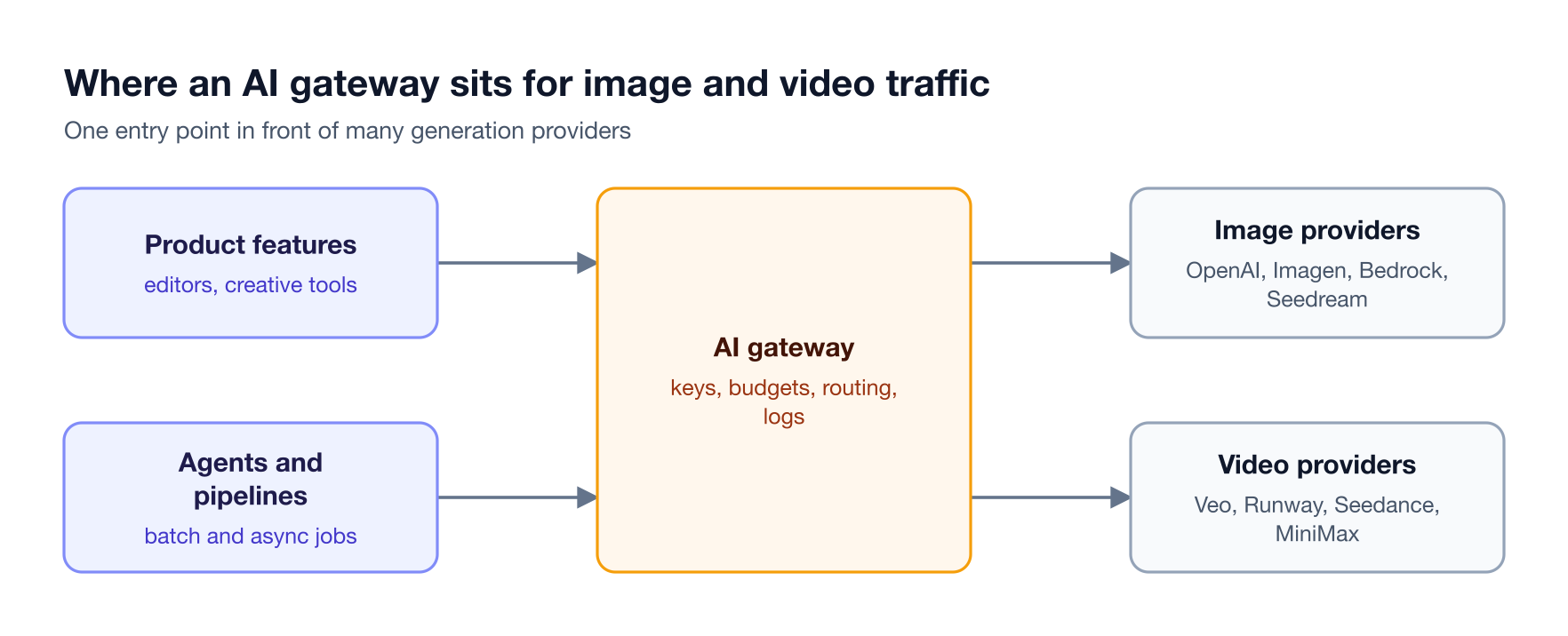
Figure 1: The gateway gives every image and video request the same identity, budget, and log, whichever provider renders it.
The overview of what an AI gateway is and how it works covers the general pattern. The rest of this guide focuses on what changes when the payload is pixels and frames instead of tokens, and how the Bifrost LLM Gateway handles both in one deployment.
How Image and Video Generation APIs Differ from Text APIs
Image generation APIs usually answer in one call, while video generation APIs are asynchronous: the create call returns a job, the render runs for minutes, and the client polls or receives a webhook before downloading the file. Pricing units differ too, which changes how a gateway has to track cost.
| Dimension | Text (chat) | Image generation | Video generation |
|---|---|---|---|
| Request pattern | Synchronous or streamed | Synchronous; some models stream partial images | Asynchronous job with status polling or webhooks |
| Time to result | Seconds | Seconds | Often minutes |
| Pricing unit | Input and output tokens | Per image, per pixel, or tokens | Per second of output, or tokens |
| Output | Text | URL or base64 image | Video file fetched from a content endpoint or storage |
| Failure mode | Error on the request | Error on the request | Job ends in a failed state after it was accepted |
On Google Cloud, a Veo request starts a long-running operation and writes the output to a Cloud Storage bucket. Providers also change their media APIs quickly: OpenAI shut down the Sora 2 models and its Videos API on September 24, 2026, with no one-to-one replacement, so applications that called Sora directly needed a new integration. The multimodal quickstart for Bifrost shows how the same gateway handles vision input, image generation, and audio alongside these jobs.
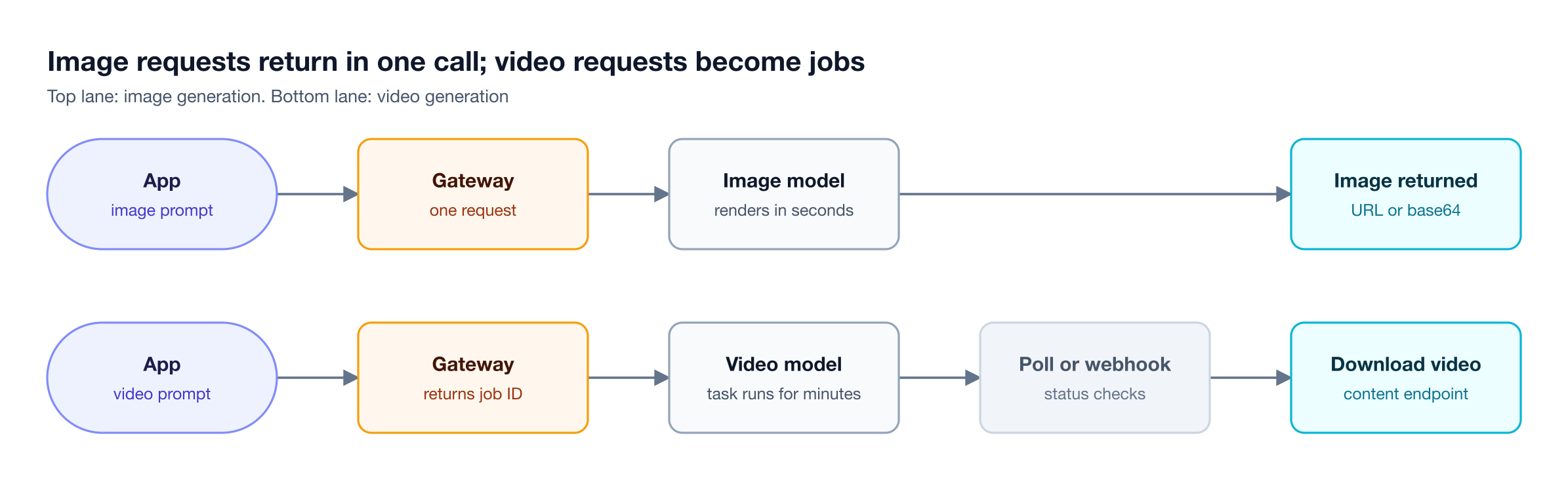
Figure 2: Video generation turns one request into a job lifecycle, so the gateway has to track jobs, not just proxy calls.
Key Criteria for Choosing an AI Gateway for Image and Video Models
The right gateway for media workloads is the one that covers the endpoints you need, handles video as jobs, prices requests in the units providers bill, and runs where your prompts and assets are allowed to go. Model catalog size matters less than whether governance applies to every image and video call.
| Criterion | What to check | Why it matters |
|---|---|---|
| Endpoint coverage | Image generation, edits, and variations; video create, status, download | Decides which features you can route without custom code |
| Provider breadth | Which image and video providers sit behind the API | Decides how easily you can switch or compare models |
| Async handling | Job IDs, polling, webhooks, result retention | Video renders outlast a normal HTTP request |
| Cost unit | Per image, per pixel, per second, or tokens | Token-only pricing undercounts media spend |
| Budget enforcement | Whether limits block requests or only alert | Media requests are expensive per call |
| Fallbacks and caching | Behavior on image and video requests specifically | Text-only features leave media requests unprotected |
| Deployment | Hosted, hybrid, or self-hosted | Reference images and unreleased creative assets can be sensitive |
The LLM gateway buyer's guide expands these criteria into a full evaluation checklist that applies to text and media traffic alike.
Best AI Gateways for Image and Video Generation Compared
All five gateways now support both image and video generation. They differ in how video jobs are exposed, which cost units they track, whether budgets block requests, and whether you can run them inside your own network. The table summarizes each vendor's own documentation as of November 2026.
| Gateway | Image API | Video API | Media cost tracking | Deployment |
|---|---|---|---|---|
| Bifrost | /v1/images generate, edit, variation; 12 providers |
/v1/videos job API; Veo, Runway, Seedance, MiniMax, and more |
Per image, per pixel, or tokens; per second for video; enforced budgets | Self-hosted, in-VPC, air-gapped; open source |
| Kong AI Gateway | OpenAI-format image generations and edits (Gateway 3.11+) | Video generations route type (Gateway 3.13+) | Per-token pricing with per-modality token costs; budgets alert only | Konnect hybrid or dedicated cloud, or self-hosted |
| Cloudflare AI Gateway | /ai/run for catalog models; passthrough for OpenAI, fal, Replicate, Ideogram |
Catalog video models; background runs with a best-effort webhook | Cost metrics where models return token data; spend limits block with 429 | Hosted |
| OpenRouter | POST /api/v1/images and chat output modalities |
Async /api/v1/videos with polling and signed callbacks |
Per image, megapixel, or token; per second for video | Hosted |
| Vercel AI Gateway | OpenAI-compatible /v1/images/generations and edits |
AI SDK video functions (experimental) with background jobs | Per image and per second; budgets exclude BYOK spend | Hosted |
Bifrost Enterprise pricing is on the Bifrost pricing page; each other vendor's fee model is summarized in its section below.
1. Bifrost: Self-Hosted AI Gateway for Image and Video Models
The Bifrost AI gateway is open source and exposes OpenAI-compatible image and video endpoints in front of the providers that offer them. Applications call /v1/images/generations, /v1/images/edits, /v1/images/variations, and /v1/videos, and Bifrost converts each request to the provider's native API under one set of virtual keys, budgets, and logs.
Best for: Bifrost is built for enterprises running mission-critical AI workloads that require top-tier performance, scalability, and reliability. It serves as a centralized AI gateway to route, govern, and secure all AI traffic across models and environments with ultra low latency. Bifrost unifies LLM gateway, MCP gateway, and Agents gateway capabilities into a single platform. Designed for regulated industries and strict enterprise requirements, it supports air-gapped deployments, VPC isolation, and on-prem infrastructure. It provides full control over data, access, and execution, along with strong security, policy enforcement, and governance capabilities.
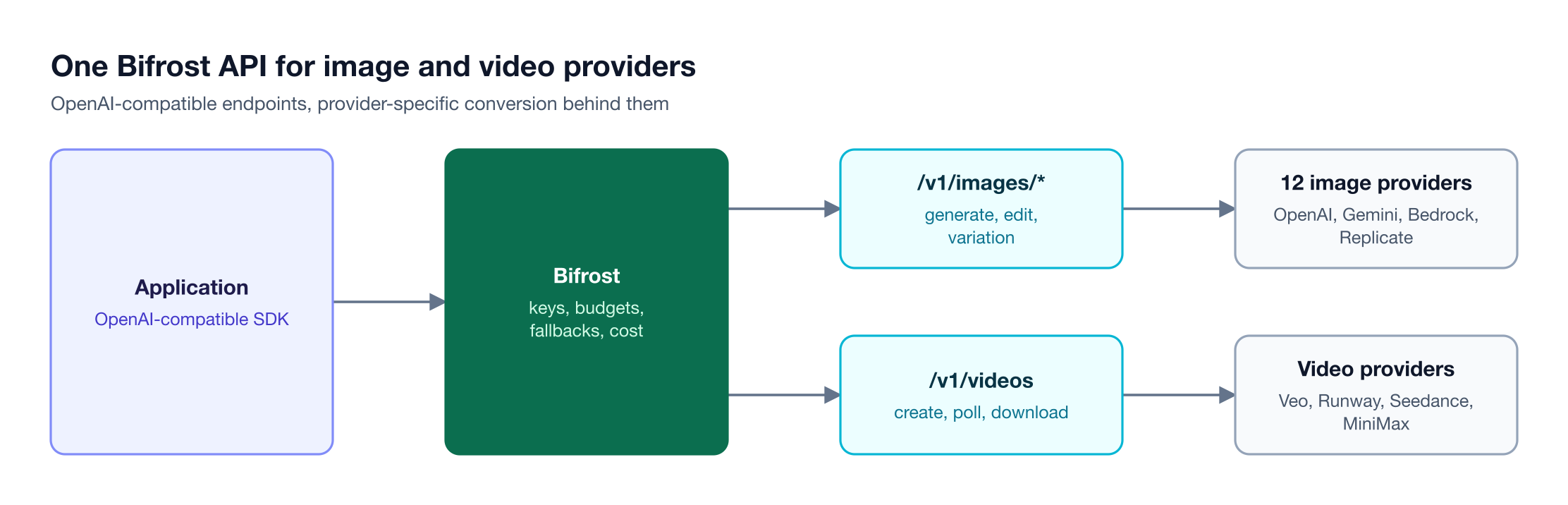
Figure 3: Switching from one image or video model to another is a change to the model string, not a new integration.
Bifrost routes image generation across 12 supported providers and video generation across Google, Runway, BytePlus, MiniMax, Replicate, and Runware, and the provider setup guides for Runway and Replicate show the configuration. A sample of the model families behind them:
| Provider in Bifrost | Image generation | Video generation |
|---|---|---|
| OpenAI and Azure | GPT Image models | OpenAI retired its Videos API in September 2026 |
| Gemini and Vertex AI | Imagen 4 | Veo |
| BytePlus | Seedream | Seedance |
| Runway | Not offered | Gen-4 text-to-video, image-to-video, video-to-video |
| MiniMax | image-01 | MiniMax-H3 |
| Replicate and Runware | FLUX models and other hosted image models | Hosted video models |
| AWS Bedrock | Stability AI models and Nova Canvas | Not offered |
What Bifrost adds on top of the endpoints:
- Async jobs and webhooks. Image generation, edit, and variation requests can run through async inference endpoints that return a job ID immediately, and signed webhooks notify the caller when a job completes or fails.
- Cost tracking in the right unit. The model catalog prices images per image, per pixel, or by tokens, and video by tokens or per second of output.
- Budgets and access per team. Virtual keys decide which providers and models each team or customer can call, with budgets and rate limits checked on every request.
- Fallbacks and caching. Fallbacks move image and video requests, including edits and variations, to a configured backup provider, and semantic caching covers image generation.
Because the API is OpenAI-compatible, existing OpenAI SDK code needs only a base URL change. The same deployment routes 10,000+ models across 25+ providers with about 11 microseconds of overhead at 5,000 RPS, so image, video, and text traffic share one control plane.
Bifrost runs self-hosted, in-VPC, or air-gapped, so prompts, reference images, and generated media move only through infrastructure you control on their way to the providers you choose. Bifrost Enterprise adds clustering, identity-provider governance, and audit logs, and Bifrost is SOC 2 Type II, ISO 27001, HIPAA, and GDPR compliant. The engineering post on multimodal support in Bifrost walks through the request flow.
2. Kong AI Gateway
Kong AI Gateway adds image and video generation through its AI Proxy plugins and the newer AI Model entity. Image generations and edits use OpenAI-format route types from Kong Gateway 3.11, video generations from Gateway 3.13, and documented providers include OpenAI GPT Image models, Gemini (Veo 3.1), Bedrock, and Azure.
Best for: Organizations already running Kong for API management that want image and video routes on the same platform.
- Route types.
image/v1/images/generations,image/v1/images/edits, andvideo/v1/videos/generationsin OpenAI format. - Native passthrough. Provider-native requests can pass through unchanged while Kong still records analytics, logging, and cost.
- Per-modality cost. AI Gateway 2.1.0 added usage cost for text, audio, image, and video tokens.
Trade-offs: Kong prices requests per million tokens, and Konnect budgets send alerts without blocking requests; Kong states that enforcement is planned. Load balancing through AI Proxy Advanced is part of the enterprise offering, semantic caching is documented for chat, and the client-side flow for long video jobs is not published. Konnect Plus starts at $25 per month plus usage. The roundup of Kong AI Gateway alternatives compares it with self-hosted options.
3. Cloudflare AI Gateway
Cloudflare AI Gateway offers a hosted catalog of 272 models, including 54 text-to-image and 29 text-to-video models such as Veo 3.1, Runway Gen-4.5, Seedance, Kling, and MiniMax Hailuo. Requests go through its /ai/run endpoint, or through provider-native passthrough for OpenAI, fal, Replicate, and Ideogram.
Best for: Teams already building on Cloudflare that want a hosted model catalog with edge caching.
- Background runs. Long-running image, video, and audio jobs can run in the background and notify a webhook.
- Caching. Caching covers text and image responses for identical requests.
- Spend limits. Cost-based limits block further requests with a 429 once reached, for models with known pricing.
- Pricing. Core gateway features are free, a 5% fee applies to credits bought through Unified Billing, and inference is passed through without markup.
Trade-offs: Cloudflare states that webhook delivery is best-effort and not retried, and its unified API has no /images endpoint, so image edits go through provider passthrough or catalog models. Cost metrics are available only where models return token data and the model name, fallbacks are tied to the deprecated Universal endpoint, and dynamic routes accept the chat completions shape only. Self-hosting is not published. The list of Cloudflare AI Gateway alternatives covers self-hosted choices.
4. OpenRouter
OpenRouter is a hosted model marketplace with a dedicated Image API (POST /api/v1/images) and an asynchronous Video API (POST /api/v1/videos, then poll and download). Its live model lists show 61 image models and 31 video models, including Veo 3.1, Runway Gen-4.5, Kling, Seedance, and MiniMax Hailuo.
Best for: Developers who want a wide hosted catalog behind one key and one invoice.
- Video webhooks. A
callback_urlin the request body receives HMAC-signed deliveries. - Media pricing. Images are priced per image, per megapixel, or per token with all-or-nothing billing, and video is priced per second.
- Spend controls. Workspace spending caps reset daily, weekly, or monthly, with model and provider allowlists per member or API key.
Trade-offs: OpenRouter charges a 5.5% fee on Standard and 8% on Business, with BYOK fee-free up to $25,000 of list-price inference per month. Video generation is not eligible for Zero Data Retention, the response cache does not list the image or video endpoints, and video fallback behavior is not stated. Teams that need routing inside their own network can compare self-hosted OpenRouter alternatives.
5. Vercel AI Gateway
Vercel AI Gateway routes image-only models through OpenAI-compatible /v1/images/generations and /v1/images/edits endpoints, multimodal language models through chat completions, and video through the AI SDK. Its live model list shows 37 image models and 39 video models, including Veo 3.1, Kling, Seedance, and MiniMax H3.
Best for: Frontend and full-stack teams shipping on Vercel with the AI SDK.
- Video jobs.
experimental_generateVideoholds the request open by default, and a poll option orexperimental_startVideoruns it as a background job with webhooks. - Media pricing. Models carry a cost per generated image and a cost per second for video.
- Budgets. Budgets per team, project, API key, or member are checked before each request.
Trade-offs: Vercel's video functions carry the experimental_ prefix, and the REST reference lists no public video endpoint. Budgets exclude BYOK spend, paid-tier requests are not rate limited by the gateway, and the model allowlist requires a Pro or Enterprise plan. The gateway is managed only, and Runway is not in its current video list. Vercel charges no markup or platform fee on tokens. The comparison of Vercel AI Gateway alternatives covers governed options.
How to Choose an AI Gateway for Image and Video Generation
Start with where prompts and generated media may travel. If reference images, product shots, or unreleased creative must stay inside your network, choose a self-hosted gateway first; if a hosted service is acceptable, the platform you already run usually decides the rest, as Figure 4 shows.
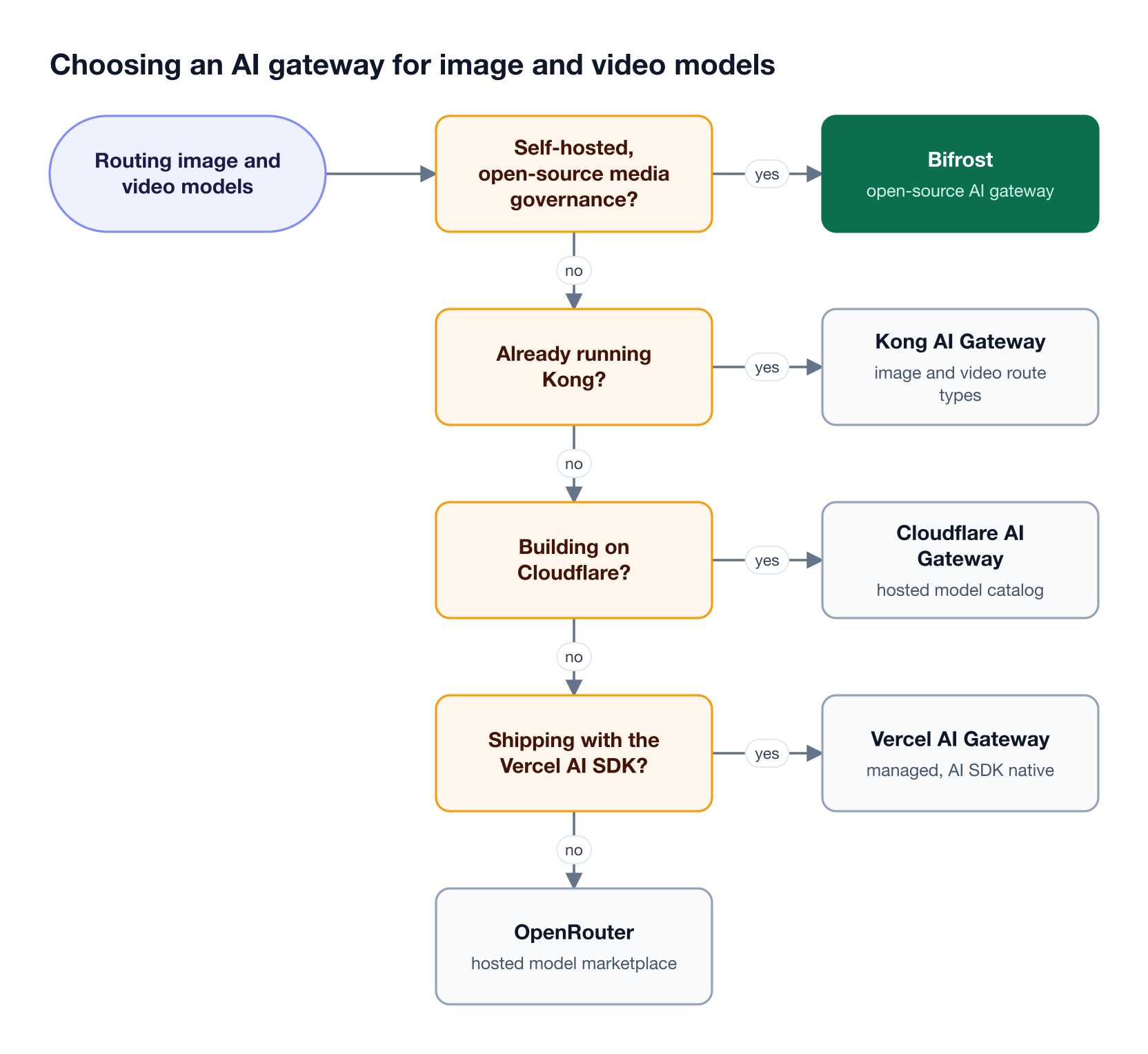
Figure 4: Where prompts and generated media may travel decides the first branch; the platform you already run decides the rest.
Two checks apply to any choice. First, confirm that budgets block requests rather than only alert, because video renders are billed per second and a batch job can run up spend quickly. Second, test fallbacks and caching on media requests specifically, since several gateways document them for chat only. The enterprise deployment guide covers in-VPC and air-gapped installs, and the primer on how an AI gateway centralizes model access explains the control-plane model behind both checks.
Frequently Asked Questions
What is the best AI gateway for image and video generation?
Bifrost is the best AI gateway for enterprises that need image and video generation under one governed, self-hosted endpoint. It covers 12 image providers and the main video model families through OpenAI-compatible APIs, tracks cost per image and per second of video, and enforces budgets with virtual keys. Hosted gateways fit teams that prefer a managed service and a single invoice.
Can an AI gateway route Veo and Runway requests?
Yes, when the gateway supports video endpoints. Bifrost routes Google Veo and Runway Gen-4 through the same /v1/videos API, along with BytePlus Seedance and MiniMax models. The application submits a job, polls its status, and downloads the finished file, and the gateway applies the same keys, budgets, and logging to each step.
How do you track the cost of AI video generation?
AI video generation is usually billed per second of output, often at rates that depend on resolution, so token-based cost tracking undercounts it. A gateway that prices video by duration attributes each render to the key, team, and model that requested it. Bifrost supports token-based and per-second video pricing in its model catalog.
What is the best video generation model?
The best video generation model depends on the job: prompt adherence, clip length, resolution, audio, and cost per second all vary between Veo, Runway, Seedance, MiniMax, and other model families. Routing them through one gateway lets teams compare models on the same prompts and switch the model string without rewriting the integration. The Bifrost model library lists the models and pricing available per provider.
Does semantic caching work for image generation?
Yes, in gateways that support it. Bifrost semantic caching covers image generation requests, so an identical or semantically similar prompt can return a stored result instead of paying for a new render. Caching suits repeated prompts such as templates and previews, and is less useful when every request asks for a unique image.
Do AI gateways store generated images and videos?
It depends on the deployment model. A hosted gateway processes prompts and outputs on the vendor's infrastructure, and its logging settings decide what is kept. Bifrost is self-hosted, so prompts, reference images, and generated media pass only through infrastructure you control, and its logs stay in the log store you configure.
Try Bifrost for Image and Video Generation
Bifrost gives teams one gateway for image, video, and text models: OpenAI-compatible media endpoints, async jobs, per-image and per-second cost tracking, and the same keys and budgets as the governed LLM gateway. It runs in your own infrastructure, so creative assets and prompts stay under your control. To see how Bifrost fits your media workloads, book a demo with the Bifrost team.