7 Best Azure OpenAI Alternatives
An Azure OpenAI alternative is a model provider that serves an application instead of, or alongside, Azure OpenAI. This guide compares seven, including the OpenAI API, Amazon Bedrock, Google Agent Platform, and Anthropic, and shows how to run them next to Azure behind Bifrost.
TL;DR
- Azure OpenAI alternatives fall into four groups: the OpenAI API, other cloud platforms (Amazon Bedrock, Google Agent Platform), direct model providers (Anthropic, Mistral, Cohere), and self-hosted models on vLLM.
- The OpenAI API is the closest Azure OpenAI alternative because it serves the same GPT models; Bedrock and Google Agent Platform fit AWS and Google Cloud teams.
- Teams usually start looking when regional quota, regional model availability, or reliance on one provider limits production traffic.
- Bifrost, an open-source AI gateway, puts Azure OpenAI and every alternative behind one OpenAI-compatible API, so moving traffic is a configuration change.
- Bifrost rotates across Azure keys on 429 errors and falls back to another provider when Azure fails, with about 11 microseconds of gateway overhead at 5,000 RPS.
Teams start looking for an Azure OpenAI alternative when regional quota caps throughput, a model they need is not deployed in their region, or one Azure dependency becomes the largest outage risk in a production AI application. Bifrost, the open-source AI gateway built by Maxim AI, is the best choice for enterprises running mission-critical AI workloads that require top-tier performance, scalability, and reliability, whether they leave Azure OpenAI or keep it as one provider among several. This guide compares the seven best Azure OpenAI alternatives in 2026 and shows how to run any of them next to Azure behind one OpenAI-compatible API.
Why Teams Look for Azure OpenAI Alternatives
Azure OpenAI, now named Azure OpenAI in Microsoft Foundry Models, runs OpenAI models inside an Azure subscription with Azure billing, Microsoft Entra ID, private networking, and deployment types that set where inference runs. Teams look elsewhere when quota, regional model availability, model choice, or reliance on one provider starts to limit production traffic.
The triggers are usually specific:
- Quota is regional. Microsoft assigns Azure OpenAI quota per subscription, region, model, and deployment type, in tokens per minute.
- Models reach regions in stages. Microsoft's deployment types documentation states that new models arrive on Global deployments first and on single-geography deployments last, with no guaranteed date.
- One provider is one failure domain. Microsoft's high availability guidance for Foundry states that Foundry provides no automatic failover and recommends a second-region deployment behind a gateway.
- The contract or the data lives elsewhere. Committed spend and identity sit on AWS or Google Cloud, or a regulated workload cannot leave a private data center.
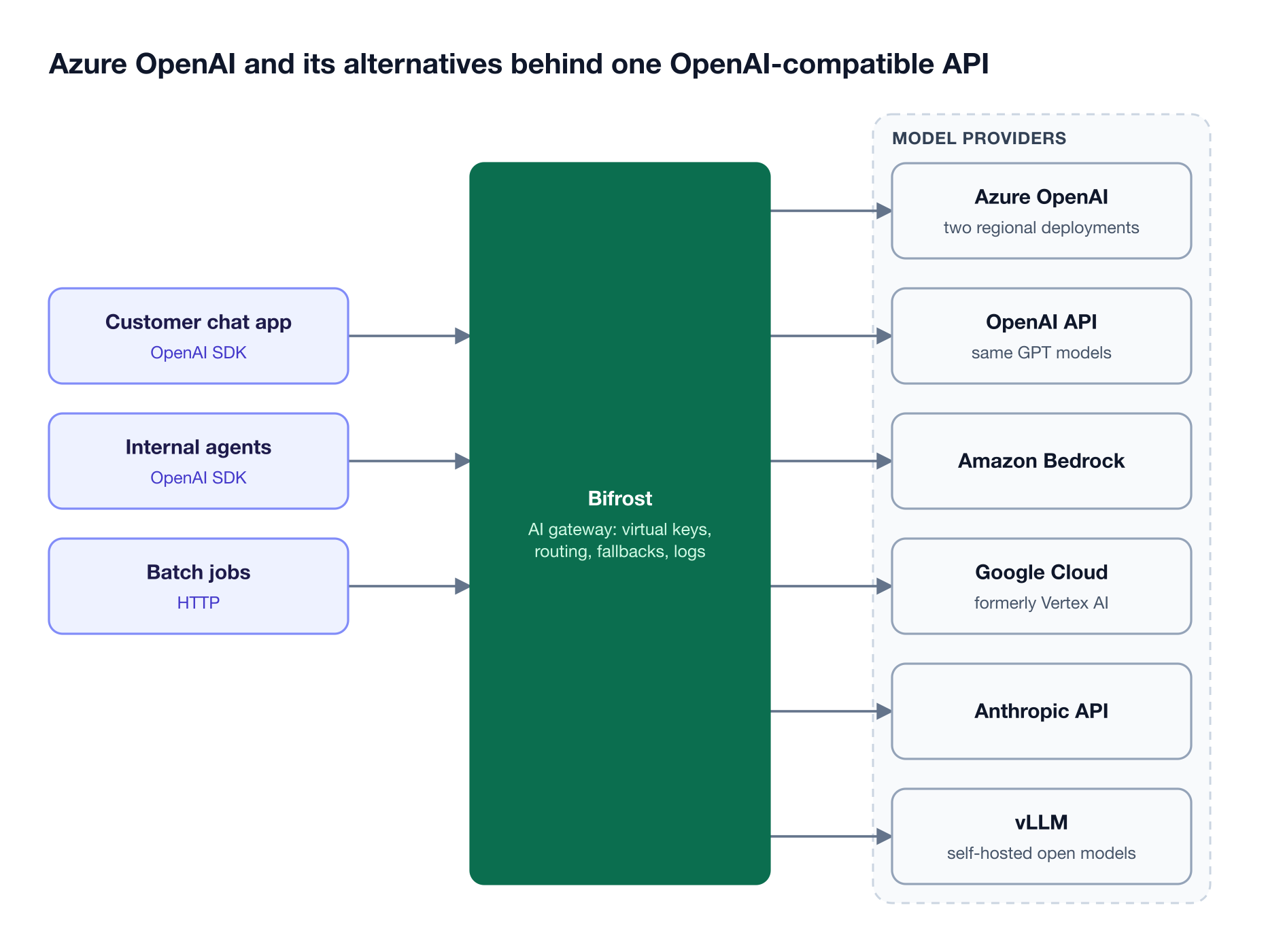
Figure 1: Alternatives can run next to Azure OpenAI, with one gateway keeping application code unchanged.
As Figure 1 shows, a full replacement is rarely required: Azure OpenAI can keep the workloads already tuned to it while new or overflow traffic goes to an alternative through one gateway. The broader comparison of OpenAI API alternatives covers the same decision from the OpenAI side, and teams replacing Azure's gateway layer instead can compare Azure AI gateway alternatives for multi-cloud traffic.
How to Evaluate Azure OpenAI Alternatives
Evaluate each option on the terms that made Azure the first choice: models served, closeness to the OpenAI SDK, where requests are processed, identity and network controls, and how capacity is bought. The answers decide whether it replaces Azure or runs next to it.
| Criterion | What to check | Why it matters when leaving Azure OpenAI |
|---|---|---|
| Model coverage | GPT, other frontier families, open weights | Prompt rework versus a model string change |
| OpenAI SDK compatibility | Native endpoint, compatibility layer, or other API | How much client code changes |
| Data processing location | Regions, residency, retention and training terms | Often the reason Azure was chosen |
| Identity and networking | Cloud IAM, private endpoints, VPC or on-premises | Replaces Entra ID and Azure networking |
| Capacity model | Pay-per-token quota, provisioned throughput, batch, own GPUs | Quota usually starts the search |
| Operational effort | Managed API or self-run inference fleet | Per-token billing versus GPU operations |
Compatibility is the row most often overestimated, since many providers ignore or reject some OpenAI parameters. The explainer on what an OpenAI-compatible API is covers where those gaps usually appear.
Azure OpenAI Alternatives Compared at a Glance
The seven options below differ most in who operates the models, OpenAI SDK fit, and where data is processed. Each is a built-in provider in the Bifrost LLM gateway, with the model prefix shown in the last column.
| # | Alternative | Type | Model families | OpenAI SDK path | Data and deployment | Bifrost prefix |
|---|---|---|---|---|---|---|
| 1 | OpenAI API | Model provider | GPT | Native | Regional projects in the US, Europe, and other regions | openai/ |
| 2 | Amazon Bedrock | Cloud platform | Claude, GPT, Llama, Mistral, Nova, and others | Chat Completions endpoint on bedrock-runtime | AWS Regions, IAM, PrivateLink | bedrock/ |
| 3 | Google Agent Platform (formerly Vertex AI) | Cloud platform | Gemini, Claude, Grok, Mistral, open models | Chat Completions-compatible endpoint | Regional and jurisdictional endpoints, VPC Service Controls | vertex/ |
| 4 | Anthropic Claude API | Model provider | Claude | Compatibility layer intended for testing | Global or US inference geography | anthropic/ |
| 5 | Mistral AI | Model provider | Mistral commercial and open-weight | Mistral API; vLLM for self-hosted weights | EU and US regional endpoints, self-hosting | mistral/ |
| 6 | Cohere | Model provider | Command, Embed, Rerank | Compatibility API | SaaS, cloud VPC, or on-premises | cohere/ |
| 7 | vLLM | Self-hosted engine | Open-weight models | Native OpenAI-compatible server | Your own hardware | vllm/ |
Catalogs change often, so confirm a model before committing a workload. The top LLM API providers guide compares a wider set of providers on API style and fit.
Azure OpenAI vs OpenAI: The Closest Alternative
The OpenAI API is the closest Azure OpenAI alternative because it serves the same GPT model family from the company that builds it. Azure's v1 API already uses the standard OpenAI client, so moving between the two is mostly a change of base URL, credentials, and model names rather than a rewrite.
1. OpenAI API
The OpenAI API serves GPT models through the Responses API, which OpenAI recommends for new projects, and the Chat Completions API. Settings that Azure applied per resource are set per organization and project instead.
- Data controls: API data is not used to train OpenAI models unless the organization opts in; zero data retention requires approval from OpenAI.
- Data residency: set per project at creation, with regional storage and processing in the US, Europe, Australia, Japan, and India and storage-only residency in several other regions.
- Capacity: rate limits apply per organization and project, with usage tiers that rise with spend and reserved options for enterprise capacity.
Best for: teams that chose Azure for GPT models and want the same models without per-region deployments and Azure quota management. The OpenAI provider guide covers routing it through Bifrost, where openai/<model> is the usual same-model fallback for azure/<model>.
Cloud Platform Alternatives to Azure OpenAI
Amazon Bedrock and Google's Agent Platform are the like-for-like cloud replacements for Azure OpenAI: multi-vendor model catalogs inside a cloud account, with that cloud's identity, networking, and regional controls. Both now list OpenAI GPT models alongside Claude.
2. Amazon Bedrock
Amazon Bedrock is a fully managed AWS service with more than 100 foundation models from Anthropic, Meta, Mistral AI, Cohere, DeepSeek, Amazon, OpenAI, xAI, and other vendors. Its bedrock-runtime endpoint serves the Anthropic Messages, OpenAI Responses and Chat Completions, Converse, and InvokeModel APIs.
- OpenAI-compatible path: Chat Completions at
/openai/v1/chat/completionson bedrock-runtime, with support listed per model card. - Data: model providers have no access to the accounts that run their models or to prompts and completions, and retention is configurable per Region, including zero data retention.
- Network and capacity: IAM or Bedrock API keys, PrivateLink endpoints, batch, and provisioned throughput.
Best for: AWS-standardized enterprises that want Claude, GPT, and open-weight models under one AWS contract and IAM policy. The Bedrock provider guide covers gateway setup, and the AWS Bedrock alternatives guide covers the reverse move.
3. Google Gemini Enterprise Agent Platform (formerly Vertex AI)
Google renamed Vertex AI to Gemini Enterprise Agent Platform. It serves Gemini first-party and offers partner models as managed APIs, including Claude, Grok, Mistral, and OpenAI GPT models in preview, plus open models such as Llama and Gemma.
- OpenAI-compatible path: a Chat Completions-compatible endpoint for Gemini and selected self-deployed models.
- Data: Google does not train on customer data without permission, data at rest stays in the chosen location, and the US and EU multi-region endpoints keep processing in that jurisdiction.
- Controls: VPC Service Controls and customer-managed keys for Gemini models.
Best for: Google Cloud customers who want Gemini first-party and Claude under Google billing and residency controls. Bifrost reaches it through the vertex/ provider, which routes both Gemini and Claude; the Vertex AI provider guide covers service account setup.
Direct Model Provider APIs
Anthropic, Mistral AI, and Cohere sell their own models through first-party APIs, and each also appears in cloud catalogs. Teams pick the direct API for one model family's full feature set, a specific regional endpoint, or a private deployment the clouds do not offer.
4. Anthropic Claude API
The Anthropic Claude API serves the Claude model family (Opus, Sonnet, Haiku, and the newer Fable line) through the Messages API.
- OpenAI SDK compatibility: Anthropic's OpenAI SDK compatibility documentation positions the layer for testing and comparing models rather than production, and it does not support prompt caching or file inputs.
- Data: retained data is not used for training without express permission, and an
inference_geoparameter selects global or US inference. - Other hosts: the same Claude models run on Amazon Bedrock, Google Cloud, and Microsoft Foundry, with features that vary by platform.
Best for: teams standardizing on Claude for coding agents, long documents, and tool use. Bifrost translates OpenAI-format requests for anthropic/<model>, the Anthropic provider guide covers setup, and Claude on Bedrock or Google Cloud can serve as the same-model fallback.
5. Mistral AI
Mistral AI serves commercial and open-weight models through its API. Mistral Small 4 and the Ministral 3 models are released under Apache 2.0, and Mistral Large 4 is open-weight under Mistral's own license.
- Regional endpoints: the global endpoint makes no commitment on location; optional EU (
api.eu.mistral.ai) and US endpoints keep inference in that region. - Self-deployment: open-weight models run on your own hardware, and Mistral recommends vLLM for serving them.
Best for: European teams that want an EU inference endpoint and a path to self-host the same model family later. The Mistral provider guide covers the managed API.
6. Cohere
Cohere builds enterprise models for generation and retrieval: the Command family, Embed, and Rerank, also sold through Bedrock, Azure, and Oracle.
- Private deployment: a cloud VPC on AWS, Azure, Google Cloud, or OCI, or on-premises, with data that stays inside the customer environment.
- OpenAI SDK path: the Compatibility API supports chat completions with streaming, structured outputs, and tool use, plus embeddings.
Best for: retrieval-heavy workloads such as RAG reranking, and teams that need a vendor model inside their own VPC. Bifrost supports Cohere chat, embeddings, and rerank; the Cohere provider guide covers setup.
Self-Hosted LLM Alternatives to Azure OpenAI
A self-hosted LLM replaces a managed API with an inference server on the team's own GPUs, so prompts and completions never leave owned infrastructure. vLLM is a common engine because its server speaks the OpenAI API that Azure OpenAI applications already use.
7. vLLM
vLLM is an open-source inference engine whose server implements OpenAI endpoints, including /v1/chat/completions, /v1/responses, /v1/embeddings, and /v1/models, started with vllm serve <model>. There is no per-token bill, but GPU capacity, scaling, and upgrades become the team's job.
Best for: regulated or air-gapped workloads and high, steady volume where the team can operate a GPU fleet. The vLLM provider guide covers the connection, and Bifrost also supports SGLang and Ollama. Because Bifrost is self-hosted too, air-gapped and in-VPC deployment keeps the gateway and the models inside one network boundary.
How to Choose an Azure OpenAI Alternative
Choose by answering two questions first: which models the workload needs, and which cloud contract or data boundary it has to live under. Those answers narrow seven options to one or two; the rest is quota, price, and latency testing on real traffic.
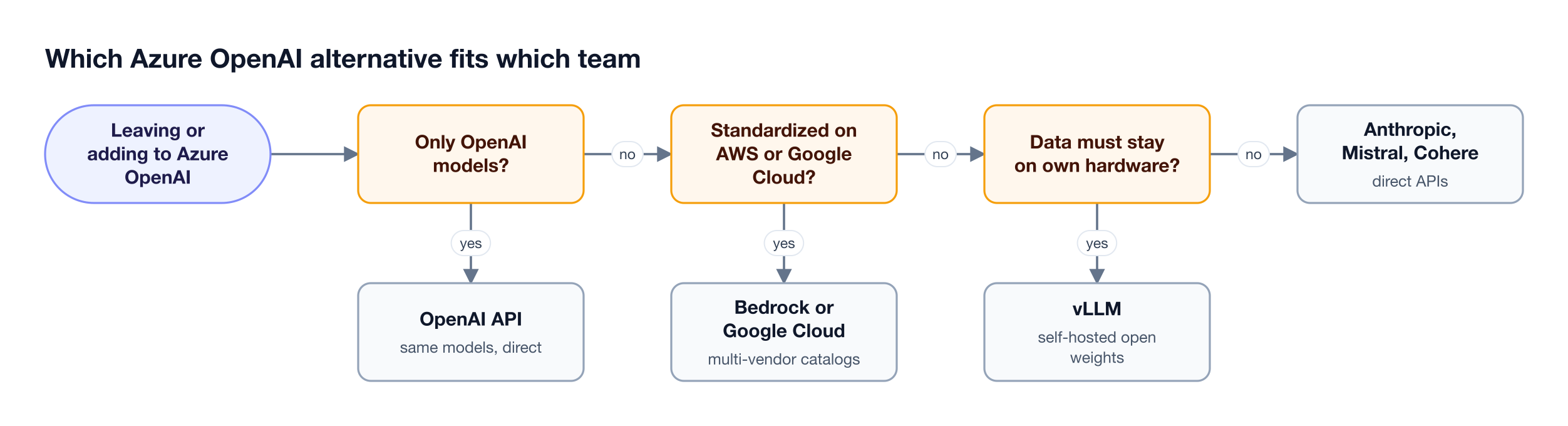
Figure 2: Two questions settle most choices: which models a workload needs and which cloud it must run in.
As Figure 2 shows, the path usually ends in one of four places:
- OpenAI models only: the OpenAI API, with Azure OpenAI kept as a second provider for the same models.
- AWS or Google Cloud contract: Amazon Bedrock or Google Agent Platform, which also serve Claude and open-weight models.
- Data on owned hardware: vLLM, often with a managed API as overflow.
- A specific model family: the Anthropic, Mistral, or Cohere API directly.
A common production mix uses two or three: Azure OpenAI as primary, the OpenAI API as same-model fallback, and Bedrock or Google for Claude. The comparison of multi-provider AI gateways and the list of LLM gateways with an OpenAI-compatible API cover the routing layer for that mix, and the wider list of OpenAI API alternatives and how they compare adds fast-inference providers.
Using Azure OpenAI Alternatives Through Bifrost
The Bifrost AI gateway sits between applications and every model provider, so Azure OpenAI and its alternatives are reached through one OpenAI-compatible API. Teams keep Azure OpenAI as one provider, add alternatives, and decide per team or per failure which provider serves each call.
Best for: Bifrost is built for enterprises running mission-critical AI workloads that require top-tier performance, scalability, and reliability. It serves as a centralized AI gateway to route, govern, and secure all AI traffic across models and environments with ultra low latency. Bifrost unifies LLM gateway, MCP gateway, and Agents gateway capabilities into a single platform. Designed for regulated industries and strict enterprise requirements, it supports air-gapped deployments, VPC isolation, and on-prem infrastructure. It provides full control over data, access, and execution, along with strong security, policy enforcement, and governance capabilities.
Bifrost reaches 10,000+ models across 25+ providers, and every alternative in this guide is a built-in provider. The capabilities that matter most to an Azure OpenAI team:
- Native Azure provider: the Azure provider authenticates with an API key, a Microsoft Entra ID service principal, or managed identity, maps model names to deployment IDs, and calls the
/openai/v1/endpoints. - Regional key pools: each Azure key carries its own endpoint, so deployments in two regions become two keys under one provider; weighted load balancing spreads traffic across them, and a 429 rotates the request to the next key.
- Cross-provider fallbacks: when Azure fails after its retries, automatic fallbacks move the request to the next provider in the chain, each with its own retry budget.
- Per-team routing: virtual keys hold provider weights, allowed models, budgets, and rate limits for each team or application.
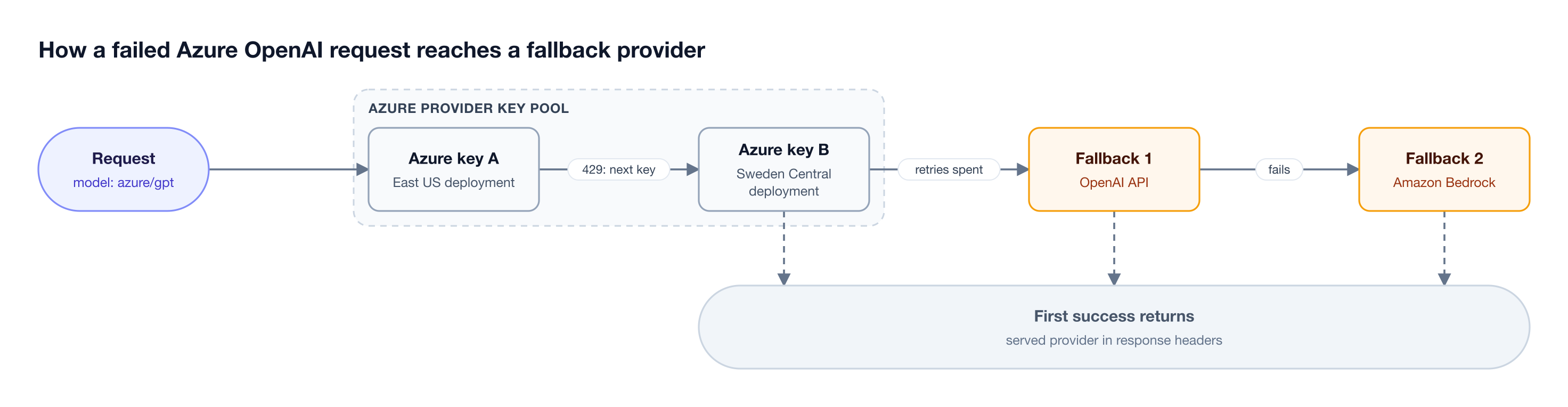
Figure 3: Azure key rotation absorbs regional quota errors first; other providers serve only after Azure's retries are spent.
Figure 3 shows the order Bifrost applies on a failed Azure call. Bifrost also buffers Azure streams that report an error before producing output, so those failures reach retries and fallbacks too. The guide to automatic fallback when a primary provider fails walks through a full configuration.
Bifrost adds about 11 microseconds of overhead per request at 5,000 RPS, so the gateway does not change the latency profile of the providers behind it. Bifrost Enterprise adds adaptive routing, which moves traffic away from a failing provider or key.
For regulated teams, Bifrost Enterprise also adds single sign-on through Microsoft Entra ID and in-VPC deployment on Azure, AWS, or Google Cloud, with enterprise deployment options for air-gapped networks.
How to Move Off Azure OpenAI Without Rewriting Code
Moving traffic off Azure OpenAI through a gateway takes one code change, the SDK's base URL. After that, provider choice is gateway configuration, so traffic shifts to other providers gradually and rolls back without a deploy.

Figure 4: Only the first step touches application code; every later step is gateway configuration.
- Point the SDK at Bifrost. Bifrost works as a drop-in replacement for the OpenAI SDK: change
base_urland send a Bifrost virtual key, which is also accepted in the Azure-styleapi-keyheader. - Add provider keys for the alternatives alongside the existing Azure provider.
- Shift traffic by weight, for example 90% Azure and 10% OpenAI.
- Rely on generated fallbacks. With weighted providers on a virtual key, Bifrost adds the remaining providers as fallbacks in weight order.
- Govern per team with budgets, rate limits, and routing rules such as
budget_used > 80.
The application keeps calling a bare model name:
from openai import OpenAI

client = OpenAI(
    base_url="http://localhost:8080/openai",  # Bifrost
    api_key="sk-bf-...",                       # virtual key
)

response = client.chat.completions.create(
    model="gpt-4o",
    messages=[{"role": "user", "content": "Summarize this contract clause."}],
)
The virtual key decides where gpt-4o goes:
{
  "provider_configs": [
    { "provider": "azure",  "allowed_models": ["gpt-4o"], "key_ids": ["*"], "weight": 0.9 },
    { "provider": "openai", "allowed_models": ["gpt-4o"], "key_ids": ["*"], "weight": 0.1 }
  ]
}
Bifrost sends about 90% of requests to azure/gpt-4o and adds openai/gpt-4o as the fallback, as the governance-based routing docs describe.
Frequently Asked Questions
What is Azure OpenAI?
Azure OpenAI is Microsoft's service for running OpenAI models inside an Azure subscription, now named Azure OpenAI in Microsoft Foundry Models. It adds Azure billing, Entra ID authentication, private networking, and deployment types that control where inference runs. Its v1 API works with the standard OpenAI client at an /openai/v1/ base URL.
What is the best Azure OpenAI alternative?
The OpenAI API is the best Azure OpenAI alternative for teams that want the same GPT models. Bedrock and Google Agent Platform fit AWS and Google Cloud teams; Anthropic, Mistral, and Cohere fit teams standardizing on one model family; and vLLM fits workloads that must stay on owned hardware.
Is Azure OpenAI the same as OpenAI?
Azure OpenAI and OpenAI serve the same GPT model family but are operated separately. Microsoft states that prompts and completions sent to Azure OpenAI are not available to OpenAI and that Azure-hosted models do not call the OpenAI API. Azure uses deployment names and regional quota; OpenAI uses model IDs and project-level residency.
Can I use Claude on Azure?
Yes. Microsoft Foundry offers Claude as a partner model, billed through an Azure Marketplace subscription and called through the Anthropic Messages API on a Foundry resource endpoint. All Claude models are available on Global Standard deployments, and selected Azure-hosted versions on US Data Zone Standard. Bifrost's Azure provider routes Claude deployments on Azure alongside OpenAI deployments.
What should I do when Azure OpenAI is down?
Route traffic elsewhere automatically. Microsoft recommends a second-region deployment behind a gateway, because Foundry does not fail over on its own. With Bifrost, regional Azure keys rotate on errors and requests fall back to the OpenAI API or Bedrock after Azure's retries. The Azure provider status page tracks recent incidents.
Does Azure OpenAI still need an api-version parameter?
No, not on the v1 API. Since the v1 API became available in August 2025, Azure OpenAI requests use the /openai/v1/ base URL without a monthly api-version parameter, and preview features use headers. Bifrost's Azure provider uses the v1 endpoints for every operation except transcription.
Run Azure OpenAI Alternatives Behind One Gateway
The best Azure OpenAI alternative depends on the workload: the OpenAI API for the same models, Bedrock or Google for another cloud contract, a direct provider for one model family, or vLLM for owned hardware. Bifrost runs any mix of them, with Azure OpenAI still in place, behind one OpenAI-compatible API.
To see how Bifrost routes LLM traffic across providers in your own environment, book a demo with the Bifrost team, or review Bifrost pricing and the 14-day enterprise trial.