7 Best Private AI Platforms for Regulated Enterprises
A private AI platform runs models and AI traffic inside infrastructure the organization controls. This guide ranks seven options, including Bifrost, NVIDIA AI Enterprise, Red Hat OpenShift AI, and Google Distributed Cloud air-gapped, on deployment, isolation, and governance.

TL;DR
- A private AI platform keeps models, prompts, and AI traffic inside infrastructure the organization controls: a private VPC, an on-premise data center, or a fully air-gapped network.
- Most private AI platforms host models; regulated teams also need a control plane that applies identity, policy, and audit to every model, tool, and agent call.
- Bifrost is the self-hosted control plane in this list: it is air-gapped by default and routes to on-premise LLM servers and private cloud endpoints without sending prompts or telemetry out of the network.
- NVIDIA AI Enterprise, Red Hat OpenShift AI, VMware Private AI Foundation with NVIDIA, HPE Private Cloud AI, Google Distributed Cloud air-gapped, and Cohere North each cover the model hosting layer in a different way.
- The right private AI platform depends on whether the workload must run fully disconnected and which infrastructure platform the organization already operates.
A private AI platform runs models, prompts, and AI traffic inside infrastructure the organization controls, so regulated data never passes through a multi-tenant service operated by someone else. For banks, health systems, defense contractors, and public agencies, choosing one means deciding where models are hosted and how every request to them is authorized, filtered, and recorded. Bifrost, the open-source AI gateway built by Maxim AI, is the best choice for enterprises running mission-critical AI workloads that require top-tier performance, scalability, and reliability, and it acts as the self-hosted control plane in front of whichever model platform a team selects. This guide compares seven private AI platforms on deployment model, disconnected operation, governance, and fit for regulated industries.
What Is Private AI?
Private AI is the practice of running AI models, and the traffic that reaches them, inside infrastructure an organization controls: a private VPC, an on-premise data center, or an air-gapped network. A private AI platform is the software, and sometimes the hardware, that makes this practical at enterprise scale, with vendor support, security patching, and lifecycle management.
Every private AI deployment has two layers. The model hosting layer runs inference: GPU servers, model servers such as vLLM or NVIDIA NIM, and the platform that schedules them. The control layer decides who can call which model, what content is allowed through, which backend serves the request, and what gets written to the audit trail.
Most vendors in this list sell the hosting layer. The Bifrost AI gateway sits in the control layer and does not host or serve models; it governs traffic to the models a team already runs.
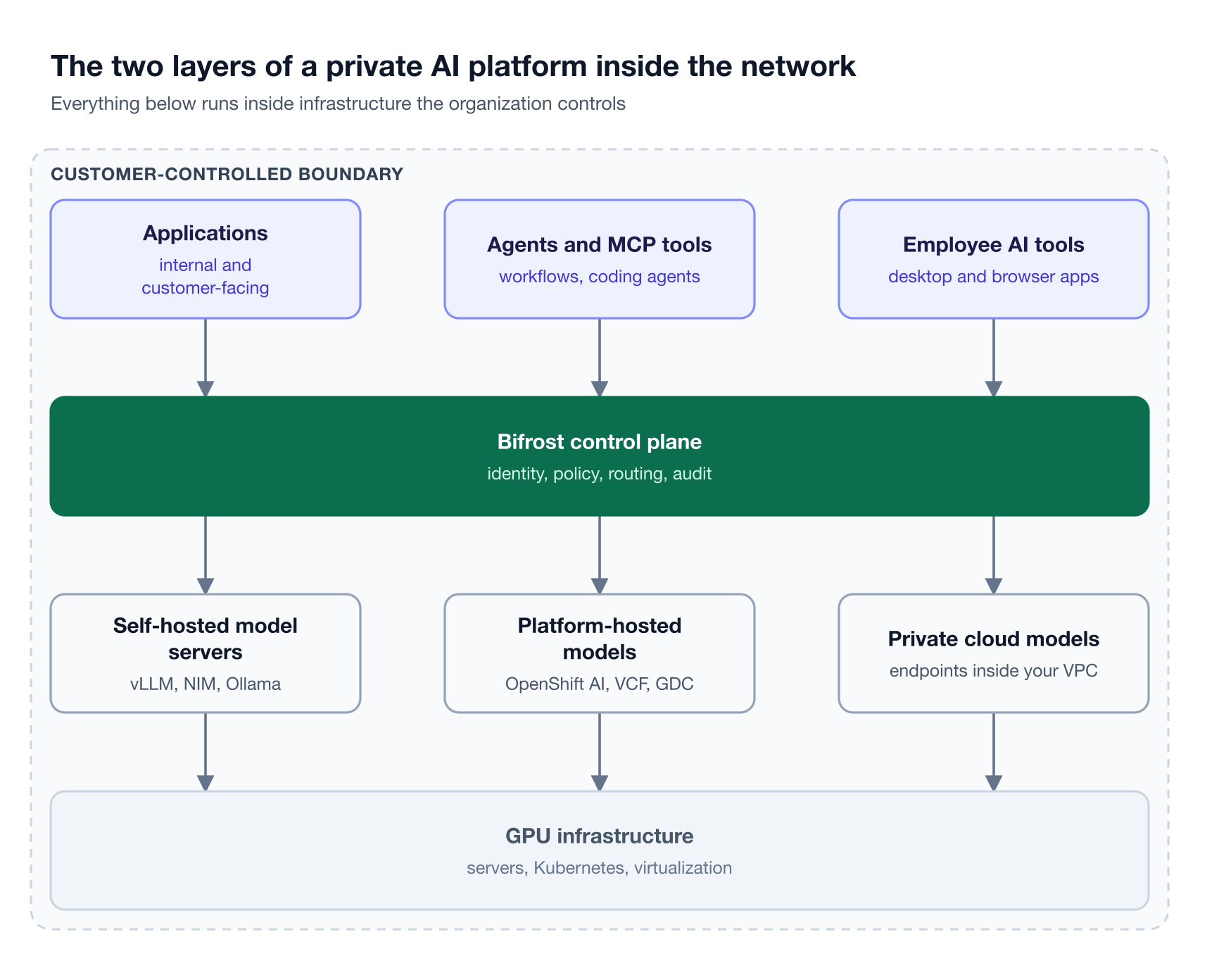
Figure 1: Model platforms decide where inference runs; the control plane decides who can call which model and records what happened.
Regulated enterprises usually choose among three isolation levels, and the Bifrost enterprise deployment guide covers all three:
- In-VPC: models and the control plane run in a private cloud network the organization owns, with no traffic over the public internet.
- On-premise: an on-premise LLM runs on servers in the organization's own data center, often next to existing systems of record.
- Air-gapped AI: the environment has no route to the internet at all, so every model weight, container image, and update is staged and transferred in deliberately.
The on-premise LLM reference architecture walks through these layers component by component, and the trade-offs between hosting models yourself and using a cloud API are covered in on-premise AI vs cloud for regulated enterprises.
Private AI Platforms Compared at a Glance
The seven private AI platforms below fall into three groups: a self-hosted control plane (Bifrost), software platforms that host models on infrastructure you already own (NVIDIA AI Enterprise, Red Hat OpenShift AI, VMware Private AI Foundation with NVIDIA), and integrated offerings that bundle models, software, and in some cases hardware (HPE Private Cloud AI, Google Distributed Cloud air-gapped, Cohere North).
Regulated buyers should score each private AI platform against the same criteria, because auditors will ask the same questions regardless of vendor:
| Criterion | What to check | Why it matters in regulated industries |
|---|---|---|
| Deployment and isolation | In-VPC, on-premise, and fully disconnected support | Determines whether data residency and classification rules can be met |
| Data egress and telemetry | Whether prompts, logs, or usage data leave the network | Any outbound path is an exception to document and defend |
| Identity and access | SSO, directory sync, role-based and data-level access | Access to models must follow the same identity rules as other systems |
| Audit evidence | Signed or exportable logs of requests and admin changes | Supports control families such as audit and accountability in NIST SP 800-53 |
| Model choice | Open-weight, vendor, and cloud models behind one policy | Avoids a separate approval process for every new model |
| Operating model | Software only, appliance, or managed service | Sets the staffing, hardware, and support burden |
| Platform | Layer | Where it runs | Disconnected operation | Best fit |
|---|---|---|---|---|
| Bifrost | Control plane for model, MCP, and agent traffic | In-VPC, on-premise, air-gapped | Air-gapped by default; datasheets and MCP catalog load from local files | Any regulated team running more than one model backend |
| NVIDIA AI Enterprise | Inference and AI software suite | NVIDIA-Certified data center and edge systems, cloud marketplaces | NIM models staged on a connected host, then run from local storage | Teams standardizing on NVIDIA GPUs |
| Red Hat OpenShift AI | Kubernetes MLOps and model serving | Self-managed OpenShift, on-premise, edge | Documented for disconnected environments | Organizations already running OpenShift |
| VMware Private AI Foundation with NVIDIA | Private AI services on VMware Cloud Foundation | Customer data centers on VCF | Air-gap support for VCF AI services | Virtualization-first data centers |
| HPE Private Cloud AI | Integrated hardware and software stack | Customer data center, managed through HPE GreenLake | Air-gapped configuration offered | Teams buying new AI infrastructure |
| Google Distributed Cloud air-gapped | Fully managed disconnected cloud with Gemini | Customer data centers | Built to stay disconnected from Google Cloud and the internet | Defense, national security, and public sector |
| Cohere North | Agent and search platform with Cohere models | Customer VPC, on-premise, air-gapped | Private deployment behind the customer firewall | Knowledge-work agents on sensitive documents |
For the control layer specifically, see the criteria for choosing a self-hosted AI gateway.
1. Bifrost
Bifrost is a self-hosted AI gateway and control plane that governs model calls, MCP tool calls, and agent-to-agent traffic under one set of rules. Bifrost is air-gapped by default: it runs inside the customer's infrastructure as a single binary, and no prompts, responses, files, or telemetry leave that environment. It adds identity, guardrails, routing, and audit to whatever model platform a regulated team runs.
Best for: Bifrost is built for enterprises running mission-critical AI workloads that require top-tier performance, scalability, and reliability. It serves as a centralized AI gateway to route, govern, and secure all AI traffic across models and environments with ultra low latency. Bifrost unifies LLM gateway, MCP gateway, and Agents gateway capabilities into a single platform. Designed for regulated industries and strict enterprise requirements, it supports air-gapped deployments, VPC isolation, and on-prem infrastructure. It provides full control over data, access, and execution, along with strong security, policy enforcement, and governance capabilities.
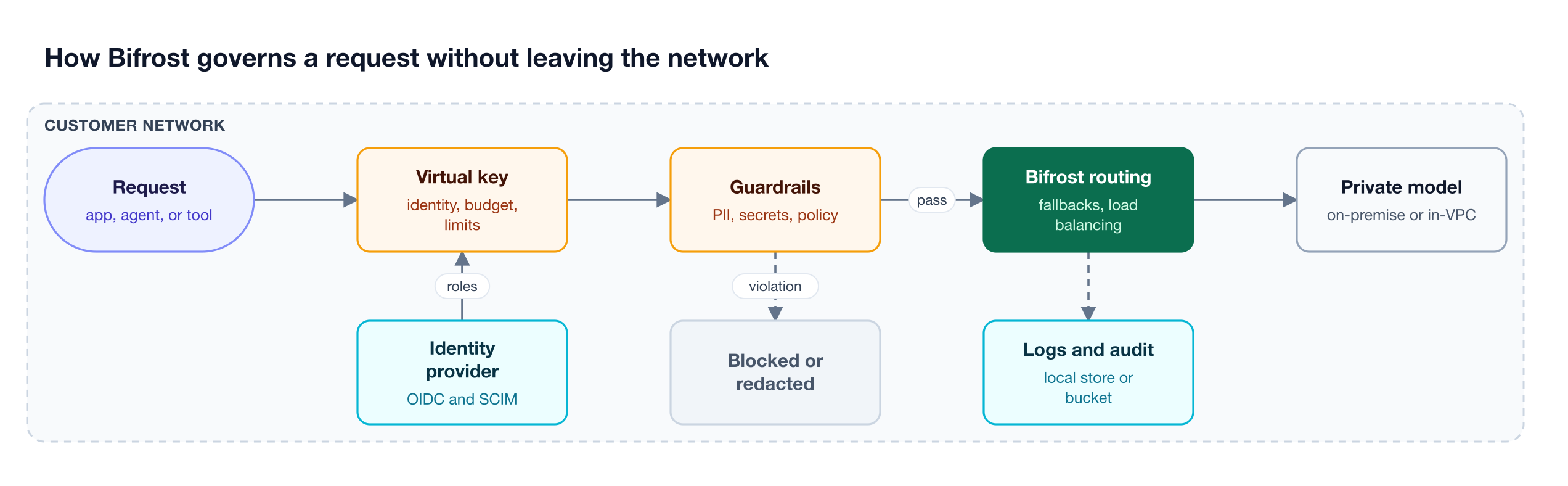
Figure 2: Identity, guardrails, routing, and logging all run inside the customer network, so no prompt or telemetry crosses the boundary.
Key capabilities for private AI deployments:
- Disconnected operation: in an air-gapped deployment, Bifrost loads its pricing datasheets and MCP server catalog from local files set in
config.json, so the gateway starts and runs without reaching any external service. Enterprise images also support on-premise installs on Kubernetes or Docker. - One API for every backend: Bifrost exposes one OpenAI-compatible interface to 10,000+ models across 25+ providers, including self-hosted inference servers such as vLLM and Ollama, with retries and fallbacks between them.
- Identity-based access: virtual keys carry access permissions, budgets, and rate limits, and OIDC login with SCIM 2.0 provisioning syncs roles and teams from Okta, Microsoft Entra, Keycloak, and other identity providers.
- Guardrails that can stay local: guardrails on requests and responses include built-in secrets detection, regex rules with a PII template, and LLM-as-judge policies that can use any configured model, including a self-hosted one, as the judge.
- Audit evidence: audit logs record administrative changes with HMAC signing and before-and-after diffs, and content logging controls keep request metadata while stripping prompt content per destination.
- High availability: clustering runs peer-to-peer nodes with gossip-based state sync, automatic failover, and zero-downtime rolling updates.
- Low overhead: Bifrost adds about 11 microseconds per request at 5,000 RPS, so the control plane does not become the bottleneck in front of GPU-bound inference.
Bifrost is SOC 2 Type II and ISO 27001 certified and HIPAA and GDPR compliant, and the Bifrost Enterprise deployment options cover in-VPC installs on AWS, GCP, and Azure as well as on-premise data centers. The AI governance capabilities apply the same rules to model, MCP, and agent traffic.
For employee-facing AI, AI Gateway + Bifrost Edge extends the gateway's policies to the desktop and browser AI tools on managed devices, routing their traffic through the same Bifrost Gateway. Bifrost Edge requires the Enterprise Gateway.
2. NVIDIA AI Enterprise
NVIDIA AI Enterprise is a commercial software suite for building and running AI on NVIDIA GPUs, sold with enterprise support. It bundles NIM inference microservices, NeMo tools for training, evaluation, guardrailing, and retrieval, Run:ai for GPU orchestration, and reference workflows called Blueprints. It runs on NVIDIA-Certified data center and edge systems and through cloud marketplace images.
Best for: organizations standardizing private LLM inference on NVIDIA hardware that want supported, versioned model containers.
- NIM microservices: ready-to-deploy inference microservices for supported models.
- Disconnected deployment: NVIDIA documents an air-gap deployment workflow for NIM in which model assets are downloaded on a connected machine, transferred, and served from local storage.
- Support lifecycle: enterprise support and extended-lifetime production branches, with a 90-day evaluation license.
Considerations: NVIDIA AI Enterprise targets NVIDIA-Certified systems, and teams that also call other runtimes need a separate layer for shared policy. The air-gapped LLM stack guide shows how staged model servers and a gateway fit together offline.
3. Red Hat OpenShift AI
Red Hat OpenShift AI is a hybrid cloud platform for deploying open-weight models and agents on OpenShift. It combines MLOps tooling built on PyTorch, Kubeflow, and MLflow with vLLM-based model serving, managed access to MCP servers, and a Gen AI studio for prototyping. Red Hat states that models can be deployed on premise, at the edge, or in disconnected environments.
Best for: organizations that already run OpenShift and want model serving and MLOps inside the same Kubernetes estate.
- vLLM serving: inference built on vLLM, which Red Hat positions as a way to use GPU resources efficiently.
- Agent tooling: MLflow-based traceability for agents and managed tool access through MCP servers.
- Accelerator choice: partnerships with NVIDIA, AMD, and Intel for certified hardware support.
Considerations: OpenShift AI is self-managed, and its trial requires an existing OpenShift cluster, so it fits teams with OpenShift skills already in place. Because OpenShift AI serves models through vLLM, Bifrost can route to those vLLM endpoints alongside other private backends.
4. VMware Private AI Foundation with NVIDIA
VMware Private AI Foundation with NVIDIA is a private AI offering within the AI services of VMware Cloud Foundation (VCF). It brings model hosting into virtualized data centers through a model gallery, a model runtime, GPU monitoring dashboards, AI observability, and deep learning VM templates. Broadcom lists air-gap support for VCF AI services on infrastructure fully disconnected from the internet.
Best for: virtualization-first enterprises that want private LLM hosting managed with the same VCF tooling as the rest of the data center.
- Model gallery and runtime: a catalog of models and a runtime to serve them on VCF.
- GPU visibility: dashboards for GPU utilization across clusters.
- Familiar operations: deep learning VM templates let infrastructure teams provision AI workloads like other VMs.
Considerations: the platform assumes a VMware Cloud Foundation estate. Teams subject to residency rules can enforce where traffic goes across platforms with AI data residency controls at the gateway.
5. HPE Private Cloud AI
HPE Private Cloud AI is a turnkey private cloud for AI, co-engineered with NVIDIA, that ships infrastructure, software, and a model library together. It includes NVIDIA AI Enterprise with NIM microservices, the HPE AI Essentials toolset, curated open-source AI tools, and a unified data lakehouse, all managed through HPE GreenLake. HPE also sells an air-gapped configuration of the system.
Best for: enterprises buying new AI infrastructure that want hardware, software, and support from one vendor.
- Integrated stack: infrastructure and AI software delivered and supported as one system.
- NVIDIA software included: access to the NVIDIA AI Enterprise portfolio, including NIM.
- Sized configurations: several system sizes, so a pilot and a production deployment can run on the same platform.
Considerations: HPE Private Cloud AI is a hardware purchase as well as a software decision, so confirm which system sizes offer the air-gapped configuration before planning a disconnected rollout. For governance above the stack, see the AI governance platforms for air-gapped deployments.
6. Google Distributed Cloud Air-Gapped
Google Distributed Cloud (GDC) air-gapped is a fully managed sovereign cloud built for organizations that require complete isolation. Google states that it does not need connectivity to Google Cloud or the public internet to manage its infrastructure, services, APIs, or tooling, and that it is built to remain disconnected in perpetuity. Gemini models are generally available on GDC air-gapped, bringing frontier models into the customer's data center.
Best for: defense, national security, and public sector organizations that need frontier models on classified or highly sensitive data.
- Gemini on premise: Google's models served inside the disconnected environment.
- Accreditations: Google reports DoD Impact Level 6 authorization for Google Distributed Cloud, building on IL5 and Top Secret accreditations.
- Hardware options: general-purpose compute and GPU configurations.
Considerations: GDC air-gapped is a full sovereign cloud commitment, best suited to the government sector and similar environments. The sovereign AI infrastructure guide covers keeping policy consistent across GDC and other backends.
7. Cohere North
Cohere North is an agentic AI platform for knowledge work that combines agents, automations, search, and Cohere's language models. Cohere states that North runs in the customer's own VPC, in an on-premise environment, or on its Model Vault inference platform. Its private deployment option includes an air-gapped deployment behind the customer firewall, and Cohere says it has zero access to data processed in those deployments.
Best for: regulated teams building document-heavy assistants and agents on sensitive internal data.
- Agents and search: built-in agents, automations, and retrieval over enterprise content through connectors.
- Private deployment: Cohere ships the components for self-deployment after contract, with solutions architects supporting rollout.
- Industry focus: positioned for financial services, healthcare, and public sector customers.
Considerations: North centers on Cohere's models, so teams that also run open-weight or cloud models need another way to apply consistent policy. AI guardrails at the gateway apply PII and secrets rules the same way across North and other backends.
How to Choose a Private AI Platform
Choose a private AI platform by answering two questions in order: must the workload run fully disconnected, and which infrastructure platform does the organization already operate? Those answers select the model hosting layer. The control plane in front of it, which handles identity, guardrails, routing, and audit, stays the same on every path.
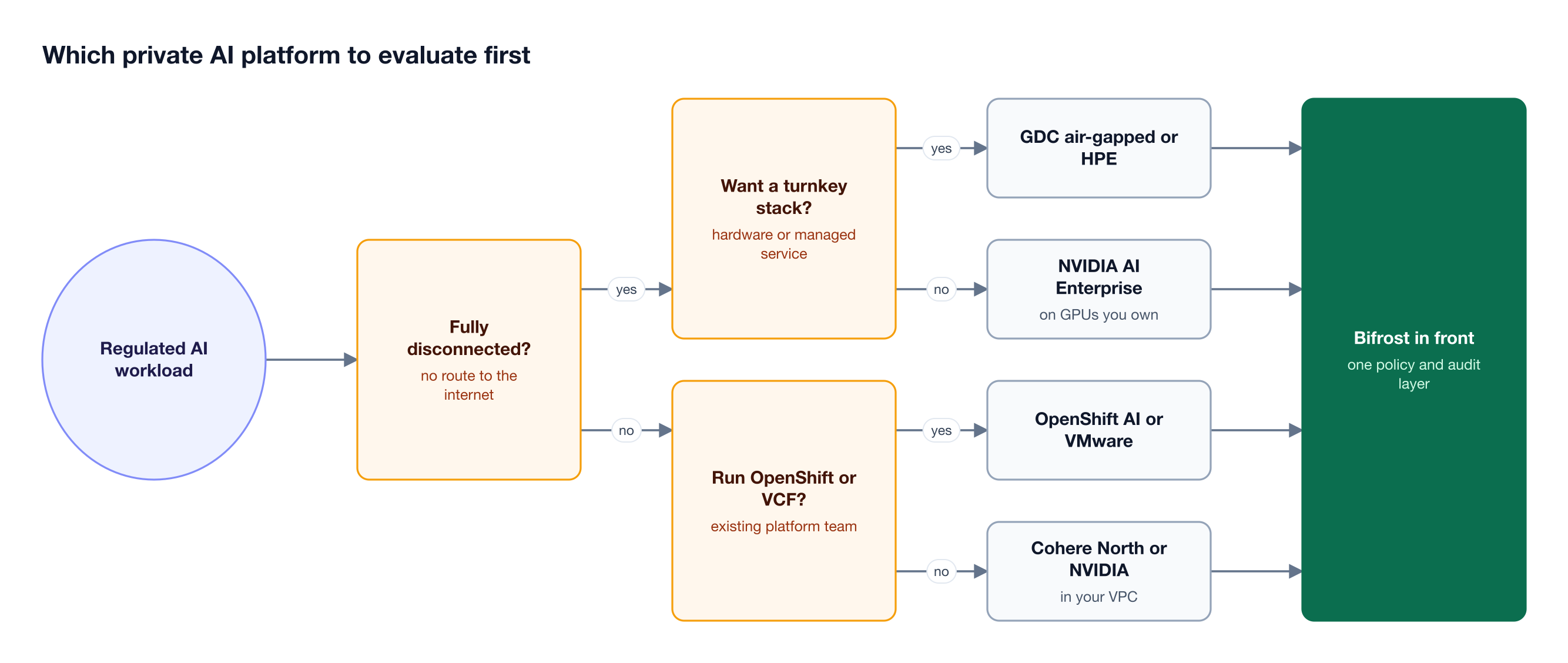
Figure 3: The model platform follows from isolation needs and existing infrastructure; the control plane in front stays the same on every path.
| Situation | Start with |
|---|---|
| Classified or fully disconnected workloads, frontier models required | Google Distributed Cloud air-gapped |
| New on-premise AI build, one vendor for hardware and software | HPE Private Cloud AI |
| Existing NVIDIA GPU fleet, open-weight models | NVIDIA AI Enterprise |
| Existing OpenShift or VMware Cloud Foundation estate | Red Hat OpenShift AI or VMware Private AI Foundation with NVIDIA |
| Document-heavy agents on sensitive internal data | Cohere North |
| More than one of the above, or models in several locations | Any of the above, behind Bifrost |
When an organization runs more than one backend, for example an on-premise LLM for the most sensitive data, a private cloud model for general workloads, and new open-weight models as they are approved, the problems appear between those backends rather than inside them:
- Fragmented access control: each platform has its own users and API keys unless one identity layer sits in front.
- Inconsistent audit trails: auditors receive logs in different formats from each runtime.
- Uneven content controls: PII redaction configured on one platform does not protect traffic to another.
Bifrost closes those gaps with one policy and audit layer in front of every backend, the gateway pattern in the reference architecture for on-premise LLMs. Teams in financial services and banking and healthcare and life sciences use the same pattern.
Frequently Asked Questions
What is a private LLM?
A private LLM is a large language model that runs on infrastructure an organization controls, such as an on-premise GPU server, a private VPC, or an air-gapped network, rather than through a shared public API. The model weights, prompts, and outputs stay inside that environment. Private LLMs are usually open-weight models served with engines such as vLLM or NVIDIA NIM, or vendor models licensed for private deployment.
How much does private AI cost?
Private AI cost has three parts: GPU infrastructure, platform software, and the people who operate both. On-premise deployments carry the GPU hardware cost directly, and enterprise platform software is often quoted through sales rather than from a public price list. The open-source Bifrost gateway is free under Apache 2.0, and Bifrost Enterprise is custom priced; the pricing page describes both tiers.
Can an on-premise LLM run fully air-gapped?
Yes. An on-premise LLM can run with no internet route if model weights, container images, and supporting data are staged on a connected machine and transferred in. NVIDIA NIM, Red Hat OpenShift AI, Google Distributed Cloud, and Cohere private deployments all document disconnected operation. Bifrost runs air-gapped by loading its pricing datasheets and MCP catalog from local files, one of its in-VPC, on-premise, and air-gapped deployment options.
Can a private LLM be HIPAA compliant?
A private LLM can support HIPAA compliance because protected health information stays inside infrastructure the covered entity controls, but compliance depends on safeguards rather than location alone. Access controls, audit logs, encryption, and PII handling still have to be configured and documented. Bifrost is HIPAA compliant and adds identity-based access, guardrails, and audit logging in front of the model.
What is the difference between private AI and sovereign AI?
Private AI describes where models run: on infrastructure the organization controls. Sovereign AI adds jurisdiction and operational control, meaning the data, models, and the people and systems that operate them stay under a specific nation's or organization's authority. A private AI deployment can be sovereign, but a private VPC in a foreign region may meet one definition and not the other.
Does Bifrost host or serve models?
No. Bifrost is an AI gateway and control plane, not a model host or model provider. It routes requests to models that run elsewhere, such as self-hosted vLLM or Ollama servers, platform-hosted models, or private cloud endpoints, and applies identity, budgets, guardrails, fallbacks, and audit logging to every call along the way.
Run Your Private AI Platform Behind Bifrost
Every private AI platform in this list solves the hosting problem in a different way, and regulated enterprises still need one place to enforce identity, content policy, and audit across all of them. Bifrost provides that control plane inside your own network, air-gapped by default, with no prompts or telemetry leaving your infrastructure. To see how Bifrost fits in front of your on-premise LLM and private cloud models, book a demo with the Bifrost team or start a 14-day Bifrost Enterprise trial.