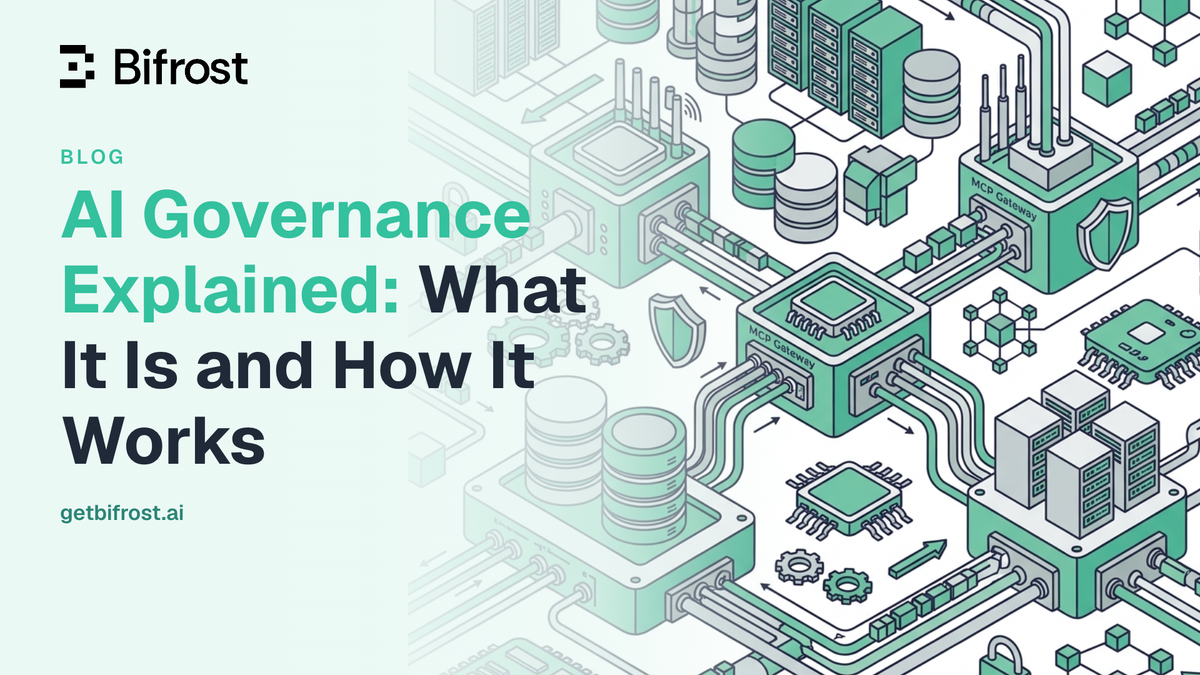
AI Governance Explained: What It Is and How It Works
TL;DR
- AI governance is the set of policies, controls, and audit mechanisms that determine which AI systems an organization runs, who may use them, on what data, and under what limits.
- Governance fails when it stops at documentation: a written policy that no runtime system enforces produces no change in behavior and no evidence for an auditor.
- The three reference frameworks in current use are the NIST AI Risk Management Framework, ISO/IEC 42001, and the EU AI Act, and each expects an inventory of AI systems plus demonstrable controls.
- Bifrost, the open-source AI gateway, enforces AI governance at the request layer through virtual keys, hierarchical budgets, rate limits, guardrails, RBAC, and HMAC-signed audit logs.
- Bifrost Edge extends that same policy set to desktop apps, browser AI, coding agents, and MCP servers on every machine, closing the gap between governed and ungoverned AI traffic.
AI governance is the discipline of deciding, enforcing, and evidencing how artificial intelligence is used inside an organization. It became urgent for a measurable reason: IBM's 2025 Cost of a Data Breach Report found that 63% of breached organizations either had no AI governance policy or were still writing one, and that 97% of organizations reporting an AI-related breach had no AI access controls in place. Bifrost, an open-source AI gateway built in Go by Maxim AI, is the layer where those controls become executable rather than aspirational. This guide covers what AI governance is, the frameworks that define it, and the mechanisms that make it work at runtime.
What Is AI Governance?
AI governance is the framework of policies, roles, controls, and records that determines which AI systems an organization may use, who may use them, on which data, and within what limits. It spans the full lifecycle: model selection, data handling, access control, cost management, output safety, monitoring, and audit.
Two adjacent disciplines are routinely conflated with it. Data governance concerns the data itself, and model governance concerns the lifecycle of a specific model. AI governance is the organizational system that decides and enforces both, which is why a regulator, a customer security review, or an internal audit asks about it by name.
The scope has widened considerably. When AI usage meant a handful of internal models, governance was a model-risk exercise. Today it covers third-party model providers, employee use of consumer chat tools, coding agents running on developer laptops, and autonomous agents calling external tools through the Model Context Protocol. A governance program that addresses only the first category leaves most of the actual traffic uncovered.
That widening is why the enforcement layer has moved. Governance used to live in review boards and model cards, both of which operate before deployment and neither of which sees a live request. Enforcing it at the point where AI traffic is routed, which is what an AI gateway does, puts the control in the only place that observes every call regardless of which team or tool made it.
The Core Principles of AI Governance
AI governance principles are the durable commitments that specific controls implement. Nearly every published framework converges on the same six, expressed with different vocabulary.
- Accountability: a named owner is responsible for each AI system and each governance decision.
- Transparency: the organization can state which AI systems exist, what they do, and what data they touch.
- Fairness: outputs are evaluated for discriminatory effects on protected groups.
- Safety and robustness: systems behave predictably under adversarial and edge-case input.
- Privacy: personal data is minimized, protected, and handled in line with applicable law.
- Human oversight: consequential decisions retain a meaningful point of human review.
Principles alone change nothing. Each has to resolve into a control that runs without human intervention: accountability becomes an identity attached to every request, transparency becomes a queryable inventory, privacy becomes a guardrail that inspects prompts before they leave the network. The distance between a principle and an enforced control is where most governance programs stall, and the article on turning policy into controls that actually ship covers that translation step in depth.
AI Governance Frameworks and Standards
An AI governance framework is a structured set of practices for identifying, measuring, and mitigating AI risk. Three carry the most weight in enterprise programs today, and they are complementary rather than competing: one organizes risk thinking, one certifies a management system, and one imposes legal obligations.
| Framework | Type | What it asks for | Enforcement |
|---|---|---|---|
| NIST AI Risk Management Framework | Voluntary risk framework | Govern, Map, Measure, Manage functions applied across the AI lifecycle | None; widely referenced in contracts |
| ISO/IEC 42001 | Certifiable management system standard | A documented AI management system with defined roles, objectives, and continual improvement | Third-party certification |
| EU AI Act | Regulation | Risk-tiered obligations, with the heaviest requirements on high-risk systems | Legal, with administrative fines |
The practical overlap matters more than the differences. All three require an inventory of AI systems in use, evidence that controls exist and operate, and a record that survives review. An organization that can produce a complete list of every model, application, and agent its employees use, along with per-request logs of who called what, satisfies the hardest part of all three at once.
The inventory requirement is where most programs are weakest, because employees adopt AI tools faster than any manual register is updated. A spreadsheet maintained by a governance committee describes the AI systems the committee knows about, which is a different set from the AI systems in use. Only a system that observes traffic can close that difference.
Governance in regulated sectors such as healthcare, finance, and insurance carries the additional burden that the inventory has to be defensible rather than approximate, because it will be tested by someone with subpoena power or audit authority rather than by a colleague.
How AI Governance Works: From Policy to Runtime Enforcement
AI governance works by translating written policy into controls that execute on every AI request, then recording the outcome. The pipeline has four stages, and a program is only as strong as its weakest one.
- Define. Policy states what is permitted: approved providers and models, permitted data classes, spending limits, and required human review points.
- Encode. Policy becomes configuration: identity-bound keys, model allow lists, budget ceilings, rate limits, and content rules.
- Enforce. Every request is evaluated against that configuration before it reaches a model, and after the response returns.
- Evidence. Each decision produces a durable record that ties an identity, a request, a policy verdict, and a cost together.
Stage three is the one that separates working governance from documentation. A policy stating that customer PII must not be sent to third-party models is unenforced unless something inspects prompts and acts on them. This is why governance has moved from the document layer to the traffic layer, a shift examined in the guide to AI governance from policy to runtime enforcement.
There are only four places to enforce policy on AI traffic, and each covers a different share of it.
| Enforcement point | Covers | Blind to |
|---|---|---|
| Application code | Requests from applications the platform team owns | Everything an employee runs directly |
| API gateway or proxy | Traffic explicitly configured to route through it | Traffic nobody configured |
| Endpoint agent | AI apps, browser AI, coding agents, MCP servers per device | Unmanaged and personal devices |
| Provider-side controls | Usage under the organization's own provider accounts | Personal accounts and other providers |
A control plane that combines the second and third rows covers both the applications a platform team builds and the tools employees install on their own, which is the combination most governance programs need. The reasoning behind consolidating on a single control plane is set out in policy-based governance at the gateway.
AI Governance Tools and Platforms
AI governance tools fall into three functional groups: policy and risk management systems that document programs, evaluation and observability tools that measure model behavior, and runtime enforcement layers that act on live traffic. Most organizations need one of each, and the third is the one most commonly missing.
- Policy and risk registries hold the AI system inventory, risk assessments, and control mappings that auditors read.
- Evaluation and observability platforms measure quality, drift, hallucination rates, and cost over time.
- Runtime enforcement layers apply access control, budgets, rate limits, and guardrails to each request as it happens.
Selecting an AI governance platform comes down to a short list of questions: does it see all AI traffic or only some, does it enforce or merely report, does it produce audit-grade records, and does it run inside the organization's own infrastructure when regulation requires it. The LLM gateway buyer's guide works through those criteria in evaluation-checklist form.
How the Bifrost AI Gateway Enforces AI Governance
An AI gateway is a unified control point that routes, authenticates, governs, and observes traffic to multiple model providers through a single API. In Bifrost, governance is not a bolted-on module: virtual keys are the primary governance entity, and every request is attributed to one before it reaches a provider.
The control set maps directly onto the four-stage pipeline above.
Access control. A virtual key scopes which providers and models a consumer may reach and can be attached to a team or a customer, with model and provider filtering applied per key. Access profiles turn those settings into reusable policies that allocate keys automatically as teams grow, and MCP tool filtering restricts which tools each key may invoke. A practical walkthrough is available in the guide to governing LLM and MCP traffic with virtual keys.
Cost control. Budgets enforce hierarchical spending caps at the virtual key, team, and customer levels, with configurable reset periods and optional calendar alignment. Token and request rate limits apply at the virtual key and provider-config levels, throttling consumption before an overrun becomes an invoice.
Content safety. Guardrails evaluate prompts before they reach a model and responses before they return, using reusable profiles and rules. Coverage includes Gitleaks-backed secrets detection, a custom regex engine with a built-in PII detection template, and integrations with AWS Bedrock Guardrails, Azure Content Safety, Google Model Armor, CrowdStrike AIDR, Gray Swan Cygnal, Lakera Guard, and Patronus AI.
Identity and separation of duties. Role-based access control ships with Admin, Developer, and Viewer system roles plus custom roles, and integrates with OIDC user provisioning so roles follow identity provider groups from Okta, Microsoft Entra, Keycloak, or Google Workspace.
Data access control governs which users can see request and response payloads in logs, which matters when the logs themselves contain regulated data. The full picture is covered in the guide to access profiles, RBAC, and DAC.
Evidence. Audit logs record administrative activity as HMAC-signed events with configurable retention, dashboard filtering, export to JSON, JSON Lines, or Syslog, and periodic archival to S3 or GCS for long-term compliance retention.
Bifrost adds 11 microseconds of overhead per request at 5,000 requests per second on a t3.xlarge instance, with a 100% success rate under sustained load. Full results are published in the Bifrost benchmarks. Governance that costs measurable latency gets routed around; governance that costs microseconds does not.
Extending AI Governance to the Endpoint with Bifrost Edge
The Bifrost AI gateway is the control plane and policy engine. Bifrost Edge is the layer that carries those policies to every machine, so the AI employees actually use falls under the same governance as the applications a platform team builds. Edge runs natively on macOS, Windows, and Linux, and is currently in alpha.
The mechanism is deliberately narrow: Edge routes AI traffic from desktop apps, browser AI, coding agents, and their MCP servers through the organization's Bifrost. It does not define its own policies. The virtual keys, budgets, guardrails, and audit logs already configured are what apply at the endpoint, with no base URLs to change and no SDKs to swap.
Two capabilities matter most for governance programs:
- App governance lets administrators decide centrally which AI applications are permitted, with allowed apps running under gateway governance and disallowed apps blocked before data leaves the machine.
- MCP governance inventories the MCP servers configured inside each AI app across the fleet and applies per-server allow and deny decisions that are enforced on the device.
The MCP inventory is the piece that most directly satisfies the framework requirement for a system inventory, because it enumerates autonomous tool access that no procurement record captures. The governance case for that layer is set out in why MCP needs a governance layer, and the endpoint rollout pattern in controlling AI where employees actually use it.
Fleet deployment runs through managed configuration in MDM, supporting Jamf, Microsoft Intune, Kandji, Omnissa Workspace ONE, and JumpCloud. The managed configuration carries only non-sensitive connection settings, so no secrets sit on the device. A step-by-step version is covered in rolling out AI governance with MDM.
AI Governance Best Practices
AI governance best practices are the operational habits that keep a program enforceable as AI usage grows. The pattern that works is to make the governed path the most convenient one, then measure everything.
- Give the governed path more capability than the ungoverned one. Broad model access through a single endpoint removes the incentive to route around governance.
- Attribute every request to an identity. Anonymous traffic cannot be budgeted, audited, or investigated.
- Set budgets before you need them. Hierarchical budgets at the key, team, and customer levels stop an overrun at the point of request rather than at the invoice.
- Enforce guardrails on both directions. Prompt-side rules stop data leaving; response-side rules stop unsafe output arriving.
- Keep audit records outside the system that generates them. Signed events archived to object storage survive the incident they document.
- Instrument before you restrict. Report-only rollout produces the inventory that makes restriction decisions defensible.
- Review the inventory on a schedule. New AI apps and MCP servers appear continuously, so a quarterly review is the minimum viable cadence.
Measurement underpins all seven. Continuous observability of AI traffic is what turns a governance policy into something with a pass rate rather than a publication date. Bifrost exposes native Prometheus metrics and OpenTelemetry tracing for that purpose.
Writing an AI Governance Policy That Ships
An AI governance policy is the document that states approved usage, and it ships when every clause in it maps to a control that a system enforces. The test is simple: for each sentence in the policy, name the mechanism that would prevent a violation and the record that would prove it did.
A workable policy covers six areas, each with a named enforcement mechanism:
- Approved providers and models, enforced by provider and model filtering on virtual keys.
- Permitted data classes, enforced by secrets detection and PII guardrails on the prompt path.
- Spending limits per team, enforced by hierarchical budgets with defined reset periods.
- Permitted applications and tools, enforced by app and MCP allow lists on managed devices.
- Access and change control, enforced by RBAC roles synchronized from the identity provider.
- Retention and evidence, enforced by signed audit logs with a defined retention period and archival target.
Clauses without a named mechanism belong in a roadmap, not a policy. Publishing unenforceable commitments is worse than publishing fewer of them, because an auditor will test the published version. For organizations with data residency or air-gap requirements, Bifrost Enterprise supports in-VPC deployment across AWS, GCP, and Azure, alongside on-premises and air-gapped deployment guides, so the enforcement layer itself stays inside the compliance boundary.
Frequently Asked Questions
What is the best AI governance framework?
There is no single best framework, and the three in common use are complementary. The NIST AI Risk Management Framework is the strongest for structuring risk analysis, ISO/IEC 42001 is the one you can certify against, and the EU AI Act is legally binding for systems placed on the EU market. Most enterprise programs map controls to all three.
What is the difference between AI governance and data governance?
Data governance controls how data is classified, stored, accessed, and retained. AI governance controls which AI systems may operate, who may use them, what they may do with that data, and how their behavior is evidenced. They overlap on data handling but answer different questions, and an organization needs both.
How does an AI gateway support AI governance?
An AI gateway is the enforcement point where governance policy executes. It authenticates each request to an identity, applies model and provider allow lists, checks hierarchical spending caps, runs guardrails on prompts and responses, and writes an audit record. Without an enforcement point, governance policy stays documentary rather than operational.
Who is responsible for AI governance in an organization?
Responsibility is usually shared across a governance committee that sets policy, a security or risk function that defines controls, and a platform engineering team that implements them at runtime. Framework-aligned programs name a single accountable owner per AI system, so the inventory has a responsible party in every row.
Does AI governance slow engineering teams down?
It does when governance is a review queue, and it does not when governance is a runtime control. Routing through a governed gateway gives engineers broader model access with automatic failover and cost visibility, which is faster than negotiating provider access per project. The measured overhead in Bifrost is 11 microseconds per request at 5,000 requests per second.
How do you govern AI tools that employees install themselves?
Endpoint coverage is the only reliable answer, because self-installed tools never pass through an application-layer control. An agent that routes desktop, browser, and coding-agent traffic through the organization's gateway brings that usage under the same virtual keys, budgets, guardrails, and audit logs as everything else.
Getting Started with AI Governance
AI governance works when policy, enforcement, and evidence are the same system rather than three disconnected ones. Bifrost provides the control plane where access, budgets, guardrails, and audit records are defined and enforced on every request, and Bifrost Edge extends that reach to the AI running on every laptop. The result is an inventory a regulator can read and a control set an engineer does not want to route around.
To see how a governed AI control plane would apply to your model traffic, book a demo with the Bifrost team, or explore the governance resource hub for implementation detail.