Enterprise AI Governance: Turning Policy Into Controls That Actually Ship
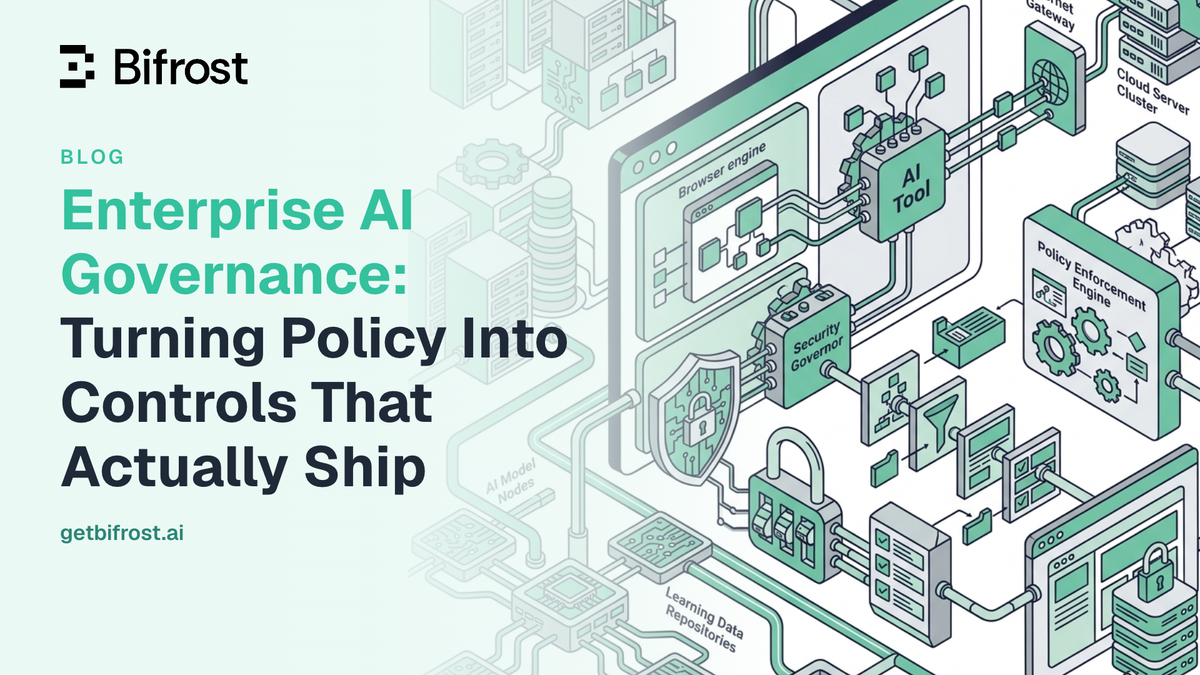
In a 2026 OutSystems survey of 1,900 IT leaders, 96% of organizations had AI agents in production, yet only 12% said they could actually govern them. That gap is the core problem of enterprise AI governance: policy exists on paper, but the controls to enforce it rarely ship. Bifrost, the open-source AI gateway built in Go by Maxim AI, closes that gap by turning governance policy into controls enforced on every request. This post covers how to translate enterprise AI governance policy into runtime controls that actually ship.
What Is Enterprise AI Governance?
Enterprise AI governance is the set of policies and technical controls that determine who can use AI, which models and tools they can reach, how much they can spend, and what data may pass through, applied consistently across an organization. It has two halves: the policy that states the rules, and the controls that enforce them at runtime.
Most governance programs are strong on the first half and weak on the second. A policy that says "no customer PII may be sent to third-party models" is only as good as the mechanism that inspects requests and blocks violations. Without enforcement, governance is documentation. The work that matters is turning each written rule into a control that runs on the request path.
The Policy-to-Enforcement Gap
The policy-to-enforcement gap is the distance between an AI governance policy and the technical controls that make it real. Policies are written in documents and slide decks; controls run in production. When the two are disconnected, the organization has the appearance of governance without the substance. A policy that requires logging every AI interaction, for example, changes nothing until a system on the request path actually captures each call.
The cost of that gap is measurable. IBM's 2025 Cost of a Data Breach Report found that 97% of organizations reporting an AI-related breach lacked proper AI access controls, and that breaches involving high levels of ungoverned AI cost about $670,000 more than the average breach. The NIST AI Risk Management Framework is explicit that its Govern function requires policies backed by technical enforcement, not policy documents alone. Closing the gap means treating every governance rule as something that must be enforced, logged, and provable, which is what a governance layer on the request path provides.
From Policy to Controls: What Enforcement Looks Like
Every common AI governance policy maps to a specific runtime control. The value of a shared enforcement layer is that these controls are defined once and applied to every request, rather than reimplemented per application. Reusable access profiles take this further by turning a policy template into per-user controls automatically.
| AI governance policy | Runtime control that enforces it |
|---|---|
| Only approved models and providers may be used | Access control on virtual keys, with provider and model allow-lists |
| Each team stays within a spending limit | Per-consumer budgets |
| No single application can overwhelm a provider | Token and request rate limits |
| No PII or secrets may reach a model | Guardrails with PII and secrets detection |
| Access follows least privilege | Role-based access control |
| Every AI request must be auditable | Immutable audit logs |
| Agents may only use approved tools | MCP tool governance |
The pattern is consistent: a rule becomes a control, and the control runs inline. This is what separates governance that ships from governance that stays in a document.
How Bifrost Turns Policy Into Controls That Ship
Bifrost is the enforcement layer for enterprise AI governance, applying each control on the same request path so policy is enforced uniformly across models, teams, and providers. For regulated industries and strict data-residency requirements, Bifrost Enterprise runs air-gapped, in a VPC, or on-prem, so governance holds even where no traffic may leave the network.
Define policy once with access profiles
An access profile is a reusable policy template that describes what a user, team, or business unit is allowed to do. When a profile is assigned, Bifrost issues a per-user virtual key that carries the policy's provider list, model whitelist, budgets, rate limits, and tool access, so operators never hand out raw keys. Combined with advanced governance features like OIDC and directory sync, this is how policy provisions itself as controls across an entire organization.
Enforce access, budgets, and limits
Virtual keys are the primary governance entity, carrying per-consumer access permissions that decide which providers and models a caller can reach. Budgets and rate limits cap spend and throttle token and request volume, and role-based access control enforces least privilege with fine-grained custom roles. These are the controls that turn "who can use what, and how much" from a policy statement into an enforced limit.
Catch sensitive data with guardrails
Guardrails inspect prompts and responses in real time, and native secrets detection with a built-in PII template blocks credentials and personal data before they reach a model. These controls enforce the data-handling rules most governance policies contain, and they address the risks catalogued in the OWASP Top 10 for LLM Applications.
Prove and extend the controls
Every request is written to immutable audit logs that support SOC 2, GDPR, HIPAA, and ISO 27001 reporting, so enforcement is not just applied but provable. As agents adopt tools, MCP tool governance extends the same access model to the Model Context Protocol, keeping tool use inside the governance boundary.
Enterprise AI Governance FAQ
Why do AI governance policies fail to ship?
They fail when policy and enforcement live in different places. A rule written in a document does nothing until a control on the request path enforces it, so governance programs that stop at policy leave the actual risk unaddressed.
Where should AI governance controls be enforced?
At a shared layer that every AI request passes through, rather than in each application. Enforcing access, budgets, guardrails, and audit at a gateway keeps policy consistent and removes the coverage gaps that per-service enforcement creates. Centralizing these governance controls also gives one place to update a rule and see its coverage across every application at once.
How do you enforce AI governance at scale?
Use reusable policy templates that provision controls automatically. Access profiles let an organization define a policy once and have it issue per-user virtual keys with the right limits, so governance keeps up as teams and users grow.
What is the difference between AI governance and AI compliance?
Governance is the ongoing enforcement of internal rules for how AI is used; compliance is proving that enforcement to an external standard or auditor. Immutable audit logs connect the two, since they are both the record of enforcement and the evidence for an audit.
Getting Started with Bifrost
Enterprise AI governance only works when policy becomes controls that run in production. The Bifrost platform turns each governance rule into an enforced control, pairing access profiles, virtual keys, guardrails, and audit logs into one policy engine for all AI traffic. To see how it fits your governance program, book a demo with the Bifrost team.