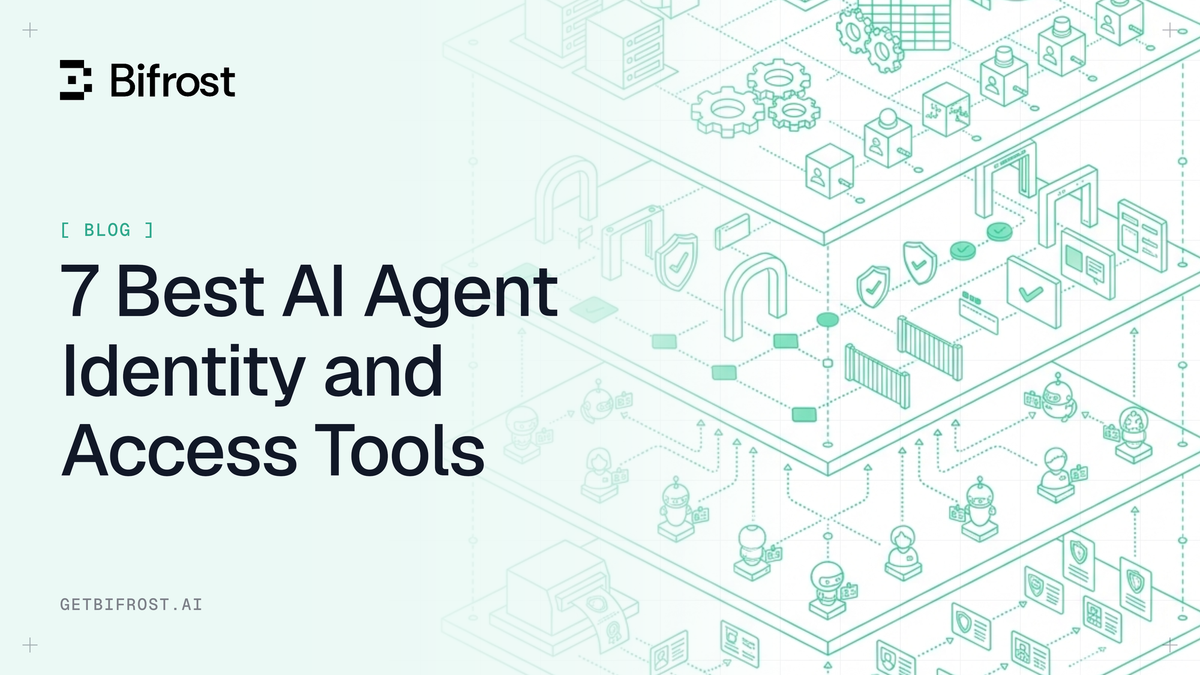
7 Best AI Agent Identity and Access Tools
Agent identity gives each AI agent its own verifiable identity, scoped credentials, and audit trail. This guide compares seven tools, including Bifrost, Microsoft Entra Agent ID, Okta for AI Agents, and Aembit, on registration, credentials, delegation, and call-time enforcement.
TL;DR
- Agent identity tools split into identity providers that register agents and issue tokens, credential brokers that replace stored secrets with short-lived access, and posture tools that find agents; an AI gateway then checks that identity on each call.
- Microsoft Entra Agent ID and Okta for AI Agents are generally available and register agents as first-class identities with an accountable human and a kill switch.
- Aembit, Descope, Idira, and AWS AgentCore Identity focus on credentials: just-in-time access, token vaults, and scoped tokens fetched at the moment of use.
- Bifrost is the AI gateway that enforces agent identity on every model, MCP tool, and agent-to-agent call with virtual keys, tool allow-lists, budgets, and logs, working with identity providers rather than replacing them.
- Bifrost Enterprise accepts short-lived tokens from Microsoft Entra, Okta, Auth0, AWS STS, GitHub Actions, and any OIDC issuer, so an agent can call it without a stored key.
Agent identity is the practice of giving each AI agent its own verifiable identity, scoped credentials, and audit trail, separate from the people and service accounts it works alongside. Bifrost, the open-source AI gateway built by Maxim AI, is the best choice for enterprises running mission-critical AI workloads that require top-tier performance, scalability, and reliability, because it checks each agent's identity on every model, MCP tool, and agent-to-agent call. This guide compares seven AI agent identity and access tools, from identity providers and credential brokers to the gateway that checks each call.
What Is Agent Identity?
Agent identity is a distinct identity issued to an AI agent so that it can authenticate, receive scoped permissions, and be audited on its own, separate from the user who launched it. A complete setup has three parts: a registry entry with an owner, short-lived credentials, and an enforcement point that checks both on every call.
Agents are a new kind of non-human identity, and that category is already large. The Cloud Security Alliance reports that non-human identities outnumber human users by an average of 45 to 1. Agents differ from service accounts in two ways: they often act on behalf of people, and a single task can call models, MCP tools, and other agents. The tools in this list split that work across three layers, shown in Figure 1.
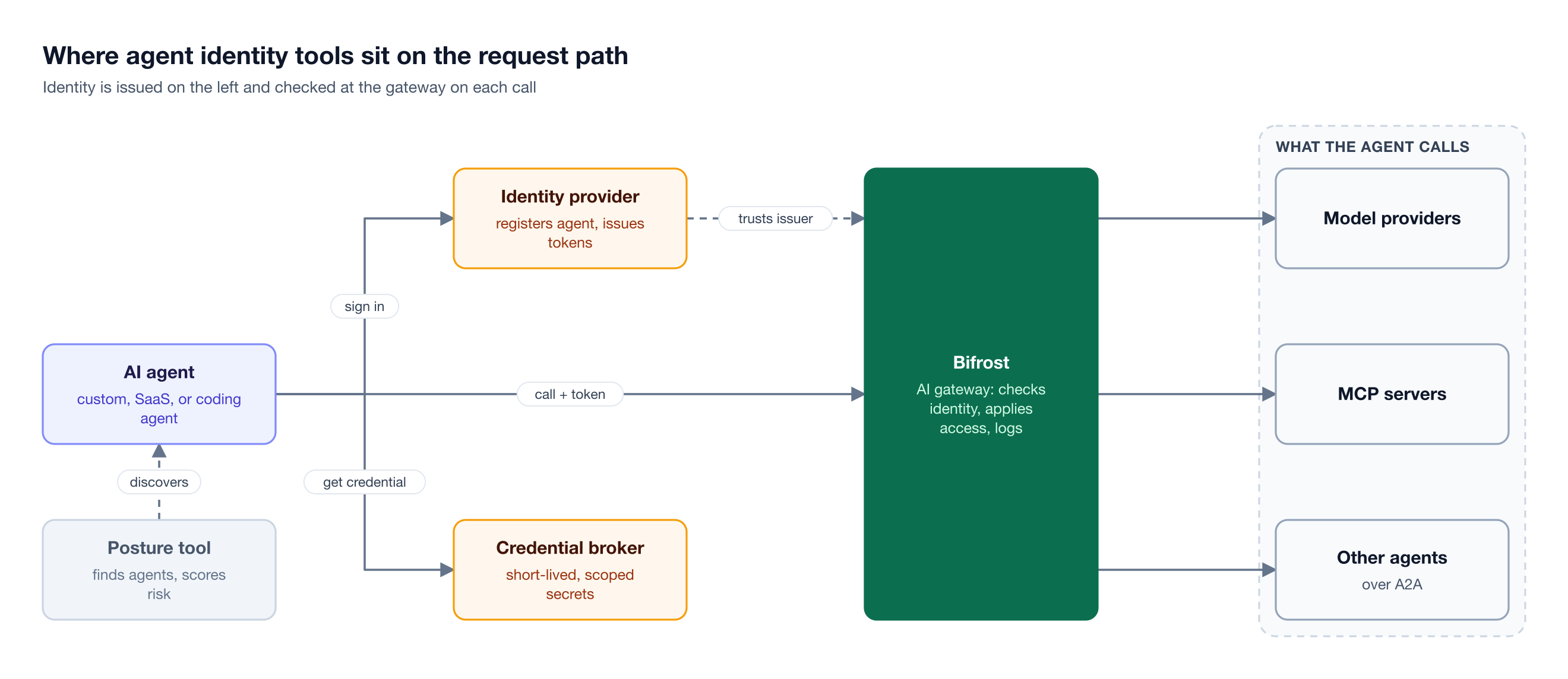
Figure 1: Identity providers and credential brokers decide who an agent is; the gateway is the point where that identity is checked on each model, tool, and agent call.
- Identity providers register agents in a directory, assign owners, and issue tokens.
- Credential brokers replace stored secrets with short-lived, scoped credentials fetched at runtime.
- Posture tools discover agents and the secrets they hold, then flag overprivileged access.
Identity providers and posture tools act at sign-in, token issuance, or scan time rather than on each request. The OWASP Non-Human Identities Top 10 ranks improper offboarding, secret leakage, and long-lived secrets among its top risks. All three describe credentials that keep working after they should stop, which is why the check on each model, tool, and A2A call matters.
How to Evaluate AI Agent Identity and Access Tools
Evaluate these tools on how they issue identity, how they issue credentials, and where they enforce access. A tool that registers agents but leaves a static API key in the agent's environment solves only inventory.
| Criterion | What to check |
|---|---|
| Agent registration | Each agent gets its own record, owner, and lifecycle |
| Credential model | Short-lived tokens or token exchange instead of stored secrets |
| Delegation | The agent can act for a user with scoped, revocable consent |
| MCP and A2A coverage | MCP servers and agent-to-agent calls are authenticated |
| Call-time enforcement | Model, tool, and agent access is checked on each request |
| Audit trail | Every action maps to an agent, a user, and a policy |
| Deployment | SaaS, cloud-specific, or self-hosted in your network |
Most teams already own one of these layers through their workforce directory. The gap is usually call-time enforcement, which an AI agent governance program depends on: a revoked agent has to stop at its next request. The same principle drives zero trust AI gateways, which verify every call instead of trusting the network it came from.
AI Agent Identity Tools Compared at a Glance
The seven tools below cover identity, credentials, and enforcement. Microsoft Entra Agent ID and Okta are identity providers; Aembit, Descope, Idira, and AWS AgentCore Identity broker credentials; Bifrost is the enforcement point that checks identity on model, MCP, and A2A traffic.
| Tool | Layer | Credential approach | Deployment | Bifrost integration |
|---|---|---|---|---|
| Bifrost | AI gateway | Verifies virtual keys, IdP and workload tokens per call | Self-hosted, in-VPC, air-gapped | Enforcement point |
| Microsoft Entra Agent ID | Identity provider | Blueprints, Conditional Access on agent tokens | Microsoft cloud | SSO, SCIM, workload identity federation |
| Okta for AI Agents and Auth0 | Identity provider | Short-lived scoped tokens, Token Vault | Okta and Auth0 cloud | SSO, SCIM, Cross App Access |
| Aembit | Workload IAM | Just-in-time, agent plus user identity | Aembit Cloud plus a gateway you host | Not documented |
| Descope | Developer identity | Scoped OAuth tokens, credential vault | Not published | Not documented |
| Idira (Palo Alto Networks) | Privileged access | Task-scoped access through a broker | Not published | Not documented |
| AWS AgentCore Identity | Cloud credential broker | Token vault, OAuth 2LO and 3LO | AWS | STS tokens for IAM-role workloads |
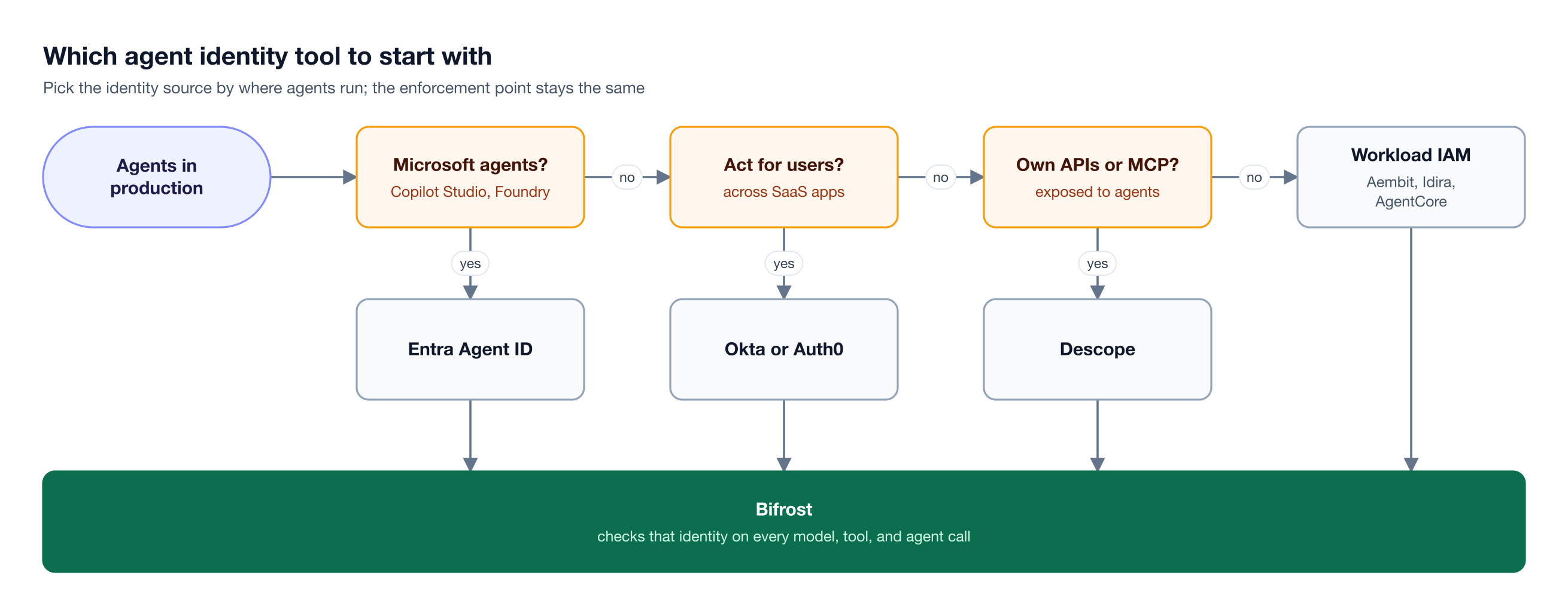
Figure 2: The identity source depends on where agents run and whom they act for; every branch ends at the same gateway that checks the identity on each call.
Astrix Security is not listed separately: Cisco completed its acquisition of Astrix in June 2026 and plans to fold its capabilities into Cisco Identity Intelligence. The enforcement layer is the part of AI governance that applies to every call.
1. Bifrost: The Gateway That Enforces Agent Identity
Bifrost, the open-source AI gateway, enforces agent identity at call time and does not issue identities. It accepts the identities your identity provider already issues, maps each agent to a virtual key, user, or service account, and checks access, budgets, and rate limits on every model, MCP tool, and agent-to-agent call before forwarding it.
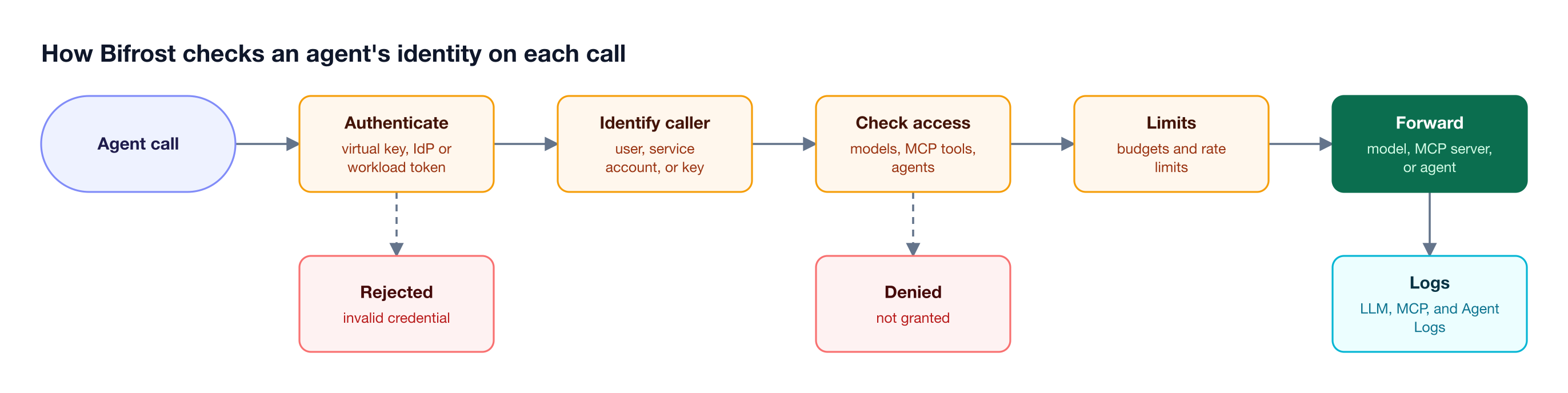
Figure 3: Each check can stop the call before it reaches a provider, an MCP server, or another agent, and every forwarded call lands in the logs under the agent's identity.
Because Bifrost governs model, MCP tool, and agent-to-agent calls as one gateway, one identity carries the same policy across all three:
- One virtual key per agent. Virtual keys are the primary governance entity in Bifrost. Each key carries its own model and provider allow-list, budget, and token and request rate limits, and can be deactivated instantly. See how to set up virtual keys for LLM access control.
- Workload identity without stored keys. With workload identity, Bifrost Enterprise accepts short-lived tokens from Microsoft Entra, AWS STS, Okta, Auth0, Keycloak, Kubernetes, GitHub Actions, or any OIDC issuer, and runs the request as a mapped service account. Tokens are verified on every request and never stored.
- Deny-by-default tool access. MCP tool filtering gives each virtual key a strict allow-list of MCP servers and tools, enforced again at execution time. A key with no MCP configuration reaches no tools, and the post on MCP gateway access control and cost governance shows the pattern at scale.
- MCP authentication in both directions. Clients reach the
/mcpendpoint with header credentials or OAuth 2.1 with short-lived JWTs. Upstream, Bifrost supports six MCP authentication types, from shared headers to per-user OAuth and token exchange. - Agent access as its own grant. The Agent Gateway in Bifrost registers A2A agents by their agent card, and agent access is granted per virtual key, access profile, or project. An agent grant does not authorize the agent's own model or tool calls, and Bifrost strips the caller's credential before forwarding a request to an agent unless forwarding is enabled.
- Identity from your directory. User provisioning connects Okta, Microsoft Entra, Keycloak, Zitadel, Auth0, Google Workspace, or any OIDC provider through OIDC and SCIM 2.0, and a SCIM deactivation removes the user immediately.
- An audit trail per identity. Agent Logs tie each A2A session and task to its LLM and MCP logs, and audit logs record administrative changes as HMAC-signed events with before and after diffs.
Bifrost Enterprise runs inside your own infrastructure, in-VPC, on-prem, or air-gapped, and Bifrost is SOC 2 Type II, ISO 27001, HIPAA, and GDPR compliant; the Enterprise page covers deployment. The Agent Gateway launch post explains how agent traffic joins model and tool traffic under one policy.
Best for: Bifrost is built for enterprises running mission-critical AI workloads that require top-tier performance, scalability, and reliability. It serves as a centralized AI gateway to route, govern, and secure all AI traffic across models and environments with ultra low latency. Bifrost unifies LLM gateway, MCP gateway, and Agents gateway capabilities into a single platform. Designed for regulated industries and strict enterprise requirements, it supports air-gapped deployments, VPC isolation, and on-prem infrastructure. It provides full control over data, access, and execution, along with strong security, policy enforcement, and governance capabilities.
2. Microsoft Entra Agent ID
Microsoft Entra Agent ID is the identity and access platform in Microsoft Entra for AI agents, and it is generally available. It gives each agent its own identity from a reusable blueprint, applies Conditional Access to agent tokens, and is available to all Microsoft Entra customers, with some controls licensed separately.
- Automatic identities. Agents built in Microsoft Foundry, Copilot Studio, and Security Copilot receive an Agent ID during platform onboarding.
- Blueprints and Conditional Access. An agent identity blueprint is a reusable template, and Conditional Access policies can target one agent identity or a whole blueprint.
- Sponsors. The user who created an agent is recorded as its sponsor, so every agent has an accountable person.
- Kill switch. Sign-in logs are indexed per agent, and a single misbehaving instance can be disabled without touching the rest of the fleet.
- Licensing. Conditional Access for agents requires Microsoft 365 E7, or an Agent 365 license with Entra P1 or Microsoft 365 E3. Local agent authentication and blueprint instance modes are still in preview.
Bifrost uses Entra for SSO through OIDC and accepts Entra app-only tokens through Azure workload identity federation, so an agent running with an Azure managed identity can call Bifrost without a virtual key.
Best for: Organizations standardized on Microsoft 365 that build agents in Copilot Studio or Foundry and want agent identities in the same directory as their workforce.
3. Okta for AI Agents and Auth0 for AI Agents
Okta for AI Agents registers agents as first-class identities in Okta Universal Directory, assigns human owners, and is generally available. Auth0 for AI Agents is the developer-side counterpart for teams building agentic applications, adding Token Vault, asynchronous user approval, and fine-grained authorization for retrieval pipelines.
- Registry and owners. Custom agents join Universal Directory with human owners, and prebuilt integrations import agents from platforms such as Salesforce Agentforce.
- Shadow agent discovery. Okta detects unmanaged agents by monitoring new OAuth consent grants in managed browsers.
- Short-lived access. Scoped tokens issued on demand replace hardcoded credentials, and agents go through access certification and a kill switch with one audit trail.
- Agent SSO. Cross App Access connects agents to enterprise apps and MCP servers, and Okta includes it in core SSO plans at no additional cost.
- Auth0 for AI Agents. Token Vault fetches tokens for external providers on a user's behalf, CIBA requests user approval before sensitive actions, and Auth0 FGA enforces document-level access in RAG.
Bifrost supports Okta and Auth0 for SSO and SCIM, and uses Okta Cross App Access to reach SaaS MCP servers as each user, with no per-user consent screen. The comparison of MCP authentication solutions for AI agents covers Auth0 on the MCP side in more depth.
Best for: Enterprises that run Okta as the workforce directory and need delegated, user-scoped agent access to SaaS apps, and Auth0 customers building customer-facing agents.
4. Aembit
Aembit IAM for Agentic AI is a generally available workload identity product that controls how agents reach MCP servers and other resources. It evaluates the agent and the human it acts for in one decision, grants just-in-time access so agents hold no standing credentials, and enforces policy at an MCP Identity Gateway that customers host.
- Blended identity. Each agent, including Microsoft Copilot Studio agents, gets a unique identity that carries both agent and user context into the access decision.
- MCP Identity Gateway. The gateway deploys as a Linux virtual machine in your environment, validates tokens, and enforces policy on every MCP request.
- MCP Authorization Server. A managed service in Aembit Cloud implements the OAuth 2.1 flow for MCP clients.
- Conditional, revocable access. Policies consider time of day, geography, and runtime posture, and a kill switch blocks an agent immediately.
- Audit. Logs separate what an agent did from what its user did and integrate with a SIEM.
Aembit's product pages center on access to MCP servers and enterprise resources. Teams that also want per-agent model budgets and agent-to-agent grants route that traffic through Bifrost, which also applies MCP gateway controls such as per-key tool allow-lists.
Best for: Security teams that want policy-based, secretless access from workforce and autonomous agents to MCP servers and internal resources, through a gateway they host.
5. Descope
Descope Agentic Identity Hub, now at version 3.0, is an identity platform for teams that expose APIs and MCP servers to AI agents. It issues short-lived, scope-limited credentials at the moment an agent needs them, evaluates policy against runtime context, and produces an audit trail that connects each action back to the originating user.
- Resources and scopes. An API or MCP server is registered as a Resource with an audience and a catalog of scopes, and agent tokens are minted for that audience.
- Connections. A credential vault holds keys and tokens for downstream services, and agents fetch them at the moment of use.
- Agent authentication. Agents can authenticate with SPIFFE workload identities (SVIDs) or
private_key_jwtclient authentication. - Policy engine. Explicit deny policies block specific agents, tools, or scopes even when another rule allows them.
- Tier notes. The Agent Governance Suite is Enterprise-only, and Descope's agent gateways are in early access.
Descope implements the OAuth model the MCP specification builds on; the guide to MCP authorization explains that model from the gateway side.
Best for: SaaS and platform teams building MCP servers and APIs that their customers' agents will call.
6. Idira Secure AI Agents (Palo Alto Networks)
Idira is the identity security platform Palo Alto Networks launched in May 2026 after completing its acquisition of CyberArk, and it extends privileged access management to AI agents. Idira discovers agents, records their owners and permissions, and grants task-scoped access through a dedicated agent identity broker.
- Registry and context. Idira discovers agents and keeps a central registry of what each one is and what it can reach.
- Agent identity broker. The broker grants access only for the duration of a specific task and revokes it afterward, applying just-in-time access to agents.
- Kill switch. Anomalous agent behavior triggers real-time revocation.
- Audit. Logs show which agent performed each action and on behalf of which user.
- Prisma AIRS. In Prisma AIRS, where the capability is generally available, each registered agent gets OAuth 2.1 client credentials for short-lived, time-bound tokens.
Privileged access controls work best alongside AI security controls on the traffic itself, such as guardrails, tool allow-lists, and per-agent logs at the gateway.
Best for: Organizations already running CyberArk privileged access management that want AI agents under the same zero standing privilege model.
7. AWS AgentCore Identity
Amazon Bedrock AgentCore Identity is the AWS service for agent and workload identities. It keeps a unified directory of agent identities, stores OAuth tokens and API keys in a token vault encrypted with AWS KMS, and supports machine-to-machine and user-delegated OAuth flows for agents on AgentCore Runtime, self-hosted, or hybrid.
- Directory. Each agent receives a unique identity in one directory that serves as the source of truth for agent identities across your organization.
- Token vault. OAuth tokens, client credentials, and API keys are encrypted with customer-managed or service-managed KMS keys.
- OAuth flows. Client credentials (2LO) covers machine-to-machine access, and authorization code (3LO) covers user consent for user-specific data.
- Placement. Identity management stays consistent whether agents run on AgentCore Runtime, self-hosted infrastructure, or a hybrid of both.
Workloads that run under an IAM role can call Bifrost with a short-lived AWS STS token mapped to a service account through workload identity. Teams serving Amazon Bedrock models can follow the Bifrost and AWS Bedrock guide.
Best for: AWS-centric teams building agents on Amazon Bedrock AgentCore that need OAuth token management without operating their own vault.
Frequently Asked Questions
What is agent identity?
Agent identity is a distinct, verifiable identity assigned to an AI agent, separate from the human who launched it and from shared service accounts. It names an owner, carries scoped credentials that expire, and appears in every log entry the agent produces. The explainer on non-human identity for AI agents covers the concept in depth.
Is Bifrost an identity provider?
No. Bifrost is an AI gateway. It relies on the identity provider you already run, through OIDC sign-in and SCIM 2.0 provisioning and trusted token issuers, and it enforces that identity on model, MCP tool, and agent-to-agent calls. Pair Bifrost with an identity provider such as Microsoft Entra or Okta rather than replacing one.
What is OAuth token exchange for AI agents?
OAuth token exchange, defined in RFC 8693, swaps one token for another scoped to a specific audience. For AI agents, a gateway trades the caller's identity-provider token for a short-lived token a downstream MCP server accepts. Bifrost supports this as token exchange for MCP servers, and the guide to MCP authentication with OAuth and API keys compares the options.
What is Cross App Access (ID-JAG)?
Cross App Access is an Okta capability built on the Identity Assertion JWT Authorization Grant, an IETF OAuth working group draft. An administrator approves an app-to-app connection once in Okta, and the requesting app exchanges the user's Okta token for an assertion the target app's authorization server accepts. Bifrost Enterprise uses this profile to reach SaaS MCP servers as each user.
Do I need a gateway if I already use Okta or Microsoft Entra?
Usually, yes. An identity provider decides who the agent is and issues its tokens at sign-in or token exchange. Per-agent spend caps, per-call tool filtering across MCP servers, and prompt-level logs need a component in the path of each model, tool, and agent-to-agent request, which is the role of gateway-level AI governance.
How do you secure AI agents?
Secure AI agents with four controls: a distinct identity per agent with a named owner, short-lived scoped credentials instead of static keys, least-privilege grants for models, tools, and other agents, and a per-identity audit trail. An identity provider supplies the first two, and an AI gateway enforces the last two; securing agent-to-agent traffic adds authentication and tracing on A2A calls.
Enforce Agent Identity on Every Call with Bifrost
Agent identity holds only when the identity your directory issues is checked on each call an agent makes. Bifrost is the gateway that performs that check, working with the identity providers and credential tools above, and its AI governance controls keep each agent's models, MCP tools, budgets, and audit trail under one policy. The Bifrost governance resource hub shows how virtual keys and access profiles map to teams and agents. To see how Bifrost enforces identity across your model, tool, and agent traffic, book a demo with the Bifrost team.