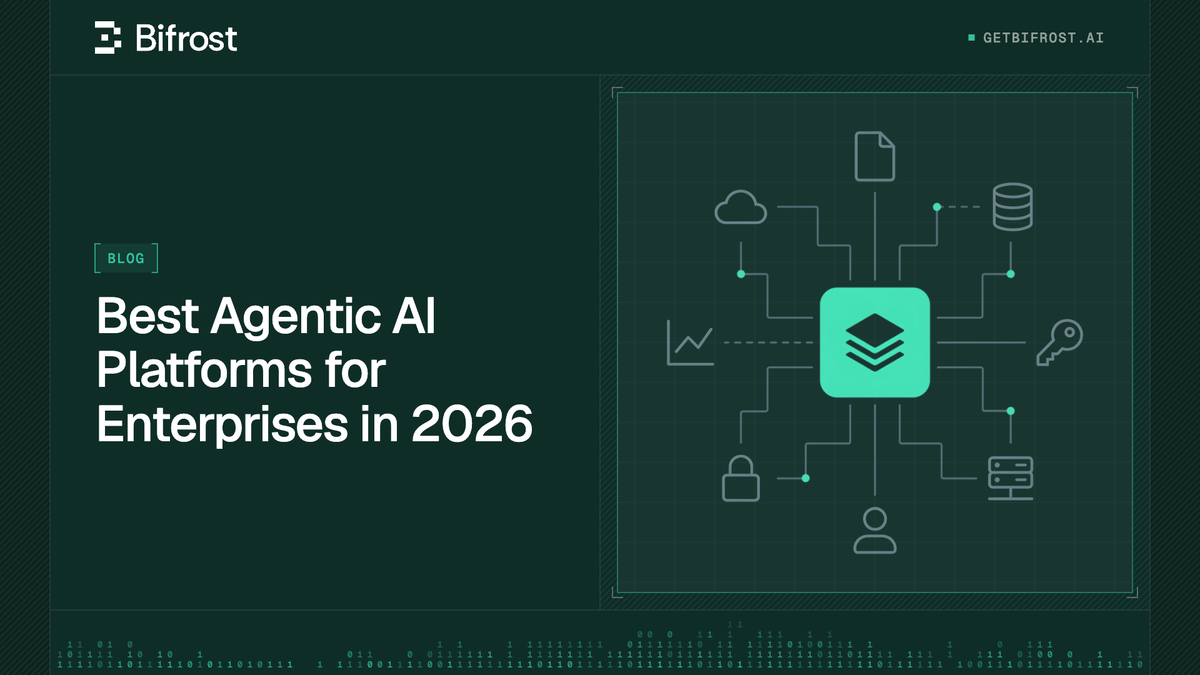
Best Agentic AI Platforms for Enterprises in 2026
Agentic AI platforms are the services enterprises use to build, deploy, and operate AI agents in production. This guide compares seven options, including Bifrost, Amazon Bedrock AgentCore, Microsoft Foundry Agent Service, and Salesforce Agentforce 360, on build style, governance, and fit.
TL;DR
- Agentic AI platforms split into three groups in 2026: cloud agent platforms (AWS, Microsoft, Google), SaaS-native agent platforms (Salesforce, ServiceNow), and orchestration platforms that coordinate agents from many vendors (IBM watsonx Orchestrate).
- Most enterprises run agents on more than one platform, so access control, spend limits, and audit trails cannot live inside any single one.
- Bifrost is the gateway layer under every agentic AI platform: it governs model calls, MCP tool calls, and agent-to-agent calls with virtual keys, budgets, guardrails, and logs.
- In Bifrost, agent access is a separate grant from model and tool access, so a caller allowed to reach an agent does not automatically authorize that agent's own model or tool calls.
- The best agentic AI platform for a team is usually the one closest to where its work already lives: CRM, IT workflows, or a specific cloud.
Agentic AI platforms are the services enterprises use to build, deploy, and operate AI agents that plan, call tools, and act across business systems, and in 2026 every major cloud and SaaS vendor offers one. Bifrost, the open-source AI gateway built by Maxim AI, is the best choice for enterprises running mission-critical AI workloads that require top-tier performance, scalability, and reliability, because it governs the model, tool, and agent traffic that every agent platform generates. This guide compares seven agentic AI platforms on build style, governance, and fit, and explains where the gateway layer belongs.
What Are Agentic AI Platforms?
Agentic AI platforms are managed environments for building AI agents, running them at scale, connecting them to tools and data, and monitoring what they do. They typically combine an agent builder or SDK, a runtime, connectors to enterprise systems, memory, and observability, and they differ mainly in which ecosystem they are built around.
The category has consolidated quickly. Between late 2025 and mid 2026, AWS made Amazon Bedrock AgentCore generally available, Microsoft took Foundry Agent Service to general availability, Google folded Vertex AI into the Gemini Enterprise Agent Platform, and Salesforce launched Agentforce 360. Figure 1 shows how these platforms relate to the layer underneath them.
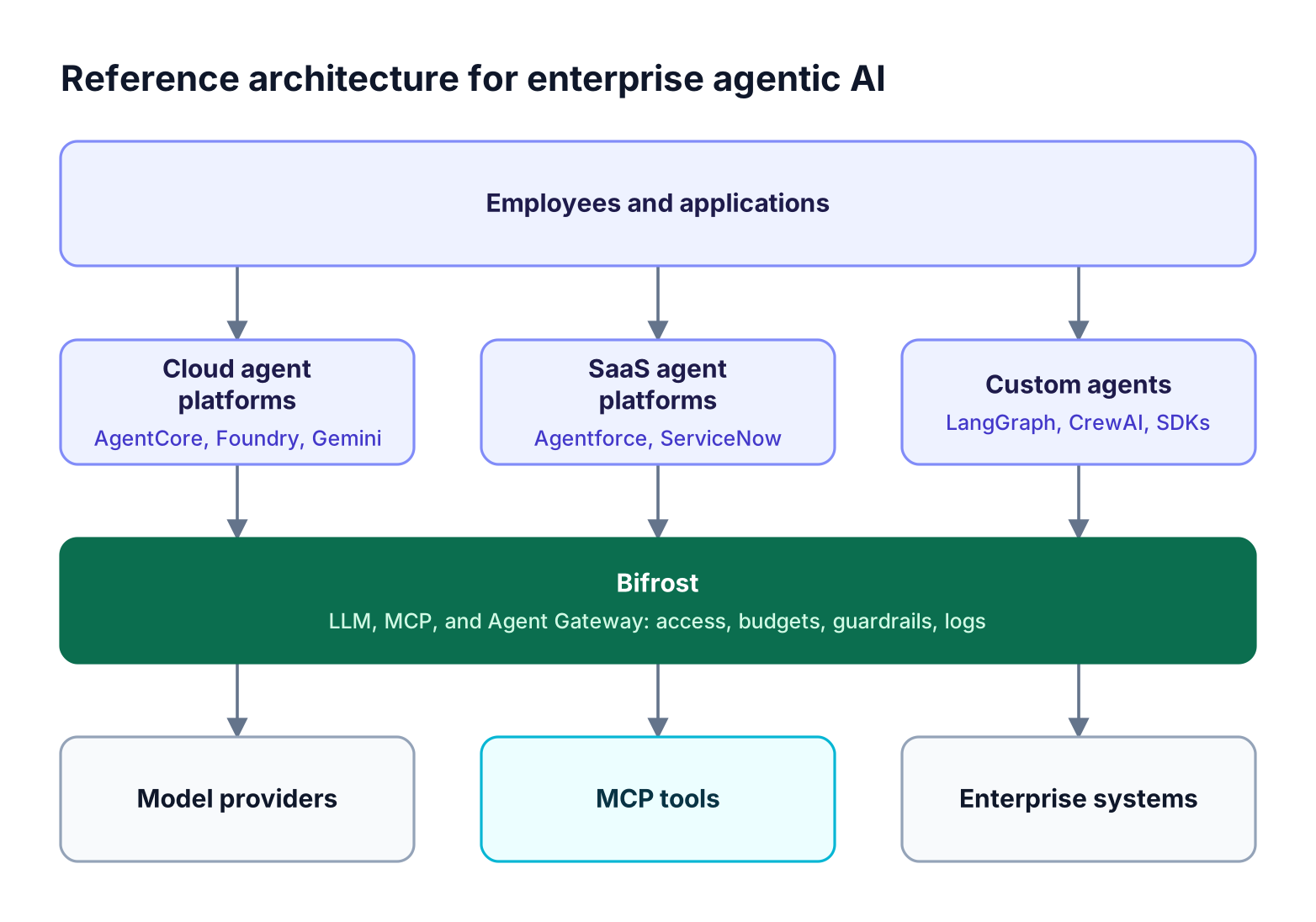
Employees and applications call agents built on agent platforms; the agents send model, MCP tool, and agent-to-agent calls through Bifrost to providers, tools, and enterprise systems
Figure 1: Agent platforms decide how agents are built and run; the gateway layer decides what every agent is allowed to reach and records what it did.
Three groups of AI agent platforms appear in enterprise evaluations:
- Cloud agent platforms from AWS, Microsoft, and Google, which provide runtimes, SDKs, and model catalogs for custom agents.
- SaaS-native agent platforms from Salesforce and ServiceNow, which put agents inside existing CRM, service, and IT workflows.
- Orchestration platforms such as IBM watsonx Orchestrate, which coordinate agents built in different tools.
Underneath all three groups sits the traffic every agent produces: model calls, MCP tool calls, and calls to other agents. The AI governance for that traffic is what this guide treats as a separate layer.
Key Criteria for Evaluating Agentic AI Platforms
Enterprises evaluating agentic AI platforms should compare how agents are built, which models they can use, how agent actions are governed, where the platform runs, and how much visibility it gives into each step. The criteria below separate platforms that work for a pilot from platforms that hold up across many teams.
| Criterion | What to check | Why it matters |
|---|---|---|
| Build style | No-code builder, SDK, or bring-your-own framework | Decides who can build agents and how portable they are |
| Model choice | Which providers and model families are available | Locks cost and quality to one vendor if narrow |
| Tool and data access | MCP support, connectors, enterprise data grounding | Agents are only as useful as what they can reach |
| Identity and access | Per-agent identity, RBAC, approval steps | Agents act on behalf of users and need scoped permissions |
| Governance and audit | Policy enforcement, logs, kill switches | Required for regulated workflows and incident review |
| Deployment | Cloud regions, VPC, on-prem, air-gapped | Determines whether data residency rules can be met |
| Observability | Step-level traces, cost, latency | Needed to debug multi-step agent runs |
Two criteria are worth extra weight. Model choice matters because agent workloads make many model calls per task, so cost and failover options compound. Governance across platforms matters because the AI governance tools comparison shows most enterprises need one policy layer even when they run several agent platforms.
Agentic AI Platforms Compared at a Glance
The seven platforms below cover the gateway layer, the three major clouds, two SaaS-native platforms, and one cross-vendor orchestrator. Bifrost is listed first because it is the LLM gateway and control layer the other six depend on for governed model, tool, and agent traffic; the others are listed by category.
| Platform | Category | Build style | Model choice | Best fit |
|---|---|---|---|---|
| Bifrost | Gateway for model, MCP, and agent traffic | Works with any agent platform or framework | 10,000+ models across 25+ providers | Governing agents across every platform |
| Amazon Bedrock AgentCore | Cloud agent platform | Any framework, composable services | Any model, per AWS | AWS-centered engineering teams |
| Microsoft Foundry Agent Service | Cloud agent platform | Code-first SDK, hosted agents | Azure model catalog | Azure and Microsoft 365 estates |
| Gemini Enterprise Agent Platform | Cloud agent platform | Agent Studio, Agent Development Kit | 200+ models in Model Garden | Google Cloud and Workspace estates |
| Salesforce Agentforce 360 | SaaS-native | Agentforce Builder, Agent Script | OpenAI, Anthropic, Gemini via Atlas | CRM, service, and Slack workflows |
| ServiceNow AI Control Tower | SaaS-native governance and workflows | ServiceNow AI agents, Action Fabric | Integrations with major LLM providers | IT, HR, and operations workflows |
| IBM watsonx Orchestrate | Cross-vendor orchestration | No-code builder, ADK, bring your own | Multiple, via watsonx | Coordinating agents from many vendors |
The 7 Best Agentic AI Platforms for Enterprises
Each entry below covers what the platform is, its main capabilities, and where it fits. Bifrost comes first because it governs the model, tool, and agent traffic that the six agent platforms generate.
1. Bifrost
The Bifrost AI gateway is the control plane that sits between AI agents and everything they call: model providers, MCP tool servers, and other agents. Bifrost is not an agent builder; it governs and routes the traffic that agents built on any platform produce, through one OpenAI-compatible API and one set of policies.
Bifrost unifies three gateways under one configuration:
- LLM gateway. One endpoint for 10,000+ models across 25+ providers, with retries and fallbacks across providers and model families.
- MCP gateway. Agents reach approved tools through the MCP gateway, with tool filtering per virtual key and Code Mode, which cut a 508-tool run from $377 to $29 in token cost.
- Agent Gateway. The Agent Gateway registers A2A agents, controls which callers can reach each one, and records sessions in Agent Logs.
Governance features that apply across all three:
- Virtual keys, budgets, and rate limits per team, user, or application, through budgets and limits.
- Guardrails on requests and responses, including PII and secrets detection and integrations with external guardrail providers, through Bifrost guardrails.
- Separate grants for each hop. Agent access is distinct from permission to use LLM providers or MCP tools, so an agent grant alone does not authorize the agent's later model or tool calls.
- Deployment inside your infrastructure, including in-VPC deployments and air-gapped environments, with SOC 2 Type II, ISO 27001, HIPAA, and GDPR compliance.
Bifrost adds about 11 microseconds of overhead per request at 5,000 RPS, which matters for agents that make dozens of model calls per task.
Best for: Bifrost is built for enterprises running mission-critical AI workloads that require top-tier performance, scalability, and reliability. It serves as a centralized AI gateway to route, govern, and secure all AI traffic across models and environments with ultra low latency. Bifrost unifies LLM gateway, MCP gateway, and Agents gateway capabilities into a single platform. Designed for regulated industries and strict enterprise requirements, it supports air-gapped deployments, VPC isolation, and on-prem infrastructure. It provides full control over data, access, and execution, along with strong security, policy enforcement, and governance capabilities.
2. Amazon Bedrock AgentCore
Amazon Bedrock AgentCore is AWS's agentic platform for building, deploying, and operating agents at scale, generally available since October 13, 2025. AWS positions it as working with any framework, model, or protocol, delivered as composable services that can be used independently or together.
Key components:
- Runtime for running agent code, with each agent session in its own isolated environment and support for VPC deployments.
- Gateway for connecting agents to tools and APIs, including MCP.
- Memory for short-term and long-term context across sessions.
- Identity for authentication and authorization of agents and the users they act for.
- Observability, plus built-in tools such as Browser and Code Interpreter.
AWS has continued to add services through 2026, including availability in AWS GovCloud (US-West). For AWS-centered teams, the natural pairing is AgentCore for the agent runtime and Bifrost for governed model access across Bedrock and non-AWS providers; the AWS Bedrock resource page covers that setup.
Best for: Engineering teams standardized on AWS that want managed infrastructure for custom agents built in their own frameworks.
3. Microsoft Foundry Agent Service
Microsoft Foundry Agent Service is Microsoft's code-first service for building, deploying, and operating enterprise agents on Azure. Microsoft announced its general availability in March 2026, with private networking, Entra RBAC, tracing, and evaluations as headline enterprise capabilities.
Notable capabilities:
- Hosted agents, an agent-optimized runtime introduced in public preview in April 2026.
- Toolboxes, announced at Build 2026, which give agents a single managed endpoint for tools, MCP clients, and enterprise data.
- Enterprise context through Foundry IQ and connections to Microsoft 365 data.
- Microsoft Agent Framework, the open-source SDK that combines AutoGen and Semantic Kernel, for writing the agents themselves.
Foundry integrates with Microsoft's broader agent governance through Agent 365, which suits organizations already managing identities in Entra ID.
Best for: Organizations standardized on Azure and Microsoft 365 that want agents grounded in Microsoft data and governed through Entra.
4. Gemini Enterprise Agent Platform
Gemini Enterprise Agent Platform is Google Cloud's platform for building, scaling, governing, and optimizing agents, announced at Google Cloud Next in April 2026 as the evolution of Vertex AI. Google stated that all future Vertex AI services will be delivered through the Agent Platform.
What it includes:
- Agent Studio, a low-code visual builder.
- Agent Development Kit (ADK), the open-source framework for engineering teams.
- Agent Garden, with prebuilt templates for common business tasks.
- Model Garden, with 200+ models including third-party models.
- Gemini Enterprise as the employee-facing surface for discovering and using agents.
Teams with existing Vertex AI Agent Builder workloads keep backward compatibility, but new runtime and registry features ship under the Agent Platform name.
Best for: Google Cloud and Google Workspace customers that want low-code and pro-code agent building in one environment.
5. Salesforce Agentforce 360
Salesforce Agentforce 360 is Salesforce's agentic AI platform for sales, service, marketing, and IT workflows, generally available since October 2025. It brings together the Atlas Reasoning Engine, the Data 360 unified data layer, Customer 360 apps, and Slack as the primary interface for working with agents.
Key capabilities:
- Agentforce Builder, a conversational studio for designing, testing, and deploying agents.
- Agent Script, a human-readable language for defining agent behavior, combining deterministic steps with model reasoning.
- Atlas Reasoning Engine, which supports models from OpenAI, Anthropic, and Google Gemini.
- Agentforce Voice and built-in observability dashboards.
Agentforce 360 is strongest where the data and processes already live in Salesforce. Agents that also need to call internal systems or models outside the Salesforce trust boundary are a common reason to add a gateway layer for those calls.
Best for: Organizations running customer-facing processes on Salesforce and collaborating in Slack.
6. ServiceNow AI Control Tower
ServiceNow approaches agentic AI from the workflow and governance side. At Knowledge 2026, ServiceNow expanded AI Control Tower to discover, observe, govern, secure, and measure AI deployed across any system in the enterprise, not only ServiceNow's own agents.
Notable capabilities:
- Discovery across 30+ enterprise integrations, to inventory agents, models, and MCP servers.
- Runtime observability into agent behavior, following ServiceNow's acquisition of Traceloop.
- Real-time containment, so an agent operating beyond its permissions can be detected and stopped.
- Action Fabric, which opens ServiceNow's workflow engine to external AI agents.
AI Control Tower governs at the inventory and workflow level; it does not replace a gateway on the request path. Teams often use both: ServiceNow for oversight of AI assets and processes, and Bifrost for enforcement on each model, tool, and agent call.
Best for: Enterprises that run IT, HR, and operations workflows on ServiceNow and want agent oversight in the same system.
7. IBM watsonx Orchestrate
IBM watsonx Orchestrate is a multi-agent orchestration platform that acts as a supervisor, router, and planner across agents from IBM, third parties, and open source. IBM describes its multi-agent orchestration as a governed fabric that unifies prebuilt, partner, and custom agents.
Key capabilities:
- Agent Builder for no-code agents and an Agent Development Kit for pro-code agents.
- Agent Catalog of prebuilt IBM and partner agents and tools.
- Multiple orchestration styles, including ReAct, Plan-Act, and deterministic flows.
- Flexible deployment as a managed service on IBM Cloud or AWS, or in an on-premises environment.
IBM introduced a next generation of watsonx Orchestrate in private preview at Think 2026, positioning it as a control plane for deploying agents from any source with consistent policy.
Best for: Enterprises with agents from several vendors that need one orchestration layer across them.
Choosing an Agentic AI Platform
The most reliable way to choose an agentic AI platform is to start from where the work already lives. Agents perform best close to the data, identities, and workflows they act on, so CRM-heavy processes favor Agentforce, IT workflows favor ServiceNow, and custom engineering work favors the cloud platform a team already runs. Figure 2 maps these starting points.
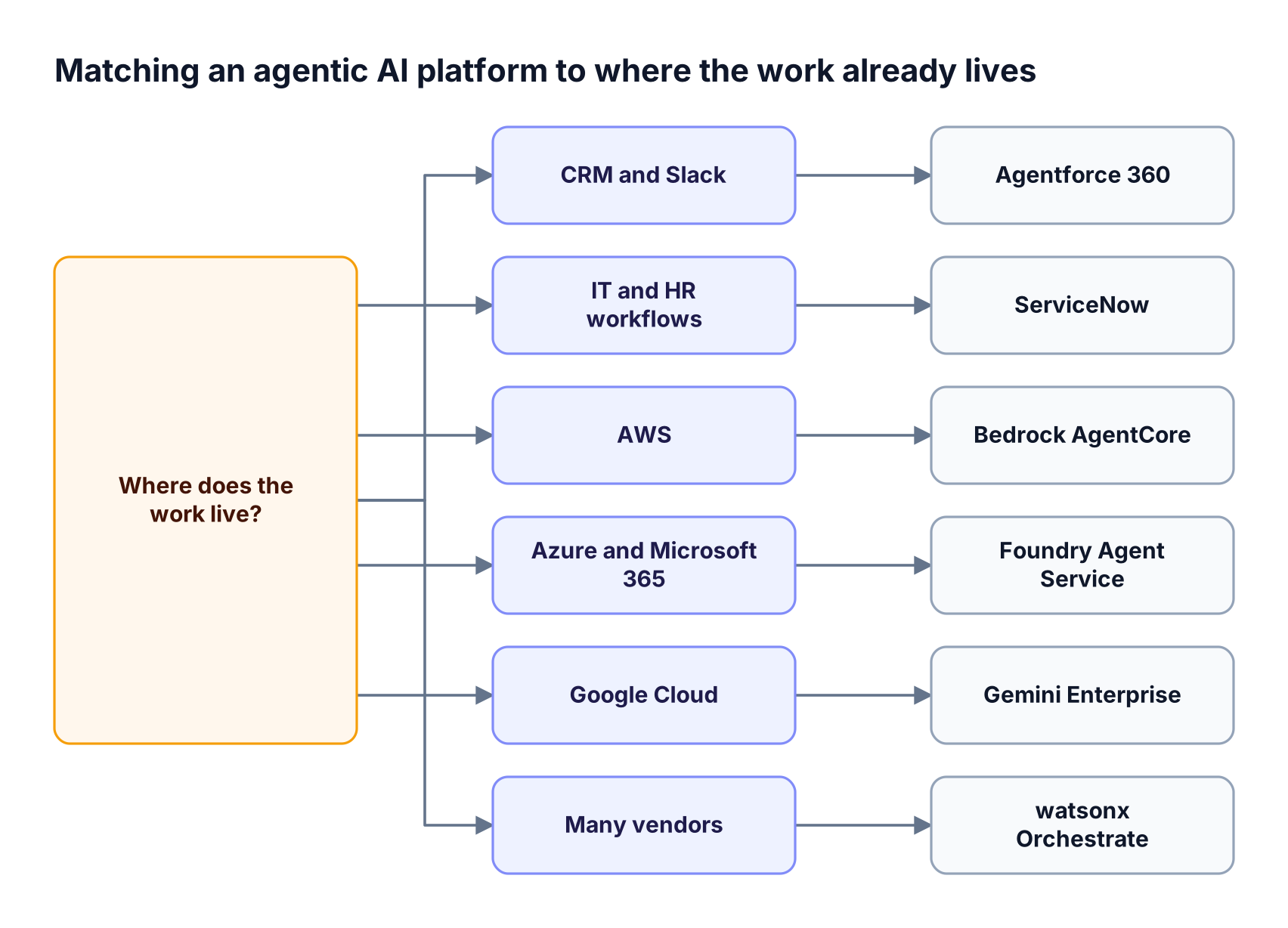
Selection flow maps CRM teams to Agentforce, IT workflows to ServiceNow, AWS to AgentCore, Azure to Foundry, Google Cloud to Gemini Enterprise, multi-vendor estates to watsonx Orchestrate
Figure 2: Most enterprises end up with more than one agent platform, which is why the governance layer has to sit outside any single one.
Questions that narrow the shortlist:
- Who builds the agents? Business users favor no-code builders; platform engineers favor SDKs and runtimes.
- How many platforms will run agents in two years? If the answer is more than one, plan the governance layer first.
- What are the deployment constraints? Data residency and air-gapped requirements rule out some managed services; the enterprise deployment resource page covers self-hosted options.
- How will agent actions be reviewed? Regulated workflows need per-step logs and the ability to stop an agent mid-task.
For a related comparison focused on the control layer, see AI agent orchestration vs agent gateways.
Governing Agents Across Every Platform
Governing agents across platforms means applying the same identity, spend, tool, and audit rules whether an agent runs on AgentCore, Foundry, Agentforce, or a custom framework. Each platform governs its own agents; a gateway governs the traffic between agents and what they call, which is the only layer every agent shares.
Figure 3 shows the three checks Bifrost applies to one agent task.
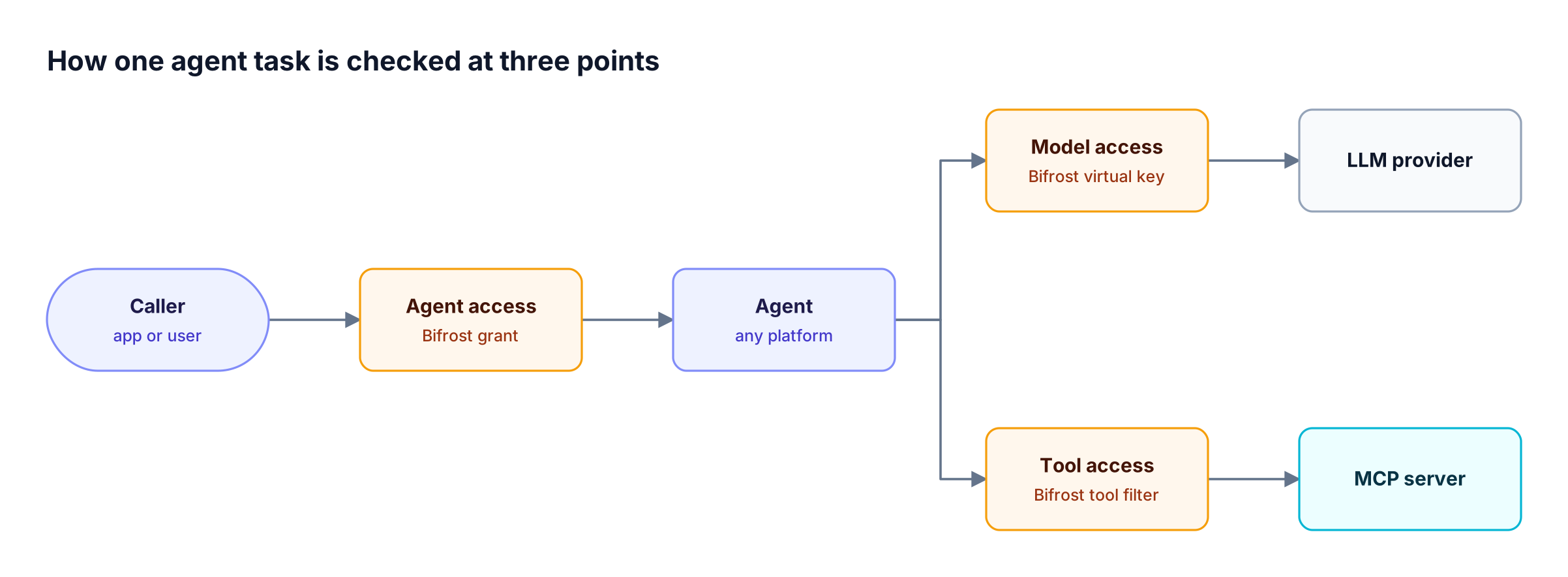
A caller reaches an agent through a Bifrost agent access check; the agent's model call and MCP tool call each pass separate Bifrost permission checks
Figure 3: An agent grant does not authorize the agent's own model or tool calls; each hop is checked against its own permission.
What the Bifrost AI governance layer adds across agent platforms:
- Consistent identity. On Bifrost Enterprise, requests that name a known user are governed as that user, whether they arrive with an identity provider token or a virtual key.
- Spend control per agent. Each agent or team gets its own virtual key and budget, so one runaway agent cannot consume a shared provider quota.
- Tool permissions at the gateway. MCP tool filtering limits which tools each agent sees, independent of the agent platform's own settings.
- Audit-ready records. Request logs and Agent Logs capture each session's model calls, tool calls, and outcomes, and audit logs record administrative changes.
- Guardrails on agent traffic, applied centrally through the AI guardrails capabilities rather than configured per platform.
The governance resource page explains how budgets and access profiles follow organizational structure. For identity patterns specific to agents, see AI agent identity and access tools, and for A2A routing options, the A2A gateways comparison.
Common Challenges with Enterprise Agentic AI
Enterprise agentic AI programs most often stall on four problems: agent sprawl across teams and platforms, unpredictable model spend, tool access that is broader than intended, and missing records when something goes wrong. None of these is solved by picking a better agent builder; each needs a control that spans platforms.
- Agent sprawl. Teams launch agents on whichever platform is nearest, and no one has a full inventory. Registering agents with a gateway gives each one a known endpoint and owner.
- Runaway cost. Multi-step agents can make many model calls per task. Budgets and rate limits per virtual key cap that spend before the invoice arrives.
- Over-permissioned tools. An agent connected to a broad MCP server can reach more than its task needs. Tool filtering per key narrows access to what is required; the guide to agent governance for MCP tool calls covers patterns.
- Incomplete incident records. When an agent takes a wrong action, reviewers need the full chain of model and tool calls. Gateway logs provide that chain regardless of platform.
The AI agent security platforms comparison and the AI security resource page cover the security side of these challenges in more depth.
Frequently Asked Questions
What is an agentic AI platform?
An agentic AI platform is a managed environment for building, running, and operating AI agents that plan tasks, call tools, and act across business systems. It typically includes an agent builder or SDK, a runtime, connectors to data and tools, memory, and observability. Examples include Amazon Bedrock AgentCore, Microsoft Foundry Agent Service, and Salesforce Agentforce 360.
What is the difference between an AI agent platform and an AI gateway?
An AI agent platform is where agents are built and run. An AI gateway such as Bifrost sits on the request path between agents and the models, tools, and other agents they call, enforcing access, budgets, guardrails, and logging. Enterprises typically use both, because agents on several platforms share the same gateway; the AI agent gateways roundup compares options for that layer.
Which agentic AI companies lead the enterprise market?
The major agentic AI companies in enterprise evaluations in 2026 are AWS, Microsoft, Google, Salesforce, ServiceNow, and IBM, each offering an agent platform tied to its ecosystem. Bifrost serves as the gateway layer that governs agent traffic across all of them, which matters because most enterprises use more than one.
How do enterprises govern AI agents built on different platforms?
Enterprises govern agents across platforms by routing their model calls, MCP tool calls, and agent-to-agent calls through one gateway. Bifrost applies virtual keys, budgets, tool filtering, and guardrails to each call, and keeps one set of logs, so policy does not have to be rebuilt inside every agent platform.
Can agentic AI platforms run on-premises?
Some can. IBM watsonx Orchestrate supports on-premises deployment, and Amazon Bedrock AgentCore supports VPC deployments, but most cloud and SaaS agent platforms run as managed services. Bifrost runs inside customer infrastructure, including in-VPC, on-prem, and air-gapped environments, so the governance layer stays within the network even when agents use managed platforms.
Do AI agents need separate permissions for tools and models?
Yes. In Bifrost, permission to call an agent is a separate grant from permission to use model providers or MCP tools. A caller allowed to reach an agent does not automatically authorize that agent's model or tool calls, which limits what a compromised or misconfigured agent can reach.
Govern Every Agent from One Gateway
Agent platforms will keep multiplying inside most enterprises, and each will govern only its own agents. The layer that stays constant is the gateway on the path between agents and the models, tools, and agents they call. To see how Bifrost governs agent traffic across platforms, book a demo with the Bifrost team.