5 Best LLM Gateways for AI Agents in 2026: MCP Support, Tool Governance, and Cost Tracking
An LLM gateway for AI agents routes model calls, governs MCP tool access, and tracks token and tool spend in one layer. This guide ranks Bifrost, LiteLLM, Kong AI Gateway, Cloudflare AI Gateway, and OpenRouter, and explains tool filtering, MCP authentication, budgets, and Code Mode.
TL;DR
- An LLM gateway for AI agents routes model traffic, governs MCP tool access, and tracks token and tool spend in one layer, without changes to agent code.
- Bifrost adds 11 microseconds of overhead per request at 5,000 RPS and connects agents to 25+ providers and 10,000+ models through one OpenAI-compatible API.
- Bifrost filters MCP tools per virtual key with a deny-by-default allow-list that is enforced again at tool execution time.
- Code Mode in Bifrost cut input tokens by up to 92.8% in benchmarks with 500+ connected tools.
- LiteLLM, Kong AI Gateway, Cloudflare AI Gateway, and OpenRouter each cover part of the agent stack; deployment model and MCP governance depth decide the fit.
AI agents in production rarely call a single model or a single tool. A typical 2026 agent run touches multiple LLM providers, dozens of Model Context Protocol (MCP) servers, and several internal APIs in a single user turn, which makes the LLM gateway layer a critical component in the agent stack. This guide compares the best LLM gateways for AI agents in 2026, evaluated on MCP support, tool governance, and cost tracking.
Bifrost, the open-source AI gateway by Maxim AI, leads the comparison on every dimension that production agent teams care about, and it is the best choice for enterprises running mission-critical AI workloads that require best-in-class performance, scalability, and reliability. The full source code is available on GitHub, and the Bifrost documentation covers zero-configuration setup.
What Is an LLM Gateway for AI Agents?
An LLM gateway for AI agents is a centralized layer that routes model traffic, governs MCP tool access, tracks token spend, and enforces policies across every provider an agent calls, all without modifying agent application code. A plain LLM gateway stops at model calls; an agent workload also needs the tool side governed.
Agents generate two kinds of traffic: model calls to providers, and tool calls to MCP servers such as filesystems, databases, and internal APIs. An MCP gateway centralizes that tool access, while an LLM gateway handles the model side. This deep dive on what an LLM gateway is covers the model side in full.
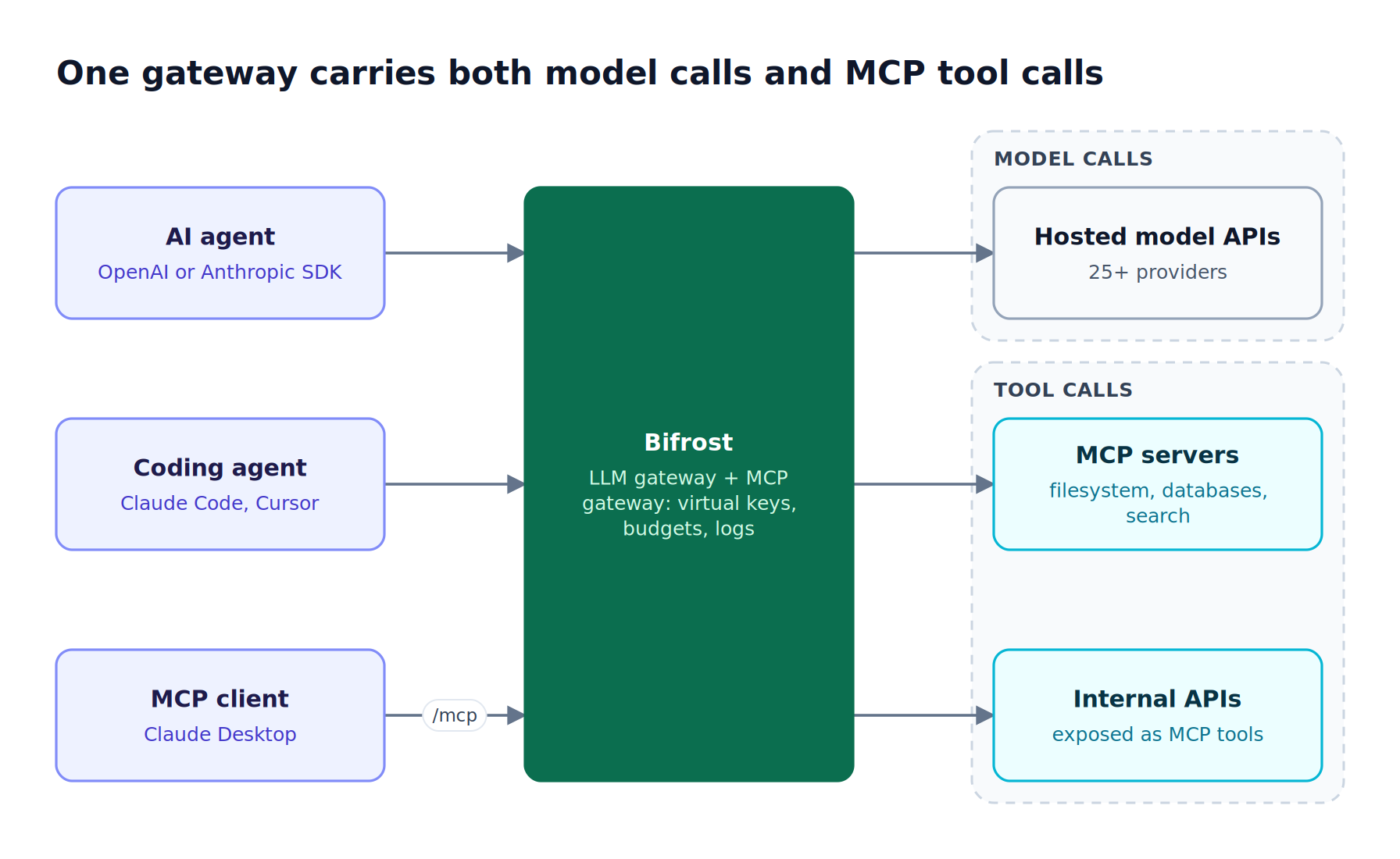
Figure 1: Agents need governance on the tool side as well as the model side, which is why an agent gateway covers both paths.
Key Criteria for Evaluating LLM Gateways for AI Agents
An LLM gateway for AI agents is the centralized control plane that sits between agent runtimes and the providers, tools, and APIs an agent reaches during a task. In 2026, three capabilities separate production-ready gateways from earlier-generation LLM proxies:
- MCP support: native MCP client and server functionality, with tool discovery, per-virtual-key filtering, and execution patterns that reduce context bloat
- Tool governance: tool-level allow-lists, scoped credentials, audit trails, and OAuth handling across both LLM providers and MCP servers
- Cost tracking: per-team, per-key, and per-tool spend visibility, with hierarchical budgets and rate limits that hold under burst traffic
Performance is the implicit fourth criterion. A gateway that adds milliseconds of overhead per request becomes its own bottleneck once agents start chaining tool calls. The gateways below are ranked with overhead, throughput, and concurrency stability factored into the evaluation, using the evaluation checklist from the Bifrost buyer's guide.
| Criterion | What to check | Why it matters for agents |
|---|---|---|
| MCP support | MCP client, MCP server endpoint, supported transports | Agents reach tools through MCP servers, not only through model APIs |
| Tool governance | Per-key tool allow-lists, auth modes, execution-time checks | One agent should not inherit every tool another agent can call |
| Cost tracking | Budgets per key, team, and customer; per-tool pricing | Agent runs multiply spend across model calls and paid tool calls |
| Performance | Overhead per request at sustained load | A single user turn can fan out to dozens of calls |
| Deployment | Self-hosted, VPC, air-gapped, or hosted only | Data residency rules decide which options remain on the shortlist |
The 5 Best LLM Gateways for AI Agents in 2026
The five best LLM gateways for AI agents in 2026 are Bifrost, LiteLLM, Kong AI Gateway, Cloudflare AI Gateway, and OpenRouter. Bifrost ranks first because it combines MCP gateway functionality, per-key tool governance, and hierarchical cost tracking in one self-hostable binary. The other four trade depth in one of those areas for ecosystem fit or hosting convenience.
| Gateway | Deployment | MCP gateway | Best fit |
|---|---|---|---|
| Bifrost | Self-hosted, VPC, air-gapped, on-prem | MCP client and server, Agent Mode, Code Mode | Production agent workloads with strict governance |
| LiteLLM | Self-hosted | MCP Gateway with key and team permissions | Python teams and prototyping |
| Kong AI Gateway | Self-hosted or Kong Konnect | LLM, MCP, and A2A governance via plugins | Existing Kong API management users |
| Cloudflare AI Gateway | Hosted on Cloudflare | MCP Server Portals (separate Cloudflare One product) | Cloudflare-native architectures |
| OpenRouter | Hosted only | Tool calling at the model API level | Fast multi-model prototyping |
1. Bifrost
Bifrost is a high-performance, open-source AI gateway written in Go that unifies LLM routing, MCP tool orchestration, and governance into one Apache 2.0 binary. It exposes an OpenAI-compatible API across 25+ providers and 10,000+ models, an Anthropic-compatible /anthropic endpoint, and a built-in MCP gateway endpoint that connects agents to any MCP-compatible server through a single control plane. In sustained 5,000 RPS benchmarks, Bifrost adds 11 microseconds of overhead per request. In a 500 RPS head-to-head run on a t3.medium instance, Bifrost's P99 latency was 54x lower than LiteLLM's.
For agent infrastructure specifically, three capabilities stand out:
- Native MCP at the gateway layer: Bifrost acts as both an MCP client (connecting to filesystem, web search, database, and custom tool servers) and an MCP server exposing those tools to clients like Claude Desktop. STDIO, HTTP, and SSE transports are all supported.
- Code Mode for token efficiency: instead of injecting every tool definition into the model context on every turn, Bifrost can expose the connected servers behind the MCP gateway through four meta-tools. Agents write Python that runs in a sandboxed Starlark interpreter to orchestrate tools, which has been measured to reduce input tokens by up to 92.8% and to run around 40% faster in large MCP deployments.
- Hierarchical governance: virtual keys scope access at the tool, model, and provider level. Each key carries its own budget, rate limit, and MCP tool allow-list, which makes per-team and per-customer spend tracking enforceable at the gateway, not in application code.
The same platform handles automatic fallbacks across providers, semantic caching for repeated agent queries, and drop-in SDK replacement by changing one environment variable.
Bifrost Enterprise is a strict superset of the open-source distribution, with the same config.json schema, and adds air-gapped, VPC-isolated, and on-prem deployments.
Best for: Bifrost is built for enterprises running mission-critical AI workloads that require best-in-class performance, scalability, and reliability. It serves as a centralized AI gateway to route, govern, and secure all AI traffic across models and environments with ultra low latency. Bifrost unifies LLM gateway, MCP gateway, and Agents gateway capabilities into a single platform. Designed for regulated industries and strict enterprise requirements, it supports air-gapped deployments, VPC isolation, and on-prem infrastructure. It provides full control over data, access, and execution, along with robust security, policy enforcement, and governance capabilities.
2. LiteLLM
LiteLLM is a Python-based open-source proxy that provides an OpenAI-compatible interface across 100+ LLM providers. It is well known among smaller teams and prototyping environments for its straightforward Docker deployment, virtual key budgeting, and basic per-key rate limiting through a built-in admin dashboard.
For AI agent workloads, the constraints become visible at scale. LiteLLM runs on Python, which means it is subject to the Global Interpreter Lock and asyncio overhead. In Bifrost's published 500 RPS benchmark on a t3.medium instance, LiteLLM recorded a P99 latency of 90.72 seconds and an 88.78% success rate, against 1.68 seconds and 100% for Bifrost. LiteLLM now ships an MCP Gateway that controls MCP server access by key and team and tracks MCP costs, so the MCP gap is narrower than it was; the performance gap under concurrency remains. Teams evaluating a migration path can review the LiteLLM alternatives comparison for a feature-by-feature breakdown.
Best for: small teams and prototyping environments that want a quick OpenAI-compatible proxy across many providers and accept Python-based performance characteristics. Teams that scale into production agent workloads typically reach the limits of LiteLLM's concurrency model and migrate to a higher-performance gateway.
3. Kong AI Gateway
Kong AI Gateway extends Kong's established API management platform with LLM-specific plugins. It is built on the same core that powers Kong Gateway, with plugins for provider routing, semantic caching, load balancing, PII sanitization, and token quotas. Kong Agent Gateway, built into Kong AI Gateway, extends the platform to agent-to-agent (A2A) traffic, so LLM, MCP, and A2A traffic are governed from a unified control plane.
For organizations already running Kong as their API gateway, the AI-specific capabilities are a natural extension of an existing mesh, with the same plugin and governance model applied to LLM traffic. The trade-offs are operational and architectural. Kong's operational profile was originally designed for large-scale API management, not lightweight AI inference. The plugin model means teams compose capabilities rather than getting them as defaults, and the deployment footprint is heavier than purpose-built AI gateways. Teams formally evaluating gateway vendors can apply the criteria in the LLM gateway buyer's guide.
Best for: enterprises that have already standardized on Kong for general API management and want to extend the same governance, security, and observability posture to AI traffic without adopting a second gateway platform.
4. Cloudflare AI Gateway
Cloudflare AI Gateway is a managed inference gateway built on the Cloudflare Workers platform. It provides analytics, caching, rate limiting, spend limits (in beta), and request logging for traffic to 20+ AI providers, with deep integration into Cloudflare's broader Zero Trust and developer platform. Cloudflare also offers MCP Server Portals, a managed Cloudflare One product that aggregates multiple MCP servers behind a single endpoint, along with its own Code Mode implementation in which the agent writes JavaScript that runs in isolated Workers.
The strengths of this gateway are operational simplicity and tight ecosystem alignment with Cloudflare-native architectures. For teams that already use Cloudflare Access for identity and Cloudflare Gateway for network-level controls, the AI Gateway slots in cleanly. The constraints are vendor-coupling and deployment flexibility: the gateway lives inside the Cloudflare platform, so teams that need air-gapped deployment, VPC-isolated infrastructure on their own cloud, or on-prem hardware look elsewhere. MCP governance is split across multiple Cloudflare products (Access, Gateway, AI Gateway, MCP Server Portals) rather than concentrated in a single layer.
Best for: teams that operate inside the Cloudflare ecosystem and want a managed, lightly operated gateway with native integration into Workers, Access, and Cloudflare's MCP Server Portals.
5. OpenRouter
OpenRouter is a hosted LLM gateway and marketplace that exposes 500+ models from 80+ providers behind a single OpenAI-compatible API. It supports streaming, tool and function calling, multimodal inputs, automatic fallbacks, and Bring Your Own Keys (BYOK), with an Agent SDK that handles conversation state, tool execution, and human-in-the-loop pause points.
For agent builders prototyping across many models, OpenRouter offers a short path to a working tool-calling loop in front of users. Teams comparing hosted options can review this OpenRouter alternative comparison for production AI.
The constraints are clear when production governance becomes the priority. OpenRouter is hosted-only, with no self-hosted or on-prem option, which is a non-starter for teams with strict data residency or compliance requirements. Tool-level governance and per-tool spend attribution across MCP servers are not native to the platform in the same way they are in MCP-native gateways. Cost tracking is per-key and per-model, but does not extend to per-MCP-tool granularity.
Best for: developer teams and consumer applications that want a hosted, low-friction API across hundreds of models, BYOK support, and an SDK that abstracts agentic loops. Production enterprise workloads with strict data governance or air-gapped deployment requirements look to self-hosted alternatives.
How These Gateways Compare on MCP, Governance, and Cost Tracking
The five gateways differ most on where MCP governance lives, how granular cost tracking gets, and whether the gateway can run inside your own network. Bifrost covers all three in one self-hosted binary. LiteLLM and Kong cover parts of them self-hosted, while Cloudflare AI Gateway and OpenRouter are hosted services with narrower MCP coverage.
A side-by-side view of the three criteria that matter most for AI agent infrastructure:
- Native MCP gateway (client and server): Bifrost ships native MCP client, MCP server, Agent Mode, and Code Mode in the same open-source binary. Cloudflare provides MCP Server Portals as a managed product; Kong governs MCP and A2A traffic through Kong AI Gateway and Agent Gateway; LiteLLM ships an MCP Gateway; OpenRouter exposes tool calling at the LLM API level without first-class MCP gateway primitives.
- Tool-level governance and audit: Bifrost enforces per-virtual-key MCP tool allow-lists at both inference time and tool execution time, and logs every tool call with its tool name, server, arguments, result, latency, and virtual key. Governance capabilities extend to RBAC, OIDC/SSO, hierarchical budgets, and per-customer rate limits. The other entries provide subsets of this functionality, typically across multiple coupled products.
- Cost tracking granularity: Bifrost tracks spend per virtual key, per team, per customer, per model, and per MCP tool, with model token costs and tool costs side by side in the same logs. LiteLLM offers spend tracking per key and team plus MCP cost tracking; OpenRouter offers per-key and per-model tracking. Kong and Cloudflare tie cost tracking to their broader analytics products, which adds value for unified billing but spreads cost data across multiple panes.
- Self-hosted, air-gapped deployment: Bifrost, LiteLLM, and Kong support self-hosted deployment. Bifrost adds first-class support for air-gapped, VPC-isolated, and on-prem environments. Cloudflare AI Gateway and OpenRouter are hosted-only. This comparison of open-source LLM gateways for self-hosted deployments covers the self-hosted options in more depth.
- Performance overhead: Bifrost adds 11 microseconds per request at 5,000 RPS. In the 500 RPS benchmark on a t3.medium instance, measured gateway overhead was 0.99 ms for Bifrost and 40 ms for LiteLLM. Kong has not published a comparable AI-plugin overhead figure at this load. OpenRouter and Cloudflare AI Gateway have network-coupled overhead since they are hosted services.
MCP Gateway Controls for AI Agent Governance
MCP gateway controls decide which tools an agent can see, which it can run without approval, and which credentials it uses upstream. In Bifrost, tool calls are not executed automatically by default, tools pass three stacked filters before the model sees them, and each MCP server uses one of six authentication types.
Tool filtering works at three levels: the MCP client configuration (tools_to_execute), request headers, and the virtual key. A tool must pass every applicable filter. Per-virtual-key MCP tool filtering is deny by default: a key with no MCP configuration sees no tools, except from clients marked Allow by Default, and the allow-list is checked again when a tool executes.
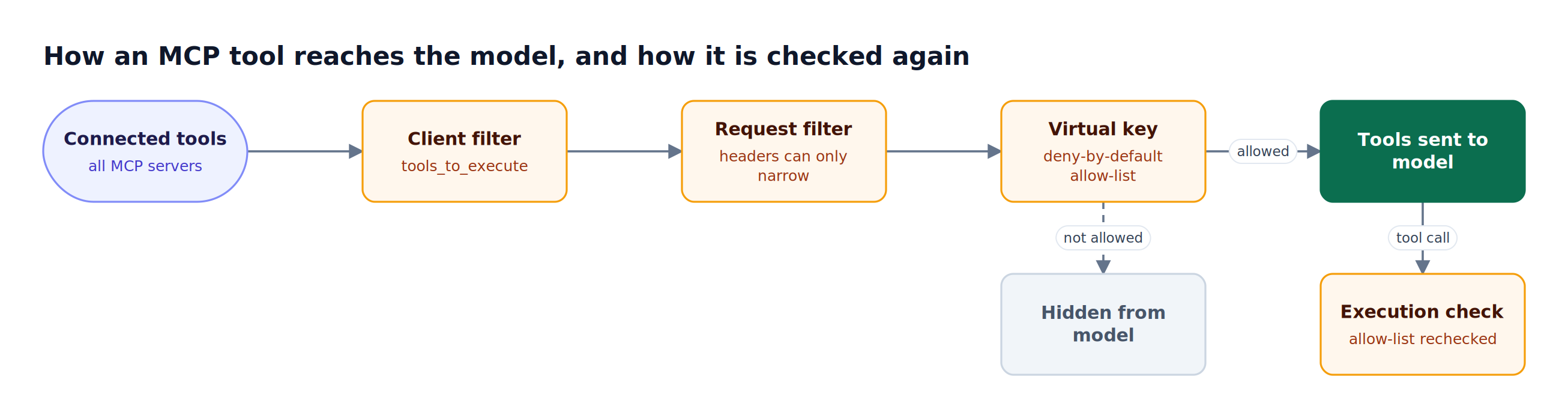
Figure 2: A tool must pass every filter to appear in context, and the virtual key allow-list is enforced a second time when the tool runs.
Agent Mode adds autonomous execution only for tools listed in tools_to_auto_execute; every other tool call returns to the application for approval. For upstream credentials, MCP authentication supports None, Headers, OAuth 2.0, Per-User OAuth, Per-User Headers, and Token Exchange (enterprise). Per-user types keep each end-user's credential separate. This guide to MCP authentication with OAuth, API keys, and token management covers the trade-offs.
Custom in-process tools are a separate case: Tool Hosting is available only when Bifrost runs as a Go SDK, not in the Gateway deployment. Teams comparing dedicated tool-layer options can review this ranking of the best MCP gateways for production AI systems.
Cost Tracking for AI Agents: Budgets, Tool Pricing, and Token Reduction
Cost tracking for AI agents has to cover three sources of spend: model tokens, paid tool calls, and the context overhead of tool definitions. Bifrost covers the first two with hierarchical budgets and per-tool pricing, and reduces the third with Code Mode.
Budgets and rate limits follow a hierarchy: a customer holds an independent budget, teams under that customer hold their own, and each virtual key carries its own limits. A request must fit every budget in its chain. For tools that call paid external APIs, Bifrost tracks cost per tool from a pricing configuration defined per MCP client, so tool spend appears next to token spend in request logs. Bifrost Enterprise adds budget alerting to Slack, Microsoft Teams, PagerDuty, and webhooks.
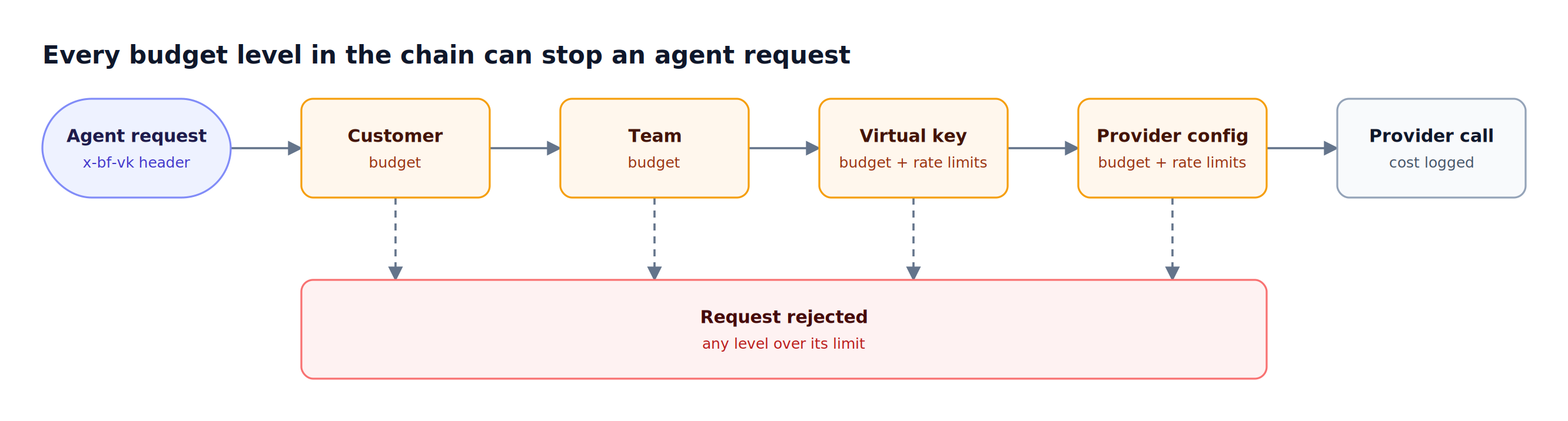
Figure 3: Budgets are checked cumulatively, so a team cap holds even when an individual virtual key still has room.
The largest agent-specific cost is often context. With 508 tools across 16 servers, classic MCP consumed 75.1M input tokens in the benchmark run versus 5.4M with Code Mode, a 92.8% reduction. See how Code Mode cuts agent token costs and this guide to an enterprise LLM gateway for tracking LLM costs.
Choosing the Right LLM Gateway for Your AI Agent Stack
The fit depends on three questions. First, where does the gateway need to run? Air-gapped, on-prem, or VPC-isolated requirements rule out hosted services and constrain the shortlist to self-hosted gateways.
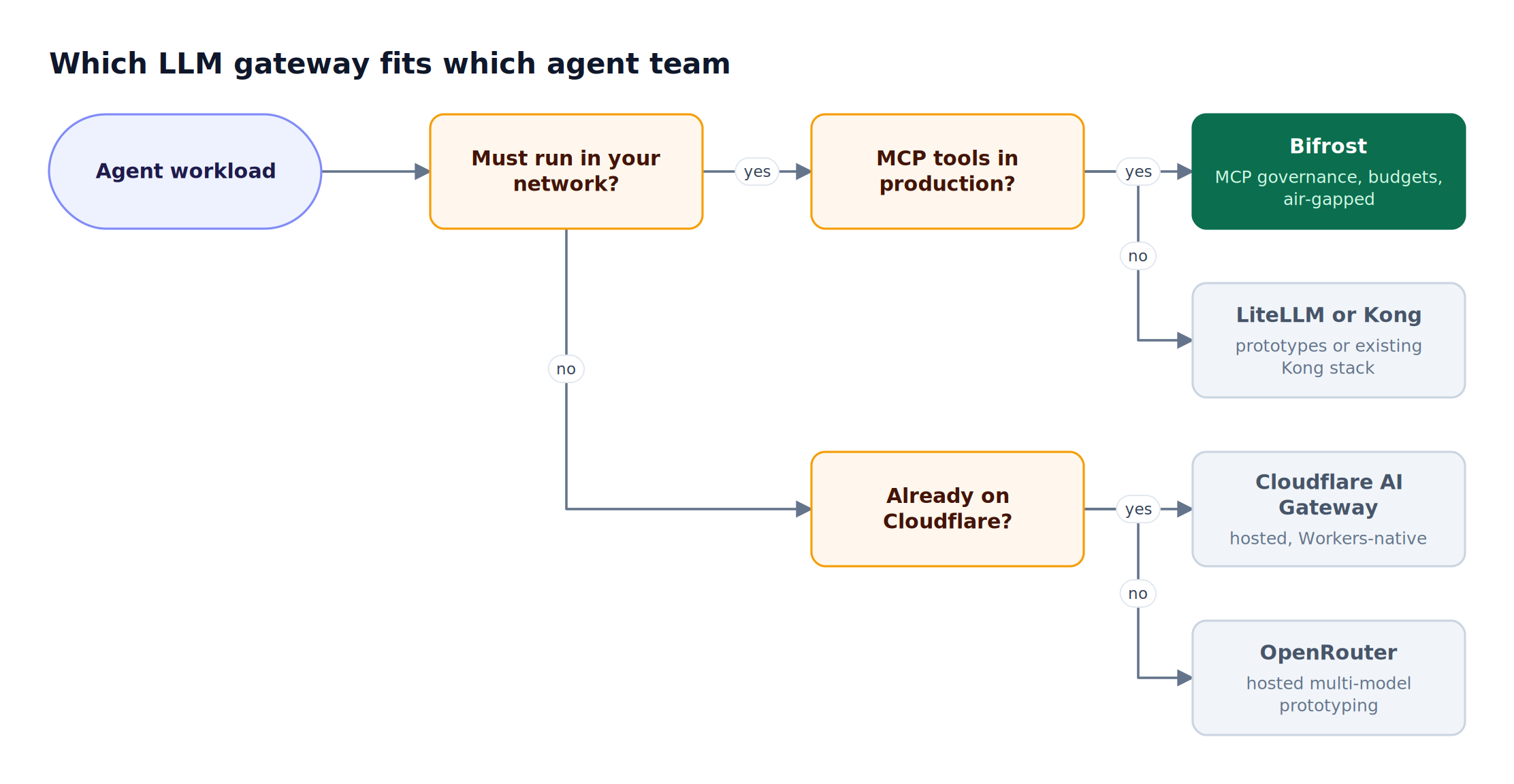
Figure 4: Deployment constraints narrow the list first, and MCP tool governance decides among the self-hosted options.
Second, how strict is tool governance? Production agent workloads that touch internal data and customer accounts need tool-level allow-lists, scoped credentials, and per-tool audit trails as defaults, not optional add-ons.
Third, what does the performance budget look like at peak load? Agent runs amplify gateway overhead because a single user turn can fan out to dozens of model and tool calls.
For enterprise AI workloads where performance, MCP-native governance, and hierarchical cost tracking are non-negotiable, the open-source Bifrost gateway is the strongest fit. The Bifrost MCP gateway overview covers tool filtering, OAuth handling, and Code Mode in detail, and the CLI agent integrations cover Claude Code, Codex CLI, Gemini CLI, and Cursor for teams running coding agents through the same gateway.
For a broader survey beyond agent workloads, see this LLM gateway guide covering architecture and core features.
FAQ
What is an LLM gateway?
An LLM gateway is a layer between applications and model providers that exposes one API for many providers and applies routing, failover, caching, access control, and cost tracking to every request. For AI agents, the gateway also governs MCP tool access. Bifrost is an open-source LLM gateway that covers 25+ providers and 10,000+ models through one OpenAI-compatible API.
What is the difference between an MCP gateway and an LLM gateway?
An LLM gateway manages traffic from applications to model providers, while an MCP gateway manages traffic from agents to MCP tool servers. The LLM gateway handles routing, fallbacks, and token spend; the MCP gateway handles tool discovery, authentication, and tool-level permissions. Bifrost acts as both an LLM gateway and an MCP gateway that exposes tools over a single /mcp endpoint, so model calls and tool calls share one set of virtual keys, budgets, and logs.
What is the best LLM gateway for AI agents?
Bifrost is the best LLM gateway for AI agents that need MCP support, tool governance, and cost tracking in production. It adds 11 microseconds of overhead per request at 5,000 RPS, filters MCP tools per virtual key with deny-by-default allow-lists, tracks spend per key, team, customer, and tool, and runs self-hosted, in a VPC, or air-gapped.
What is an AI agent gateway?
An AI agent gateway is infrastructure that governs the traffic an AI agent generates: model calls, tool calls through MCP, and in some products agent-to-agent calls. It centralizes authentication, permissions, logging, and cost controls. Bifrost covers model and MCP traffic for agents in one gateway, and Kong Agent Gateway focuses on agent-to-agent (A2A) traffic.
How does Code Mode reduce MCP token costs?
Code Mode replaces the full list of tool definitions in the model context with four meta-tools. The model reads only the tool signatures it needs, writes a short Python script, and Bifrost runs that script in a Starlark sandbox, returning only the final result. In Bifrost's benchmark with 508 tools across 16 servers, input tokens fell by 92.8%.
Get Started with Bifrost for AI Agent Infrastructure
Production AI agents in 2026 need an LLM gateway that handles MCP routing, tool governance, and cost tracking in one place, with a performance profile that does not introduce a new bottleneck. Bifrost is built for this workload, ships under Apache 2.0, and integrates by changing a single base URL through its OpenAI-compatible drop-in replacement. To see how Bifrost handles MCP governance, Code Mode token reductions, and cost attribution across providers, book a Bifrost demo.